Return to Castle Wolfenstein – Review

There is something inherently violent about humans, there really is no way to ignore it. Archaeological evidence of mass graves where the occupants show signs of sharp and blunt force trauma, and historical records of battles throughout history attest to this. This may be why gamers are drawn towards to violent games. Although, it is not so much the killing but the hero fantasy that we seek. We are never going to take on an entire castle of baddies using only our guile, sharpshooting and hand to hand combat skills in real life (thankfully), so we immerse ourselves in artifical worlds. Some may think there is something wrong with that. I say, what’s wrong with a little hero fantasy every now and them?

Title screen (screenshot taken by the author)

Return to Castle Wolfenstein is a first-person shooter, and a reboot of Wolfenstein 3D (1992). It was developed by Gray Matter Interactive (Nerve Software developed the multiplayer) and published by Activision. It was released for the Microsoft Windows in 2001, Linux and Macintosh in 2002, Xbox and PlayStation 2 in 2003, and Steam in 2007. I chose to review the Microsoft Windows version.

Plot

It’s 1943 and World War II has been raging for four years. The Nazis have uncovered an ancient demon named Henrich who has been trapped deep underground in a magical prison for 1000 years. They’re also developing a super soldier capable of destroying the allies and winning the war. You play as US Army Ranger William Blazkowitz who is charged with investigating the Nazis’ SS Paranormal Division and stopping their evil plans.

Even after 80 years, games about World War II are still popular (screenshot taken by the author)

Gameplay

The missions consist of assassinations, data retrieval and sabotage. Some of the missions rely on stealth and your mission is over if you are spotted, which adds an extra layer of difficulty and breaks up the action nicely. It’s quite a long game, with some of the missions being quite lengthy for the time. There are plenty of authentic World War II weapons to choose from as well as fictional weapons such as the Tesla gun. Along the way, you will find ammo, armour and health packs to restore you weapons and health.

Enemies vary in strength and difficulty, these include standard German soldiers, experimental soldiers and the undead.

Sometimes, discretion is the better part of valour (screenshot taken by the author)

How Does It Handle?

The story, although fantastical, is engaging. The AI, as with lots of games of this era, still needs work. The controls work well, although, with the more stealthier missions, it’s not always easy to see whether you are in the enemies line of sight.

Graphics

The graphics look a tad polygonal now but when the game was released it looked awesome. There is plenty of detail in the scenery to help immerse yourself in the cave.

Music

If memory serves, there’s not much music in this game. However, the diegetic music of the old gramophone records really draws you into the game. This was a nice touch by the creators.

(screenshot taken by the author)

Replay Value

There is not much replay value here but the multiplayer addition was critically acclaimed.

Did I Complete The Game?

I am adamant that I completed this game when I first played it after its release. However, this time around, I couldn’t get defeat the final boss.

What The Critics Said:

Computer Gaming World: “If all you want to do is blast your way through countless Nazis and zombies, then this game is probably for you. But if you want a deep, engaging storyline with surprising twists and turns, this probably isn’t for your cup o’ tea. Overall 3.5/5.[1]

Eurogamer: “Return to Castle Wolfenstein is a worthy addition to the stable of id Software affiliated shoot ’em ups. The single player game is average to good and takes quite a while to finish, but the game really earns its salt by shipping with a first class multiplayer element. Overall 8/10. [2]

Game Revolution: “But in all, Return to Castle Wolfenstein is not what it could have been. As a story it’s utterly bizarre, as a sequel it’s sub-par, but as a stand-alone game it’s very good. The simple truth is that regardless of the detractions, killing Nazis will always be fun…always. There are few times that you can play a game and feel you made the world a better place. Wolfenstein 3D was one of those times. If the world isn’t any better after playing Return to Castle Wolfenstein, at least it might brighten your day. Overall 3.5/5.[3]

Gamespot: “In a weird inversion of the typical shooter model, Return to Castle Wolfenstein features an amazing multiplayer component coupled with a good if somewhat underwhelming single-player game. Then again, fans of id Software’s previous 3D shooters should be familiar with this model. But honestly, Return to Castle Wolfenstein is well worth buying for the multiplayer game alone, so the fact that you get a solid single-player game in the box can only be considered a bonus. Overall 9.2/10.[4]

IGN: “The single player campaign is certainly decent and will hold people’s interest long enough to get them accustomed to the various weapons in time to jump into multiplayer. It’s not quite the revolutionary trip back to Castle Wolfenstein that people may have been hoping for, but that’s no reason to discount it, as it is nothing less than a solid and satisfying experience. But it’s no doubt that the real value in the title falls on the multiplayer which is definitely one of the most enjoyable experiences I’ve had in quite a while. It all adds up to a really fun game that fans of the genre will love to get a piece of. Overall 9/10.[5]

My Verdict:

“Defeating the Nazi’s always feels fun and for the most part so is this game. I like the story, I like the graphics and I like the variety of missions. Unless you play multiplayer, there isn’t much replay value, but the game is long enough to certainly justify the purchase.”

Rating:

What are your memories of Return to Castle Wolfenstein? I would love to hear your thoughts, and don’t for get to follow and subscribe so that you don’t miss my latest reviews! You can also find me on Instagram: @nicklovestogame.


[1] Price, T., ‘Reviews – Return to Castle Wolfenstein’. Computer Gaming World. (March 2002). Issue 212:74-5.

[2] Bramwell, T., (25th July 2001). ‘Return to Castle Wolfenstein’, Eurogamer.net. (https://www.eurogamer.net/articles/r_rtcw Accessed 4th August 2020).

[3] Radakovic, N., (1st July 2001) ‘Return to Castle Wolfenstein Review’. GameRevolution.com.  (https://www.gamerevolution.com/review/32806-return-to-castle-wolfenstein-review Accessed 4th August 2020).

[4] Wolpaw, E., (27th Nov 2001). ‘Return to Castle Wolfenstein Review’. Gamespot.com. (https://www.gamespot.com/reviews/return-to-castle-wolfenstein-review/1900-2827475/ Accessed 4th August 2020).

[5] Adams, D., (1st December 2001). ‘Return to Castle Wolfenstein’. IGN.com (https://www.ign.com/articles/2001/12/01/return-to-castle-wolfenstein Accessed 4th August 2020).

Altered Beast (Mega Drive) – Review

Altered Beast was one of the first 16-bit games I played as child and I have idealised memories of how good the game was. The question is…how will I feel revisiting it after 25 years?

Title screen (screenshot taken by the author)

Altered Beast is a side-scrolling beat ‘em up with some platform gaming elements. It was developed and published by Sega, and released in the arcade in 1988. It was later ported to the Master System, PC, NES, Atari ST, Mega Drive, ZX Spectrum, MSX, Commodore 64, Amstrad CPC, Amiga and MS-DOS. It was later released in the Wii Virtual Console, Xbox and PlayStation. For this review, I played the Mega Drive version.

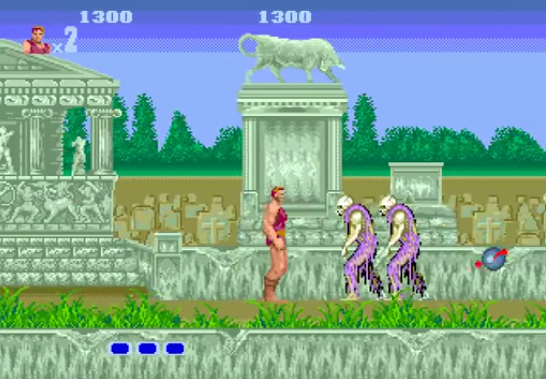
After rising from your grave, you must fight your way through a graveyard whilst collecting orbs that turn you into an anthropomorphic beast (screenshot taken by the author)

Plot

“Rise from your grave!” commands Zeus, as you emerge from your tomb. You play as a Roman Centurion who is resurrected by Zeus (I know Zeus was a Greek God and the Roman equivalent was Jupiter, but let’s overlook the mythological inconsistencies). Your mission is to rescue Zeus’ daughter, Athena, (Minerva for the Romans) from the evil Demon God known as Neff who has taken her to the Underworld.

The cutscenes are accompanied by some incredibly eerie gothic organ music (screenshot taken by the author)

Gameplay

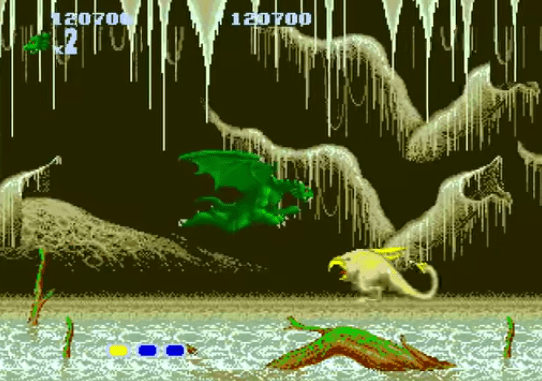
You must punch and kick your way through graveyards and caverns to reach the Underworld, all the while fighting numerous undead minions and monsters. In order to meet and defeat the end of level bosses, you need to collect three orbs which increase your strength and eventually morph you into anthropomorphised animals such as wolves, bears, tigers and dragons, each with unique abilities.

Chicken Stingers, as they are called in the manual, are similar to the pink creatures you ride in Golden Axe, with a similar attack. Does this mean Altered Beast and Golden Axe are in the same universe? (screenshot taken by the author)

How Does It Handle?

Modern critics argue that the game doesn’t hold up to today and I have to agree. The game is tougher and more frustrating than I remember. The screen scrolls slowly from left to right automatically, meaning you have no choice but to advance. The controls are sluggish and your punching and kicking range is so small that you need to get very close to the enemies. They are quicker than you and so can kick your arse pretty easily.

Graphics

The graphics are clearly, early 16-bit. The sprites and backgrounds would be cleaner and more detailed if this game was released a few years later. Having said that, I still think the games looks good.

Music

The music isn’t that much to write home about. However, the creepy gothic organ music during the cutscenes is pretty cool.

Shining in the Darkness and Golden Axe Link?

In a previous review, Shining in the Darkness, I discussed the possible links that suggest Shining in the Darkness and Golden Axe were in the same universe, due to the presence of Gilius Thunderhead, the green dwarf. During this review, I noticed that the Chicken Stingers, are identical (except for the colour palette change) to some of the Bizzarians in Golden Axe. Does this mean that Altered Beast is also set in the same universe as Shining in the Darkness and Golden Axe?

Did I Complete The Game?

Yes

What The Critics Said:

Mean Machines Sega: “Altered Beast is a spot-on conversion of the coin-op. The trouble is, the game wasn’t exactly a smash-hit – it’s a very simply beat ‘em up with only five levels. The gameplay is very samey, and it doesn’t take long to get all the way through the game. Overall 67%.”[1]

Sega Pro: “For its day, it was amazing – speech, smooth scrolling and lots of playability. However, its finest hour has truly passed. Overall 74%.[2]

The Games Machine: Altered Beast turns out very close indeed to its arcade origins, complete with two-player mode. The main characters and enemy sprites look ever so slightly washed out, but the detail is all there, and background graphics are spot on. Overall 87%.[3]

Sega Power: “However much you enjoy the coin-op, give this one a miss. Poor scrolling, jerky animation and limited gameplay. Overall 2/5.[4]

My Verdict:

“Does Altered Beast deserve the accolade of being a classic title? There are many video games that acheive the accolade as a ‘classic’ but not all of them are worthy of title. Having revisited Altered Beast, I can say that the concept was great, but the execution was lacking. The game is too short, the controls too sluggish and frustrating, and the graphics should have been better. I think this game is better remembered than played.”

Rating:

What are your memories of Altered Beast? I would love to hear your thoughts, and don’t for get to follow and subscribe so that you don’t miss my latest reviews! You can also find me on Instagram: @nicklovestogame.


[1] ‘Review: Mega Drive – Altered Beast’. Mean Machines Sega. (October 1992). Issue 1:137.

[2] ‘Sega Software Showdown – Altered Beast – Mega Drive.’ Sega Pro. (November 1991). Issue 1:19.

[3] ‘Review – Altered Beast’. The Games Machine. Issue 19:17.

[4] Jarrett, S., ‘The Hard Line – Altered Beast’. Sega Power. (April 1991). Issue 23:52.

Indiana Jones and the Fate of Atlantis – Review

“It belongs in a museum!”

I was introduced to the Indiana Jones movies by my older brother. I soon became a huge fan as a consequence. Controversially, I don’t think the Kingdom of the Crystal Skull was a bad a movie as most think. For the record, these films had nothing to do with me going into archaeology as a profession. Time Team holds that honour.

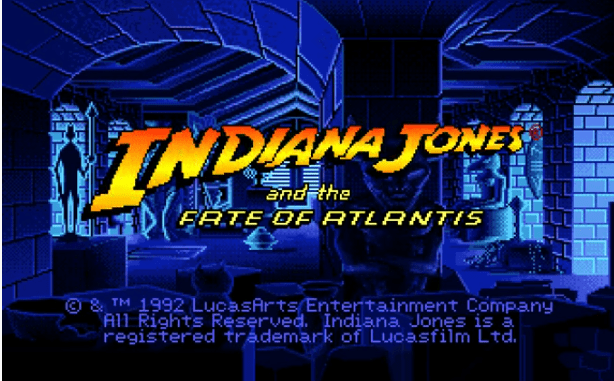
Title screen (screenshot taken by the author)

Indiana Jones and the Fate of Atlantis is a point and click adventure game developed and published by Lucas Arts. It was released in 1992 for the Amiga, FM Towns, MS-DOS and Macintosh. In 2009, a version was also released on the Wii. The version I chose to review was purchased from Steam.

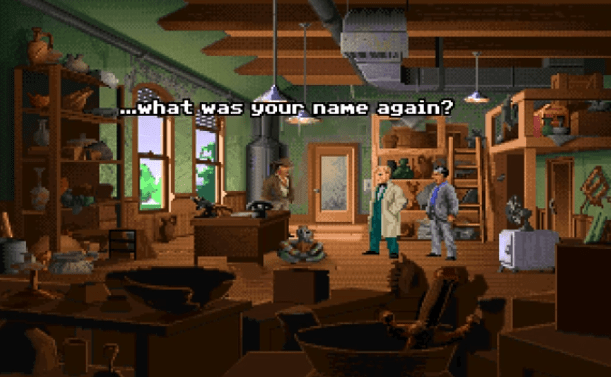
“We do not follow maps to buried treasure, and X never, ever marks the spot.” (screenshot taken by the author)

Plot

It’s 1939, shortly before the outbreak of World War II. After a Nazi agent tricks Indy into opening an artefact before running off with its contents, Indy finds himself in a race to find Atlantis before the Nazis do. Whilst dodging Nazi henchmen, Indy must solve a plethora of puzzles and learn the secrets of Atlantis. Indy is accompanied on his adventure with colleague Sophia Hapgood, a former archaeologist turned psychic.

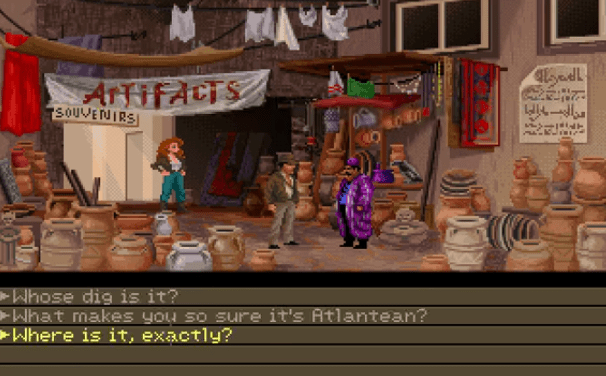
“What is Shankara?”, “Fortune and glory, kid. Fortune and glory.” (screenshot taken by the author)

Gameplay

The game plays in a similar way to the early Monkey Island series. You have several commands at the bottom left part of the screen (“talk to”, “pick up” etc.) and need to use your cursor to highlight a command before clicking on the object or person you wish to interact with. Your inventory is located in the bottom right of the screen. When talking to a person, dialogue will appear at the bottom for you to select. Asking the right questions will help you progress in the game.

How Does It Handle?

The game is easy to play but this old style of point and click can get frustrating when you are stuck and relying on specific commands to solve a puzzle. I have no real complaints about the controls though.

“Half the German army’s on our tail, and you want me to go to Berlin?” (screenshot taken by the author)

Graphics

One thing I will say about Lucas Arts is that they know how to make a game look great. The graphics and animation are fantastic! The characters and backgrounds are very detailed and beautifully illustrated and animated.

Music & SFX

Originally, there was no voice acting. This was added to the enhanced version released in 1993. Alas, Harrison Ford didn’t reprise his role as Indy, which, for me, shatters the illusion of the game. The theme music is an 8-bit version of the film’s main theme which, let’s face it, would have been ridiculous if Lucas Arts couldn’t get the rights to a movie theme produced by Lucas Film.

Replay Value

There are three “storylines” giving the game good replay value, but I struggled to maintain my interest for one storyline let alone try the other two. There are also two alternative bad endings. I have been reliably informed by chums who have played the game that it is best to allow Sophia to join you on your quest, so i will no doubt return to this game in the future.P

Personal Experience

Although this game was critically acclaimed, I just didn’t enjoy it but I can’t quite put my finger on why. Some of the puzzles were frustrating and convoluted, and I question whether an Indiana Jones game works in this format. Surely, an action-adventure game would work better!? After all, the beauty of Indiana Jones films is not necessarily the intellectual intricacies of archaeology, but more the action of swinging with your whip, fighting a foe who is twice as large as you, and beating him, and running from falling boulders or indigenous tribes.

Did I Complete The Game?

No, I’ve yet to complete this one.

What The Critics Said:

Dragon: “We can’t speak highly enough of this offering, and we ask Lucas Arts to consider future Indiana Jones game releases to please gamers of all ages. Overall 5/5.[1]

PC Review: “Fate of Atlantis is simply brilliant. I can honestly say I haven’t really enjoyed playing an adventure game as much since Indiana Jones and the Crusade. Overall 9/10”.[2]

Electronic Games: “The graphics here are spectacular, studded with the sort of period effects expected from the Indy films. Overall 97%.[3]

Mega Zone: “Overall, this is one of the best adventure games I’ve seen in a long time (and I’ve seen a few). The combination of excellent graphics, great game play and the multiple plots (sheer genius) makes for great value for money. Overall 94%.[4]

Awards:

Best Adventure – Mega Zone Game of the Year Awards ‘92[5]

My Verdict:

“This game is beautiful! The detail and animation of the sprites and backgrounds are first rate. The game play is simple but can get tiresome when trying to find the exact command needed to progress. I have to confess that I just didn’t enjoy this game all that much. I found myself becoming easily bored with it. For me, Indiana Jones is an action-adventure, not a slow-paced point and click.”

Rating:

What are your memories of Indiana Jones and the Fate of Atlantis? I would love to hear your thoughts, and don’t for get to follow and subscribe so that you don’t miss my latest reviews! You can also find me on Instagram: @nicklovestogame.


[1] ‘Reviews – Indiana Jones and the Fate of Atlantis’. Dragon. (May 1993). 193:60-1.

[2] Presley, P., ‘PC Review – Indiana Jones and The Fate of Atlantis’. PC Review. (September 1992). 11:40-4.

[3] Video Game Gallery: SNES – Indiana jones and the Fate of Atlantis. Electronic Games. (October 1992). Volume 1 Issue 1:823.

[4] ‘Review: – Indiana Jones and the Fate of Atlantis’. Megazone. (October/November 1992). Issue :46-7.

[5] ‘Game of the Year Awards 1992 – Indiana jones and the Fate of Atlantis’. Megazone. Issue 25:20.

Age of Mythology and The Titans Expansion – Review

Ancient mythology has always fascinated me. It is the religion of the ancients before monotheism took hold. Although ancient mythology is not quite given the respect it deserves by modern theists, our world would certainly be poorer without it. Tales of heroes, gods and demi-gods have been the subject of legends and epic sagas for thousands of years, and more recently, movies and TV series.

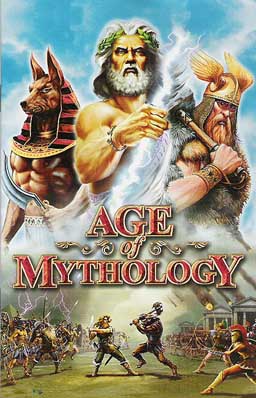
Title Screen (screenshot taken by the author)

Age of Mythology is a real-time strategy game, and a spin off of the Age of Empires series. Developed by Ensemble Studios and published by Microsoft Games, it was released in 2002 for the PC. An extended edition was released on Steam in 2014 but I chose to review the original version.

Plot

The civilisations are based on Greek, Norse and Egyptian mythology. You follow the story of Atlantean hero Arkantos who is hunting a cyclops. This cyclops is in league with Poseidon, whose plan it is to release the Titans and bring the rule of Zeus, Odin and Ra to an end. To stop the Titans from being freed, Arkantos and his army must travel from Atlantis through Greece, Scandinavia and Egypt to find and re-seal doors to Tartarus.

Gameplay

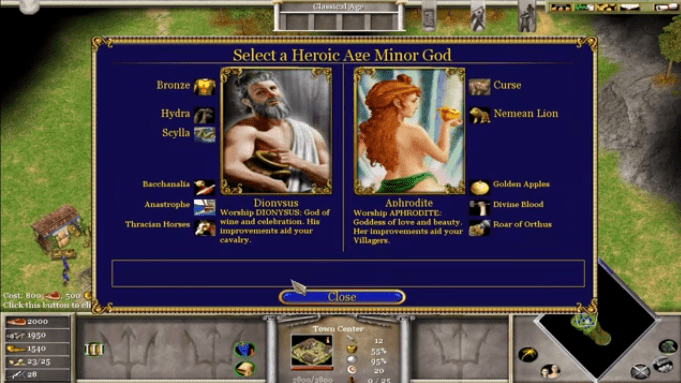
The gameplay is more or less the same as Age of Empires series. You must collect resources to build a base and an army in order to wipe out the opposition. However, there are a few features that distinguish this from the Age of Empires series. Firstly, you are able to train and use mythological creatures, but in order to do so, you must gain favour from the Gods (favour replaces stone in this game). Each civilisation gains favour in different ways (Greek – send villagers to worship at the temples, Norse – gains favour in battle and Egypt – gains favour by building statues). Secondly, when advancing to the next age (the four ages are: Archaic, Classical, Heroic and Mythical) you must choose which God to follow into the next age. Different Gods offer different units and abilities. You will also gain unique God powers to add to your arsenal. Some will aid in attacking the enemy, others will add to your resources and villager gathering abilities. A great new feature is that whilst building your army, you can now produce up to five units at a time, meaning that five units will be released from the barracks instead of one which rememdies a gripe that I have had with the Age of Empires series. Interestingly, there is also a slight difference in how you gather resources and build with the Norse civilisation. Not only will you have a portable storage caravan, but the Ulfsarks, who are an infantry unit, can also build. Your villagers will gather resources as normal, but you can also produce dwarves who are better at mining gold.

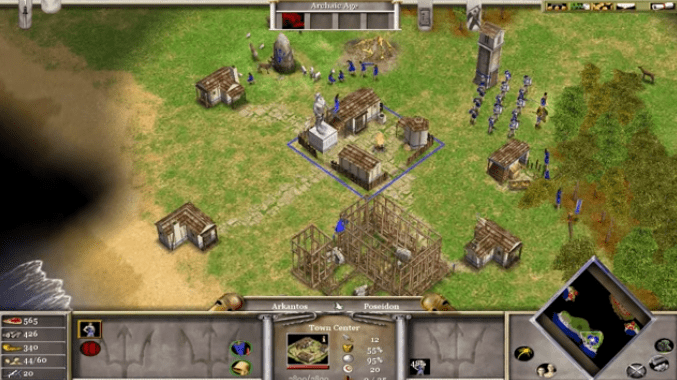
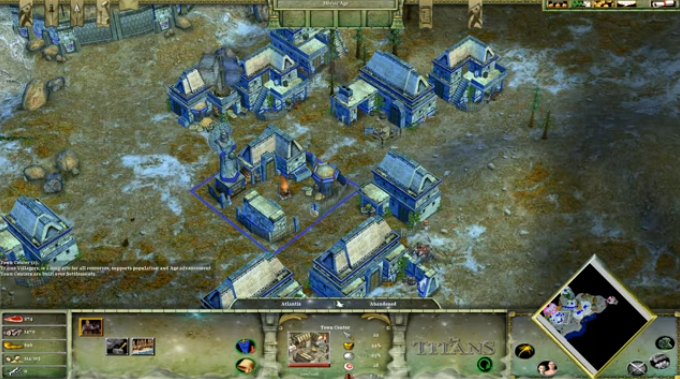
The new 3D engine looks great! (screenshot taken by the author)

The effectiveness of units is based on the rock-paper-scissors model: Infantry are good against cavalry, cavalry are good against archers, and archers are good against infantry. Mythological units are great against normal units but are vulnerable to heroes. Heroes are few and far between in the Greek and Egyptian civilisations, but any Hersir units can be upraded to hero status provided you have enough resources.

Throughout every map stage, there are hidden relics which are valuable to collect. Your hero can carry them to your temple where they will assist you in either supplying a trickle of a particular resource, making certain improvments cheaper, or regenerating certain units when they die.

How Does It Handle?

The controls are very straight forward and the game is easy to learn. I see no glaring issues that need to be addressed.

Graphics

The graphics have moved into the 3D realm and are stunning by 2002-3 standards. The bright colours of the landscape, the detail of the sea and terrain, and the design of the sprites are fantastic.

Music

The music is memorable and fitting to the atmosphere of the game. Ensemble Studios have a habit of creating great music for their AOE series and AOM is no exception. It is soothing and I enjoy listening to it even when not playing the game.

You must choose which God to worship. Each God will offer different units and abilities (screenshot taken by the author)

Replay Value

There is plenty of replay value in multiplayer mode and changeable difficulty settings. I have played through this game multiple times over the years, and even spent hours on Random Map mode. You will quickly learn which civilisations and Gods you prefer to play with and use. In 2016, another expansion pack, Tale of the Dragon was released but I have yet to play this expansion.

Did I Complete The Game?

I have played through and completed these games many times, and I enjoy them so much, I’m sure I’ll play through many times in the future.

What The Critics Said About Age of Mythology:

Gamespot: “Of course, what’s most important is that Age of Mythology plays remarkably well. Featuring lots of interesting, inventive design decisions, plenty of fun-to-use units, and tons of variety, Age of Mythology is the last real-time strategy game you’ll need for a long time. It’s a necessary addition to any real-time strategy fan’s collection, and the game is accessible enough so that even those without much experience with the genre should be able to pick up and enjoy the game without getting overwhelmed. Novices and die-hard RTS players alike will all note the remarkable amount of care and quality that clearly went into every aspect of Age of Mythology–the sorts of things that have already established Ensemble Studios as one of the leading developers of real-time strategy games and that now reinforce the company’s position as a leader and innovator in one of PC gaming’s most competitive and most popular genres.Overall 9.2/10”.[1]

IGN: “I can’t recommend this game enough. It’s particularly gratifying that, in a year with so few RTS games (and fewer good ones), Ensemble has favored (sic) us with such a fantastic complete package. It’s a real ornament for the genre and a benchmark that won’t soon be surpassed. After thousands of words of explanation, the short take is this: if you love the RTS genre, you have to own this game. I won’t take any excuses. Overall 9.3/10.[2]

My Verdict:

“What can I say? This game looks great, plays great, sounds great, and keeps the player thoroughly interested with the clear distinctions between civilisations and Gods. This game is an absolute  banger and I can’t sing its praises enough.“

Rating:

In 2003, an expansion pack, The Titans, was released.

Plot

The story follows Kastor, son of Arkantos, who is tricked into attacking his allies and helping release the Titans.

Title screen (screenshot taken by the author)

What’s New?

AOM: The Titans adds a fourth civilisation, the Atlanteans, to the mix. Although similar to the Greeks, there are some differences including the ability to turn most human units into heroes. They do not require drop off points for resources as each villager is accompanied by a donkey.

There is also the new addition of Titan powers to use. Gaia, Kronos and Oranos are the main Titans and with each age advancement you must choose which minor Titan to follow, again, each offer different units and technologies.

A new Atlantean civilisation has been added (screenshot taken by the author)

On some of the missions, and in Random Map mode, you will be able to release a Titan to cause the destruction of your enemies. They are slow moving but incredibly powerful. They can be killed but you need a huge army with lots of mythical and hero units or a Titan of your own. Once the Titan is dead you cannot create another.

Release a Titan to smite your enemies (screenshot taken by the author)

Did I Complete The Expansion Pack?

I have completed AoM: The Titans many times and will no doubt return again in the future.

What The Critics Said About Age of Mythology: The Titans:

IGN: “Sure, I’d still like to have seen a completely new civilization based on an entirely different set of myths, but The Titans serves as a nice coda to the previous game, which I’m not sure would’ve been possible if the series had branched out a bit more. In the end, the balance and personality are what keep me coming back for more. Overall 8.9.[3]

Gamespy: “While I was in the game, I was having too much fun to give serious consideration to what are essentially minor quibbles. The bottom line is this: Age of Mythology: The Titans is a great add-on that gives AoM fans plenty of new toys to play with that are not only fun in their own right, but make the game they’re attached to much, much better. Overall 4.5/5.[4]

My Verdict:

“What a fantastic expansion…a great new story and a new civilisation to learn about and use. The introduction of the Titans as a physical entity that you can use a great addition too.”

Rating:

What are your memories of Age of Mythology and The Titans expansion? I would love to hear your thoughts, and don’t for get to follow and subscribe so that you don’t miss my latest reviews! You can also find me on Instagram: @nicklovestogame.


[1] Kasavin, G., (November 1, 2002). ‘Age of Mythology Review’. Gamepsot.com. https://www.gamespot.com/reviews/age-of-mythology-review/1900-2896451/ Accessed on 14th July 2020.

[2] Butts, S., (November 4, 2002). ‘Age of Mythology Review’. IGN. (https://www.ign.com/articles/2002/11/04/age-of-mythology-review Accessed on 14th July 2020).

[3] Butts, S., (September 30, 2003). ‘Age of Mythology: The Titans Review. IGN. (https://www.ign.com/articles/2003/09/30/age-of-mythology-the-titans-review Accessed on 14th July 2020).

[4] Rausch, A., (October 9, 2003). ‘Reviews – Age of Mythology: The Titans.’ Gamespy.com. http://pc.gamespy.com/pc/age-of-mythology-the-titans/498508p1.html Accessed on 14th July 2020).

Double Dragon – Review

If memory serves, my first time playing Double Dragon was on the Sinclair Spectrum ZX. I remember loving it and I’m sure this was another game that I played with my dad and older brother. It has gone down in history as a classic game and I was certainly looking forward to revisiting it again.

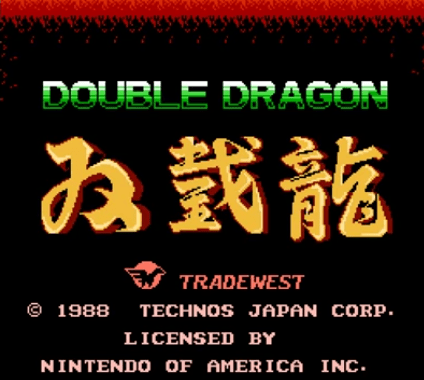
Title screen (screenshot taken by the author)

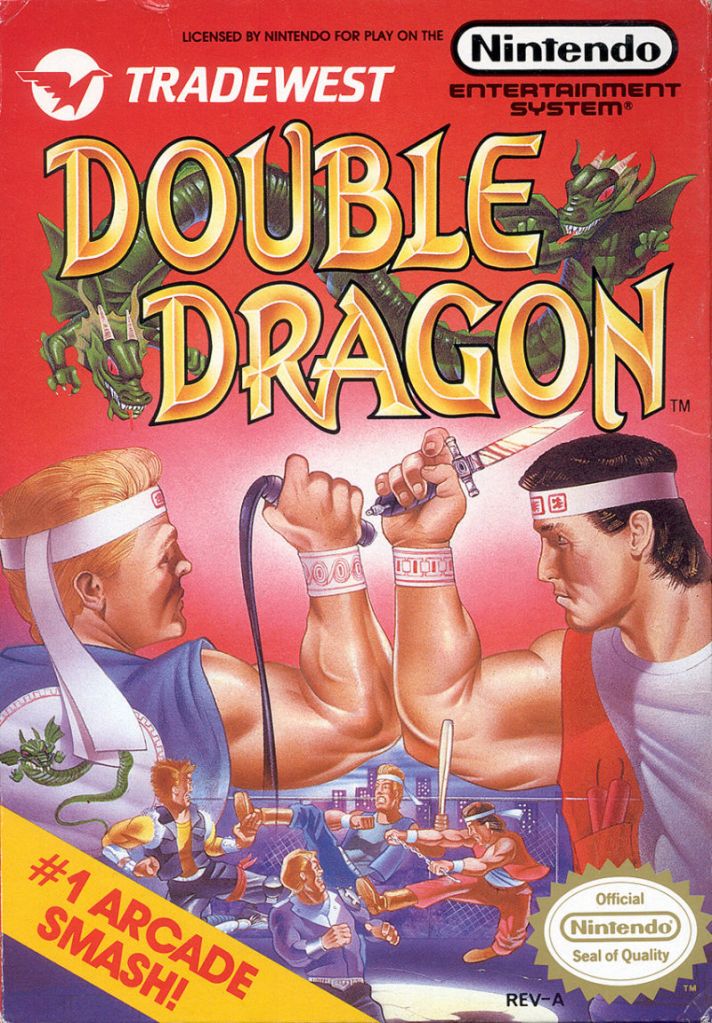
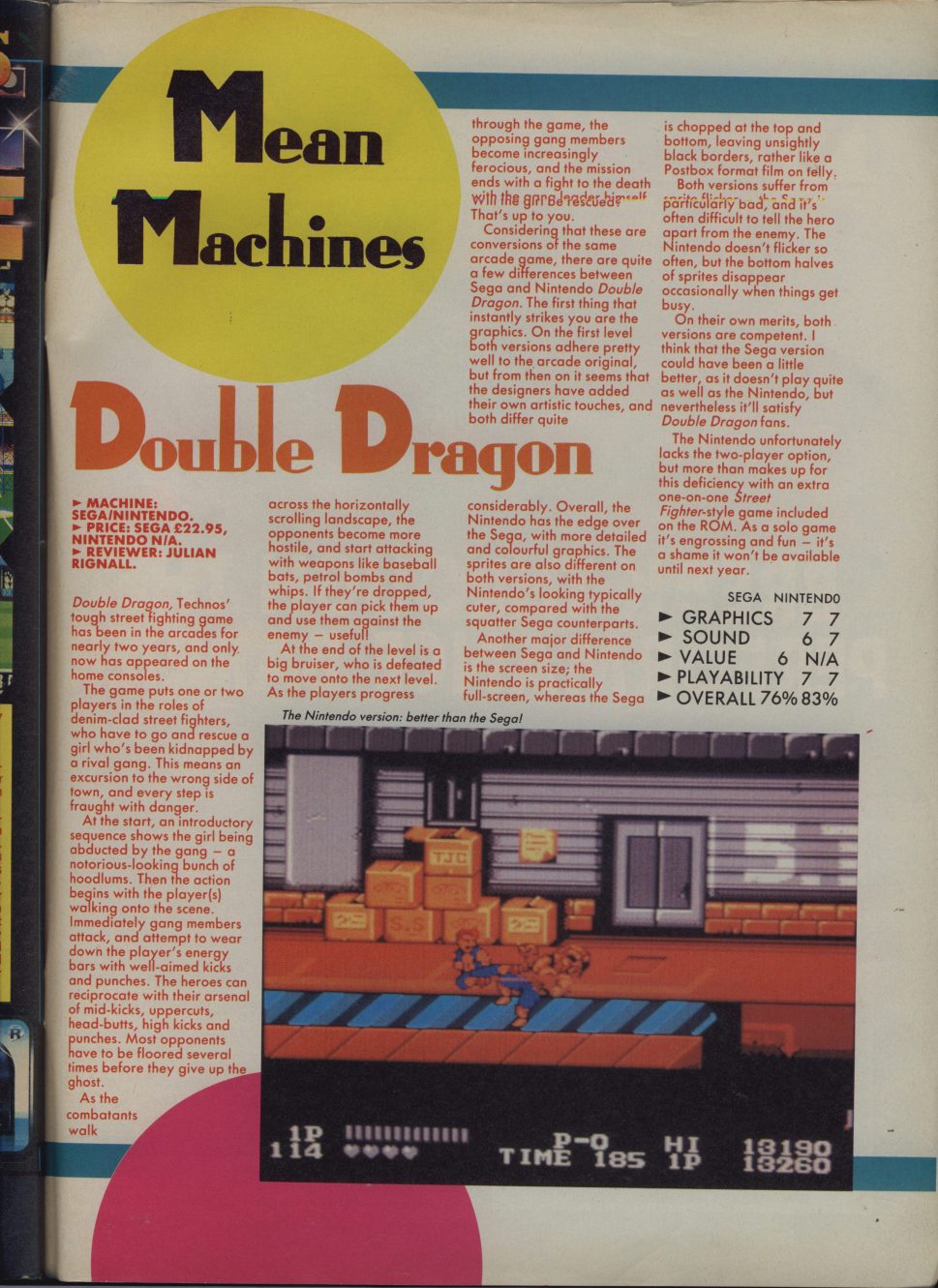
Double Dragon is a beat-em up developed by Technōs Japan and released in the Arcade in 1987. It was published in Europe and North America by Trade West, coming to home consoles in 1988. Versions have been released on the NES, Master System, Atari 2600, Atari 7800, Atari ST, Amiga, Amstrad CPC, Commodore 64, Game Boy, Mega Drive, Game Gear, ZX Spectrum and Atari Lynx to name a few. It appeared on the Wii Virtual Console in 2008, Nintendo 3DS in 2013 and Wii U in 2013. For this review, I played was the NES version.P

Plot

You play as twin brothers Billy and Jimmy Lee (Hammer and Spike in the American versions), who must fight their way through the territory of the Black Warriors gang to rescue Billy’s girlfriend Marian.

Gameplay

At your disposal are an array of punches, kicks, headbutts, throws and elbow strikes. Along the way, you can temporarily use weapons such as baseball bats, knives, whips and dynamite sticks.

There are only four levels, but the game is challenging enough.

Unlike the arcade, the home console version’s two-player co-operative mode was replaced by alternating play, meaning each player plays the game on their own, which was a poor decision by the game designers. Initially, you are limited to just a few fighting moves but as you gain experience points, more fighting moves become available to you which I thought was a nice touch.

(screenshot taken by the author)

How Does It Handle?

The controls are easy to learn but aren’t as responsive as they could be. You can’t turn around quickly whilst punching but you can whilst kicking. I’d recommend kicking rather than punching anyway. One annoying part of level three is where you need to jump across a stream but as soon as you land you are hit by an enemy and fall into the water, losing a life.

Graphics

The graphics are good, especially the background of level one, and are superior to many contemporary games such as Renegade. The characters are distinctive, but the protagonist looks like he’s barefoot.

Due to the lack of power, the NES could only generate two enemies on the screen at any one time.

Replay Value

The NES version also contains a MODE B for both one and two-players where you can select any character from the game to fight in one-on-one battles which adds some replay value.

Oddly, this character looks like The Thing from Marvel’s Fantastic Four (screenshot taken by the author)

Did I Complete The Game?

No, I’ve yet to complete the NES version. I can only make it to level three (I swear I completed this game as a kid!).

What The Critics Said:

Entertainment Weekly Magazine: “…Double Dragon now has quality as well as content. There are more screens than the arcade, as well as vertical scrolling and the one on one match that is very reminiscent of Karate Champ (thrown in for free!)…This game is worth every penny! DIRECT HIT!”.[1]

Computer and Video Games: “Nintendo unfortunately locks the two-player mode option, but more than makes up for this deficiency with an extra one-on-one Street Fighter-style game included on the ROM. Overall 83%.[2]

Joystick: “Overall 75%”.[3]

Awards:

Best Graphics – Electronic Gaming Monthly “1989 Player’s Choice Awards”[4]

My Verdict:

“Double Dragon is a classic title and I don’t know anyone who hasn’t played it. In fact, I’d wager that I have never met a gamer who hasn’t at least heard of it. The game looks good, and there is a nice amount of hand-to-hand attacks and weapons to use. When this game was released, I can imagine it being a great game! However, it loses marks for the lack of a two-player co-op mode and its short length. It is not a game that encourages regular revisits. Sadly, the game is not as good as I remember but then it is always difficult to revisit games.”

Rating:

What are your memories of Double Dragon? I would love to hear your thoughts, and don’t for get to follow and subscribe so that you don’t miss my latest reviews! You can also find me on Instagram: @Nicklovestogame.


[1] Moon, J., ‘Review – Double Dragon’. Electronic Gaming Monthly – 1989 Annual. (March 31 1989). :44.

[2] Rignall, J., ‘Mean Machines – Double Dragon’. Computer and Video Games. (December 1988). : (https://ia800604.us.archive.org/view_archive.php?archive=/1/items/World_of_Spectrum_June_2017_Mirror/World%20of%20Spectrum%20June%202017%20Mirror.zip&file=World%20of%20Spectrum%20June%202017%20Mirror/sinclair/magazines/Computer-and-Video-Games/Issue086/Pages/CVG08600175.jpg Accessed on 4th July 2020).
[3] Huyghues-Lacour, A., ‘Double Dragon’. Joystick. (April 1991). 15:112.

[4] The 1989 “Player’s Choice Awards” – Best Graphics: Double Dragon. Electronic Gaming Monthly – 1989 Annual. (March 31 1989). :19.

Shadow Warriors/Ninja Gaiden/Ninja Ryūkenden – Review

Throughout the 70s and 80s, the popularity of eastern martial arts rose dramatically in the west through Bruce Lee and The Karate Kid movies. Naturally, gamers are attracted to games where they can perform a flurry of punches, an array of agile kicks and jumps, and master hand to hand combat because, let’s face it, these things take years of training and dedication which many of us don’t have the inclination for.

Title screen (screenshot taken by the author)

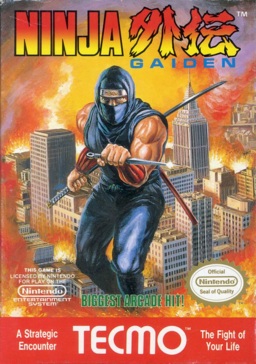
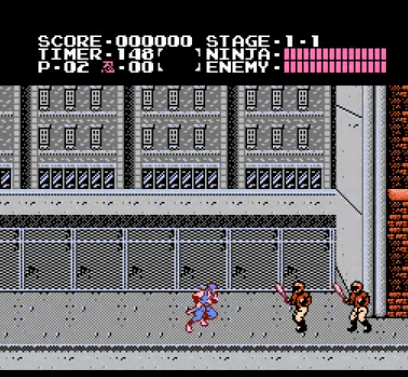
Shadow Warriors is a side-scrolling action-platform game developed and published by Tecmo. It was released for the NES in Europe in 1991, having previously been released in Japan in 1988 as Ninja Ryūkenden, and in North America in 1989 as Ninja Gaiden. It was later ported to the SNES, PC and mobile phones. For this review, I chose to play the NES version.

Plot

You control Ryu Hayabusa who travels to America to avenge the murder of his father. He soon learns of a person known as “The Jaquio” who plans to take over the world with the help of an ancient demon whose power is contained within two statues. The game contains 20 levels broken down into six acts.

I’m not sure why Ryu has a reddish tinge to him (screenshot taken by the author)

Gameplay

The gameplay mostly consists of running at and cutting down your enemies. Ryu’s main weapon is a sword but you are able to pick up and use limited numbers of shuriken. Ryu can also jump and cling onto the walls, but can only climb if he is on a ladder. If not, and a wall is opposite, he can spring himself up by jumping between walls.

How Does It Handle?

The controls are very responsive and the movement tight, allowing for close control. Annoyingly, and this is common amongst early games, if you progress to a higher screen and you fall back down the hole you just came from, you die as oppose to simply fall to the level below.

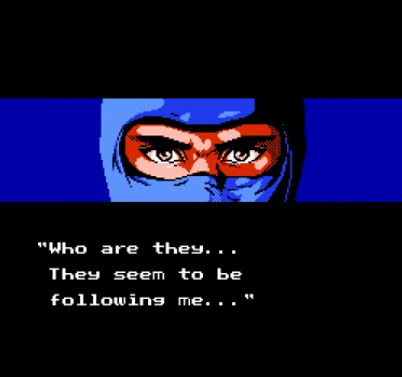
Between levels, there are beautifully illustrated cut scenes (screenshot taken by the author)

Graphics & Music

The graphics and music are standard for 8-bit home consoles in the 80s but with the introduction of 16-bit consoles, begin to look dated by the time of its release in Europe in 1991. The Ryu sprite has a reddish glow to him, which is strange. After each act, there is a beautifully illustrated anime-style cutscene furthering the storyline.

Personal Experiences

The levels are very difficult and unforgiving, but you do receive unlimited continues. Sadly, I was only able to get to Act Three as my version kept crashing. However, I really enjoyed playing this game and so will definitely return to it in the future.

Did I Complete The Game?

No, my game kept crashing on Act Three.

What The Critics Said:

Mean Machines: “A superb game, very similar to Shadow Warriors coin-op. Highly recommended top Nintendo beat ‘em up fans. Overall 88%.[1]

Mean Machines: “A superbly presented Ninja game which proves very playable. Overall 90%.[2]

Awards:

Best Challenge 1989 – Nintendo Power Awards 1989[3]

Best Ending 1989 – Nintendo Power Awards 1989[4]

Best Game of the Year – Electronic Gaming Best and Worst of 1989[5]

My Verdict:

“Tight controls, beautiful cut scenes but very difficult and unforgiving. A good edition to the ninja genre”

Rating:

What are your memories of Shadow Warriors? I would love to hear your thoughts, and don’t for get to follow and subscribe so that you don’t miss my latest reviews! You can also find me on Instagram: @nicklovestogame.


[1] ‘Nintendo Review – Ninja Gaiden’. Mean Machines. (July 1990). Issue 06:12-4.

[2] ‘Nintendo Review – Shadow Warrior’. Mean Machines. (July 1991). Issue 10:66-8.
[3] ‘Nintendo Power Awards ‘89’. Nintendo Power. (May/June 1990). Issue 12:27.

[4] ‘Nintendo Power Awards ‘89’. Nintendo Power. (May/June 1990). Issue 12:28.

[5] ‘Best and Worst of 1989’. Electronic Gaming Monthly – 1990Video Game Buyer’s guide. 5:17.

Shining In The Darkness – Review

Shining in the Darkness (Shining and the Darkness in Japan) is a role-playing game developed by Climax Entertainment and Sonic Software Planning, and was published by Sega in 1991 for the Mega Drive. This was the version I chose to review.

Shining in the Darkness doesn’t have a title screen as such (screenshot taken by the author)

Plot

In the Kingdom of Thornwood, the king’s daughter, Princess Jessa, has disappeared whilst visiting the shrine of her deceased mother. Mortred, one of the king’s most brave and trusted knights, was charged with escorting her to the shrine. He is also missing. You take control of Mortred’s son and agree to be the search party.

Gameplay

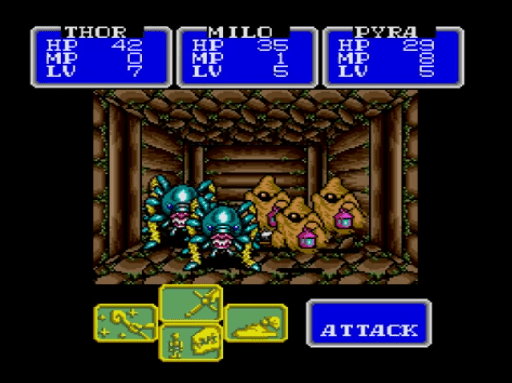
Shining in the Darkness is a real dungeon crawler that sees your character, along with friends Milo and Pyra, exploring what seems like endless miles of dungeons. Along the way you have random encounters with all manner of ugly beasts. Deafeating these will help your team gain experience points and level up, increasing stats and allowing new spells to be learnt. Gold is also acquired which allows you to buy new weapons and armour.

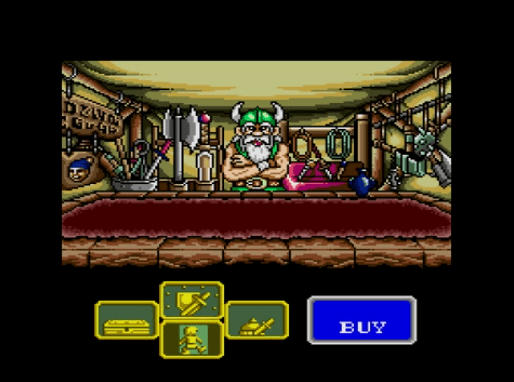
When leaving the palace, a map appears showing you the three locations you can visit: the palace, the town or the dungeons. In the town you can visit the shrine to save your progress; enter the tavern to talk to some interesting characters and regain your health with an overnight stay; visit the weaponry and armoury where you can upgrade to stronger weapons and armour; and buy antidotes and healing potions needed for your adventures in the dungeon from the Alkemist (not alchemist I might add).

Isn’t that Gilius Thunderhead from Golden Axe? (screenshot taken by the author)

Moving through the dungeons is simple. You can move forwards, walk backwards and turn left or right. The interactive menu consists of four boxes at the bottom of the screen and can be called upon at any time. It allows you to check your party’s status, use items, equip weapons and armour etc. When confronted with enemies, the menu changes to include attack, use item, use magic and flee options. When attacking, you have the option to choose which groups of enemies to attack first, but sadly, you cannot choose which individuals to attack within a group. If your health gets too low, you can spirit yourself out of the dungeons using the egress spell or angel feather.

How Does It Handle?

Although it is easy to learn, the game soon becomes too monotonous in my opinion. Having to navigate the same dungeon levels to gain enough experience points to fight deadlier opponents and raise enough money for better weapons becomes a real drag after a while. I know this is the whole point of RPGs but I found myself losing interest, especially when you have to traverse the same dungeons you’ve completed to reach the next dungeon. There are also times when it is unclear where you should go next. I definitely recommend you draw your own map else you will get lost.

Graphics

The graphics are awesome. The palace, tavern and shop scenes are bright and colourful, and the dungeons themselves and the enemies are well illustrated. There really are no complaints here. The game looks gorgeous!

Music

The music sounds great and has heroic air, fitting for such a game.

To arms! (screenshot taken by the author)

Golden Axe Link?

A nice little Easter Egg is that the dwarf who sells you your weapons seems to be the dwarf Gilius Thunderhead from Golden Axe. One of his sacks on the left in the background even has a picture of one of those little imps who you steal magic potions from. Does this mean that Golden Axe and Shining in the Darkness occur in the same universe?

What The Critics Said:

Mean Machines: “A reasonable, but pricey RPG with impressive graphics, let down by combat system that soon becomes a chore. Overall 69%.[1]

Mean Machines Sega: “A role-playing game with excellent graphics and a brilliant window system. Shining in the Darkness is recommended to RPG buffs. Watch out though for irritating combat, reliant on luck than the player’s skill. Overall 72%.[2]

Dragon: “The game combines the icons and combat of Phantasy Star III, the first person perspective of Phantasy Star I, and the great close-up graphics of Phantasy Star II. The combat can sometimes be tedious without the battle animation so well programmed in Phantasy Star II. Overall 4/5.[3]

Sega Force: “Shining in the Darkness is the most colourful, enchanting RPG I’ve played on the Mega Drive – I enjoyed it even more than Phantasy Star II and III. Overall 90%“.[4]

Sega Pro: “RPG’s and great graphics don’t usually go together but Shining in the Darkness breaks the mould. Loads of playability and potential addictiveness will make this RPG a game to remember. Overall 93%.[5]

Sega Power: “Startling graphics, super smooth animation and brilliant labyrinths to explore. A corker! Overall 5/5.[6]

My Verdict:

“This is a beautiful game! It is easily to learn and there is plenty there to keep hardened RPG fans interested for hours and hours. For the average gamer though, monotony and frustration at repeating the same areas again and again soon becomes tiresome. However, this game is definitely worth your attention”

Rating:

What are your memories of Shining in the Darkness? I would love to hear your thoughts, and don’t for get to follow and subscribe so that you don’t miss my latest reviews! You can also find me on Instagram: @Nicklovestogame.


[1] ‘Mega Drive Review: Shining in the Darkness’. Mean Machines. (November 1991). Issue 14:112-3.

[2] ‘Review: Mega Drive – Shining in the Darkness’. Mean Machines Sega. (October 1992). Issue 1:140.

[3] ‘Reviews – Shining in the Darkness’. Dragon Magazine. (February 1992). Issue 178:60.

[4] ‘Reviewed – Shining in the Darkness’. Sega Force. (January 1992). Issue 1:52-3.

[5] ‘Proreview – Shining in the Darkness’ Sega Pro. (November 1991). Issue 1:58-60.

[6] Jarrett, S., ‘The Hard Line – Shining in the Darkness’. Sega Power. (April 1991). Issue 23:54.

Alien Storm – Review

By the early 90s, multiplayer beat ‘em ups/hack and slash games such as Golden Axe, Streets of Rage, Teenage Mutant Ninja Turtles and Final Fight were growing increasingly popular. The increasing array of characters and fighting moves kept gamers playing these games time and again, using all characters in a bid to master them. The multiplayer modes meant that you could play with friends and spend countless rainy afternoons and cold winter evenings in imaginary worlds saving the planet, defeating crime bosses or rescuing royalty.

Title screen (screenshot taken by author)

Alien Storm is a beat ‘em up/shooter hybrid developed and published by Sega for the arcade in 1990, and ported to the Mega Drive and Master System in 1991. It was later released in the Wii Virtual Console in 2007, and as part of the Sega Mega Drive Ultimate Collection for the Xbox 360 and PlayStation 3. For this review, I chose to play the original Sega Mega Drive version.

Plot

Earth is being invaded by an army of incredibly ugly and aggressive aliens. A team of crack special force operatives known as the “Alien Busters”, comprising of the flame-thrower wielding Karen; the hunky Garth (Gordon in some versions) with his electric rifle, and Scooter (Slammer in PAL version) the robot, are sent to repel the invasion. Eight missions sees them battle through cities and towns, laboratories, electronic goods stores and eventually a UFO.

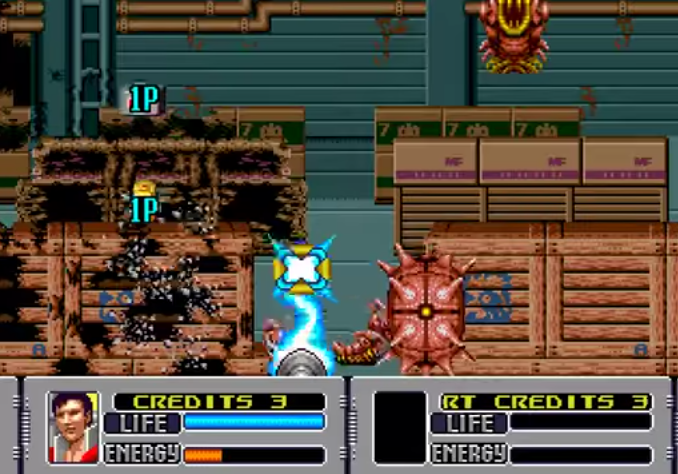
Oddly, the main character looks like Elvis Presley in his profile picture (screenshot taken by author)

Gameplay

The game is mostly a linear beat ‘em up which sees the players fight from left to right. There are sections of the levels where the game changes to a shooter style game which adds a nice bit of variety to the action. Each character can attack, run, and perform a running attack. There are two bars: life and energy to keep an eye on too. When using your weapon, the energy bar begins to deplete. If you use your special attack, the energy bar depletes more quickly. Along the way, you can pick up medicine and batteries to replenish your life and energy levels. There are a few end of level bosses in the game which take a long time to deafeat if you don’t have special attacks, so I recommend not using them until the boss fights.

Alien Storm incorporated elements of the rail-shooter genre (screenshot taken by author)

How Does It Handle?

The controls are very easy to learn, and the game quickly turns into a button masher with little strategy required.

Graphics

The graphics are great! The levels contain detailed backgrounds and the sprites are bright, colourful and well designed with clear outlines. As the game progresses the increased difficulty of the aliens is noted by a colour palette change.

Interestingly, if you look at the profile picture of Gordon in the bottom left corner of the screen, to me, he looks unmistakably like Elvis Presley.

Music

I think the music to this game is very good and fits well. I particularly like the short piece player before the beginning of each level. It’s quite sci-if/horror-sequel.

Watch out for the alien marsupials!!! (screenshot taken by author)

Replay Value

Before beginning the game, you can choose between three difficulty settings: easy, normal or hard. To add an extra element of difficulty, you can also set your energy bar levels to either easy, normal or hard. When you complete the game, after the end of game scenes and credits, you get a score and a rating. As far as I know, your score makes no difference to the game ending. This adds to the replay value of the game as it encourages additional run throughs.

Each character has an individual move set and special attack but there doesn’t seem to be a difference in strength, agility etc. This encourages you to replay the game trying out the different characters.

As with these types of games, two-player co-op modes only add to the fun. To further increase the replay value of the game, the Mega Drive version also contained a Duel mode and a Player vs Player mode. In the Duel mode, you select a player and must compete in fights with differing numbers and strengths of aliens. The more rounds you win, the higher your overall score at the end. I received a score of 82 and the title “Champion”. During these battles there is no way to regain your energy so use your weapons sparingly. In the Player vs Player mode, you and your opponent select one of the three main protagonists each to fight in a one on one battle. The first player to win two rounds, wins the fight. Sadly, this is a bit naff due to the fact that you only have a limited move set. There is not enough variation in attack combinations to make these battles interesting.

Did I Complete The Game?

Yes, I have completed this game many times over the years in both one and two-player modes, but only in easy mode.

What The Critics Said:

Mean Machines:An absolutely outstanding conversion from the coin-op, with great graphics and highly enjoyable one or two-player action. The big problem is that it’s just too easy. For some unknown reason, the import version was harder, but even then, it’s not that difficult to finish. Those new to the Mega Drive scene will really enjoy the action – experts, though, are warned that they might just find themselves finishing this prematurely. Overall 78%.[1]

Sega Pro: “A space age Golden Axe. One or two players can choose from three characters and then walk through eight levels packed with superbly animated and intricately detailed aliens. Great fun as each of the players has a special weapon and executes them in an amusing way. For instance, the robot takes off his (head) and self-destructs as he walks off screen. Way too easy, though. Overall 79%.[2]

Sega Power: “The game is, if anything, pitched a little too easy, and although the sound effects, music (especially the dance tunes) and graphics are excellent, there is little left to grab you after you’ve heard and seen them all. But as an original theme for a blast-‘em up, it’s got a lot of guts (urgh!). Easily a worthy of addition to your Sega collection. Overall 83%.[3]

Sega Power: “Horizontal scrolling blast-‘em up in the vein of high-tech Golden Axe.Great 3D shooting sections and ultra-high-speed scroll, but crippled by easy gameplay. Overall 3/5.[4]

My Verdict:

“I have great memories playing this game with my sister and brother. Its looks great, plays great, and the mix of beat ‘em up and shooter adds some nice variety. The replay value is there too, and I think this is an underrated game from the Mega Drive catalogue. However, it must be said that titles such as Golden Axe and Streets of Rage are still superior in every aspect: Story, graphics, music…the lot.”

Rating:

What are your memories of Alien Storm? I would love to hear your thoughts, and don’t for get to follow and subscribe so that you don’t miss my latest reviews! You can also find me on Instagram: @nicklovestogame.


[1] ‘Review: Mega Drive – Alien Storm’. Mean Machines. (October 1992). Issue 1:137.

[2] ‘Sega Showdown – Alien Storm’. Sega Pro. (November 1991). Issue 1:19.

[3] ‘Reviews – Alien Storm’. Sega Power. (April 1991). Issue 23:40.

[4] Jarrett, S., ‘The Hard Line – Alien Storm’. Sega Power. (April 1991). Issue 23:52.

Tiny Toon Adventures – Review

“We’re tiny, we’re toony. We’re all a little looney. And in this cartoony we’re invading your TV. We’re comic dispensers. We crack up all the censors. On Tiny Toon Adventures get a dose of comedy.”

Title screen (screenshot taken by the author)

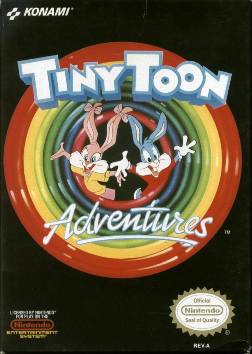
Tiny Toons Adventure is a single-player platform game developed and published by Konami. It was released on the NES in 1991 and it was this version I chose to review.

Plot

Not all is well in Acme Acres. The spoilt rich kid Montana Max is angry because he was unable to bribe the judges of the Animation Festival at Acme Looniversity. Now in a sulk, and wanting to get back at the winner, Buster Bunny, he kidnaps Babs Bunny. Buster, along with pals Dizzy Devil, Furrball, Plucky Duck and Hampton, sets out to rescue Babs.

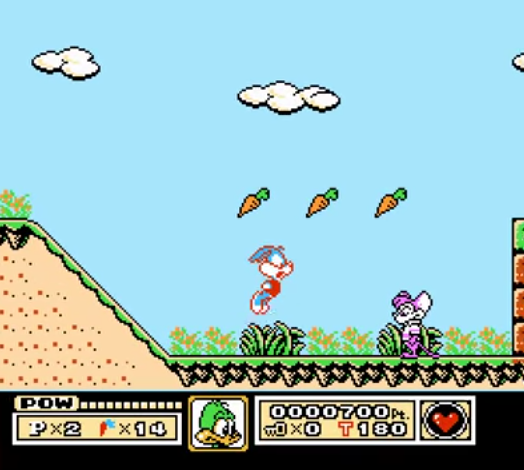
A cute little platform game (screenshot taken by the author)

Gameplay

You initially start as Buster Bunny, but can also select Dizzy Devil, Furrball and Plucky Duck, each with their own unique abilities, to assist Buster. You will become your selected character when you collect the star icon. Using these characters, you must complete six worlds each with three levels (except the last two worlds which need to be completed in one go). These include:

1. Field of Screamz

2. Motion Ocean

3. Sure Weird Forest

4. Boomtown

5. Wacklyland

6. Monty’s Mansion

Each world ends with a boss battle. Throughout the levels you have the chance to collect carrots which can be exchanged with Hampton for extra lives.

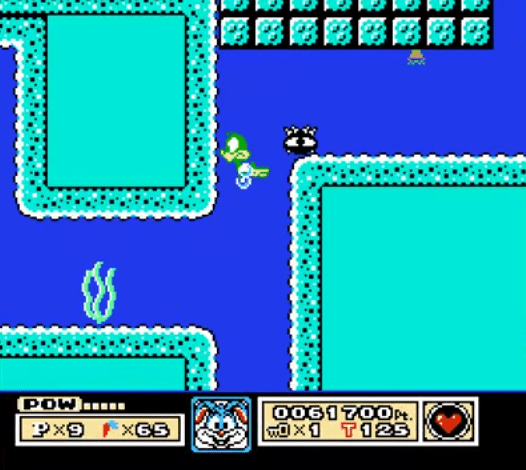
You can only choose one character to assist Buster at the beginning of each world. It is disappointing that in order to change characters, you need to find the star icon as it would have been a nice opportunity to put in some more complex puzzles where each character is needed to use their unique skill. My preferred sidekick was Plucky Duck as he is the best swimmer and can glide whilst jumping.

How Does It Handle?

This is a cute little game, and it’s quite fun to play as the different characters. The controls are easy to learn and are very responsive. Each level has a time limit, which gives you a warning if the timer goes below 30 seconds. You also have unlimited continues. However, if you do use a continue, it takes you back to the beginning of the world.

Each character has unique abilities. Plucky Duck is the best swimmer (screenshot taken by the author)

It is also frustrating that if you die in the boss battle, you are sent back to the beginning of the level, but I guess they need to give the game some longevity.

Graphics

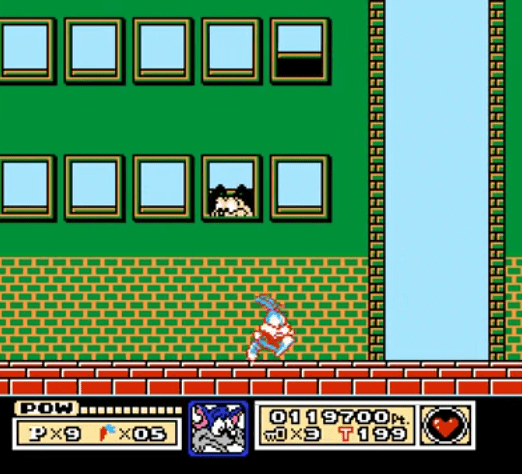
The Graphics for the levels and backgrounds are good…not great, just good. Then again, they don’t need to be ground-breaking. This is based on a children’s cartoon after all. The sprites are nicely drawn, although, it is a bit peculiar how Buster Bunny and Plucky Duck don’t have a nice clear black outline like the other sprites.M

Music

Oddly, there is no music over the title screen, but the in-game music is an 8-bit version of the Tiny Toon theme from the animated series. There is some musical variety through the different levels, but it is the main theme that is most often heard throughout the game.

I’m confused as to why Plucky Duck and Buster Bunny don’t have a nice clear black outline like all the other sprites (screenshot taken by the author)

Did I Complete The Game?

Yes, although I think I used approximately 20 continues for the last two worlds alone.

What The Critics Said:

GamePro: “Strip away that popularity, however, and you’ve still got a solid game with decent challenge. Konami’s given the Toons’ graphics their 8-bit best. Overall 3.4/5.[1]

Entertainment Weekly: “This multilevel action game is easy enough for even small children to master, although older kids may be challenged by the higher levels. Overall A-“.[2]

N-Force: “The funky fluffy sounds, perfectly compliment the graphics, and gameplay’s as brilliant as ever, with six massive levels and a multitude of sub-levels, the lastability factor’s excellent. Overall 89%”.[3]

My Verdict:

“Nice graphics and a fun little game which is diverting in its own way. The last two worlds in particular are quite challenging. Sadly, with one difficulty setting, there is a real lack of replay value. Definitely one for the younger gamers out there.”

Rating:

What are your memories of Tiny Toons Adventure? I would love to hear your thoughts, and don’t for get to follow and subscribe so that you don’t miss my latest reviews! You can also find me on Instagram: @nicklovestogame.


[1] The Missing Link. ‘Nintendo Pro Review – Tiny Toon Adventure’. GamePro. (December 1991). Issue 29:38.

[2] Strauss, B., ‘The Latest Video Games Reviewed’. Entertainment Weekly. (August 7th, 1992). https://ew.com/article/1992/08/07/latest-videogames-reviewed/ Accessed on 10th May 2020).

[3] ‘Reviewed! – Tiny Toons Adventure’. N-Force. (August 1992). Issue 2:56-7.

Final Mission (S.C.A.T./Action in New York) – Review

Shoot ’em ups are not for the light-hearted. They require the quick reflexes and hand-eye coordination of a sprightly feline. They can also be immensely fun to play, especially in co-op mode. These sorts of games were perfect for the arcades and players brave enough to attempt them would soon find they had a mass of spectators cheering them on. Those were the days!

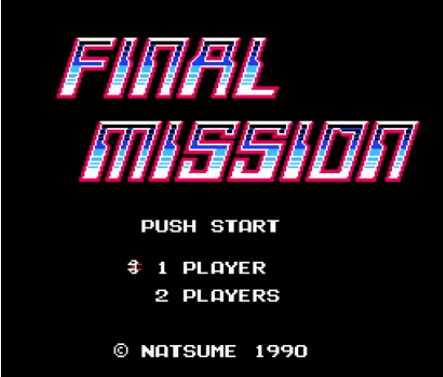
Title screen (screenshot taken by the author)

Final Mission is a side-scrolling shoot ‘em up developed by Natsume. It was published by Natsume Co. Ltd. (North America and Japan), Infogames (Europe), and Konami (Australia). It was released on the NES in Japan in 1990. In North America it was released in 1991 under the name SCAT: Special Cybernetic Attack Team. In 1992, it was released in Europe and Australia under the name Action in New York. It was later released on the Wii Virtual Console in 2011, and the Nintendo DS and Wii U in 2014. For this review, I played the NES version.

Plot

The year is 2029, Supreme Commander Vile Malmort leads an army of aliens to invade and conquer Earth. A team consisting of soldiers that are part-human, part-machine, are assembled and sent to repel the invasion.

Use your satellites to attack the enemy, and protect your six! (screenshot taken by the author)

Gameplay

Final Mission can be played in one or two-player co-op modes. You play as either Arnold or Sigourney, no doubt a nod to Arnold Schwarzenegger and Sigourney Weaver (in the Japanese version they are both male). You are equipped with jet packs and two satellite modules that fire at the enemies as you fly around the levels destroying the invaders. You must battle your way through five levels: New York City Ruins; Subterranean Realm; the Astrotube; the Battleship; and the Orbiting Platform. You can pick-up several upgrades along the way, boosting your attacking power and maneuverability. The upgrade icons are:

S – Increases the speed of your warrior

L – You wield a high powered laser gun that can shoot through some walls

W – You wield a wide beam to attack multiple enemies

B – Explosive shells

R – Restores your lost energy

How Does It Handle?

The controls are simple and easy to learn. The D-pad moves you around the screen. The B button fires your weapons (some weapons fire continuously when the fire button is held down). The A button locks your satellites into position, and unlocks them again so that they can change position as you move. There is no time limit but the screen will scroll sideways (and sometimes up and down). This feature adds an element of strategy when battling through the levels. Sadly, it only takes three of four hits before you die. You only have one life and four or five continues, which are used up very quickly making this game is very tough.

Graphics

The graphics and level detail are good. The backgrounds are very detailed and look great. In NES shoot ‘em ups, the backgrounds aren’t usually as detailed (see Gradius II [1988] and Over Horizon [1991]), but Final Mission’s backgrounds are really impressive. However, there is a little bit of flicker when the screen gets too busy.

Did I Complete The Game?

Nope, didn’t even get past the first stage.

What The Critics Said:

At present I have been unable to find a contemporary review of this game.

My Verdict:

“This game looks great and the controls easy to learn and are very responsive. Sadly, the difficulty level is rather off putting and I found that I simply didn’t enjoy playing this game. However, it is a little more fun in two-player mode.”

Rating:

What are your memories of Final Mission? I would love to hear your thoughts, and don’t for get to follow and subscribe so that you don’t miss my latest reviews! You can also find me on Instagram: @nicklovestogame.