Shoot ’em ups are not for the light-hearted. They require the quick reflexes and hand-eye coordination of a sprightly feline. They can also be immensely fun to play, especially in co-op mode. These sorts of games were perfect for the arcades and players brave enough to attempt them would soon find they had a mass of spectators cheering them on. Those were the days!
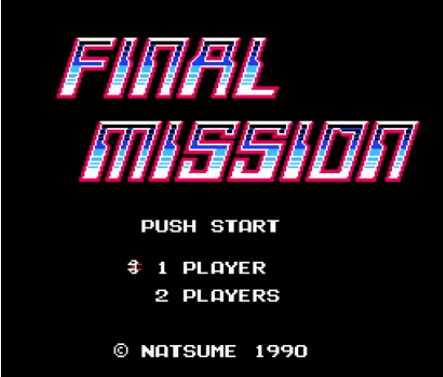
Title screen (screenshot taken by the author)
Final Mission is a side-scrolling shoot ‘em up developed by Natsume. It was published by Natsume Co. Ltd. (North America and Japan), Infogames (Europe), and Konami (Australia). It was released on the NES in Japan in 1990. In North America it was released in 1991 under the name SCAT: Special Cybernetic Attack Team. In 1992, it was released in Europe and Australia under the name Action in New York. It was later released on the Wii Virtual Console in 2011, and the Nintendo DS and Wii U in 2014. For this review, I played the NES version.
Plot
The year is 2029, Supreme Commander Vile Malmort leads an army of aliens to invade and conquer Earth. A team consisting of soldiers that are part-human, part-machine, are assembled and sent to repel the invasion.
Use your satellites to attack the enemy, and protect your six! (screenshot taken by the author)
Gameplay
Final Mission can be played in one or two-player co-op modes. You play as either Arnold or Sigourney, no doubt a nod to Arnold Schwarzenegger and Sigourney Weaver (in the Japanese version they are both male). You are equipped with jet packs and two satellite modules that fire at the enemies as you fly around the levels destroying the invaders. You must battle your way through five levels: New York City Ruins; Subterranean Realm; the Astrotube; the Battleship; and the Orbiting Platform. You can pick-up several upgrades along the way, boosting your attacking power and maneuverability. The upgrade icons are:
S – Increases the speed of your warrior
L – You wield a high powered laser gun that can shoot through some walls
W – You wield a wide beam to attack multiple enemies
B – Explosive shells
R – Restores your lost energy
How Does It Handle?
The controls are simple and easy to learn. The D-pad moves you around the screen. The B button fires your weapons (some weapons fire continuously when the fire button is held down). The A button locks your satellites into position, and unlocks them again so that they can change position as you move. There is no time limit but the screen will scroll sideways (and sometimes up and down). This feature adds an element of strategy when battling through the levels. Sadly, it only takes three of four hits before you die. You only have one life and four or five continues, which are used up very quickly making this game is very tough.
Graphics
The graphics and level detail are good. The backgrounds are very detailed and look great. In NES shoot ‘em ups, the backgrounds aren’t usually as detailed (see Gradius II [1988] and Over Horizon [1991]), but Final Mission’s backgrounds are really impressive. However, there is a little bit of flicker when the screen gets too busy.
Did I Complete The Game?
Nope, didn’t even get past the first stage.
What The Critics Said:
At present I have been unable to find a contemporary review of this game.
My Verdict:
“This game looks great and the controls easy to learn and are very responsive. Sadly, the difficulty level is rather off putting and I found that I simply didn’t enjoy playing this game. However, it is a little more fun in two-player mode.”
Rating:
What are your memories of Final Mission? I would love to hear your thoughts, and don’t for get to follow and subscribe so that you don’t miss my latest reviews! You can also find me on Instagram: @nicklovestogame.
I often wonder what goes through the minds of game creators. Naturally, creators wish to make money but at the same time, surely they want to make a game that’ll be loved by gamers. Why they would create games that frustrate gamers because of limited moves, the inability to select weapons, and limited lives and continues, I’ll never know? Kage is one such game!
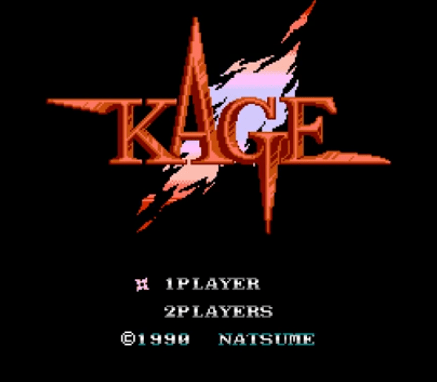
Title screen (screenshot taken by the author)
Kage was developed and published by Natsume in 1990 (Taito in 1991). It was later renamed as Shadow of the Ninja in Japan and Blue Shadow in Europe and Australia. Originally released on the NES, it was later re-released for the Virtual Console on the Wii. For this review, I played the NES version.
Plot
Set in 2029, the evil Emperor Garuda has taken over the USA. Two ninjas from the Iga clan, Lord Hayate and Lady Kaede, are sent to infiltrate the Emperor’s stronghold and assassinate him.
Gameplay
Using weapons such as the katana (sword), shuriken (throwing stars) and kusarigama (sickle and chain), the ninjas must fight through numerous enemies and sub-bosses. There are five levels broken down into 16 stages, which see you fight through a seaport, underground sewers, city rooftops, an air fortress and a final fortress.
You can select to play either as Lord Hayate or Lady Kaede (screenshot taken by the author)
It can be played in both single and two-player mode. In one-player mode, you have the option to decide who you play as. You can run, jump and attack, and even hold onto certain platforms and hang from them. You can then choose to flip up to that platform or drop to the platform below. However, you can only attack the way you are facing when hanging from a platform.
How Does It Handle?
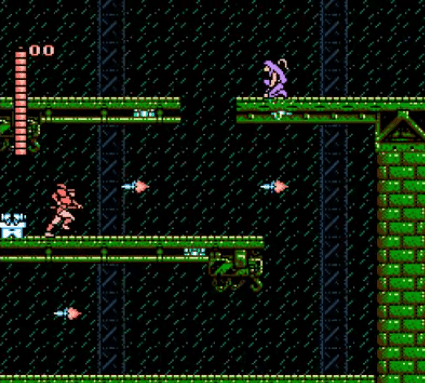
The controls are responsive and simple…perhaps too simple. When using the katana and shuriken, you can only attack straight in front of you or in a crouching position. You cannot slash your sword or throw a shuriken up or diagonally, which I think is pretty dumb, especially where the shuriken is concerned. You can attack diagonally up and straight up when you wield the kusarigama, but not down or diagonally down. Finding scrolls throughout the levels increases the range of your attack, but I didn’t find any on the first stage. You may also find bombs and health potions.
Hangin’ tough (screenshot taken by the author)
Annoyingly you cannot switch between weapons meaning when you pick up shurikens, you have to use them up before reverting back to the katana or kusarigama, or you need to find an item box conatining a different weapon or additional shuriken. This is frustrating because, and I’m sure I don’t need to explain this, but I will, it would be very handy with some bosses and sub-bosses to be able to save some shurikens back.
Thankfully, there is no time limit on the levels meaning you can take your time.
Be prepared to evade small missiles (screenshot taken by the author)
Graphics
Graphically, levels are detailed and well designed, and the sprites are clean and well defined. No complaints there.
Music
The music is very basic and easily forgettable.
Personal Thoughts
I didn’t spend that much time on this game because I found the limited move set frustrating and I just didn’t enjoy playing it. The inability to defeat various enemies without taking hits is frustrating.
Did I Complete The Game?
No, I only managed to get to level 2.2 before I gave up.
What The Critics Said:
GamePro:“Shadow of the Ninja, however, is above average Ninja fare with top of the line graphics and fast-paced gameplay. One minor hang-up is the sluggish transition between dialogue screens. But all in all this is a top flight, fast-paced action cart.” Overall 4.6/5”.[1]
Electronic Gaming Monthly: “Superb Graphics and sound intensify this battle for freedom. No rating”.[2]
Total!: “A sexy-looking and very playable platform hack ‘em up, with great two-player option. It’s just a bit too easy for my liking. Overall 74%”.[3]
My verdict: “This game isn’t bad, but the limited ways to attack your enemies make it very frustrating. Sadly, this detracts from the nice graphics and keeps me from wanting to pay more. It’s a poor man’s Ninja Gaiden”.
Rating:
What are your memories of Kage? I would love to hear your thoughts, and don’t for get to follow and subscribe so that you don’t miss my latest reviews! You can also find me on Instagram: @nicklovestogame.
[1] Bro Buzz. ‘Nintendo Proview – Shadow of the Ninja’. GamePro. (July/August 1991). :24-5.
[2] ‘Shadow of the Ninja’. Electronic Gaming Monthly. (April 1991). 21:98-102.
After six years and four games, Phantasy Star IV sees the conclusion of the original Phantasy Star series. In the Phantasy Star universe, the games have spanned several thousand years and players were introduced to many different characters including Alis, one of the first female protagonists in computer game history. I have thoroughly enjoyed playing through the series but as George Harrison wrote, “All things must pass”.
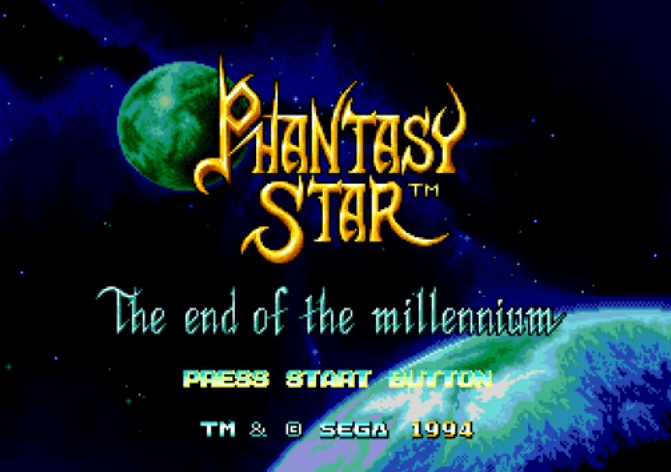
Title screen (screenshot taken by the author)
PSIV is a role-playing game that was developed and published by Sega and released for the Sega Genesis in Japan in 1993. It would not make an appearance in North America and Europe until 1995. It was later released on the Wii U Virtual Console in 2008. For this review, I played the version found on the Sonic’s Ultimate Genesis Collection (2009) for the PlayStation 3.
Plot
Taking place 1000 years after the events of Phantasy Star II (1989), a cataclysmic event known as the Great Collapse has turned Motavia back into a desert planet, and once again there is an increase in biomonsters appearing throughout the world. Chaz Ashley, a young hunter, learns of the link between the biomonsters and the ecological crisis on the planet. The computer system put in place to control the climate is malfunctioning, and the planet is reverting back to its original desert-like state. It also seems that Dark Force is back, hellbent on destroying the Algol system once and for all.
Gameplay
The gameplay has been kept the same as previous instalments – that is, top down view with the exception of battle mode. As you walk around you will have random battle encounters that allow you to earn money and gain experience points. The more points you earn, the higher each player’s stats will become. The view changes to a third person view fir the battles.
Sadly, the overworld graphics seem to have reverted back to the PSII model making it look a little dated (screenshot taken by the author)
How Does It Handle?
Firstly, the story is more fleshed out than it’s previous instalments, and a lot more engaging. The dialogue in general feels like there was a better translation of the original script. Additionally, during dialogue moments, character profile boxes appear which are beautifully illustrated. It also clarifies exactly who is speaking. During cutscenes, more illustrated boxes are added giving the illusion that you’re reading a comic book. There are also a few nice surprises in the form of characters from previous games reappearing, but I won’t spoil it by telling you who.
There is a significant increase in walking speed for the characters, meaning you can get from A to B a lot quicker. You are also able to increase the speed of the battles and text to help hurry the game along. One annoyance was that when you approach a person and/or object, whilst still pressing that direction, you walk around the target as oppose to stopping in front of it. When you play it, you’ll know what I mean.
The menu system is easy to access and straight forward to navigate. What made me particularly happy is that you no longer need to manually go into your menu and pass items between characters in order for them to equip or use them. The weapons and armour will automatically be available to those who can wield them.
Originally the game came with a very comprehensive 40-page manual explaining every aspect of the game including: Information on each character, what the main items are for, what all the spells and techniques do when used, what injuries you can incur, a map of Motavia, and information on weapons and armour.
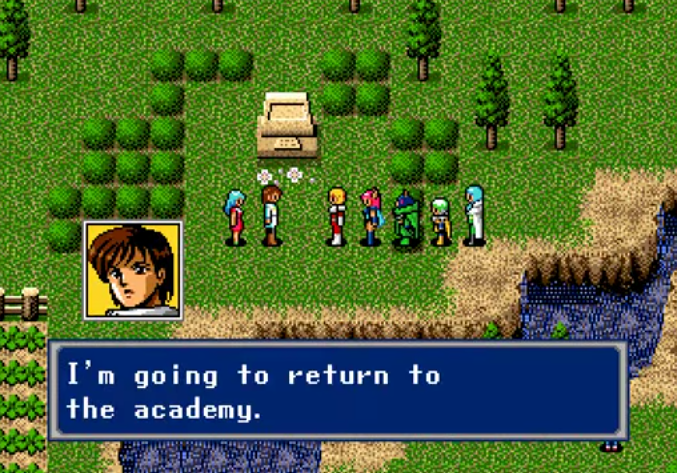
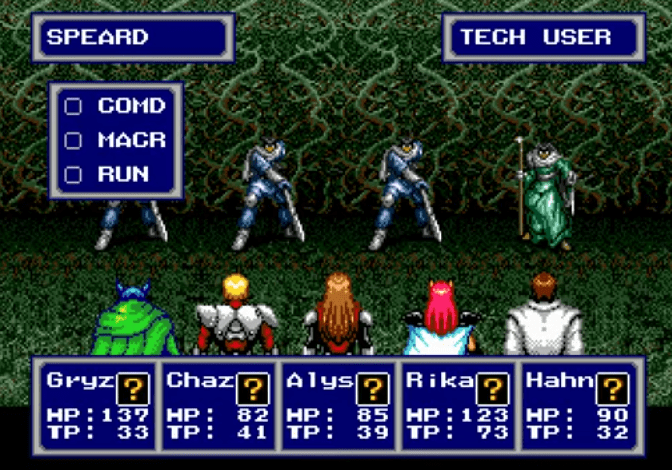
The graphics in battle mode have also reverted back to a similar style to PSII (1989), with the addition of illustared backgrounds (screenshot taken by the author)
Graphics
Oddly, the sprites in the overworld seem to have reverted to PSII (1989) style graphics as oppose to PSIII (1990) or creating newer, more improved graphics. Comparing the two, one could be forgiven for thinking PSIII (1990) was a later instalment. Sadly, these graphics look dated for the mid-90s, especially when compared to RPGs such as Al-Qadim: The Genie’s Curse (1994) and Shining Force 2 (1993). Also, the PlayStation had been released in 1994, upping the expected standard for games in general. When the PlayStation could produce RPGs like Suikoden (1995), what chance did the Mega Drive have?
On Dezo – added snowy effects give the impression that you are in a blizzard. However, this effect is heavy on the eyes. (screenshot taken by the author)
Buying and equipping weapons and armour has been simplified, and for the better. When you buy a new weapon or piece of armour, arrows appear by the name of the individual who can wield it. Sadly, you cannot see if an item will improve the stats of that character until you buy it and equip it.
PSIV reintroduces fighting animations back into battle mode, similar to that of PSII. However, this time the backgrounds have also been kept. The animations of the physical attacks of the characters are the same as they were in PSII which is a little disappointing. The backgrounds during the battles are more detailed and, in some cases, animated. Additionally in PSIV, you can now use your transport vehicle during battles instead of using your characters.
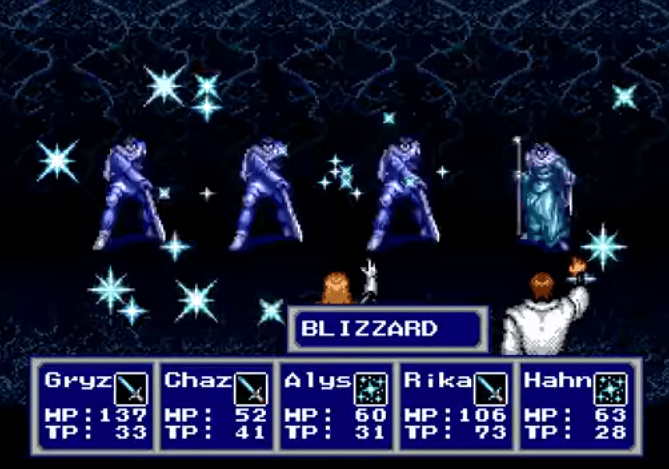
A nice new feature is that two or more characters can combine their spells and techniques to create bigger and more powerful attacks. Sadly, this is very trial and error and it doesn’t always work (screenshot taken by the author)
The enemies are beautifully illustrated and animated. There are some real ugly bastards in this game. A nice little extra is that sometimes, when two or more fighters use a certain technique or spell, it can combine to produce a stronger attack. Sadly, this doesn’t happen everytime you attempt it.
One added bonus is that you no longer need to pay to restore a fallen comrade. You simply go to a hostel, and bed down for the night. In the morning, said comrade will be right as rain.
Finally, and thank Christ, the battle menu is now wonderfully intuitive. It is very easy to learn, and they have finally simplified the way you can chose which enemy to attack. This makes strategic attacks a hell of a lot easier.
Did I complete the game?
Yes, a walkthrough was needed on several occasions though.
What the critics said:
Electronic Gaming Monthly: “This is the fourth instalment in the Phantasy Star series with an improved magic system that allows you to combine spells for more power. Overall 7.75/10”[1]
GameFan: “The graphics are gorgeous, the music is some of the best I’ve heard in a while on the Genesis., full of batchin’ samples, and the game exudes nothing but pure, joyous power. Overall 93/100”.[2]
Mean Machines Sega: “The best pure RPG for the Megadrive…” Overall 88%”.[3]
Sega Saturn Magazine:“The gameplay – controlling inventories, arming combatants, and using spells – is not to everyone’s taste. But the game succeeds by creating climactic moments, introducing new characters and powers, and taking many weird and wonderful plot turns. Overall 90%”.[4]
Game Players:“Newer RPGs like Final Fantasy III make this game look ancient…this still feels like every other Phantasy Star Game…The game offers plenty of items while staying clear and user-friendly. Fighting every other step drives you crazy. Overall 70%”.[5]
My verdict:
“Although the graphics are beginning to look a bit dated, they are still pleasing to look at for the most part. The story is compelling with some nice surprises, and they have simplified the menu systems making them easier to navigate. Personally I feel this is the best Phantasy Star in the series.”
Rating:
What are your memories of Phantasy Star IV? I would love to hear your thoughts, and don’t for get to follow and subscribe so that you don’t miss my latest reviews! You can also find me on Instagram: @nicklovestogame.
Arcade games were designed to be nigh on impossible to complete. This was because not only did the creators want to challenge gamers, but they also needed to be able to sell a product to arcade owners who in turn wanted games that gamers would repeatedly pump their pocket money in to continue playing…it is a business after all. When arcade games were ported to home consoles, it often seems that the creators failed to adjust the difficulty levels. Young gamers today have no idea how easy they have it all with constant automatic saving, online walkthroughs and cheat pages close-by, at the touch of a button.
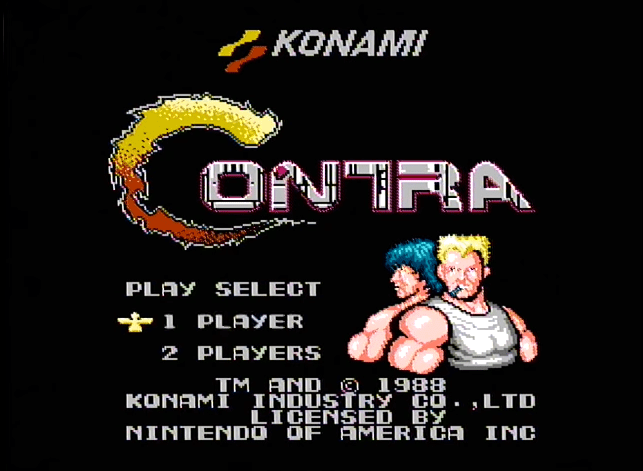
Title screen (screenshot taken by the author)
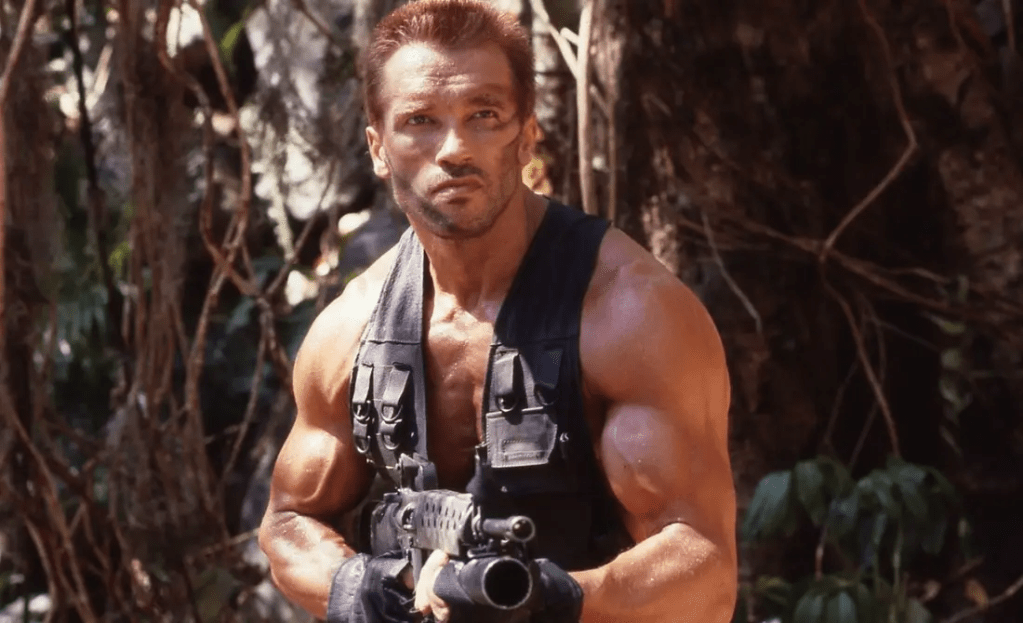
Contra is a run and gun video game developed and published by Konami for the Arcade in 1987. A home version was released on the NES in 1988 (in Europe, Contra was known as Probotector). Ocean Software ported the game to the ZX Spectrum, Commodore 64 and Amstrad CPC in Europe in 1988 under the name Gryzor. Interestingly, Ocean’s cover art for the game was a clearly influenced by a photograph of Arnold Schwarzenegger in the film Predator. For this review, I played the NES version of this game.
The cover art was clearly influenced by Arnold Schwarzenegger in the film Predator (1987).
Plot
According to the NES manual, in 1957, a large object crashed into the Amazon near some Mayan ruins. Nothing further seemed to have happened and the incident was forgotten about. 30 years later, reports of weird alien monsters terrorising the local villages have been received by the Pentagon. Rather than create a political incident by sending in an army, the US send in two commandos, Lance and Bill, to find and destroy the aliens.[1]
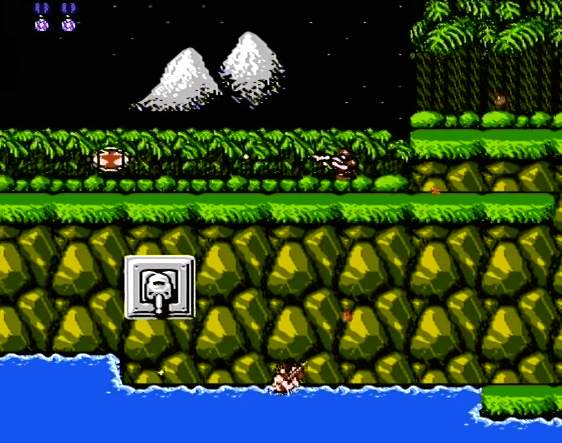
Bright colours, clearly defined sprites, and excellent gameplay (screenshot taken by the author)
Gameplay
Contra is easy to play but tough to master. You mainly run, jump, lay down, and shoot. The controls are nice and responsive, and you can shoot in all directions. However, if you want to shoot directly down, then you need to jump. You can jump down to a lower platform simply by pressing down and jump. Be careful though…one shot can kill you and you only get a finite amount of lives and continues.
The manual describes all the levels you will fight through as well as what all the power-ups do. The power-ups are greatly appreciated as you progress through the games and the enemies begin to increase in number and strength. They also make defeating the end of level bosses much easier.
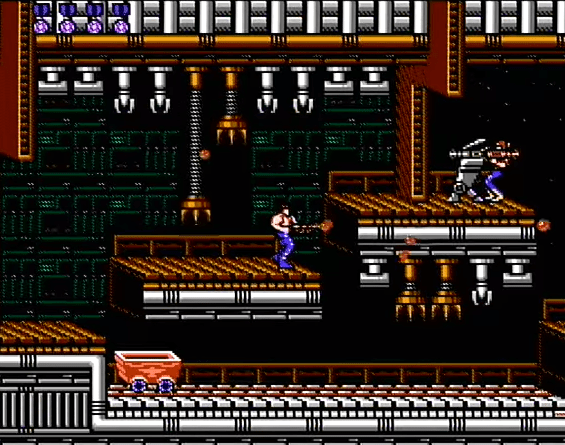
After every level, the perspective changes and your character begins in the foreground firing at enemies and defensive weapons in the background. Once you destroy the circular flashing light, which powers the electrical fence stopping you from moving forward, the rear wall explodes and you can progress to the next room. This must be done several times before you complete the level.
After every level you must battle your way through a series of rooms by destroying a flashing button to lower the electrical field (screenshot taken by the author)
How Does It Handle?
The controls are tight and easy to learn. Being able to fire in all directions, and jump up and down to platforms really makes you feel like you’re at the arcades.
Graphics
The levels are very well designed and very detailed. They are brightly coloured with many different platforms for you to jump up to and down from.
Music
The music fits the game well, and the sprites are clean and nicely animated. The overall graphics are pretty damn good for a home console in 1988.
(screenshot taken by the author)
Replay Value
The game becomes a lot more fun in two-player mode. Although you are competing for points, you are actually co-operating to beat the game, and it certainly makes the game easier. Mrs. L was my co-op buddy for this run through.
Did I Complete The Game?
Mrs. L and I did complete the game, but we needed the cheat that gave us 30 odd lives each. Without the cheat we could only get past the first few levels. On YouTube I did see one video where someone completed the game without dying once. Fair play to them.
What The Critics Said:
Computer Gaming World: “Two player contests are always in demand, because most video games are designed for a solo gamer. Contra is doubly welcome, because it is a truly outstanding action epic.” No rating given.[2]
“Although this game is tough, it is also a lot of fun, especially in two player mode. Great graphics, tight controls, and adrenalin inducing levels. I think that you will find yourself returning to this game again and again.”
Rating:
What are your memories of Contra? I would love to hear your thoughts, and don’t for get to follow and subscribe so that you don’t miss my latest reviews! You can also find me on Instagram: @nicklovestogame.
Ah, role-playing games. The opportunity for real adventure. Battle ugly-ass monsters, fill your pockets with treasure, and wield magic weapons. Cast spells of fire, lightning, as well as healing. Journey through mystical and fantastical lands, through deadly dungeons, dark forests, and creepy castles. Build your fighter’s stats until they are strong enough to defeat the demonic rulers of the evil armies.
Title screen (screenshot taken by the author)
Phantasy Star III: Generations of Doom is an RPG developed and published by Sega and is the sequel to Phantasy Star II. It was released in Japan in 1990 for the Sega Mega Drive and reached Europe and North America in 1991. For this review, I played the version found on Sonic’s Ultimate Genesis Collection (2009) on the PlayStation 3.
Plot
1000 years before the start of the game, which seems to be set in a medieval setting as oppose to a science-fiction setting, two factions are engulfed in a bitter feud. Orakio, a swordsman, and Lava, a sorceress, meet for an armistice and both mysteriously disappear. Both factions blame each other for their leader’s disappearance, and all communication and travel between the two worlds cease. War seems inevitable…
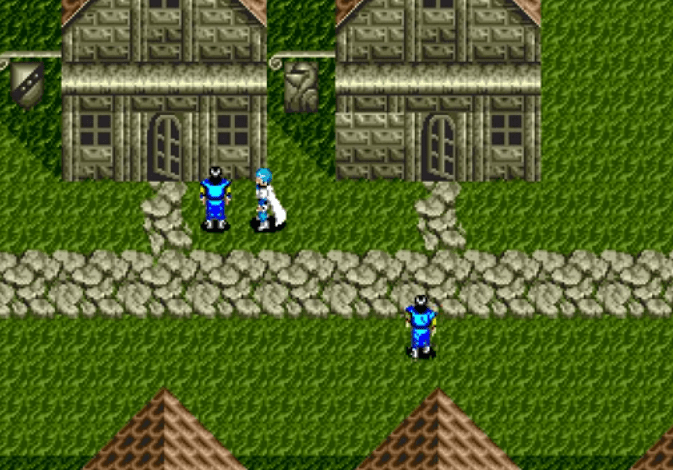
The colours are less headache-inducing, and the graphics are more detailed than previous instalments (screenshot taken by the author)
Firstly, you get a nice intro with some beautiful illustrations, and text explaining the back story. The game then begins with Rhys, Prince and heir to the Orakian kingdom of Landen. He is due to marry Maia, whom Rhys found washed up on a beach two months earlier (a bit odd, but ok). The ceremony is interrupted by a dragon, identified as a Layan, who abducts Maia in what is seemingly a deliberate act of war. During his search for Maia, Rhys recruits a number of fighters to assist him.
Strangely, PSIII doesn’t resolve what happened at the end of PSII (1989). What happened to your fighters? What happened to Rolf, Rudo and company? Were they defeated? Did they survive? Me may never find out!
Gameplay
Continuing in the tradition of most RPGs, PSIII involves the player exploring a 2D world, recruiting characters, random enemy encounters, and a turn-based battle system. You can attack the enemy in three ways: with a weapon, using magic spells, and/or using special techniques. I know in PSIV (1993) you can use dynamite to attack the enemies, but I don’t recall seeing that option in this game…I may be wrong of course. Once enemies are defeated you gain Meseta (money) and experience points. Experience points are necessary to increase your fighter level which in turn, increases their stats.
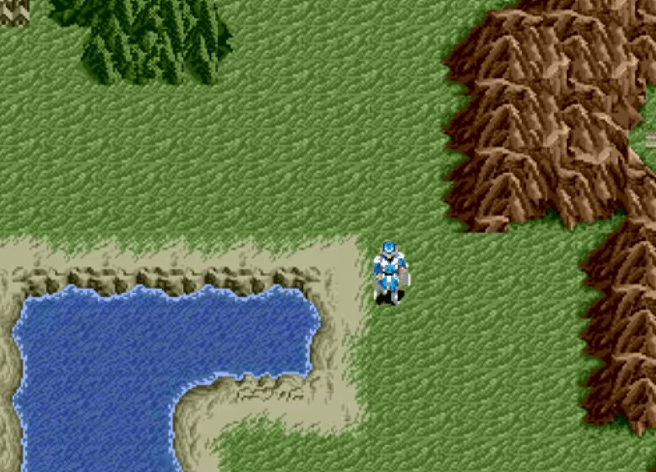
The overworld is more detailed and realistic than previous instalments (screenshot taken by the author)
The overworld gameplay hasn’t changed. It is still a near top down view and you must wander from town to town whilst buying new weapons and armour, gleaning information from local villagers, and fighting a multitude of different creatures.
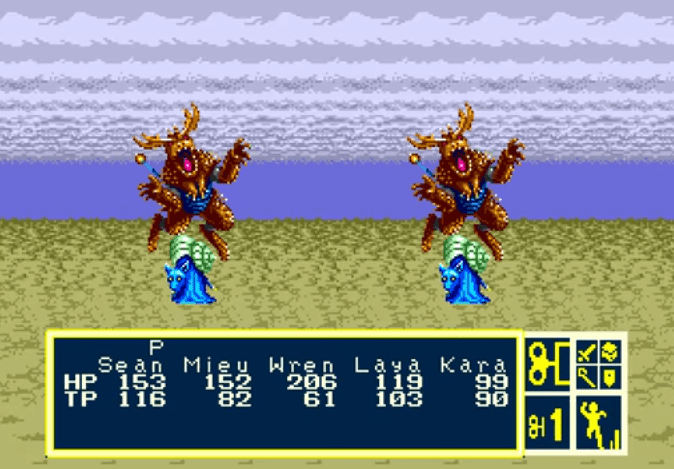
The blue grid system has been done away with in favour of scene-setting backgrounds (screenshot taken by the author)
How Does It Handle?
The battle menu is still more complicated than it needs to be. In PSIV (1993), they rectify this to create an intuitive, and simple battle menu.
Graphics
The overworld graphics are less vibrant, but more detailed, and realistic in my opinion. It certainly gives me less of a headache looking at it anyway.
When battling enemies, for some reason they have done away with seeing your fighters attack the enemies which is disappointing because it looked great in PSII (1989). The enemies are more detailed, and some, in the later levels, just look really peculiar and I have no idea what they are supposed to be. Thankfully, they have brought back the backgrounds, and done away with the blue grid. Controversially, I prefer the backgrounds from PSI (1987) as I think they are more interesting to look at.
Why is Guile from Street Fighter II appearing as if he belongs in an 80s new romantic band? (screenshot taken by the author)
Replay Value
What is unique about PSIII, compared to other games in the franchise, is that the story spans three generations. At the end of each generation, you have the option to choose who you wish to marry. This determines who you will take control of in the next generation storyline. As I understand it, the only difference it makes is that it will affect the offspring’s ability to use their techniques. There are potentially 10 different generational choices, which affect the game’s ending. Although this adds to the replay value, I don’t imagine many people would wish to play through such a gargantuan game a second or third time…but then again, I may be wrong.
Did I Complete The Game?
Yes, but with the help of a walkthrough at times.
What The Critics Said:
Mean Machines:“Another enormous role-playing game, but this one has far more depth and variety than its predecessor. It’s by far the best RPG on the Megadrive…Overall 89%”.[1]
Electronic Gaming Monthly: Martin – “One of the best RPGs ever! Phantasy Star 3 blows away the previous games, although it isn’t necessarily more challenging overall. The game throws in a lot of new features like different generations who each will encounter their own quests to overcome. Awesome RPG! Overall 8/10”.[2]
Dragon:“Though we didn’t like it as much as Phantasy Star II, Phantasy Star III is creative in many ways. First, you have the ability to marry a person and then become the offspring of that union to continue the quest. The various endings in the game are a definite plus as well. The graphics are excellent, except for combat (Phantasy Star II is better here)…Overall, this game will definitely keep you fixed to the television for weeks. Overall 4/5”.[3]
Games-X: “The game is graphically excellent but above all, the control system is easy to use. A highly enjoyable cartridge that will appeal to most RPG fans. Overall 4/5”.[4]
My Verdict:
“Another great game for the Phantasy Star universe. Improved graphics, a great story with a new generational storyline, and alternate storylines. They still need to decide what they are doing with the battle scene animations and battle menus.”
Rating:
What are your memories of Phantasy Star III? I would love to hear your thoughts, and don’t for get to follow and subscribe so that you don’t miss my latest reviews! You can also find me on Instagram: @nicklovestogame.
[1] ‘Review: Mega Drive – Phantasy Star III’. Mean Machines. (October 1992). Issue 1:140.
Every game from the Super Mario franchise has been hotly anticipated by fans of the series. After the success of Super Mario World, the bar was set extremely high for the sequel. The creators not only succeeded in producing a fantastic sequel (although it’s actually a prequel), but a game that proved so popular that its success spawned a series of spin-offs and sequels in itself. It really does seem like there is no stopping the Super Mario franchise!
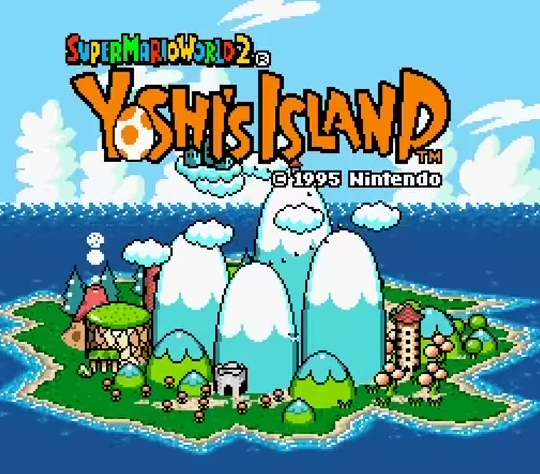
Title screen (screenshot taken by the author)
Super Mario World 2: Yoshi’s Island (SMW2) is a side-scrolling platform game developed and published by Nintendo. It was released for the SNES in 1995, the Game Boy Advance in 2002, the Nintendo 3DS in 2011, and the Wii U Virtual Console in 2014. For this review, I played the version found on the SNES Mini.
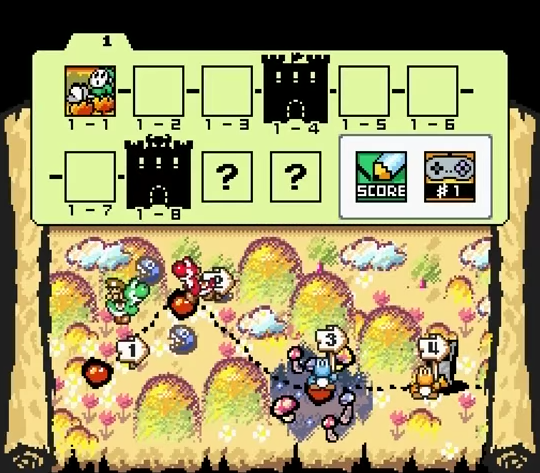
The overworld map is different from Super Mario World, but does allow you to track your progress in each level (screenshot taken by the author)
Plot
SMW2 is a prequel to Super Mario World (SMW), and what a prequel it is! Magikoopa and the Koopalings intercept a stork that is carrying Baby Mario and Luigi. During the attack, Baby Mario is dropped but safely caught by Yoshi. The many Yoshies must bring Baby Mario back to the stalk. Oddly, it doesn’t explain why Magikoopa and the Koopalings are trying to intercept the brothers, or what they will do with them once they have captured them. Does Bowser know that they will grow up to be a thorn in his side?
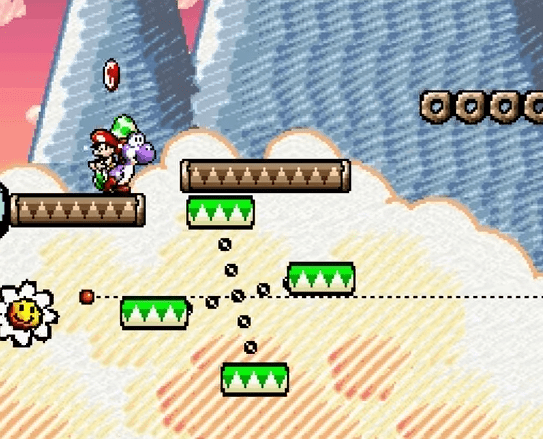
Yoshi must carry Baby Mario through some dangerous levels whilst collecting gold coins, red coins, stars and flowers (screenshot taken by the author)
Gameplay
Keeping with the Super Mario traditions, the game mostly consists of running and jumping through the levels whilst collecting coins and tokens, although this game involves more puzzle-solving and item collecting than other platforms. The levels and bosses increase in difficulty as the game progresses. There is no time limit which allows deeper exploration into each level and enables you to take your time.
Yoshi has the ability to eat most of his enemies, spit and throw objects at his enemies, and jump or stamp on them (as long as they don’t have spikes). He can also briefly levitate which greatly helps whilst jumping larger gaps.
Yoshi also collects eggs which he can use to fire at enemies and obstacles. These can be found by either hitting a white and green coloured block from below (red and yellow ones also occur), or by eating certain enemies and laying them as eggs. Green eggs can simply be used as a projectile to either kill enemies or aimed to collect coins and flowers. Red eggs produce stars for you to collect when thrown, and yellow eggs produce coins when they are thrown. Yoshi can also eat green and red watermelons and then spit the seeds and fire at his enemies.
There are several areas where Yoshi can touch an icon and be transformed into either a helicopter, car, drill or submarine where applicable. This enables Yoshi to reach bonus coins and flowers etc. that were previously inaccessible. A flashing star power-up is also available which makes Mario invincible for a limited amount of time.
Although Yoshi is basically invincible, he will die if he falls onto spikes and into lava etc. When he does get hit by an enemy, Baby Mario becomes encased in a bubble and begins to fly away. A countdown will begin and you need to retrieve him before the time runs out. Once caught, the timer will increase again to ensure that you have at least 10 seconds on the timer. Throughout the game you can also collect little stars that increase the amount of time you have to retrieve Baby Mario.
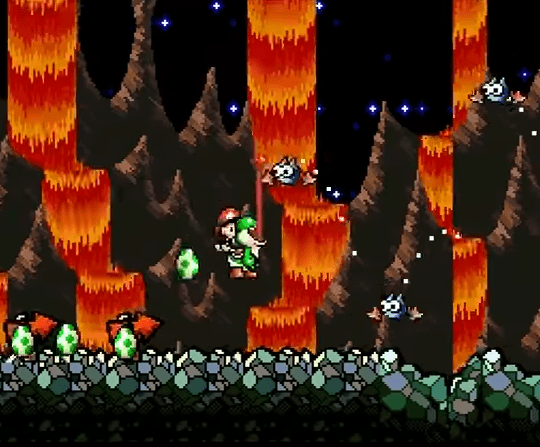
Like Super Mario World, Yoshi can eat most of the enemies (screenshot taken by the author)
How Does It Handle?
The game plays very well, as one would expect from a Mario platform game. One incredibly irritating aspect to the game is that sometimes the bubble Baby Mario is in, floats to areas of the screen that Yoshi cannot reach.
Graphics
The game’s illustration style is reminiscent of a colouring book coloured by crayons. The levels, backgrounds, sprites and animations look great, but I personally prefer the illustration and colour scheme of SMW. Alas, the music isn’t as memorable as SMW or Super Mario Kart (1992) for that matter.
Music & SFX
The music is good but not as memorable as it’s predecessor. Baby Mario’s crying makes you want to leave him and turn the game off.
Replay Value
As well as simply playing through the levels, there is an added challenge of collecting 100% of the flowers, stars and red coins from over 40 levels (plus several different bonus levels and games). This greatly extends the game’s life and adds replay value.
Personal Memories
Yoshi’s Island is a very good prequel and I enjoyed playing through it. There are plenty of new features and designs that clearly distinguish this from SMW, but it is easy to learn and familiar enough to not seem too different from other Mario games. However, I feel this game lacks the charm of SMW, and although it is challenging, I found the game too frustrating in places, making me not want to bother trying to achieve 100%.
Did I Complete The Game?
I have completed the main storyline, but am yet to achieve 100% throughout.
What The Critics Said:
Edge: “…Yoshi’s Island is a welcome addition to the series – as playable, challenging and entertaining as the best of the other Mario games. Overall 9/10”.[1]
Gamefan: “One word immediately springs to mind – perfect. Perfect gameplay, perfect graphics, perfect music. Overall 9.7/10”.[2]
Next Generation: “The most impressive features of Yoshi’s Island are its size and playability. Strewn with bonus levels of all kinds, much like the original, this game will keep your dinosaur friend hopping in several different directions. You’ll find yourself baffled at the task of completing this gargantuan game, but you’ll definitely enjoy trying. Overall 5/5”.[3]
Nintendo Life: “Yoshi’s Island isn’t just a great platformer: it’s a reminder of why this silly little hobby of ours is so wonderful. Sure, the game contains no political satire, no poetic justice, no character development. But if what Miyamoto and Tezuka crafted isn’t a work of art, then the definition of “art” needs to be amended. Overall 10/10”.[4]
Awards:
Action Platform Game of the Year – 1995 Game Fans Mega Awards
SNES Game of the Year – 1995 Game Fans Mega Awards
16-Bit Game of the Year – 1995 Game Fans Mega Awards[5]
My Verdict:
“A great and worthy prequel which I feel lacks a bit of the charm of Super Mario World. However, the graphics are gorgeous, and there is plenty to learn and find, differentiating it from its predecessors and most of its contemporaries. Don’t be fooled, this game is much tougher than Super Mario World and although there is plenty here to keep you coming back, rage quits will be frequent!”
Rating:
What are your memories of Yoshi’s Island? I would love to hear your thoughts, and don’t for get to follow and subscribe so that you don’t miss my latest reviews! You can also find me on Instagram: @nicklovestogame.
[1] ‘Testscreen: SNES – Super Mario World 2: Yoshi’s Island’. Edge. (November 1995). Issue 26:62-65.
In the early 90s, I was at the height of my Sci-fi geekdom. I watched and re-watched Star Trek and Star Wars movies with unhealthy regularity. The video games that the franchises were producing in the early 90s were also filling my daily quota of science fiction. Resisting the entreaties of my parents to go out into the summer sun, I preferred to stay in a darkened room and lose myself in these cherished universes. Some would say it was an unhealthy hobby for a teenager, and they could be right…if it wasn’t for the fact that I played competitive football at least twice and week, and worked part-time jobs that is. However, the memories I have playing these games with a childhood chum (who I shall refer to as MC), are not to be discarded lightly.
Title screen (screenshot taken by the author)
Star Wars: Dark Forces is a first-person shooter developed and published by Lucasart in 1995 for MS-DOS and Macintosh. A year later it was released for PlayStation. In 2009 it was re-released on Steam. The version I played for this review was for the PC.
A map can be used whilst still moving around the levels which is very helpful (screenshot taken by the author)
Plot
You play as Kyle Katarn, who is studying agricultural mechanics with the intention of working in the family business. Whilst at the academy, he is told that his parents were killed by the Rebels, causing him to enlist in the Imperial Army. Whilst working for the Imperial Army he meets Jan Ors, a double agent working for the Rebels. She informs Katarn that it was an Empire raid that killed his parents. With the truth known, he helps Ors escape. He then becomes a mercenary and begins to take on jobs for the Rebel Alliance.
The first mission is set during Rogue One (2016), and sees Katarn charged with stealing the Death Star plans (naturally this storyline is not considered official canon). It then skips to after A New Hope (1977). Once the Death Star is destroyed, the Rebels ask Kyle to investigate an assault on a Rebel base by a new type of Imperial soldier.
Gameplay
This first-person shooter sees Katarn navigate his way through several locations including a Star Destroyer, Jabba the Hutt’s Palace, and the planet Coruscant.
You can choose between a number of different weapons with which to fight the Imperial soldiers including blasters, thermal detonators, land mines, and some more explosive weapons. All weapons have a secondary mode which offers a different effect when fired. All weapons need ammunition so use the more powerful weapons sparingly.
The map unfolds as you progress for the level, adding to the feeling of isolation and the unknown. You can toggle this map to be overlaid whilst you are walking around the level too which is a useful tool to have.
“There he is, blast him!” (screenshot taken by the author)
How Does It Handle?
The levels are well designed and challenging, and really give the illusion that you are in the Star Wars universe. Throughout the levels, there are lots of secret doors which contain power-ups and goodies to help you on your way.
There are times in the game when you need to use night-vision goggles and breathing apparatus which are nice touches. Just remember that you’ll need to pick up batteries for the night vision goggles as they only have limited power.
The controls let this game down a little. Whilst you are able to run, jump, duck, swim and look around, the mouse only allows you to look horizontally turning left and right. You need to use the keyboard to look up and down. This makes it unnecessarily difficult when shooting at enemies on high ledges. The jumping is frustrating too as the player doesn’t stop instantly when landing which, although realistic, means plummeting to your death alot as it’s difficult to gauge when you are near to falling off the edges.
Graphics & SFX
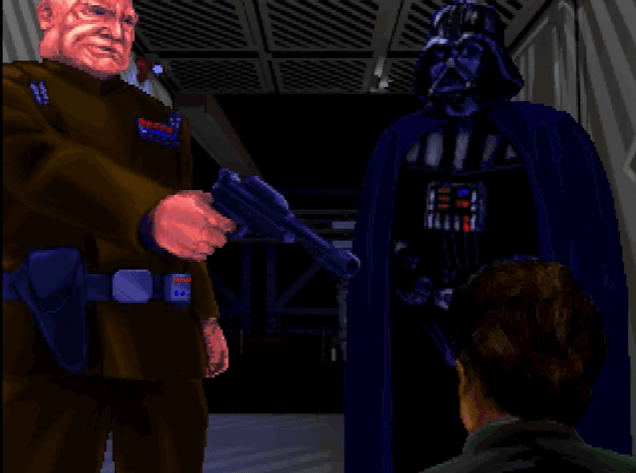
The in-game graphics are generally good. Although the levels are 3D, the baddies are 2D. However, they are well illustrated and use familiar exclamations such as “You’re not authorised in this area!”, and “There he is, blast him!”. Sadly, they do become a little pixelated as you get closer to them. The cutscenes are beautifully illustrated but sadly, it’s not the real voice Darth Vader.
Music
The in-game music is atmospheric, but very basic. Don’t expect John William’s well-constructed musical themes blasting through your speakers in high fidelity.
Even animated, Darth Vader is an imposing figure (screenshot taken by the author)
Replay Value
The three difficulty settings, and the fact this is a Star Wars game, give this game some replay value, but I don’t think this is a game that will have you returning time and time again.
Did I Complete The Game?
Yes!
What The Critics Said:
Gamespot: “Of course, it doesn’t hurt that the game is set in the Star Wars universe. It’s much more fun to blast Imperial lackeys than faceless monsters. The familiar setting is enhanced by your enemies’ taunts, like “Stop, Rebel Scum!” Dark Forces’ only real flaws are its tragically short length – less than a dozen levels – and its lack of multiplayer options or add-ons, which severely limits the replay value. Overall 7.6/10”.[1]
Next Generation:“Ultimately, Dark Forces offers nothing that Doom didn’t provide a year ago apart from some pretty Star Wars cut-scenes. And Technically, it’s on par with the most accomplished 3D games, but it seems that LucasArts’ reputation as a software pioneer has made it wary of producing an instantly playable title. Dark Forces will be judged by Doom Standards, and in most areas, it falls just short. Overall 3.5/5”.[2]
PC Zone:“The best Doom-inspired game to date, based on Star Wars. Overall 95%.”[3]
My Verdict:
“Overall the game has a good storyline and is fun, even for non-Star Wars fans. Some of the controls need a little fine tuning but the number of weapons you can use, the level designs and familiar phrases such as “There he is, blast him!” make this game worth playing. However, the game does have limited replay value.”
Rating:
What are your memories of Dark Forces? I would love to hear your thoughts, and don’t for get to follow and subscribe so that you don’t miss my latest reviews! You can also find me on Instagram: @nicklovestogame.
With the success of Broken Sword: The Shadow of the Templars, it was inevitable that a sequel would follow…but how do you follow up such a compelling story of conspiracy and murder?
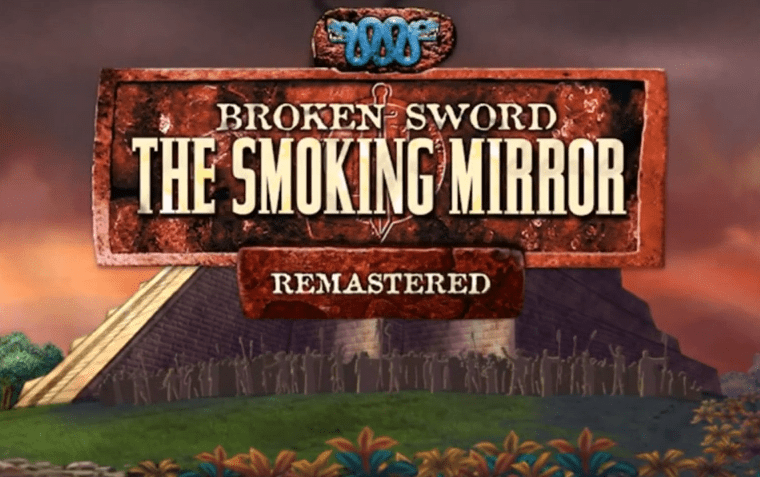
Title screen (screenshot taken by the author)
Broken Sword 2: The Smoking Mirror is a point-and-click adventure game developed by Revolution Software and published by Virgin Interactive. It was released in 1997 on Microsoft Windows and the PlayStation. A remastered edition was released in 2010 on Microsoft Windows, OSX and iOS. For this review, I looked at the original version on the Playstation and PC, and the remastered version on the PC.
Plot
It has been six months since George Stobbart and Nico Collard stopped the Templar plot. Stobbart has returned to France from the US, where he was visiting his ill father, and plans to resume his relationship with Nico. Together they visit the house of archaeologist Professor Oubier in order to learn about a Mayan artefact that Collard has been researching. After arriving at Oubier’s house, they are ambushed, and Nico is kidnapped. Stobbart must rescue her whilst learning about, and preventing, a conspiracy to release the Mayan God Tezcatlipoca during an imminent eclipse.
Gameplay
The gameplay is unchanged from its predecessor, that is, you can control George and Nico (at separate times during the game) and direct them to walk or interact with objects by using a cursor. The cursor icon will change depending on what action you can do. For example, if you place the cursor over an item you are able to pick up, the icon will turn into an animated hand that motions as if to pick up an object. It’s all very clear and straight forward. You are also able access your items from your inventory by moving your cursor to the top of the screen, where your collected items will appear. Similarly, when talking to another character, icons will appear at the bottom of the screen, indicating that more information can be gleaned from that person.
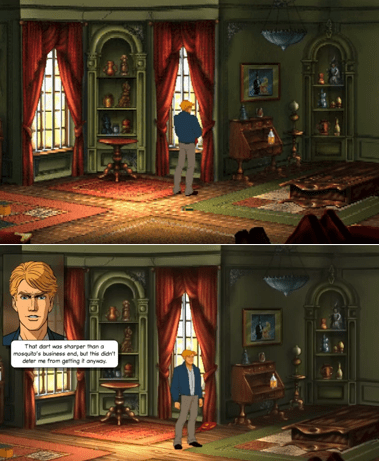
A comparison between the original (top) and the remastered (bottom) versions (screenshot taken by the author)
How Does It Handle?
The game easy to learn and play. I think if I had one criticism though, it’d be that I think the action is a little slow when you get George or Nico to interact with an object.
Graphics
“If it ain’t broke, don’t fix it!”, or so the old saying goes. The graphics have remained in the classic animated film style, which I am a fan of.
Music
The music, whilst subtle, is atmospheric and fitting, and usually indicates either danger or that an important puzzle has been solved.
The Remastered Version
After replaying the game years after its release, Charles Cecil, who originally designed the game, wished to fix several issues he noted about the original version. He felt that the backgrounds were too pixelated, the movies were of poor quality, the audio needed sharpening up and that some of the dialogue seemed a bit out of place. With these issues addressed, Cecil explains that they decided to add a diary and a hint system. He also enlisted the help of illustrator Dave Gibbons to create new artwork for an interactive-comic bonus.[1]
There is a small difference with the original in how you gain access to your items. In the corners of the screen are slightly translucent icons. The bottom left is a satchel where your can find your collected items; the bottom right is the diary, reminding you of your journey; top left is the option menu, and top right is a question mark for when you need help. When talking to another character, a box will appear onscreen with icons that you can click on to gather information from that person.
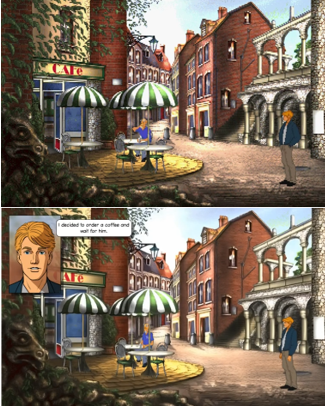
A comparison between the original (top) and the remastered (bottom) versions (screenshot taken by the author)
Remastered Graphics
In the remastered version, the graphics do look a lot smoother, and the colours have been toned down a bit to add more realism to the scenes. The little portrait character boxes that appear during conversations is a nice new touch too.
Personal Memories
I enjoyed playing this game, but I think I still prefer the first instalment. It was great to see some familiar faces from the first game, and there were some interesting new characters added too. For me, there are two things that let this game down. Firstly, I felt that they didn’t provide enough information on the Maya and Tezcatlipoca. Other players may not feel they needed more information but I’m an archaeologist and a historian by trade, and so my curiosity naturally seeks more information on such subjects. My second gripe was slightly rectified in the remastered version in that I wish they had added something new to the game too.
Did I Complete The Game?:
Yes, but I found this game tougher than the first and so probably used hints more often.
What The Critics Said Of The Original Version:
Gamespot: (Playstation) “The horrendous loading times that plagued the original have been trimmed a great deal, and the animation runs a lot smoother. Still, the game is not for everyone. Earfuls of semi-relevant conversation and the digital pad’s inability to properly replicate a mouse make Broken Sword II tedious at times. But while Broken Sword II certainly isn’t revolutionary, it’s still refreshing to see a game of this nature done well. A compelling story, plot twists, offbeat humour, great graphics, and solid sound makes Broken Sword II a game with great aspirations. It’s simply too bad the game’s format and the Playstation’s limited capabilities keep Broken Sword II from fully realizing them. Overall 6.9/10”.[2]
Gamespsot: (PC) “George is slightly more sophisticated (a consequence of all that traveling he did in Circle of Blood no doubt), Nico has been fleshed out a bit and takes on a few adventures of her own, and the quirky humour of Circle of Blood raises its oddball head once more (i.e., the minor character who gets up from his desk only to reveal that he works in bikini underwear – not pants – because it makes him feel friskier). It’s Circle of Blood with new characters, a new storyline, a new threat to world harmony, and a few omissions and additions that help to streamline the adventure. Overall 7.9/10”.[3]
Next Generation: (PC) “What’s new helps the game immensely, and the already intuitive interface is still there. Smoking Mirror may not be an outstanding leap in graphics adventures, but much like the sequel to a good book, it’s a fun romp with familiar characters and well-worth the price of purchase. Overall 3/5“.[4]
Computer Gaming World: (PC) “All in all, Broken Sword: The Smoking Mirror is above average, but it’s not great. While the engine and the graphics have been refined, there are some minor slips in plot, dialogue, puzzles that bring the whole experience down a bit. Overall 3.5/5”.[5]
What The Critics Said Of The Remastered Version:
Gamezone: (PC) “Among the most impressive things about the Broken Sword series are its animated cut scenes, which look fantastic on the iPad. The animation itself is a bit dated, but it also brings a sense of nostalgia, reminiscent of cartoons and animated movies of the same time period. The voice acting is solid, and the game sounds great on the iPad. The remastered version of The Smoking Mirror is compatible with both the iPad and iPhone, and though the game can look a bit stretched and blurry at times on the iPad, the bigger screen is preferable for gameplay purposes. Overall 8/10”.[6]
My Verdict:
“A great sequel and enthralling storyline. Great graphics, and tougher puzzles than the first instalment. Pity about the lack of innovation in gameplay, and information regarding the Mayan culture”
Rating:
What are your memories of Broken Sword II? I would love to hear your thoughts, and don’t for get to follow and subscribe so that you don’t miss my latest reviews! You can also find me on Instagram: @nicklovestogame.
Before the 1990s, RPGs were a niche genre in the video game world. They take a lot of time and effort to play, and not everyone has the patience or desire to attempt such gargantuan games. However, those that do play RPGs cherish every moment of their journeys through fantastical universes. They take great care in building up their warriors and magic users in order to defeat hordes of enemies. Phantasy Star was one such RPG which was highly praised by critics, even though it did push the Sega Master System to its limits.[1] The successor to the Master System, the Mega Drive, offered the creators of Phantasy Star II more to work with.
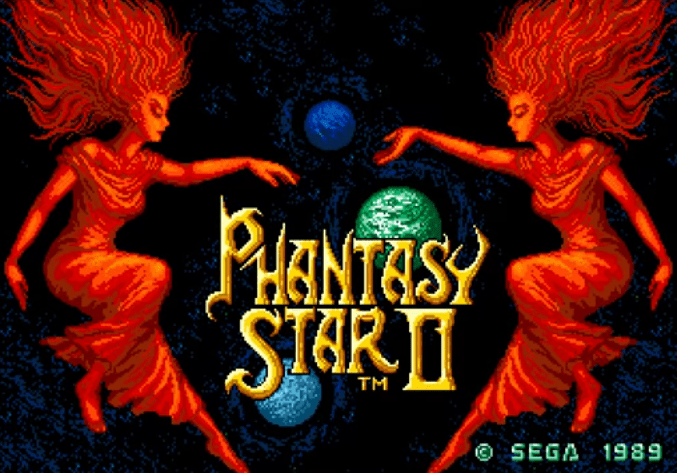
Title screen (screenshot taken by the author)
Phantasy Star II is a single-player RPG developed and published by Sega. It was released for the Mega Drive in 1989, but it wouldn’t reach North America and Europe until 1990. It was later re-released on the Sega Saturn and Game Boy Advance as part of the Phantasy Star Collection, and the Dreamcast as part of the Smash Pack Volume 1. In 2005, an updated remake was released in Japan for the PlayStation 2 and PlayStation Portable. For this review, I played was the Mega Drive version on Sonic’s Ultimate Genesis Collection (2009) on the PlayStation 3 (also available on the Xbox).
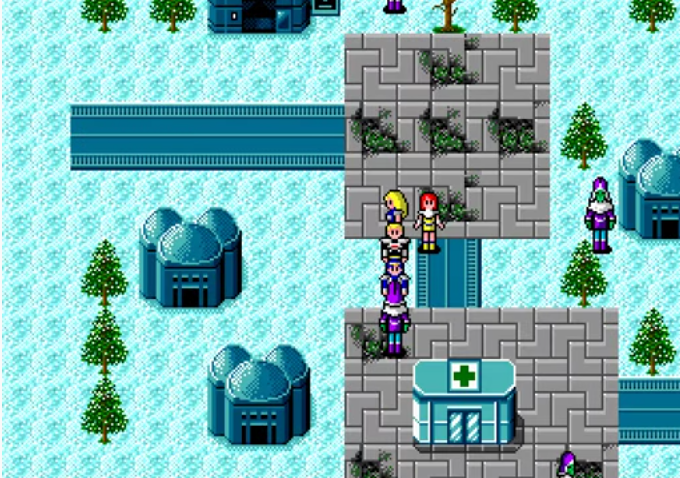
Walking around the overworld (screenshot taken by the author)
Plot
The game is set 1000 years after the events of Phantasy Star and takes us back to the Andromeda galaxy and the Algo star system. Orbiting the Algo sun are three planets: Palma – where the government reside; Mota – once an arid desert planet that has since been transformed into a tropical paradise; and Dezo – an inhospitable ice planet.
The Algo star system has prospered under the control of Mother Brain, a computer that regulates the climate, and is responsible for terraforming Mota. However, Mother Brain has started malfunctioning, producing increasingly strong monsters. One night, Rolf (our main protagonist) awakes from a nightmare, where a young girl whom he doesn’t recognise is battling a demon. It is suggested that this girl is Alis from Phantasy Star. After being informed of Mother Brain’s malfunction, Rolf, along with Nei, a humanoid with cat-like features, sets off to investigate why Mother Brain has seemingly turned against its creators.
Gameplay
Phantasy Star II is first video game to use a mega 6-bit cartridge. This enabled the designers to create the largest world yet seen in a video game.[2] They have dispensed with the dungeon crawling parts of the game (much to the chagrin of many who love dungeon crawlers), and have focussed on the overworld views when trawling through the dungeons.
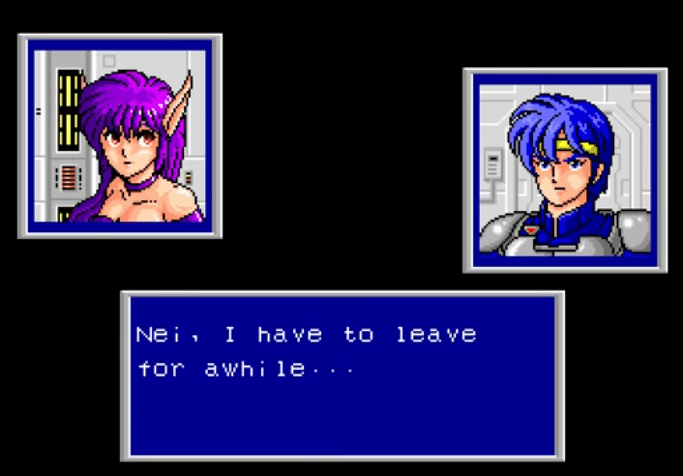
The screens for dialogue have been greatly improved (screenshot taken by the author)
How Does It Handle?
They have still yet to fix the fighting menu. Annoyingly, you still need to scroll through the menus to target individual monsters which is tiresome.
There are two further irritating aspects to this game which I would have hoped they’d have resolved by now. The first is that many of the names of the plethora of spells you are able to use do not indicate what type of spell it is. The manual doesn’t have any information on this either, so you need to experiment during battles to find out what the oddly named spells do.
“That’s part of the fun!”, I hear some of you cry. Not really. One would assume that a magic user would know what the spell was they were using. Hopefully this will be resolved in Phantasy Star III.
The second irritating aspect is that you do not have a combined inventory, so you need to constantly scroll through the menus in order to exchange items between your fighters. Its exasperating!
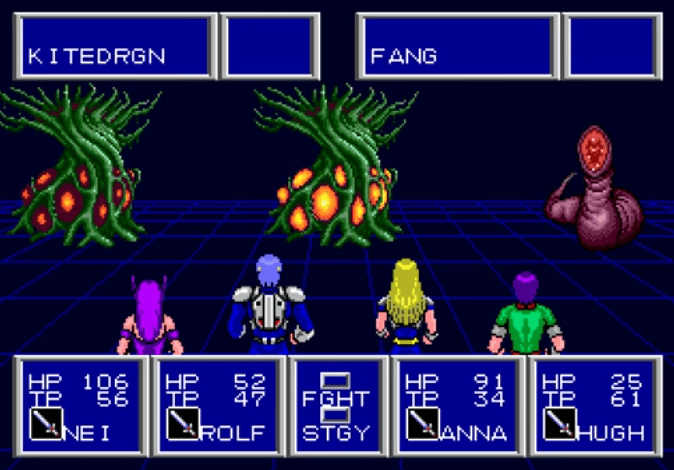
Where did the beautiful backgrounds go? (screenshot taken by the author)
Graphics
As expected, the overall graphics have been improved, creating three very distinct worlds. The sprites in the overworld maps are more individualised and are brightly coloured. The dialogue screens have also been greatly updated to anime-style character screens.
The battles screens are greatly improved. Firstly, you can now see your characters attacking animations, and the enemies are more varied and detailed. Sadly, they decided to take away the scenic backgrounds and replace them with a blue grid. I’m not sure what the thinking was behind that decision.
Overworld view on Dezo world (screenshot taken by the author)
Music & SFX
I don’t really recall much about either. They clearly aren’t very memorable.
Did I Complete The Game?
Yes, it felt like a slog at times, and needed a walkthrough on occasion.
Dragon: “The animation, especially for battles, is superb. There are over 50 spells available. Even weapons and armor can give benefits to characters beyond their normal effects. For example, special armor found in one dungeon allows the wearer to cast a healing spell every so often. The battle system enables more than one type of creature to attack and allows the characters to attack specific creatures instead of idiotically going after one creature at a time. This game is definitely a winner. Overall 5/5”.[3]
Electronic Gaming Monthly: Martin – “RPG’s aren’t my thing., but this one has a monstrous quest anyone can get involved with and lost in…I wish the battle scenes were on landscapes instead of boring blue grid, but all in all PS2 is presented well. Overall 8/10”.[4]
Raze: “Large combat sprites, wonderful scenes and backdrops. Great in-game effects and unobtrusive background music. A challenging quest packed with gameplay. Overall 90%”.[5]
Video Games and Computer Entertainment: “It’s very user friendly, with a simple but extensive menu system, and a battery back-up that allows you to save numerous games in progress. The plot advances quickly, providing a constant stream of new subplots…Phantasy Star II is a complex and eminently enjoyable game that will give you more variety and challenge for your buck than any other video game. Overall 9/10”.[6]
Zero: “Phantasy Star II is definitely not just any old thing. In fact, it’s just about everything you could want from this kind of game – big (very big), involved, exciting and challenging. Overall 89%”.[7]
Sega Power:“Long-awaited sequel to the MS RPG. With a massive quest set over different worlds and four characters to control, you should be thankful for your battery back-up! Overall 5/5”.[8]
My Verdict:
“Graphically, a great improvement on the first, with an engaging story and plenty of action to keep you quiet for many hours. They just need to sort out that poxy battle menu! RPG fans will love this game!”
Rating:
What are your memories of Phantasy Star II? I would love to hear your thoughts, and don’t for get to follow and subscribe so that you don’t miss my latest reviews! You can also find me on Instagram: @nicklovestogame.
In 1986, The Legend of Zelda was released for the NES and sold over 6 million copies.[1] Its success spawned a whole series of video games that continue today, with every instalment being much anticipated by fans all over the world. A Link to the Past was one of the SNES’s earliest games in Europe, but sadly I wouldn’t get to play it through properly until 2019.
Title screen (screenshot taken by the author)
The Legend of Zelda: Link to the Past is the third game in the Zelda series. It is an action-adventure game developed and published by Nintendo. It released for the SNES in Japan in 1991, and Europe and North America in 1992. It was ported to the Game Boy Advance as A link to the Past and Four Swords, as well as the Wii, Wii U. It was accessible for the Nintendo 3DS through the Virtual console and the Nintendo Switch through Nintendo Switch Online. The chose to review the version which came with the SNES Mini.
Plot
You play as young adventurer Link who must defeat the evil Ganon from gaining the power of the Triforce which would allow him to turn the world dark and evil. Link must save the Kingdom of Hyrule and stop Ganon by rescuing several maidens who are the descendants of the Seven Sages. To do this he must scour the dungeons and defeat a plethora of enemies and end of dungeon bosses.
Gameplay
Link is armed with a sword, shield, and bow and arrow with which to fight his enemies. By killing the many minions throughout the worlds, you can gain rupees, arrows and health. Your sword has two actions: You can swing it to attack or if you hold the attack button, your sword will charge and will produce a 360 degree swing, which is handy if you are surrounded by enemies. Once you gain the Pegasus Boots you can charge your enemies and stab them with your sword. Along the way, you can acquire upgrades for your armour, sword and shield as well as many magical items to aid you in your quest.
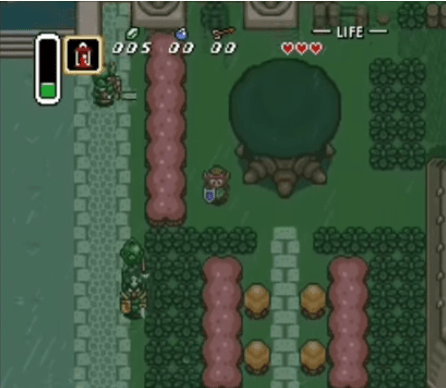
Link can slash or pick up bushes and stones to find health and rupees (screenshot taken by the author)
How Does It Handle?
The open world design enables you to explore every inch of the Light and Dark worlds. However, you need to warp from the Light and Dark worlds in different parts of the map in order to access areas that are inaccessible in the other world (it’ll make sense when you play it). The enemies re-spawn which can be annoying at times, but it also gives you the opportunities to gain more health, rupees and magic.
It would be very easy to get lost in this game. Thankfully you have a map to refer to. The map screen has a Mode 7 design which is a layer that can be easily rotated and scaled, and lends itself very well to racing games such as Super Mario Kart (1992).
The increasing difficulty of the dungeons and end bosses adds a challenging aspect to the game. You will find yourself spending many hours on this game as there is so much to explore. Don’t feel bad if you use a walkthrough, as some items are hard to find.
Link must warp from the Light to the Dark worlds and back again to gain access to certain areas
Graphics
This game looks fab. The graphics are bright in the Light World but not garish. The darker tones of the Dark World differentiate the two worlds very well. The overhead perspective offers a more 3D feel to the game and allows more detail and colour to the backgrounds and sprites.
Musicand SFX
The main music for the Light World, known as the Hyrule Overture, is dramatic and fitting for the game. It is the music of a hero! I also like the little riff you hear when you find a secret.
The SFX sound great too. Like the sound of coins clinking together when you collect rupees. The SFX work really well.
The dungeons increase in difficulty, so make sure you are well prepared before attempting them (screenshot taken by the author)
Personal Memories
My little brother had a SNES growing up, but he didn’t buy Link to the Past. The first time I saw it was at my friend Graeme’s house. I never really got to play it, but I watched the very early bits of it and was amazed by how great it looked. When I bought the SNES Mini, I was excited that I would finally get to play it. Was it as good as I’d hoped? Hell yes! My only gripe was that by the end of the game I was a bit bored as I felt it had become monotonous, and I should have been wanting more. Other than that, this is a great game and I would recommend it to all.
Did I Complete The Game?
Yes, but I did have some assistance from a walkthrough to find certain items.
What The Critics Said:
Nintendo Power: George: “This game is amazing. Its got incredible graphics, great sound effects, and it’s a well thought out adventure. Overall 4.675/5”.[2]
Electronic Gaming Monthly: “Wow! This is the closest a game has ever come to being perfect. Everything except the graphics gets the best score possible. Unfortunately, Nintendo let us down when it comes to the graphics as there is nothing spectacular here. Overall 8.75/10”.[3]
Computer and Video Games:“The graphics are very simple, but the animation is fluid and the game is packed full of colour. Sound-wise, Zelda III is spot on. It has some great orchestral scores and lovely sound effects throughout. If you liked the first two games, or you fancy a spot of RPG related malarkey, the get this straight away. It’s a corker! Overall 89%”.[4]
Superplay: “The long awaited 16-bit Zelda is a brilliantly designed and implemented adventure that puts similar games to shame, in much the same way as Mario dominates the platform world – Nintendo’s top programmer was involved in both games. Overall 9/10”.[5]
Awards:
Best Video Game Sequel (All Systems) – Electronic Gaming Monthly’s Best and Worst of 1992[6]
My Verdict:
“It was worth the 27 year wait!!! Beatutiful to look at, excellent gameplay, and an engaging story. Frustratingly lengthy at times, but a classic of the genre, and every gamer must at least attempt to play this game.”
Rating:
What are your memories of Zelda: A Link to the Past? I would love to hear your thoughts, and don’t for get to follow and subscribe so that you don’t miss my latest reviews! You can also find me on Instagram: @nicklovestogame.
[4] O’Connor, F., ‘Review: Famicom – The Legend of Zelda III’ Computer and Video Games Magazine. (February 1992). Issue 123: 68.
[5] ‘What Cart? RPG/Adventure Games: SNES – Zelda III: A Link to the Past’. Superplay. (November 1992). Issue 1:90.
[6] ‘EGM’s Best and Worst of 1992: Best Video Game Sequel (All Game Systems) – Legend of Zelda III‘. Electronic Gaming Monthly’s 1993 Video Game Buyer’s Guide. (1993). :17.








#/media/File:Contra_cover.jpg)




_box_art.jpg)










 Nick Loves to Game