If memory serves, my first time playing Double Dragon was on the Sinclair Spectrum ZX. I remember loving it and I’m sure this was another game that I played with my dad and older brother. It has gone down in history as a classic game and I was certainly looking forward to revisiting it again.
Title screen (screenshot taken by the author)
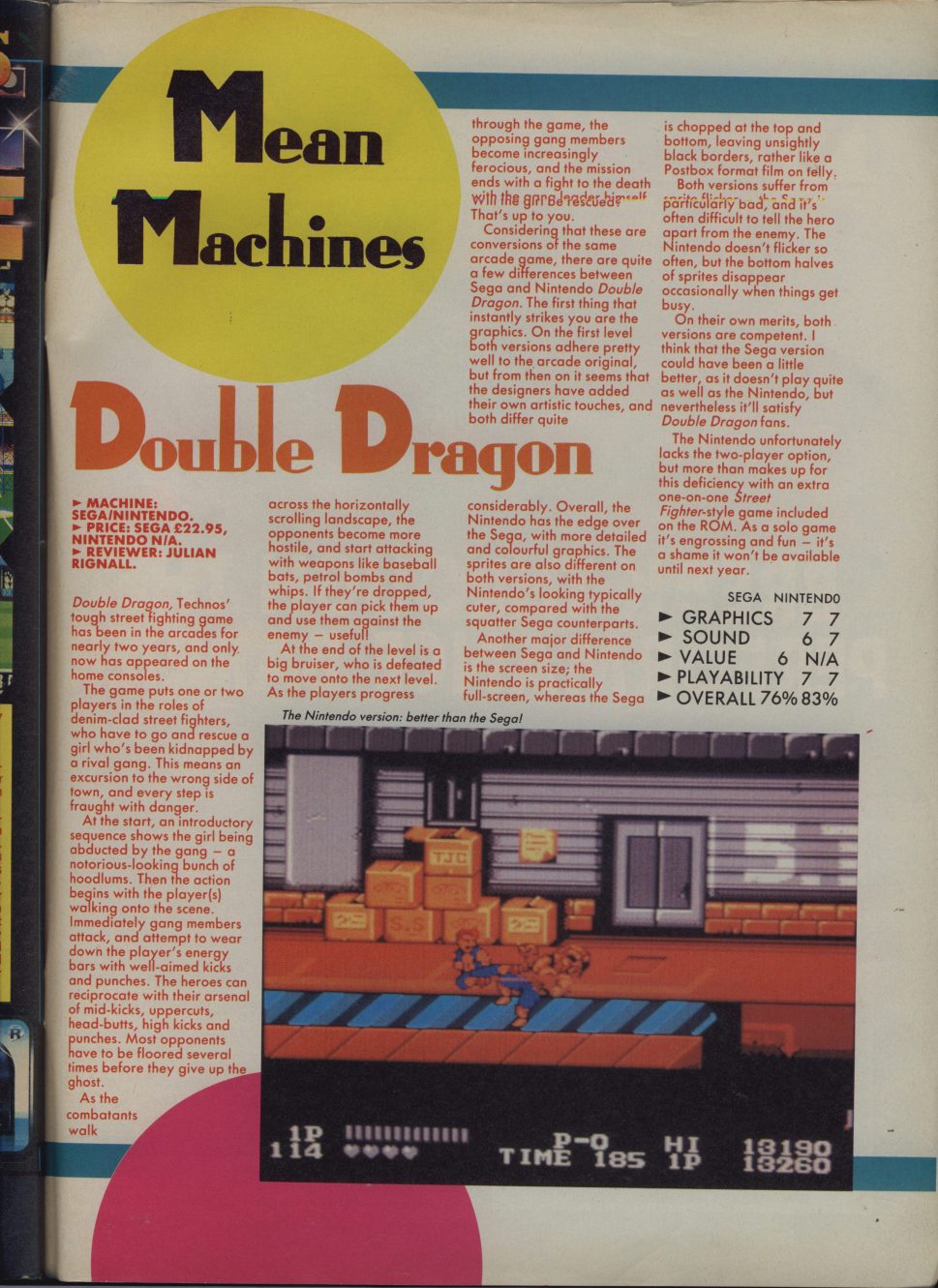
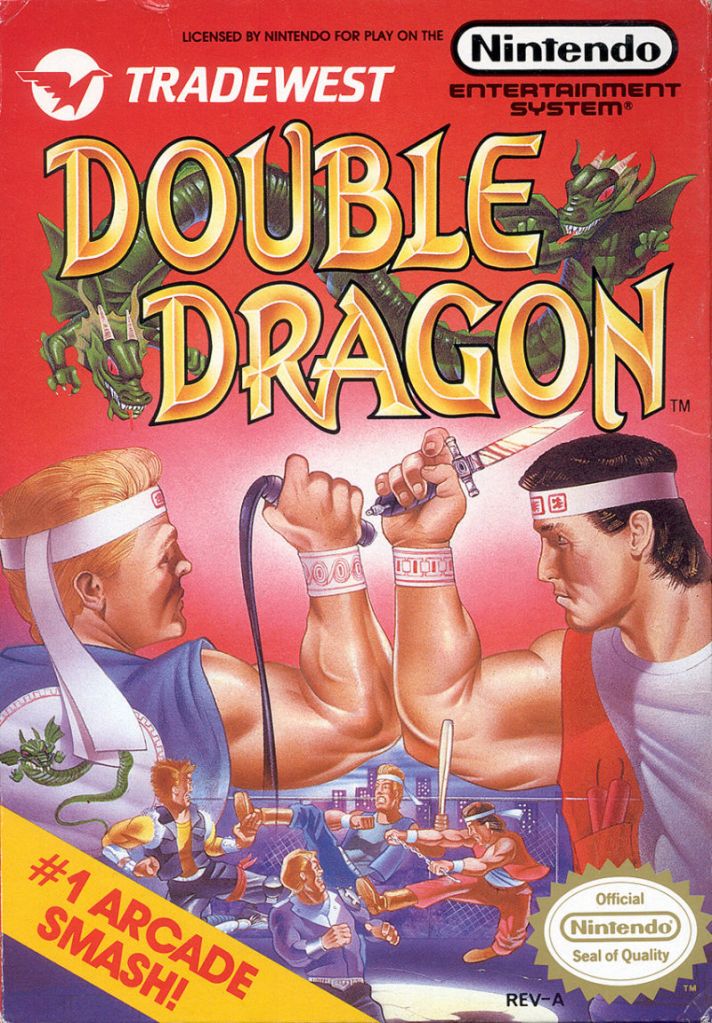
Double Dragon is a beat-em up developed by Technōs Japan and released in the Arcade in 1987. It was published in Europe and North America by Trade West, coming to home consoles in 1988. Versions have been released on the NES, Master System, Atari 2600, Atari 7800, Atari ST, Amiga, Amstrad CPC, Commodore 64, Game Boy, Mega Drive, Game Gear, ZX Spectrum and Atari Lynx to name a few. It appeared on the Wii Virtual Console in 2008, Nintendo 3DS in 2013 and Wii U in 2013. For this review, I played was the NES version.P
Plot
You play as twin brothers Billy and Jimmy Lee (Hammer and Spike in the American versions), who must fight their way through the territory of the Black Warriors gang to rescue Billy’s girlfriend Marian.
Gameplay
At your disposal are an array of punches, kicks, headbutts, throws and elbow strikes. Along the way, you can temporarily use weapons such as baseball bats, knives, whips and dynamite sticks.
There are only four levels, but the game is challenging enough.
Unlike the arcade, the home console version’s two-player co-operative mode was replaced by alternating play, meaning each player plays the game on their own, which was a poor decision by the game designers. Initially, you are limited to just a few fighting moves but as you gain experience points, more fighting moves become available to you which I thought was a nice touch.
(screenshot taken by the author)
How Does It Handle?
The controls are easy to learn but aren’t as responsive as they could be. You can’t turn around quickly whilst punching but you can whilst kicking. I’d recommend kicking rather than punching anyway. One annoying part of level three is where you need to jump across a stream but as soon as you land you are hit by an enemy and fall into the water, losing a life.
Graphics
The graphics are good, especially the background of level one, and are superior to many contemporary games such as Renegade. The characters are distinctive, but the protagonist looks like he’s barefoot.
Due to the lack of power, the NES could only generate two enemies on the screen at any one time.
Replay Value
The NES version also contains a MODE B for both one and two-players where you can select any character from the game to fight in one-on-one battles which adds some replay value.
Oddly, this character looks like The Thing from Marvel’s Fantastic Four (screenshot taken by the author)
Did I Complete The Game?
No, I’ve yet to complete the NES version. I can only make it to level three (I swear I completed this game as a kid!).
What The Critics Said:
Entertainment Weekly Magazine: “…Double Dragon now has quality as well as content. There are more screens than the arcade, as well as vertical scrolling and the one on one match that is very reminiscent of Karate Champ (thrown in for free!)…This game is worth every penny! DIRECT HIT!”.[1]
Computer and Video Games: “Nintendo unfortunately locks the two-player mode option, but more than makes up for this deficiency with an extra one-on-one Street Fighter-style game included on the ROM. Overall 83%”.[2]
Best Graphics – Electronic Gaming Monthly “1989 Player’s Choice Awards”[4]
My Verdict:
“Double Dragon is a classic title and I don’t know anyone who hasn’t played it. In fact, I’d wager that I have never met a gamer who hasn’t at least heard of it. The game looks good, and there is a nice amount of hand-to-hand attacks and weapons to use. When this game was released, I can imagine it being a great game! However, it loses marks for the lack of a two-player co-op mode and its short length. It is not a game that encourages regular revisits. Sadly, the game is not as good as I remember but then it is always difficult to revisit games.”
Rating:
What are your memories of Double Dragon? I would love to hear your thoughts, and don’t for get to follow and subscribe so that you don’t miss my latest reviews! You can also find me on Instagram: @Nicklovestogame.
By the early 90s, multiplayer beat ‘em ups/hack and slash games such as Golden Axe, Streets of Rage, Teenage Mutant Ninja Turtles and Final Fight were growing increasingly popular. The increasing array of characters and fighting moves kept gamers playing these games time and again, using all characters in a bid to master them. The multiplayer modes meant that you could play with friends and spend countless rainy afternoons and cold winter evenings in imaginary worlds saving the planet, defeating crime bosses or rescuing royalty.
Title screen (screenshot taken by author)
Alien Storm is a beat ‘em up/shooter hybrid developed and published by Sega for the arcade in 1990, and ported to the Mega Drive and Master System in 1991. It was later released in the Wii Virtual Console in 2007, and as part of the Sega Mega Drive Ultimate Collection for the Xbox 360 and PlayStation 3. For this review, I chose to play the original Sega Mega Drive version.
Plot
Earth is being invaded by an army of incredibly ugly and aggressive aliens. A team of crack special force operatives known as the “Alien Busters”, comprising of the flame-thrower wielding Karen; the hunky Garth (Gordon in some versions) with his electric rifle, and Scooter (Slammer in PAL version) the robot, are sent to repel the invasion. Eight missions sees them battle through cities and towns, laboratories, electronic goods stores and eventually a UFO.
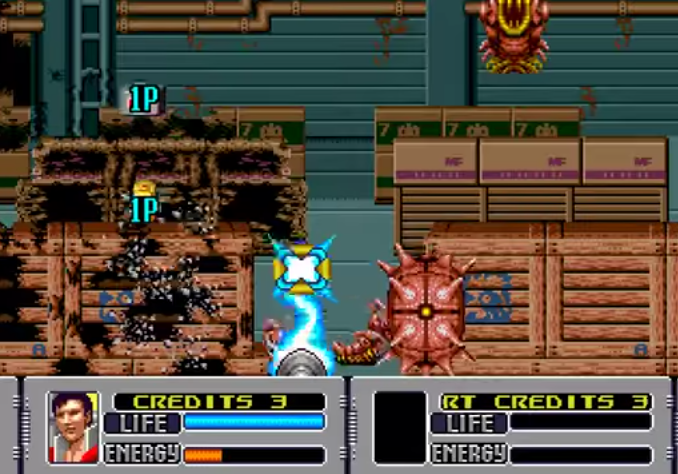
Oddly, the main character looks like Elvis Presley in his profile picture (screenshot taken by author)
Gameplay
The game is mostly a linear beat ‘em up which sees the players fight from left to right. There are sections of the levels where the game changes to a shooter style game which adds a nice bit of variety to the action. Each character can attack, run, and perform a running attack. There are two bars: life and energy to keep an eye on too. When using your weapon, the energy bar begins to deplete. If you use your special attack, the energy bar depletes more quickly. Along the way, you can pick up medicine and batteries to replenish your life and energy levels. There are a few end of level bosses in the game which take a long time to deafeat if you don’t have special attacks, so I recommend not using them until the boss fights.
Alien Storm incorporated elements of the rail-shooter genre (screenshot taken by author)
How Does It Handle?
The controls are very easy to learn, and the game quickly turns into a button masher with little strategy required.
Graphics
The graphics are great! The levels contain detailed backgrounds and the sprites are bright, colourful and well designed with clear outlines. As the game progresses the increased difficulty of the aliens is noted by a colour palette change.
Interestingly, if you look at the profile picture of Gordon in the bottom left corner of the screen, to me, he looks unmistakably like Elvis Presley.
Music
I think the music to this game is very good and fits well. I particularly like the short piece player before the beginning of each level. It’s quite sci-if/horror-sequel.
Watch out for the alien marsupials!!! (screenshot taken by author)
Replay Value
Before beginning the game, you can choose between three difficulty settings: easy, normal or hard. To add an extra element of difficulty, you can also set your energy bar levels to either easy, normal or hard. When you complete the game, after the end of game scenes and credits, you get a score and a rating. As far as I know, your score makes no difference to the game ending. This adds to the replay value of the game as it encourages additional run throughs.
Each character has an individual move set and special attack but there doesn’t seem to be a difference in strength, agility etc. This encourages you to replay the game trying out the different characters.
As with these types of games, two-player co-op modes only add to the fun. To further increase the replay value of the game, the Mega Drive version also contained a Duel mode and a Player vs Player mode. In the Duel mode, you select a player and must compete in fights with differing numbers and strengths of aliens. The more rounds you win, the higher your overall score at the end. I received a score of 82 and the title “Champion”. During these battles there is no way to regain your energy so use your weapons sparingly. In the Player vs Player mode, you and your opponent select one of the three main protagonists each to fight in a one on one battle. The first player to win two rounds, wins the fight. Sadly, this is a bit naff due to the fact that you only have a limited move set. There is not enough variation in attack combinations to make these battles interesting.
Did I Complete The Game?
Yes, I have completed this game many times over the years in both one and two-player modes, but only in easy mode.
What The Critics Said:
Mean Machines: “An absolutely outstanding conversion from the coin-op, with great graphics and highly enjoyable one or two-player action. The big problem is that it’s just too easy. For some unknown reason, the import version was harder, but even then, it’s not that difficult to finish. Those new to the Mega Drive scene will really enjoy the action – experts, though, are warned that they might just find themselves finishing this prematurely. Overall 78%“.[1]
Sega Pro:“A space age Golden Axe. One or two players can choose from three characters and then walk through eight levels packed with superbly animated and intricately detailed aliens. Great fun as each of the players has a special weapon and executes them in an amusing way. For instance, the robot takes off his (head) and self-destructs as he walks off screen. Way too easy, though. Overall 79%”.[2]
Sega Power:“The game is, if anything, pitched a little too easy, and although the sound effects, music (especially the dance tunes) and graphics are excellent, there is little left to grab you after you’ve heard and seen them all. But as an original theme for a blast-‘em up, it’s got a lot of guts (urgh!). Easily a worthy of addition to your Sega collection. Overall 83%”.[3]
Sega Power: “Horizontal scrolling blast-‘em up in the vein of high-tech Golden Axe.Great 3D shooting sections and ultra-high-speed scroll, but crippled by easy gameplay. Overall 3/5”.[4]
My Verdict:
“I have great memories playing this game with my sister and brother. Its looks great, plays great, and the mix of beat ‘em up and shooter adds some nice variety. The replay value is there too, and I think this is an underrated game from the Mega Drive catalogue. However, it must be said that titles such as Golden Axe and Streets of Rage are still superior in every aspect: Story, graphics, music…the lot.”
Rating:
What are your memories of Alien Storm? I would love to hear your thoughts, and don’t for get to follow and subscribe so that you don’t miss my latest reviews! You can also find me on Instagram: @nicklovestogame.
[1] ‘Review: Mega Drive – Alien Storm’. Mean Machines. (October 1992). Issue 1:137.
Every once in a while, a game comes along and raises the bar for video games everywhere. In the 70s there was Space Invaders, Pong, and Asteroids. In the 80s you had Pacman, Super Mario Bros. and Tetris. In 1991 Street Fighter II hit the arcade and was an instant hit with people lining up to spend their pocket money for a few minutes of intense action.
Title screen (screenshot taken by the author)
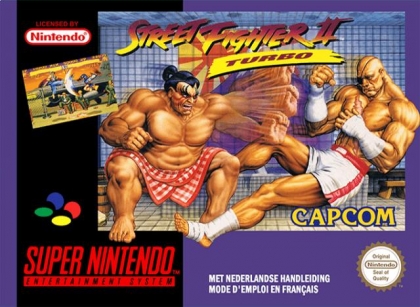
Street Fighter II Turbo: Hyper Fighting is a competitive fighting game developed and published by Capcom for the arcade and released in 1992. It is part of a sub-series of Street Fighter II games along with Street Fighter II: Championship Edition, Super Street Fighter II: The New Challengers, Super Street Fighter Turbo, and Hyper Street Fighter II: The Anniversary Edition. I will not be reviewing each sub-series instalment individually, so they will all be lumped in together. For this review, I revisited Street Fighter II Turbo: Hyper Fighting version that can be found of the SNES Mini.
Street Fighter II Turbo: Hyper Fighting was also ported to the following:
1992 – Amiga, Atari ST, Commodore 64, Amstrad CPC, Spectrum ZX and PC (DOS)
1994 – CPS Changer
1995 – Game Boy
1997 – Master System
1998 – Saturn and PlayStation
2004 – Mobile
2006 – PlayStation 2, XBox and PlayStation Portable
2018 – PlayStation 4, XBox One, Nintendo Switch and Windows
Plot
According to Street Fighter “canon”, Ryu won the first tournament by defeating Sagat. During the battle, Sagat was badly injured by Ryu, hence his chest scar, and suffered a mental breakdown. Later, the story seems to have changed a bit. Now, Sagat was winning the fight quite easily. When Ryu had been knocked down, Sagat offers a hand to help him up. Ryu, possibly affected by the darker nature of his martial art, takes advantage of this show of mercy and performs a Shoryuken to Sagat’s chest. Ryu goes on to win the tournament. Sagat melts away, is recruited by M. Bison and joins Shadaloo (Shadowloo – a powerful and deadly criminal organisation).[1]
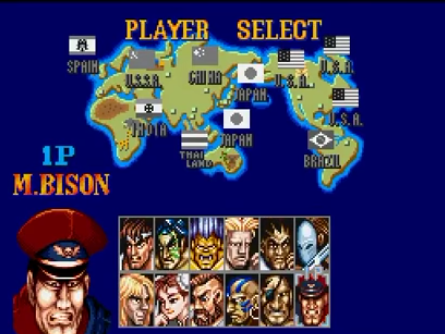
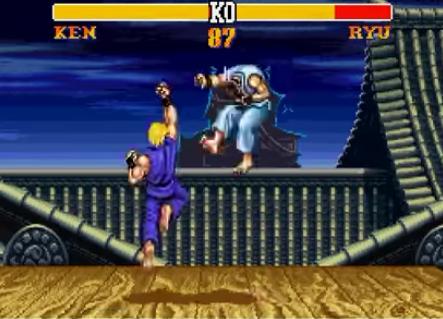
There are 12 characters to choose from and the fights take place all over the world (screenshot taken by the author)
So, we find ourselves entering a second tournament. Who are the competitors?
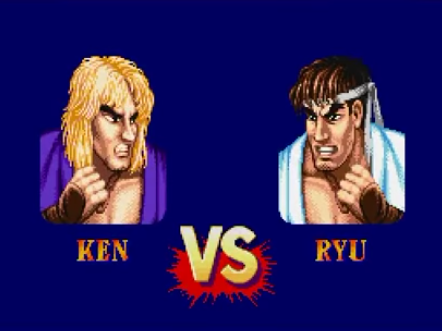
Ryu is the champion of the first tournament and a student of Shotoken karate. Dedicating his entire life to martial arts, Ryu has no home, no family or friends. He wanders the globe testing his skills against other fighters.
Ken is also a student of Shotoken karate, but has a huge ego to match his fighting ability. In recent years, Ken has not been training as hard, and is not as sharp as he used to be. A challenge from fellow student Ryu prompts Ken back into action and he enters the tournament.
E. Honda is the greatest sumo wrestler of all time and has received the highly prestigious title of “Yokozuna” (Grand Champion). After hearing that the world doesn’t consider sumo wrestling a true sport, he has entered the tournament to prove himself.
Guile is ex-special forces. He was captured and imprisoned, along with co-pilot Charlie, during a mission to Cambodia (or Malaysia depending on which information you read). After months of imprisonment in the jungle, they escaped and began their long trek back to civilisation. Along the way Charlie died, and Guile has been seeking vengeance ever since.
Chun-Li is an undercover Interpol officer secretly tracking a smuggling organisation known as Shadowloo. The trail leads to the tournament in which she enters, believing that one of the Grand Masters (Balrog, Vega, Sagat or M. Bison) is responsible for her father’s death.
Blanka is somewhat of an enigma. From the rainforest of Brazil, he is the source of reported sightings of a creature that is half-man, half-beast. Recently he has been found wandering into cities and fighting whoever dares to confront him.
Zangief is a proud Russian. He loves his country and he loves fighting! One of his favourite pastimes is wrestling bears, hence the scars all over his body.
Dhalsim has spent a lifetime dedicating himself to yoga. He has a disciplined mind, but now he wishes to enter the tournament to test his fighting skills. Proving himself will help him gain a higher state of consciousness.
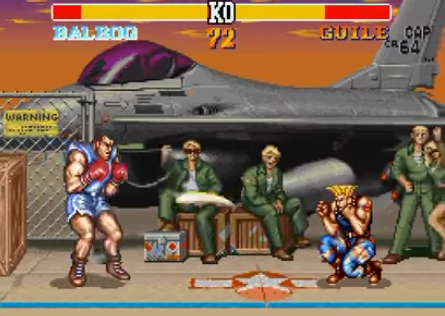
Balrog (based on boxer Mike Tyson) is a former Heavyweight boxing champion who has been banned from the ring for disobeying the rules. He is very strong and very aggressive, and fights in the streets of Las Vegas for money. He is also bodyguard to M. Bison.
Vega is a nobleman by birth, and has spent time blending Ninjitsu with skills learnt while he was a matador. He has been nicknamed the “Spanish Ninja”.
Sagat was once labelled “King of the Street Fighters” but has since lost this title due to being defeated by Ryu in the first tournament. Skilled in Muay Thai boxing, he plans to regain his title in this tournament.
M. Bison is a mysterious but powerful man. He is the leader of the criminal organisation Shadowloo and the ultimate boss that must be defeated to ensure victory.[2]
Fight! (screenshot taken by the author)
Gameplay
Street Fighter II can be played in one or two-player modes. In one-player mode, once you have selected a fighter, you must battle your way through all the other opponents before fighting the Grand Masters: Balrog, Vega, Sagat and M. Bison. There are eight difficulty settings allowing for less experienced players to practice on easier settings. Each character has their own motivation for entering the tournament, and in order to see each character’s own unique ending, you need to defeat the game on at least level six (as I recall but I may be wrong).
Each character is distinct (although nowadays some argue a ylittle stereotyped) and has their own individual fighting styles, except for Ken and Ryu who have the same Shotoken fighting style.
Shoryuken! (screenshot taken by the author)
How Does It Handle?
Like all great games, Street Fighter II is easy to play but difficult to master. Once the fun of the one-player mode has been exhausted, Street Fighter II really comes into its own with a highly addictive two-player mode. All over the world, you can be guaranteed to bump into people who have memories and stories about rainy afternoons and late nights with friends playing into the the early hours of the morn. Additionally, during one and two-player modes, you can increase the fun and challenge even more by turning the time limit on or off, and increasing or decreasing the speed of the game.
Graphics
The fights take place all over the world with beautifully illustrated and animated backdrops. The characters are highly detailed and are easily recognisable.
Music & SFX
The music is memorable, with each fighter having their own distinct tune. Some, annoyingly, get stuck in your head.
For the SFX, many of the phrases from the fighters such as “hadouken”, “sonic boom”, “yoga flame” and “tiger uppercut” have become part of our everyday lexicon.
Balrog was based of former Heavyweight Boxing Champion Mike Tyson (screenshot taken by the author)
Replay Value
Two-player fighting games like this have tons of replay value in two-player mode. With 12 characters with unique endings, plus eight difficulty settings, you’ll be getting your money’s worth with this game.
Did I Complete The Game?
I have completed the game in the sense that I have finished the game with all 12 characters and have seen their respective endings. However, I have not defeated the game with all 12 players on the hardest setting.
What The Critics Said:
Edge Magazine: “If you own SNES SFII it’s still a tricky decision whether you should buy Turbo: at current import prices, probably not. But if you’ve yet to be introduced to the genteel art of street-fighting, and have a few pounds to shed, SFII Turbo is the one to get. Overall 9/10“.[3]
Gamepro:“Despite the minor quibbles with the AI of the computer, the repetitive crowd-noise effect, and the removal Re-Dizzy Combos from CE mode, SF II Turbo is worth every penny for its boss and speed features alone. Overall 5/5“.[4]
Nintendo Power:“This game is a must have for all Super NES players who like action and competition. Overall 4/5“.[5]
Electronic Games:“For those looking for a good fighting game, Street Fighter II is the best to date. Capcom should be proud. This translation has no equal. Overall 94%“.[6]
Superplay:“Faults? Well, as a one-player game it’s superb, but inevitably has its limits – it’s the two-player game that makes it so great, even trouncing Super Tennis for laughs and general lasting interst. Overall 94%“.[7]
Super NES Buyer’s Guide: “Spectacular graphics, great animations and realistic sounds make this a great game to get! Overall 9.3/10“.[8]
Electronic Gaming Monthly: Steve: “All the moves, graphics, gameplay and sounds are rolled into a 16-Meg cartridge that will do anything but disappoint fans of the arcade original or fighting games in general. Awesome! Overall 9.5/10“.[9]
N-Force: “The smooth animation’s poetry in motion, it’s martial art! Apart from minor control problems which will be remedied with the new joypad, this is everything you could ask for. If you’ve got a SNES you’ve got to get a copy. It’s the game of the year! Overall 96%”.[10]
Megazone: “Street Fighter II is already and undoubted classic on the arcades and this classy conversion will be a smash hit for the Super Nintendo. Overall 95%“.[11]
Awards:
Best Game of the Year (All Games Systems) & (SNES) – Electronic Gaming Monthly’s Best and Worst of 1992[12]
Best Video Game Ending (All Systems) – Electronic Gaming Monthly’s Best and Worst of 1992[13]
Joint winner of Best Video Game Babe (All Systems) – Electronic Gaming Monthly’s Best and Worst of 1992[14]
Hottest New Character in a Video Game (All Systems) – Electronic Gaming Monthly’s Best and Worst of 1992[15]
Best Trick That Didn’t Work (All Systems) – Electronic Gaming Monthly’s Best and Worst of 1992[16]
According to Wikipedia, Street Fighter II won several more accolades, but as of yet, I have been unable to find the original magazines to verify.
My Verdict:
“Memorable characters, memorable music, and fab gameplay. SFII has multiple difficulty levels, plenty of different characters to use, and a competitive two-player mode, giving this game huge replay value. SFII remains close to the hearts of gamers everywhere.”
Rating:
What are your memories of Street Fighter II? I would love to hear your thoughts, and don’t for get to follow and subscribe so that you don’t miss my latest reviews! You can also find me on Instagram: @nicklovestogame.
[11] Iredale, A., ‘Review: SNES – Street Fighter II’. Megazone. (October/November 1992). Issue :36-7.
[12] ‘EGM’s Best and Worst of 1992: Best Game of the Year (All Game Systems) & (SNES) – Street Fighter II: Turbo’. Electronic Gaming Monthly’s 1993 Video Game Buyer’s Guide. (1993). :14.
[13] ‘EGM’s Best and Worst of 1992: Best Video Game Ending (All Systems) – Street Fighter II’. Electronic Gaming Monthly’s 1993 Video Game Buyer’s Guide. (1993). :20.
[14] ‘EGM’s Best and Worst of 1992: Best Video Game Babe (All Systems) – Street Fighter II’. Electronic Gaming Monthly’s 1993 Video Game Buyer’s Guide. (1993). :20.
[15] ‘EGM’s Best and Worst of 1992: Hottest New Character in a Video Game (All Systems) – Street Fighter II’. Electronic Gaming Monthly’s 1993 Video Game Buyer’s Guide. (1993). :20.
[16] ‘EGM’s Best and Worst of 1992: Best Trick That Didn’t Work (All Systems) – Street Fighter II’. Electronic Gaming Monthly’s 1993 Video Game Buyer’s Guide. (1993). :22. (
You stand in the tunnel and hear the chants from the stands echo all around you. Your supporters expect glory. Can you immortalise yourself and your team by winning silverware and reigning supreme? Tie up the laces of your football boots and adjust your shin pads. It’s not just Kick Off, it’s Super Kick Off!
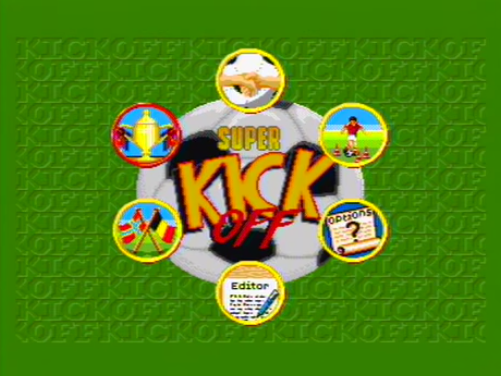
Title screen (screenshot taken by the author)
Super Kick Off is the sequel to Kick Off 2. It was developed by Anco Software, Tiertex Design Studios and Enigma Variations, and published by US Gold, Imagineer, and Misawa Entertainment in 1991. It was released on the Mega Drive, Master System, Game Gear, and SNES. I chose to review the Mega Drive version.
Gameplay
The main menu has six options. In the picture below starting at the top and moving clockwise you have: Friendly, Practice, Game Settings, Editor, International Friendly, or Cup Competitions. There are four competitions to compete for: The League, The Cup, European Cup, and the International Cup. To win these trophies, you simply need to win all you matches.
The gameplay consists of pass, shoot, trap the ball, and tackle. An overlay on the pitch with coloured dots allows you to see where your players are who aren’t on screen.
In-game menu (screenshot taken by the author)
How Does It Handle?
The in-game menu icons are not labelled but are fairly self-explanatory. One league and three cup competitions, plus a two-player mode. It is also possible to increase the overall speed of the game and adjust the difficulty setting of the opponent, to add more of a challenge.
The teams are a random array of Europe’s better teams from the early 90s. The names of the players are not real but are close enough to distinguish who they really are (Griggs = Giggs etc.). Oddly, some players begin out of position. For example, when playing with Man Utd, Spruce (Steve Bruce), starts upfront instead of in defense, so a little tinkering is needed to amend such insanity.
Controlling the ball takes a bit of getting used to. You have to either manoeuvre the player around the moving ball or press the ‘trap’ button before changing direction. The ‘trap’ button also acts as the pass button and so many times the ball gets kicked wildly out of play. Tackling is pretty much non-existant other than running into the opposition to steal the ball, and the offside rule tends to happen at odd times during the match. Once you can beat the computer regularly on the hardest setting (14-0 if you must know), you know it’s time to stop playing the game.
Although an improvement on most previous football games, I am still at a loss as to how computer designers were consistently unable to produce a realistic football game in the 80s and early 90s. You only need three buttons: For attacking – 1) short pass, 2) long pass, and 3) shoot. For defense – 1) standing tackle, 2) sliding tackle, and 3) control nearest player to the ball. It’s that simple!
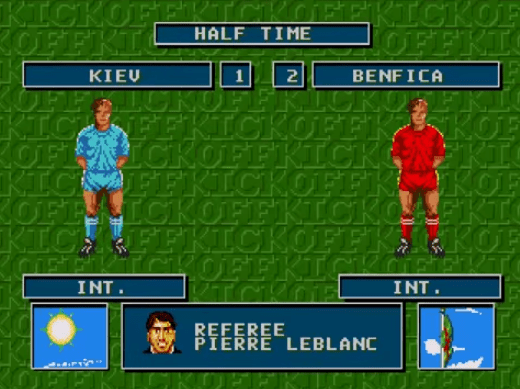
Half-time (screenshot taken by the author)
Graphics
The game is played with a top down view, similar to that of World Cup Italia ’90, but the overall graphics are more detailed, especially where the sprites are concerned. The game has added footballers with different skin tones, making the game more realistic. The pitches are also prettier and the crowd is brightly coloured.
Music& SFX
The music is forgettable and not as catchy as World Cup Italia ’90 which had a very cool Latino feel to it. There are a few SFX but the gasps from the crowd every time the ball is either saved by the goalkeeper or goes out of play is rather annoying.
Replay Value
Most sport games have plenty of replay value as there is always another team to play as and there is always a two-player mode.
In-game action (screenshot taken by the author)
Did I Complete The Game?
Yes, I won all leagues and trophies in this game.
What The Critics Said:
Mean Machines Sega:“The best football game going, and one which every Mega Drive owner, regardless of their interest in sport, should leap out and purchase. Overall 95%”.[1]
Sega Power:“You wanted a decent football game and you’ve got one! You’ll need patience to get used to controlling the players, but it’s more than worth the effort. Overall 5/5“.[2]
My Verdict:
“An improvement on most previous football games, and certainly worth playing. However, there is still a long way to go where football games are concerned. I still prefer World Cup Italia 90 to this.”
Rating:
What are your memories of Super Kick Off? I would love to hear your thoughts, and don’t for get to follow and subscribe so that you don’t miss my latest reviews! You can also find me on Instagram: @nicklovestogame.
[1] ‘Review: Mega Drive – Super Kick Off’. Mean MachinesSega. (February 1993). 5:18-21.
[2] ‘The Hard Line: Mega Drive – Super Kick Off’. Sega Power. (September 1993). 46:98.
The lightning quick blue ball of spikes has returned, and this time he has speedy side-kick. Yes, Sonic is back with a faster, bigger, and more challenging game for those with quick reflexes.
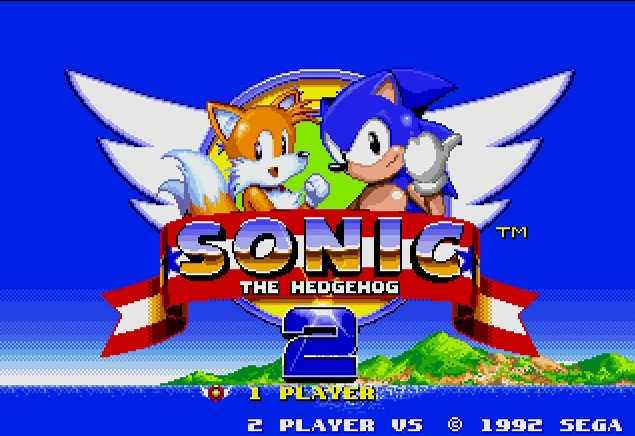
Title screen (Screenshot taken by the author)
Sonic the Hedgehog 2 is a platform game developed and published by Sega for the Megadrive in 1992. It is the sequel to Sonic the Hedgehog with 8-bit versions being released on the Master System and Game Gear. In recent years, versions were released for multiple mobile platforms as well as part of a number of Sega collection packages for the PlayStation and Xbox systems. I chose to review the Mega Drive version of Sonic 2.
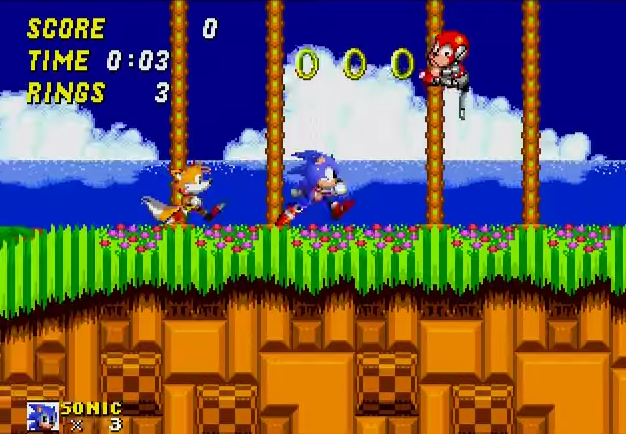
Sonic is accompanied by Tails (Screenshot taken by the author)
Plot
Sonic is back, and this time he has assistance from his trusty sidekick Miles “Tails” Prower, a two-tailed fox. Dr. Robotnik is also back, and again plans to steal the Chaos Emeralds to power his space station known as the Death Egg. Sonic must make his way through an array of different levels evading the robotic minions of Dr. Robotnik. Like the first instalment, Sonic has the option to destroy the minions to release the animals that Dr. Robotnik has trapped inside them.
Gameplay
At the start you can choose to play as Sonic, Tails, or as Sonic with Tails (a second player can control Tails but the camera will always follow Sonic). There is no real difference between Sonic and Tails.
The zones you will travel through are:
Emerald Hill Zone
Chemical Plant Zone
Aquatic Ruin Zone
Casino Night Zone
Hill Top Zone
Mystic Cave Zone
Oil Ocean Zone
Metropolis Zone
Sky Chase Zone
Wing Fortress Zone
To traverse the levels, Sonic (and Tails) can run at incredibly high speeds, jump, and spin. Along the way you can collect as many coins. These act as a life bar. If you get hit whilst holding coins, they will spill out and you have only a second or two to recover them before they disappear. When jumping, our protagonists will curl into a ball allowing them to attack and destroy the enemies. However, enemies with spikes will cause them to lose their coins or die if they aren’t holding any. If you pass the Star Post and it turns from blue to red, you will return to this point if you die. If you have 50 coins of over when you pass one, a horizontal circle will appear and expand. Jump into this and it will take you to a Special Stage for a chance to win a Chaos Emerald. If you collect 100 coins, you will gain an extra life.
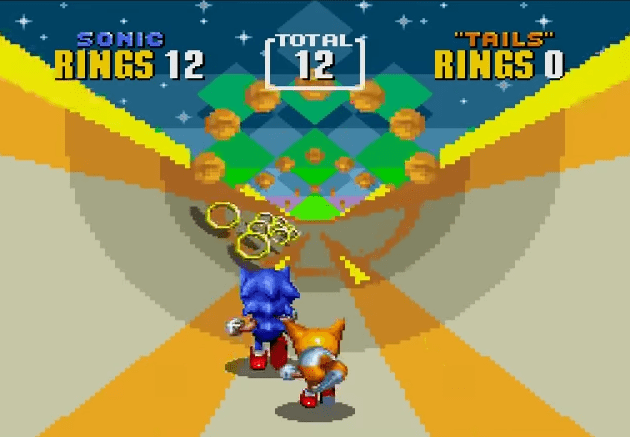
The Special Stages are now designed like a half-pipe run and are broken into stages. You must gain ‘X’ amount of rings to progress to the next stage, all the while dodging obstacles that will make you lose rings if you hit them. I would recommend playing as one or the other alone because if you have Tails with you, he will often get hit by an obstacle and will lose you rings.
As with the original Sonic the Hedgehog (1991), there are goodies to look out for:
Power Sneakers – These allow Sonic and Tails to run and even faster speeds for a short time
Super Rings – Earn 10 rings
One-Ups – Gain a life
Invincibility – Sonic becomes impervious to harm for a short time
Shield – Protect Sonic for one hit
A new feature is the introduction of the Spin Dash. This allows sonic and Tails to curl into a ball and build up a head of speed on the spot before an explosive release where he is propelled forward at high speed.
The new half-pipe special stages (Screenshot taken by the author)
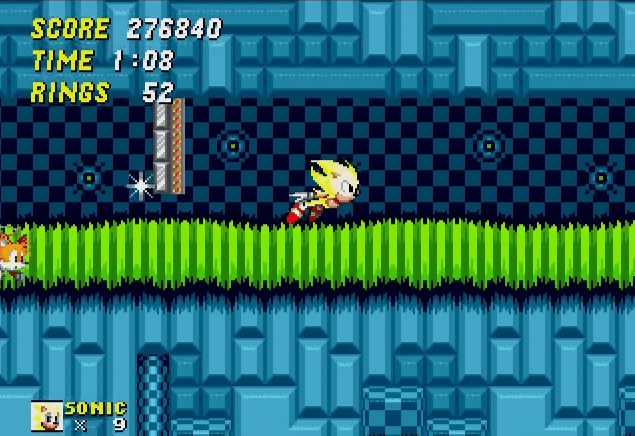
Once you have won all the Chaos Emeralds, Sonic gains the ability to transform into Super Sonic by gaining 50 rings and jumping into the air. As Super Sonic you are invincible, can run faster and jump higher. However, it uses up your rings at a rate of one per second. Once they are gone, Sonic reverts back to his normal self.
After you collect all the Chaos Emeralds, Sonic will be able to temporarily transform into Super Sonic (Screenshot taken by the author)
The addition of a competitive two-player mode where you can race another player through certain levels and special stages adds an extra element of fun which I know myself and my buddies found particularly diverting.
With the release of Sonic and Knuckles (1994), the two cartridges could be interlocked, enabling you to play through Sonic 2 as Knuckles the Echidna. Knuckles can glide and climb walls, enabling you find alternative routes through the levels. However, he cannot jump as high as Sonic and Tails, making some of the boss fights a bit more difficult.
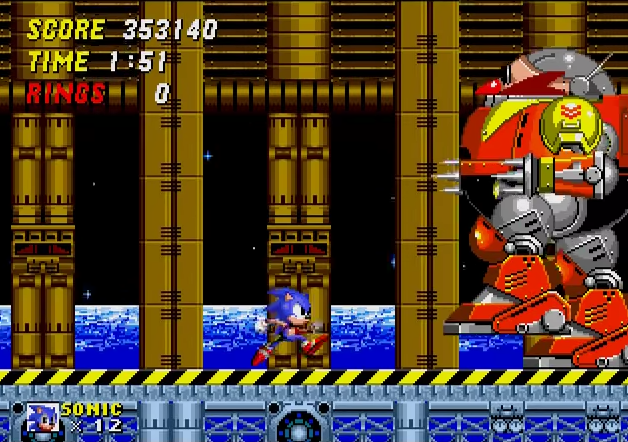
Sonic and Tails must fight their way through an array of new machines built by Dr. Robotnik (Screenshot taken by the author)
How Does It Handle?
The controls are tight, no complaints there, and the game feels faster than it’s predecessor. The levels are longer, less linear (you sometimes have to go back on yourself to find the correct route) and more intricately designed, making traversing the levels more challenging. Some of the evil minions are harder to destroy and the end of level bosses are certainly more challenging and inventive too.
Having revisited the game I noticed that in both one and two-player mode, the game has a tendency to slow down and the sprites flicker a bit when Sonic and Tails are going top speed, and in particularly when you are hit by an enemy and lose lots of rings.
Graphics
The graphics haven’t changed that much since the first Sonic game. The Sonic sprite is a slightly darker shade of blue, and the enemy sprites are designed to have a more mechanical look. Lots of colour, great looking levels, and beautifully designed sprites. The game still looks awesome.
Music& SFX
The music is still great, but I don’t think its quite as memorable as the first game for me. I don’t think I would be able to tell you the stage the music comes from like I can with the first. In fact, I mostly remember the Special Stages music.
The SFX are also in keeping with the Sonic sound from the original. When doing a Spin Dash, you can really rev up the speed and the sound that accompanies it really emphasizes the speed at which Sonic is going.
Personal Memories
The two-player mode is what my friends and I played alot when we got this game. I remember distinctly arriving at my buddy’s house and eagerly turning the game on for the first time. We played for hours.
I did feel that the way you have no rings or means to get them for the last two bosses is a cheap way to make the bosses harder, and I found that frustrating.
Did I Complete The Game?
Yes, I have completed this game a few times through whilst winning all the Chaos Emeralds.
What The Critics Said:
Gamepro: “Its tough to follow a classic but Sonic the Hedgehog 2 earns top honours. There’s enough stuff that’s new and different in Sonic 2 to make it a must-have cart for fans of the original. Overall 19.5/20”.[1]
Gamesmaster:“The changes are there, but they’re just not profound enough to transform the game into an essential buy for owners of the original. Overall 65%”.[2]
Computer & Video Games: Paul Anglin – “At first glance Sonic may not look radically different to the original, but it packs a lot more punch than Bluey’s first outing. The levels are absolutely massive, with so much to do and so much to find that you’ll bust a gut trying. Overall 94%“.[3]
Computer & Video Games: Tim Boone –“For a start it’s all a tad faster, and the addition of Tails is a real master stroke to beef up the gameplay. Graphics are no great improvement over the original, but seeing as the first game’s were about the best you’ll find that’s no bad thing! Sound is ace too. Overall 94%”.[4]
Gamer Fan:“Sonic 2 is amazing, faster and nastier than ever spinning through awesome new zones that will make your eyes bug out! The creativity and attention to detail is remarkable and to finish with all the chaos emeralds is a worthy challenge for even the best players. Overall 98.5%”.[5]
Mean Machines Sega:“Sonic has outdone itself. An absolute gem of a game which your Megadrive will be screaming out for. Overall 96%”.[6]
Mega: “Sonic 2 is pure, top grade video game entertainment. No one should miss it. Fight for a copy. Overall 94%”.[7]
Megazone:“Sonic 2 is a brilliant sequel, and does what most sequels don’t do – improve and expand on the original. Overall 96%”.[8]
Sega Force: “One of the best games of the year and definitely worth the wait! Overall 97%”.[9]
Electronic Games: “Sonic the Hedgehog 2 offers the same exciting play as the first, but the welcome additions of two-player simultaneous play and more levels only enhance this exciting title. Sonic shows no signs of slowing down! Overall 91%”.[10]
Awards:
Best Game of the Year (Sega Genesis) – Electronic Gaming Monthly Best and Worst of 1992[11]
Game of the Year – Megazone Games of the Year 1992[12]
Hottest New Character in a Video Game (All Systems) – Electronic Gaming Monthly’s Best and Worst of 1992[13]
My Verdict:
“There was something about this game that I didn’t like, but I can’t quite put my finger on what it was. I just didn’t enjoy it as much as I did the first. That being said, this is a solid sequel, and I did have fun revisiting the game. There are plenty of new features, to make it worth playing, and the addition of a two-player mode adds to the overall enjoyment of the game”
Rating:
What are your memories of Sonic the Hedgehog 2? I would love to hear your thoughts, and don’t for get to follow and subscribe so that you don’t miss my latest reviews! You can also find me on Instagram: @nicklovestogame.
[1] The Unknown Gamer. ‘Pro Review: Megadrive – Sonic the Hedgehog 2’. Gamerpro. (January 1993). 43:46-50.
[2] Lowe, A., ‘Game Review: Mega Drive – Sonic the Hedgehog 2’. Gamemaster Magazine. (January 1993). Issue 1:56-8.
[3] Anglin. P., ’Review: Mega Drive – Sonic the Hedgehog 2’. Computer & Video Games. (November 1992). issue 132:22-3.
[4] Boone, T., ‘Review: Mega Drive – Sonic the Hedgehog 2’. Computer & Video Games. (November 1992). Issue 132:22-3.
[5] ‘Viewpoint: Mega Drive: Sonic the Hedgehog 2’. Gamer Fan. (December 1992). Volume 1 Issue 2:9.
[6] ‘Review: Mega Drive – Sonic the Hedgehog 2’. Mean Machines Sega. (November 1992). Issue 2:60-3.
[7] ‘Review: Mega Drive – Sonic the Hedgehog 2’. Mega. (November 1992). Issue 2:36-41.
[8] Clarke, S., ‘Review: Mega Drive – Sonic the Hedgehog 2’. Megazone. (December 1992/January 1993). Issue 25:31-33.
[9] ‘Review: Mega Drive – Sonic the Hedgehog 2’. Sega Force. Issue 12:14-16.
[10] Carpenter, D., ‘Video Game Gallery: Genesis – Sonic the Hedgehog 2’. Electronic Games. (December 1992). Volume 1 Issue 3:72-4.
[11] ‘EGM Best and Worst of 1992 Video Game of the Year’. Electronic Gaming Monthly1993 Video Game Buyer’s Guide. (1993). :14.
[12] ‘Game of the Year Awards 1992 – Sonic the Hedgehog 2’. Megazone. (December 1992/January 1993). Issue 25:21.
[13] ‘EGM’s Best and Worst of 1992: Hottest New Character in a Video Game (All Systems) – Sonic The Hedgehog 2‘. Electronic Gaming Monthly’s 1993 Video Game Buyer’s Guide. (1993). :20.
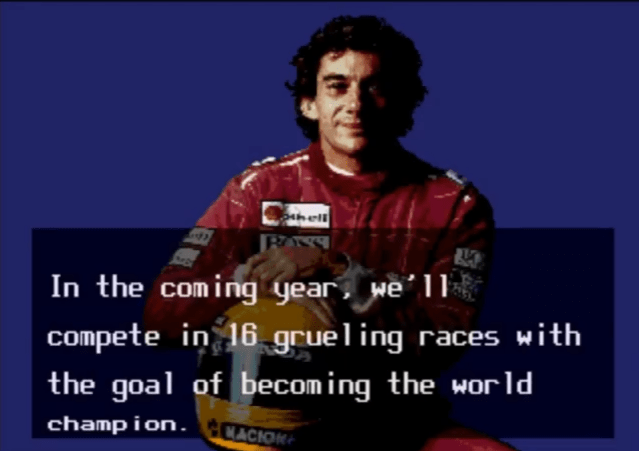
In the voice of the great Formula 1 commentator Murray Walker, “And there he goes! Look at that! Senna has passed him! Senna has won the Brazilian Grand Prix!“.
Title screen (Screenshot taken by the author)
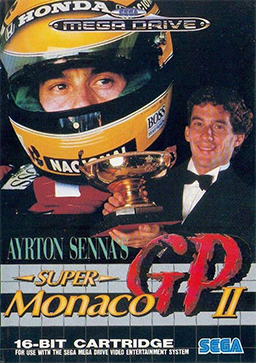
Ayrton Senna’s Super Monaco GP II is a single-player Formula One racing game developed and published by Sega. It was released on the Mega Drive, Master System and Game Gear in 1992, and is the follow up to Super Monaco GP (1989). The game’s development was also assisted by Senna, who supplied his own advice about the tracks featured in the game. I chose to review the Mega Drive version.
Objective
Naturally the object of the game is to win the Driver’s World Championship and/or the Senna GP. To win the World Championship, you must race 15 other drivers on tracks from the 1991 Formula One season. You gain points depending on the position that you finish. The higher the finish, the more points you accrue.
Gameplay
In Practice Mode, you can choose to train freely or simulate a race. This enables you to familiarise yourself with the sharp turns of each track, and allows you to perfect your racing line. You can also select the number of laps you wish to complete, your starting position and sometimes, the weather.
The late, great Ayrton Senna died tragically from injuries sustained during a crash whilst competing in the 1994 San Marino Grand Prix (Screenshot taken by the author)
In Beginner Mode, you first enter your name and select your nationality. You are then given the choice to run a few practice laps before the main race. When you select Race Mode, you can choose your preferred type of gear box (automatic, 4-speed manual and 7-speed manual). Before the main race starts you must complete a lap in the quickest time possible. Your time compared to the times of the other drivers will dictate your starting position. Your aim is to be the Polesitter.
Master Mode is pretty much the same as Beginner Mode with the exception that you may get the opportunity to drive better race cars by challenging rivals during races. If you beat the rival, you race their car from then on. There are five different car companies to achieve. Personally, I’ve never understood this. Why would you want to own the car you’ve just beaten? Surely, the fact that you have just beaten it suggests that your car is superior.
For the Senna GP, you simply compete in one race. You can choose from three tracks, and your lap times are given after each race.
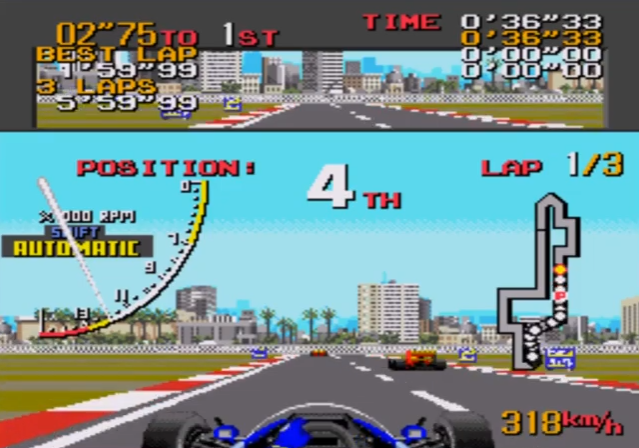
In-game screen offering all the views and information you need (Screenshot taken by the author)
How Does It Handle?
The game is challenging and much practice is needed to understand the physics of the game. Frustratingly, when a collision with another racer occurs, you always seem to come off worse than the other racer. No serious damage occurs, it just slows you down. However, if you hit a sign or barrier at high speed, you will crash and your race is over.
As mentioned, when reviewing Super Hang-On, I’m not a fan of racing games. There’s nothing wrong with them, they just don’t do it for me, so I am reluctant to spend too much time on them. However, I did enjoy playing it this one the more I played it.
Graphics
The graphics are bright and colourful, and should be praised for their realism. I’d argue that they are superior to F1 (1993). I really liked that you could look in the rear view mirror to see who was coming up behind you. This enable you to manoeuvre your car to block your opponent from overtaking you.
Music& SFX
The music is very basic and easily forgettable, but then again you’re not playing a racing game for the music are you!
The SFX mainly consist of the beeping at the start of race, and the low thrum of the engine and a weird annoying sound that indicates skidding, I assume. There is also a very muffled “Final Lap”. I found the SFX rather annoying in this game.
Replay Value
The 16 tracks plus the Beginner, Master, and Senna GP modes increase the replay value considerabley, and fans of racing games will find that this is not a game that will be completed within a few hours. Alas, it is a pity there is not a two-player option.
Did I Complete The Game?
Sadly no. The best result I achieved was fourth overall in the World Championship.
What The Critics Said:
Mean Machines: “A very good racing game – but if you’ve already got Super Monaco GP, this simply isn’t different enough to be worth buying. Overall 87%”.[1]
Mean Machines:“If you already have the original Super Monaco in your cart collection, take a look before you buy because it is very similar. However, if you’ve just got your Mega Drive and fancy owning one of the greatest road racers money can buy, take a look at Ayrton Senna’s Super Monaco GP II – it leaves the others on the starting grid. Overall 94%”.[2]
Computer & Video Games:“Super Monaco still ranks one of the best racers on the Mega Drive, right up there with the likes of Road Rash and Super Hang-On. However, it has to be said that this sequel is quite a disappointment because it’s too close to the original game! Overall 84%”.[3]
Sega Power: “Bigger and Badder sequel to the original game, this time with the golden touch of Ayrton Senna himself. Hit the gas and burn some rubber, baby. Groovy! Overall 5.5”.[4]
My Verdict:
“Becomes more enjoyable the more you play it. Fans of racing games with love the realism, and the challenge.”
Rating:
What are your memories of Ayrton Senna’s Super Monaco GP 2? I would love to hear your thoughts, and don’t for get to follow and subscribe so that you don’t miss my latest reviews! You can also find me on Instagram: @nicklovestogame.
[1] ‘Review: Mega Drive – Ayrton Senna’s Super Monaco GP II’. Mean Machines. (June 1992). Issue 21:20-1.
[2] Leadbetter, R., ‘Review: Mega Drive – Ayrton Senna’s Super Monaco GP II’. Mean Machines. (October 1992). Issue 1:126.
[3] Boone, T., ‘Review: Mega Drive – Ayrton Senna’s Super Monaco Grand Prix 2’ Computer & Video Games. (July 1992). Issue 128:68.
[4] ‘The Hard Line – Review: Mega Drive – Super Monaco GP II’. Sega Power. (September 1993). Issue 46:99.
He may not be the sharpest flint in pre-history, but Chuck Rock has a head as hard as a granite and a belly that is deadly. So get ready to navigate jungles and swamps, battle dinosaurs, and rescue your wife before Garry Gritter has his way with her. Unga Bunga!!!
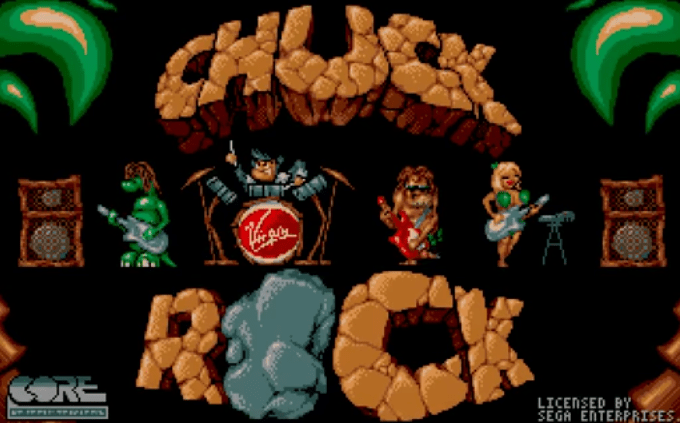
Title screen (screenshot taken by author)
Chuck Rock is a single-player side-scrolling platform game developed by Core Design. It has been published and ported to many other platforms including:
Core Design – Atari St and Amiga (1991), Commodore 64 (1992), and Amiga CD32 (1994)
Krisalis Software – Acorn Archimedes (1991)
Virgin Interactive – Sega Megadrive (1991), Sega Master System (1993) and Game Gear (1992)
Sony Imagesoft – Sega Mega-CD (1993), SNES (1992) and Game Boy (1993).
I chose to review the Mega Drive version.
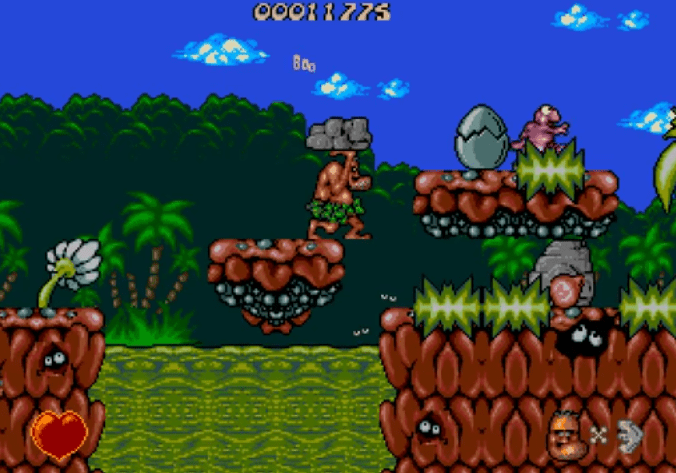
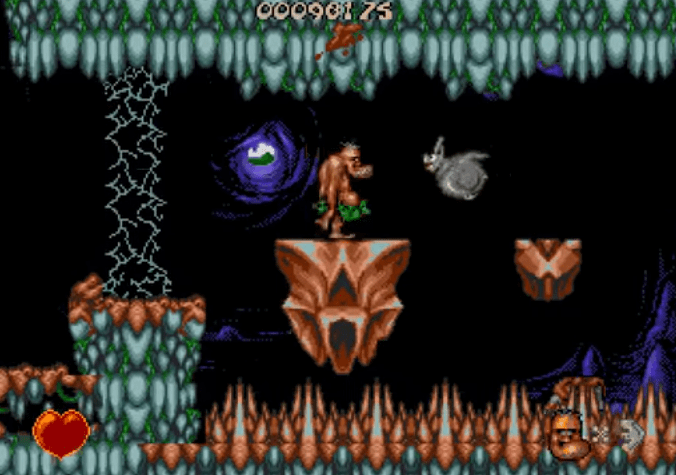
Beautiful level design (screenshot taken by author)
Plot
Set in a fantasy prehistoric Stone Age, Chuck is enjoying a lazy day in front of his TV drinking beer (root beer that is). His wife, Ophelia, is going about her daily chores unaware that she will soon be kidnapped by the evil Gary Gritter, who has designs on her. Chuck hears the commotion and investigates, only to find a pile of crumpled, dirty clothes and signs that something heavy has been dragged away. Since he has no clothes to wear, he ducks behind some nearby bushes and fashions some leafy pants to cover his modesty. He must now rescue his wife.
Gameplay
Chuck must navigate his way through five levels, each with three-five stages, all the while evading various dinosaurs and prehistoric animals; or if you are feeling brave, barging them out the way with your belly, performing flying kicks, or picking up huge boulders and throwing them. I’d recommend using the latter two to kill your enemies.
The levels are:
The jungle scene
The caves scene
The water scene
The Ice scene
The Graveyard scene
Chuck may look like a everyone’s least favourite uncle, but he is the hero of this tale (screenshot taken by author)
How Does It Handle?
The controls are easy to learn and are nice and responsive. The game is challenging with some tough levels. Oddly, the end of level bosses are all very easy to defeat with the exception of the third boss. The only boss that you need a strategy to defeat is the first boss, but other than that, it is simply a case of button mashing. One nice little touch is that when Chuck is carrying a large rock, he won’t move as fast.
Graphics
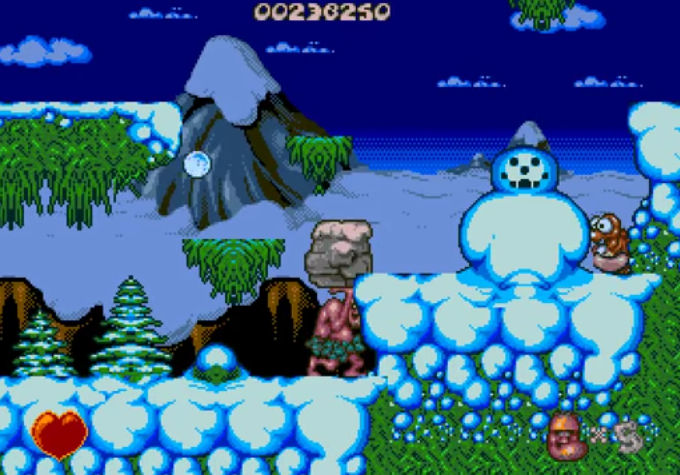
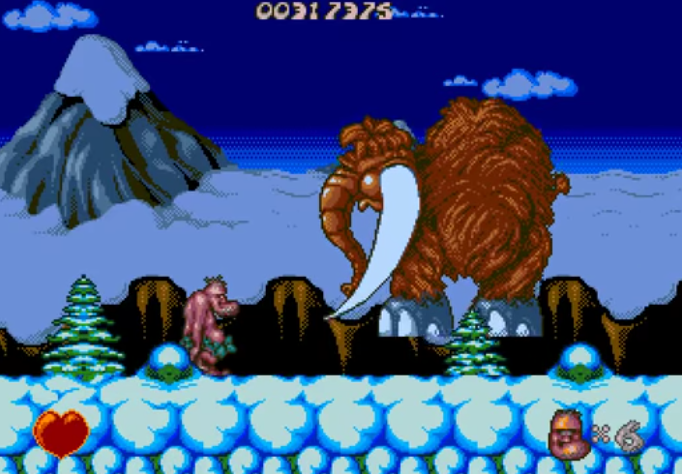
Throughout the entire game the graphics look fab. The overall feel of the graphics is more on the whacky side than the realistic side. The background look great, and I particularly like the snowman on The Ice scene level. There’s plenty to catch the eye and make you think “That looks cool!”, like a T-rex with boxing gloves…awesome!
The levels look gorgeous (screenshot taken by author)
Music& SFX
The music is good throughout the game. The opening musical number on the title screen is awesome and I found myself delaying playing the game in order to listen to the song the whole way through. It seems that even though Chuck isn’t the sharpest tool in the box, he has aspired to lead singer of a rock band. The music speeds up during the boss battles.
There are plenty of SFX throughout the game as Chuck jumps, throws rocks, and bounces enemies of his belly.
Replay Value
Sadly, this game lacks replay value. There is only one difficulty setting and once completed you may only wish to revisit it once or twice before turning your attention to the next challenge.
(screenshot taken by author)
Did I Complete The Game?
Yes, I completed the game without the use of cheats. Sadly, upon completing the game you are met another example of an anti-climatic ending to a game that deserved more.
What The Critics Said:
Mean Machines: “An excellent and quite original platform game that’s highly recommended to all Megadrive players. Overall 91%.”[1]
Mean Machines Index: “A brilliant, humorous Megadrive platform game with real character. Its graphics are out-of-this-world, the sound completely brilliant, and the game play pretty good too! A must have for your Megadrive collection. Overall91%”[2]
Sega Power: “Groovy goings-on 100 million years B.C. with wild sonics and graphics as Chuck rescues his wife from the evil Garry Glitter. Overall4/5.”[3]
Electronic Gaming Monthly: “The gameplay could use a little fine tuning, but it is still very fun to play. The graphics are comical and the music jams. Overall7.75/10”.[4]
Megazone:“Graphics wise this game is a hit (as good as the Amiga on the Mega Drive), the sound is pretty good (not quite up to the Amiga, but still pretty hot) and some imaginative sprite drawings have been added to this game. Overall85%”.[5]
GamePro:“The game’s worth the bucks for the music and graphics alone. From standpoint of challenge and gameplay, it’s middle of the road – not too hard and not too easy. Overall4.6/5.”[6]
My Verdict:
“Unga Bunga – The game has nice graphics and is fun to play. The simple button mashing as oppose to a strategy needed to defeat end of level bosses, is a mark against this game. The lack of replay value means that once completed I doubt you will want to play through again.”
Rating:
What are your memories of Chuck Rock? I would love to hear your thoughts, and don’t for get to follow and subscribe so that you don’t miss my latest reviews! You can also find me on Instagram: @nicklovestogame.
[1] ‘Review: Mega Drive – Chuck Rock’. Mean Machines. (June 1992). Issue 21:76-8.
[2] ‘Review: Mega Drive – Chuck Rock’. Mean Machines. (October 1992). Issue 1:137.
[3] ‘The Hard Line – Review: Mega Drive – Chuck Rock’. Sega Power. (September 1993). Issue 46:96.
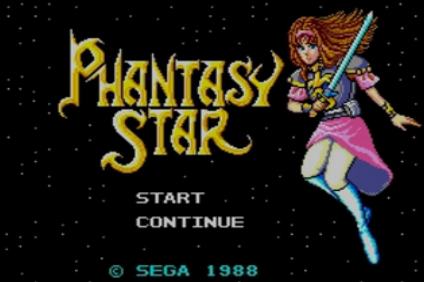
Role-playing games have the ability to take us out of ourselves and whisk us off to fantasy lands where we can choose to be warriors, mages, dwarves, and any other imaginary creature that suits us. We can select our own weapons, and if we are successful, gain strength and are harder to defeat. Phantasy Star promised to whisk us off to such a fantasy universe.
Screenshot taken by the author
Phantasy Star is a single-player role-playing game developed and published by Sega. It was released on the Sega Master System in 1987, and latterly re-released on the Sega Saturn, PS2, and Nintendo Switch. To review, I played this game as part of Sonic’s Ultimate Genesis Collection (2009).
Plot
The game is set in the fictional Algol star system which contains three planets: Palma – a lush and green planet, Motavia – a desert planet, and Dezoris – an ice planet. Algol is ruled by King Lassic, who early in his reign was considered kind and benevolent. He later becomes a cruel and sociopathic ruler. Soon, a rebellion begins to overthrow the now evil king. One hero, who falls during a battle, is Nero. His sister, Alis, the main protagonist (incidently, one of the first female protagonists for video games), swears to avenge her brother. She assembles a party consisting of a warrior named Odin, a wizard named Noah, and a cat-like creature named Myau. Together the party swear to kill King Lassic and restore peace to the kingdom.
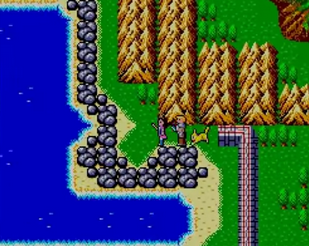
The overworld is how you traverse the landscape (screenshot taken by author)
Gameplay
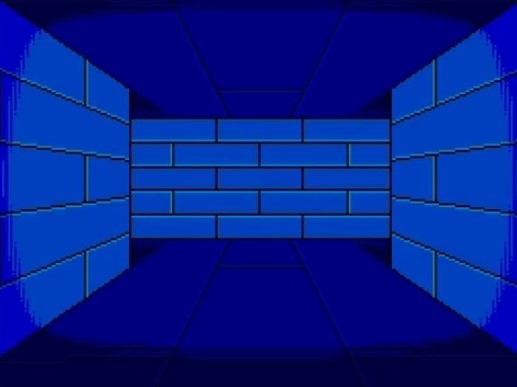
There are two gameplay modes. The first is from a near top down perspective whilst walking around the villages and planet surfaces. When walking around the surface of the planet, outside the cities, and in caves etc. You come across random battle encounters where you must choose to fight your opponent or attempt to run away. When exploring dungeons and caves, and in a battle, the view switches to first-person mode.
If you are successful in battle, you will gain experience points and money. As your experience points increase, your overall level of each character increases and subsequently, your characters stats making them stronger in attack and defense.
Gaining money will also allow you to buy stronger weapons, armour, and other items.
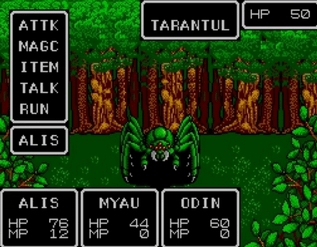
The battle scenes are highly detailed and look fantatsic (screenshot taken by author)
How Does It Handle?
The game is easy to learn and enjoyable. The fight mode is simple, but it can become frustrating that when fighting multiple enemies, you seem unable to select which enemy to attack, which can hinder fighting tactics. The game contains a back-up save option, which if you play RPGs will know that this is very useful.
RPGs can be a bit of a slog though. Known as grinding, you seek out and fight the same smaller enemies in order to gain experience points and increase your stats. Whilst hardened RPG gamers may love this type of gaming, many find it dull and repetitive.
The dungeon-crawling sections are very atmospheric (screenshot taken by author)
Graphics
For an 8-bit game, I think it is really beautiful! The colours are vibrant, the sprites are well designed, and there is a great variety of them to fight. The backgrounds during the fight scenes are also varied and are very detailed. I’ll wager this game pushed the Master System to its limits.
Music
The music becomes tiresome after a while but since it is not essential to the game, you can simply turn the sound off and listen to your own music or podcasts.
Did I Complete The Game?
I did complete the game, but with the assistance of a walkthrough. Sadly, as I have gotten older, I simply don’t have the time or inclination to spend countless hours on these sorts of RPGs.
What The Critics Said:
Computer & Video Games Magazine: “Real RPG fans should definitely check Phantasy Star out, but anyone with a passing interest in this type of game might not feel they’re getting their money’s worth. Overall 75%”[1]
S: The Sega Magazine:“An excellent entertainment – once you’ve teamed up with Odin, Noah and Myau and built up some strength, it’s like controlling an interactive movie. Brilliant? Yes it is. Overall 94%”[2]
Mean Machines: “A sprawling RPG which offersa great depth of gameplay, decent graphics and a good challenge. There are slightly better games of this sort (and cheaper too – this cart costs £40), but if you’re an RPG fan who has them all, this is well worth getting. Overall 75%”[3]
Sega Power: “If you’re into RPG adventures this is the one to go for. Explore stunning 3D labyrinths and solve a quest big enough to last for months. Huge. Astounding Get it. Overall 5/5“.[4]
Sega Power: “If you’re into RPG adventures this is the one to go for. Explore stunning 3D labyrinths and solve a quest big enough to last for months. Astounding and huge. Get it. Overall 5/5.”[5]
Awards:
Best Graphics – 1989 Electronic Gaming Monthly’s Player’s Choice Awards[6]
My Verdict:“A beautiful 8-bit game, just a pity the story is a bit thin. However, all RPG fans should enjoy this game.”
Rating:
What are your memories of Phantasy Star? I would love to hear your thoughts, and don’t for get to follow and subscribe so that you don’t miss my latest reviews! You can also find me on Instagram: @nicklovestogame.
[1] Rignall, J., ‘Mean Machines Review: Master System – Phantasy Star’. Computer & Video Games Magazine. Issue 89:92-3.
[2] ‘Special: Phantasy Star’. S: The Sega Magazine. (June 1990). Issue 7:11.
[3] ‘Games Index: Master System – Phantasy Star’. Mean Machines. (October 1992). Issue 1:135.
[4] Jarrett, S., ‘The Hard Line – Phantasy Star’. Sega Power. (April 1991). Issue 23:58.
[5] ‘The Hard Line – Review: Master System – Phantasy Star’. Sega Power. (September 1993). Issue 46:100.









#/media/File:Phantasy_Star_MS_cover.png)
 Nick Loves to Game