Throughout the 70s and 80s, the popularity of eastern martial arts rose dramatically in the west through Bruce Lee and The Karate Kid movies. Naturally, gamers are attracted to games where they can perform a flurry of punches, an array of agile kicks and jumps, and master hand to hand combat because, let’s face it, these things take years of training and dedication which many of us don’t have the inclination for.
Title screen (screenshot taken by the author)
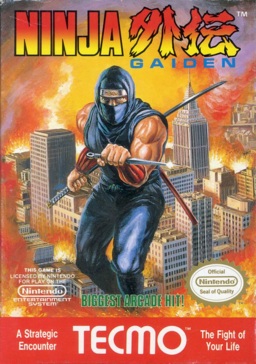
Shadow Warriors is a side-scrolling action-platform game developed and published by Tecmo. It was released for the NES in Europe in 1991, having previously been released in Japan in 1988 as Ninja Ryūkenden, and in North America in 1989 as Ninja Gaiden. It was later ported to the SNES, PC and mobile phones. For this review, I chose to play the NES version.
Plot
You control Ryu Hayabusa who travels to America to avenge the murder of his father. He soon learns of a person known as “The Jaquio” who plans to take over the world with the help of an ancient demon whose power is contained within two statues. The game contains 20 levels broken down into six acts.
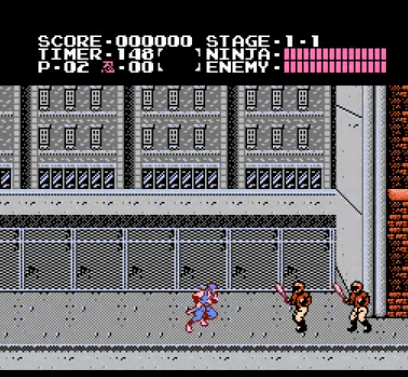
I’m not sure why Ryu has a reddish tinge to him (screenshot taken by the author)
Gameplay
The gameplay mostly consists of running at and cutting down your enemies. Ryu’s main weapon is a sword but you are able to pick up and use limited numbers of shuriken. Ryu can also jump and cling onto the walls, but can only climb if he is on a ladder. If not, and a wall is opposite, he can spring himself up by jumping between walls.
How Does It Handle?
The controls are very responsive and the movement tight, allowing for close control. Annoyingly, and this is common amongst early games, if you progress to a higher screen and you fall back down the hole you just came from, you die as oppose to simply fall to the level below.
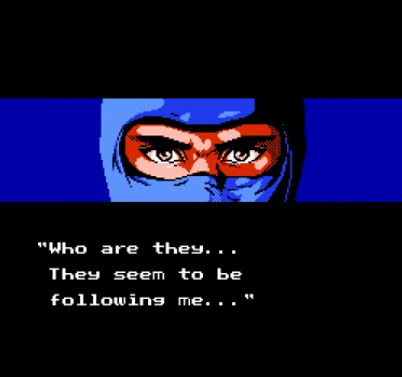
Between levels, there are beautifully illustrated cut scenes (screenshot taken by the author)
Graphics & Music
The graphics and music are standard for 8-bit home consoles in the 80s but with the introduction of 16-bit consoles, begin to look dated by the time of its release in Europe in 1991. The Ryu sprite has a reddish glow to him, which is strange. After each act, there is a beautifully illustrated anime-style cutscene furthering the storyline.
Personal Experiences
The levels are very difficult and unforgiving, but you do receive unlimited continues. Sadly, I was only able to get to Act Three as my version kept crashing. However, I really enjoyed playing this game and so will definitely return to it in the future.
Did I Complete The Game?
No, my game kept crashing on Act Three.
What The Critics Said:
Mean Machines:“A superb game, very similar to Shadow Warriors coin-op. Highly recommended top Nintendo beat ‘em up fans. Overall 88%”.[1]
Mean Machines:“A superbly presented Ninja game which proves very playable. Overall 90%”.[2]
Awards:
Best Challenge 1989 – Nintendo Power Awards 1989[3]
Best Game of the Year – Electronic Gaming Best and Worst of 1989[5]
My Verdict:
“Tight controls, beautiful cut scenes but very difficult and unforgiving. A good edition to the ninja genre”
Rating:
What are your memories of Shadow Warriors? I would love to hear your thoughts, and don’t for get to follow and subscribe so that you don’t miss my latest reviews! You can also find me on Instagram: @nicklovestogame.
Shining in the Darkness (Shining and the Darkness in Japan) is a role-playing game developed by Climax Entertainment and Sonic Software Planning, and was published by Sega in 1991 for the Mega Drive. This was the version I chose to review.
Shining in the Darkness doesn’t have a title screen as such (screenshot taken by the author)
Plot
In the Kingdom of Thornwood, the king’s daughter, Princess Jessa, has disappeared whilst visiting the shrine of her deceased mother. Mortred, one of the king’s most brave and trusted knights, was charged with escorting her to the shrine. He is also missing. You take control of Mortred’s son and agree to be the search party.
Gameplay
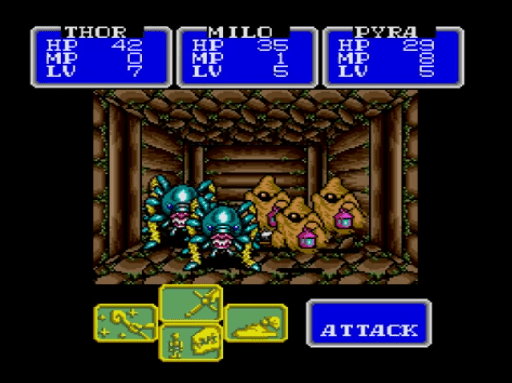
Shining in the Darkness is a real dungeon crawler that sees your character, along with friends Milo and Pyra, exploring what seems like endless miles of dungeons. Along the way you have random encounters with all manner of ugly beasts. Deafeating these will help your team gain experience points and level up, increasing stats and allowing new spells to be learnt. Gold is also acquired which allows you to buy new weapons and armour.
When leaving the palace, a map appears showing you the three locations you can visit: the palace, the town or the dungeons. In the town you can visit the shrine to save your progress; enter the tavern to talk to some interesting characters and regain your health with an overnight stay; visit the weaponry and armoury where you can upgrade to stronger weapons and armour; and buy antidotes and healing potions needed for your adventures in the dungeon from the Alkemist (not alchemist I might add).
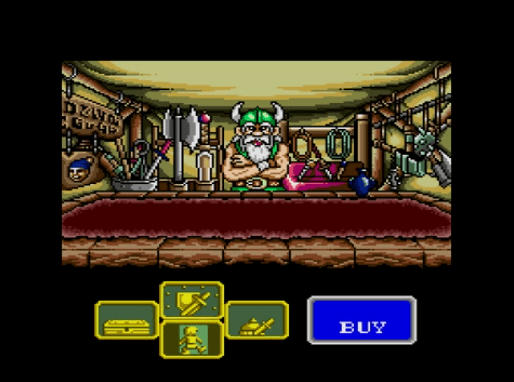
Isn’t that Gilius Thunderhead from Golden Axe? (screenshot taken by the author)
Moving through the dungeons is simple. You can move forwards, walk backwards and turn left or right. The interactive menu consists of four boxes at the bottom of the screen and can be called upon at any time. It allows you to check your party’s status, use items, equip weapons and armour etc. When confronted with enemies, the menu changes to include attack, use item, use magic and flee options. When attacking, you have the option to choose which groups of enemies to attack first, but sadly, you cannot choose which individuals to attack within a group. If your health gets too low, you can spirit yourself out of the dungeons using the egress spell or angel feather.
How Does It Handle?
Although it is easy to learn, the game soon becomes too monotonous in my opinion. Having to navigate the same dungeon levels to gain enough experience points to fight deadlier opponents and raise enough money for better weapons becomes a real drag after a while. I know this is the whole point of RPGs but I found myself losing interest, especially when you have to traverse the same dungeons you’ve completed to reach the next dungeon. There are also times when it is unclear where you should go next. I definitely recommend you draw your own map else you will get lost.
Graphics
The graphics are awesome. The palace, tavern and shop scenes are bright and colourful, and the dungeons themselves and the enemies are well illustrated. There really are no complaints here. The game looks gorgeous!
Music
The music sounds great and has heroic air, fitting for such a game.
To arms! (screenshot taken by the author)
Golden Axe Link?
A nice little Easter Egg is that the dwarf who sells you your weapons seems to be the dwarf Gilius Thunderhead from Golden Axe. One of his sacks on the left in the background even has a picture of one of those little imps who you steal magic potions from. Does this mean that Golden Axe and Shining in the Darkness occur in the same universe?
What The Critics Said:
Mean Machines: “A reasonable, but pricey RPG with impressive graphics, let down by combat system that soon becomes a chore. Overall 69%”.[1]
Mean Machines Sega:“A role-playing game with excellent graphics and a brilliant window system. Shining in the Darkness is recommended to RPG buffs. Watch out though for irritating combat, reliant on luck than the player’s skill. Overall 72%“.[2]
Dragon: “The game combines the icons and combat of Phantasy Star III, the first person perspective of Phantasy Star I, and the great close-up graphics of Phantasy Star II. The combat can sometimes be tedious without the battle animation so well programmed in Phantasy Star II. Overall 4/5”.[3]
Sega Force: “Shining in the Darkness is the most colourful, enchanting RPG I’ve played on the Mega Drive – I enjoyed it even more than Phantasy Star II and III. Overall 90%“.[4]
Sega Pro: “RPG’s and great graphics don’t usually go together but Shining in the Darkness breaks the mould. Loads of playability and potential addictiveness will make this RPG a game to remember. Overall 93%”.[5]
Sega Power:“Startling graphics, super smooth animation and brilliant labyrinths to explore. A corker! Overall 5/5”.[6]
My Verdict:
“This is a beautiful game! It is easily to learn and there is plenty there to keep hardened RPG fans interested for hours and hours. For the average gamer though, monotony and frustration at repeating the same areas again and again soon becomes tiresome. However, this game is definitely worth your attention”
Rating:
What are your memories of Shining in the Darkness? I would love to hear your thoughts, and don’t for get to follow and subscribe so that you don’t miss my latest reviews! You can also find me on Instagram: @Nicklovestogame.
[1] ‘Mega Drive Review: Shining in the Darkness’. Mean Machines. (November 1991). Issue 14:112-3.
[2] ‘Review: Mega Drive – Shining in the Darkness’. Mean MachinesSega. (October 1992). Issue 1:140.
[3] ‘Reviews – Shining in the Darkness’. Dragon Magazine. (February 1992). Issue 178:60.
[4] ‘Reviewed – Shining in the Darkness’. Sega Force. (January 1992). Issue 1:52-3.
[5] ‘Proreview – Shining in the Darkness’ Sega Pro. (November 1991). Issue 1:58-60.
[6] Jarrett, S., ‘The Hard Line – Shining in the Darkness’. Sega Power. (April 1991). Issue 23:54.
By the early 90s, multiplayer beat ‘em ups/hack and slash games such as Golden Axe, Streets of Rage, Teenage Mutant Ninja Turtles and Final Fight were growing increasingly popular. The increasing array of characters and fighting moves kept gamers playing these games time and again, using all characters in a bid to master them. The multiplayer modes meant that you could play with friends and spend countless rainy afternoons and cold winter evenings in imaginary worlds saving the planet, defeating crime bosses or rescuing royalty.
Title screen (screenshot taken by author)
Alien Storm is a beat ‘em up/shooter hybrid developed and published by Sega for the arcade in 1990, and ported to the Mega Drive and Master System in 1991. It was later released in the Wii Virtual Console in 2007, and as part of the Sega Mega Drive Ultimate Collection for the Xbox 360 and PlayStation 3. For this review, I chose to play the original Sega Mega Drive version.
Plot
Earth is being invaded by an army of incredibly ugly and aggressive aliens. A team of crack special force operatives known as the “Alien Busters”, comprising of the flame-thrower wielding Karen; the hunky Garth (Gordon in some versions) with his electric rifle, and Scooter (Slammer in PAL version) the robot, are sent to repel the invasion. Eight missions sees them battle through cities and towns, laboratories, electronic goods stores and eventually a UFO.
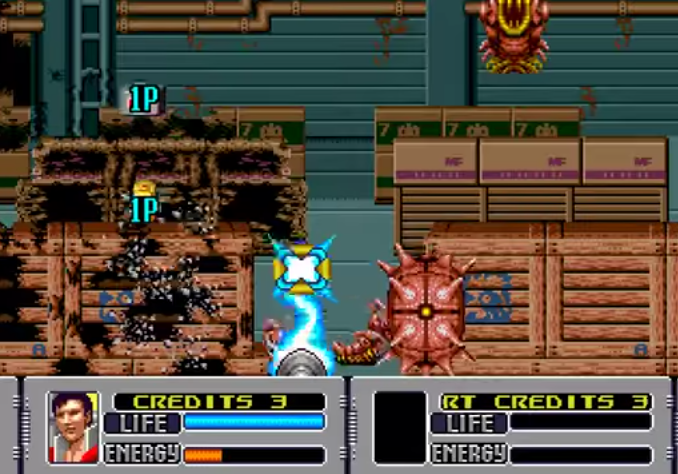
Oddly, the main character looks like Elvis Presley in his profile picture (screenshot taken by author)
Gameplay
The game is mostly a linear beat ‘em up which sees the players fight from left to right. There are sections of the levels where the game changes to a shooter style game which adds a nice bit of variety to the action. Each character can attack, run, and perform a running attack. There are two bars: life and energy to keep an eye on too. When using your weapon, the energy bar begins to deplete. If you use your special attack, the energy bar depletes more quickly. Along the way, you can pick up medicine and batteries to replenish your life and energy levels. There are a few end of level bosses in the game which take a long time to deafeat if you don’t have special attacks, so I recommend not using them until the boss fights.
Alien Storm incorporated elements of the rail-shooter genre (screenshot taken by author)
How Does It Handle?
The controls are very easy to learn, and the game quickly turns into a button masher with little strategy required.
Graphics
The graphics are great! The levels contain detailed backgrounds and the sprites are bright, colourful and well designed with clear outlines. As the game progresses the increased difficulty of the aliens is noted by a colour palette change.
Interestingly, if you look at the profile picture of Gordon in the bottom left corner of the screen, to me, he looks unmistakably like Elvis Presley.
Music
I think the music to this game is very good and fits well. I particularly like the short piece player before the beginning of each level. It’s quite sci-if/horror-sequel.
Watch out for the alien marsupials!!! (screenshot taken by author)
Replay Value
Before beginning the game, you can choose between three difficulty settings: easy, normal or hard. To add an extra element of difficulty, you can also set your energy bar levels to either easy, normal or hard. When you complete the game, after the end of game scenes and credits, you get a score and a rating. As far as I know, your score makes no difference to the game ending. This adds to the replay value of the game as it encourages additional run throughs.
Each character has an individual move set and special attack but there doesn’t seem to be a difference in strength, agility etc. This encourages you to replay the game trying out the different characters.
As with these types of games, two-player co-op modes only add to the fun. To further increase the replay value of the game, the Mega Drive version also contained a Duel mode and a Player vs Player mode. In the Duel mode, you select a player and must compete in fights with differing numbers and strengths of aliens. The more rounds you win, the higher your overall score at the end. I received a score of 82 and the title “Champion”. During these battles there is no way to regain your energy so use your weapons sparingly. In the Player vs Player mode, you and your opponent select one of the three main protagonists each to fight in a one on one battle. The first player to win two rounds, wins the fight. Sadly, this is a bit naff due to the fact that you only have a limited move set. There is not enough variation in attack combinations to make these battles interesting.
Did I Complete The Game?
Yes, I have completed this game many times over the years in both one and two-player modes, but only in easy mode.
What The Critics Said:
Mean Machines: “An absolutely outstanding conversion from the coin-op, with great graphics and highly enjoyable one or two-player action. The big problem is that it’s just too easy. For some unknown reason, the import version was harder, but even then, it’s not that difficult to finish. Those new to the Mega Drive scene will really enjoy the action – experts, though, are warned that they might just find themselves finishing this prematurely. Overall 78%“.[1]
Sega Pro:“A space age Golden Axe. One or two players can choose from three characters and then walk through eight levels packed with superbly animated and intricately detailed aliens. Great fun as each of the players has a special weapon and executes them in an amusing way. For instance, the robot takes off his (head) and self-destructs as he walks off screen. Way too easy, though. Overall 79%”.[2]
Sega Power:“The game is, if anything, pitched a little too easy, and although the sound effects, music (especially the dance tunes) and graphics are excellent, there is little left to grab you after you’ve heard and seen them all. But as an original theme for a blast-‘em up, it’s got a lot of guts (urgh!). Easily a worthy of addition to your Sega collection. Overall 83%”.[3]
Sega Power: “Horizontal scrolling blast-‘em up in the vein of high-tech Golden Axe.Great 3D shooting sections and ultra-high-speed scroll, but crippled by easy gameplay. Overall 3/5”.[4]
My Verdict:
“I have great memories playing this game with my sister and brother. Its looks great, plays great, and the mix of beat ‘em up and shooter adds some nice variety. The replay value is there too, and I think this is an underrated game from the Mega Drive catalogue. However, it must be said that titles such as Golden Axe and Streets of Rage are still superior in every aspect: Story, graphics, music…the lot.”
Rating:
What are your memories of Alien Storm? I would love to hear your thoughts, and don’t for get to follow and subscribe so that you don’t miss my latest reviews! You can also find me on Instagram: @nicklovestogame.
[1] ‘Review: Mega Drive – Alien Storm’. Mean Machines. (October 1992). Issue 1:137.
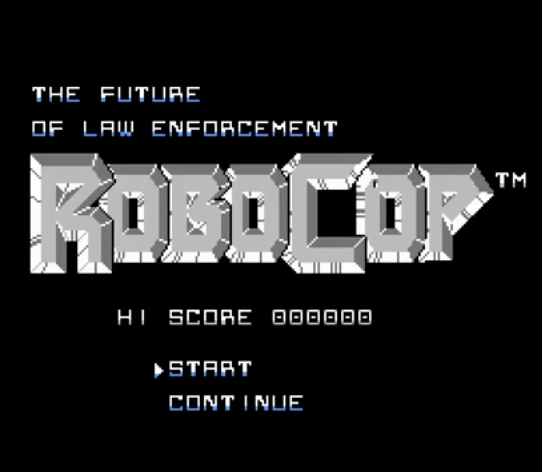
Robocop is a beat ’em up/run and gun arcade game developed and published by Data East. Based on the 1987 film Robocop, it was released in 1988 for the Arcade, Apple 2, PC, Amiga and Atari ST. It was later release on the NES in 1989 and the Game Boy in 1990. For this review, I chose to play the NES version.
Plot
A crime wave has swept the city of Detroit and the streets are no longer safe. OCP, a private company, have developed a cyborg to assist law enforcement. Using his fists, and an array of guns, the cyborg known as Robocop aims to clean up the streets, destroy ED-209, and defeat Dick James, the mastermind behind the crime epidemic.
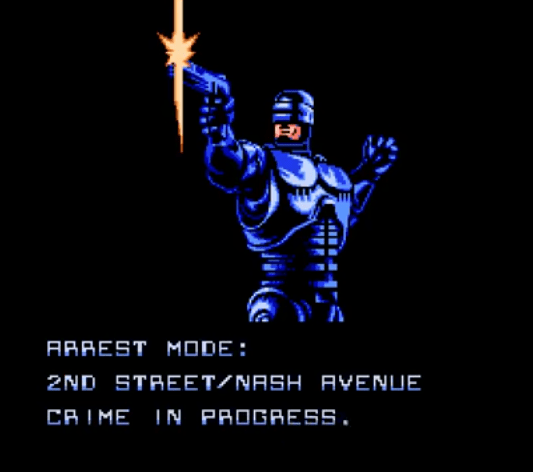
Before the game starts, the intro consists of a run through of Robocop’s cybernetic make-up, which I think would have been made better with a bit more backstory as to how Robocop came to be. Not everyone has seen the film after all.
A short but well illustrated cut scene kicks the game off (screenshot taken by the author)
Gameplay
That game is very easy to play. Robocop is a big hunk of machinery and so he can only walk at one speed (As you can imagine, he cannot jump). However, he can also climb and descend stairs, crouch and block, and punch or fire his gun (Note: when descending the stairs you only need to press down as oppose to diagonally down). He can fire his gun in all directions except straight down. During the levels, Robocop can pick up and use other firearms other than his standard side-arm including a machine gun and cobra gun (Robocops standard side-arm has infinite ammo but these other weapons do not).
There is no time limit to the levels, but Robocop’s energy bar depletes as he progresses through the level. Once the bar is depleted he will cease to function and need to restart the level. Thankfully, he can pick up batteries along the way to restore his energy bar. Robocop’s health bar will deplete if he is hit by an enemy. Collecting bottles labelled ‘P’ will help restore his health.
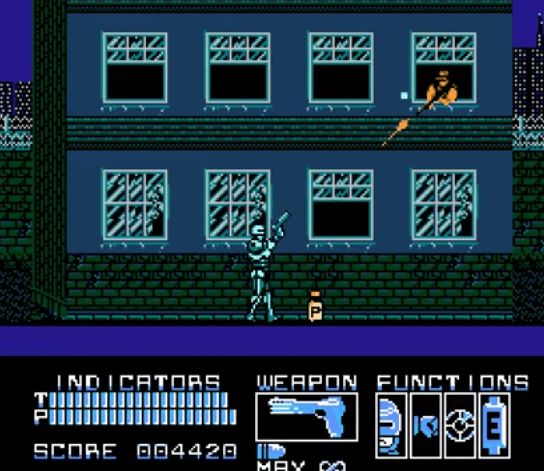
Why unarmed criminals try to take on a cyborg I’ll never know! (screenshot taken by the author)
At the bottom right of the screen are four symbols. When they flash they indicate the following:
Infrared Vision – Which will help you locate a weak wall that you need to punch to break through.
Punch – You can only defeat an enemy by punching.
Foe Detector – Begins to flash faster and faster the closer you get to a boss/sub-boss.
Energy/Power Alarm – Indicates when energy or health levels are low or when they drop dramatically.
How Does It Handle?
I do have a few issues with this game though. Firstly, the stupidity of the unarmed enemies and dogs. Why on Earth would you run towards a huge bloody cyborg that can dispatch you quite easily with one punch…especially when your only attack is a flying kick?! Also, you have one life, then it’s game over. You do seem to get an infinite number of continues but when you use them it takes you back to the beginning of that level. If you are going to force people to use continues and restart the level, then please give them more than one life.
That being said, like the film, Robocop matches his weapon to the threat level of his attackers, which I think is a very neat feature and adds an element of realism to the game. This means that Robocop won’t use his gun until he comes face to face with an enemy who uses guns, flamethrowers or explosives etc.
Graphics
Graphically, this game is good for an 8-bit console in 1989, and matches the likes of Ninja Gaiden. The sprites are detailed and clearly defined against the backgrounds, and when using his gun, Robocop even mimics the one-handed stance seen in the film. The backgrounds themselves are pretty good too. However, there is a fair bit of sprite flicker, especially from the dogs and when you’re shooting at the first boss.
The cut scenes between the levels are nicely illustrated and the phrase “Crime in progress” appears which is a nice nod to the movie.
Robocop will only use his gun when the threat level increases (screenshot taken by the author)
Replay Value
This game only has one difficulty setting so there really is not much to keep you coming back once the game is completed.
Did I Complete The Game?
No, I barely got past the first level. I just couldn’t be bothered with getting to the end of level boss, dying and being sent back to beginning of the level.
What The Critics Said:
At present I have been unable to locate contemporary reviews for the NES version.
My Verdict:
“Graphically, this game is good and the controls are simple and responsive. However, the game itself is very tough, and although it will certainly pose a challenge to gamers everywhere, the lack of lives sees you having to repeat the same monotonous levels over and over again. This game could have been so much more.”
Rating:
What are your memories of Robocop? I would love to hear your thoughts, and don’t for get to follow and subscribe so that you don’t miss my latest reviews! You can also find me on Instagram: @nicklovestogame.
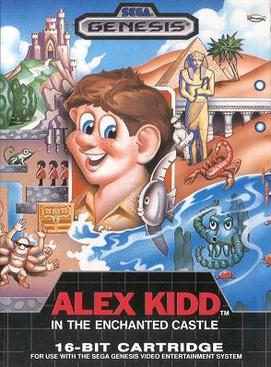
Alex Kidd proved to be a hit on the Sega Master System throughout the eighties, and was arguably the console’s mascot. The question was, could he continue to be their main draw for Sega’s latest console, the Mega Drive? Clearly not, as this was his only outing on the 16-bit console.
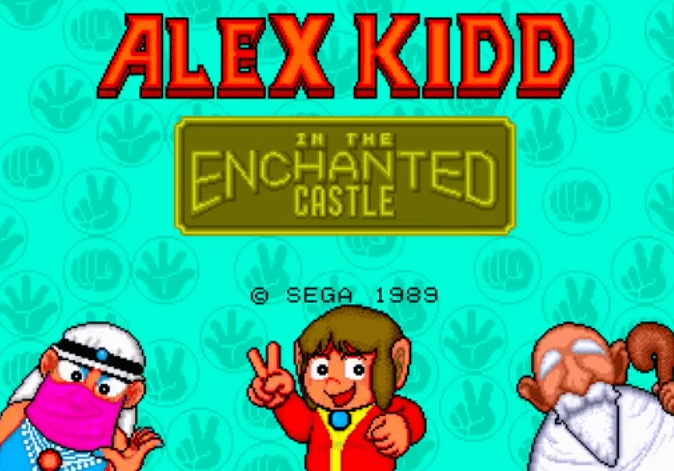
Title screen (screenshot taken by the author)
Alex Kidd and the Enchanted Castle is a single-player platform game developed and published by Sega. It was released for the Mega Drive in Japan in 1989, Europe in 1990, and the US in 1991. It was later released on the Wii Virtual Console, Mega Drive Handheld, Cloud Online, and Steam. I chose to review the original Mega Drive version.
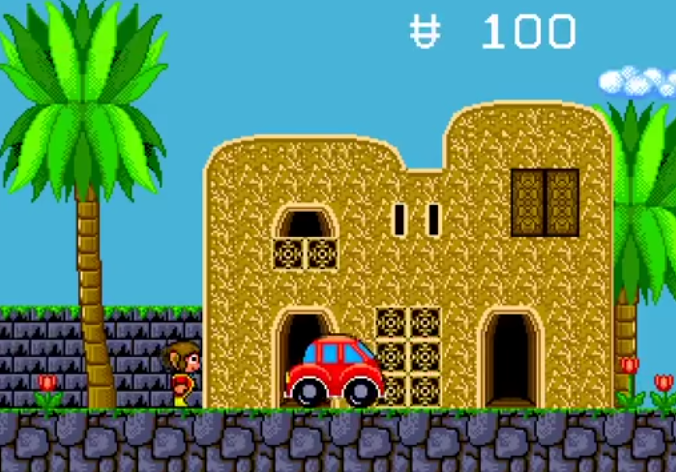
Rookie Town (screenshot taken by the author)
Plot
On the planet Aries, Alex Kidd’s father, King Thor, has been kidnapped by Ashra, the ruler of planet Paperrock. Alex travels to Paperrock in a bid to rescue his father. He must navigate through 11 stages:
1. Rookie Town
2. The Prairie
3. The Splashy Sea
4. Scorpion Desert
5. The Pyramid
6. The Hiho Forest
7. Tropics Town
8. Rocky Mountain #1
9. Rocky Mountain #2
10. In the Sky
11. Sky Castle
Gameplay
The gameplay is simple: Run, jump, punch, kick, crawl and swim. When breaking into red treasure chests, coins will spill out for Alex to collect. Grey treasure chests contain lives and power-ups. Beware, however, as some chests, some contain bombs that explode and will kill Alex.
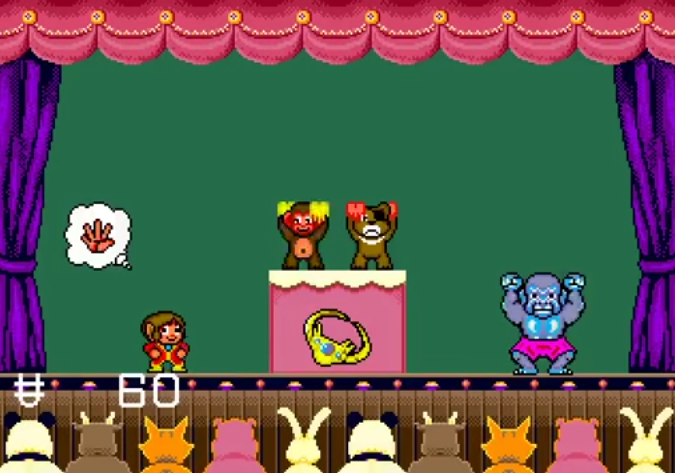
Jan-Ken-Pon (screenshot taken by the author)
Along the way, Alex can pay to compete in Janken fights (paper, scissor and rock) with shopkeepers to win equipment and power-ups. These include motorcycles, helicopters, a pogo stick, a wizard’s cane, a cape, and a necklace that helps Alex to see the thoughts of his opponent. This item gives you a better chance at winning Janken. At the end of every level, Alex must collect a piece of cake to progress.
Alex can swim and, thankfully, seems to be able to breathe underwater (screenshot taken by the author)
The power bracelet is very useful and allows alex to shoot a crescent-shaped band of light that kills the baddies.
Spoiler alert!!!
You need to have the power bracelet equipped after beating Ashra at Janken so that you can fire at him from a distance. This is the only way to defeat him.
How Does It Handle?
The physics of the game take a bit of getting used to. Alex will slide around a bit when quickly changing direction, and is a bit floaty when jumping, which takes a bit of getting used to, so be careful near enemies.
Graphics
Graphically, the Mega Drive is capable of so much more. The sprites are nicely drawn, if a little cutsie, suggesting this game was meant for a younger audience. Sadly, the levels and backgrounds are rather basic.
Music
The music, however, is very catchy and will get stuck in your head. When revisiting this game after 20 odd years, I still remembered the tunes instantly and began to hum along.
Replay Value
There are three difficulty settings: easy, medium and hard. With increased difficulty, you are given less lives to start with and the Janken opponents are harder to defeat, adding to the game’s replay value.
Did I Complete The Game?
Yes, but I have only played through on easy mode.
What The Critics Said:
Mean Machines Sega:“The graphics and sound are almost Master System Standard, and while it’s fun to play, with plenty of secret rooms and things to work out, it lacks that really addictive spark that makes the 8-bit Sega Alex Kidd games so much fun to play. For ardent Alex Kidd fans only. Overall 68%”[1]
Sega Pro: “Alex’s only appearance on the Mega Drive is not a bad attempt…although it can get repetitive. Overall 77%”.[2]
The Games Machine:“It goes without saying that Alex Kidd highly playable and incredibly addictive. Overall 82%”.[3]
Sega Power:“Alex goes 16-bit in this colourful platform exploration romp. As with previous Alex Kidd games, the jolly atmosphere belies the testing gameplay. Fun and very polished. Overall 3/5”.[4]
My Verdict:
“Definitely one for the younger gamer. It can be completed very easily without too much hassle, but there is little to keep you coming back for more. Catchy music, nice sprites and bright colours, but the level design and backgrounds are a bit basic and could be more visually pleasing. However, I do have a softspot for this game and feel it’s been harshly judged by critics. I certainly keep it in my collection and revisit it every year or so. It’s also handy to keep around for my niblings.”
Rating:
What are your memories of Alex Kidd in the Enchanted Castle? I would love to hear your thoughts, and don’t for get to follow and subscribe so that you don’t miss my latest reviews! You can also find me on Instagram: @nicklovestogame.
[1] ‘Game Index: Mega Drive – Alex Kidd and the Enchanted Castle’. Mean Machines Sega. (October 1992). Issue 1:137.
[2] ‘Sega Showdown – Alex Kidd and the Enchanted Castle.’ Sega Pro. (November 1991). Issue 1:18.
[3] ‘Alex Kidd and the Enchanted Castle’. The Games Machine. (June 1989). Issue 19:18-9.
[4] Jarrett, S., ‘The Hard Line – Alex Kidd and the Enchanted Castle’. Sega Power. (April 1991). Issue 23:52.
“We’re tiny, we’re toony. We’re all a little looney. And in this cartoony we’re invading your TV. We’re comic dispensers. We crack up all the censors. On Tiny Toon Adventures get a dose of comedy.”
Title screen (screenshot taken by the author)
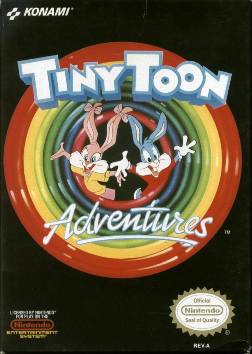
Tiny Toons Adventure is a single-player platform game developed and published by Konami. It was released on the NES in 1991 and it was this version I chose to review.
Plot
Not all is well in Acme Acres. The spoilt rich kid Montana Max is angry because he was unable to bribe the judges of the Animation Festival at Acme Looniversity. Now in a sulk, and wanting to get back at the winner, Buster Bunny, he kidnaps Babs Bunny. Buster, along with pals Dizzy Devil, Furrball, Plucky Duck and Hampton, sets out to rescue Babs.
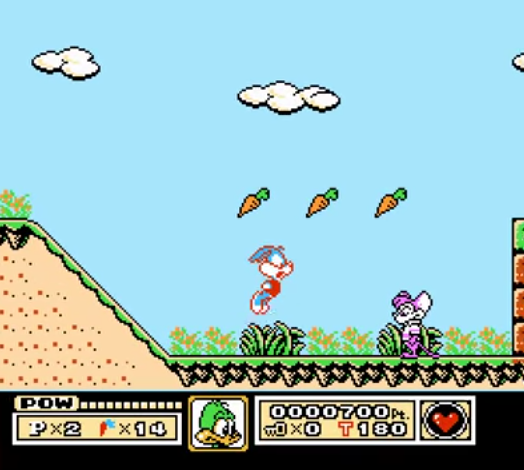
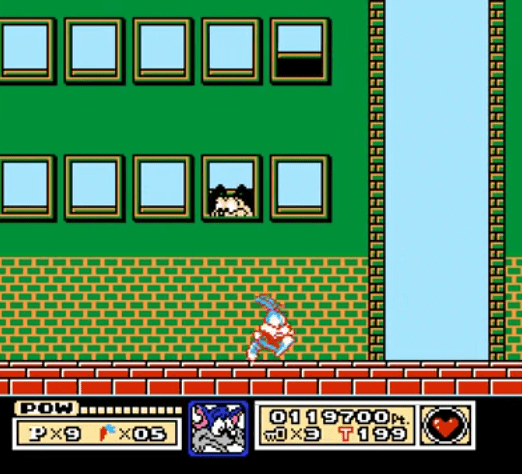
A cute little platform game (screenshot taken by the author)
Gameplay
You initially start as Buster Bunny, but can also select Dizzy Devil, Furrball and Plucky Duck, each with their own unique abilities, to assist Buster. You will become your selected character when you collect the star icon. Using these characters, you must complete six worlds each with three levels (except the last two worlds which need to be completed in one go). These include:
1. Field of Screamz
2. Motion Ocean
3. Sure Weird Forest
4. Boomtown
5. Wacklyland
6. Monty’s Mansion
Each world ends with a boss battle. Throughout the levels you have the chance to collect carrots which can be exchanged with Hampton for extra lives.
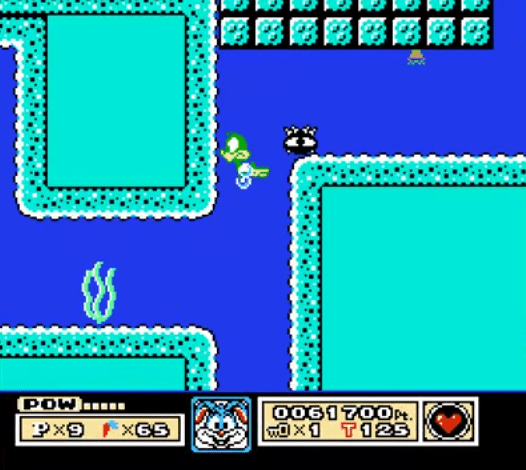
You can only choose one character to assist Buster at the beginning of each world. It is disappointing that in order to change characters, you need to find the star icon as it would have been a nice opportunity to put in some more complex puzzles where each character is needed to use their unique skill. My preferred sidekick was Plucky Duck as he is the best swimmer and can glide whilst jumping.
How Does It Handle?
This is a cute little game, and it’s quite fun to play as the different characters. The controls are easy to learn and are very responsive. Each level has a time limit, which gives you a warning if the timer goes below 30 seconds. You also have unlimited continues. However, if you do use a continue, it takes you back to the beginning of the world.
Each character has unique abilities. Plucky Duck is the best swimmer (screenshot taken by the author)
It is also frustrating that if you die in the boss battle, you are sent back to the beginning of the level, but I guess they need to give the game some longevity.
Graphics
The Graphics for the levels and backgrounds are good…not great, just good. Then again, they don’t need to be ground-breaking. This is based on a children’s cartoon after all. The sprites are nicely drawn, although, it is a bit peculiar how Buster Bunny and Plucky Duck don’t have a nice clear black outline like the other sprites.M
Music
Oddly, there is no music over the title screen, but the in-game music is an 8-bit version of the Tiny Toon theme from the animated series. There is some musical variety through the different levels, but it is the main theme that is most often heard throughout the game.
I’m confused as to why Plucky Duck and Buster Bunny don’t have a nice clear black outline like all the other sprites (screenshot taken by the author)
Did I Complete The Game?
Yes, although I think I used approximately 20 continues for the last two worlds alone.
What The Critics Said:
GamePro:“Strip away that popularity, however, and you’ve still got a solid game with decent challenge. Konami’s given the Toons’ graphics their 8-bit best. Overall 3.4/5”.[1]
Entertainment Weekly:“This multilevel action game is easy enough for even small children to master, although older kids may be challenged by the higher levels. Overall A-“.[2]
N-Force:“The funky fluffy sounds, perfectly compliment the graphics, and gameplay’s as brilliant as ever, with six massive levels and a multitude of sub-levels, the lastability factor’s excellent. Overall 89%”.[3]
My Verdict:
“Nice graphics and a fun little game which is diverting in its own way. The last two worlds in particular are quite challenging. Sadly, with one difficulty setting, there is a real lack of replay value. Definitely one for the younger gamers out there.”
Rating:
What are your memories of Tiny Toons Adventure? I would love to hear your thoughts, and don’t for get to follow and subscribe so that you don’t miss my latest reviews! You can also find me on Instagram: @nicklovestogame.
[1] The Missing Link. ‘Nintendo Pro Review – Tiny Toon Adventure’. GamePro. (December 1991). Issue 29:38.
Shoot ’em ups are not for the light-hearted. They require the quick reflexes and hand-eye coordination of a sprightly feline. They can also be immensely fun to play, especially in co-op mode. These sorts of games were perfect for the arcades and players brave enough to attempt them would soon find they had a mass of spectators cheering them on. Those were the days!
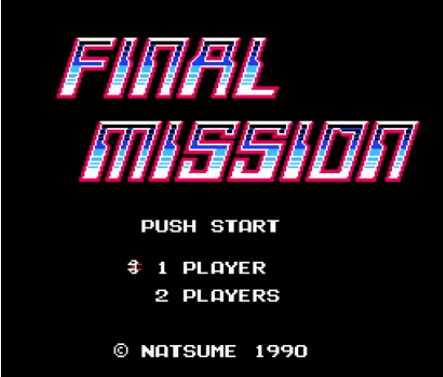
Title screen (screenshot taken by the author)
Final Mission is a side-scrolling shoot ‘em up developed by Natsume. It was published by Natsume Co. Ltd. (North America and Japan), Infogames (Europe), and Konami (Australia). It was released on the NES in Japan in 1990. In North America it was released in 1991 under the name SCAT: Special Cybernetic Attack Team. In 1992, it was released in Europe and Australia under the name Action in New York. It was later released on the Wii Virtual Console in 2011, and the Nintendo DS and Wii U in 2014. For this review, I played the NES version.
Plot
The year is 2029, Supreme Commander Vile Malmort leads an army of aliens to invade and conquer Earth. A team consisting of soldiers that are part-human, part-machine, are assembled and sent to repel the invasion.
Use your satellites to attack the enemy, and protect your six! (screenshot taken by the author)
Gameplay
Final Mission can be played in one or two-player co-op modes. You play as either Arnold or Sigourney, no doubt a nod to Arnold Schwarzenegger and Sigourney Weaver (in the Japanese version they are both male). You are equipped with jet packs and two satellite modules that fire at the enemies as you fly around the levels destroying the invaders. You must battle your way through five levels: New York City Ruins; Subterranean Realm; the Astrotube; the Battleship; and the Orbiting Platform. You can pick-up several upgrades along the way, boosting your attacking power and maneuverability. The upgrade icons are:
S – Increases the speed of your warrior
L – You wield a high powered laser gun that can shoot through some walls
W – You wield a wide beam to attack multiple enemies
B – Explosive shells
R – Restores your lost energy
How Does It Handle?
The controls are simple and easy to learn. The D-pad moves you around the screen. The B button fires your weapons (some weapons fire continuously when the fire button is held down). The A button locks your satellites into position, and unlocks them again so that they can change position as you move. There is no time limit but the screen will scroll sideways (and sometimes up and down). This feature adds an element of strategy when battling through the levels. Sadly, it only takes three of four hits before you die. You only have one life and four or five continues, which are used up very quickly making this game is very tough.
Graphics
The graphics and level detail are good. The backgrounds are very detailed and look great. In NES shoot ‘em ups, the backgrounds aren’t usually as detailed (see Gradius II [1988] and Over Horizon [1991]), but Final Mission’s backgrounds are really impressive. However, there is a little bit of flicker when the screen gets too busy.
Did I Complete The Game?
Nope, didn’t even get past the first stage.
What The Critics Said:
At present I have been unable to find a contemporary review of this game.
My Verdict:
“This game looks great and the controls easy to learn and are very responsive. Sadly, the difficulty level is rather off putting and I found that I simply didn’t enjoy playing this game. However, it is a little more fun in two-player mode.”
Rating:
What are your memories of Final Mission? I would love to hear your thoughts, and don’t for get to follow and subscribe so that you don’t miss my latest reviews! You can also find me on Instagram: @nicklovestogame.
I often wonder what goes through the minds of game creators. Naturally, creators wish to make money but at the same time, surely they want to make a game that’ll be loved by gamers. Why they would create games that frustrate gamers because of limited moves, the inability to select weapons, and limited lives and continues, I’ll never know? Kage is one such game!
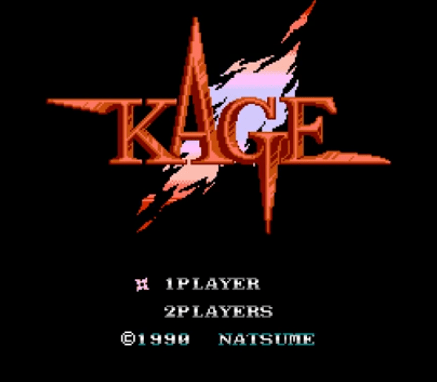
Title screen (screenshot taken by the author)
Kage was developed and published by Natsume in 1990 (Taito in 1991). It was later renamed as Shadow of the Ninja in Japan and Blue Shadow in Europe and Australia. Originally released on the NES, it was later re-released for the Virtual Console on the Wii. For this review, I played the NES version.
Plot
Set in 2029, the evil Emperor Garuda has taken over the USA. Two ninjas from the Iga clan, Lord Hayate and Lady Kaede, are sent to infiltrate the Emperor’s stronghold and assassinate him.
Gameplay
Using weapons such as the katana (sword), shuriken (throwing stars) and kusarigama (sickle and chain), the ninjas must fight through numerous enemies and sub-bosses. There are five levels broken down into 16 stages, which see you fight through a seaport, underground sewers, city rooftops, an air fortress and a final fortress.
You can select to play either as Lord Hayate or Lady Kaede (screenshot taken by the author)
It can be played in both single and two-player mode. In one-player mode, you have the option to decide who you play as. You can run, jump and attack, and even hold onto certain platforms and hang from them. You can then choose to flip up to that platform or drop to the platform below. However, you can only attack the way you are facing when hanging from a platform.
How Does It Handle?
The controls are responsive and simple…perhaps too simple. When using the katana and shuriken, you can only attack straight in front of you or in a crouching position. You cannot slash your sword or throw a shuriken up or diagonally, which I think is pretty dumb, especially where the shuriken is concerned. You can attack diagonally up and straight up when you wield the kusarigama, but not down or diagonally down. Finding scrolls throughout the levels increases the range of your attack, but I didn’t find any on the first stage. You may also find bombs and health potions.
Hangin’ tough (screenshot taken by the author)
Annoyingly you cannot switch between weapons meaning when you pick up shurikens, you have to use them up before reverting back to the katana or kusarigama, or you need to find an item box conatining a different weapon or additional shuriken. This is frustrating because, and I’m sure I don’t need to explain this, but I will, it would be very handy with some bosses and sub-bosses to be able to save some shurikens back.
Thankfully, there is no time limit on the levels meaning you can take your time.
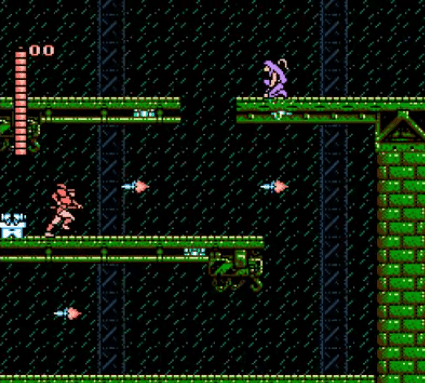
Be prepared to evade small missiles (screenshot taken by the author)
Graphics
Graphically, levels are detailed and well designed, and the sprites are clean and well defined. No complaints there.
Music
The music is very basic and easily forgettable.
Personal Thoughts
I didn’t spend that much time on this game because I found the limited move set frustrating and I just didn’t enjoy playing it. The inability to defeat various enemies without taking hits is frustrating.
Did I Complete The Game?
No, I only managed to get to level 2.2 before I gave up.
What The Critics Said:
GamePro:“Shadow of the Ninja, however, is above average Ninja fare with top of the line graphics and fast-paced gameplay. One minor hang-up is the sluggish transition between dialogue screens. But all in all this is a top flight, fast-paced action cart.” Overall 4.6/5”.[1]
Electronic Gaming Monthly: “Superb Graphics and sound intensify this battle for freedom. No rating”.[2]
Total!: “A sexy-looking and very playable platform hack ‘em up, with great two-player option. It’s just a bit too easy for my liking. Overall 74%”.[3]
My verdict: “This game isn’t bad, but the limited ways to attack your enemies make it very frustrating. Sadly, this detracts from the nice graphics and keeps me from wanting to pay more. It’s a poor man’s Ninja Gaiden”.
Rating:
What are your memories of Kage? I would love to hear your thoughts, and don’t for get to follow and subscribe so that you don’t miss my latest reviews! You can also find me on Instagram: @nicklovestogame.
[1] Bro Buzz. ‘Nintendo Proview – Shadow of the Ninja’. GamePro. (July/August 1991). :24-5.
[2] ‘Shadow of the Ninja’. Electronic Gaming Monthly. (April 1991). 21:98-102.
Many gamers love a good martial arts beat ’em up…Double Dragon, Shinobi, and Ninja Gaiden to name a few. Oddly, Kick Master is set in a medieval world where you battle through forests and caves as oppose to city streets. Where are the knights with their mighty steeds and glinting armour? Where are the broadswords, morning stars, maces and axes? There are none. Apparently, the best way to defeat the monsters in this game is by using an array of kicks. So limber up those hamstrings and groin muscles, and prepare defend yourself against an army of evil demons. Why? Because yet another princess needs saving! After all, if you don’t do it, who else will?
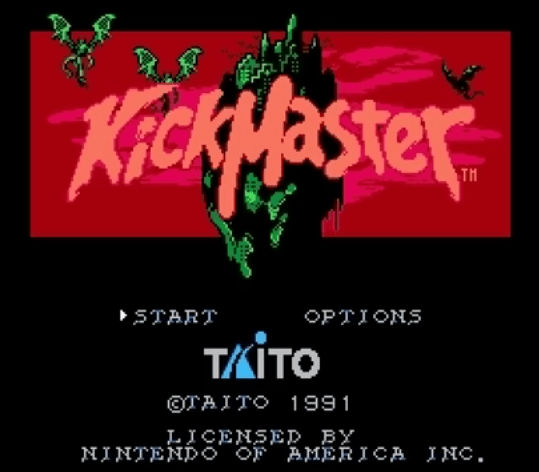
Title screen (screenshot taken by the author)
Kick Master is an action game developed by KID and Published by Taito. Although it is considered an action game, it contains elements of a role-playing game, explained below. It was released on the NES in 1992, and this was the version I chose to review.
Plot
Castle Lowrel has been attacked by the evil witch Belzed. The king and queen have been slain, and Princess Silphee (strange name I know) has been abducted. You play as Thonolan, an aspiring martial artist, who must battle through eight stages of monsters and defeat Belzed by using an array of kicks and magic spells.
Gameplay
When you kill a monster, it releases three objects for you to grab. Each object either assists you (heart for energy, coin for experience points, and potion bottle for magic points) or hinders you (skull and crossbones for poison). Along the way you will pick up different magical abilities such as lightning, healing and fireballs etc. (thankfully these are also explained in the manual). As your experience level increases, more types of kicks are unlocked.
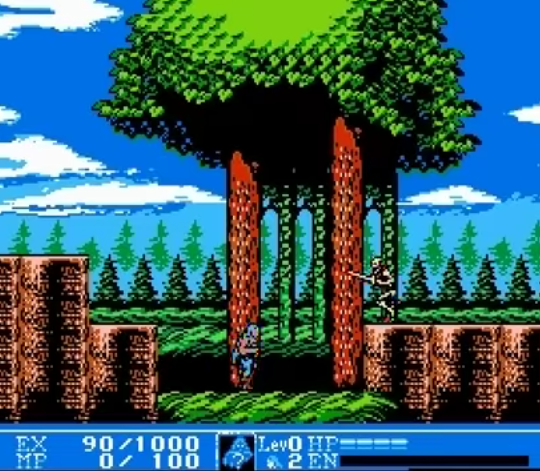
The level graphics are very detailed and push the NES to its limit (screenshot taken by the author)
How Does It Handle?
The gameplay is quite frustrating and takes some getting used to. The reach of your kicks isn’t all that far, so you have to be incredibly precise with the timing of your attacks else you get hit by the monsters.
The levels have no time limit which allows the player to take their time and really get to grips with the different kicks when they become available. The game has infinite continues, and after each level you will be given a password, allowing you to walk away and come back to it another day. However, you will not get to see the end credits until you complete it on the hardest setting.
The game actually requires a certain amount of tactics. As mentioned above, when an enemy is killed, they release three objects. If you’re quick enough you may be able to catch two before they disappear off screen. However, it soon becomes clear that you must either focus on gaining experience points to unlock more kicks, or collect magic points to be able to use spells. You can do a mix of both of course. This adds a layer of complexity to the game not often found in these sorts of 8-bit adventures.
Additionally, one nice feature is that in the options menu, there is a demonstration of all the kicks Thonolan can perform, and at what level he needs to achieve to unlock them. This is also explained in the manual.
Graphics
The title screen is quite plain, with a black screen and a rectangular banner with Kick Master splashed across it.
The pre-game intro is text based, but once the game begins, an animated introduction shows how Thonolan’s brother is killed in battle. The illustrations are bright and colourful, but the animation is very basic. The character illustrations do not move but the background does in a parallaxing kind of way.
Graphically, the levels look great and are very detailed. They probably pushed the NES to its limits. All the sprites are distinctive and are varying in their strength and difficulty to defeat. This was also the first game to use parallax scrolling.
Music
The music that then plays is quite catchy and fits well with the game, adding an air of almost Castlevania-esque creepiness to it.
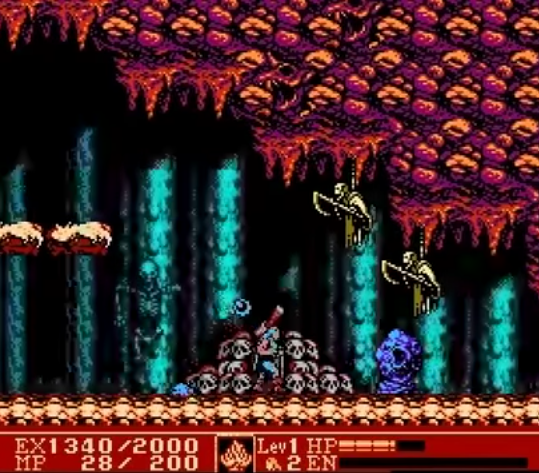
Entering the bowls of the Earth! (screenshot taken by the author)
Personal Experience
I can’t say that I didn’t enjoy playing this game, but then again, I can’t say that I did. I am…indifferent to it. I wasn’t instantly enamoured with this game, but I will say that the game grows on you the more your play.
Did I Complete The Game?
At present, I have been unable to complete the game. I managed to reach the octopus boss battle at the end of level 5 but so far am unable to defeat it. I do, however, have a password and will no doubt return to this game in the future.
What The Critics Said:
Gamepro:“If Kick Master sounds similar to most NES side-scrolling martial arts offering, you’re right. But that doesn’t mean it’s not great. The challenge pushes the fast-and-furious needle almost off the scale, but that’s cool because you get unlimited continues and passwords. Overall 21/25”.[1]
“The gameplay takes a little getting used to but the graphics look great. Take time to get used to Kick Master as it will grow on you. This game is a challenge and will not be completed in an afternoon.”
Rating:
What are your memories of Kick Master? I would love to hear your thoughts, and don’t for get to follow and subscribe so that you don’t miss my latest reviews! You can also find me on Instagram: @nicklovestogame.
[1] Boss Music. ‘Nintendo Pro Review – Kick Master’. Gamepro. (February 1992). 31:28.
[2] ‘Kick Master’. Nintendo Power. (September 1991). 28:42-47.
“Space…the final frontier. These are the voyages of the starship Enterprise. Its five-year mission to explore strange new worlds; to seek out new life and new civilisations; to boldly go where no man has gone before.”
Title screen (screenshot taken by the author)
Star Trek: 25th Anniversary is a single-player adventure video game in the point and click format. It was developed and published by Interplay for DOS in 1992, Amiga in 1994, MacOS in 1995 and OSX and Linux in 2015. For this review, I played the Enhanced CD version.
Plot
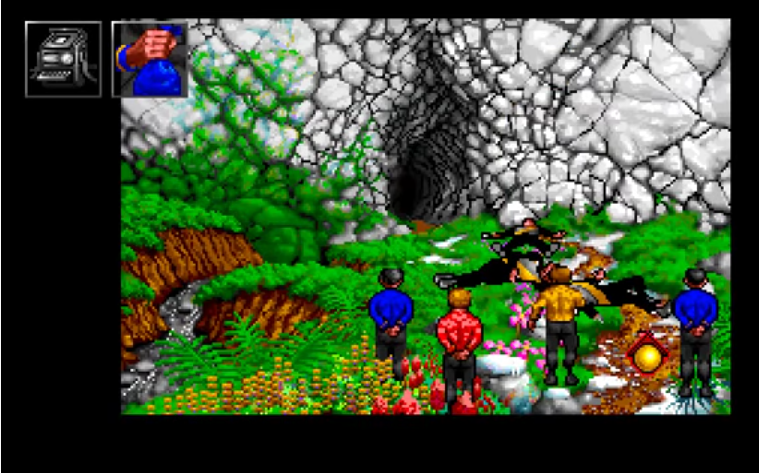
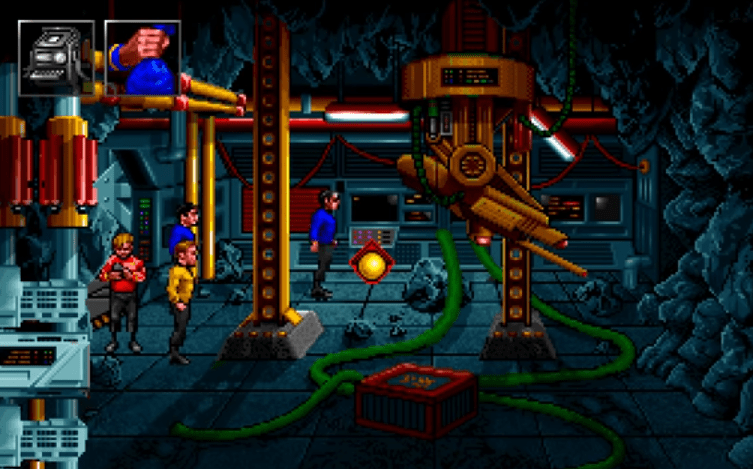
Based on Star Trek: The Original Series, the game sees you take control of the crew of the starship USS Enterprise. There are seven missions to complete, with each mission styled like an episode of the series. During these missions you encounter strange new species, as well as run-ins with more familiar alien races such as the Klingons and Romulans. There is even an encounter with notorious con-artist Harry Mudd. However, the game isn’t just point and click based. There are also opportunities for space battles too when dealing with the Elasi pirates.
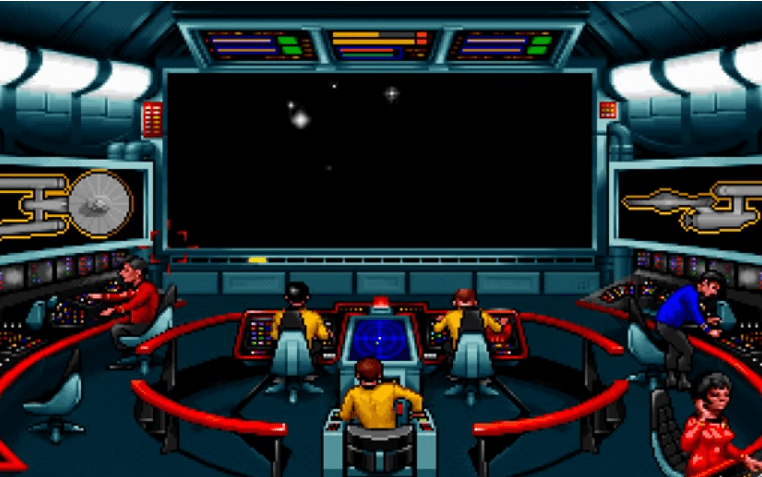
On the bridge of the USS Enterprise (screenshot taken by the author)
Gameplay
The gameplay is mostly point and click based. You can select whether to walk, look, speak to, or interact with; scenery, people, and items. Your inventory is available at the top left of the screen where you can choose to wield weapons or items when interacting with your surroundings. You also have the ability to select characters to interact with your environment which adds to the realism of the game…you wouldn’t ask Bones to decipher a computer lock would you…”Damn it Jim I’m a doctor, not a locksmith!!”.
When talking to the many characters you encounter, you sometimes have several options of how to interact. Only one is the correct way to reply or ask a question. The others are considered too hostile for Federation standards and affect how the other character reacts and, ultimately, your end of mission score.
Occasionally, you may be called upon to use your phasers against an enemy. You will have the option not to fire, fire on stun setting, or set your phasers to kill. Again, your decision affects not only the safety of your crew, but also your end of mission score.
It’s the Klingons!!! (screenshot taken by the author)
How Does It Handle?
This game is a bit more complex than most point and clicks of its time. The main point and click parts of the game are straight forward. However, the starship battles take practice as you need to learn to fix your ships damage whilst flying your starship.
The puzzles have varying degress of difficulty. Most are simple enough, but some of the missions allow for more than one outcome which greatly affects your end of mission score. One mission however, is very tough, especially if you find maths difficult. I don’t know anyone who worked it out without using a walkrthough.
A particularly nice touch is that before you beam to your destination, you are able to access the ship’s computer and type in keywords from your mission brief. A computer voice will then read out the relevant information and then, like Wikipedia, you find yourself scribbling down keywords and going down a rabbit hole gaining more and more information about the mission ahead.
Be advised, if you buy this game online, you will need to Google for the star map which came with the original instruction manual wise you won’t know which solar systems to navigate to and will end up in counties space battles with Klingons, Romulans or Elasi Pirates.
Graphics
Graphics wise, the game looks brilliant. The sprites are bright, colourful and clearly defined. The backgrounds are incredibly detailed and well-illustrated. The only downside to the graphics are the pixalated look of the starships and planets during the intro and beginning of each mission. During battles, the starships are designed to give the illusion of the ships being 3D but they clearly are not, and at times look less than smooth.
SFX
What makes this game particularly great, is that it contains the actual voices of the original crew, with authentic music from the show (albeit an 8-bit version). The background sound FX, especially when you are on the bridge of the Enterprise, are very reminiscent of the TV show and really immerses you in the game. Additionaly, what brings this game to life is the interactions between the characters which makes you feel as if you are watching an episode of Star Trek.
“Fascinating” (screenshot taken by the author)
Spoiler Alert!!!
Beware on the last mission. There seems to be a bug which leads you to a dead end. I spent a lot of time revisiting rooms before looking online to see where I’d gone wrong. This was where I read some walkthroughs and realised, I’d gone wrong. I only used the walkthrough to help progress on Mission six where some advanced mathematical skills are needed to find a code.
Did I Compete The Game?
Yes, many years ago, but I did need help for mission six when you need to work out a code for a door lock.
What The Critics Said:
Computer & Video Games: Frank O’Connor “The graphics are in super mega VGA-o-Vision and look dreamy. The sprites are excellent, right down to the high-heeled boots for the male characters. The music is a spot-on rendition of the TV themes, with a smattering of groovy sound effects for good measure. Overall 93%”.[1]
ACE:“The only real problem is the overall longevity, as defined by the number of missions – with only eight of them, seasoned adventurers may find the challenge distressingly short-lived. Those new to the genre, however, would be hard pushed to find a friendlier, more enjoyable and absorbing experience. Overall 960/1000”.[2]
My Verdict:
“Authentic, fun, challenging…one of the best Star Trek games ever made. Point and click fans should also enjoy the game, even if they’re not Star Trek fans.”
Rating:
What are your memories of Star Trek: 25th Anniversary? I would love to hear your thoughts, and don’t for get to follow and subscribe so that you don’t miss my latest reviews! You can also find me on Instagram: @nicklovestogame.
[1] O’Connor, F., ‘Review: PC – Star Trek: 25th Anniversary’. Computer & Video Games Magazine. (April 1992). Issue 125:60-1.







#/media/File:RoboCop_arcade_flyer.jpg)











#/media/File:St25thannivboxsm.jpg)


 Nick Loves to Game