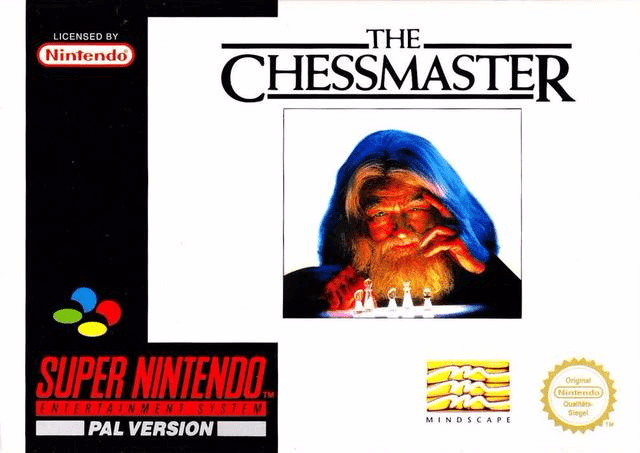
Chess is one of those games that I find rather intimidating. People who excel at chess are considered incredibly intelligent…which is probably why I suck at the game! TheChessmaster franchise was originally developed by Ubisoft and published by The Software Toolworks (formally Software Country). The first instalment of the franchise was released under the name of The Chessmaster 2000 (1986) for the Amiga, Amstrad CPC, Apple II, Atari 8-bit, Atari ST, Commodore 64, DOS, Macintosh, MSX, and ZX Spectrum. Since its humble beginnings, technology (and gamer expectations) had moved on. How would the mighty SNES deal with those expectations?
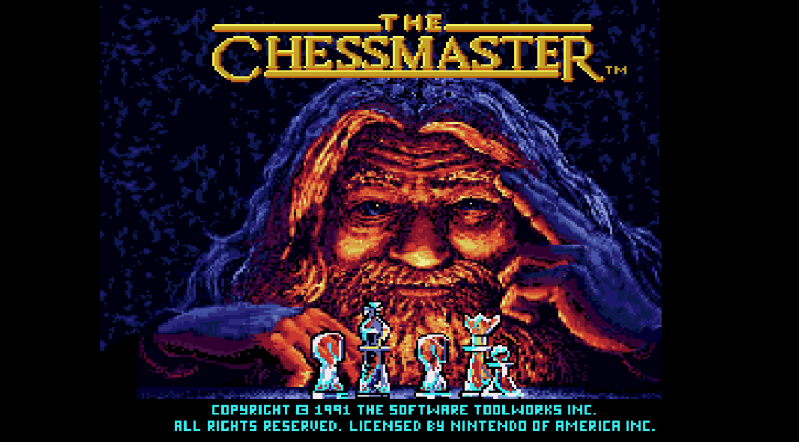
Title screen (screenshot taken by the author)
The Chessmaster is a chess simulator released for the NES (1989), Game Gear and Game Boy (1991), and the SNES and Mega Drive in (1992). For this review, I played the SNE version.
Objective
Manoeuvre your pieces so that you can gain a “checkmate” on your opponent. A “checkmate” is when you position your pieces in such a way that your opponent cannot move their king safely out of “check”, block your pieces with one of theirs, or take one of your pieces to take their king our of “check”.
Gameplay
The game can be played in single or two-player mode. You ad your opponent begin with a full army of troops that include:
Pawn x 8 – They can move two spaces forward on their first turn but can only move forward one space after that. They can “take” an opponent’s piece if they are diagonally one space in front of them. If the make it to the last row closest to you opponent, your pawn can be promoted to either a Rook/Castle, Knight, Bishop or Queen.
Rook/Castle x 2 – They can move as many spaces as they like horizontally or vertically (forward and backward) or until they are blocked by another piece.
Knights x 2 – They can move in all directions as long as it equates to one space forward/backward/sideways and then one space diagonally in the same direction. They are the only piece that can leap over other pieces.
Bishops x 2 – They move diagonally forward or backwards in a straight line as many spaces as they like until they are blocked by another piece.
Queen – The most powerful piece. She can move in a straight line in all directions as many spaces as they like until they are blocked by another piece.
King – The king can only move one space, in any direction they wish, at a time (with the exception of “castling”, see below).
If the king is in “check”, the only move you can make is to either move the king out of check or move another of your pieces to block the check, or take the piece that has the king in “check”.
To move your pieces, use the ‘D’ pad to move the hand over the piece you wish to move and then drag them to the square you wish to place them. The computer will tell you if you try to make an illegal move.
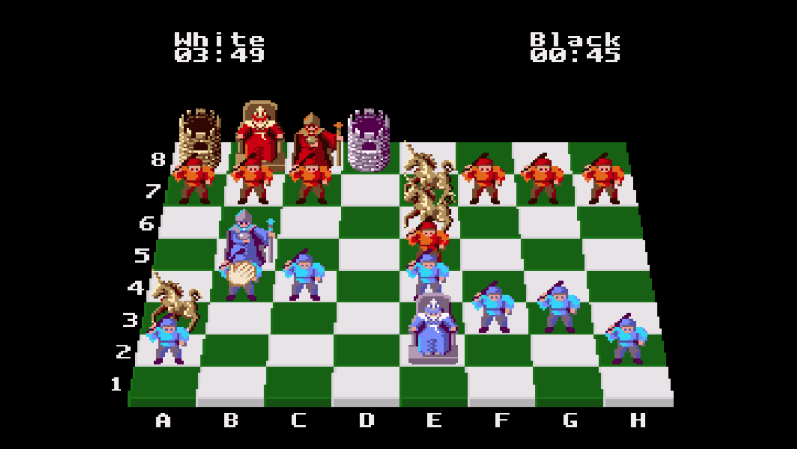
Standard 3D view (screenshot taken by the author)
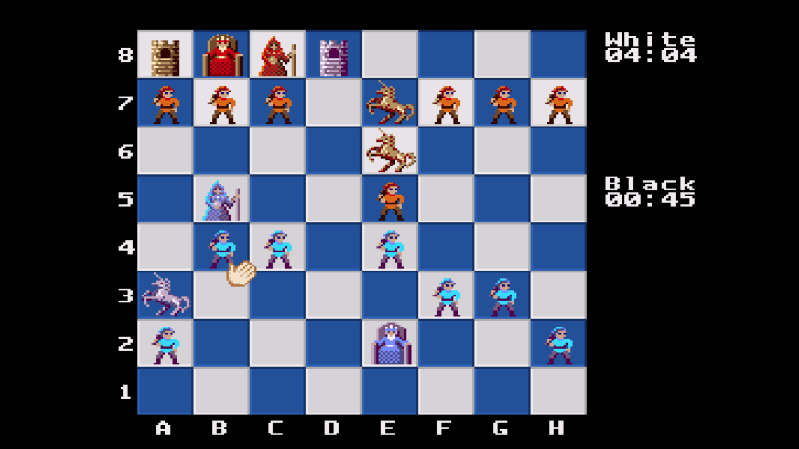
Standard 2D view (screenshot taken by the author)
Special Moves:
En Passant – French for “in passing”, it can only be performed under specific circumstances by pawns. Rather than me attempting to poorly explain it to you, follow the link to hear chess expert David Pruess explain the manoeuvre.
Castling – This is one of the first special moves you are likely to have been taught when playing chess. Your rook/castle and king must still be in their original starting positions without having been moved so far during the game and with no other piece of either colour standing between them. The king can then move two spaces towards the castle. The castle then automatically transfers to the next space on the opposite side of the king.
At anytime in this version, you can open up the options menu which allows you the option of the following:
The option screen…which can only be accessed during a game (screenshot taken by the author)
How Does It Handle?
Once you learn how the pieces move, it is easy to play. However, I’d still recommend playing in 2D mode as I found I was less likely to miss opportunities take a piece or would not spot when one of my pieces was going to be taken.
One of the things I found odd was that from the title screen, you simply jump straight into a game. You then have to open the options menu and make any necessary changes you wish to make. This doesn’t make sense to me. Why not have the options screen available before beginning a game?
Also rather than the hand, I think I would have preferred the square to be highlighted instead. I think this would make it slightly easier to navigate the board.
Fantasy 3D view (screenshot taken by the author)
Fantasy 2D view (screenshot taken by the author)
Graphics
The graphics are very basic, but some would argue you don’t need more than that for a chess game. A chessboard against a black backdrop is sufficient. The 3D fantasy mode looks ok but I think you’d expect better sprites from the SNES and maybe even a little animation like Battle Chess (1988). The fantasy pieces are fun and quirky, but serious gamers may prefer to stick with the standard pieces.
It is unclear why the 2D fantasy view is the only view that changes from green squares to blue squares.
Music & SFX
The music over the title screen (you can also turn this on throughout the game) is a very cheap 8-bit piece that is unbecoming of the SNES.
As for the SFX, there aren’t any, save for a weird duh-duh-duh-da after every move. Who on Earth thought that was a good idea? It becomes incredibly annoying almost instantly.
War Room view(screenshot taken by the author)
Replay Value
If you enjoy chess, then this game has endless replay value. There are around 16 different difficulty levels and every game will be different. For the casual gamer, it may not hold the attention for that long.
Did I Complete TheGame?
I only beat the game on level Newcomer 1.
What the Critics Said:
At present, I couldn’t find and contemporary review of this game.
My Verdict
“Awful, cheap music and SFX really let this game down. I know chess is a serious game and doesn’t need all the bells and whistles, but this is a SNES game and I expected a bit more in those departments. I just hope it didn’t cost £40 on its release!”
Rating:
What are your memories of The Chessmaster? I would love to hear your thoughts, and don’t for get to follow and subscribe so that you don’t miss my latest reviews! You can also find me on Instagram: @nicklovestogame.
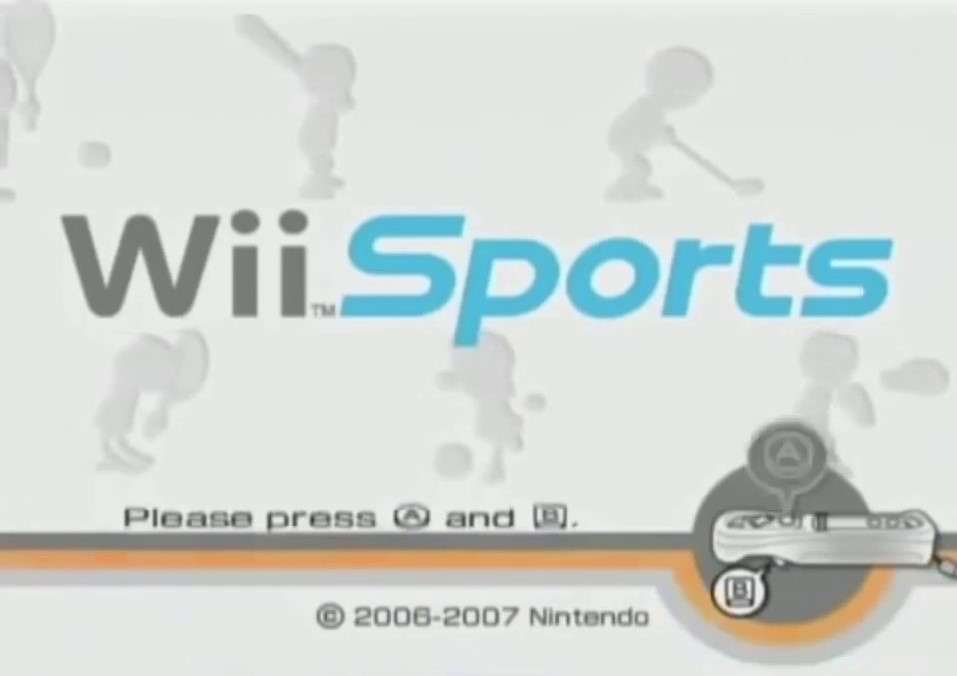
Wii Sports holds the accolade of Nintendo’s biggest selling video game with 82.9 million units sold as of 2022. However, these figures seem less impressive when you keep in mind that it was part of the bundle when you bought the Wii.[1] That being said, one cannot fault Nintendo’s pushing of gaming boundaries here. The results may not have been perfect, but it sparked an array of easily accessible games for people of all ages and abilities to enjoy.
Title screen (screenshot taken by the author)
Wii Sports is a sports simulation game developed and published by Nintendo. It was released for the Wii in 2006. For this review, I dusted off my old Wii and had a trip down memory lane.
Plot (or in this case, what is the game all about?)
As with all sport sims, there is no “plot”. Instead, there are five different sports for you to compete in and can be played with upto four players with the exception of boxing and baseball which are single- or two-player games. To play the games, you use the Wii remote to simulate the actions you would make if you were to play these games in real life.
Tennis
Gameplay
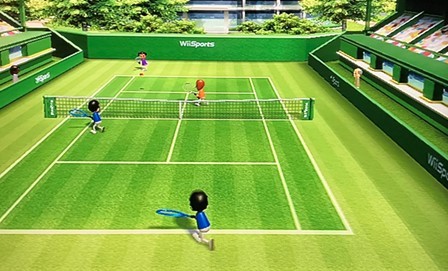
With up to four players, you can choose to play a single game, best of three games or best of five games. The direction you hit the ball is very much based on the timing of your swing and the position of your Mii (your character). However, when serving, you simply raise your remote as if throwing a ball into the air before swiping at it to send it towards your opponents. The rules and point system are the same as a real life tennis game.
How Does It Handle?
The fact that the direction the ball is hit is based on the timing of your swing and the position of your Mii can be frustrating because you don’t have control over the position of the Mii. Their movements are controlled by the computer and so one can be forgiven for shouting, in the immortal words of Eliza Doolittle in the movie of My Fair Lady (1964), “Move your bloomin’ arse!“. One little hint when serving is that if you can time it so that you strike the ball when it has reached its peak height, you will hit the ball incredibly hard and fast, making it difficult for your opponent to return the serve.
Graphics
For all the sports in this game, the Mii designs are never going to win prizes for asthetics. However, they don’t need to be breathtakingly detailed because that is not what Wii Sports is about, so I won’t hold their design against the game. The environments of Tennis are nicely coloured, and conjure up feelings of summer days watching Wimbledon and eating strawberries and cream. The varying arrays of greens is rather impressive.
Music and SFX
You only really hear music when you are selecting how many players will play or during the replays when you win the match. The SFX are very realistic. From the sound the ball makes as your strike it, to the cheer of the crowd when a point is scored, the SFX are awesome. The umpire calling out the scores after a point is scored reminds me a lot of old arcade games.
“New balls please!” (screenshot taken by the author)
Baseball
Gameplay
Up to two players can play at any one time. One player bats and the other player pitches. Once you get three opposing players out, your innings ends, and it is your opponents turn to bat. Each team has three innings but if one team leads by 5 runs, a mercy ruling is imposed and the game ends with the winner being the team with the most runs.
To hit the ball when batting, you simply need to time your swing as the ball approaches. However, the pitcher will use all their cunning and guile to throw different types of pitches to ensure you miss the ball. For example, by simply motioning the remote as if throwing a ball, your pitcher will perform a fastball (the fastest ball I can pitch reaches 151KM/H). The faster you throw, the faster the ball will travel. Holding the ‘A’ button while throwing will perform a swerve ball. Holding the ‘B’ button will perform a curve ball and holding both ‘A’ and ‘B’ will perform a splitter. This is where the ball swerves downwards at the last second making the batter swing and miss. If you swing and miss three times, your batter is out. If you hold your nerve and don’t swing at the splitters, four times, then your player will get a free walk to first base. Hitting the ball into the stands within the foul lines will earn you a home run, and all players at the bases can freely run home to score you points.
How Does It Handle?
As the pitcher, trying to disguise your pitch is all part of the fun. The fielding is automatic and so once you throw a pitch, the rest of the game is out of your hands. As the batter, timing your swing is everything. Once you hit the ball, that is pretty much all there is to it. You can’t steal bases, you simply hit the ball and let the computer do the rest. It is a simple game, but suprisingly fun in two-player mode.
Graphics
Again, the graphics are adequate for what the sport is offering. Clear and colourful graphics…what more do you want from such a game?
Music and SFX
You hear the Wii Sports fanfare (which is very memorable) as the players line up at the beginning of the match, and another piece of music once the match has been won (which is not very memorable). Some noticeable SFX consist of when you strike the ball and when the ball is caught by a fielder. However, the main SFX comes from the constant crowd noise giving you a real sense of stadium atmosphere.
“Let’s go Blue Jays!!!” (screenshot taken by the author)
Ten-pin Bowling
Gameplay
This can be played with up to four players. Each player has ten frames. In each frame, you are allowed to bowl twice, with the object being to knock down all the pins. If you knock down all the pins with your first ball, your frame is over and it is the next person’s frame and so on (Note: For frame 10, if you get a strike or a spare, you will end up bowling an extra ball. The maximum score you can achieve is 300 (My highest is only 192). Before bowling the ball, you can adjust your aim, then you simply hold down ‘B’, and perform a bowling motion, letting go of ‘B’ as your follow through.
How Does It Handle?
The game handles very realistically I think. As a right hander, there will always be a natural draw to the left when bowling (to the right if you’re a southpaw), but the method to adjust your position and trajectory is easy to use (this doesn’t mean getting a perfect game is easy though). By twisting the remote as you bowl, you can add spin to the ball as it sails down the lane which is fun to try and master. One nice little quirk of the game is that if you let go of the ball too early, it will fly backwards and land with a thud making the spectators jump.
Graphics
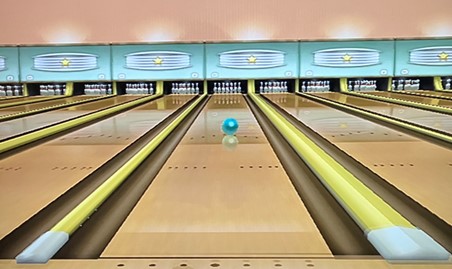
Nothing spectacular is needed for this type of sport, but there are some nice touches. For example, seeing the reflection of the pins and the ball as it is being bowled adds to the illusion of a slick and well maintained bowling alley. Also, when the camera pans around so that you can see what’s behind the bowler, you can see all the Miis wandering back and forth to their lanes.
Music and SFX
The main SFX are the satisfying noise of the pins as they tumble together and fall. Interestingly, for this game they have chosen a lo-fi soundtrack l, that I didn’t notice at first, that plays throughout. However, the post-game music is a nice guitar-riffed country-esque affair, and arguably the nicest piece of music in the entire game.
“We’re gonna score tonight. We’re gonna score tonight!” (screenshot taken by the author)
Golf
Gameplay
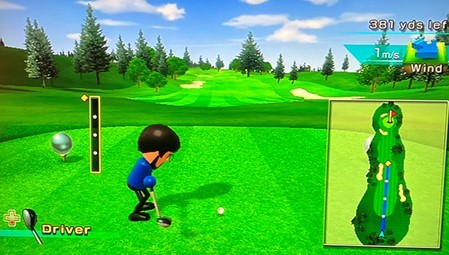
Up to four players can play at any one time. The aim is to get around the nine-hole course in the least number of strokes. To the left of your Mii, you will see a gauge. As you swing the remote, a blue bar will appear to fill the gauge. The harder you swing, the more the gauge will fill. However, if you swing too hard, the gauge will turn red, causing your shot to either draw or slice uncontrollably. You can take as many practice swings as you like but when you wish to hit the ball you will need to press and hold the ‘A’ button to move the Mii forward to prepare for your shot. To help gauge how hard you should swing, dots on the gauge correspond with the dots on the map to your right. This will indicate where your ball should land (taking into account wind and elevation etc.).
How Does It Handle?
I think the game handles well. You are able to swing the remote incredibly lightly too when putting, allowing for the deftess of touches.
Graphics
Again, a lovely array of greens set against a cloudy but blue sky, with the odd sand bunker or water feature present. The colourscheme is strangely relaxing and comforting.
Music and SFX
The main SFX are the when you strike the ball, and when it lands in the water, on land, or when you get it in the hole. If you hit the ball well you are greeted with a “Nice Shot” vocalisation and a cheer from the crowd which (realistically) dies down as the player addresses the ball for their next shot. There is also the pleasant ambience of nature around you complete with bird tweets.
Driving for show, putting for dough (screenshot taken by the author)
Boxing
Gameplay
Up to two-players can play at any one time. The object is to knock your opponent out. Using the Wii remote and the nunchuck, you block, jab and hook as you would if you were really boxing. You can also tilt the controllers left or right to bob and weave and evade the opponent’s strikes.
How Does It Handle?
Although this game shows the potential future of sporting sim games, I didn’t spend much time on the boxing. There is little finesse to the game and I feel that you just end up slugging it out. I’m sure there are people out there who practically make their Mii dance, but I did not have the inclination to become as proficient.
Graphics
Your Mii is transparent but your gloves are fully opaque. I would have liked the option of first person perspective for this game.
Music and SFX
The only music you hear is an urban beat sounding piece after the fight when your stats are shown. The most distinctive sound you’ll hear is the crowd noise as they cheer during the fight. There’ll be plenty of familiar sounding thuds as punches are landed too.
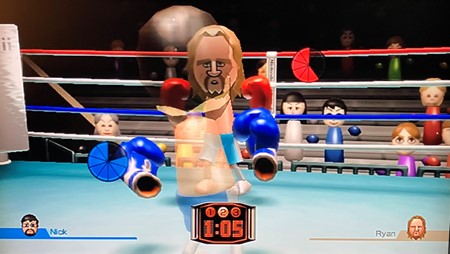
“You’re gonna eat thunder and crap lightning” (screenshot taken by the author)
Extras
As an extra bonus, the game also contains two other features. The first is a training mode which gives you three different training sessions per sport to help improve your skill. The second is a fitness mode which uses tennis, baseball, and bowling to test your speed, strength, and stamina. It then calculates your Wii age…my last attempt put my age at 33. At the time of writing this in 2022, I am 39 so I’ll take that.
Replay Value
Personally, I found this game to have tons of replay value, especially in two- or multi-player modes. The gaining of experience points was a good option too as the competitve amongst us will ensure their Mii has the highest number of points. However, I do also concede that Wii Sports may also be a Marmite game. You’ll either love it or you’ll hate it!
Personal Memories
Many years ago, when I used to live with a buddy, Friday nights were for listening to Reel Big Fish and playing Wii Sports. We’d crack open the beers and would compete mostly on golf and baseball. We occasionally play bowling and tennis, but our hearts lay with golf and baseball. We actually became pretty darn good at the golf game and could birdie most holes.
Did I Complete The Game?
As with most modern sport sims, this is not the sort of game you complete.
What The Critics Said:
Allgame: “As a key launch title, Wii Sports accomplishes everything it sets out to do. It introduces the system’s control scheme in an appealing way, it incorporates the cutesy Mii characters for a personal touch, and it shows off some of the console’s communication capabilities by sending players notes whenever they achieve a certain milestone. More importantly, it is exactly the type of game that will bring users of all ages and skill levels together for laughs, cheers, and some excitement about what may be in store from Nintendo in the years ahead.Overall 12/25”.[1]
Electronic Gaming Monthly: “Good – Grandma can play, comes with the system. Bad – Zero depth. Coolest Feature – Seeing your customized Miis wandering the sidelines. Overall 19/30”.[2]
Eurogamer: “…what it’s actually got here brilliantly embodies the Wii’s dramatic premise: that this kind of control can appeal to people who don’t play games and people who used to play games as well as people who’ve been playing them for as long as we have. That’s not to say that it’s all things to all people, or that it’s without flaws – but when you get lost in tennis late at night, you can be playing because your opponent’s smart, and needs to be forced out of position with varied ground shots, top spin and precisely angled shots; or you can be playing because, golly Michael, come see what Tom’s brought home, it’s a sort of magical tennis racket. It’s more than the parlour game that we all expected, then, but perhaps the beautiful thing is that it still can be that if you want it to. Overall 8/10.”[3]
Gamepro: “Even though Wii Sports is included in the system, we don’t want to give it too much leeway because it’s free. But, realistically, we can’t help but enjoy the fact that we’re getting a solid sports experience for nothing. It’s definitely more fun in groups and won’t have a great deal of longevity, but anyone who doesn’t find at least some fun in Wii Sports has a heart of coal. There, I said it. Overall 4.25/5.”[4]
Gamerspot: “The first time the games included in Wii Sports were shown to the public, it was simply as tech demos to prove that Nintendo wasn’t totally crazy for building a whole console around motion-sensitive controls. Though there’s still kind of a tech-demo feel to Wii Sports, it’s a fun, unique package you’ll enjoy so long as you don’t expect too much detail from it. Overall 7.8/10.”[5]
Gamespy:“Wii Sports is at its best in a group setting, where the familiarity that everyone has with these games makes them incredibly easy to pick up and play. It’s a game you can play with your friends and family, and it perfectly highlights the direction that Nintendo is taking with the platform. It’s not the best-looking game on the system, and it’s definitely not the deepest, but it may well be the most fun. You’re not forking over any money for Wii Sports, so consider it the best money you won’t spend this year. Overall 4/5”.[6]
GameTrailers:“Wii Sports is incredibly fun to play for the first couple days you have it, and you’ll undoubtedly sell some Wiis for Nintendo if you bust it out at a party. But eventually, the relative lack of depth to any of the games exposes it for what it is–a free game that comes packed-in with the system. Overall 8/10”.[7]
GameZone: “Mario. Tetris. Mario World. Wii Sports. These are the four games Nintendo has chosen to include with four of their game consoles. In terms of sales and longevity, Wii Sports won’t do for Nintendo Wii what Mario did for the NES. Wii Sports won’t be played by as many people as Tetris. It is, however, a killer, innovative showpiece that will draw in anyone who witnesses all that it can do. Sure, it lacks goals and can be beaten very quickly. But the ultra-responsive technology and high multiplayer replay value are far greater than any other party or sports game collection. Excite Truck is good, but this is the one that should’ve been packed in Wii kiosks all over the country. Overall 8.5/10”.[8]
IGN: “Wii Sports is a successful showpiece for Nintendo’s new hardware and a fantastic means to get non-gamers talking about Wii. Not all of the games are spectacular. Given the choice, I’d prefer not to play either boxing or golf, which is disappointing because both sports seem like a fine fit for the remote. But the games that do work really work. Baseball is good in short bursts. Tennis is a lot of fun, especially with two or more. And bowling is fantastic – I can’t wait for Nintendo to use these mechanics and release the inevitable (and much deeper) Mario Bowling.
What you’re going to find in Wii Sports is a title that demonstrates the potential of the Wii remote, but comes up short in depth and visuals. Play it for an hour with friends and you’ll love it. Your non-gamer friends will be dazzled by the immediately intuitive controls and the imported Miis. But the title sacrifices incredible depth and visuals for an immediately accessible experience. Overall 7.5/10.”[9]
Nintendo Gamer:“…even though the tennis, golf, and baseball aren’t that great, there’s still no denying that Wiis Sports is a lot of fun. Bowling and boxing alone make it a great party game, and the rest of the sports, though flawed, at least provide a glimpse of what the Wii is capable of…Overall 78/100.”[10]
Nintendo Life:“It’s simply a fun game that is somewhat plagued by the simplicity and a few other errors, but offers a refreshing and satisfying experience. Overall 8/10.”[11]
Nintendo Power:“The whole fitness aspect is cool, but in the single-player game you’ll experience everything Wii Sports has to offer in a matter of hours. Then again, the game does come free with the console, so ГИ stop whining. Overall 8.25/10.”[12]
Official Nintendo Magazine:“Maybe a month or two down the line you’ll have put Wii Sports back on the shelf because the basic nature of the games means that once you get used to them there isn’t much of a replay factor (although the training mode does provide a number of missions for you to complete). But if someone comes over to your house and asks to see how the Wii works, Wii Sports is the game you’ll use to demonstrate. It’s simple yet has a surprising amount of depth, and when played with a group of friends is one of the best multiplayer experiences on the Wii. And it didn’t cost you a penny. Overall 90%”.[13]
PALGN: “A very solid first effort for the Wii, and provides just a taste of what is, and what will be, great about the Wii console. Pick it up, play it and have fun. Very nice. Overall 7.5/10”.[14]
Videogamer: “Undoubtedly, Wii Sports did start out as “just a tech demo” but the game that’ll arrive with your Wii has come a long way since then. It’s come far enough, in fact, that were Nintendo to sell this separately for say £20, it would be something akin to a must buy. It may not win any awards for the best looking or sounding game but it’s great pure fun, and is instantly accessible to pretty much anyone. We all know roughly how to swing a tennis racket, or bowl a bowling ball – even if we haven’t done either before – and the Wii Remote does a great job of recreating the sensations of the real thing by being neither too accurate nor too forgiving, but just right. Overall 8/10“.[15]
My Verdict:
“I have a real soft spot for this game. The multitude of fond memories I have playing it with friends may account for my generous score. Wii Sports will never win awards for graphics, but the colours and sports designs are pleasing to the eye. Most of the music and SFX are easily forgettable, but I think there is so much fun to be had playing this with friends that it can be forgiven its shortcomings.”
Rating:
What are your memories of Wii Sports? I would love to hear your thoughts, and don’t for get to follow and subscribe so that you don’t miss my latest reviews! You can also find me on Instagram: @nicklovestogame.
In the sphere of TV and films, Tim Burton’s 1989 Batman film was a stark contrast to the colourful and campy 1960s TV show. The choice of Michael Keaton for the role of the Caped Crusader was controversial to say the least, but he acquitted himself admirably and, in my opinion, rivals Christian Bale as the definitive Batman.
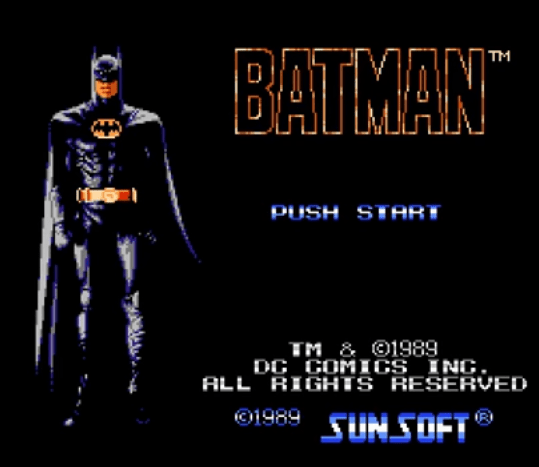
Title screen (screenshot taken by the author)
Batman: The Video Game is a side-scrolling platform game developed and published by Sunsoft. It was released on the NES in Japan in 1989, and North America and Europe, as well as for the Game Boy, in 1990 (oddly both games are actually different). I chose to review the NES version.
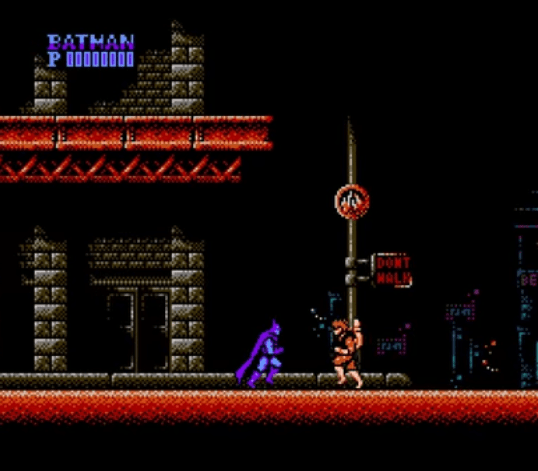
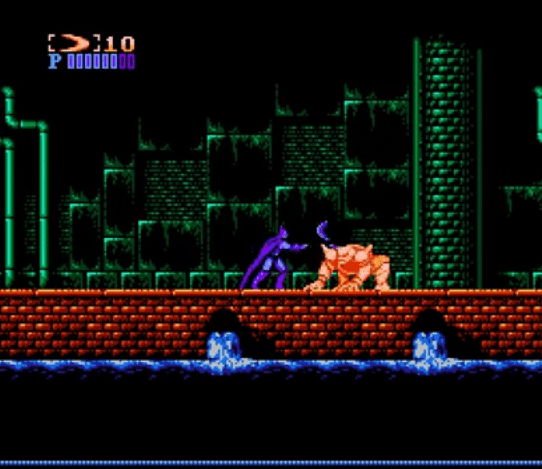
Fight your way through the City of Gotham (screenshot taken by the author)
Plot
The bicentenary of Gotham City is fast approaching, and the city’s officials are hard at work planning festivities for the event. However, the city is engulfed by a crime wave orchestrated and encouraged by the Joker. It is up to the Caped Crusader to stop the Joker’s evil plans and save the city.
Although based on the 1989 Tim Burton movie Batman, there are a few differences. Yes, you are pursuing the Joker and trying to save the City of Gotham, but the game contains enemies with rocket packs or that are mutants. These definitely do not appear in movie. However, these differences take nothing away from the game.
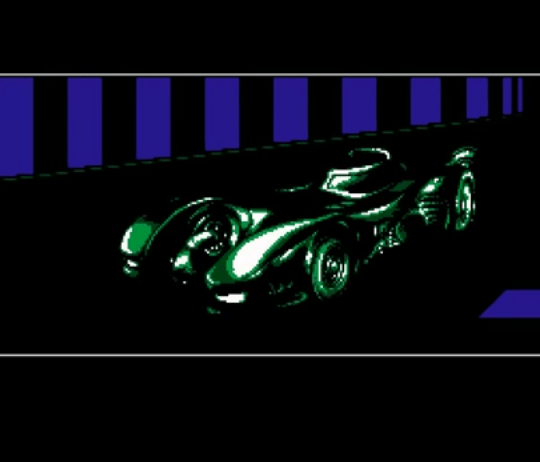
The in-between level animations look fantastic (screenshot taken by the author)
Gameplay
The game contains five levels (each level has four or five sub-levels):
Gotham City
AXIS Chemical Factory
Underground Conduit
Ruins of Laboratory
The Cathedral
Whilst battling his way through the levels, Batman utilises hand-to-hand combat as well as weapons such as a spear gun, Batarang and dirk (which is more like a shuriken) to defeat his enemies. The levels contain no time limit allowing your to take your time through the levels.
Beautifully detailed with an understated, dark colour scheme suits this game well (screenshot taken by the author)
How Does It Handle?
The controls are simple but they don’t need to be complicated. You can punch whilst standing and crouching, and select one of three weapons to use. You can jump to different heights, depending on how long you hold the ‘jump’ button for, and you can even use the walls to help you jump even higher and to avoid some nasty floor spikes.
Graphics
The game looks great! It begins with an awesome and intimidating looking title screen containing the figure of Batman looking menacing, and the game title in the same font used for the 1989 movie. Between each level, there is a short animated cutscene which again looks very cool.
For the in-game graphics, yes, Batman is coloured purple but that is purely so that you can see him clearly as the levels have a dark colour scheme. The levels themselves are very detailed. They help create a dark atmosphere for the game which fits well with Tim Burton’s vision. The sprites are beautifully illustrated, detailed and colourful. Throughout the game, I noticed that there was practically no flicker in the graphics at all.
Music
The music, although not from the movie, fits the game well and certainly has an arcade feel to it. It’s great for getting the adrenaline pumping.
Replay Value
Although this is an incredibly tough game, I had a lot of fun playing through it. The difficulty level is my only real gripe with this game. You are unable to change the difficulty level which is a pity as this would have given the game a bit more replay value.
Did I Complete The Game?
No, I was unable to get past level 3-1
What The Critics Said:
Mean Machines: “A classy license through and through. If you own a NES you’d be bats to miss this – so there! Overall 87%“[1]
Awards:
Best Movie to Game – Electronic Gaming Monthly’s ‘Best and Worst of 1989’[2]
My Verdict:
“It looks great, sounds great, has tight controls and a challenge to test even the most hardened of gamers. The game proves that not all superhero games suck.”
Rating:
What are your memories of Batman: The Video Game? I would love to hear your thoughts, and don’t for get to follow and subscribe so that you don’t miss my latest reviews! You can also find me on Instagram: @nicklovestogame.
I love a superhero game. I imagine nearly everyone wishes they had some kind of superpower (although whether you’d use your powers for good or for evil I can only guess). Superhero games, although popular are, for the most part, disappointing. Why is it so hard to get superhero games right? Is it because they are difficult to translate into video games? Are they just a quick money grabbing scheme on an unsuspecting public? Are our expectations simply too high? I’d love to hear your thoughts on this.
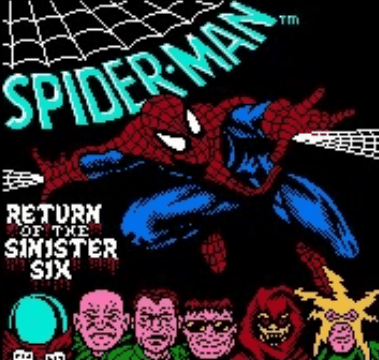
Title screen (Screenshot taken by the author)
Spider-Man: Return of the Sinister Six is a single-player action-adventure game developed by Bits Studios. It was published by LJN for the NES in 1992, and Flying Edge for Master System and Game Gear in 1992 and 1993 respectively. For this review, I played the NES version.
Plot
The game is based off the story arc found in The Amazing Spider-Man #334-339. The plot sees Doctor Octopus attempting to take over the world with the Sinister Six (Electro, Sandman, Mysterio, Vulture, Hobgoblin and, of course, Doctor Octopus himself).
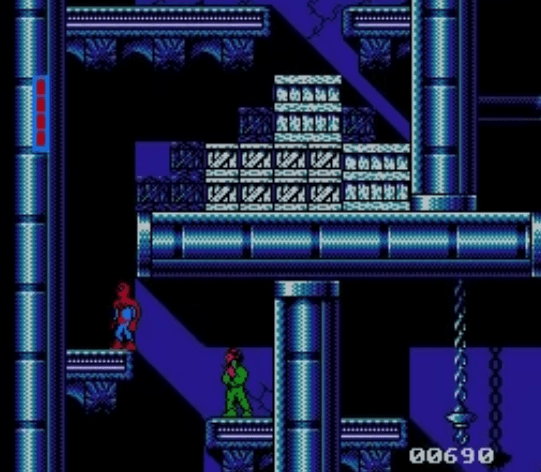
I think the graphics and animations are pretty darn good. Although when standing still, Spidey looks like he has developed a bit of a paunch (Screenshot taken by the author)
Gameplay
There are six levels which will see Spidey swing through. At the end of each level, you will face one of the Sinister Six:
Level 1: The Power Station
Level 2: Toxic Waste Dump
Level 3: The House of Illusion
Level 4: Streets and Rooftops
Level 5: The Forest & Hobgoblin’s Cave
Level 6: Doc Ock’s Castle
Throughout the levels, Spidey must swing and fight his way through a number of minions. There are two types of pick-ups available to you. Attack Web Fluid (which one can only assume is different from Swinging Web Fluid), and a special item which is different on every level. This item needs to be found for you to progress to the next level.
Spidey takes on The Sandman (Screenshot taken by the author)
How Does It Handle?
The gameplay is a let down. Firstly, the buttons have been mapped incorrectly. ‘A’ is punch and ‘B’ is jump. This may seem pedantic to some, but it makes the game feel “unnatural” and less intuitive. Spider-Man’s flying kick needs to be surprisingly accurate to cause damage. So many times you completely miss the enemy and fly straight past them.
Spidey is only able to shoot a web at his enemies when he picks up web packs…oddly, he seems to have an endless supply to swing around the levels. Whilst we’re on the subject of web-swinging, this is supposed to be a Spider-Man game, but you really don’t need to use your web-swinging or wall-climbing skills at all. Why Spidey can climb some walls and not others is anyone’s guess. At least the jumping is easy to control I guess.
For the most part, Spidey’s movements are very quick as one would expect, but he is quite slow when turning around. This frustrating, particularly when fighting The Sandman.
Interestingly, the enemies only inflict damage on you when they actively strike you. You can easily run and jump past them with no damage taken.
This game DOES win back points with me because the levels aren’t simply a case of running through, evading enemies and reaching the end. You actively need to find objects to help you progress in the level. For example, on Level 2, you need to find dynamite and a detonator in order to progress, adding a layer of complexity to the game.
Music
The music sucks! Nuff said!
Graphics
The graphics are pretty good. The backgrounds are incredibly detailed and the animation of Spidey is smooth, although oddly, when he stands still, it looks like he has bit of a paunch and not like the svelte superhero we are all used to.
Before each level, there is a very brief illustration letting you know which member of the Sinister Six you wil be facing next. The illustration looks good but I feel the cutscenes should have been a bit more in the comic-strip style with more than one slide, which in turn would give the story a bit more depth.
Replay Value
There is only one difficulty setting which limits its replay value.
I really didn’t spend that much time on this game, nor did I wish to. Where was the need for using your web to swing over large gaps or over pools of deadly lava or fire? Why couldn’t Spidey hang upside down on the ceiling to avoid enemies or crawl into small spaces? This game is not fun and I found it very disappointing.
Did I Complete The Game?
Nope, at present I’ve been unable to complete Level 3.
What The Critics Said:
Nintendo Power: “George: ‘The graphics are good and the villains are great, but play control is a little rough’; Rob: ‘You can release what looks like a perfect punch and end up releasing right past your enemy. That gets kind of frustrating, but otherwise it’s a fun game. Overall 2.925/5”.[1]
Electronic Games: “The graphics are average for the NES, though the flicker is excessive in a few spots. The Spiderman figure is failry well animated and holds together during leaps, climbing, and somersaults. As in many 8bit cartridges, it isn’t always easy to tell three dimensional objects from non-interactive backgrounds. Overall 72%”.[2]
My Verdict:
“Initially, I disliked this game outright. After revisiting it, it has gone up a little in my estimation. The game looks good, but is let down by the gameplay and the music. You really could take a character from another game and swap them for Spidey because his special skills of web-slinging and wall-climbing aren’t really needed for this game. It’s not a game you’ll be returning too. Unless you’re a Marvel fan, I’d not bother with this one.”
Rating:
What are your memories of Spider-Man: Return of the Sinister Six? I would love to hear your thoughts, and don’t for get to follow and subscribe so that you don’t miss my latest reviews! You can also find me on Instagram: @nicklovestogame.
[1] George & Rob., ‘Now Playing – Spider-Man: Return of the Sinister Six’. Nintendo Power. (October 1992). Issue 41:103 &105.
[2] Stevens, S., ‘Video Game Gallery: NES – Spiderman: Return of the Sinister Six’. Electronic Games. (December 1992). Volume 1 Issue 3:61-2.
When a games console is coming to the end of its life, the output of the games can seem odd, as if the creators are just trying to cash in one last time before taking the console out back and humanely laying it to rest. One would assume that the last few games would be the ones that really push the console to its limits, highlighting the need to move to a more powerful machine. However, it seems that some creators delve into the depths of their rejected titles to see if they can use up the last of their stockpile before moving on to pastures new. Mitsume ga Tooru (The Third-Eyed One) was one such game.
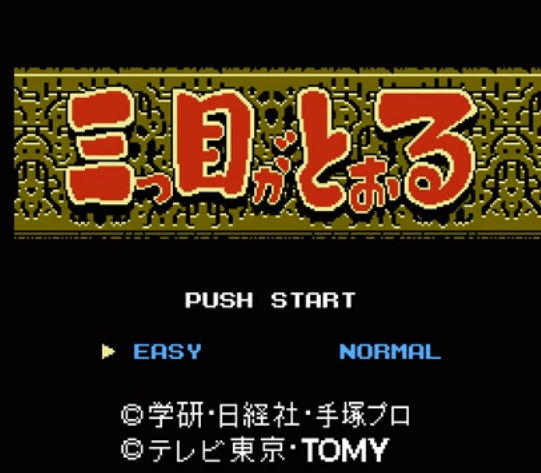
Title screen (Screenshot taken by the author)
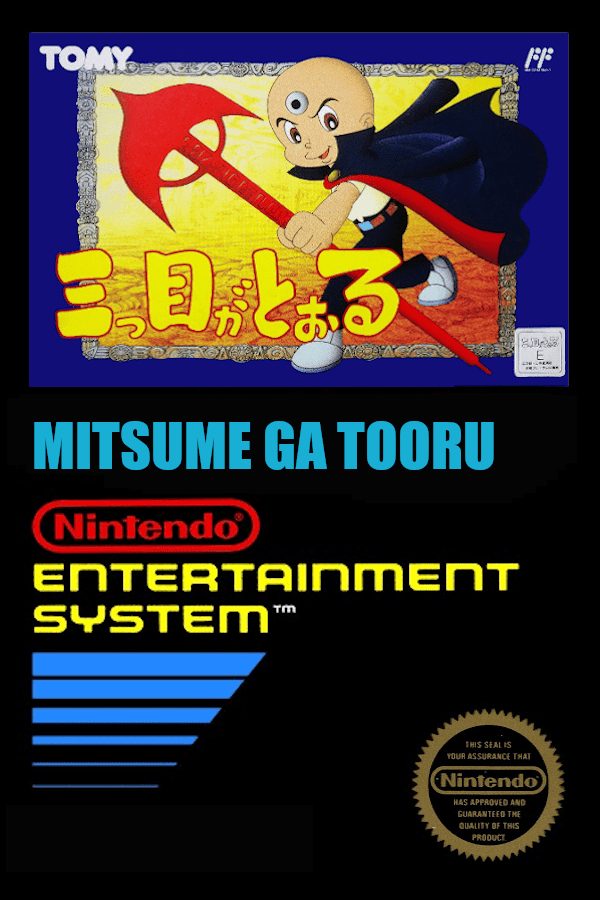
This week’s review, is Mitsume ga Tooru (The Third-Eyed One) an action-platformer based on the manga and anime series of the same name. It was developed by Natsume and published by Tomy for the NES in 1992.
Hosuke’s main attack is a bullet fired from his third eye (Screenshot taken by the author)
Plot
Hosuke Sharaku is the last Three-Eyed Man. He must rescue his friend Wato Chiyoko who has been captured by Prince Godaru.
Gameplay
The game contains five levels with a boss at the end of each level. The levels are:
Level 1 – The City, where Hosuke searches for his girlfriend.
Level 2 – Forest and Caves
Level 3 – Ancient Pyramid and Catacombs
Level 4 – Abandoned Ship
Level 5 – Sodom
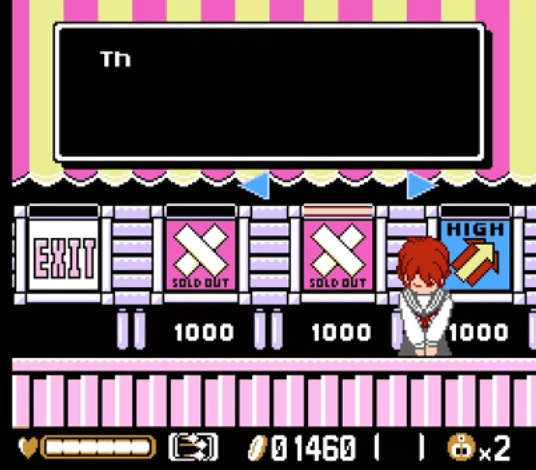
When you destroy enemies, they drop coins for you to collect and spend at your girlfriend’s shop (Screenshot taken by the author)
Graphics
The backgrounds and sprites are really nice (if a little limited in variety) and are just as good as other games released on the NES c.1992 like Felix the Cat and Joe & Mac, and are better than others like The Simpsons: Bartman Meets Radioactive Man, Hudson Hawk, and The Blues Brothers.
For me, the gameplay just feels very lacklustre. You can jump and shoot (from your third eye), and summon a red condor (which can be used as a platform), but that is about it. You cannot crouch, or shoot in any direction other than forward, which is annoying to say the least. Occasionally, you need to use a spear to help you jump over tall walls or large gaps. When you throw the spear, it only goes a short distance before turning and coming back toward you. You need to jump and land on it for it to stop and become a platform for you.
You also only run at one speed, which is lucky because there is no time limit to race against. The controls are tight and there is practically no slide when you come to a stop. Jumping is easy to control too.
You have six bars of life in your life meter which deplete by one whenever you get hit. If you fall off the edge into a hole, your red condor swoops down to save you but you still lose one bar of life. If you lose all your lives, you can continue but will be taken back to the beginning of the stage.
When you destroy an enemy, they will drop coins for you to collect. These coins can be used to buy special weapons and bonuses from your girlfirend. These include:
Wave – It allows you to curve your shot up and down, handy for enemies attacking at higher and lower altitudes.
Sonic – Three consecutive shots (High Middle and low)
High – Fires three laser blasts straight at the enemy
Spear – I’m not entirely sure what this one does as the language of the game is in Japanese.
You can also buy medikits to increase health, and extra lives. In order to select the different weapons, you need to pause the game. However, you will lose those weapons if you die.
The issue I have with the gameplay is that one expects more from a game released in 1992, even from the outdated (by 1992 the NES was outdated) NES. You’ve only got to look at other titles such as Vice: Project Doom (1991), Duck Tales (1989), and even Jackie Chan’s Action Kung-Fu (1990) to see how fun and interesting gameplay can be on the NES.
The sprites and backgrounds are beautifful illustrated (Screenshot taken by the author)
At least the fact that there are two difficulty settings offers the gamer some replay value.
Did I complete the game:
I lost all my lives on stage 3. Although you can continue, I didn’t enjoy this game that much to warrant continuing to play.
What the critics said:
At present, I have been unable to find a contemporary review of this game.
My verdict:
“This game looks great and has tight controls…but there just isn’t that much to it. This game could have been awesome but it just felt half-arsed. By all means, play it if a friend has it or you can find a cheap copy, but you won’t be losing sleep if you never play this game. I feel this game is aimed toward a younger audience and so is not a game I shall be returning to anytime soon.”
Rating:
What are your memories of Mitsume ga Tooru (The Third-Eyed One)? I would love to hear your thoughts, and don’t for get to follow and subscribe so that you don’t miss my latest reviews! You can also find me on Instagram: @nicklovestogame.
RPGs are like Marmite. You either love ’em or you hate ’em. What tends to put gamers off is the investment needed to play through the game and many argue that the need to fight endless battles against minor minions to increase stats are a cheap way to ensure the longevity of a game. However, this is also what attracts many gamers. They fully immerse themselves in their chosen character and enter a world of pure escapism where they can be a barbarian, dwarf, mage, elf or countless other humanoid species.
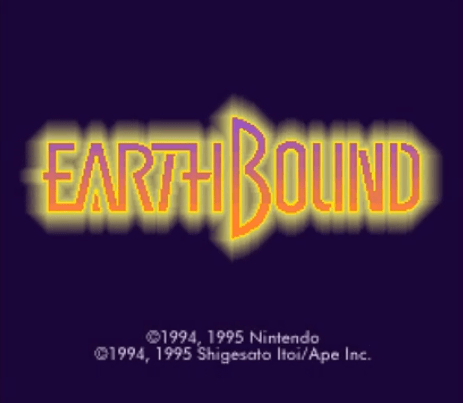
Title screen (screenshot taken by the author)
Earthbound (Mother 2 in Japan) is a single-player RPG developed by Ape Inc. and HAL Laboratory, and published by Nintendo. It is the second game in the Mother series, and was released in Japan in 1994 and North America in 1995 for the SNES and Game Boy Advance. In 2013, it was released on the Wii U Virtual Console. For this review, I played the version found on the SNES Mini.
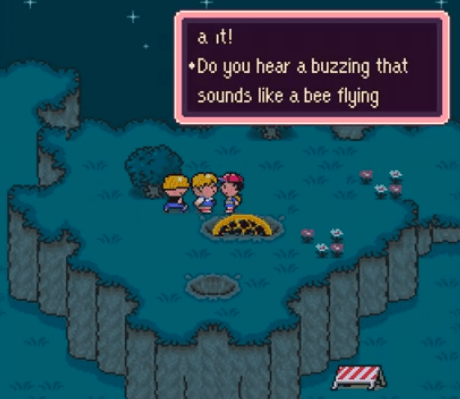
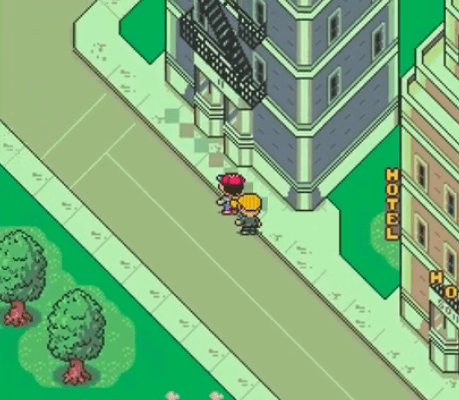
The graphics suggest the game was designed for a younger audience (screenshot taken by the author)
Plot
A decade after the events of Mother, the alien force that is Giygas has enveloped and consumed the world with hatred, turning animals, plants and humans into monsters. With his three companions: Paula, Jeff and Poo, Ness must travel the world collecting melodies from the eight sanctuaries in order to stop the invasion.
Characters:
Ness – Just a normal kid who defeats his enemies with the use of a baseball bat
Paula – Ness’ friend who possesses psychic powers
Jeff – A young scientific genius
Poo – A mysterious Eastern prince
Fighting scenes sport an array of weird and whacky opponents (screenshot taken by the author)
Gameplay
The game is viewed in 2D with the overworld view being an iosmetric design Interestingly, unlike other RPGs, there is no difference between the over-world and town/dungeon scenes, meaning the game moves seamlessly between the two.
What makes Earthbound different form other RPGs, is that it isn’t based on random encounter scenarios. In this game, you can actually see your enemies and can give them a wide berth if you do not wish to fight. Also, once your team reach a certain level, many of the lesser enemies are automatically defeated, meaning you don’t have to waste your time faffing around with pointless battles that give you little in the way of experience points. Additionally, you can gain a tactical advantage by approaching an enemy from behind. This allows you to strike first everytime. I thought that these were great features to have. I have always disliked the random encounter aspect of RPGs. I understand that they may be important for the game to ensure your characters build their stats but I’d rather have the option to fight when I wanted to because I feel random encounters just slow the game down too much.
The battle scenarios consist of standrd RPG practice in that it is a turn based affair. You can choose to attack, use an object, defend yourself, use PSI, flee etc. However, you still need to do battle with them in order to gain inexperience points, items and money.
There are a few other interesting aspects to this game. Firstly, your father regularly deposits money into your account so that you are never short of cash to buy new weapons and other items. Secondly, because you can only carry a certain amount of items, you can drop off items or have them delivered to you when you find a telephone. Thirdly, your character becomes homesick at times, which I believe affects him during battles. To remedy this, you simply need to call your mother who gives you a pep talk…very cute!
Isometric overworld view (screenshot taken by the author)
How Does It Handle?
Although the game looks to be aimed towards a younger audience with whacky and childish jokes, I thought that it was quite fun to play. The story is well thought out, if a little bizarre, and there are plenty of collectables to keep you interested. The controls are simple to learn and the game isn’t to complex and so can be easily picked up played.
Graphics
Although cartoon like, I thought the graphics were good (but not great), bright and colourful, with lots of variations amongst the sprites.
Did I Complete The Game?
Yes, with minimal help from a walkthrough
What The Critics Said:
Gamefan: “If you love RPGs, you really must buy earthbound. At first glance the game may not seem like much, but a rich and involving adventure hides just beneath this game’s 8-bit veneer. While not as mind blowing as, say, FFIII, EB is just as fun to play simply because it’s so wacky, original and amusing. Overall 89%”.[1]
Super Play:“An RPG that’s very much more than the sum of its parts. If you’ve got the patience to suffer its crude elements then prepare to be boggled: there’s simply nothing like it on the SNES. Overall 88%”.[2]
Nintendo Power: “A great story, fun graphics, good sound effects. Frequent, sometimes tedious battles. Poorly designed inventory system limits how many items you can carry. Overall 4/5”.[3]
Game Players:“The game’s biggest strength is its humour, but while there’s something here for everyone, most of the quips and strangeness are geared for the younger set – it ain’t exactly Final Fantasy or Illusion of Gaia. Overall 69%”.[4]
“I really wanted to give this game five stars, but I feel that the graphics let this game down a bit. When compared to the likes of Final Fantasy III and Secret of Mana, the graphics are not what one expects from a SNES. However, don’t be put off by first impressions. This game has much to offer and endears itself to you the longer your play it. Say ‘Fuzzy Pickles'”
Rating:
What are your memories of Earthbound? I would love to hear your thoughts, and don’t for get to follow and subscribe so that you don’t miss my latest reviews! You can also find me on Instagram: @Nicklovestogame.
Side-scrolling beat ‘em ups were huge in arcades in the 80s. However, home consoles of the 80s struggled to replicate the arcade versions, which were far superior. Although the NES and Master System produced some good quality beat ‘em ups, it wouldn’t be until the late 80s that “arcade quality” beat ‘em ups could be found on home consoles like the Sega Mega Drive, Turbografx-16 and PC Engine.
title screen (screenshot taken by the author)
Mighty Final Fight is a side-scrolling beat ‘em up developed and published by Capcom in 1993 for the NES. It is a spin-off of the 1989 arcade classic Final Fight, and was later released on the Game Boy Advance (2006) and Wii Virtual Console (2014). I chose to review the NES version.
Plot
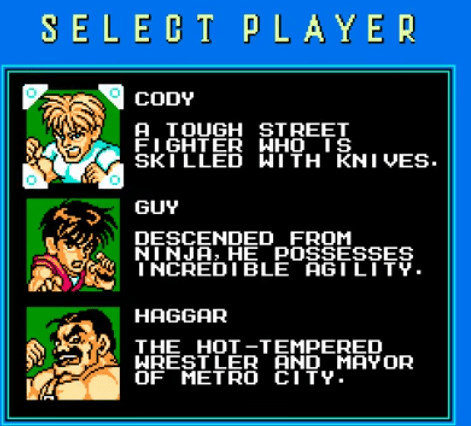
The Mad Gear Gang, the most notorious crime gang in Metro City, have kidnapped Jessica, the daughter of Haggar who is the city Mayor. Along with Cody, Jessica’s boyfriend, and Cody’s training partner, Guy, they attempt to rescue her from the gang.
Sadly, the game can only be played in single-player mode (screenshot taken by the author)
Gameplay
You can choose to be either:
Haggar – City Mayor and former professional wrestler
Cody – A street fighter who has developed his own unique fighting style by fusing boxing and karate
Guy – A master of Ninjutsu
Each character has their own strengths and fighting styles. As the game progresses, you gain experience points which increase the strength of your character and unlock more fighting moves. Weapons can be found throughout the levels but they are dependant on the character you’re playing as (Cody – knife, Guy – shuriken, Haggar – oversized mallet).
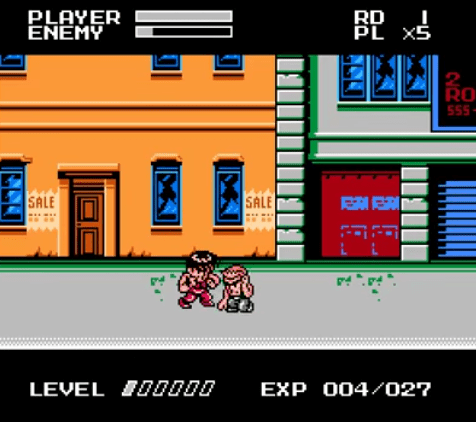
The graphics have been adapted in the Chibi art style (screenshot taken by the author)
How Does It Handle?
The gameplay is pretty good. The controls are responsive, and the hit detection is spot on. The introduction of new moves keeps the fighting interesting too.
Graphics
The game has been redesigned in the Chibi art style which gives the characters and overall game a more childlike look. The graphics and backgrounds are a great improvement on previous games such as Double Dragon and Renegade, even if Haggar does look like he has a huge double chin. However, by 1993, the SNES and Mega Drive were already producing far superior titles such as Streets of Rage (1991), Golden Axe (1989) and Teenage Mutant Ninja Turtles IV: Turtles in Time (1991). There is also a limited number of sprites allowed on the screen at any one time, and there is a fair bit of flicker when fighting. This game is clearly pushing the NES to its limits.
Replay Value
What really let’s this game down is that it is a single-player game and there is only one difficulty setting. This is a real shame, as side-scrolling fighters are always better in two-player mode. Without a two-player mode and the chance to increase the game’s difficulty, this game will never become a staple for late night gaming with buddies. However, it is slightly redeemed by having three distinct characters that does add a bit of replay value of the game.
Did I Complete The Game?
Yes, my go to character is Cody. My older brother’s choice was always Guy.
What The Critics Said:
At present, I have been unable to locate a contemporary review.
My Verdict:
“A fun little beat ‘em up which looks great, for a NES game, and plays very well. Good differentiation between the characters but a lack of two-player mode severely limits its replay value.”
Rating:
What are your memories of Mighty Final Fight? I would love to hear your thoughts, and don’t for get to follow and subscribe so that you don’t miss my latest reviews! You can also find me on Instagram: @Nicklovestogame.
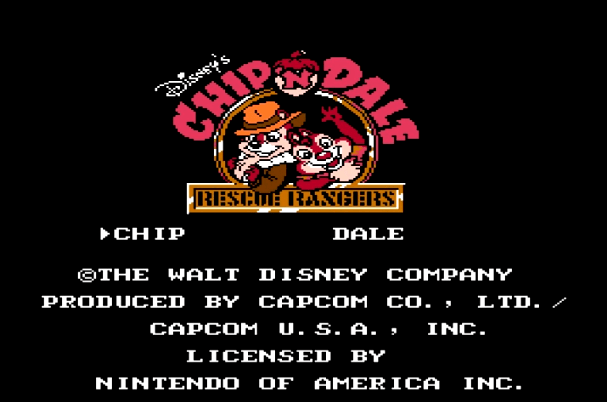
Chip ‘n’ Dale Rescue Rangers is a platform game developed and published by Capcom and released for the NES in 1990. It would later be released in the 2017 The Disney Compilation Collection for Microsoft Windows, PlayStation 4 and Xbox One. I chose to review the NES version.
Plot
The evil Fat Cat has stolen Mandy’s kitten. The Rescue Rangers pledge to rescue the kitten.
Gameplay
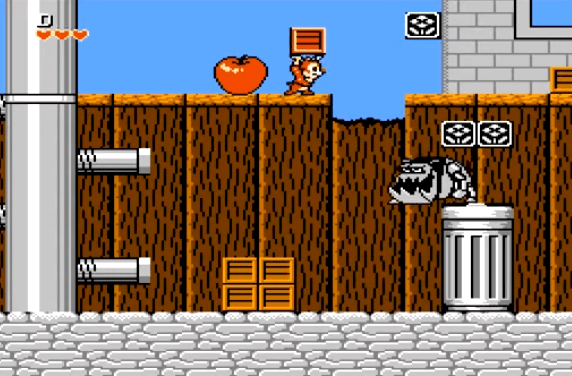
Through streets, over and through buildings, and forests; Chip and Dale must evade foes such as mechanical bulldogs, robotic rats, and gansgter lizard-type things known as warts. You can choose to dodge these dangerous foes or throw various items such as crates and apples at them. After each level, Gadget offers some advice about how to defeat the trickier aspects of the next level.
The game can be played in on or two-player mode. In one-player mode, you can choose to be either Chip or Dale. Each player can only be hit three times before they die.
You can use objects such as crates and apples to throw at your enemies (screenshot taken by the author)
How Does It Handle?
This game plays really well. The controls are responsive and I don’t recall many (if any) parts of the game where you die cheaply. The game has many trickier parts but it is enjoyable to play. I wasn’t expecting to like this game but I really enjoyed it.
Graphics
The levels are brightly coloured, well designed and detailed, and pose a nice challenge for the average gamer. It is easy to distinguish between the two protangonists as Chip wears a hat and a dark jacket.
Replay Value
Although the game has minimal replay value, it’s a lot of fun and a great game to be played with a younger sibling or child.
Did I Complete The Game?
Yes
What The Critics Said:
Electronic Gaming Monthly:“Every part of this game from the graphics, to the sounds to the gameplay are well done indeed. Rescue Rangers only falls flat in terms of challenge and difficulty. Overall 7.75/10”.[1]
Mean Machines: “Not groundbreakingly original, but very good nonetheless. Fun to play and long-lasting Overall 88%.”[3]
Total!: “Groovesome, slick and utterly dashing platform game with some ingenious two-player twist and a brain curdling difficulty curve! Overall 81%”.[4]
“This game looks great…but don’t be fooled by its cutsie look. There are some challenging parts to it, but nothing a seasoned gamer can’t handle. Excellent gameplay too. I enjoyed it more than I thought I would.”
Rating:
What are your memories of Chip & Dale Rescue Rangers? I would love to hear your thoughts, and don’t for get to follow and subscribe so that you don’t miss my latest reviews! You can also find me on Instagram: @Nicklovestogame.
Multiplayer arcade games used to be goldmines in the arcades. There’s not much better as a teenager than spending your pocket money battling alongside your friends in a bid to rescue (insert person’s name here). Many of these games were ported to home consoles meaning you could do battle without leaving the comfort of your own home. However, not all converted coin-op games were successful. How did Teenage Mutant Ninja Turtles II: The Arcade Game fair?
Title screen (screenshot taken by the author)
Teenage Mutant Ninja Turtles: The Arcade Game (TMNT II on the NES) is a side-scrolling beat ‘em up, developed and released by Konami for the Arcade in 1989. It was ported to the NES in 1990 with some additional levels and enemies that were different from the arcade version. In 1991, it was released for the ZX Spectrum, Amiga, Amstrad CPC, Atari ST, PC and Commodore 64. For this review, I chose to play the NES version.
Plot
Tempted by a large bounty placed on the heads of the Turtles by arch-nemesis Shredder, two intergalactic bounty hunters kidnap April O’Neil and use her as bait to lure the Turtles out into the open.
Gameplay
To rescue April, The Turtles give chase and must fight their way through 10 hazardous levels, where endless numbers of enemies and several boss battles stand in their way in order to reach Shredder.
You start with three lives but can gain more with every 200 enemies you defeat. You can also regain health by eating pizza slices.
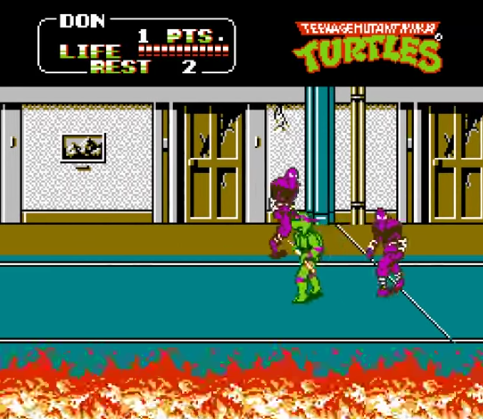
The graphics are far superior to the original NES TMNT game (screenshot taken by the author)
How Does It Handle?
I do, however, have a few gripes with this game. Firstly, these are supposed to be “ninja” Turtles, yet they have maybe three different moves: a flying kick, and two different ways to swing their weapons. WTF? There are no throws, there are no kick or punch combinations, and you cannot pick up extra weapons to throw at the enemies. Earlier games such as Double Dragonhad more of a move set to prevent the fighting from becoming monotonous.
Secondly, Donatello is supposed to have a bo, a long wooden stick. Yet, his reach is pitiful. You have to get close to the enemies, within their striking range, to attack. If you don’t wish the game to be too easy, simply slow down his attack or make his bo attacks weaker. These points made the game very frustrating and dull for me.
Disappointingly, the NES version could only cope with a one- and two-player mode, so it loses the four-player mode which is what made the arcade version an awesome fighting experience.
Graphics & Music
Straight away, it is clear to see how much the graphics have been improved when compared to the first TMNT NES game. The levels and characters look great! They are colourful and vibrant, and the sprites are very well animated. The intro, although short, gets you straight into the action and contains the authentic TMNT theme. The game is faster, slicker, and the upbeat music really gets your blood pumping.
Donatello takes on Bebop (screenshot taken by the author)
Did I Complete The Game?
No, nowhere near.
What The Critics Said:
GamePro: “The heavy-duty faithful-to-the-arcade style game play (and it’s a long game!) are real crowd pleasers, and the radioactive mutants are as personable as ever. The new scenes blended in with the original arcade scenes are a great addition. The music could have been better but, hey, you can’t have everything.Overall 4.6/5”.[1]
My verdict:
“This game looks fantastic! With the music, it looks and sounds just like a Turtle game should be! However, the gameplay is dull. These guys are supposed to be ninjas. Where are all their moves? The game becomes very boring, very quickly, even in two-player mode. I think this is a game for the younger gamer. It is overrated and only hardcore Turtles fans should bother with this game.”
Rating:
What are your memories of Teenage Mutant Ninja Turtles II: The Arcade Game? I would love to hear your thoughts, and don’t for get to follow and subscribe so that you don’t miss my latest reviews! You can also find me on Instagram: @Nicklovestogame.
As a married man with a full time job, I find that I have less and less time to devote to videogames. I love modern games like the Uncharted and Assassin’s Creed series and thoroughly enjoy playing and immersing myself into these worlds. Sadly, I don’t have 40 extra hours a week to devote to such in-depth games on a regular basis. It is for this reason that I have embraced the retrogaming world. Games that one can simply pick up, mess around with for 20 minutes and put down again very much have their place in the gaming world. Simpler games should not be sniffed at!
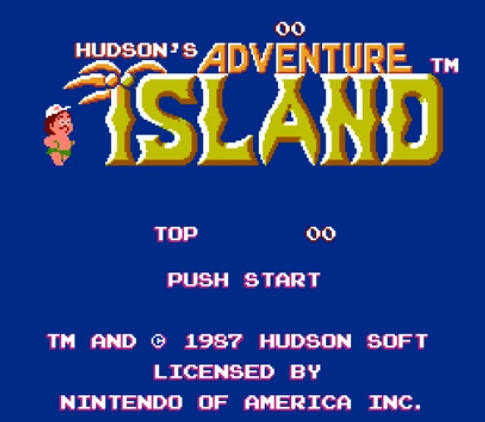
Title screen (screenshot taken by the author)
Hudson’s Adventure Island is a side-scrolling platform game adapted from the arcade game Wonder Boy. It was developed and published by Hudson Soft, released in Japan in 1986, North America in 1987, and Europe in 1992 under the title of Adventure Island Classic. Versions can be found on the NES, MSX, Game Boy, Gamate, Game Boy Advance, Game Cube and PlayStation 2. For this review, I played the NES version.
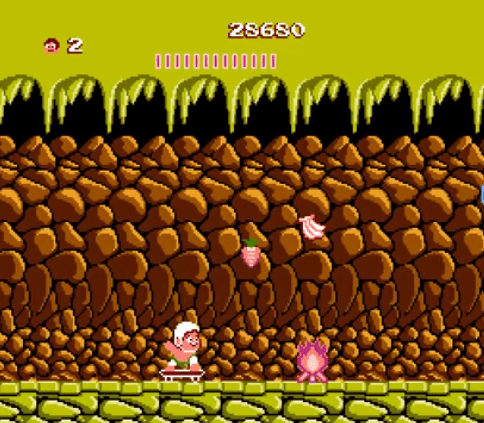
These eggs contain items that will help you on your way (screenshot taken by the author)
Plot
You play as Master Higgins (Master Wigins in the UK and Takahashi Meijin in Japan), who has travelled to an island in the South Pacific to rescue Princess Leilani (sometimes known as Tina) from the Evil Witch Doctor. Along the way you need to eat fruit that appear out of the ether in order to keep your energy levels up. However, if you get touched by an enemy, you instantly die.
Gameplay
You run from left to right running through forests, mountains and caves, jumping to avoid your enemies. Along the way you will find eggs that contain bonus items to help you on your way. These items include:
Stone axes – Which can be used to throw at the enemies
Skateboard – Helps you travel faster
A flower – Double the points you get from collecting fruit
Milk – Fills up your energy bar
Honey – Make you invincible for a limited period of time
However, beware of the:
Eggplant – Takes energy away from you (which is fair enough as eggplants suck!)
There are 32 stages in total spread out over eight worlds. These are further divided up with checkpoints. Once the fourth stage of an area is completed, you must fight and defeat an end of level boss.
How Does It Handle?
Adventure’s Island’s controls are very slip/slidey (seemingly even more so than in similar games), meaning lots of sliding off the edges of platforms and it takes a while to get used to. It is also very unforgiving. You only have three lives, with little chance of gaining more and no continues.
Graphics
It’s easy to look at these videogames nowadays and compare them to modern games, where they will always be found wanting. It is very unfair to do so. So let us compare it to a game that is still revered and remember fondly today: Super Mario Bros 2 (1988). Initially, I don’t think the background graphics necessarily any better or worse than SM2, but the more I see both games, the more I think that SM2 just looks better. However, the sprite design and colours that separate the two here. From what I have seen so far from Adventure Island, the enemy sprites have little to no animation, a stark contrast to SM2.
Music
Also, unlike the Super Mario Bros.franchise, Adventure Island’s music is very forgettable.
Did I Complete The Game?
No, at present, I can only get to the third level of world one.
What the critics said:
At present, I cannot find any comptemorary reviews.
My Verdict:
“I just didn’t enjoy playing this game and had little desire to put too much time and energy into it. The graphics are good and it is diverting if you have a spare 15 minutes on your hands, but it just lacks charm and for me, the game just feels cheap.”
Rating:
What are your memories of Hudson’s Adventure Island? I would love to hear your thoughts, and don’t for get to follow and subscribe so that you don’t miss my latest reviews! You can also find me on Instagram: @nicklovestogame.














.jpg)

#/media/File:Chip_'n_Dale_Rescue_Rangers_NES_Cover.png)
#/media/File:TMNT2boxNES.jpg)


#/media/File:Adventureisland.jpg)

 Nick Loves to Game