In 1989, Nintendo released Tetris on the Game Boy, and it proved to be an instant hit. By its 25-year anniversary Tetris had sold over 70 million copies worldwide.[1] Sega, eager to compete, needed a puzzle game of their own. Blockout (1989) has failed to be a success like Tetris (1989) so Sega tried a different tack with Columns. Similar enough not to deter Tetris fans, but different enough to try and attract a new audience. Sadly, Columns couldn’t imitate Tetris’ success.
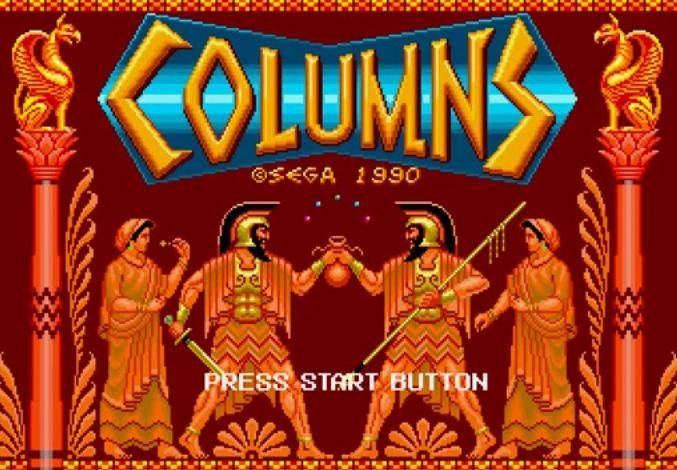
Title screen (screenshot taken by the author)
Columns is a puzzle game created by Jay Geertsen for the arcade in 1989 and was originally developed and published by Sega in 1990. Its success led to it being ported to many other platforms. The version I chose to review was from the Sonic’s Ultimate Sega Collection (2009) on the PlayStation 3.
Gameplay
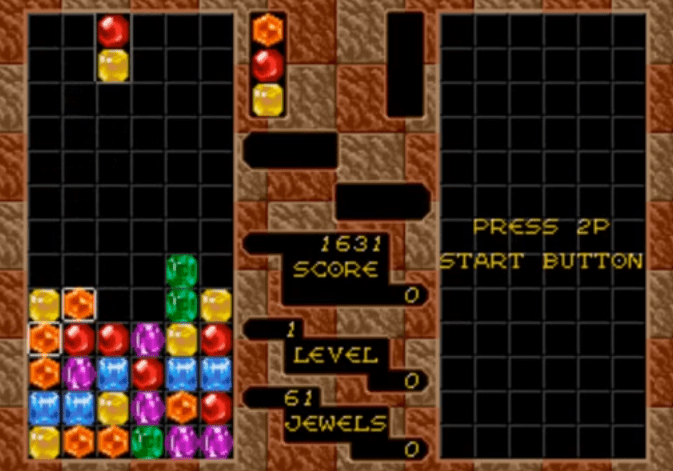
The game consists of three coloured jewels being dropped to the bottom of a rectangular screen, similar to Tetris. However, instead of aiming to complete horizontal lines, you must match three or more of the same coloured jewels in either a vertical, horizontal or diagonal line. Once lined up, the jewels will disappear allowing any jewels above to fall down to the lowest point possible. You will also be awarded points. You are able to cycle the order of the jewels to aid in your organisation of landed jewels. If a multi-coloured, flashing set of jewels appears, you can land any colour of jewel that you wish and all of that type of jewel will disappear. The higher your score, the faster the jewels will fall.
The jewels are all unique and easily discernible from the others (screenshot taken by the author)
How Does It Handle?
The controls are very straight forward and easy to just pick up and play. By the time the game becomes harder, you will have a full understanding of how to play the game.
Graphics
I have a real soft spot for this game and prefer it to Tetris, possibly because of the beautifully coloured jewels. The overall graphics in general have a classical Greek/Roman feel to them, and each jewel is brightly coloured and easily distinguishable from the others.
Music& SFX
The music is rather basic. There are three themes to choose from: Clotho, Lathesis, and Atropos. Clotho is my favourite and does have a tendency to get stuck in your head, but mostly you will find that you’ll turn the sound down and listen to your own music, podcast or an audiobook.
The SFX mainly consist of a thud when block of jewels are placed and a sort of sparkly sound when you get a set of three or more and they disappear. It can become a bit jarring after a while.
Replay Value
Columns can be played in one-player and multiplayer modes, flash-modes and a time trial mode which add to the replay value of such a seemingly simple but highly addictive game. There are also three difficulty settings.
Personal Memories
I used to play this game a lot and got pretty damn good at it. As you can see from the photograph below, the highest score I achieved was 5408848 at level 121. I would have continued but I had been playing for a while and was due to go out for the evening. I could have paused and come back to it but I feel that I had proved my aptitude for the game.
A photograph of my highest ever score (photo taken by the author)
Did I Complete The Game?
No one seems to know how high the score or levels go, and I don’t know of anyone who has “completed” this game, so I’m going to assume this is a game that cannot be completed.
What The Critics Said:
Mean Machines Index:“Sega’s answer to Tetris, this puzzle game is excellent. There’s a huge variety of options, including arcade-style time trials, three different difficulty settings, nine different starting levels, and a two-plater head-to-head made which adds to the game’s lasting appeal. Overall 88%”.[2]
Sega Power: “A Tetris clone with a superb challenge mode. Simple and addictive. Overall 4/5”.[3]
Sega Power:“A Tetris clone with superb one-on-one challenge mode. More of an end-of-blast relaxer than a main game. Simple, addictive , but expensive for what it is. Overall 4/5”.[4]
Wizard: “Good puzzle game, drop jewels, like Tetris but a bit better. Overall B+”.[5]
My Verdict:
“It’s like Tetris, but better in my opinion. Colourful, challenging and surprisingly addictive.”
Ratings:
What are your memories of Columns? I would love to hear your thoughts, and don’t for get to follow and subscribe so that you don’t miss my latest reviews! You can also find me on Instagram: @nicklovestogame.
In the voice of the great Formula 1 commentator Murray Walker, “And there he goes! Look at that! Senna has passed him! Senna has won the Brazilian Grand Prix!“.
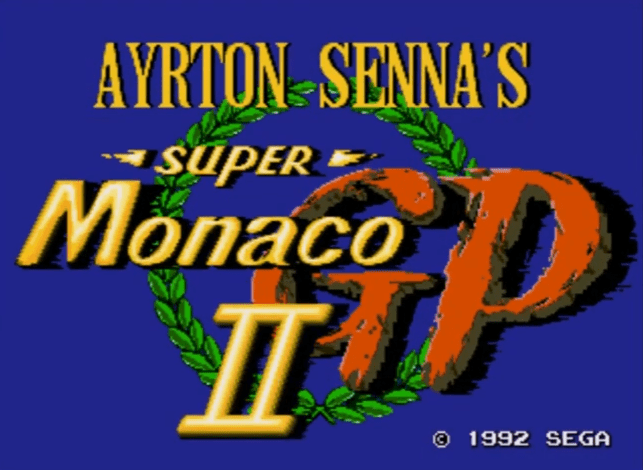
Title screen (Screenshot taken by the author)
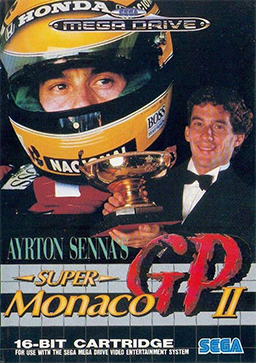
Ayrton Senna’s Super Monaco GP II is a single-player Formula One racing game developed and published by Sega. It was released on the Mega Drive, Master System and Game Gear in 1992, and is the follow up to Super Monaco GP (1989). The game’s development was also assisted by Senna, who supplied his own advice about the tracks featured in the game. I chose to review the Mega Drive version.
Objective
Naturally the object of the game is to win the Driver’s World Championship and/or the Senna GP. To win the World Championship, you must race 15 other drivers on tracks from the 1991 Formula One season. You gain points depending on the position that you finish. The higher the finish, the more points you accrue.
Gameplay
In Practice Mode, you can choose to train freely or simulate a race. This enables you to familiarise yourself with the sharp turns of each track, and allows you to perfect your racing line. You can also select the number of laps you wish to complete, your starting position and sometimes, the weather.
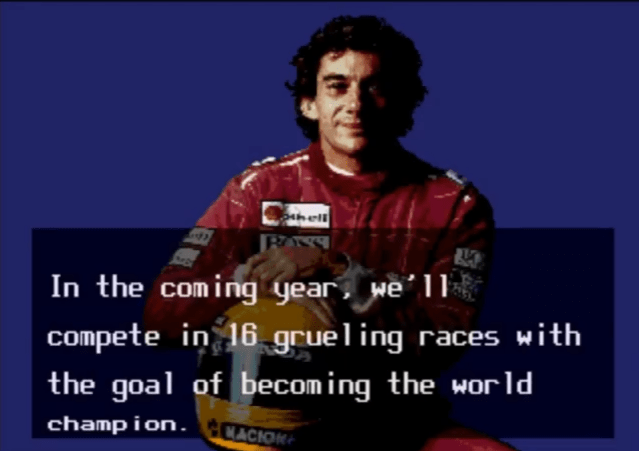
The late, great Ayrton Senna died tragically from injuries sustained during a crash whilst competing in the 1994 San Marino Grand Prix (Screenshot taken by the author)
In Beginner Mode, you first enter your name and select your nationality. You are then given the choice to run a few practice laps before the main race. When you select Race Mode, you can choose your preferred type of gear box (automatic, 4-speed manual and 7-speed manual). Before the main race starts you must complete a lap in the quickest time possible. Your time compared to the times of the other drivers will dictate your starting position. Your aim is to be the Polesitter.
Master Mode is pretty much the same as Beginner Mode with the exception that you may get the opportunity to drive better race cars by challenging rivals during races. If you beat the rival, you race their car from then on. There are five different car companies to achieve. Personally, I’ve never understood this. Why would you want to own the car you’ve just beaten? Surely, the fact that you have just beaten it suggests that your car is superior.
For the Senna GP, you simply compete in one race. You can choose from three tracks, and your lap times are given after each race.
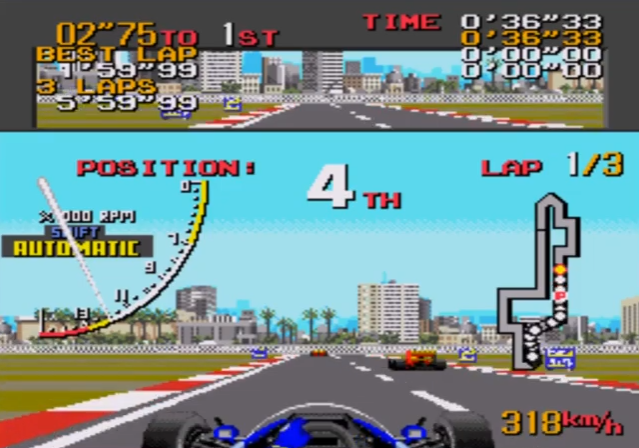
In-game screen offering all the views and information you need (Screenshot taken by the author)
How Does It Handle?
The game is challenging and much practice is needed to understand the physics of the game. Frustratingly, when a collision with another racer occurs, you always seem to come off worse than the other racer. No serious damage occurs, it just slows you down. However, if you hit a sign or barrier at high speed, you will crash and your race is over.
As mentioned, when reviewing Super Hang-On, I’m not a fan of racing games. There’s nothing wrong with them, they just don’t do it for me, so I am reluctant to spend too much time on them. However, I did enjoy playing it this one the more I played it.
Graphics
The graphics are bright and colourful, and should be praised for their realism. I’d argue that they are superior to F1 (1993). I really liked that you could look in the rear view mirror to see who was coming up behind you. This enable you to manoeuvre your car to block your opponent from overtaking you.
Music& SFX
The music is very basic and easily forgettable, but then again you’re not playing a racing game for the music are you!
The SFX mainly consist of the beeping at the start of race, and the low thrum of the engine and a weird annoying sound that indicates skidding, I assume. There is also a very muffled “Final Lap”. I found the SFX rather annoying in this game.
Replay Value
The 16 tracks plus the Beginner, Master, and Senna GP modes increase the replay value considerabley, and fans of racing games will find that this is not a game that will be completed within a few hours. Alas, it is a pity there is not a two-player option.
Did I Complete The Game?
Sadly no. The best result I achieved was fourth overall in the World Championship.
What The Critics Said:
Mean Machines: “A very good racing game – but if you’ve already got Super Monaco GP, this simply isn’t different enough to be worth buying. Overall 87%”.[1]
Mean Machines:“If you already have the original Super Monaco in your cart collection, take a look before you buy because it is very similar. However, if you’ve just got your Mega Drive and fancy owning one of the greatest road racers money can buy, take a look at Ayrton Senna’s Super Monaco GP II – it leaves the others on the starting grid. Overall 94%”.[2]
Computer & Video Games:“Super Monaco still ranks one of the best racers on the Mega Drive, right up there with the likes of Road Rash and Super Hang-On. However, it has to be said that this sequel is quite a disappointment because it’s too close to the original game! Overall 84%”.[3]
Sega Power: “Bigger and Badder sequel to the original game, this time with the golden touch of Ayrton Senna himself. Hit the gas and burn some rubber, baby. Groovy! Overall 5.5”.[4]
My Verdict:
“Becomes more enjoyable the more you play it. Fans of racing games with love the realism, and the challenge.”
Rating:
What are your memories of Ayrton Senna’s Super Monaco GP 2? I would love to hear your thoughts, and don’t for get to follow and subscribe so that you don’t miss my latest reviews! You can also find me on Instagram: @nicklovestogame.
[1] ‘Review: Mega Drive – Ayrton Senna’s Super Monaco GP II’. Mean Machines. (June 1992). Issue 21:20-1.
[2] Leadbetter, R., ‘Review: Mega Drive – Ayrton Senna’s Super Monaco GP II’. Mean Machines. (October 1992). Issue 1:126.
[3] Boone, T., ‘Review: Mega Drive – Ayrton Senna’s Super Monaco Grand Prix 2’ Computer & Video Games. (July 1992). Issue 128:68.
[4] ‘The Hard Line – Review: Mega Drive – Super Monaco GP II’. Sega Power. (September 1993). Issue 46:99.
Avast me hearties! Guybrush Threepwood be back with a new adventure for ye. So, grab your mouse and be ready for more whacky adventures says I.
Original title screen (screenshot taken by the author)
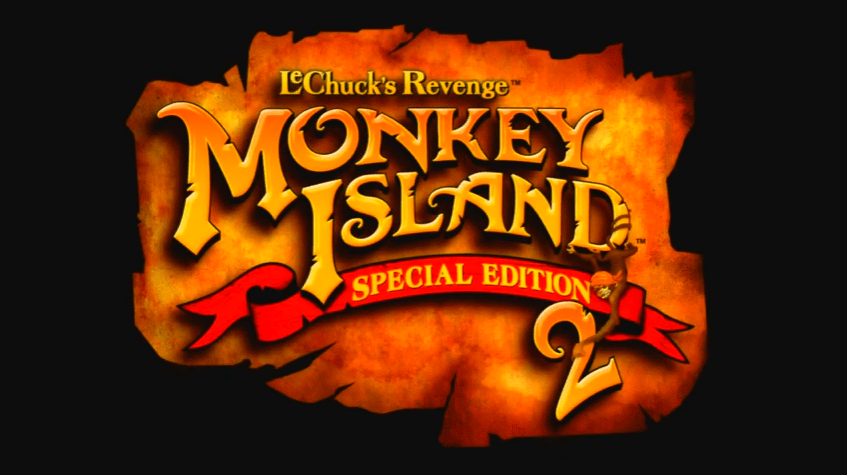
Special Edition title screen (screenshot taken by the author)
Monkey Island 2: LeChuck’s Revenge is a single-player point-and-click adventure game, and the second game in the Monkey Island series. It was developed and released by Lucasart in 1991 for the Amiga, FM Towns, Mac OS, and MS-DOS. The special edition was released in 2010 for iOS, Microsoft Windows, Playstation 3, Xbox 360, and Xbox One. I chose to review the version downloaded from Steam.
Seven months after defeating the pirate LeChuck, wannabe pirate Guybrush Threepwood finds himself back in the Caribbean in an attempt to locate the treasure of Big Whoop. From finding ingredients to make a voodoo doll, to attending fancy dress parties, rigged gambling, and drinking and spitting contests, Threepwood attempts to locate the map that’ll lead him to Big whoop.
Gameplay
The gameplay is identical to The Secret of Monkey Island. So I have copied and pasted what I wrote from there: You control the cursor and must search the environment for people and items that you can interact with. The screen is broken into four parts:
Animation Window – Where the action happens
Sentence Line – When you cursor hovers over something you can interact with, a sentence will appear such as ‘Talk to pirate’.
Command List – Click on a command and then interact with a character or the environment. There are 12 different commands to perform which are: open, close, push, pull, walk to, pick up, talk to, give, use look at, turn on, and turn off. You can alternatively use the keyboard hot keys.
Inventory – List where you can find the items you have collected.
When talking to a character, a list of questions and conversation starters will appear at the bottom of the screen.
The option to use the hot keys is a bit of a God send else it would be very tiring having to use the mouse to click on the command list every time. The controls are simple and easy to use, you just have to make sure you are precise with your commands.
In the Special Edition, they have simplified the command list even more by doing away with the list completely. When hovering over a character or a bit of the environment you can interact with, an icon appears depicting the action.
However, for some reason that I can’t put my finger on, I didn’t enjoy this game quite as much as The Secret of Monkey Island, and that may be because there was nothing new to learn. Then again, that may just be me being very picky.
Although cartoonish, and originally in 8-bit graphics, the backgrounds and characters are very colourful and incredibly detailed with a large number of internal and external scenes. When moving around, the characters move surprisingly fast which is a relief as some point and clicks have very slow moving characters making the game drag. Oddly enough, when close-ups of characters occur, they look very life-like, which is the opposite of the Special Edition. For me, the Special Edition graphics adds more life to the environment.
The scrolling not as smooth as it could be but that tends to be standard for these sorts of point and clicks.
Music and SFX
The introduction music is quite jaunty new take on the original Monkey Island (1990) theme but I didn’t like it as much as the original. This is one of the first adventure games with music throughout the gameplay. The music throughout fits the game well. It is quite understated but fits well with the game.
There is still no vocalization and the SFX are few and far between but it doesn’t take away from the experience of the game.
In the Special Edition, the music has been updated. The speech is now vocalised and the SFX are more ambient (lightning strikes, birds tweeting, and water running). These new SFX really add to the experience.
Replay Value
All point and clicks have limited replay value as they tend to be single-player games with on difficulty setting. You may revisit it annually, but not as often as you would other genres.
Did I Complete The Game?
Yes, I did complete the game with the assistance of a walkthrough on several occasions.
What The Critics Said About The Original:
Amiga Computing:“…horribly close to being a perfect game. It’s certainly the best adventure game I’ve seen in ages… Overall 95%”[1]
Computer and Video Games Magazine:“Already Monkey Island has staked a claim to the best game of this year…. Overall 96%.”[2]
What The Critics Said About The Special Edition:
“…good, but the lack of keyboard support took something away for me. That said, the game picked up on the problems I had with the first and changed it for the better. I did feel that this game took away some experiences, so that brought its score down a little. There are things you should be told but you should also learn on your own, and they gave away too much to the player this time around. Overall B+.”[3]
Awards:
Winner – 1992 Computer Gaming World ‘Best Adventure Game of the Year’[4]
My Verdict:
“Lucasart have done it again. They have produced a worthy sequel with plenty of humour, challenging puzzles and plenty of head scratching moments. The animation is smooth, the characters and the backgrounds are colourful and detailed”
Rating:
What are your memories of Monkey Island 2: LeChuck’s Revenge? I would love to hear your thoughts, and don’t for get to follow and subscribe so that you don’t miss my latest reviews! You can also find me on Instagram: @nicklovestogame.
[1] Whitehead, D., . ‘Review: Amiga – Monkey Island 2: LeChuck’s Revenge’. Amiga Computing. (August 1992). Issue 51:10-1.
[2] Boone, T., ‘Review: PC – Monkey Island 2: LeChuck’s Revenge’ Computer and Video Games Magazine. (February 1992). Issue 123: 15-7.
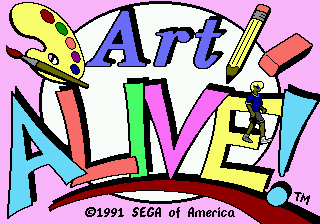
Remember when you were bored in computer classes in the pre-internet days of the early 90s? You had the choice of playing Solitaire or, if you were artistically minded, trying to create a some art with Microsoft Paint. Sega decided to make an alternative version for the Mega Drive. Did it inspire a generation of pick up their proverbial paintbrush and express themselves, or was Sega’s attempt to bring “Paint” to their console a smudge on the face of electronic easels around the world?
Art Alive is a paint program developed by Western Technologies and Farsight Technologies, and published by Sega, and Tech Toy for the Megadrive. It was released in 1991 in North America, and Europe and Japan in 1992. The Mega Drive version I chose to review was lent to me by a friend.
My wife is a professional illustrator and so I asked if she would give up some time in her busy schedule to review the game for me. This is what she said:
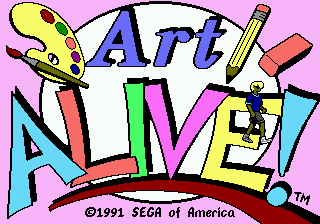
(Screenshot taken by the author)
“I didn’t read the instructions, but the game was easy to learn and fairly intuitive. Even though there was a limited palette, the ability to use patterns was neat, even if they were only 16-bit. The SFX became very annoying very quickly, especially when accessing the menu. It was disappointing too that music was only played when certain tools were used. Having music throughout would have made the game more enjoyable. The limited nature of the title would make the modern gamer become bored very quickly. However, I’m sure it would have been more engaging when it was released.”
Entertainment Weekly: “More of a toy than a game, Sega’s draw-and-paint program is pretty colourless compared with what you can accomplish on some mid-range personal computers, but it’s still a welcome alternative to those burnt out on mindless shoot-’em-ups. Overall C+”[1]
My Verdict: “It’s basically Microsoft Paint…but for the Mega Drive. It might be worth picking up if you’re a collector, but other than that, I doubt it is even worth acquiring for your children, if you have any.”
Rating:
What are your memories of Art Alive? I would love to hear your thoughts, and don’t for get to follow and subscribe so that you don’t miss my latest reviews! You can also find me on Instagram: @nicklovestogame.
Hold on to your hats guys, its time to rev that engine, feel the horsepower, and leave your competitors to eat your dust. Glory awaits!
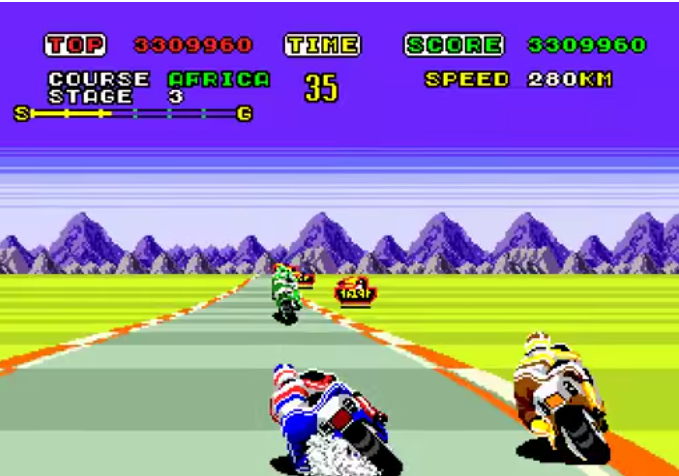
Screenshot taken by the author
Super Hang-On is a single-player motorcycle racing game developed and published by Sega. Originally released in the arcade in 1987 as a sequel to Hang-On, it would later be released for the following:
1987 – Amstrad CPC, Arcade, Commodore 64, and ZX Spectrum.
1989/1990 – Atari ST, Commodore Amiga, Macintosh, DOS, Sega Megadrive, and Sharp X68000.
2003 – Game Boy Advance (Sega Arcade Gallery)
2010 – Wii’s Virtual Console (2012 in North America)
2012 – Xbox Live Arcade (Sega Vintage Collection)
I chose to review the Sega Mega Drive version found on the Mega Games I (1992) package.
Gameplay
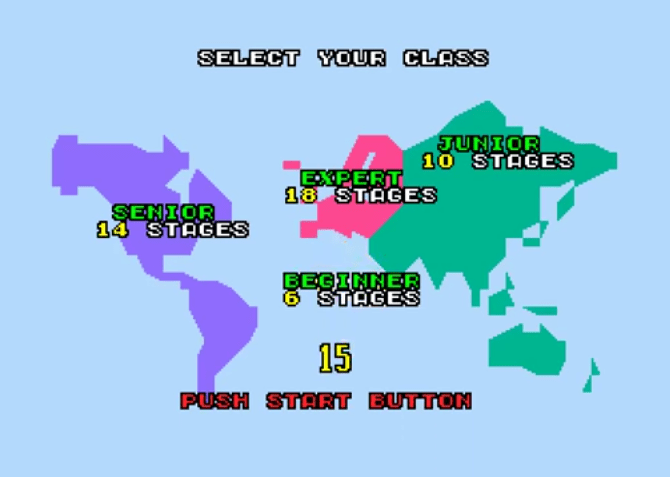
Whilst still similar to Hang-On, there is now a choice of four new tracks, based on the continents of the world. Each continent contains a different number of stages to increase difficulty (Africa = 6 stages, Asia = 10 stages etc.). A turbo button is also available should you need an extra boost. For those that are interested, the motorbike you are riding is the SGR-500(R).
Screenshot taken by the author
The Mega Drive version contains both the full Arcade Mode, and an Original Mode. In the Arcade Mode, you race against the clock. You have a limited amount of time to clear each stage. If you fail to reach the checkpoint within the allotted time, it is game over. The Original Mode is a bit more in-depth and allows you to gain sponsorship and earn money to upgrade your motorbike. Any time you crash, you damage your motorbike which affects its performance until you end the race and you mechanic can fix it. Like in real life, your bike is also subject to wear nd tear and so parts will need to be replaced anyway. You continue to compete against other racers until you have beat every opponent.
Screenshot taken by the author
How Does It Handle?
The bike is easy to control, and the game is easy to learn. However, the game can become frustrating when you crash in Arcade Mode as there is no way to make the time up again, so you may as well restart the game. I also dislike the time countdown in Arcade Mode too. In the arcade one can understand a time limit as you want games that are “quarter guzzlers”, but for gaming at home, it’s just plain annoying. Admittedly I didn’t spend that much time on this game as I’m not a racing fan, but if you are, I am sure that you will enjoy the challenge of this game.
Graphics
The graphics are clean, with brightly coloured sprites making it easy to distinguish yourself from other riders. The backgrounds and time of day change as you move through the stages of the races giving you a real sense of location and distance. At the top of the screen you have information telling you your score, speed, what course and stage you are on, and a countdown dial.
Music and SFX
Interestingly, the music only begins when you select a mode to play. You then get the option of four tracks to listen to whilst you play. The music does fit the game but is not very memorable for me.
SFX are limited to the beep of the changing lights on the starting line, the low thrum of the motorbike’s engine, and crashing. A nice little touch is that if you overtake another bike closely, you can hear their engine.
Replay Value
It is a pity there is no two-player mode for this game as racing against a friend is always fun. The Original Mode adds a lot of replay value to the game though.
Personal Memories
I have vague recollections of playing this in the arcade at Folkestone Rotunda Amusement Park when I was a pre-pubescent imp. It had the full arcade set up complete with a replica motorbike that you could sit on and use your weight to lean left or right. Being small at the time, my father would stand at the back of the bike and help me lean it, ensuring I didn’t go flying off.
I’m unsure if this is the exact one I played as a kid, but this was the sort of machine I remember form the arcades.
Did I Complete The Game?
Nope, nowhere near.
What The Critics Said:
Mean Machines: “A high quality racing game which is a must for speed freaks. Overall 86%”.[1]
Mean Machines:“This cart manages to contain all of the playability of the coin-op, coulpled with slick audio-visuals. Definitely worth getting if you enjoyed the coin-op, or if you’re after a decent Mega Drive game at a bargain price. Overall 90%.”[2]
Sega Power: “Brilliant biking coin-op conversion. Terrific sensation of speed and movement, with good graphics and smooth 3D update. Thrilling to play and lasts for ages. Overall 5/5“.[3]
Sega Power “Another coin-op classic of yesteryear. Fine, but a bit mouldy. Overall 4/5.”[4]
MegaTech:“Converted from the Sega coin-op, this is an excellent copy and has all the features of the original machine plus an extra challenge game thrown in for good measure! The graphics and sound are both excellent, and with playability to match, this is a race game that no Megadrive owner should be without. Overall 89%”.[5]
My Verdict:
“I’m not a fan of racing games but if you are, this may prove a challenge. Beautiful graphics and scenery too, and enough replay value to make it worth adding to your collection.”
Ratings:
What are your memories of Super Hang-On? I would love to hear your thoughts, and don’t for get to follow and subscribe so that you don’t miss my latest reviews! You can also find me on Instagram: @nicklovestogame.
[1] ‘Mega Drive Review – Super Hang-On’. Mean Machines. (October 1990). Issue 1:82-4.
[2] Leadbetter, R.,’Review: Mega Drive – Super Hang-On’. Mean Machines. (October 1992). Issue 1:127.
[3] Jarrett, S., ‘The Hard Line – Super Hang-On’. Sega Power. (April 1991). Issue 23:54.
[4] ‘The Hard Line – Review: Mega Drive – Super Hang-On’. Sega Power. (September 1993). Issue 46:98.
[5] ‘Game Index – Super Hang-On’. MegaTech. (May 1992). Issue 5:78.
“Red…7…28…hut, hike!!!”. American Football, that favourite of North American Sports that just doesn’t seem to translate well in the UK. The computer games did, however, and this one was no exception. Get ready for hard-hitting defensive plays and Hail Mary passes, as we delve into this offering from Electronic Arts.
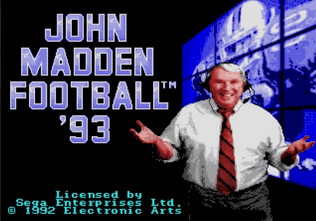
Title screen (Screenshot taken by the author)
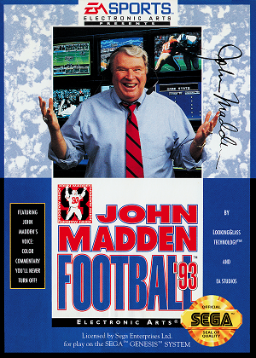
Madden ’93 is another in the line of the Madden franchise. It was developed by Blue Sky Productions for the Mega Drive and Electronic Arts for the SNES. It was published by EA Sports Network and released in 1992. I chose to review the Mega Drive version.
Gameplay
You can play either one-player, two-player head to head or co-operative modes
Like its predecessor, you have the option to play the following modes:
Pre-Season – An exhibition match with no fouls except offsides and the 45 second play clock is turned off
Regular Season – Exhibition but with all game rules in effect
New Playoffs – Begin a new tournament
Continue Playoffs – Continue with a previous tournament
Sudden Death – Normal game rules but the first to score wins the game
A new mode, All-Time Greats has been added which is a smaller 8-team tournament.
American football consists of four quarters, and you can choose how long these quarters are. Quarter lengths can be either 5, 10, and 15 minutes in length.
You then get to choose the type of stadium and field you play on. The choices are:
Open stadium with grass
Open stadium with Astroturf
Domed stadium with Astroturf
When you select open stadiums, the weather can affect the game in the guise of wind, rain and snow. In the snow and rain, players are slower and have less traction. The wind affects field goals and punts making it trickier to judge direction.
The game came with a very comprehensive manual explaining in detail the intricacies of the plays and in-depth stats on the players. Simply
What’s New?
Some of the new features include stumbling, taunting, head-butting, and one-handed catches. Although you can play in snow, wind and rain etc., they still haven’t added a random weather option, which would be a nice touch. Sadly, there is still no sign of real player names, but on a positive note, you no longer need a password as the game automatically saves your progress.
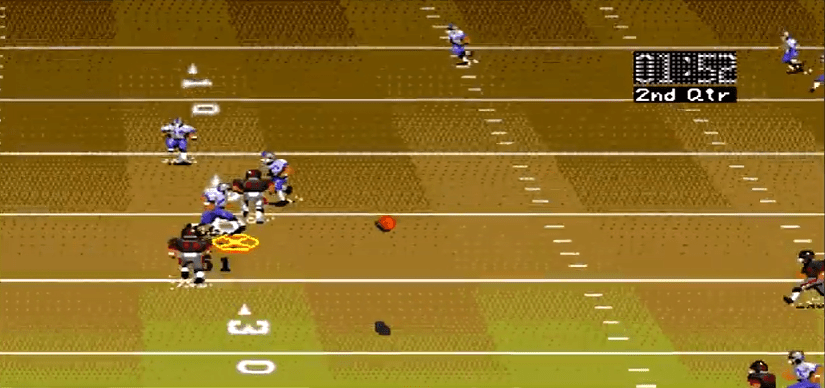
The game looks identical to its predecessor (Screenshot taken by the author)
How Does It Handle?
The gameplay has been improved since it’s predecessor. It’s tougher to dominate matches with a throwing game as defensive players intercept and block the passes a lot more. The running game is slightly better with faster runners, but I’d still recommended not bothering and sticking to a throwing game unless you are near the touchdown line.
Graphics
The graphics are pretty much the same as Madden ’92. In that, they still look very good. Not complaints here. I do like the little dances the players do when they score a touchdown.
Music & SFX
The theme song over the title screen and game set-up is an upbeat, rocky number that suits the game well. there is no in-game music though except when you score a touchdown.
SFX are quite minimalist is this game. There’ll be plenty of “First Down”’s from the referees, calls from the quarterback and grunts from the players as they tackle you. There a low murmur from the crowd through with the occasional cheers as you score a touchdown. An ambulance siren indicates your player is injured.
Replay Value
Sports games always have a lot of replay value, especially in two-player mode. The addition of the two-player co-op mode adds a little more replay value to this game
Throwing plays is still the best tactic (Screenshot taken by the author)
Did I Complete The Game?
In many modern sports games you don’t necessarily complete these sorts of games, as much as win the league and cup titles, and then move on to the next season. Completing early sports games simply means winning a tournament or league once before restarting with a different team. I have won the play-offs many times with several different teams including Chicago, Cincinnati, Buffalo and Philadelphia.
What The Critics Said:
Computer & Video Games Magazine:“Definitely the worst of the trio, and hopefully EA will learn that ’92 is virtually impossible to improve on. Overall 77%”.[1]
Gamesmaster Magazine:“John Madden ’93 is simply the most sophisticated, intriguing and complex game available on any system anywhere. If you fancy yourself as having a brain as well as a fast trigger-finger, this is the game for you. Overall 90%”[2]
Sega Power: “Can’t fault it as a football game, but the differences between this and the ’92 version aren’t that noticebale. If you haven’t got any of the John Madden games, get it. Overall 5/5”.[3]
Gamerpro:“John Madden Football ’93 is even more fun to play than Madden ’92…it’s clealy the benchmark for all other football video games. Overall 4.6/5”.[4]
Mean Machines Sega: “Not a bad game at all, but hopelessly redundant nonetheless. Go for the slightly better John Madden ’92 if you’re after a definitive American football game and give this one a miss. Overall 89%”.[5]
Awards:
Best Sports Game of the Year (All Systems) – Electronic Gaming Monthly’s Best and Worst of 1992[6]
My Verdict:
“Overall, the game is more challenging than Madden ’92, which is for the better. A step forward for the franchise.”
Rating:
What are your memories of Madden ’93? I would love to hear your thoughts, and don’t for get to follow and subscribe so that you don’t miss my latest reviews! You can also find me on Instagram: @nicklovestogame.
[1] Anglin, P., ‘Game Review: Mega Drive – John Madden ’93’. (January 1993). Computer & Video Games Magazine. (January 1993). Issue 124:90.
[2] ‘Game Review: Mega Drive – John Madden Football ’93’. Gamemaster Magazine. (January 1993). Issue 1:66-8.
[3] ‘The Hard Line – Review: Mega Drive – John Madden Football ‘93’. Sega Power. (September 1993). Issue 46:97.
[4] Weekend Warrior ‘Pro Review: Genesis – John Madden Football ‘93’. Gamerpro. (December 1992). :141-2.
[5] ‘Review – John Madden Football ‘93’. Mean Machines Sega. (December 1992). Issue 3:102-4.
[5] ‘EGM’s Best and Worst of 1992: Best Sports Game of the Year (All Game Systems) – John Madden Football ‘93‘. Electronic Gaming Monthly’s 1993 Video Game Buyer’s Guide. (1993). :16.
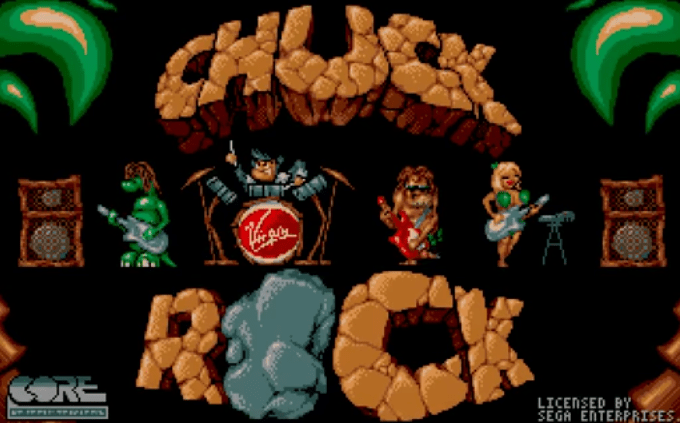
He may not be the sharpest flint in pre-history, but Chuck Rock has a head as hard as a granite and a belly that is deadly. So get ready to navigate jungles and swamps, battle dinosaurs, and rescue your wife before Garry Gritter has his way with her. Unga Bunga!!!
Title screen (screenshot taken by author)
Chuck Rock is a single-player side-scrolling platform game developed by Core Design. It has been published and ported to many other platforms including:
Core Design – Atari St and Amiga (1991), Commodore 64 (1992), and Amiga CD32 (1994)
Krisalis Software – Acorn Archimedes (1991)
Virgin Interactive – Sega Megadrive (1991), Sega Master System (1993) and Game Gear (1992)
Sony Imagesoft – Sega Mega-CD (1993), SNES (1992) and Game Boy (1993).
I chose to review the Mega Drive version.
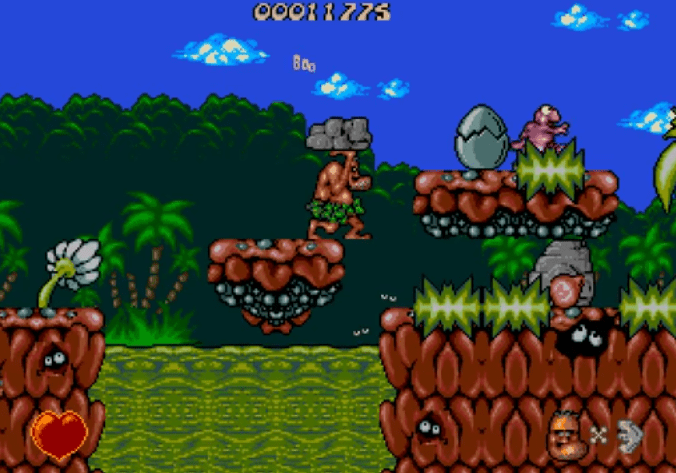
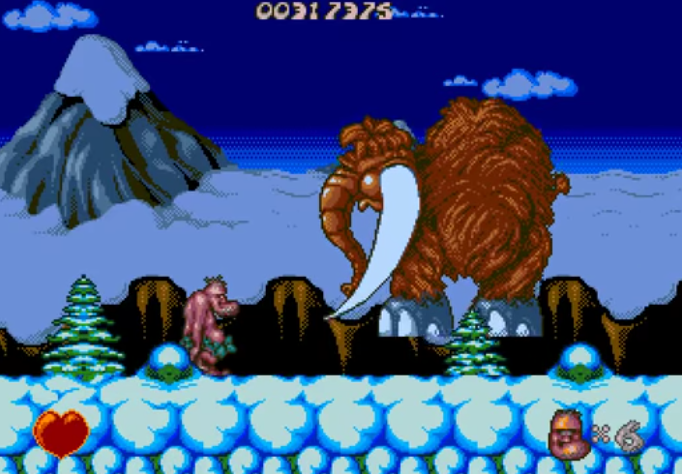
Beautiful level design (screenshot taken by author)
Plot
Set in a fantasy prehistoric Stone Age, Chuck is enjoying a lazy day in front of his TV drinking beer (root beer that is). His wife, Ophelia, is going about her daily chores unaware that she will soon be kidnapped by the evil Gary Gritter, who has designs on her. Chuck hears the commotion and investigates, only to find a pile of crumpled, dirty clothes and signs that something heavy has been dragged away. Since he has no clothes to wear, he ducks behind some nearby bushes and fashions some leafy pants to cover his modesty. He must now rescue his wife.
Gameplay
Chuck must navigate his way through five levels, each with three-five stages, all the while evading various dinosaurs and prehistoric animals; or if you are feeling brave, barging them out the way with your belly, performing flying kicks, or picking up huge boulders and throwing them. I’d recommend using the latter two to kill your enemies.
The levels are:
The jungle scene
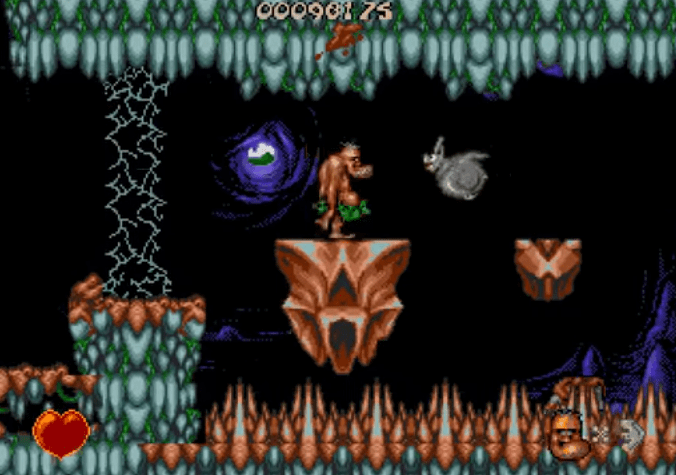
The caves scene
The water scene
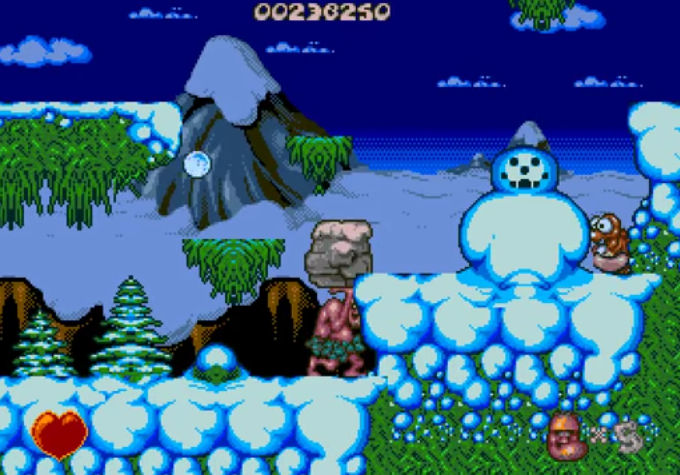
The Ice scene
The Graveyard scene
Chuck may look like a everyone’s least favourite uncle, but he is the hero of this tale (screenshot taken by author)
How Does It Handle?
The controls are easy to learn and are nice and responsive. The game is challenging with some tough levels. Oddly, the end of level bosses are all very easy to defeat with the exception of the third boss. The only boss that you need a strategy to defeat is the first boss, but other than that, it is simply a case of button mashing. One nice little touch is that when Chuck is carrying a large rock, he won’t move as fast.
Graphics
Throughout the entire game the graphics look fab. The overall feel of the graphics is more on the whacky side than the realistic side. The background look great, and I particularly like the snowman on The Ice scene level. There’s plenty to catch the eye and make you think “That looks cool!”, like a T-rex with boxing gloves…awesome!
The levels look gorgeous (screenshot taken by author)
Music& SFX
The music is good throughout the game. The opening musical number on the title screen is awesome and I found myself delaying playing the game in order to listen to the song the whole way through. It seems that even though Chuck isn’t the sharpest tool in the box, he has aspired to lead singer of a rock band. The music speeds up during the boss battles.
There are plenty of SFX throughout the game as Chuck jumps, throws rocks, and bounces enemies of his belly.
Replay Value
Sadly, this game lacks replay value. There is only one difficulty setting and once completed you may only wish to revisit it once or twice before turning your attention to the next challenge.
(screenshot taken by author)
Did I Complete The Game?
Yes, I completed the game without the use of cheats. Sadly, upon completing the game you are met another example of an anti-climatic ending to a game that deserved more.
What The Critics Said:
Mean Machines: “An excellent and quite original platform game that’s highly recommended to all Megadrive players. Overall 91%.”[1]
Mean Machines Index: “A brilliant, humorous Megadrive platform game with real character. Its graphics are out-of-this-world, the sound completely brilliant, and the game play pretty good too! A must have for your Megadrive collection. Overall91%”[2]
Sega Power: “Groovy goings-on 100 million years B.C. with wild sonics and graphics as Chuck rescues his wife from the evil Garry Glitter. Overall4/5.”[3]
Electronic Gaming Monthly: “The gameplay could use a little fine tuning, but it is still very fun to play. The graphics are comical and the music jams. Overall7.75/10”.[4]
Megazone:“Graphics wise this game is a hit (as good as the Amiga on the Mega Drive), the sound is pretty good (not quite up to the Amiga, but still pretty hot) and some imaginative sprite drawings have been added to this game. Overall85%”.[5]
GamePro:“The game’s worth the bucks for the music and graphics alone. From standpoint of challenge and gameplay, it’s middle of the road – not too hard and not too easy. Overall4.6/5.”[6]
My Verdict:
“Unga Bunga – The game has nice graphics and is fun to play. The simple button mashing as oppose to a strategy needed to defeat end of level bosses, is a mark against this game. The lack of replay value means that once completed I doubt you will want to play through again.”
Rating:
What are your memories of Chuck Rock? I would love to hear your thoughts, and don’t for get to follow and subscribe so that you don’t miss my latest reviews! You can also find me on Instagram: @nicklovestogame.
[1] ‘Review: Mega Drive – Chuck Rock’. Mean Machines. (June 1992). Issue 21:76-8.
[2] ‘Review: Mega Drive – Chuck Rock’. Mean Machines. (October 1992). Issue 1:137.
[3] ‘The Hard Line – Review: Mega Drive – Chuck Rock’. Sega Power. (September 1993). Issue 46:96.
Ah the city of Paris, home of the Notre Dame Cathedral, the Eiffel Tower, and the Louvre. A city that countless visitors seek for romantic getaways, art and culture. American lawyer George Stobbart was visiting Paris. He was enjoying a coffee and minding his own business…then a bomb exploded in the café he was sitting at.
Title screen (screenshot taken by the author)
Broken Sword: Shadow of the Templars (also known as Circle of Blood) is a point and click game developed and published by Revolution Software in 1996. It was released on multiple platforms including Android, Game Boy Advance, iOS, Linux, Mac OS, Nintendo DS, Nintendo Switch, Palm OS, PlayStation, PlayStation 2, PlayStation 4, PlayStation Vita, Wii, Windows, Windows Mobile, Xbox, Xbox One. Here, I will review the Director’s Cut which was released in 2009.
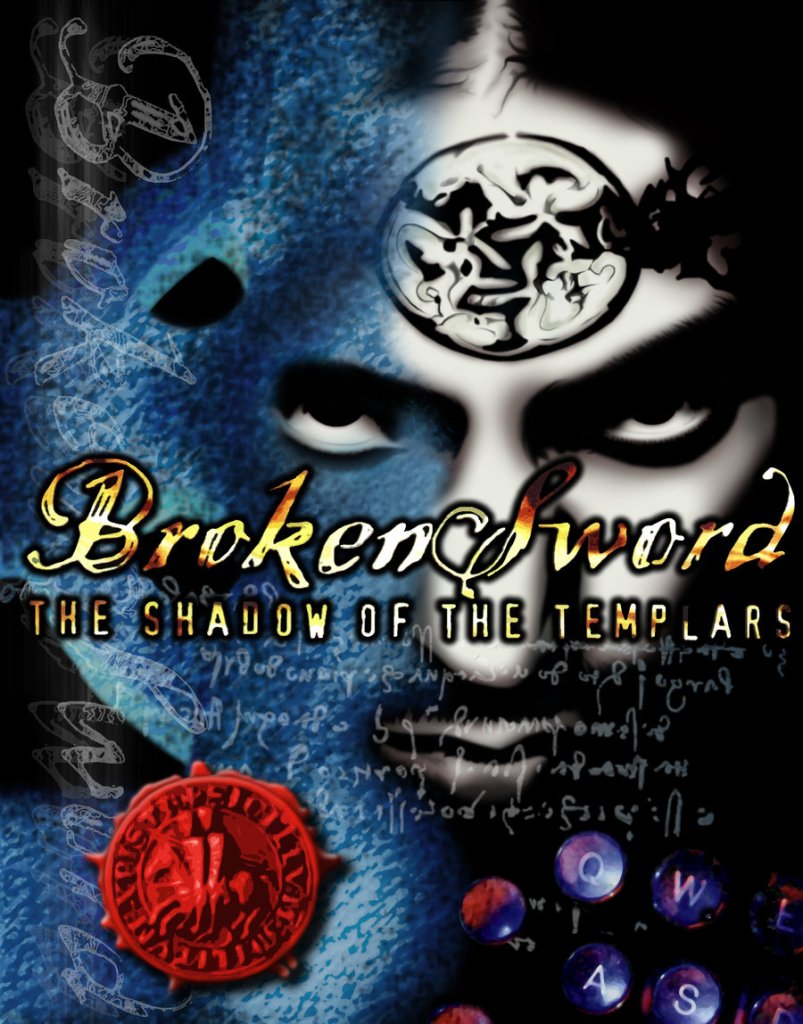
Director’s Cut cover art
Plot
This is the first instalment of the Broken Sword series. You play as American George Stobbart who witnesses the assassination of a man named Plantard. Whilst enjoying a coffee at a Parisian Café, Stobbart observes the assassin enter and then leave with a briefcase moments before an explosion destroys the establishment. Naturally Stobbart begins to investigate the murder because, let’s face it, the explosion almost killed him too and to rub salt into the wound, he appears to be a suspect. During his investigation he meets and allies himself with French reporter Nicole “Nico” Collard. What starts as a murder investigation soon unravels as a conspiracy plot involving the Knights Templar, which takes Stobbart and Collard to several different countries including Ireland, Spain, Syria, and Scotland in search of the murderer.
Gameplay
Like with all point and click games, you control a cursor on the screen. By hovering it over certain objects or characters, you have the option to look at or interact with them. By moving the cursor to the lower part of the screen, you will gain access to your inventory and any objects you have picked up. When talking to characters, a number of pictures will appear and when these pictures are clicked, George of Nico will engage in a line of questioning which will help the story progress.
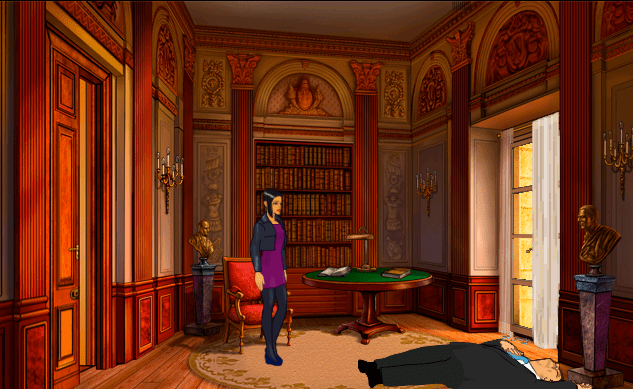
The animation style is in the beautiful classic animation tradition (screenshot taken by the author)
How Does It Handle?
The gameplay is easy to learn and intuitive. The story is engaging, especially if you love a good conspiracy theory, and I felt immediately drawn in by it. The puzzles are challenging but not convoluted like in some other point and clicks. I did need assistance to help with the odd puzzle, but I never got bored of this game.
Graphics
The game is designed to be reminiscent of the classic animated film genre. The scenes are incredibly detailed and the characters are realistically animated. With beautiful Parisian streets, rural Irish settings, and Syrian towns, there is a good array of different scenes.
Music
The music is rather understated and takes a back seat in this game. It is mainly used in cutscenes or when you solve a major puzzles. This game doesn’t need music though. The silence and minimalist SFX adds to the realism of the game.
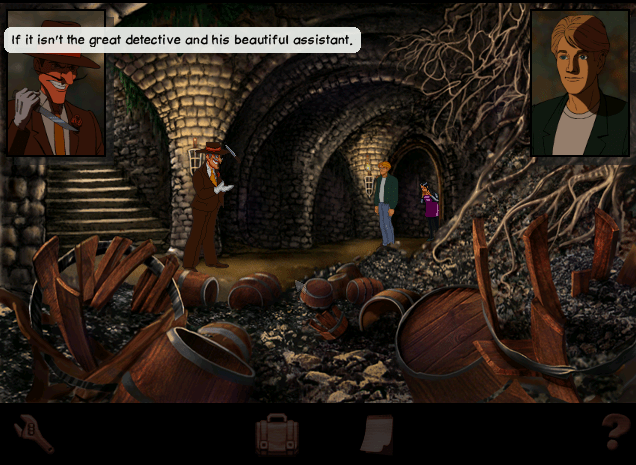
George and Nico’s adventures see them meet a number of undesirables (screenshot taken by the author)
Differences With The Original Release
The Director’s Cut has several differences when compared with the original release. The graphics have been improved and are smoother. There are extra scenes; in the original you begin with Stobbart at the Café, but in the Director’s Cut, you begin with Nico needing to escape Plantard’s house. Artwork of character profiles appear during conversation scenes, and there are extra puzzles to work your way through.
Did I Complete The Game?
I did, but there were one or two occasions when I had to use a walkthrough.
What The Critics Said About The Original Version:
Gamespot.com “Without question, Circle of Blood is an adventure of epic proportions and ranks as one of the most intriguing games to roll out this year. Its only drawback is that the graphics might be too real. After playing the game, you might find yourself wanting to pack your bags and take in the European sights first-hand. But if you’re lacking for travel funds and must stay home and play computer games, Circle of Blood definitely won’t disappoint you.Overall rating 9.2 superb”[1]
What Critics Said About The Director’s Cut:
PC Gamer Magazine“Wonky visuals, but this is as close to the Da Vinci Code meets Monkey Island as we’ll get. Did I mention the hot French accent? Overall 69%”[2]
(Wii version) Best European Adventure 2011 – European Game Awards[5]
My Verdict:
“I love this game, and am a huge fan of the franchise. I love the graphics, the story, and the puzzles. If you like point and clicks, and even if you don’t, I’m sure you will find this game entertaining.”
Rating:
What are your memories of Broken Sword: Shadow of the Templars? I would love to hear your thoughts, and don’t for get to follow and subscribe so that you don’t miss my latest reviews! You can also find me on Instagram: @nicklovestogame.
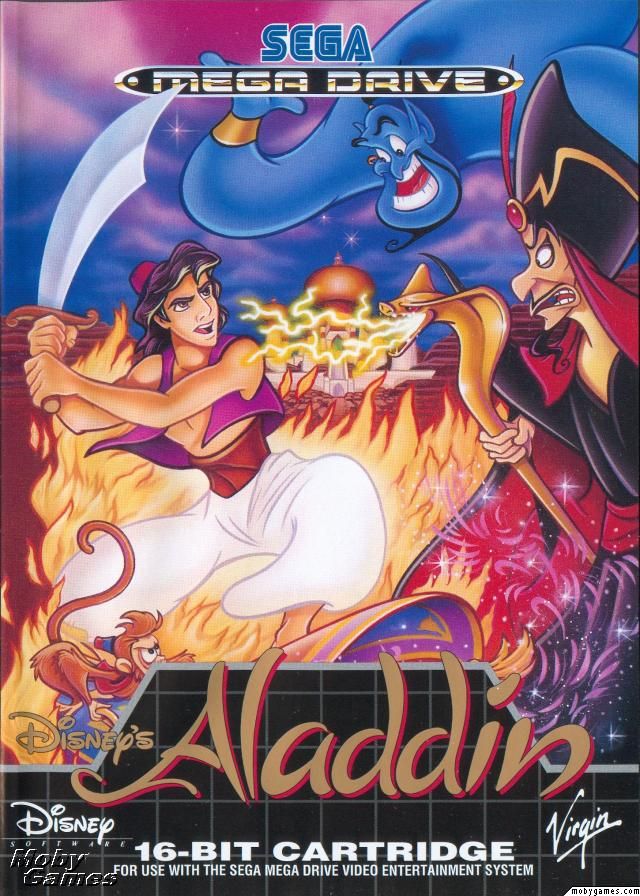
Aladdin is a Middle-Eastern folk tale about a boy who went from rags to riches with the help of a genie. It is one of the more well-known stories from the Arabic world. The western world embraced this tale and in 1992, Disney released their animated film version, bringing Aladdin to a “whole new world”…er…I mean generation. Its popularity, due to a great soundtrack and an award winning performance by Robin Williams, saw a video game released a year after the films hit the cinemas.
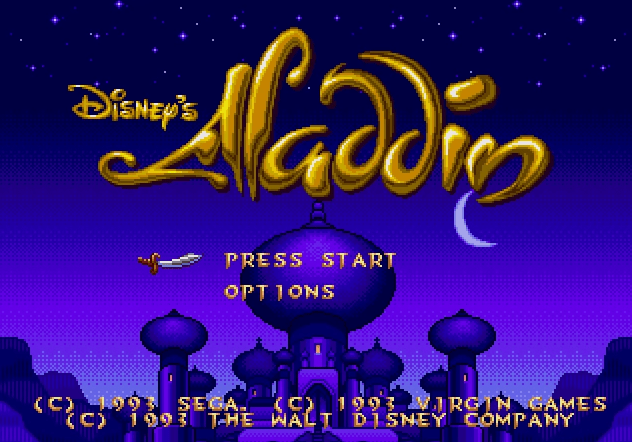
Title screen (screenshot taken by the author)
Aladdin is a single-player side-scrolling action platformer which was developed by Virgin Games. It was published in 1993 by Sega and Disney Software for the Sega Megadrive, and by Capcom for the SNES. It was later ported to the NES, Game Boy, Amiga and DOS formats. I chose to review the Mega Drive Version.
Plot
The game is not identical to, but still has the same storyline as the film. In the Arabic city of Agrabah, a lovable street rat called Aladdin lives with his monkey companion Abu. One day, he stops a stranger from getting her hand chopped off for giving a starving child an apple. This stranger turns out to be Princess Jasmine, and Aladdin is smitten.
Meanwhile, the Sultan’s evil adviser Jafar is plotting to overthrow the Sultan and marry Jasmine. Aladdin must must rescue the Princess Jasmine from the evil Jafar.
Gameplay
You can choose from three difficulties: Practice, Normal or Difficult. Once the game begins, prepare to navigate the following levels:
Agraban Street
The Desert
Agraban Rooftops
Sultan’s Dungeon
Cave of Wonders
The Escape
Rug Ride
Inside the Lamp
Sultan’s Palace
Jafar’s Palace
Whilst traversing the levels you are able to jump, crouch, and climb ropes. To defeat enemies, you have the choice of a scimitar with which to slash your opponent or you can collect apples to use as projectiles. If you collect tokens of the Genie’s head or Abu’s head, you will gain access to bonus stages to gain extra lives and such. Gems can also be acquired to buy extra continues and wishes from the peddler.
Clearing a level with one or more of the Genie’s tokens takes you to the Genie’s Bonus Machine where you can win gems, apples, and extra tries. The amount of spins you get depends on the number of Genie tokens you have.
If you find an Abu token, you gain access to his bonus stage. He must run back and forth, wielding a scimitar, and trying to pick up special objects that are dropped from the sky whilst avoiding rocks and pots that are also falling. Again, your aim is to collect gems, extra tries, and apples.
There are cut scenes between the levels allowing the storyline to move along, but you do not need to have seen the film in order to enjoy the game.
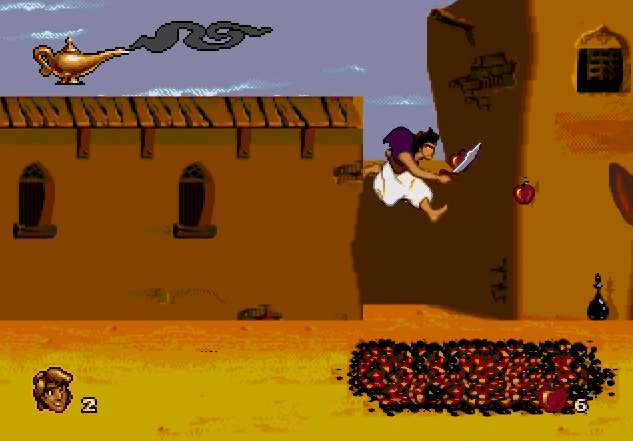
Aladdin was praised by critics for its graphics (screenshot taken by the author)
How Does The Game Handle?
The controls are tight, and the physics of the game are easy to get used to. One level which sees our hero trying to escape the Cave of Wonders is particularly hard and had me swearing many times at the TV and/or controller pad.
Graphics
The graphics are incredible! They are bright and colourful, and the animation is excellent and fun to watch. I particularly liked the smoke from the genie’s lamp being used as a health meter and the way little Abu runs around in his bonus stage.
All the levels are detailed, look beautiful and make you feel like you’re playing the movie. The parallax scrolling of the chains in the foreground of the Sultan’s Dungeon really helped with the feeling of being locked inside. To be fair, all the levels look amazing.
Music& SFX
The music consists of songs from the movie soundtrack so no doubt you will be humming along. For example, over the title screen you will hear “A Whole New World” and over the first level it is “Prince Ali”.
The main SFX you will hear is the sound of air being cut as Aladdin swinging his sword and little ‘trings’ as he picks up items. There are lots of SFX in this gave and it’s awesome.
SPOILER ALERT!!!
Frustratingly, at the end of the game you can only defeat Jafar by throwing apples at him. What the game doesn’t tell you is that you need 36 apples to defeat him. If you don’t have enough there is little else you can do other than restart the entire game, and ensure you use the apples sparingly.
“Prince Ali fabulous he Ali Ababwa” (screenshot taken by the author)
Replay Value
When the game is completed the ending is practically non-existant, which begs the question, should one have bothered to complete it in the first place. The answer, of course, is yes as this is a good game and worth playing again.
Did I Complete The Game?
Yes, but I wasn’t happy about getting all the way to the end before realising that I had to restart and play through again to ensure I had enough apples to defeat Jafar.
What The Critics Said:
Edge Magazine: “…almost perfect. The sound could have been better – but that’s a minor quibble. Anyway, at last the Mega Drive has a new platform king. Move over spiky blue one, Aladdin’s in town. Overall8/10.”[1]
My Verdict:“Prince Ali! Fabulous He! Ali Ababwa. A fun little game that is well worth your time. Great graphics and music, however older generations might get bored a little easily with this one.”
Rating:
What are your memories of Aladdin? I would love to hear your thoughts, and don’t for get to follow and subscribe so that you don’t miss my latest reviews! You can also find me on Instagram: @nicklovestogame.
The history of the world is full of civilisations competing for resources, wealth and glory. Age of Empires offered the chance to relive those struggles, and immerse ourselves in a world that we are so far removed from. Rise from humble beginnings, defeat your enemies and rule the world!
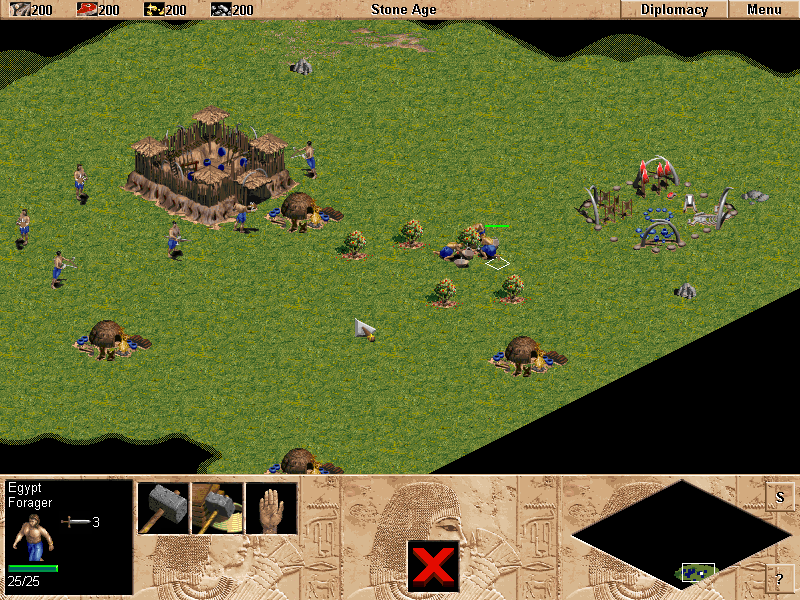
You begin in the Stone Age with rudimentary weapons and little technology (screenshot taken by the author)
Age of Empires was developed by Ensemble Studios and published by Microsoft Games. It was released in 1997 for the PC, spawned a number of sequels and spin-offs, and has gained a loyal following. It was the original PC version I chose to review.
Gameplay
AOE is a real-time strategy game which sees you lead the ancient civilisations of Egypt, Greece, Babylonia and the Yamato, through the Stone Age, Tool Age, Bronze Age and Iron Age, in order to rise up and become dominant empires. In order to progress through the ages, you need to build your base and grow your army. To do this you send villagers to gather resources of wood, food, gold and stone. Upon reaching a new age, better soldiers, weapons and technologies become available to you.
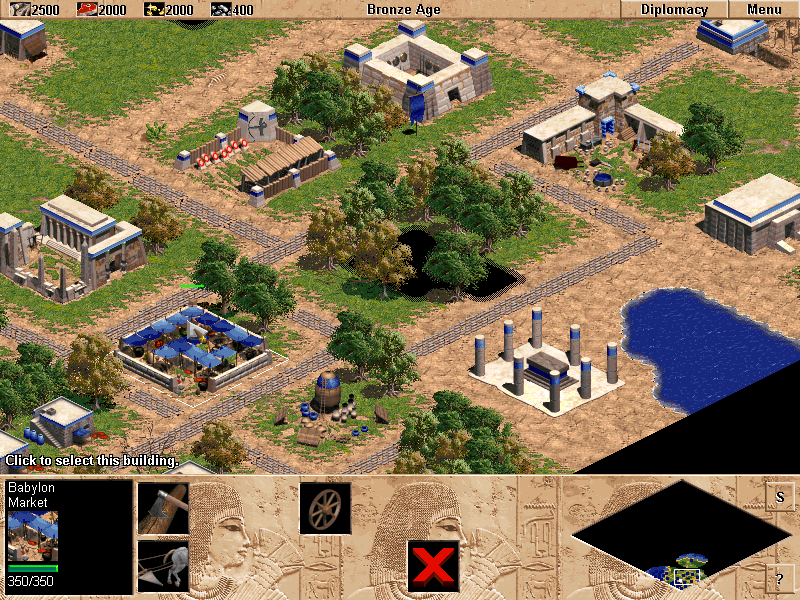
Build your civilisation to conquer the known world (screenshot taken by the author)
You have the option of playing single player campaigns, as well as a Random Map mode in which different maps are generated for each match. Other adjustments can be made to make the matches harder such as adding a Death Match mode. You can even create your own scenarios in the Scenario Builder and set your own match parameters. Multiplayer is also available to play online. These features give this game tons of replay value.
Each campaign contains a number of missions. Before each mission, you are given a timeline and briefing with mission objectives and hints to draw you into the game.
The campaigns are:
Egyptians (8000 BCE – 1457 BCE) – 12 scenarios – Helping you learn the game initially through hunting and foraging through to the Siege in Canaan.
Greeks (1600 BCE – 334 BCE) – 8 scenarios – From competing to with smaller tribes for agricultural land, to fighting in the Trojan War, to helping Alexander the Great build a wonder.
Babylonians (1760 BCE – 612 BCE) – 8 scenarios – See the rise of Babylonia under King Hammurabi and throw off the yoke of Assyrian oppression.
Yamato (210 BCE – 740 CE) – 6 scenarios – From making a pre-emptive strike on a clan of would be assassins’ to defeating the Kyushu army to confirm Yamato as the dominant empire in Japan.
How Does It Handle?
The controls are simple. You use your mouse to hover over a unit (villager, priest, military personnel etc.) and click on them to gain control. You can then either move them or call them to action. For example, if you highlight a villager, and then click on a tree, the villager will begin to gather wood and carry it to the nearest storage pit or town centre. A menu also appears in at the bottom of the screen with options to build and repair buildings.
For military personnel, once they have been highlighted, you can direct them to attack enemy units or buildings. Default stances can also be set which will instruct them to attack enemies on sight, attack enemies within a certain range of your settlement before returning to their original position, or simply ordering them to stand their ground. ‘Standing Your Ground’ is useful for archers and artillery (for these units, there is also a ‘ceasefire’ option). With artillery such as catapults, you can damage your own troops so be aware when deploying troops.
When clicking a building, options will appear at the bottom of the screen where you can choose to research technologies or create new troops (obviously depending on the type of building). Each civilisation has a slightly different technology tree and so certain technologies will need to have been researched before progressing to the next age, or before certain troops and other technologies become available. For example, you can only build a market once you have reached the Tool Age. Building a market will allow you to build farms which in turn is a vital food source. However, you need wood to build farms. It all weaves together beautifully like an intricate web. Markets also allow you to offer tribute in the form of resources to other players.
Graphics
Visually, the game has an isometric view and I think it looks beautiful. The attention to detail of the landscapes, buildings and units make the game look awesome and really gives you the feeling you are watching these ancient civilisations grow.
Music& SFX
I adore the music too. The creators tried to ensure that the music was authentic to the time periods and cultures by performing with instruments that would have been used by musicians of the time. This attention to detail really adds to the atmosphere of the game.
There is always a background activity. Whether it is the light thuds of axes hitting trees, or the ‘tink, tink’ as your villagers mine for gold, or even the distinctive clash of steel on steel as your soldiers fight your enemies and destroy their buildings, the sounds of activity bring to live the atmosphere of the game. I particularly like the sounds of the waves when you are near the sea.
Replay Value
The many different campaigns, scenarios, modes and multiplayer options, and difficulty settings give this game tons of replay value. I revisit the game at least once a year just to prove to myself I can still cut the mustard.
Personal Memories
Just hearing the music again takes me back to when I was 16, playing this game for hours on end when I should have been studying for my G.C.S.E’s. I ended up with poor grades so let that be a lesson to you not to neglect your studies! I love the music so much that I often listen to the AOE soundtrack.
The Rise of Rome extension was released in 1998 and contained four extra campaigns based on the Roman Empire. These campaigns included the Rise of Rome, Ave Caesar, Pax Romana, and Enemies of Rome. The expansion pack added more civilisations, technologies and units. It also had some extra features such as being able to queue the production of units, allowing you to continue with other objectives whilst your army is being created. It also allows the player to double-click a single unit to highlight all similar units on the screen, handy for when in the height of battle.
The new campaigns are:
Rise of Rome (509BC-27BC) – Help establish Rome and defeat the likes of the Macedonian King Pyrrhus of Epirus, defeat the Carthaginians in the Second Punic War and put an end to Hannibal’s threat once and for all.
Ave Caesar (75BC-48BC) – Help Julius Caesar escape from Cilician pirates, invade Great Britain, put down a rebellion in Gaul, and defeat Pompey at the Battle of Pharsalus.
Pax Romana (31BC-373AD) – Help Caesar conquer Marc Antony and Cleopatra at the Battle of Actium, help settle Rome after the death of the notorious Emperor Nero, recover a caravan of gold originally sent to pay the ransom of Emperor Valerian, put down a Palmyran rebellion, and witness the beginning of the downfall of Rome with the arrival of the Huns.
Enemies of Rome – Four scenarios focusing on different enemies of Rome:
Crossing the Alps – (219BC) – Hannibal fights his way through the Alps
Third Macedonian War – (171BC) – Push back the Roman legions and prevent them from establishing a foothold in Greece.
The Revolt of Spartacus (73BC-71BC) – Defeat the slave army of Spartacus
Odaenathus, Lord of Palmyra – (260AD) Help the Romans defend their eastern provinces from the Persians.
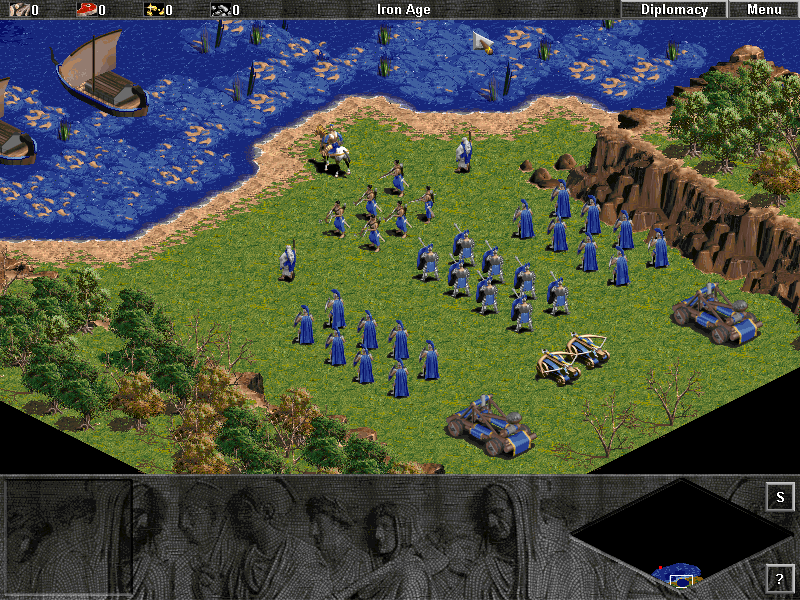
Help Caesar conquer Britannia (screenshot taken by the author)
Any Negative Points To AoE And The Rise Of Rome Expansion?
A few negative points include the lack of diversity in the units amongst the different civilisations. If you didn’t know from the campaign menu or didn’t select a civilisation when beginning a Random Map game, you could be forgiven for not knowing which civilisation you were. Regardless of what colour your army is, an indication to which civilsation you are can only be found by looking at the style of the border at the bottom of the screen.
The hoplite armies are also very overpowered. If you have a squad of about 10, you can pretty much decimate any confrontation with ease. Your only hope to defend against such an army is to either have an equal army of hoplites or get a few lucky strikes with a catapult. Having a large contingent of Heavy Horse Archers also helps as they can easily keep their distance. Lastly, some of the missions can become monotonous. Most missions are simply building an army and destorying the enemy base. There are a few more interesting missions such as finding and marking ancient horse symbols, but these are few and far between.
My Final Word
That being said, this game is utterly brilliant. What’s not to like? The game is easy to learn and highly addictive. There are plenty of different units with which to build your mighty army. The missions increase in difficulty, challenging your strategy to the end, and the replay value will have you coming back year after year.
I have successfully completed all campaigns on easy mode without the use of cheats and loved every second of it. I will no doubt unsheathe my sword again in the future, just to ensure I can still cut the mustard.
What The critics Said Of Age of Empires:
Allgame.com:“Although the building at the beginning of a mission is slightly repetitive at times, the game is still extremely enjoyable. Overall 4.5/5”[1]
Gamespot.com: “Age of Empires looked, and pretends, to be so very much more. It still has tons of potential and a fundamental gameplay that remains entertaining enough to overcome the flaws and merit a fair rating. The system can go very far with some fine-tuning, but as it stands it seems downright schizo. Is it a simplified Civilization or a modestly beefed up Warcraft? It’s almost as if the designers started out to create one game and ended up with another. Overall 6.8/10”[2]
PC Zone Magazine: “You’ll have to spend a few hours getting to know it before you’ll be able to find the fastest routes to each main advance and what you should be researching first to get to the weapons and buildings that suit your style of play best. But then this is the sort of thing that gets people hooked in the first place. And hooked you will be. Overall 9.4/10”[3]
What The Critics Said Of Age of Empires: The Rise of Rome:
Computer Games Strategy Plus: “If you enjoyed Age of Empires, Rise of Rome will put fresh blood on your sword. Overall 4/5”[4]
Awards:
Finalist – 1997 Computer Gaming World ‘Strategy Game of the Year’[5]
Outstanding Multiplay – CGW 1998 Premier Awards: Special Award[6]
My Verdict:“A classic real-time strategy game, and you even learn a little about classical history too. It has tons of replay value, and although it’s not perfect, I find myself drawn back to this game year after year.”
Rating:
What are your memories of Age of Empires? I would love to hear your thoughts, and don’t for get to follow and subscribe so that you don’t miss my latest reviews! You can also find me on Instagram: @nicklovestogame.
#/media/File:Columns.jpeg)
















#/media/File:Age_of_Empires_Coverart.jpg)

 Nick Loves to Game