Revisiting games can be fun…but it can also be disappointing. We romanticise games in our minds and revisiting them years later, especially when technology has moved on, often destroys these rose-tinted memories. Altered Beast (1988) is an example of one such game. When I revisited it, I was disappointed that it wasn’t as good as I remember. No doubt, there will be many more to come. Will Shining Force II suffer when I revisit it with older eyes and a colder heart?
(Screenshot taken by the author)
Shining Force II: The Ancient Seal is a tactical RPG developed by Sonic! Software Planning and published by Sega. It was released for the Mega Drive in 1993. It was re-released for the Wii U Virtual Console in 2008, as well as being part of Sonic’s Ultimate Genesis Collection (2009) for Xbox 360 and PlayStation 3. It is the sequel to Shining in the Darkness, and is set 40-70 years after the events of Shining Force Gaiden: Final Conflict (1995) on the Game Gear. although the stories consist of different characters.Although I did used to own the original Mega Drive cart, for this review, I played through the version found on Sonic’s Ultimate Genesis Collection for PlayStation 3.
Plot
It is a dark, stormy night. A small band of thieves led by Slade, break into an ancient shrine looking for treasure. They happen upon two coloured jewels: one blue and one red. Upon stealing the jewels, they unwittingly break a magical seal that has held the demon King Zeon captive. With the seal broken, but not yet at his full strength, Zeon orders his minions to find the Jewel of Darkness so that he can restore his power and conquer the world.
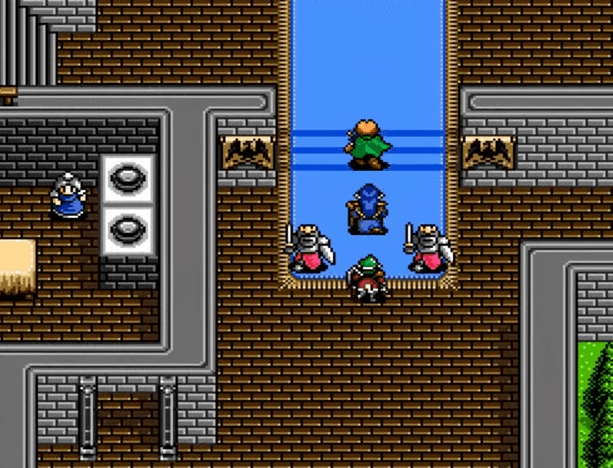
The sprites and overall design are almost identical to Shining Force (Screenshot taken by the author)
Main Characters:
Bowie is the main character (although you can choose to change his name). He is a student of Astral the Wizard, is a human and a swordsman. He is an all-rounder and can be promoted to Hero.
Jaha is a dwarf and a warrior. He is very strong but his movement is limited. He is also a student of Astral. He can be promoted to Gladiator, but with a special item, can become a Baron.
Chester is a centaur and a knight. He is also a student of Astral. He can use either a lance for short range attacks or you can equip him with a spear for longer ranged attacks. When prompted he becomes a Paladin but with a special item, he can become a Pegasus.
Sarah is an Elf and a priest. She is also a student of Astral. She is not very good in hand-to-hand combat but she is great for casting spells and healing your injured party. When promoted, she become a vicar, but with a special item, she can become a Master Monk which greatly increases her hand-to hand combat skills.
Kazin is an Elf and a mage. Once promoted he becomes a wizard.
There are many other characters who join your party along the was but I won’t discuss them here.
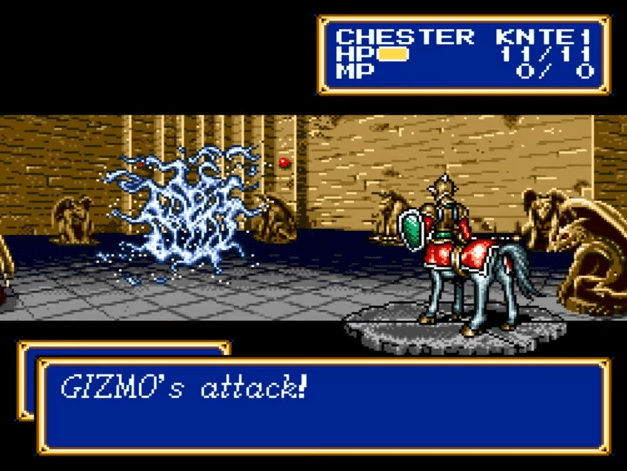
During battles, you must be careful to position your stronger units where they can defend your weaker units (Screenshot taken by the author)
Gameplay
The menu is exactly the same asShining Force (1992). That is, when walking around both urban and rural areas, you begin with four boxes that are animated when your cursor is over them These options are:
Member – Check the status of member sof your party
Item – It will take you to another menu where you can choose to use an item, pass an item to someone else, equip an item or drop one.
Search – Use this when you come across chests, boxes and vases. In fact, there are lots of hidden items in odd areas, so use this option freely.
Magic – Takes you to a menu where you can cast spells. In non-battle scenarios, only the detox spell works.
During your adventure, there are plenty of opportunities to visit shops where you can buy new weapons and sell old ones. You can also buy provisions such as herbs that help regain health, an angel wing which acts like an Egress spell and an antidote for poison. There are also options to repair your weapons (I’ve never had to use this) or to ask for deals. The deal option is pretty pointless because, as far as I can tell, items only appear there when you have already sold those special items to the shops.
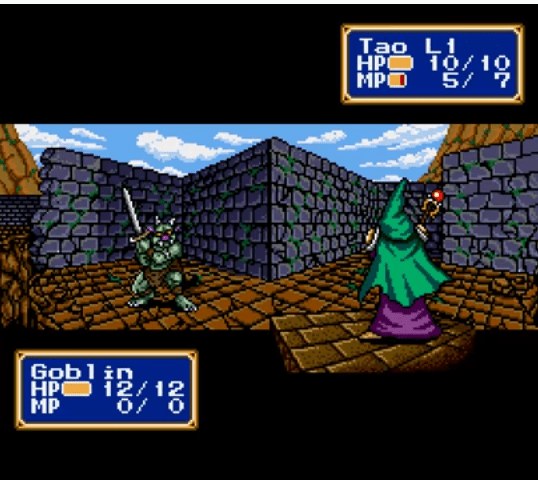
The battle scenes are beautifully illustrated (Screenshot taken by the author).
Again, the combat is exactly the same as SF (1992), in that it is a turn-based tactical affair where you must manoeuvre members of your party into good tactical positions before engaging the enemy. Depending on the type of fighter, certain members have a much larger movement range that others. When attacking an enemy, you can opt to use yor primary weapon, cast a spell or use an item. If you do not wish to attack you can simply press “stay” and that ends that character’s turn until it comes around to them again.
There is also more than one way to promote members of your party. Like SF (1992), you can promote your party when visiting a priest, once your party member has reached level 20. However, there are instances when you can promote your party member to a different class of fighter with the help of special items.
How Does It Handle?
Whereas SF (1992) was a very linear game, SFII involves more free-roaming. There are many places you need to return to in order to find special items or for the game to progress. The menu system is very intuitive and the controls are easy to learn.
Graphics
Like SF (1992), I think this game is beautiful. The environment in the overworld maps (forests and trees) have been improved, but the sprites themselves and the battle scenes are practically the same. This is not necessarily a bad thing, as they are a great improvement on games like Phantasy Star IV (1993), and better than the graphics of games like Earthbound (1994), Dark Sun: Wake of the Ravager (1994) and Final Fantasy VI (1994) (FF III in North America). Yes, I personally prefer Shining Force II‘s graphics to FFVI (1994).
Did I Complete The Game?
Yes, more than once!
What The Critics Said:
Electronic Gaming Monthly:“A worthy follow-up to the first RPG, with bigger areas to explore and characters to meet. This will definitely appeal to the fans of first one, and RPG fans in general. It assumes you’ve played the first Shining Force, but the story could use a few more twists and turns. The music is very good, as is the easy-to-follow configuration. Overall 34/50”.[1]
My Verdict:
“Personally, I think this is a great sequel. I enjoyed the story, the battles, the graphics and music. Hardened RPG fans may think this too easy, but I think it’s a game for the average gamer to enjoy, and maybe a nice introduction to RPGs.”
Rating:
What are your memories of Shining Force II: The Ancient Seal? I would love to hear your thoughts, and don’t for get to follow and subscribe so that you don’t miss my latest reviews! You can also find me on Instagram: @nicklovestogame.
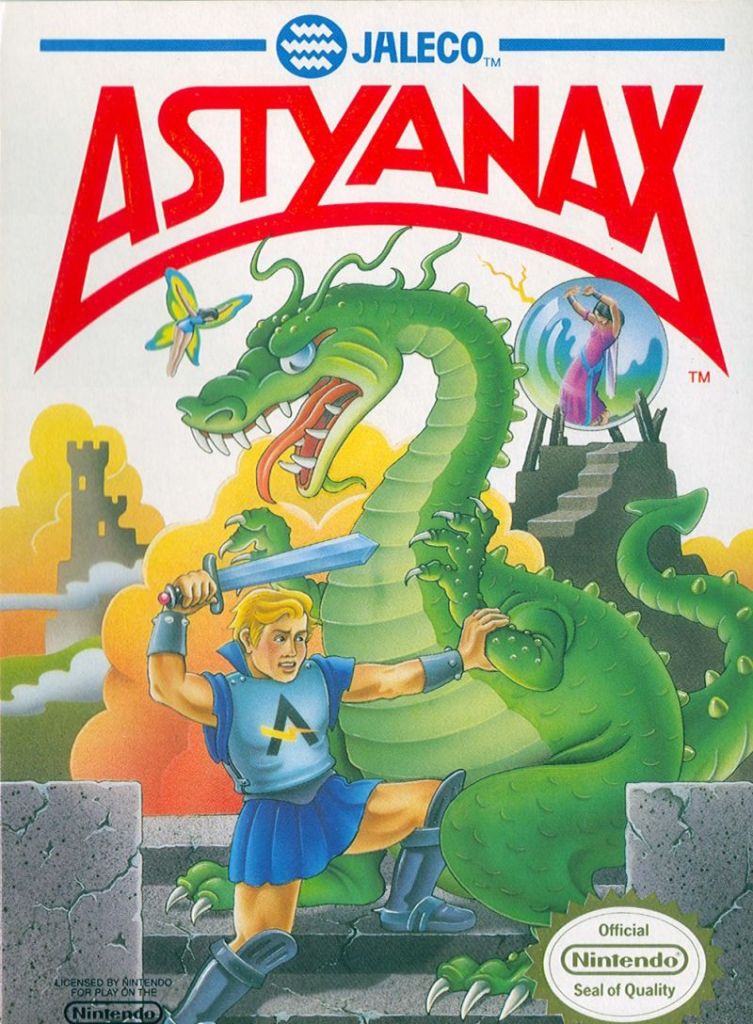
Game creators have never been shy about using aspects of ancient mythology as a basis for their games, and why wouldn’t they? Ancient mythology is filled with stories of derring-do: defeating giants, outsmarting the Gods and rescuing fair maidens. In Greek mythology, Astyanax (also known as Scamandrius) was the son of Hector, prince of Troy, and Andromache. When Troy fell, he was either thrown from the walls to his death by Neoptolemus or killed by Odysseus (depending on your source).[1]
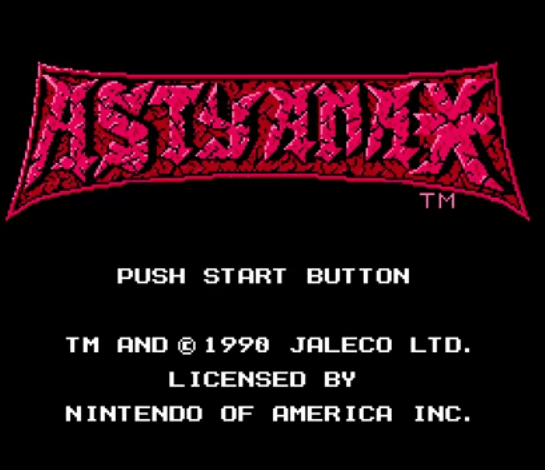
Title screen (Screenshot taken by the author)
Astyanax, known in Japan as The Lord of King, is a side-scrolling platform action game developed by Aicom and published by Jaleco. It was first released in the arcade in 1989, then later that year on the NES in Japan before getting a release in Europe and North America in 1990. For this review, I revisited the NES version.
Plot
Astyanax is a 16-year-old student from Greenview High who keeps having a recurring dream of a woman calling his name. One day, he is transported to another dimension where he meets a fairy named Cutie. She persuades Astyanax to rescue Princess Rosebud, Ruler of Remlia, from the evil wizard Blackhorn. Using either the legendary axe known as ‘Bash’, a spear or a sword, Astyanax must fight through forests, caves and a castle to reach Blackhorn.
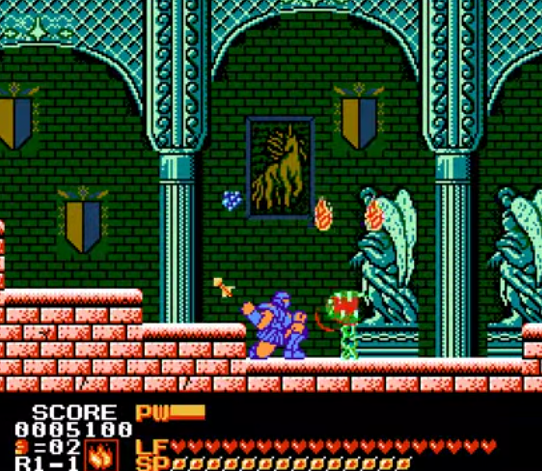
Graphics-wise, the game looks good. (Screenshot taken by the author)
Gameplay
You have energy three bars: the first is a power gauge showing how hard you hit the enemy. This descreases anytime you swing your weapon at an enemy. When you stop attacking, the bar increases again. The length of your power bar increases as you find power-ups. The second is your health bar, and the third is your magic bar. Unlike the arcade version, the NES version can only be played in one player mode.
How Does It Handle?
The controls, whilst easy to learn, are frustrating because you can only strike straight ahead, whilst crouching or whilst jumping. you cannot jab upwards. It is ridiculously tough too. Many enemies attack at awkward heights, and you find yourself accidentally pressing up and attack which casts a spell and uses up your magic supply. Some later levels have an insane number of monsters swarming the screen at once. Oddly enough, the end of level bosses are not that difficult to defeat.
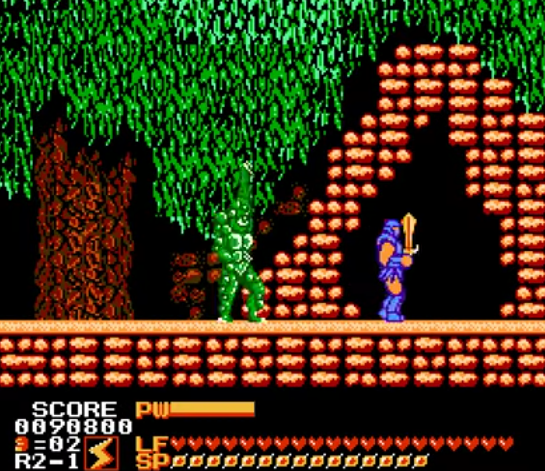
Attack of the Green Monster type thing! (Screenshot taken by the author)
Graphics
Graphically, this game looks good, especially when compared to its contemporaries such as Iron Sword: Wizards and Warriors 2 and Clash at Demonhead, both released in 1989. It has detailed and colourful backgrounds, and well defined sprites, especially the end of level bosses. After each level, you are treated to some beautifully illustrated cut scenes which help move the story along. However, there is a bit of flicker when you attack the enemy and at times, whole blocks of detail disappear.
Replay Value
Once completed though, there is little to make you want to play through again as the game only has one difficulty setting.
I wanted to give this game a better score but due to the monotonous music, the attacking issue, and the fact that you will need a cheat code to complete this game, lowers the score for me. There are better, more enjoyable games out there. I just didn’t enjoy playing this game that much so I doubt I shall be returning anytime soon.
Did I Complete The Game?
Yes, but I had to use the invincibility cheat, as this game is too damn hard. Without the cheat, I could only get to the end of level boss on level 3.
What The Critics Said:
As of yet, I have been unable to find contemporary reviews.
My Verdict:
“This game looks good, has tight controls, and a challenge that hardened gamers look for. The issue is that the controls are limited. It is perhaps too tough for the average gamer and has little in the way of replay value. It’s worth playing, but it’s not a game you’ll return to very often, if at all.”
Rating:
What are your memories of Astyanax? I would love to hear your thoughts, and don’t for get to follow and subscribe so that you don’t miss my latest reviews! You can also find me on Instagram: @nicklovestogame.
It must be difficult for game creators. Do they stick to a winning formula for a sequel and run the risk of the concept becoming stale, or do they gamble on new features that have the potential to disgruntle loyal fans to the franchise? It’s a hard balance to get right as many games have shown over the years. The question is, will Sonic 3 fall foul of over-zealous creators or will they get it right for a third time in a row?
Title screen (Screenshot taken by the author)
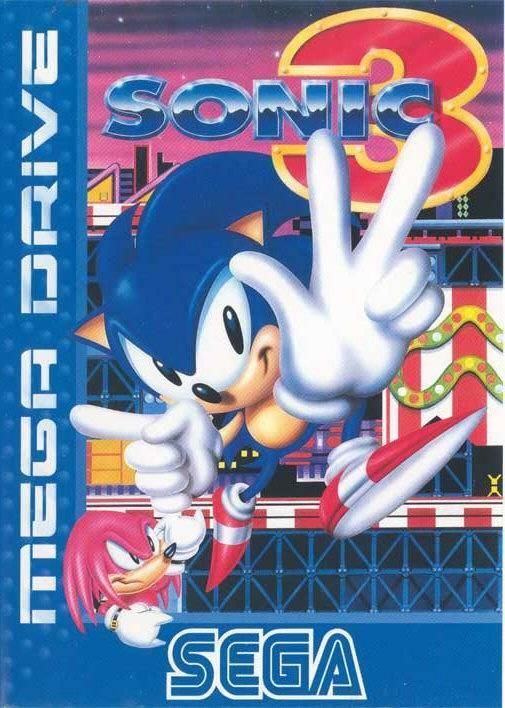
Sonic the Hedgehog 3 is a platform game developed and published by Sega. It was released in 1994 on the Sega Mega Drive/Genesis and latterly for Windows in 1997. Later, it would be made available for the Game Cube, PS3 and Xbox 360. For this review, I revisited the Sega Mega Drive version.
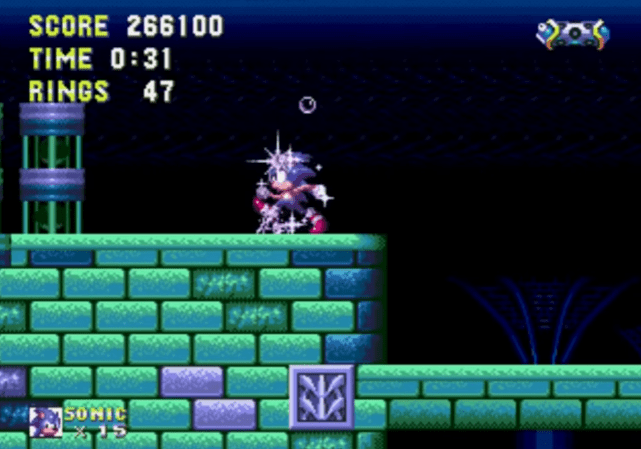
Visually, very little has changed between Sonic 1, 2, and 3 (Screenshot taken by the author)
Plot
After Sonic 2, Dr. Robotnik’s spaceship crashed into the mysteriously floating Angel Island. He meets and tricks the island’s guardian, Knuckles the Echidna, into believing that Sonic is trying to steal the Master Emerald. Sonic and Tails must once again defeat Dr. Robotnik who is being aided by Knuckles.
Gameplay
Once again, you can choose to play as Sonic and Tails alone, or have as Sonic but have Tails tagging along controlled by the computer. Apart from the usual gameplay of running through levels and collecting of rings in order to access bonus stages to win the Chaos Emeralds, there are several new features to this game. Firstly, access to the bonus stages are now via giant gold rings which can be found in secret locations.
The bonus stages themselves are much for interesting and fun than Sonic 2. They consist of Sonic and Tails running around a globe in third person view. The object is to collect all the blue spheres. If you hit a red sphere you fail. The more blue spheres you collect, the faster Sonic runs, adding some difficulty to the harder bonus stages.
Once Sonic gains all the Chaos Emeralds, he can become Super Sonic, making him invincible for a short period of time.
Secondly, Sonic can attain three shields: lightning, bubble and fire, each giving him a unique ability when using them.
The new bonus stages are so much more enjoyable than the tunnels of Sonic 2 (Screenshot taken by the author)
How Does It Handle?
As usual, this game plays incredibly well. Tight controls, fun to play, and the new features, although not groundbreaking or genre defining, add enough to ensure the franchise doesn’t become stagnant.
One of the issues I have with this game is that the levels are so much bigger than previous games, but are filled with slopes and shoots and other features that you feel like you’re just whizzing through the levels without actually doing much. I appreciate that the whole appeal of Sonic is that he is fast, but sometimes it feels like you’re just on autopilot because he just whizzes through the game. Along with this speed comes another issue that the creators have yet to rectify…when Sonic is going at full speed, and the screen is busy, the game lags and the sprites flicker.
Graphics
As expected, the game looks great. Lots of beautifully designed levels for you to navigate through, and plenty of unique sprites to evade or destroy. However, I feel that if you were to be shown screenshots of Sonic 1, 2and 3, there are times you’d be hard pressed to distinguish between the three. This is certainly not the case with the Mario franchise where the graphics of each game are very distinguishable. Now, I concede that Super Mario 1, 2 and 3 were all released on the NES and Super Mario World on the SNES, and so is bound to look different. However, even when comparing Super Mario World to Super Mario World 2: Yoshi’s Island, there is a clear distinctive design to the levels and enough gameplay changes so that both games can stand on their own.
The all too familiar underwater levels…you’d have thought he would have learnt to swim by now! (Screenshot taken by the author)
Music
The intro music has changed and although it is more update and emphasises Sonic’s speed. I still prefer the original theme tune. That is a personal thing of course. The rest of the music, for me, isn’t as memorable as previous games with the exception of the Carnival Night levels where they’ve mixed in a very “carnival” sounding theme into the music.
Did I Complete The Game?
Yes, with all Chaos Emeralds captured.
What The Critics Said:
Electronic Gaming Monthly:“Sonic 3 is simply the perfect Sonic game. It beats out all previous Sonics with outstanding graphics, more hidden items and new items like many types of shields…The bonus rounds give the average player a fair chance this time, unlike “those tunnels” of part 2. It seems unlikely that Sega will be able to top this one. Overall 38/40“.[1]
Gamepro: “Sonic 3 proves that you can teach the old hedgehog new and exciting tricks. Take that old Sonic magic, add fun new variations, and you have another spectacular game. Overall 19/20”.[2]
Hyper:“Everything you expect from a Sonic game, nothing more. If it was just me, the score would be lower, but Sonic freaks are going to go off. Overall 90%“[3]
Entertainment Weekly:“Sonic 3, by contrast, represents the apotheosis of the Sonic concept: Unlike previous games, the stages are linked cinematically (Sonic and Tails literally tumble from one scene to the next), and the characters have some stunning new techniques — I, for one, never thought I’d see a spiny blue hedgehog on a pair of skis. Ovearll A+”[4]
Mean Machines Sega: “Sonic’s Back! Back! Back! This game re-establishes him as King of the Hill, Top of the Heap and Life Emperor of the Platform Universe. Huzzah! Huzzah! Overall 94%”[5]
Sega Power:“No radical changes to the game, but its sheer size, super graphics, wealth of imagination and above all playability, guarantee Sonic gold status. Overall 90%“.[6]
Sega Magazine:“An amazing release and serious contender for Best Platform Game ever award. Overall 95%“.[7]
My Verdict:
“Sonic 3 is a very good game. If you like the solid formula of speed, ring collecting and bonus stages that the creators have been successful with in their first two outings, then this game is for you and you’ll enjoy every second of it. Personally, I worry that there aren’t enough differences between this and the previous two games and it’s in danger of going stale.”
Rating:
What are your memories of Sonic the Hedgehog 3? I would love to hear your thoughts, and don’t for get to follow and subscribe so that you don’t miss my latest reviews! You can also find me on Instagram: @nicklovestogame.
Keeping sequels fresh whilst staying true to the original franchise is a tough challenge for game creators. You can’t change things too much or too quickly without a backlash of disgruntlement from fans, but you also need to be seen as being progressive and innovative. The Age of Empires franchise has always been innovative in the way it has taken the gamer through history and given them control of countless civilisations from around the world. After the success of Age of Empires II and its spin-off, Age of Mythology, what new features would its creators include to keep the franchise fresh whilst still staying true to the originals concepts?
Title screen (Screenshot taken by the author)
Age of Empires III (AOE III)is a real-time strategy game and the third in the Age of Empires franchise. Developed by Ensemble studios, it was published for PC by Microsoft Games in 2005 (The Mac version was published by Destineer’s MacSoft in 2006). Glu-Mobile published a mobile version in 2009. A remastered version was released in 2020. For this review, I revisited the original PC versions.
Plot
AOE III focusses on the European colonisation of the America’s between 1492 and 1876. The story mode focuses on the Black family and their fortunes and failures in North America. The story mode has a similar style to that of Age of Mythology (AOM) where there are cut scenes before and after each mission which progress the story along.
The Game Is Broken Into Three Acts:
Act One: Blood – The first campaign begins in the late 16th century and introduces Knight of Saint John, Morgan Black who must travel from Malta to South America in a bid to prevent the Circle of Ossus from finding the Fountain of Youth.
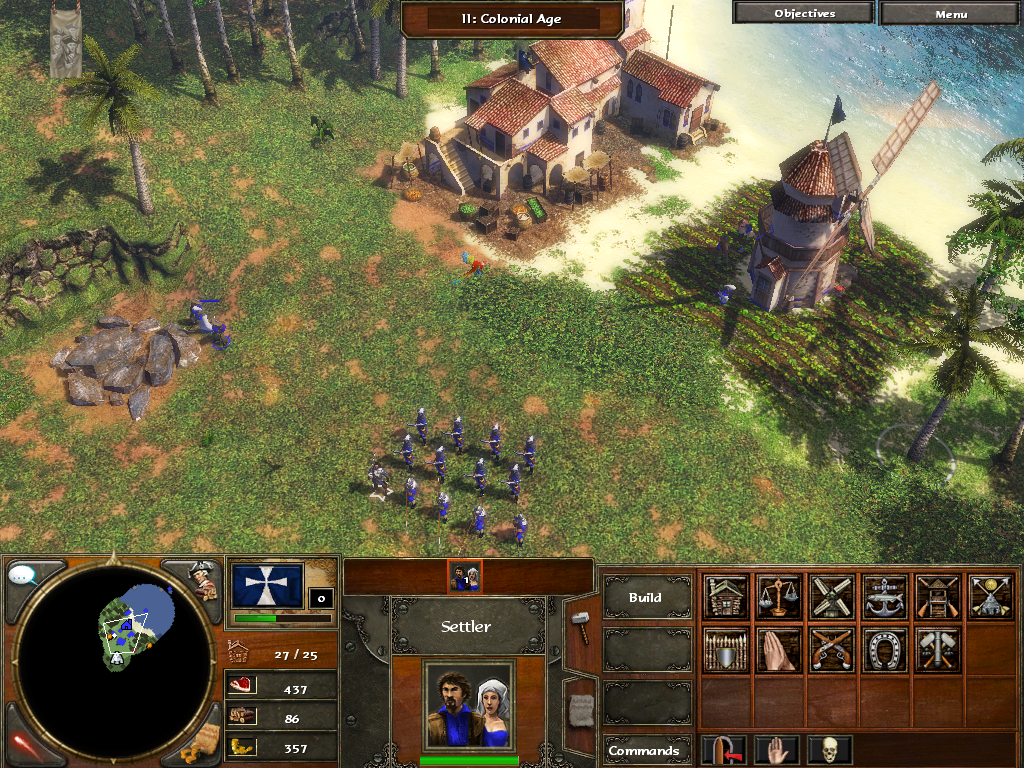
Morgan Black must travel to South America to prevent the Fountain of Youth from falling into the wrong hands (Screenshot taken by the author)
Act Two: Ice – The second act takes place in the mid-18th century, and sees Morgan’s grandson, John Black and Mohawk companion Kanyenke, ally with General Washington during the Seven Years’ War against the French.
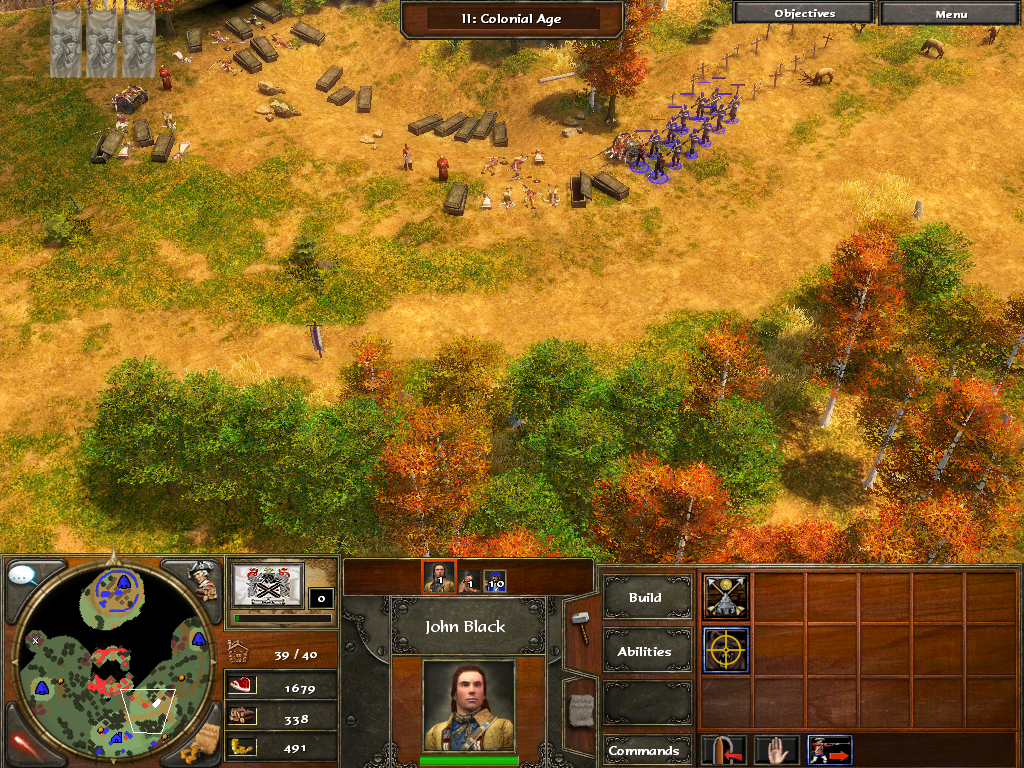
John Black and Kanyenke join forces with George Washington against the French in the Seven Years’ War (Screenshot taken by the author)
Act Three: Steel – The third act takes palce in 1817, and sees Amelia, John’s granddaughter, who is trying to expand her railroad empire, pursue a French prospector to South America where he intends to find the Lake of the Moon and the Fountain of Youth.
Amelia is trying to regain her family’s fortune by building the new railway in the US (Screenshot taken by the author)
Gameplay
Initially, this game plays like the other AOE. Using your mouse to control a cursor to select buildings and units, you send villagers out to gather resources of wood, food, gold, stone. When
Thankfully, AOE III has moved away from the simple mission objectives of “build up your base and destroy the enemy base”. Although there are many missions where that is the end goal, there are also other interesting missions to ensure the game doesn’t become monotonous. An example of this is the Pirate’s Help mission where Morgan must gain 8000 experience points by doing a number of small missions in order to impress a pirate named Lizzie. Another is the Bring Down the Mountain mission in the John Black campaign where you need to use miners to hack down rocks to block mountain passes.
Another improvement is that there is greater differentiation between the civilisations. There are plenty of unique units to each civilisation, encouraging the gamer to try them all in Random Map mode in order to find their preferred units.
Different from AOE II but kept from AOM the gamer has the opportunity to choose how they wish to advance to the next technological age. Each path will offer different improvements and units and it is up to the player to decide which path is best suited for the mission at hand.
Although AOE II had ‘Heroes’, (e.g. Joan of Arc etc.) they fought like every other unit. AOM introduced the concept of a special ability or attack that ‘Heroes’ performed but these were automatic and could not be controlled by the player. AOE III has introduced special attacks that CAN be controlled by the player. ‘Heroes’ such as John Black can either use Hawk Eye – which kills almost all units with one shot, and Eagle Eye which is a powerful shot that damages enemy units in an area. Once used, you have to wait a minute or so before it can be used again. Some ships have a similar special attack where they pepper their intended target with cannon.
Interestingly, sea battles and the use of ships in general seems to have taken a real backseat in this game. If memory serves, other than the Pirates!, Great Lakes, and Last Stand of the Boneguard missions, you can quite happily do without worrying about a naval presence. Whilst we’re on the subject of ships, they have dramatically increased the number of units each ship can carry. The problem with this is that there is no automatic disembarking button, so you have to manually click the unit’s icon for them to disembark, and when you’re carrying large numbers of troops, this can prove tricky in tight spots.
To make things a bit more challenging, and realistic with regard to technological advancement, Morgan Black’s campaign can’t advance past the Fortress Age, and John Black’s campaign cannot advance past the Industrial Age.
Other new features include:
Gaining experience points – Dotted around each map are several treasures or captured units, mostly protected by human or animal ‘guardians’. Defeating the ‘guardians’ and taking the treasures or rescuing the prisoners will gain you resources, units and/or experience points. These experience points enable the gamer to have shipments of resources, improvements or units sent to your town centre. Killing enemy units also gains experience points.
Build your shipment deck – After every mission you are unable to unlock more improvements for your shipments. This gives you the opportunity to build you own deck of shipments that you prefer to use during missions and Random Map modes. For example, one mission may require artillery, so provided you have unlocked an artillery card, you can swap that card in for another and have a shipment of artillery sent to your town centre.
Trading posts – There are two types of trading posts: The first consists of building a trading post in the village of local tribes. This enables further improvements to your units and resrouces as well as being able to train unique Native American units. The second consists of building trading posts at specific areas along trading routes. These routes regularly have traders travelling along them. At first, all these trading posts do is help gain experience points. As you move through the ages, you can upgrade the way the traders transport their goods, and also which resource you would like to have added to your stockpile.
AOE III has greatly improved graphics from AOEII. They have moved away from the 2D isometric view to a 3D model giving different parts of the screen a slightly different perspective. The buildings are incredibly detailed with animated, realistic looking smoke arising from fires and chimneys. The units are also very detailed, and beautifully illustrated and animated. This goes especially for the artillery, whose artillerymen are a hive of activity carrying, reloading and firing.
I very much enjoyed the story mode and the fact that you follow the same family over a 300 year period. Although fictional, the story is compelling and keeps you from skipping the cutscenes.
I really liked the experience points and shipment system employed in this game as I think it can certainly give you a tactical advantage when you get it right. I love the fact that parts of the buildings are blown off when they are under attack, adding the realism of warfare. Last but not least, AOE III has managed to create a beautiful score to go with the game. These are the types of musical scores that I find myself listening to simply because I enjoy them so much.
Did I complete the game?
Yes, I have played through this game several times and thoroughly enjoy the missions.
What the critics said:
1up.com: “It’s a rock-solid package, one that tightens every part of the existing game with a facelift worthy of the most talented plastic surgeon. Ensemble has proven no one can beat it at its own game, but neither will it be Age of Empires III the wannabes are aiming at in the coming months. Overall B-“.[1]
Game Revolution: “But no one buys strategy games for the sound effects – they buy them to agonize over tactics and statistics and this is why Age of Empires III is still a recommendable RTS. The steps it has taken in the gameplay department since Age of Empires II are negligible, but at least the new card-based bonus system adds an element of customization and depth to the genre. This result is as detailed as a history book, and about as much fun. Overall 3/5”.[2]
Gamespot: “Age of Empires III has some very big shoes to fill, and on top of that, the real-time strategy market has grown hugely competitive due in no small part to Ensemble Studios’ previous accomplishments. This latest game offers a lot of what made Age II so great, and it’s got plenty of depth and lasting appeal, despite how most matches tend to begin and ultimately pan out similarly. Age III does seem surprisingly rough around the edges in some respects, and those expecting the game to revolutionize or even refresh this style of gaming may come away disappointed that their high expectations weren’t met. But those looking for a complex and interesting real-time strategy game with fantastic good looks and some historical flavor will find just what they want in Age of Empires III. Overall 8.2/10”.[3]
Gamespy: “Age of Empires III is an absolutely fantastic title with superb graphics and tight gameplay. Single-player or multiplayer, no matter what your skill, you’ll get hours of joy out of this sucker online or off. Age of Empires III may not redefine real-time strategy gaming, but it sets the bar so high that we’ll be comparing games to this for years. Shoulder your musket and pony up: this one’s a real trip. Overall 5/5”.[4]
Gamezone: “Age of Empires III is a must have game for any Real Time Strategy gamer. There are so many new additions in this game that it will boggle your mind. This is one of the best looking games, much less an RTS game, that is out on the market currently. This is one purchase you will not come to regret. Overall 9.5/10”.[5]
IGN:“Age of Empires III is a superbly balanced and polished game and it definitely ups the ante for the C&C and ‘Craft developers. Discounting a few niggles in the interface, the whole presentation is rock solid. Each new release in the Age of Empires series has added something to the mix. But while Age of Empires II seemed to focus on quantity, Age of Empires III sacrifices some units and civilizations in order to make the whole experience much tighter. Overall 8.8”.[6]
Awards:
2005 PC Turn-Based Strategy – 2005 Gamespy Gamers’ Choice Awards[7]
2005 Best Graphics – 2005 Gamespy Gamers’ Choice Awards [8]
“Great graphics, fantastic soundtrack, challenging gameplay, and lots of new features to keep you interested. It is easy to see why the Age of Empires franchise is so popular. I love these games and I find myself returning to them again and again.“
Rating:
AOE III: The War Chiefs was the first AOE III expansion pack to be released. It was developed by Ensemble Studios (Destineer’s MacSoft on the Mac), and was published by Microsoft Games for the PC in 2006 and MacSoft for the Mac in 2007.
Title screen (Screenshot taken by the author)
This expansion continues to follow the story of the Black family.
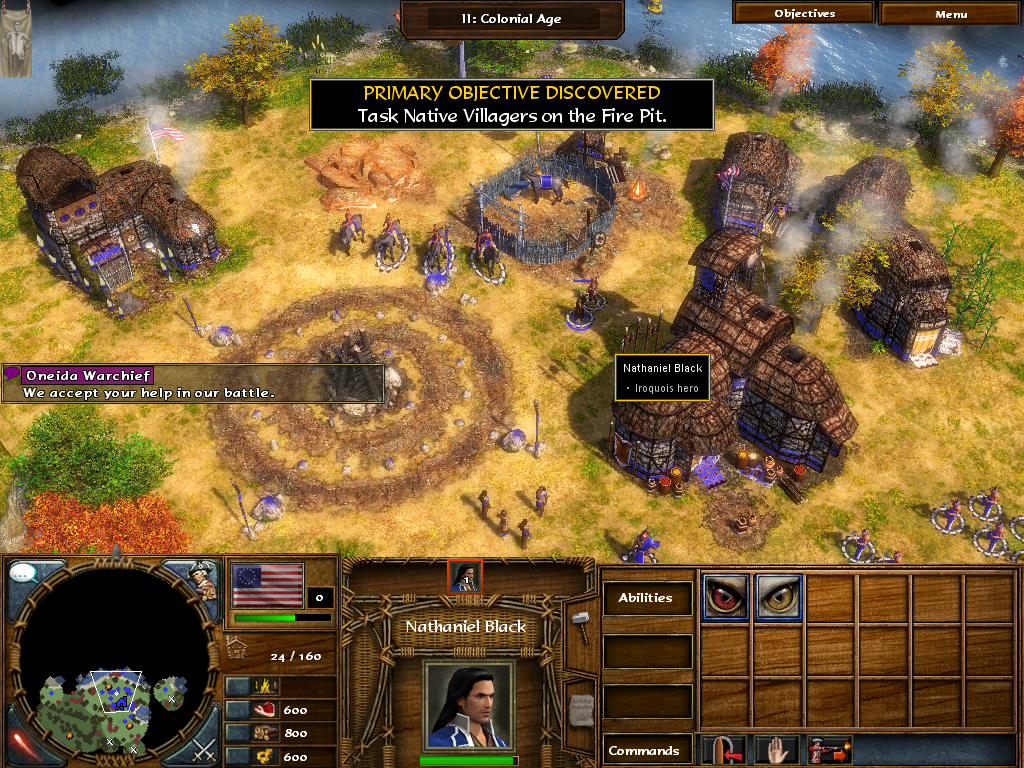
Act One: Fire – Nathanial Black is the son of John Black and Nonahkee of the Iroquis from Act Two: Ice of AOE III. His story begins in 1775. The campaign begins with Nathanial and his uncle Kanyenke trying to persuade the Seneca and Mohawk tribes not to join in the American Revolutionary War. Nonahkee is soon kidnapped by the Mohawk and a group of Hessian soldiers led by Colonel Sven Kuechler. It turns out Kuechler has gone rogue, so Nathanial joins forces with George Washington to pursue the leader of the Hessian Soldiers and rescue his mother.
Nathanial Black must join forces with George Washington in order to rescue his mother (Screenshot taken by the author).
Act Two: Shadow – The year is 1866. We are now introduced to Chayton Black, son of Amelia Black from Act Three: Steel of AOE III. His father, a member of the Lakota tribe, died when he was young. When American prospectors begin to encroach on Native American land in search of gold, Nathanial must decide which side to fight on.
Clayton Black is present at The Battle of Little Big Horn (Screenshot taken by the author).
Primary Objectives: Again, there is a nice array of different primary objectives to win the each mission. I found mission 6: Valley Forge particularly interesting because the first objective is to build 6 houses to shelter the men through the winter. The issue is that the cold depletes your gatherer’s energy bars and so you need to head back to the fires to gain your health back. Then you need to amass 3000 food before your town centre arrives and you can build a farm etc. This is before you build an army and destroy the enemy fort.
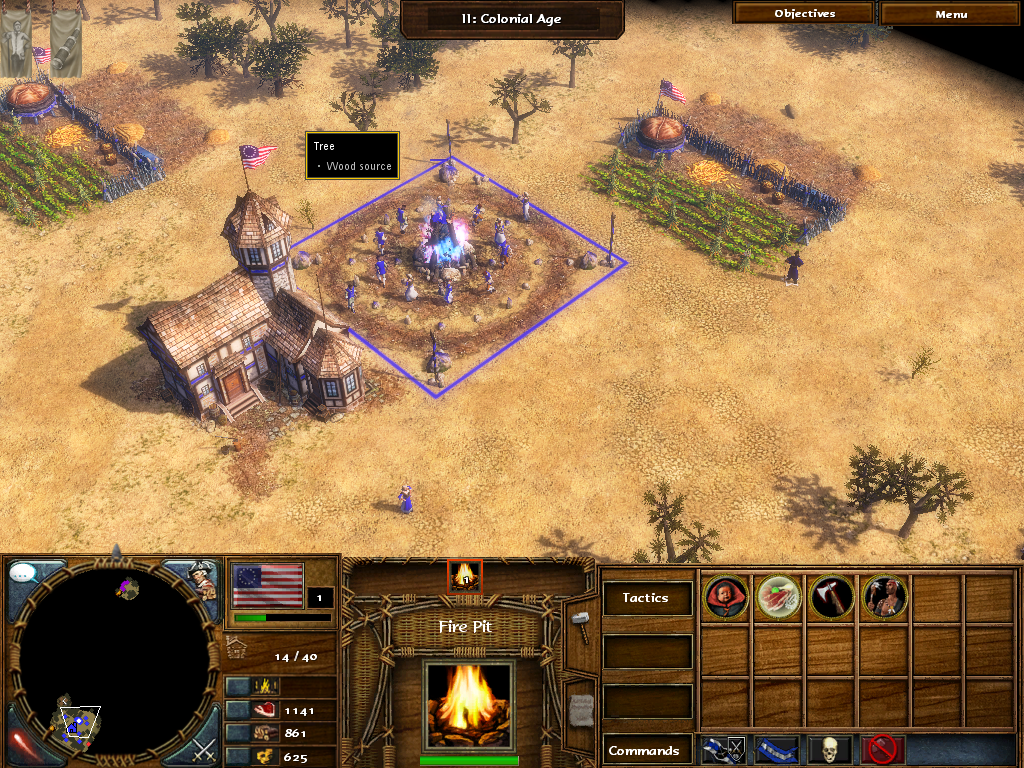
One new building that features is a fire pit. This enables you to instruct villagers to dance. There are up to 16 different dances, some of which vary depending on which tribe you are. Some of these dances are:
Fertility Dance – Increases unit training speed
Population Dance – Speeds up the production of units
Gift Dance – A slow trickle of experience
War Dance – Increases damage to enemy units
Holy Dance – Spawns Medicine Men.
Fire Dance – Increases damage to buildings and ships
Earth Mother Dance – Increases your population
The Fire Pit allows you to assign villagers to perform various dance to increase attack, resources, population etc. (Screenshot taken by the author).
Other new features include:
6 New Maps – These include: The Andes, Araucania, California, Northwest Territory, Orinoco and the Painted Desert.
Trade Monopoly – For Random Map players, a new ‘Trade Monopoly’ winning scenario has been added. Once a player owns more than half of the trading posts on a map can begin a timer. Your opponents need to destroy some of your trade posts before the timer runs down. Whilst the timer is ticking down, the player who started it cannot rebuild more trading posts if some of his has been destroyed until the timer stops.
More Native Tribes – Another four minor tribes to bring the overall total to 16.
Unique Technologies – Each Native civilisation has unique technologies.
Revolution – When advancing to the Imperial Age, European colonies have the option to revolt and form their own nation. A revolution gives your military a boost but can damage your economy as your settlers all change to colonial militia.
StealthMode – Certain Native tribe units have a stealth mode, allowing them to sneak past or sneak up on the enemy. However, this slows down your unit’s movement, and if you get too close to the enemy you will still be spotted.
New Skills for Heroes – Native heroes wuch as Wind Feather from the first mission can use Nature Friendship which convert treasure guardians to ally units.
What makes this expansion a bit more challenging is that not only are you unable to advance further than the Fortress Age, but you are also unable to build walls, an incredibly useful defensive necessity. There are also no watchtowers. Instead, your barracks act in a similar way and will fire arrows from a turret.
There is also less artillery available to the Native Americans. Instead they have either mantletes – Iroquis who carry a shield, and falconets – small cannon. There is only one mission where an allied army supplies bigger artillery for you.
Did I complete the game?
Yes
What the critics said:
Gamespot:“The WarChiefs expansion adds a solid amount of new content to the existing game, and while many of the new features provide interesting new ways to play and win the game, it’s fair to say that fans of the series will appreciate the changes. The WarChiefs does a lot to shake up the formula, but when you get down to it, the tried-and-true Age of Empires gameplay remains pretty much intact, and the expansion offers more depth and strategy to an already deep strategy experience. Overall 7.8/10”.[10]
1Up.com: “…WarChiefs turns into an exciting exercise in completely rethinking old strategies. And this, after all, is what the best expansion packs do: not just add, but entirely revise. Overall A”.[11]
Eurogamer: “All told, it’s quite a lot of newness from an expansion pack, and in many ways makes for a pretty considerable shift from how the original game works. Not everyone’s going to agree with me here, as Age Of Empires III certainly has its fans, but, for me, this is redemption (but only redemption & we’re not talking elevation to high levels of acclaim) of a sort for the original game. I laughed one of those laughs that sounds a little like crying when I heard that AOE3 had scooped the Best Online Game award at this year’s Golden Joysticks. What a baffling decision – it wasn’t a terribly interesting game, it was just by the numbers RTS, and in many ways, pretty boring. I prefer my strategy over-the-top, even slightly silly, so being able to vanquish a foe by setting a horde of hypnotised bears on him is far more like my idea of fun. Overall 6/10”.[12]
Gamespy: “In the end, The WarChiefs is yet another demonstration of why Ensemble Studios remains among the first rank of strategy game developers. The single-player aspects of the game may indeed be just more of the same, but in this case it’s pretty damned good. On top of that, the multiplayer additions elevate the expansion to a must-own. Age of Empires III: The WarChiefs has managed to re-invent and reinvigorate the game. I’m sorry guys. I’ll never doubt you again. Overall 4.5/5”.[13]
IGN: “As we said at the beginning, Ensemble’s not known for producing expansions that alter the strategies of concepts of their core games. Given the popularity and quality of the core games, who are you to argue? Fans of Age of Empires III who are just looking for more content are definitely going to be pleased with the expansion. Those who are hoping for something new or different aren’t going to find it here. Some of the Native American concepts offer a nice twist, as does the inclusion of revolutions and monopolies, but to be totally honest, they could just call the game More Age of Empires III and we’d still line up to play it. Overall 8.2”.[14]
My verdict:
“Personally, I really enjoyed War Chiefs. The limiting of the artillery and defensive structures were a challenge. The stories and scenarios were good, and it was nice to return to play as some other members of the Black family.”
Rating:
Age of Empires III: The Asian Dynasties is the second expansion pack for AOE III. It was developed by Ensemble Studios in collaboration with Big Huge Games and published by Microsoft Games for the PC in 2007; and developed and published by Destineer’s MacSoft for the Mac in 2008.
Title screen (Screenshot taken by the author)
This expansion pack leaves the Black family behind and introduces three more civilisations: Japan, China and India, and is broken down into three campaigns respectively.
Japan – This campaign focusses on the reunification of Japan (a scenario of Age of Empires II: The Conquerors) and the establishment of the Tokugawa Shogunate. It begins with The Siege of Osaka c.1614-15.
The Asian Dynasties expansion saw some beautifully designed Asian buildings and a whole plethora of new units unique to these ancient civilisations (Screenshot taken by the author).
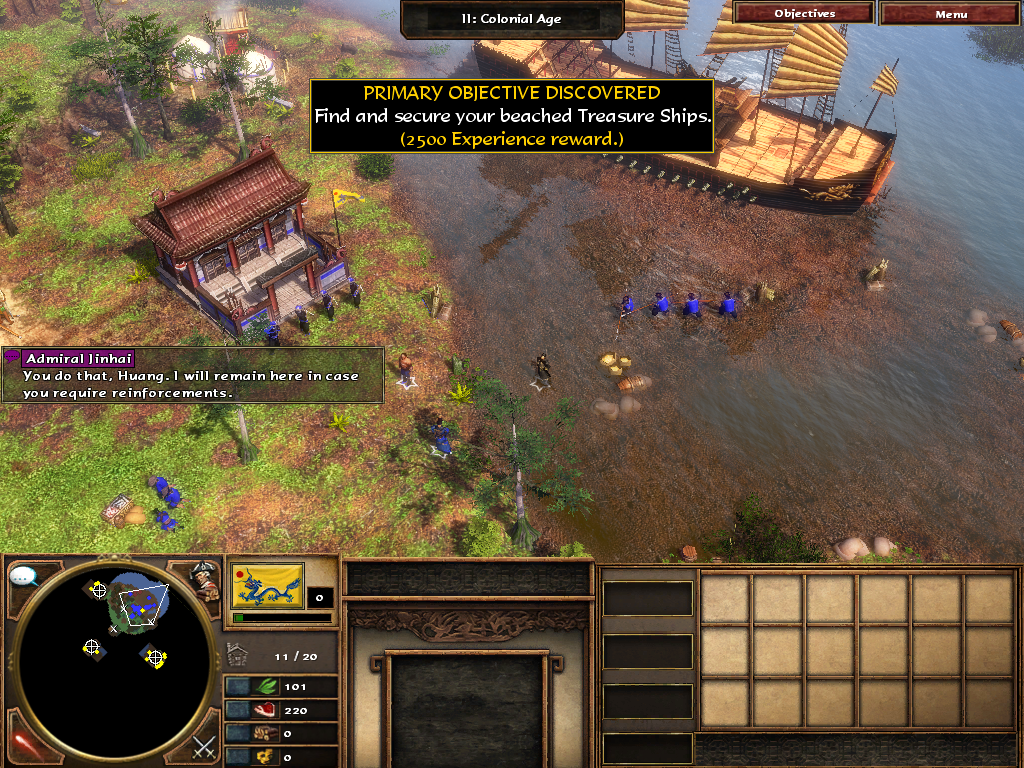
China – This campaign is based on the controversial hypothesis that China reached the Americas before Columbus.
China’s campaign sees the introduction of the Treasure Ship, which regulalry generates a resource of your choice (Screenshot taken by the author).
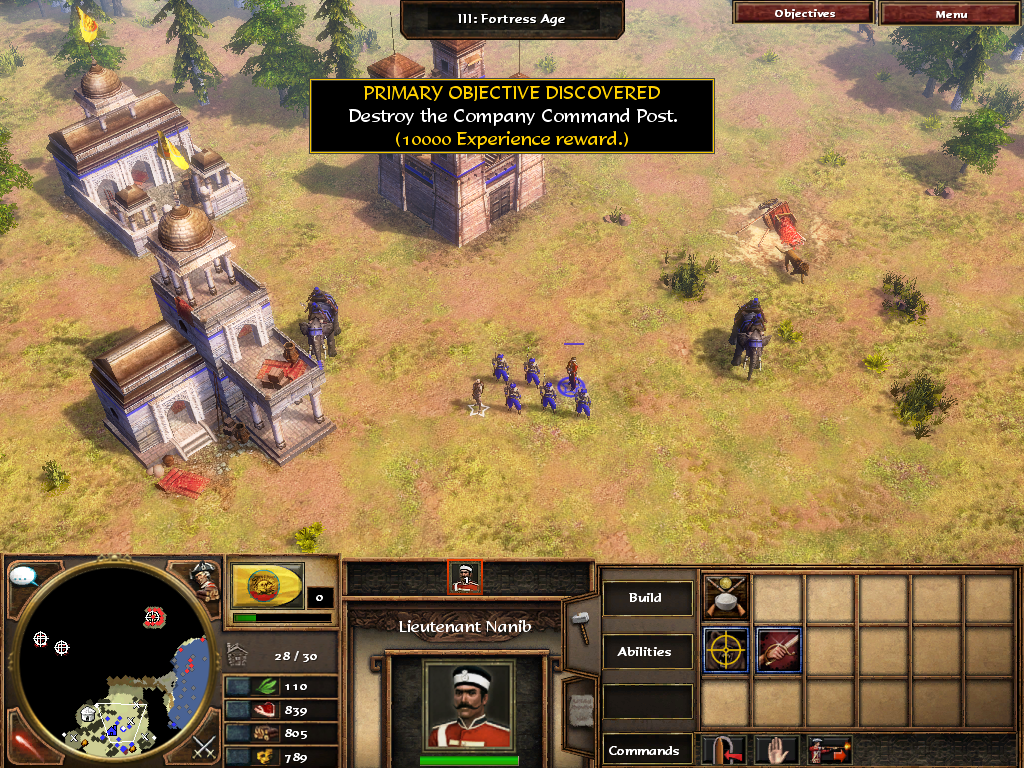
India – This campaign introduces a new character, Subedar Nanib Sahir who serves the East India Company, and focusses on the Indian Rebellion of 1857.
Follow Nanib Sahir as he joins the Indian Revolution (Screenshot taken by the author).
As well as the design of the buildings, which fit with their respective Asian cultures, there is the introduction of loads more unique units. Other new features include:
Wonders – When advancing to the next age, you must choose to build a wonder. Each wonder offers either units or a resource bonus.
Rice Paddies – Instead of farms, rice paddies can be built. They can be used by villagers to gather food or gold.
Consulates – This new building allows your base to ally with a foreign power. This allegiance will allow you to buy foreign units not otherwise available to you. Export (symbolised by a green leaf) is automatically generated as your villagers gather resources. However, it is generated a lot slower making it more difficult to buy foreign units.
Treasure Ships: For many of the Chinese campaigns, you have a treasure ship which generates a resource of your choice every minute or so.
I didn’t enjoy this expansion quite so much as the others. To me, it felt like there were so many upgrades to use resources on and they were so expensive that I found you could complete each mission before using them.
Did I complete the game?
Yes
What the critics said:
Gamespot:“Like The WarChiefs expansion from last year, The Asian Dynasties does a good job of introducing distinct new civilizations to Age of Empires III–only this time, instead of Native American tribes, there are three iconic Asian civilizations to play with now. There’s a fair amount here to dig into if you’re a serious Age of Empires fan or someone who likes Asian civilization. Overall 7.5/10”.[15]
Gamespy:“No self-respecting Age III fan would want to miss out on all the East meets West fun, not to mention the new artwork: such gorgeous pagodas, arches, minarets and colors that those musty old Europeans could scarcely imagine in their new worlds. This expansion pack is a rare and generous package of new visuals, new gameplay, and absolutely crucial improvements to the core game. If you weren’t an Age III fan before Asian Dynasties, get ready to be one now. Overall 4.5/5”.[16]
IGN: “Asian Dynasties is another great chapter in the Age of Empires series and one that strategy gamers with a yen for the Far East should definitely investigate. The units are colorful, the combat is exciting, and the story, though not as thrilling as Age 3 or as historically relevant as Age 2, is still strong enough to carry the action. It’s true that the missions leave a bit to be desired in terms of but I don’t want to come down too harshly on the campaign here because at the end of the day, Asian Dynasties is a heck of a lot of fun. I mean, the elephants alone are worth the price of admission. Overall 8/10”.[17]
My verdict:
“I enjoyed the storyline and the game still looks and plays great. My only gripe is the increase in expensive upgrades that are not worth the effort of gathering resources for. Other than that, it gets a thumbs up from me.”
Rating:
What are your memories of Age of Empires III and its expansion packs? I would love to hear your thoughts, and don’t for get to follow and subscribe so that you don’t miss my latest reviews! You can also find me on Instagram: @nicklovestogame.
RPG fans like nothing more than to take control of a character or group of characters, and immerse themselves fully in a fantasy world where they can increase their character’s stats, find magical and rare weapons, and rescue a kingdom or two. It’s pure hero fantasy…and there’s nothing wrong with that!
Title screen (screenshot taken by the author)
Shining Force: The Legacy of Great Intention is a fantasy turn-based tactical RPG. It was developed by Climax Entertainment and Camelot Co. Ltd., and published by Sega in 1992 in Japan, and 1993 in North America and Europe. Released on the Sega Mega Drive/Genesis, it would later be released for the Game Boy Advance in 2004 (under the title of Shining Force: Resurrection of Dark Dragon), Wii Virtual Console in 2007, iOS in 2010 (discontinued in 2015), and Windows, Linux and Mac (Steam) in 2011. It can also be found as part of the Sega Smash Pack Volume 1 on the Dreamcast, Sega Smash Volume 2 for Microsoft Windows, Sonic’s Ultimate Genesis Collection for Xbox 360 and PlayStation3. For this review, I revisited the version found as part of Sonic’s Ultimate Genesis Collection for the PlayStation 3.
Plot
Millenia ago, in the Kingdom of Rune, a battle between good and evil took place. Dark Dragon, who led the forces of evil, was defeated by the Warriors of Light who cast him into an alternate dimension. Dark Dragon vowed to return in 1000 years to once more wreak havoc in Rune. 1000 years later, in which time peace and tranquillity existed in Rune, the Kingdom of Runefaust attacked Rune hellbent on helping Dark Dragon to return.
Taking to people in the towns help you progress further in the game (screenshot taken by the author)
A young man named Max, who lives in the Kingdom of Guardiana, is sent to defeat the evil warrior Kane and his army. Along with an army of his own, Max soon discovers that Darksol is behind the plot and pursues him throughout Rune to stop Dark Dragon’s ressurection.
Just so there is no confusion, Dark Sol from Shining in the Darkness (1991) is the son of Darksol and Mishaela from this game, meaning that Shining Force is a prequel to Shining in the Darkness (1991).
Meet Your Party:
Max (You): Max is human and an all-round fighter, both fast and accurate. If things are looking bleak during a battle, he can cast Egress to whisk your party away to safety. Be warned, if Max is defeated in battle, you automatically lose the confrontation, and are sent back to your last save spot minus half your gold! To prevent this, keep an eye on his health and don’t be afraid to use Egress or keep a supply of Angel Wings for each member of your party (Angel Wings have the same use as Egress).
Luke: Luke is a dwarf and a great warrior. He cannot cast spells and his movement is limited, but he is strong.
Ken: Ken is a centaur and a good fighter. Centaurs have quite a long movement range so be careful he doesn’t go too far and get separated from the group.
Tao: Tao is a young elf who is training to be a mage. As she gains experience, she will be able to cast spells from afar but she is weak in hand-to-hand combat. Make sure your protect her.
Hans: Hans the Elf is an archer, perfect for ranged attacks. Again, protect him from hand-to-hand combat.
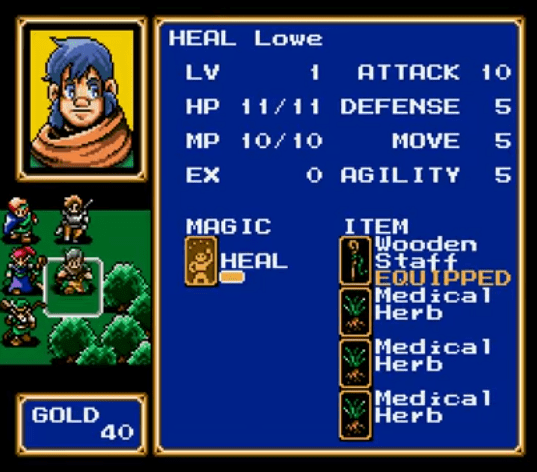
Lowe: Lowe is a halfling priest. Although weak in attack, his skill lies in healing your party during battles.
There are nine other characters who will join your party along the but you’ll have to wait to meet them to find out who they are.
An easy to use menu system helps you keep track of the stats of your party (screenshot taken by the author)
Gameplay
For the most part, the game takes place from an almost top-down view, in the traditional Japanese-style of RPGs. There are no labyrinths, and only a few puzzles to solve. You must make your way through various towns and through the overworld map in pursuit of Darksol. In the towns, you can talk to the citizens, some of whom offer insights to help you progress. You can buy and sell weapons and items from the shops to assist you on your quest. You can also find priests who can resurrect fallen characters, cure them of various ailments, promote those who have reached level 20, and record your progress.
Unlike many other RPGs, there are no random battle encounters as such, but there are areas where you can find battles should you wish to increase your stats before progressing in the game.
Battles take place on a square-grid system. Depending on their stats, characters can only move a certain number of squares at one time. Depending on your proximity to an enemy, you can either attack with a weapon, cast a spell, use an item or choose to do nothing. If you are adjacent to a member of your own party, you can swap items. This does not class as a move, and so items can be exchanged without losing your turn.
When an attack occurs, a beautifully animated action scene appears with a blue dialogue screen explaining damage inflicted or sustained, and experience points and money earned etc. When an enemy is hit by your weapon or spell, your attacking character will earn experience points for themselves. When an enemy is defeated, a larger amount of experience points will be awarded to your attacking character and the money earned will be added to your party’s kitty. For every 100 points accrued, that character will level-up increasing their attack, defence, MP, agility etc. Once a character reaches level 20, they can be promoted to a different class of fighter.
This game has beautiful fighting animation scenes (screenshot taken by the author)
How Does It Handle?
With intuitive menu system that is identical to Shining in the Darkness (1991), you’ll have no issues learning to how to play this game. This instalment is linear in story so you won’t find yourself going back to the same areas to solve puzzles and gather dirty information which some feel make this game a bit too easy.
Graphics
What can I say other than this game looks beautiful. The overworld map and village scenes are bright and vibrant, and detailed with clear distinction between the sprites and environment. The fight scenes are beautifully illustrated and animated with incredible looking sprites, action shots and backgrounds. I really cannot compliment this game enough on its graphics. For me, they are superior to games like Final Fantasy V (1992), Treasures of the Savage Frontier (1992) and Paladin’s Quest (1992). However, by the time this game reached North America and Europe, the SNES was beginning to take the graphics up a notch with games like Secret of Mana (1993) and Illusion of Gaia (1993). Had Shining Force been released a year or two later, it would have looked a but dated.
Music
The only thing that lets this game down for me, is the music. By 1992, both Nintendo and Sega had released games with fantastic 16-bit soundtracks like Super Mario World (1990) and Sonic the Hedgehog (1991) respectively. Now I know that these are different genres from Shining Force, but it is an indication of how good the music could be in games. I just feel that Shining Force loses a few marks in this department.
Replay Value
Not all your army will gain the highest possible levels. This means you may wish to play through again and ensure characters who didn’t achieve their potential, do so a second time round just to see what they are like. This adds some replay value to this game.
Did I Complete The Game?
Yes
What The Critics Said:
Mean Machines Sega: “A beautifully crafted piece of Megadrive software with just the right balance of action and adventure to satisfy all needs. Overall 91%”.[1]
Sega Power: “A beautifully produced RPG. Great tactical battle sequences. Loads of unique, cute characters, speedy gameplay and lots to see ‘n’ do. Gorgeous to play and look at. Overall 89%”.[2]
Megatech:“Finely presented combination of exploration and fighting leads Shining Force to victory. Overall 90%”.[3]
Mega: “Huge, gorgeous looking, and absorbing. I’ll never scoff at an RPG again. Overall 92%”.[4]
My verdict:
“Blood, death, war, rumpy-pumpy, TRIUMPH!!! I love this game. Shining Force looks beautiful with great graphics, illustrations and animations with plenty of different characters to get to know. The chess-like manoeuvring during battles is challenging and enables you to prepare your army for strategic assaults on the enemy. However, hardened RPG players may find this game a tad easy though.”
Rating:
What are your memories of Shining Force? I would love to hear your thoughts, and don’t for get to follow and subscribe so that you don’t miss my latest reviews! You can also find me on Instagram: @nicklovestogame.
RPGs are like Marmite. You either love ’em or you hate ’em. What tends to put gamers off is the investment needed to play through the game and many argue that the need to fight endless battles against minor minions to increase stats are a cheap way to ensure the longevity of a game. However, this is also what attracts many gamers. They fully immerse themselves in their chosen character and enter a world of pure escapism where they can be a barbarian, dwarf, mage, elf or countless other humanoid species.
Title screen (screenshot taken by the author)
Earthbound (Mother 2 in Japan) is a single-player RPG developed by Ape Inc. and HAL Laboratory, and published by Nintendo. It is the second game in the Mother series, and was released in Japan in 1994 and North America in 1995 for the SNES and Game Boy Advance. In 2013, it was released on the Wii U Virtual Console. For this review, I played the version found on the SNES Mini.
The graphics suggest the game was designed for a younger audience (screenshot taken by the author)
Plot
A decade after the events of Mother, the alien force that is Giygas has enveloped and consumed the world with hatred, turning animals, plants and humans into monsters. With his three companions: Paula, Jeff and Poo, Ness must travel the world collecting melodies from the eight sanctuaries in order to stop the invasion.
Characters:
Ness – Just a normal kid who defeats his enemies with the use of a baseball bat
Paula – Ness’ friend who possesses psychic powers
Jeff – A young scientific genius
Poo – A mysterious Eastern prince
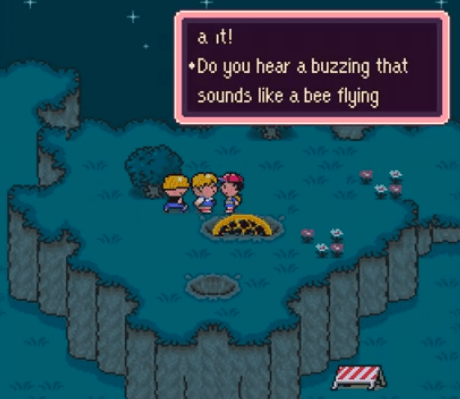
Fighting scenes sport an array of weird and whacky opponents (screenshot taken by the author)
Gameplay
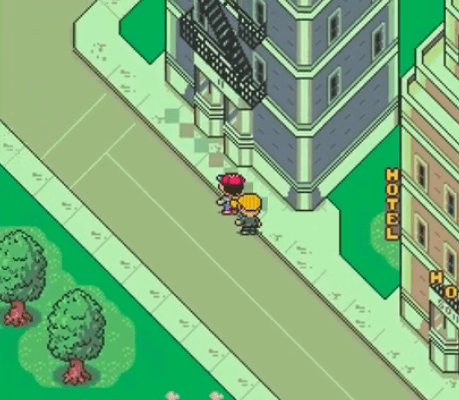
The game is viewed in 2D with the overworld view being an iosmetric design Interestingly, unlike other RPGs, there is no difference between the over-world and town/dungeon scenes, meaning the game moves seamlessly between the two.
What makes Earthbound different form other RPGs, is that it isn’t based on random encounter scenarios. In this game, you can actually see your enemies and can give them a wide berth if you do not wish to fight. Also, once your team reach a certain level, many of the lesser enemies are automatically defeated, meaning you don’t have to waste your time faffing around with pointless battles that give you little in the way of experience points. Additionally, you can gain a tactical advantage by approaching an enemy from behind. This allows you to strike first everytime. I thought that these were great features to have. I have always disliked the random encounter aspect of RPGs. I understand that they may be important for the game to ensure your characters build their stats but I’d rather have the option to fight when I wanted to because I feel random encounters just slow the game down too much.
The battle scenarios consist of standrd RPG practice in that it is a turn based affair. You can choose to attack, use an object, defend yourself, use PSI, flee etc. However, you still need to do battle with them in order to gain inexperience points, items and money.
There are a few other interesting aspects to this game. Firstly, your father regularly deposits money into your account so that you are never short of cash to buy new weapons and other items. Secondly, because you can only carry a certain amount of items, you can drop off items or have them delivered to you when you find a telephone. Thirdly, your character becomes homesick at times, which I believe affects him during battles. To remedy this, you simply need to call your mother who gives you a pep talk…very cute!
Isometric overworld view (screenshot taken by the author)
How Does It Handle?
Although the game looks to be aimed towards a younger audience with whacky and childish jokes, I thought that it was quite fun to play. The story is well thought out, if a little bizarre, and there are plenty of collectables to keep you interested. The controls are simple to learn and the game isn’t to complex and so can be easily picked up played.
Graphics
Although cartoon like, I thought the graphics were good (but not great), bright and colourful, with lots of variations amongst the sprites.
Did I Complete The Game?
Yes, with minimal help from a walkthrough
What The Critics Said:
Gamefan: “If you love RPGs, you really must buy earthbound. At first glance the game may not seem like much, but a rich and involving adventure hides just beneath this game’s 8-bit veneer. While not as mind blowing as, say, FFIII, EB is just as fun to play simply because it’s so wacky, original and amusing. Overall 89%”.[1]
Super Play:“An RPG that’s very much more than the sum of its parts. If you’ve got the patience to suffer its crude elements then prepare to be boggled: there’s simply nothing like it on the SNES. Overall 88%”.[2]
Nintendo Power: “A great story, fun graphics, good sound effects. Frequent, sometimes tedious battles. Poorly designed inventory system limits how many items you can carry. Overall 4/5”.[3]
Game Players:“The game’s biggest strength is its humour, but while there’s something here for everyone, most of the quips and strangeness are geared for the younger set – it ain’t exactly Final Fantasy or Illusion of Gaia. Overall 69%”.[4]
“I really wanted to give this game five stars, but I feel that the graphics let this game down a bit. When compared to the likes of Final Fantasy III and Secret of Mana, the graphics are not what one expects from a SNES. However, don’t be put off by first impressions. This game has much to offer and endears itself to you the longer your play it. Say ‘Fuzzy Pickles'”
Rating:
What are your memories of Earthbound? I would love to hear your thoughts, and don’t for get to follow and subscribe so that you don’t miss my latest reviews! You can also find me on Instagram: @Nicklovestogame.
Sometimes an original game or franchise contains characters or ideas for spin-offs. Some are successful such as Super Mario Kart (1992) and Donkey Kong Country (1994)…but others are real stinkers. I’ve recently read several articles titled ‘Top Ten Spin-Offs That Sucked’ or titles to that effect. Most of the games cited in those articles I have never played and so cannot comment on them. However, Street Fighter 2010: The Final Fight did…and I’m afraid I have to agree.
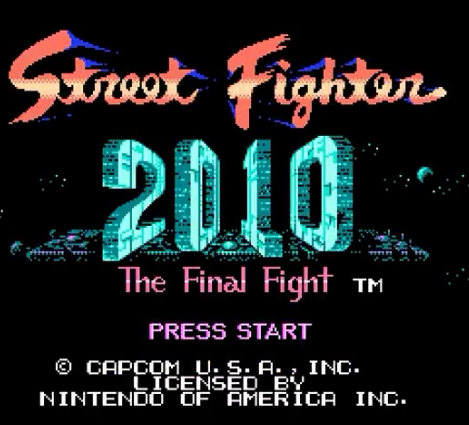
Title screen (screenshot taken by the author)
Street Fighter 2010: Final Fight is a side-scrolling platform game developed and published by Capcom and released on the NES in 1990. It was later released on the 3DS Virtual Console in 2014, and Wii U Virtual Console in 2015. I chose to review the NES version.
Plot
According to the history of this game, Ken won the original Street Fighter tournament. He later retired and became a scientist (as you do) who developed cyboplasm, a substance that gives superhuman strength to whoever uses it. Naturally, Ken has taken the substance to keep himself in tip-top shape. One day, Ken’s lab partner, Troy, is murdered and the cyboplasm is stolen leading Ken to pursue the murderer to the far reaches of the galaxy. Oh, and the future has interplanetary warp gates to assist travel between planets.
Gameplay
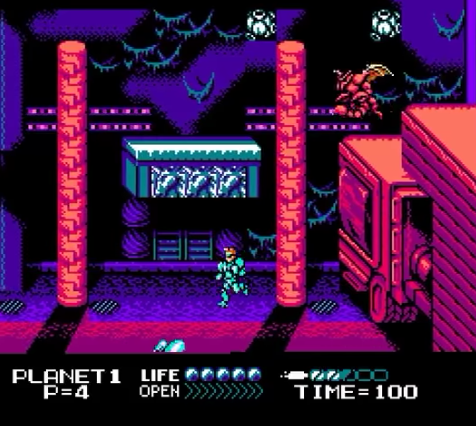
Each level seems to consist of Ken battling a weird alien whilst dodging lots of small aliens. he attacks using his gun.
The game looks pretty good. I just couldn’t get on with the gameplay (screenshot taken by the author)
How Does It Handle?
The controls are frustrating. the difficulty is too damn hard and it’s not very enjoyable at all. You can jump, climb walls and back flip, you can fire short range projectiles left, right, up, down (when flip-jumping) and diagonally up…but for some reason you can’t crouch or fire diagonally down. This is fine but there are flying machines that seem to attack you from low down and you are unable to defend yourself. Had crouching and firing diagonally down been possible, this game would have been a lot more enjoyable. Alas, it wasn’t possible, and the frustration led to me simply getting annoyed and moving on.
Graphics
Having said that, the graphics are good with colourful levels and sprites that are nicely detailed.
Personal Thoughts
I have to say that I got the feeling that this game may have originally been a different creation and was given the Street Fighter title because the creators wanted to cash in on the franchise. It’s such a departure from the original format that I cannot understand how they thought it would tie in in a believable way.
Did I Complete The Game?
No, I only got to level 2.
What The Critics Said:
At present, I have been unable to find contemporary reviews.
My verdict:
“An odd spin-off with a totally different format to the original franchise. The controls suck as does the difficulty level.”
Rating:
What are your memories of Street Fighter 2010: The FInal Fight? I would love to hear your thoughts, and don’t for get to follow and subscribe so that you don’t miss my latest reviews! You can also find me on Instagram: @Nicklovestogame.
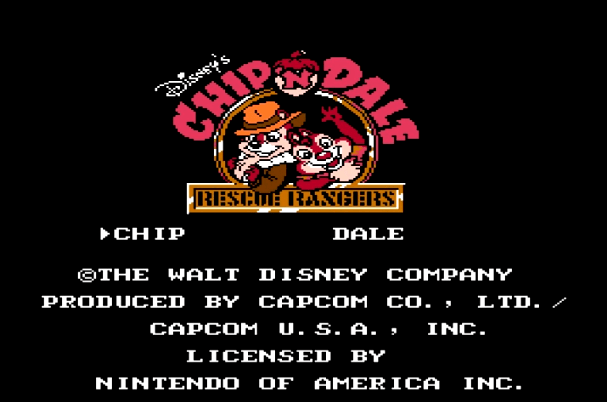
Chip ‘n’ Dale Rescue Rangers is a platform game developed and published by Capcom and released for the NES in 1990. It would later be released in the 2017 The Disney Compilation Collection for Microsoft Windows, PlayStation 4 and Xbox One. I chose to review the NES version.
Plot
The evil Fat Cat has stolen Mandy’s kitten. The Rescue Rangers pledge to rescue the kitten.
Gameplay
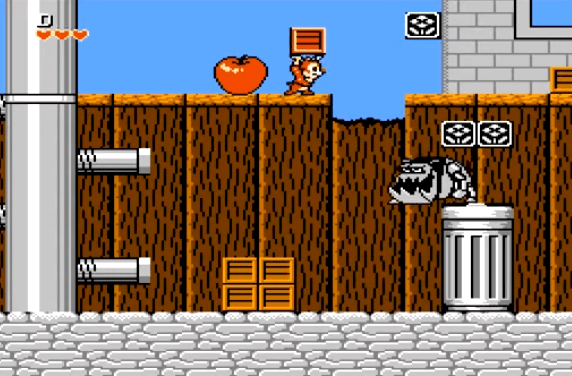
Through streets, over and through buildings, and forests; Chip and Dale must evade foes such as mechanical bulldogs, robotic rats, and gansgter lizard-type things known as warts. You can choose to dodge these dangerous foes or throw various items such as crates and apples at them. After each level, Gadget offers some advice about how to defeat the trickier aspects of the next level.
The game can be played in on or two-player mode. In one-player mode, you can choose to be either Chip or Dale. Each player can only be hit three times before they die.
You can use objects such as crates and apples to throw at your enemies (screenshot taken by the author)
How Does It Handle?
This game plays really well. The controls are responsive and I don’t recall many (if any) parts of the game where you die cheaply. The game has many trickier parts but it is enjoyable to play. I wasn’t expecting to like this game but I really enjoyed it.
Graphics
The levels are brightly coloured, well designed and detailed, and pose a nice challenge for the average gamer. It is easy to distinguish between the two protangonists as Chip wears a hat and a dark jacket.
Replay Value
Although the game has minimal replay value, it’s a lot of fun and a great game to be played with a younger sibling or child.
Did I Complete The Game?
Yes
What The Critics Said:
Electronic Gaming Monthly:“Every part of this game from the graphics, to the sounds to the gameplay are well done indeed. Rescue Rangers only falls flat in terms of challenge and difficulty. Overall 7.75/10”.[1]
Mean Machines: “Not groundbreakingly original, but very good nonetheless. Fun to play and long-lasting Overall 88%.”[3]
Total!: “Groovesome, slick and utterly dashing platform game with some ingenious two-player twist and a brain curdling difficulty curve! Overall 81%”.[4]
“This game looks great…but don’t be fooled by its cutsie look. There are some challenging parts to it, but nothing a seasoned gamer can’t handle. Excellent gameplay too. I enjoyed it more than I thought I would.”
Rating:
What are your memories of Chip & Dale Rescue Rangers? I would love to hear your thoughts, and don’t for get to follow and subscribe so that you don’t miss my latest reviews! You can also find me on Instagram: @Nicklovestogame.
Video games set in fantasy lands have always been popular. There is something enthralling about controlling musclebound and bronzed barbarians, big-breasted Amazonian women and axe-wielding dwarves who can not only hack their way through masses of monsters but also use fantastical magic when the situation warrants it. I mean, who doesn’t want to play a video game like that?
Title screen (screenshot taken by the author)
Golden Axe is a side-scrolling arcade hack ‘n’ slash developed and published by Sega, and released for the arcade in 1989. Over the next few years, it was later ported to the following:
Mega Drive/Genesis
Master System
Sega CD
IBM
PC
Amiga
Atari ST
Amstrad CPC
Commodore 64
Turbo Grafix-16
Wonder Swan
ZX Spectrum
For this review, I replayed the Mega Drive version from 1990.
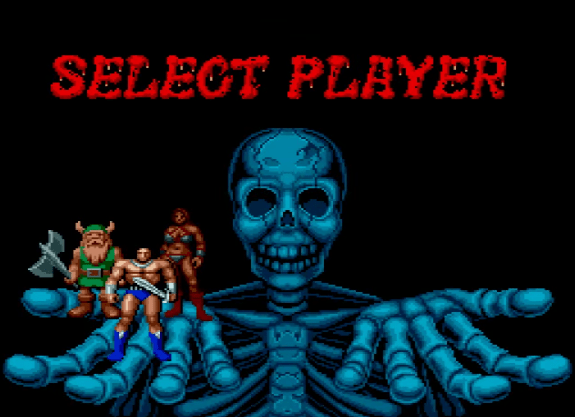
You can choose to fight as either Ax Battler, Tyrius Flare ot Gilius Thunderhead (screenshot taken by the author)
Plot
Set in the high-fantasy land of Yuria, the evil Death Adder has risen to power. His soldiers are responsible for the massacre of thousands of peaceful villagers. Soon, he kidnaps the King of Yuria and his daughter and steals the Golden Axe. Thankfully, three warriors emerge who are capable of saving the kingdom:
Ax Battler – a mighty barbarian from the far plains. He seeks to avenge the death of his mother. He is brave and strong, and wields volcanic magic.
Tyrius Flare – an Amazonian from deep within the jungles whose mother and father were killed by Death Adder. She has skill with the sword and possesses immense magical power that can rain down fire upon her enemies.
Gilius Thunderhead – a dwarf who wields a mighty axe and uses his speed and cunning to defeat his enemies. He seeks to avenge the death of his brother at the hands of Death Adder. His magic ability sees bolts of lightning strike from the heavens.
Together, they have sworn to purge Yuria of the pestilence that is Death Adder’s army and rescue the king and princess.
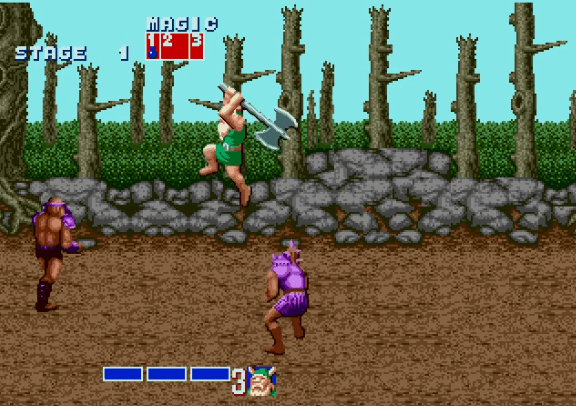
My personal favourite is Gilius Thunderhead (screenshot taken by the author)
Gameplay
To progress through the game, your heroes must battle their way through hordes of Death Adder’s ugly minions using only their swords and a bit of magic. Along the way, you will come across elves whom you can attack for magic and food. If things become too desperate, all three can use their individual magical powers to destroy their enemies. Gilius is limited to three bars, Ax to four bars and Tyrius to six bars. Tyrius magic is the more powerful of the three.
Arcade mode sees you play through all the stages whereas Beginner mode only takes you to level three where you fight Death Adder Jr. Duel mode sees you fight in 12 consecutive battles against increasingly harder opponents.
Some Bizzarians can come in very useful (screenshot taken by the author)
How Does It Handle?
The controls are slick and responsive, and the hit detection is spot on. The two main tactics you will use is to either to hack and slash your way through or charge at your enemies from a distance and either kick, shoulder barge or headbutt them. So, it’s not just a case of button mashing. You need to change your strategy depending on the enemy you’re facing. Occasionally, you may capture a Bizzarian. These weird creatures consist of one weird pink creature with a beak that uses its tail to swipe at your enemies, or dragons who breathe fire (blue = flame, pink = fireball). Interestingly, the tail swiping Bizzarian looks similar to the one’s seen in Altered Beast (1988). Could it be that Golden Axe and Altered Beast (1988) are in the same universe?
Graphics
The graphics look fantastic, expecially the backgrounds which are very detailed. The sprites look great and are animated well. Interestingly, Gilius Thunderhead seems to appear as a shopkeeper in Shining in the Darkness (1991). Even one of his sacks in the store contains a face of one of the elves from Golden Axe. Again, does this mean that Golden Axe, Altered Beast (1988) and Shining in the Darkness (1991) are all set in the same universe?
Replay Value
Naturally, the game can be played in one- or two-player mode. There are three difficulty settings: Easy, Normal and Hard, and you can adjust the number of life bars you begin from three to five. You also begin with three lives and three continues. Watch out though, in two-player mode as you can damage your co-op buddy.
Personal Memories
I have a lot of memories with Golden Axe playing with my siblings. I always played as Gilius Thunderhead. Again, it is a game that has given me many hours of fun, and I have returned to it year after year, even though I can easily complete the game. When I play in two-player mode, I don’t necessarily think it is about the challenge, but more trying to recapture an adventure with my younger brother.
Did I cComplete The Game?
Yes, I have completed this game many times over the years on easy. Strangely, I don’t think I have ever played this game on the Normal or Hard settings. I must remedy that.
What The Critics Said:
Electronic Gaming Monthly: “The screen graphics are perfect, with exceptional detail in in both the characters and background. The game is almost exactly like the arcade, with endless fighting filling each round. Axe moves slow, but has all the hack and slash action you could ask for. Overall 29/40”.[1]
Mean Machines:“A flawless conversion that even improves on the arcade game! Superb! Overall 91%”.[2]
Game Machine:“The character sprites are all big and bold, with more than a rainbowful of colours. The pounding soundtrack only adds to the involving and inviting atmosphere of the game. Fast action, superb attention to detail in the fight sequences and some breathtaking magical spells makes Golden Axe a must for all arcade action fans. Overall 92%”.[3]
Zero: “Everything about this game is good; graphics, sound and playability. One-player is brill; two-player is unbeatable. Overall 94%”.[4]
Wizard: “Again, another first generation Sega game. Medieval action game. Overall C”.[5]
Sega Power: “Hack-‘n’-slash with all the frills of the classic coin-op. Two-player mode isn’t as smooth as expected and for one it’s easy to finish. Still, hugely playable and addictive! Overall 4/5”.[6]
MegaTech:“Golden Axe is a pixel-perfect replica of the arcade machine, containing identical graphics, sound and gameplay. This is one of the best arcade conversions ever seen, and a game with no Megadrive owner should be without. Overall 94%“. [7]
My Verdict:
“An excellent coin-op conversion. It looks great, plays great and the two-player mode will have you coming back again and again.”
Rating:
What are your memories of Golden Axe? I would love to hear your thoughts, and don’t for get to follow and subscribe so that you don’t miss my latest reviews! You can also find me on Instagram: @Nicklovestogame.
Occasionally, even though the first game in a series may be panned by critics, creators will get a second bite of the cherry. When this occurs, one would hope that the creators learn where they went wrong in the first instalment and remedy these mistakes to help ensure the success of the sequel. Alternatively, they could just ignore all feedback because, let’s face it, it has a trademarked brand name in the title and will therefore sell anyway.
Title screen (screenshot taken by the author)
Star Wars: Rebel Assault 2 – The Hidden Empire is an action rail-shooter developed by Lucasart (Factor 5 for the PlayStation), and published by Lucasart. It was released 1995 for DOS/Windows, PlayStation and Mac OS. I chose to review the PC version.
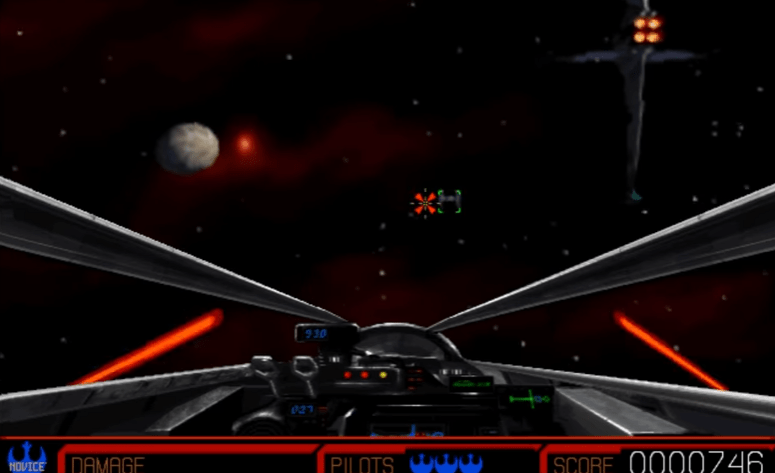
Rail-shooters are fine, but at least sort out the jittery aiming! (screenshot taken by the author)
Plot
Set after the destruction of the first Death Star, you play as Rebel pilot Rookie One. After a series of mysterious disappearances, you are sent out on patrol near the planet Dreighton to investigate. Your party soon receive a distress call from a ship whose pilot explains that he has valuable information regarding a secret project that the Galactic Empire are hatching in order to destroy the Rebel Alliance once and for all. Sadly, the pilot carrying the information is killed before you can reach him and your party is then attacked by Tie Fighters.
These levels would have been better suited with a light gun (screenshot taken by the author)
Gameplay
The gameplay is almost identical to Star Wars: Rebel Assault, in that there are three gameplay types. The first is a rail-shooter where, for the most part, the computer pilots your ship whilst you take control of the crosshair and try to shoot at the enemy. Occasionally, you will be called upon to steer when a flashing arrow appears, indicating that you need to press that direction on your joystick/control pad etc. The second sees you shoot at stormtroopers, killing a certain number before you can progress to the next screen. The third sees you take control of a ship/speeder, and you must fly through a course, again, with occasional flashing arrows showing the safest way through.
I found the controls jittery, and it is very difficult to determine depth perception (screenshot taken by the author)
How Does It Handle?
Sadly, there aren’t many positives I can give this game. The issues that plagued the first game were not fixed for the sequel. The controls are still just as jittery and frustrating to use. Whenever you release control of the cross hair, it immediately centres, which is incredibly annoying when you are trying accurately shoot moving targets with a joystick/control pad. I even tried to turn the sensitivity of my control pad down to 0, which helped aiming a bit. Annoyingly, you cannot change the axis for the joypad during the game. It is easier to have the controls as up is up and down is down for the shooting scenes, but have down is up and up is down for the flying levels. I don’t know why, it just feels more intuitive that way.
The issue with the flying levels is that it is difficult to distinguish depth perception. For the levels where you need to shoot and occasionally direct your ship, ensuring you don’t collide with asteroids or the side of the space stations, it is the pits and doesn’t compare at all to Star Wars: Tie Fighter.
I can’t understand why they didn’t learn from the first game. If you’re going to have a rail-shooter then a light gun or allowing the user to use a mouse makes more sense. Using a joytick etc. to aim is just too annoying and inaccurate.
Graphics
The game begins with the Star Wars text giving a brief backstory to the game. The opening scene really pulls you in and gets you straight into the action.
Although it may look a bit fuzzy nowadays, at the time, the graphics were awesome and just what you’d expect from any Star Wars game. The only issue with the graphics is that when flying the Millennium Falcon, for example, it’s not easy to judge when you are going to crash into the sides or into and incoming object.
Music
The intro to this game is awesome. It’s great to have the original music from the movies. Sadly, James Earl Jones didn’t reprise his role as Darth Vader.
Did I Complete The Game?
No, I rage quit after Mission 3 – The Mining Tunnels as I was so fucked off with the jerky, shitty flying controls!
What The Critics Said:
GameSpot: “There’s also a serious gameplay problem in the vehicular levels. The controls are too loose and jittery, meaning that you have to constantly fidget with the directional pad just to fly in a straight line. This also makes it almost impossible to dodge obstacles in your path. An even larger flaw is that, even with that awful control, the game is still much too easy to vanquish – any average player should be able to rip through it in two or three hours. Overall 4.9/10”.[1]
GameSpot:“Rebel Assault II’s fine musical score, well-written script, and decent acting will be enough to satisfy those seeking a worthwhile multimedia “experience,” but the limited gameplay will most likely send hard-core gamers running back to Tie Fighter. Overall 7.5/10”.[2]
Next Generation: “…you aren’t playing a game. You’re watching a movie that requires you to move a stick around and press a button at certain points until you get to see more of the movie. Overall 2/5”.[3]
My verdict:
“Star Wars: Rebel Assault 2 – The Hidden Empire seems to be unsure just what type of game it is. It has no redeeming features that would make a gamer choose this game over say, Tie Fighter or Dark Forces, as they are superior in every way. Jittery controls and poor targeting just make for a frustrating game that is no fun. What makes this game worse than Star Wars: Rebel Assault , is that they clearly didn’t learn from their mistakes.“
Rating:
What are your memories of Star Wars: Rebel Assault 2 – The Hidden Empire? I would love to hear your thoughts, and don’t for get to follow and subscribe so that you don’t miss my latest reviews! You can also find me on Instagram: @nicklovestogame.


















#/media/File:Chip_'n_Dale_Rescue_Rangers_NES_Cover.png)
#/media/File:Golden_Axe.jpg)






 Nick Loves to Game