Chuck Rock – Review

He may not be the sharpest flint in pre-history, but Chuck Rock has a head as hard as a granite and a belly that is deadly. So get ready to navigate jungles and swamps, battle dinosaurs, and rescue your wife before Garry Gritter has his way with her. Unga Bunga!!!
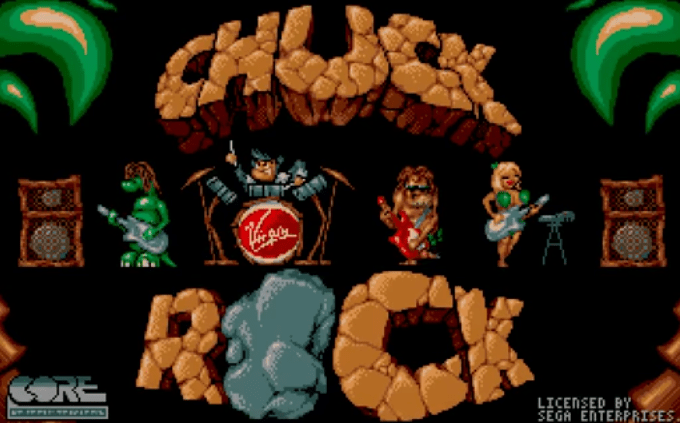
Title screen (screenshot taken by author)

Chuck Rock is a single-player side-scrolling platform game developed by Core Design. It has been published and ported to many other platforms including:

  • Core Design – Atari St and Amiga (1991), Commodore 64 (1992), and Amiga CD32 (1994)
  • Krisalis Software – Acorn Archimedes (1991)
  • Virgin Interactive – Sega Megadrive (1991), Sega Master System (1993) and Game Gear (1992)
  • Sony Imagesoft – Sega Mega-CD (1993), SNES (1992) and Game Boy (1993).

I chose to review the Mega Drive version.
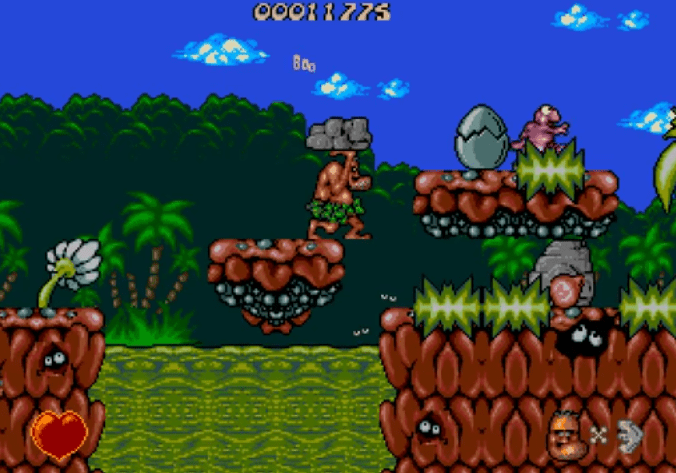
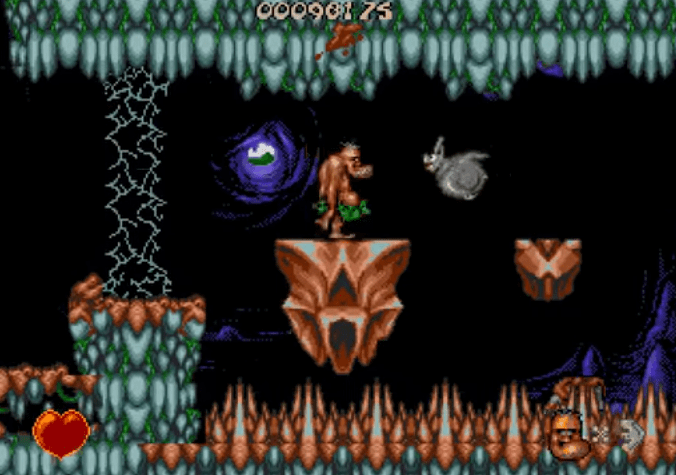
Beautiful level design (screenshot taken by author)

Plot

Set in a fantasy prehistoric Stone Age, Chuck is enjoying a lazy day in front of his TV drinking beer (root beer that is). His wife, Ophelia, is going about her daily chores unaware that she will soon be kidnapped by the evil Gary Gritter, who has designs on her. Chuck hears the commotion and investigates, only to find a pile of crumpled, dirty clothes and signs that something heavy has been dragged away. Since he has no clothes to wear, he ducks behind some nearby bushes and fashions some leafy pants to cover his modesty. He must now rescue his wife.

Gameplay

Chuck must navigate his way through five levels, each with three-five stages, all the while evading various dinosaurs and prehistoric animals; or if you are feeling brave, barging them out the way with your belly, performing flying kicks, or picking up huge boulders and throwing them. I’d recommend using the latter two to kill your enemies.

The levels are:

  1. The jungle scene
  2. The caves scene
  3. The water scene
  4. The Ice scene
  5. The Graveyard scene
Chuck may look like a everyone’s least favourite uncle, but he is the hero of this tale (screenshot taken by author)

How Does It Handle?

The controls are easy to learn and are nice and responsive. The game is challenging with some tough levels. Oddly, the end of level bosses are all very easy to defeat with the exception of the third boss. The only boss that you need a strategy to defeat is the first boss, but other than that, it is simply a case of button mashing. One nice little touch is that when Chuck is carrying a large rock, he won’t move as fast.

Graphics

Throughout the entire game the graphics look fab. The overall feel of the graphics is more on the whacky side than the realistic side. The background look great, and I particularly like the snowman on The Ice scene level. There’s plenty to catch the eye and make you think “That looks cool!”, like a T-rex with boxing gloves…awesome!
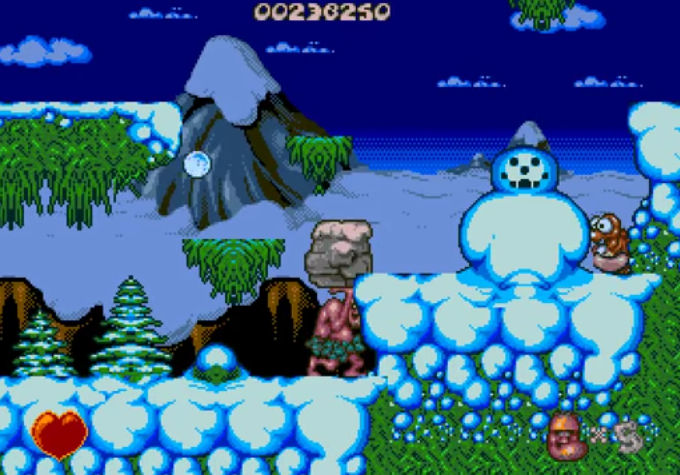
The levels look gorgeous (screenshot taken by author)

Music & SFX

The music is good throughout the game. The opening musical number on the title screen is awesome and I found myself delaying playing the game in order to listen to the song the whole way through. It seems that even though Chuck isn’t the sharpest tool in the box, he has aspired to lead singer of a rock band. The music speeds up during the boss battles.

There are plenty of SFX throughout the game as Chuck jumps, throws rocks, and bounces enemies of his belly.

Replay Value

Sadly, this game lacks replay value. There is only one difficulty setting and once completed you may only wish to revisit it once or twice before turning your attention to the next challenge.
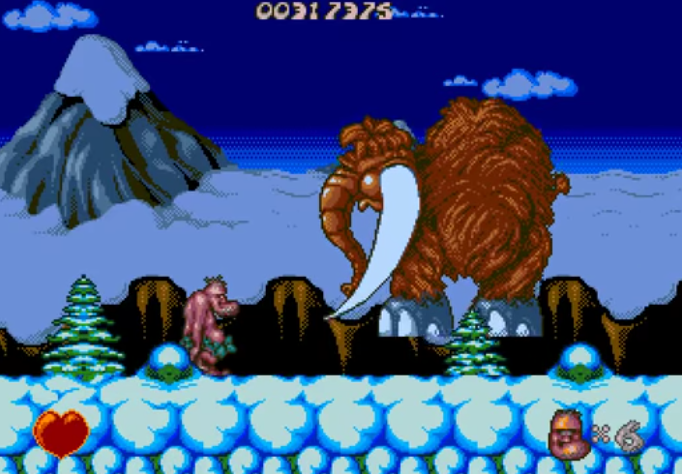
(screenshot taken by author)

Did I Complete The Game?

Yes, I completed the game without the use of cheats. Sadly, upon completing the game you are met another example of an anti-climatic ending to a game that deserved more.

What The Critics Said:

Mean Machines: An excellent and quite original platform game that’s highly recommended to all Megadrive players. Overall 91%.[1]

Mean Machines Index: “A brilliant, humorous Megadrive platform game with real character. Its graphics are out-of-this-world, the sound completely brilliant, and the game play pretty good too! A must have for your Megadrive collection. Overall 91%[2]

Sega Power: Groovy goings-on 100 million years B.C. with wild sonics and graphics as Chuck rescues his wife from the evil Garry Glitter. Overall 4/5.”[3]

Electronic Gaming Monthly: “The gameplay could use a little fine tuning, but it is still very fun to play. The graphics are comical and the music jams. Overall 7.75/10.[4]

Megazone: “Graphics wise this game is a hit (as good as the Amiga on the Mega Drive), the sound is pretty good (not quite up to the Amiga, but still pretty hot) and some imaginative sprite drawings have been added to this game. Overall 85%.[5]

GamePro: “The game’s worth the bucks for the music and graphics alone. From standpoint of challenge and gameplay, it’s middle of the road – not too hard and not too easy. Overall 4.6/5.”[6]

My Verdict:

“Unga Bunga – The game has nice graphics and is fun to play. The simple button mashing as oppose to a strategy needed to defeat end of level bosses, is a mark against this game. The lack of replay value means that once completed I doubt you will want to play through again.”

Rating:

What are your memories of Chuck Rock? I would love to hear your thoughts, and don’t for get to follow and subscribe so that you don’t miss my latest reviews! You can also find me on Instagram: @nicklovestogame.


[1] ‘Review: Mega Drive – Chuck Rock’. Mean Machines. (June 1992). Issue 21:76-8.

[2] ‘Review: Mega Drive – Chuck Rock’. Mean Machines. (October 1992). Issue 1:137.

[3] ‘The Hard Line – Review: Mega Drive – Chuck Rock’. Sega Power. (September 1993). Issue 46:96.

[4] ‘Review Crew: Genesis – Chuck Rock’. Electronic Gaming Monthly. (March 1992). 32:26.

[5] ‘Review: Mega Drive – Chuck Rock’. Megazone. (December 1992/January 1993). Issue 25:36.

[6] Feline Groovy. ‘Genesis Pro Review – Chuck Rock’. GamePro. (December 1991). 29:70.
Aladdin – Review

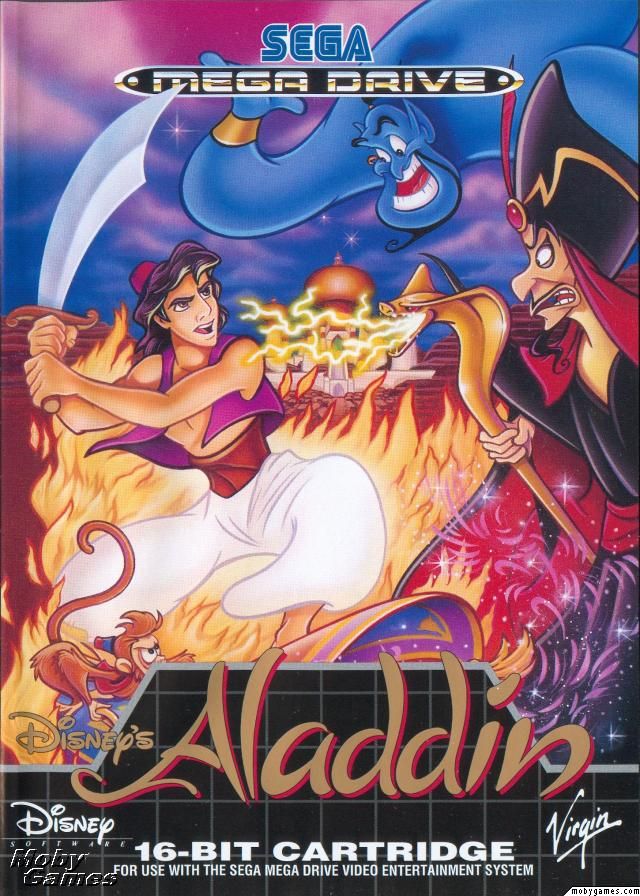
Aladdin is a Middle-Eastern folk tale about a boy who went from rags to riches with the help of a genie. It is one of the more well-known stories from the Arabic world. The western world embraced this tale and in 1992, Disney released their animated film version, bringing Aladdin to a “whole new world”…er…I mean generation. Its popularity, due to a great soundtrack and an award winning performance by Robin Williams, saw a video game released a year after the films hit the cinemas.

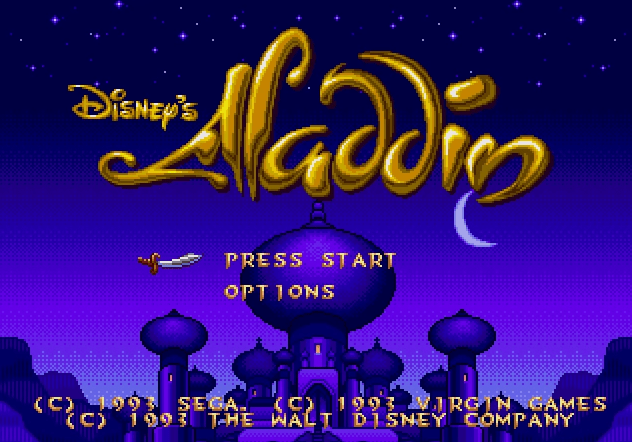
Title screen (screenshot taken by the author)

Aladdin is a single-player side-scrolling action platformer which was developed by Virgin Games. It was published in 1993 by Sega and Disney Software for the Sega Megadrive, and by Capcom for the SNES. It was later ported to the NES, Game Boy, Amiga and DOS formats. I chose to review the Mega Drive Version.

Plot

The game is not identical to, but still has the same storyline as the film. In the Arabic city of Agrabah, a lovable street rat called Aladdin lives with his monkey companion Abu. One day, he stops a stranger from getting her hand chopped off for giving a starving child an apple. This stranger turns out to be Princess Jasmine, and Aladdin is smitten.

Meanwhile, the Sultan’s evil adviser Jafar is plotting to overthrow the Sultan and marry Jasmine. Aladdin must must rescue the Princess Jasmine from the evil Jafar.

Gameplay

You can choose from three difficulties: Practice, Normal or Difficult. Once the game begins, prepare to navigate the following levels:

Agraban Street

The Desert

Agraban Rooftops

Sultan’s Dungeon

Cave of Wonders

The Escape

Rug Ride

Inside the Lamp

Sultan’s Palace

Jafar’s Palace

Whilst traversing the levels you are able to jump, crouch, and climb ropes. To defeat enemies, you have the choice of a scimitar with which to slash your opponent or you can collect apples to use as projectiles. If you collect tokens of the Genie’s head or Abu’s head, you will gain access to bonus stages to gain extra lives and such. Gems can also be acquired to buy extra continues and wishes from the peddler.

Clearing a level with one or more of the Genie’s tokens takes you to the Genie’s Bonus Machine where you can win gems, apples, and extra tries. The amount of spins you get depends on the number of Genie tokens you have.

If you find an Abu token, you gain access to his bonus stage. He must run back and forth, wielding a scimitar, and trying to pick up special objects that are dropped from the sky whilst avoiding rocks and pots that are also falling. Again, your aim is to collect gems, extra tries, and apples.

There are cut scenes between the levels allowing the storyline to move along, but you do not need to have seen the film in order to enjoy the game.

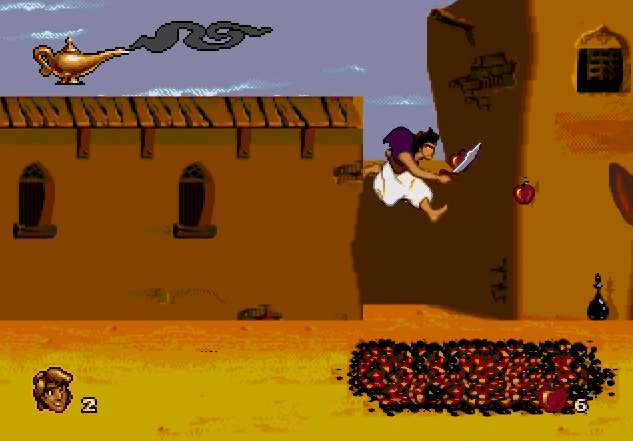
Aladdin was praised by critics for its graphics (screenshot taken by the author)

How Does The Game Handle?

The controls are tight, and the physics of the game are easy to get used to. One level which sees our hero trying to escape the Cave of Wonders is particularly hard and had me swearing many times at the TV and/or controller pad.

Graphics

The graphics are incredible! They are bright and colourful, and the animation is excellent and fun to watch. I particularly liked the smoke from the genie’s lamp being used as a health meter and the way little Abu runs around in his bonus stage.

All the levels are detailed, look beautiful and make you feel like you’re playing the movie. The parallax scrolling of the chains in the foreground of the Sultan’s Dungeon really helped with the feeling of being locked inside. To be fair, all the levels look amazing.

Music & SFX

The music consists of songs from the movie soundtrack so no doubt you will be humming along. For example, over the title screen you will hear “A Whole New World” and over the first level it is “Prince Ali”.

The main SFX you will hear is the sound of air being cut as Aladdin swinging his sword and little ‘trings’ as he picks up items. There are lots of SFX in this gave and it’s awesome.

SPOILER ALERT!!!

Frustratingly, at the end of the game you can only defeat Jafar by throwing apples at him. What the game doesn’t tell you is that you need 36 apples to defeat him. If you don’t have enough there is little else you can do other than restart the entire game, and ensure you use the apples sparingly.

“Prince Ali fabulous he Ali Ababwa” (screenshot taken by the author)

Replay Value

When the game is completed the ending is practically non-existant, which begs the question, should one have bothered to complete it in the first place. The answer, of course, is yes as this is a good game and worth playing again.

Did I Complete The Game?

Yes, but I wasn’t happy about getting all the way to the end before realising that I had to restart and play through again to ensure I had enough apples to defeat Jafar.

What The Critics Said:

Edge Magazine: “…almost perfect. The sound could have been better – but that’s a minor quibble. Anyway, at last the Mega Drive has a new platform king. Move over spiky blue one, Aladdin’s in town. Overall 8/10.”[1]

My Verdict: “Prince Ali! Fabulous He! Ali Ababwa. A fun little game that is well worth your time. Great graphics and music, however older generations might get bored a little easily with this one.”

Rating:

What are your memories of Aladdin? I would love to hear your thoughts, and don’t for get to follow and subscribe so that you don’t miss my latest reviews! You can also find me on Instagram: @nicklovestogame.


[1] ‘Review Mega Drive: Aladdin’. Edge Magazine. (November 1993). Issue 2:92-3.

European Club Soccer – Review

In 1992, I was just beginning to become interested in football. I was playing in my school team, and at weekends would play for local Saturday morning clubs. My love of football meant that I also sought out football video games. FIFA International Soccer (1993) and International Superstar Soccer Pro (1997) were a few years away yet, so I purchased European Club Soccer.

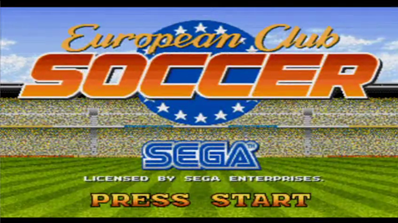
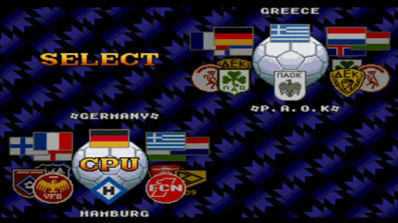
Title screen (screenshot taken by the author)

Known as World Trophy Soccer in North America, and J-League Champion Soccer in Japan, this football game was developed by Krisalis Software (Game Arts in Japan) and published by Virgin Games for the Sega Mega Drive in 1992. I chose to review the Sega Mega Drive version.

European Club Soccer had an impressive array of teams to choose from (screenshot taken by the author)

Gameplay

Playable in one and two-player mode, you can choose from over 150 teams throughout Europe to compete in tournaments. Naturally they do not have the real player names, but many of the teams are recognizable. For example, Manchester United, Liverpool, Juventus etc., are available, as well as some more obscure additions such as Rotherham United.

To win, you must utilize you teams ability to pass, tackle, dribble, and shoot in order to score goals and from prevent your opposition from scoring.

European Cup – 32 teams (up to eight players) compete for this trophy. The winners will then compete for the Super Cup.

Arcade – A one-off friendly that can be played in single or two-player mode.

You can also change the length of the matches.

How Does It Handle?

Oddly, there is no “shoot” button per se, only low pass and high pass. Frustratingly, the players lose the ball if they change direction too fast whilst dribbling and scoring from a cross or corner is pretty much impossible too. In order to score, I found that I had to have one of my players stand in front of my opponent’s goalkeeper to intercept a shot from another of my players. The keeper would dive out the way, allowing the intercepting player to score into an open net.

Due to a lack of storage, any changes made to team strips could not be saved, and the only way to continue progress through a tournament was to use a password.

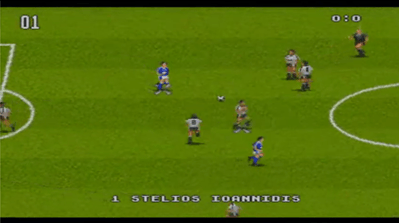
Sadly, the gameplay left alot to be desired (screenshot taken by the author)

Graphics

What the game lacks in gameplay, it makes up for in graphics. The in-game graphics are good for 1992, far superior to World Cup Italia 90 (1990) Super Kick Off (1991), and the scrolling is smooth. The animation of the players running, kicking, and slide tackling looks really good. The design of the pitch with different shades of green looks realistic and the crowd behind the goal looks incredibly detailed. There is also a nice illustration of a referee blowing his whistle for half-time and full-time, and of a player from the winning team raising his hands in triumph at the final whistle. Sadly, there is little to no celebration when a goal is scored.

Music & SFX

There is a few nice different pieces of music throughout the game. I especially liked the intro over the title screen. However, I did think the music that plays over the action would be better suited to a beat ‘em up.

The SFX are very minimal. There’s a quiet this as you kick the ball, the occasional whistle from the ref, and the background crowd noise which to me sounds like the noise you used to get when your old TV would loose signal and you’d have that black and white fuzzy screen.

Replay Value

Three difficulty settings, two-player mode, and a large number of teams with who to play with give this game a reasonable amount of replay value.

Personal Memories

I remember that I always wanted this game as a kid because I thought it looked excellent, and the cover art really sold it to me. Sadly, I couldn’t afford many games. I’m unsure if I would have felt let down had I bought this game upon release.

Did I Complete The Game?

I successfuly won all leagues and cups without the Three Shredded Wheat cheat.

What The Critics Said:

Mean Machines: “A superbly presented game which is sadly let down by some awkward gameplay points. Overall 69%.[1]

Mean Machines Index: Megadrive soccer games have a history to beingsad and this effort does little to addressthe situation. Although the graphics and sound are very good, the gameplay is let down by low player intelligence, wonky collision detention and awkward controls. As the (very) old saying goes “try before you buy!”. Overall 69%”[2]

Sega Power: “Nice introduction and options, but the whole thing is a let down by poor gameplay. It’s simply too easy to beat in one-player mode. Overall 3/5[3]

My Verdict:Not the worst football game I’ve played, but there are better ones out there to enjoy. I‘d recommend seeking out arcade football games for games released in 1992.

Rating:

What are your memories of European Club Soccer? I would love to hear your thoughts, and don’t for get to follow and subscribe so that you don’t miss my latest reviews! You can also find me on Instagram: @nicklovestogame.


[1] ‘Review: Mega Drive – European Club Soccer’. Mean Machines. (June 1992). Issue 21:106-8.

[2] ‘Review Index: Mega Drive – Euro Club Soccer’. Mean Machines. (October 1992). Issue 1:138.

[3] ‘The Hard Line – Review: Mega Drive – European Club Soccer’. Sega Power. (September 1993). Issue 46:97.