Aladdin – Review

Aladdin is a Middle-Eastern folk tale about a boy who went from rags to riches with the help of a genie. It is one of the more well-known stories from the Arabic world. The western world embraced this tale and in 1992, Disney released their animated film version, bringing Aladdin to a “whole new world”…er…I mean generation. Its popularity, due to a great soundtrack and an award winning performance by Robin Williams, saw a video game released a year after the films hit the cinemas.
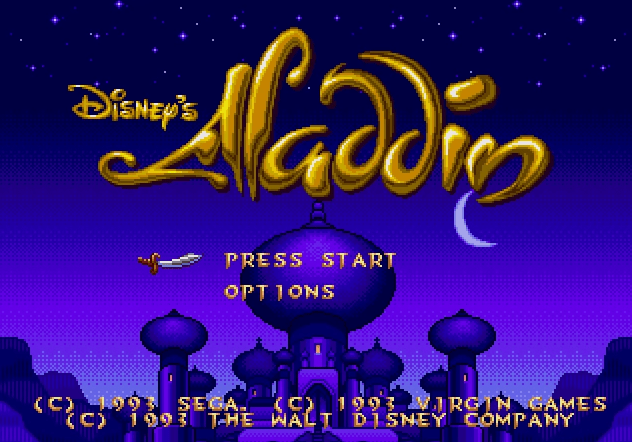
Title screen (screenshot taken by the author)

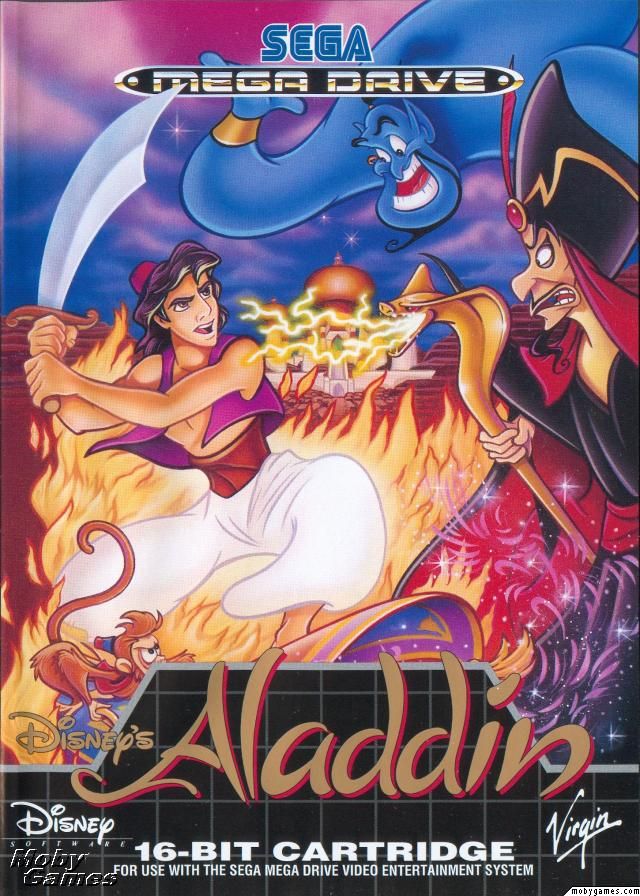
Aladdin is a single-player side-scrolling action platformer which was developed by Virgin Games. It was published in 1993 by Sega and Disney Software for the Sega Megadrive, and by Capcom for the SNES. It was later ported to the NES, Game Boy, Amiga and DOS formats. I chose to review the Mega Drive Version.

Plot

The game is not identical to, but still has the same storyline as the film. In the Arabic city of Agrabah, a lovable street rat called Aladdin lives with his monkey companion Abu. One day, he stops a stranger from getting her hand chopped off for giving a starving child an apple. This stranger turns out to be Princess Jasmine, and Aladdin is smitten.

Meanwhile, the Sultan’s evil adviser Jafar is plotting to overthrow the Sultan and marry Jasmine. Aladdin must must rescue the Princess Jasmine from the evil Jafar.

Gameplay

You can choose from three difficulties: Practice, Normal or Difficult. Once the game begins, prepare to navigate the following levels:

Agraban Street

The Desert

Agraban Rooftops

Sultan’s Dungeon

Cave of Wonders

The Escape

Rug Ride

Inside the Lamp

Sultan’s Palace

Jafar’s Palace

Whilst traversing the levels you are able to jump, crouch, and climb ropes. To defeat enemies, you have the choice of a scimitar with which to slash your opponent or you can collect apples to use as projectiles. If you collect tokens of the Genie’s head or Abu’s head, you will gain access to bonus stages to gain extra lives and such. Gems can also be acquired to buy extra continues and wishes from the peddler.

Clearing a level with one or more of the Genie’s tokens takes you to the Genie’s Bonus Machine where you can win gems, apples, and extra tries. The amount of spins you get depends on the number of Genie tokens you have.

If you find an Abu token, you gain access to his bonus stage. He must run back and forth, wielding a scimitar, and trying to pick up special objects that are dropped from the sky whilst avoiding rocks and pots that are also falling. Again, your aim is to collect gems, extra tries, and apples.

There are cut scenes between the levels allowing the storyline to move along, but you do not need to have seen the film in order to enjoy the game.
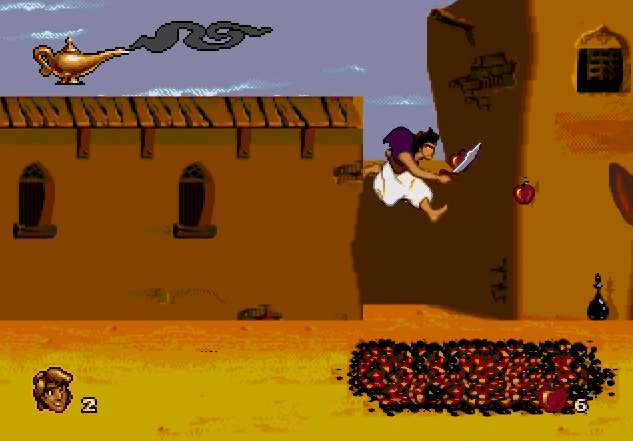
Aladdin was praised by critics for its graphics (screenshot taken by the author)

How Does The Game Handle?

The controls are tight, and the physics of the game are easy to get used to. One level which sees our hero trying to escape the Cave of Wonders is particularly hard and had me swearing many times at the TV and/or controller pad.

Graphics

The graphics are incredible! They are bright and colourful, and the animation is excellent and fun to watch. I particularly liked the smoke from the genie’s lamp being used as a health meter and the way little Abu runs around in his bonus stage.

All the levels are detailed, look beautiful and make you feel like you’re playing the movie. The parallax scrolling of the chains in the foreground of the Sultan’s Dungeon really helped with the feeling of being locked inside. To be fair, all the levels look amazing.

Music & SFX

The music consists of songs from the movie soundtrack so no doubt you will be humming along. For example, over the title screen you will hear “A Whole New World” and over the first level it is “Prince Ali”.

The main SFX you will hear is the sound of air being cut as Aladdin swinging his sword and little ‘trings’ as he picks up items. There are lots of SFX in this gave and it’s awesome.

SPOILER ALERT!!!

Frustratingly, at the end of the game you can only defeat Jafar by throwing apples at him. What the game doesn’t tell you is that you need 36 apples to defeat him. If you don’t have enough there is little else you can do other than restart the entire game, and ensure you use the apples sparingly.

“Prince Ali fabulous he Ali Ababwa” (screenshot taken by the author)

Replay Value

When the game is completed the ending is practically non-existant, which begs the question, should one have bothered to complete it in the first place. The answer, of course, is yes as this is a good game and worth playing again.

Did I Complete The Game?

Yes, but I wasn’t happy about getting all the way to the end before realising that I had to restart and play through again to ensure I had enough apples to defeat Jafar.

What The Critics Said:

Edge Magazine: “…almost perfect. The sound could have been better – but that’s a minor quibble. Anyway, at last the Mega Drive has a new platform king. Move over spiky blue one, Aladdin’s in town. Overall 8/10.”[1]

My Verdict: “Prince Ali! Fabulous He! Ali Ababwa. A fun little game that is well worth your time. Great graphics and music, however older generations might get bored a little easily with this one.”

Rating:

What are your memories of Aladdin? I would love to hear your thoughts, and don’t for get to follow and subscribe so that you don’t miss my latest reviews! You can also find me on Instagram: @nicklovestogame.


[1] ‘Review Mega Drive: Aladdin’. Edge Magazine. (November 1993). Issue 2:92-3.
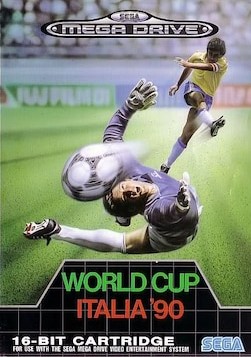
World Cup Italia ’90 – Review

I was seven during World Cup Italia ’90. Sadly, I don’t remember much about it, other than my father jumping off the sofa in celebration as England scored. I don’t recall the match but I have a feeling it may have been England v Belgium, and the goal in question was David Platt’s volley.

Title screen (screenshot taken by the author)

Released for the Sega Mega Drive in 1990, and the Sega Master System in 1991, this football game was developed and published by Sega, and can be played in one and two-player modes. To review, I revisisted the Sega Mega Drive version

Gameplay

There are three modes:

World Cup – Single-player mode only where you can choose from 24 teams in the World Cup, all with varying degrees of stats, to guide to World Cup glory and immortality. Brazil, Argentina, West Germany, Holland and England are the best rated teams for the era, but sadly, they do not use names of real players.

Test Match 1P – Single-player exhibition match

Test Match 2P – Two-player exhibition match

Once you select your mode, a map of the world will appear. You then move the cursor to select you desired team. You can only select countries that are in colour. Any land area in beige cannot be selected. Each country’s stats are broken down in the following: Speed, Skill, Defence, Keeper, Total, all labelled 1-5 (5 being the highest)

Once you have chosen your country, you then need to select which players you want for the first team. Players have different stats: Speed, Kicking Strength, Tackling, and Accuracy, again, all labelled 1-5 (5 being the highest). Once selected, the game is ready to begin!

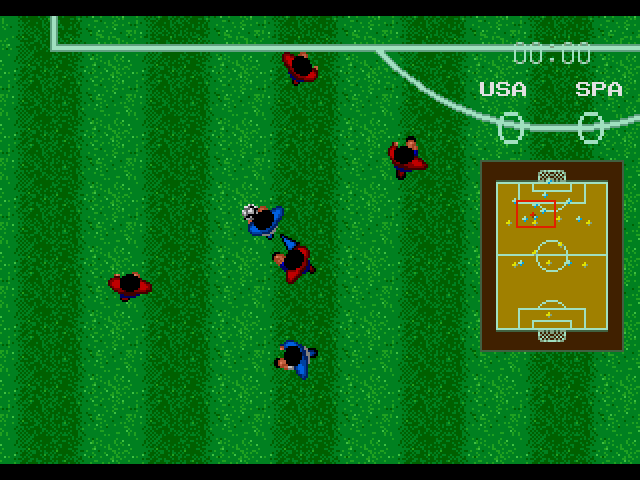
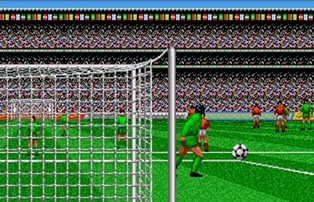
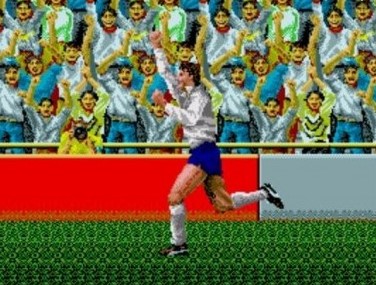
You view the game from a top down perspective, changing only during corners, penalties and goal kicks, where it changes to a more detailed, close up view. Also, when you score a goal, a picture of a player celebrating appears on the screen for a few seconds before kick-off resumes.

In-game action (screenshot taken by the author)

How Does It Handle?

The gameplay is still superior to later football games such as European Club Soccer (1992) and Super Kick Off (1991). For instance, there is a clear distinction between shoot, pass and cross functions. You can tackle and head the ball, and the overall ball control is better. You also need tactics to score goals. For example, in the first half, you need to diagonally cross ball into the penalty box to head the ball over the goalkeeper. In the second half, the goalkeeper tends to stay on his goal line, and so long shots diagonally across the penalty box into the corners of the goal are best.

There are a few things wrong with this game, however. Firstly, there are no fouls, so you can just hack away to your heart’s content. What really lets this game down though, is the length of each match. There is no way to shorten the match time, and each game seems unnecessarily long. This wouldn’t be so bad, but the simplicity of the gameplay soon becomes tiresome over such a long period of time. I achieved such a high level of skill at the game that I was scoring 20 goals per match because they are so long.

The more detailed set piece animation (screenshot taken by the author)

Graphics

The graphics are basic but they are colourful, clear and crisp. Smooth scrolling combined with more detailed illustrations and animations during set pieces are a nice touch as the game would seem rather plain otherwise. I think the football itself looks cool too, especially the way it enlarges as it rises into the air helping to ascertain its height.

Music

The music is great.! It has a very South American Latin feel to it which I’d be more than happy to listen to. The only annoyance is that every time to ball goes off for a throw-in or corner or when a goal is scored, the music restarts from the beginning.

The detailed stills are a nice touch (screenshot taken by the author)

Replay Value

Sadly, with the exception of two-player mode there is very little replay value to this game other than trying to win the World Cup with a weaker team.

Personal Memories

This game received poor reviews, but I seem to have a soft spot for it. I must confess that I love the music. Once it’s in your head, it never leaves. You’ll certainly find yourself dancing in your seat to the Latin beat.

This was also one of the first Mega Drive games I owned and completed. I felt such a sense of pride because I was only about nine years old and had often made it to the final only to be defeated.

Did I Complete The Game?

Yes, I have led the teams of Brazil and England to World Cup glory numerous times.

What The Critics Said:

Sega Power: “…this soccer game is a disappointment. Tired old gameplay and average graphics make this one for soccer fans only. Overall 2/5”.[1]

Sega Power: “This soccer game is, to put it mildly, very poor. Tired old gameplay and average graphics make this a soccer fan game only. Overall 2/5.[2]

Raze: “Smooth scrolling pitch, good animation, lots of great set-piece screens and two-player mode is great fun. Poor title tune and corny during game, feeble whistles and strange groans, doesn’t always pick the nearest player. Overall 82%.[3]

My Verdict:Although you may get bored with the formulaic ways of scoring, the music will help ease the lengthy game time. I still prefer this to European Club Soccer.”

Rating:

What are your memories of World Cup Italia ’90? I would love to hear your thoughts, and don’t for get to follow and subscribe so that you don’t miss my latest reviews! You can also find me on Instagram: @nicklovestogame.


[1] Jarrett, S., ‘The Hard Line – World Cup Italia ‘90’. Sega Power. (April 1991). Issue 23:55.

[2] ‘The Hard Line – Review: Mega Drive – World Cup Italia ‘90’. Sega Power. (September 1993). Issue 46:99.

[3] ‘Reviews: Mega Drive – World Cup Italia ‘90’. Raze. (March 1991). Issue 5:44-45.

European Club Soccer – Review

In 1992, I was just beginning to become interested in football. I was playing in my school team, and at weekends would play for local Saturday morning clubs. My love of football meant that I also sought out football video games. FIFA International Soccer (1993) and International Superstar Soccer Pro (1997) were a few years away yet, so I purchased European Club Soccer.

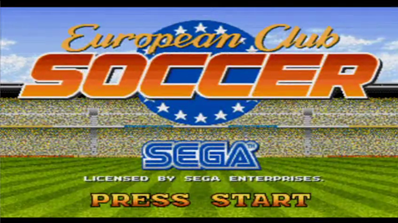
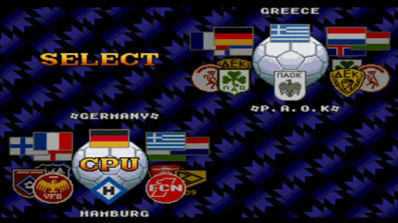
Title screen (screenshot taken by the author)

Known as World Trophy Soccer in North America, and J-League Champion Soccer in Japan, this football game was developed by Krisalis Software (Game Arts in Japan) and published by Virgin Games for the Sega Mega Drive in 1992. I chose to review the Sega Mega Drive version.

European Club Soccer had an impressive array of teams to choose from (screenshot taken by the author)

Gameplay

Playable in one and two-player mode, you can choose from over 150 teams throughout Europe to compete in tournaments. Naturally they do not have the real player names, but many of the teams are recognizable. For example, Manchester United, Liverpool, Juventus etc., are available, as well as some more obscure additions such as Rotherham United.

To win, you must utilize you teams ability to pass, tackle, dribble, and shoot in order to score goals and from prevent your opposition from scoring.

European Cup – 32 teams (up to eight players) compete for this trophy. The winners will then compete for the Super Cup.

Arcade – A one-off friendly that can be played in single or two-player mode.

You can also change the length of the matches.

How Does It Handle?

Oddly, there is no “shoot” button per se, only low pass and high pass. Frustratingly, the players lose the ball if they change direction too fast whilst dribbling and scoring from a cross or corner is pretty much impossible too. In order to score, I found that I had to have one of my players stand in front of my opponent’s goalkeeper to intercept a shot from another of my players. The keeper would dive out the way, allowing the intercepting player to score into an open net.

Due to a lack of storage, any changes made to team strips could not be saved, and the only way to continue progress through a tournament was to use a password.

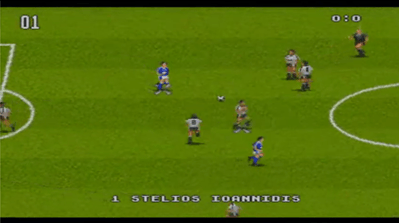
Sadly, the gameplay left alot to be desired (screenshot taken by the author)

Graphics

What the game lacks in gameplay, it makes up for in graphics. The in-game graphics are good for 1992, far superior to World Cup Italia 90 (1990) Super Kick Off (1991), and the scrolling is smooth. The animation of the players running, kicking, and slide tackling looks really good. The design of the pitch with different shades of green looks realistic and the crowd behind the goal looks incredibly detailed. There is also a nice illustration of a referee blowing his whistle for half-time and full-time, and of a player from the winning team raising his hands in triumph at the final whistle. Sadly, there is little to no celebration when a goal is scored.

Music & SFX

There is a few nice different pieces of music throughout the game. I especially liked the intro over the title screen. However, I did think the music that plays over the action would be better suited to a beat ‘em up.

The SFX are very minimal. There’s a quiet this as you kick the ball, the occasional whistle from the ref, and the background crowd noise which to me sounds like the noise you used to get when your old TV would loose signal and you’d have that black and white fuzzy screen.

Replay Value

Three difficulty settings, two-player mode, and a large number of teams with who to play with give this game a reasonable amount of replay value.

Personal Memories

I remember that I always wanted this game as a kid because I thought it looked excellent, and the cover art really sold it to me. Sadly, I couldn’t afford many games. I’m unsure if I would have felt let down had I bought this game upon release.

Did I Complete The Game?

I successfuly won all leagues and cups without the Three Shredded Wheat cheat.

What The Critics Said:

Mean Machines: “A superbly presented game which is sadly let down by some awkward gameplay points. Overall 69%.[1]

Mean Machines Index: Megadrive soccer games have a history to beingsad and this effort does little to addressthe situation. Although the graphics and sound are very good, the gameplay is let down by low player intelligence, wonky collision detention and awkward controls. As the (very) old saying goes “try before you buy!”. Overall 69%”[2]

Sega Power: “Nice introduction and options, but the whole thing is a let down by poor gameplay. It’s simply too easy to beat in one-player mode. Overall 3/5[3]

My Verdict:Not the worst football game I’ve played, but there are better ones out there to enjoy. I‘d recommend seeking out arcade football games for games released in 1992.

Rating:

What are your memories of European Club Soccer? I would love to hear your thoughts, and don’t for get to follow and subscribe so that you don’t miss my latest reviews! You can also find me on Instagram: @nicklovestogame.


[1] ‘Review: Mega Drive – European Club Soccer’. Mean Machines. (June 1992). Issue 21:106-8.

[2] ‘Review Index: Mega Drive – Euro Club Soccer’. Mean Machines. (October 1992). Issue 1:138.

[3] ‘The Hard Line – Review: Mega Drive – European Club Soccer’. Sega Power. (September 1993). Issue 46:97.

John Madden Football ’92 – Review

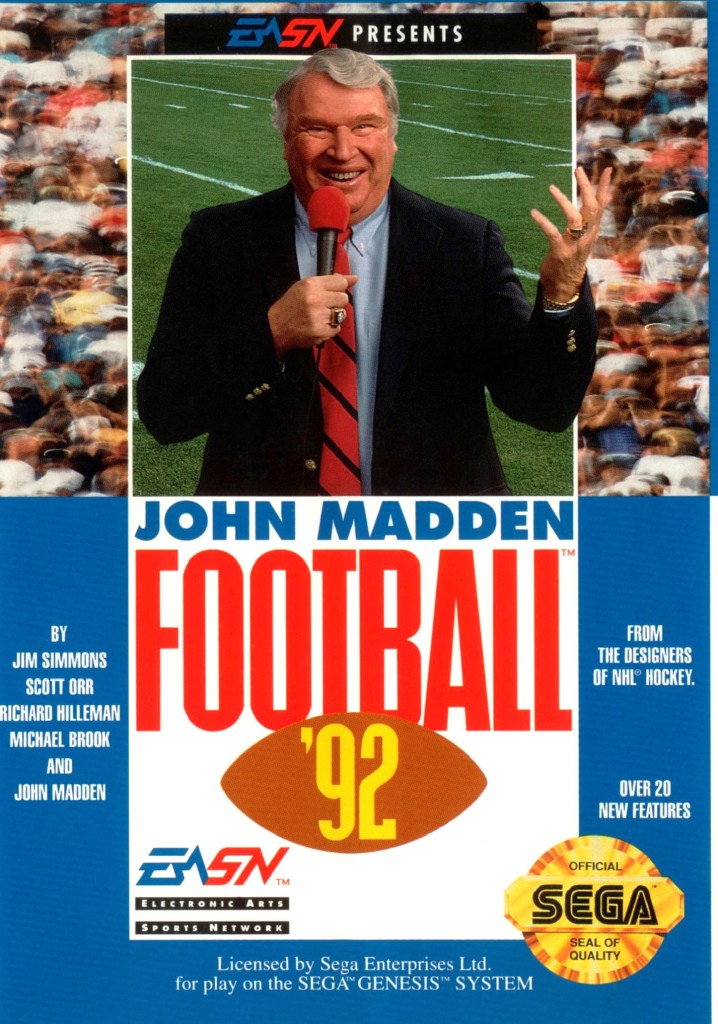
Sports games have always been popular amongst gamers. However, technology has always held creators back from producing quality and realistic sports sims. Madden ’92 is an example of an early attempt to produce a playable American football game…and to be fair, they didn’t do a bad job.

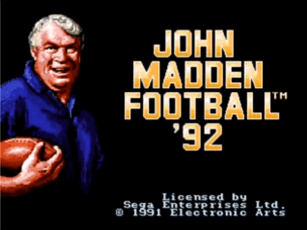
Title screen (screenshot taken by the author)

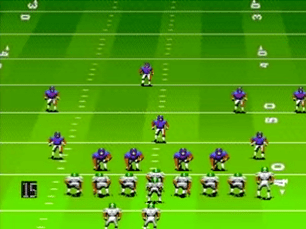
John Madden Football ’92 is an American football sports game developed and published by Electronic Arts for the Sega Mega Drive, beginning a series of yearly instalments for the video game market. I chose to review the Sega Mega Drive version.

Basic Rules

For those unacquainted with the game of American football, each team consists of groups of offensive, defensive, and special team players. When you are in possession of the ball, you have four plays or “downs” to move the ball forward 10 yards or more. This can be achieved by throwing or kicking the ball or running with it. This is decided before each play as you set your team up in a tactical way to deceive and outmanoeuvre your opponents. If you fail to move the ball 10 yards or more within those four downs, the ball passes to the opposite team. If you are successful, then you go back to a “1st Down” and the process starts again until either you score a “touchdown”, “field goal”, or lose the ball in a number of different ways.

“Red, 27, HIKE!” (screenshot taken by the author)

Gameplay

Madden ’92 can be played in single-player modes as well as two-player head-to-head and co-op modes (the later being a new feature).

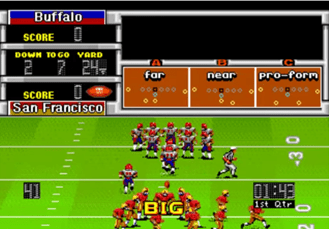
There are 28 professional teams (the All-Madden team can only be played in Regular Season) to choose from and several new options for you to play:

  • Pre-Season – An exhibition match with no fouls except offsides and the 45 second play clock is turned off
  • Regular Season – Exhibition but with all game rules in effect
  • New Playoffs – Begin a new tournament
  • Continue Playoffs – Continue with a previous tournament
  • Sudden Death – Normal game rules but the first to score wins the game

American football consists of four quarters, and you can choose how long these quarters are. Quarter lengths can be either 5, 10, and 15 minutes in length.

You then get to choose the type of stadium and field you play on. The choices are:

  • Open stadium with grass
  • Open stadium with Astroturf
  • Domed stadium with Astroturf

When you select open stadiums, the weather can affect the game in the guise of wind, rain and snow. In the snow and rain, players are slower and have less traction. The wind affects field goals and punts making it trickier to judge direction.

The game came with a very comprehensive manual explaining in detail the intricacies of the plays and in-depth stats on the players. Simply by reading the manual, one could quite easily become an expert (or a bore).

The manual will help you learn the strengths and weaknesses of the various plays you can make (screenshot taken by the author)

How Does It Handle?

Although it is not difficult to pick the game and play, a cursory flick through the comprehensive manual will allow you to use your plays more effectively. I think what lets the gameplay down is when you attempt to run with the ball. The players are very slow and although you are able to spin to avoid being tackled, the players seem to run as if they are stuck in treacle. I think you’re better off sticking with the throwing game at least until you are within ten yards of the touchdown line.

Graphics

Madden ’92’s competitors released in 1991 were Tecmo Bowl (NES) and Mike Ditka Power Football (Mega Drive). I haven’t played either of those games and so cannot compare playability, but I do think that Mike Ditka Power Football’s graphics are slightly better than Madden ’92. That’s not taking away from Madden ’92 which I think looks very good and has very smooth vertical scrolling.

I particularly like the colourful gear the teams wear which clearly distinguishes them. The different shades of green of the field too is pleasing to the eye.

Music & SFX

Music doesn’t play a big role in this game, and one can live without the SFX. I tended to listen to a podcast or stick on some music.

What little SFX there are consist mainly of the crowd cheering, referee whistles, the quarterbacks calling various numbers and colours, and the grunts of the players as they smack into each other.

Replay Value

Sports games always have a lot of replay value, especially in two-player mode. Madden ’92 is not exception. I returned to it many times when competing against my brother and friends.

Personal Memories

Naturally I had heard of American football as a youngster through American films but had never actually played it. I had previously played John Madden American Football (1990) which gave me the opportunity to learn how the sport was played. When we picked up Madden ’92, I was pleased to see there had been some improvements. There were more plays for the teams to perform, and when a player was injured, an ambulance would drive onto the pitch and proceeded to plough through the huddled mass of players, splaying them across the field. Sadly, there was still no license for authentic teams, stadium and player names.

In my youth, I would always play as Chicago (because for some reason I liked the Chicago Bears), and my older brother preferred Cincinnati (Bengals). Like most sports games, Madden ‘92 is better in two-player mode.

Did I Complete The Game?

In many modern sports games you don’t necessarily complete them, as much as win the league and cup titles and then move on to the next season. Completing early sports games simply means winning a tournament or league once before restarting with a different team. I have won the play-offs many times with several different teams including Chicago, Cincinnati, Buffalo and Philadelphia.

What The Critics Said:

Mean Machines:Better than the original John Madden’s football in every department. What more can be said?”. Overall 95%.”[1]

Mean Machines Index: “Featuring new teams, higher difficulty level and plenty of gameplay tweaks, this sequel does the impossible and improves upon the original to become the best Megadrive game yet seen! An essential purchase. Overall 96%[2]

Sega Power: “Better than the original, but at first sight it seems very similar. Don’t be fooled! (If you’ve got the original though – think before buying. It’s not radically different.) Overall 5/5.[3]

GamePro: “John Madden Football ’92 features the most talented computer opponent – ‘nuff said. Add to this the additional plays, two-player cooperative play, and improved graphics, and JMF ‘92 gives you great bang for your buck. Overall 5/5”.[4]

Sega Force: “Madden is one of those rare things, a complex game easy and fun to play, but with the detail to allow constant improvement by practice. Even rarer it merges detailed tactics with arcade gameplay so well, few people will be able to resist it. Overall 94%”.[5]

MegaTech: “This is the best American footy game anywhere on any machine. The graphics are excellent, and more importantly, the control system is easy to understand and use. No Megadrive owner should be without a copy. Overall 95%“.[6]

My Verdict: “An improvement on the first game. Definitely more enjoyable in two-player mode but sadly, the game hasn’t aged that well.”

Rating:

What are your memories of Madden ’92? I would love to hear your thoughts, and don’t for get to follow and subscribe so that you don’t miss my latest reviews! You can also find me on Instagram: @nicklovestogame.


[1] ‘Review: Mega Drive – John Madden Football ’92’. Mean Machines. (December 1991). Issue 15:20-24.

[2] ‘Review Index: Mega Drive – John Madden Football ‘92’. Mean Machines. (October 1992). Issue 1:139.

[3] ‘The Hard Line – Review: Mega Drive – John Madden ‘92’. Sega Power. (September 1993). Issue 46:97.

[4] Fanatic Fan. ‘GamePro’s Video Football Playoff – John Madden ‘92’ GamePro. (December 1991). Issue 29:55-56.

[5] ‘Reviewed – John Madden’s Football ’92’. Sega Force. (January 1992). Issue 1:36-7.

[6] ‘Game Index – John Madden Football ‘92’. MegaTech. (May 1992). Issue 5:76.