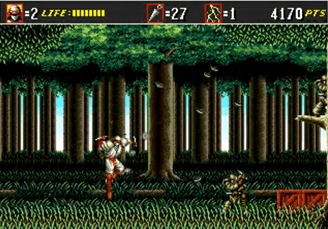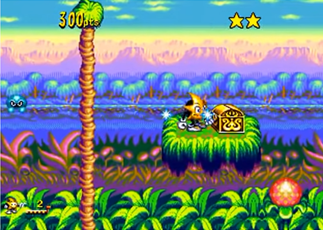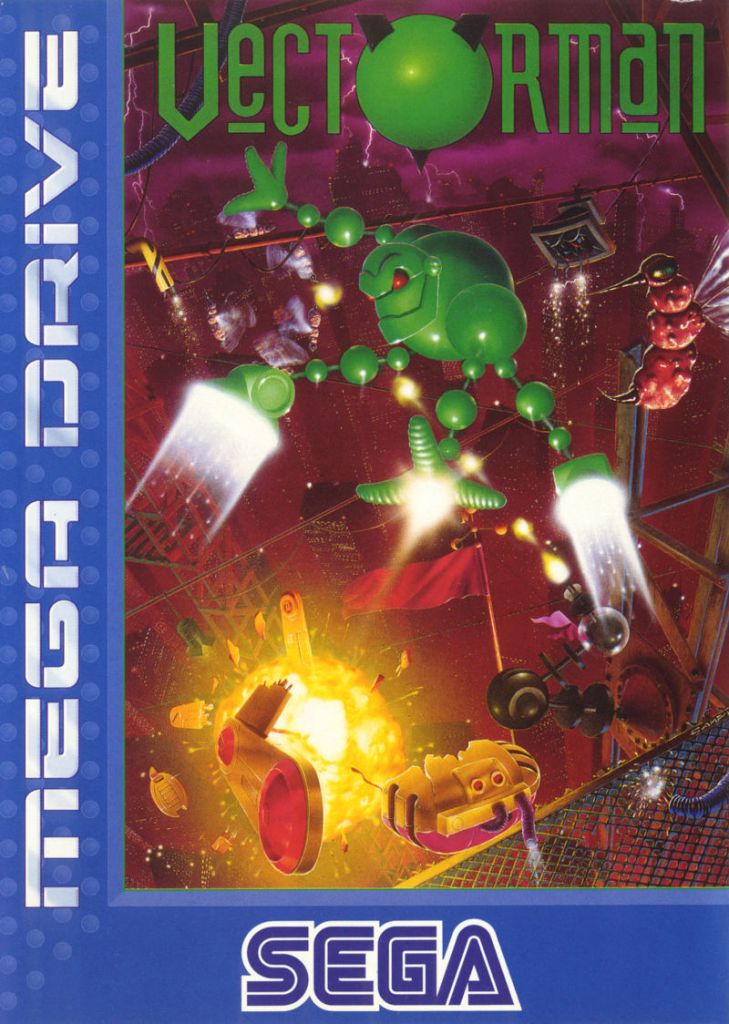
Vectorman – Review

It is always confusing when you come across a game that you’ve never heard of before and it’s awesome. Why? Because you begin to wonder why you haven’t heard of it before! Why were these games not championed more by creators, critics, and gamers alike? I wonder whether Vectorman’s late arrival to the scene was simply overshadowed by the focus on the next generation of consoles. Had Vectorman been released just a year or two earlier, it may have been given higher regard by the gamer community.

Title screen (Screenshot taken by the author)

Vectorman is a single player run and gun platform game developed by BlueSky Software and published by Sega. It was released on the Mega Drive in 1995 and would later appear on a number of compilations such as Sonic Gems Collection (2005) for the GameCube, Sega Genesis Collection (2006/7) for the PlayStation 2 and PlayStation Portable, and Sonic’s Ultimate Genesis Collection (2009) for the PlayStation 3 and Xbox 360. It was also released on the Wii Virtual Console in 2007 and on Steam in 2018 as part of the Sega Genesis Classics Pack. It was also included on the Mega Drive Mini in 2019. For this review, I played dthe version found on Sonic’s Ultimate Genesis Collection (2009).

Plot

In the year 2049, the Earth is one big cesspit of pollution and toxic waste. Humans decide to leave Earth and seek a new home to colonise. In the meantime, they create robots known as “orbots”, designed to clean up the mess whilst the humans are away. Raster, a highly advanced orbot, is accidentally connected to a nuclear weapon by a lesser orbot. This turns Raster from a benevolent orbot into the psychopathic machine known as Warhead. He is hellbent on ruling Earth himself and plans the execution of humans once they return to Earth.

Vectorman is a lesser orbot whose job is to clean up toxic waste and dispose of it in the sun. He was off planet when Raster became Warhead and returns to find the planet in a state of chaos. Vectorman decides that he should try to stop Warhead’s evil plans.

Vectorman has a built-in gun in his hand (Screenshot taken by the author)

Gameplay

The game consists of Vectorman fighting his way through 16 levels, battling Warhead’s minions on the way. At his disposal is his built-in gun, which he uses to destroy the baddies or to blow-up the TV screens that offer power-ups. The weapon power-ups include:

  • Rapid Fire: Keep the fire button held down to produce a continuous stream of bullets.
  • Wave: Useful for killing enemies not directly in your line of sight.
  • Bolo: Fires a bit rotating ball.
  • Orb: Can be used only one and designed to kill all nearby orbots in a huge explosion.
  • Nucleus Shield: Temporary invincibility. Once it runs out, you also lose your previous weapon power-ups.

Note: Shooting downwards whilst falling, will slow your descent.

Other power-ups include:

  • Health Point: Fills one ball on your health indicator.
  • Full Health: Fills all balls on your health indicator.
  • Max Health: Increases number of balls on your health indicator.
  • 1-Up: Gives you an extra life.
  • Milestone: Should you die, you restart the level where you picked this up.
  • Extra Time: Adds time to the count down.
  • Photons: Pick these up for extra points.
  • x2: Multiples points by 2.
  • x3: Multiples points by 3.
  • x5: Multiples points by 5.
  • x10: Multiples points by 10.

Vectorman can also pick up morph icons that will transform him into other types of robots to help him advance in the level:

  • Drill: Allows you to break through certain floors.
  • Bomb: Explosion will kill nearby enemies and destroy certain walls and floors.
  • Jet: Enables you to fly higher than you can jump.
  • Fish: Enables you to swim faster than you can run.
  • Missile: Enables you to break through certain ceilings.
  • Parachute: Allows you to slowly descend with greater manoeuvrability.
  • Buggy: Can be used as a battering ram to break through certain walls.

Vectorman has the ability to jump a little higher by tapping the jump button again whilst when he reaches the top of his initial jump. This will briefly ignite rockets in his feet which also causes damage to enemies.

Destroying satellite dishes allow you access to bonus stages. However, to destroy these you first need to find and destroy the shield generators which are hidden throughout the levels.

(Screenshot taken by the author)

How Does It Handle?

The game is quite chaotic at times and there is a lot on the screen to take in, and at first, I had no idea what was going on. However, there is lots of fun to be had charging through the levels and blasting all the baddies. I feel it would have been better to have the view zoomed out a little more so that you can take in more of the level.

Graphics

The Vectorman sprite looks awesome and the movements are incredibly fluid. When you move into dark areas, your sprite also goes dark, but you can still see red flashing lights on his body, face and extremities that remind us that he is a robot. This was a nice touch. I also liked the lightning flashes on Day 12.

Most of the backgrounds for the levels looked good, but I just felt that they lacked something. Maybe they just weren’t full of vibrant colour that I have been used to with so many Mega Drive games. Then again, maybe the drabness was to emphasise the polluted state the Earth is in. Even so, the flags flying in the breeze in particular look very realistic.

Music

The game contains electronic techno dance music throughout which I though suited the game very well.

Replay Value

The game has three difficulty settings Lame, wicked, and insane which offers some relay value. However, although the end of level scores state whether you picked up all the photons and destroyed all the TV screens, there is no difference to the outcome of the game if you do destroy all TV screens and pick up all the photons. I think this is a missed opportunity to add something more to the game encouraging gamers to return to it.

Did I Complete The Game?

Yes, but so far, only on the Lame setting.

What The Critics Thought?

Electronic Gaming Monthly: “It seems like Sega has a new mascot. Vectorman offers graphics that make it look like it’s on a system other than the Genesis. The animation is really smooth. Surprisingly, VM excels in the control department. It doesn’t have anything really new, but it plays well. The gameplay is fast, and the action generally is intense but not frustrating. Think of Strider with a gun. The audio is just right. Overall 33/40.[1]

GamePro: “Your 16-bit system isn’t dead yet, and Vectorman is the reason why! This entertaining platform game is tough, but it rewards you with tons of fun. Overall 19.5/20.[2]

Awards:

GamePro Editor’s Choice Awards 1995 – Best Genesis Game[3]

GameFan’s 1995 Megawards – Genesis Game of the Year[4]

GameFan’s 1995 Megawards – Best Genesis Action Platformer[5]

My Verdict:

“This is a fun game. Lots of charging through levels blasting everything in sight with an array of weapons. It’s a beautiful looking game with a solid soundtrack. My only criticism is the lack of replay value for me. Definitely worth your time though!”.

Rating:

What are your memories of Vectorman? I would love to hear your thoughts, and don’t for get to follow and subscribe so that you don’t miss my latest reviews! You can also find me on Instagram: @nicklovestogame.


[1] ‘Vectorman’. Electronic Gaming Monthly. (November 1995). Number 76:42.

[2] ProReview – Vectorman‘.GamePro. (November 1995). Issue 76:70-1.

[3] Editor’s Choice Awards 1995‘. GamePro. (February 1996). Issue 79:26.

[4] ‘GameFan’s 1995 Megawards’ GameFan. (January 1996). Volume 4 Issue 1:106.

[5] ‘GameFan’s 1995 Megawards’ GameFan. (January 1996). Volume 4 Issue 1:104.

Streets of Rage 3 – Review

Streets of Rage (1991) and Streets of Rage 2 (1992) were both awesome games worthy of the highest accolades. Their success would naturally spawn a third in the series. The question is, would the creators be able to make the game unique enough to stand on its own whilst at the same time staying true to what made the first two instalments so successful?
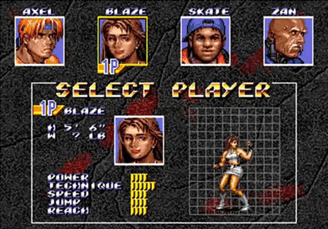
Title screen (Screenshot taken by the author)

Streets of Rage 3 (known as Bare knuckle 3 in Japan) is a side-scrolling beat ‘em up developed and published by Sega. It was released in 1994 for the Mega Drive and would appear on later compilation packs including Sonic’s Ultimate Genesis Collection (2009) for the PlayStation 3 and Xbox 360 and Sega Genesis Classics (2010) which is available for Microsoft Windows, Linux, MacOS, PlayStation 4, Xbox One and Nintendo Switch. In 2012, it was released on Steam as a stand-alone game as well as with Sega Genesis Classics Pack 5. For this review, I replayed the version for the Mega Drive found on Sonic’s Ultimate Genesis Collection (2009).

Plot

Streets of Rage 3 is a direct sequel to Streets of Rage 2 (1992). It has been Several years since Axel Stone, Blaze Fielding, Eddie “Skate” Hunter and Max Thunder defeated Mr. X and rescued Adam Hunter. However, Mr. X, head of an organised crime group known as The Syndicate has returned. Since his last defeat he founded RoboCy Corporation, a legitimate robotics company that acts as a cover for his illegal activities. He has hired the world’s foremost expert on robotics (Dr. Dahm) to create an army of androids under his command to secretly replace important city officials with a view to controlling the city. Whilst this operation comes into effect, he plants bombs throughout the city to distract the police while the city officials are replaced.

After realising what Dr. Dahm’s research as really been used for, Dr. Zan, a cyborg himself, contacts Blaze Fielding and explains Mr. X’s plans for the city officials. Upon learning of the severity of the situation, Blaze contacts her old police partners Axel Stone and Adam Hunter. Axel agrees to join the task force, but Adam is unable to because of his own commitments within the police force. However, his younger brother Eddie “Skate” Hunter agrees to join the task force in his place.

It is unclear what happened to Max Thunder but Dr. Zan takes his place (Screenshot taken by the author)

Gameplay

Consistent with the previous two instalments, Streets of Rage 3 follows suit. The game can be played in one-player or two-player co-op mode. Each fighter has different stats depending on who you prefer to play with. Some are faster, some are more powerful, but none are considered the ultimate fighter.

The fighting is much the same. You must fight your way through a number of levels fighting baddies of varying strengths. Along the way you can pick up money and gold bars which increase your points tally, and food to help restore your life gauge. Occasionally, you will spot a 1-up.

As well as the usual weapons of knives, pipes, baseball batts and swords, you can also pick up grenades. Just be sure to not hold on to them too long else they will explode, and you will suffer damage.

There are a few differences from previous games, however. This is the first game in the series to utilise the six-button controller allowing for a larger move set. For special moves, you have a power bar consisting of six segments. The higher the gauge the more damage you will do to the baddies. One you perform a special move, the bars will empty and you will need to wait a few seconds for them to recharge. If the gauge is empty when you perform a special move, your life gauge will deplete slightly. With every 40,000 points you accrue, a star appears below your fighter’s life gauge. Each star you earn increases the strength of your Blitz attack. You can earn up to three stars but if you lose a life, you will lose a star.

Whereas in Streets of Rage 2 (1992) only Skate could run, Streets of Rage 3 allows all characters to run as well as roll up or down to screen to evade enemy attacks.

The story itself is more complex, with dialogue between the characters after each level, adding another layer to the story telling.

Characters:

Dr. Zan – After discovering what The Syndicate are planninng with their androids, Dr. Zan contacts Blaze Fielding in a bid to acquire her help in stopping Mr. X.

Blaze Fielding – Since defeating The Syndicate a second time, she now works as a private detective. She agrees to help when she is informed that the next victim of this dastardly plan will be her old friend the Chief of Police.

Axel Stone – After defeating Mr. X a second time, Axel moved far from the city to start up his own martial arts school. Blaze convinces him to return to fight Mr. X one more time.

Eddie “Skate” Hunter – Since helping the others defeat Mr. X and rescue his older brother Adam, Skate has grown in strength and speed. He agrees to join the task force to take down Mr. X once and for all.

The Duel Mode has been made more interesting. It is no longer just a one-on-one fight. For example, on one fight stage, the floor contains sparks that travel along a line on the floor. If it touches you, you get electrocuted. Another has holes for you to fall down which will make you lose health.

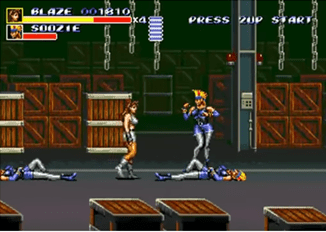
New sprites have been introduced… (Screenshot taken by the author)

How Does It Handle?

This game has tight controls, and the increase in the number of moves ensures that the fighting does not get monotonous. I did think that the hit detection was off a little though. There were instances where an enemy is slightly to the back or to the fore of the line I was on, and I was unable to hit them, but they were able to hit me. That was frustrating! There were two bosses that I felt were annoyingly difficult. The two women in the bar, and the three samurai. Even on Easy Mode I struggled with these bosses. I appreciate this may simply be a case of finding a strategy, but these fights are where I lost most of my lives.

There was an interesting level consisting of our heroes moving from right to left and having to punch through concrete walls whilst being chased by a bulldozer. This level is easy and just seems to slow down the gameplay. It was a good idea, I’m just not sure it worked.

Graphics

Even though the levels and sprites were highly detailed and well animated, I did think that the levels and sprites of four protagonists were not as good as Streets of Rage 2 (1992). There were plenty of enemy sprites who were still around from the previous two games to make it feel familiar, but I did question the reliance on sprites from previous game. Having said that, I still think the game looks pretty darn good.

One level I though was particularly good was the disco stage. The lighting occasionally flashes, making the level feel really authentic.

Music

The music was criticised by several contemporary critics (see below). Although not necessarily as memorable as the previous games, the music is still that adrenaline fuelled upbeat techno/electronic music which fits this game well.

Replay Value

There are three difficulty levels: Easy, Normal and Hard, as well as the option to alter the number of lives you begin with. Initially, when I completed the game on Easy, the game ends after five stages and I thought the game was very short. However, completing the game on harder settings reveals several more stages and a continuation of the story. Apparently, there are four endings depending on which difficulty level you complete the game on and the time it takes for you to do it. The Duel Mode has been improved too, but again, it will never compare to fighitng games such as Street Fighter II (1992).

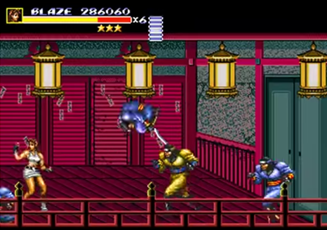
…and some old sprites resurrected (Screenshot taken by the author)

Did I Complete The Game?

I have completed the game on the Easy setting, but whilst looking into this game, I have discovered that there are more levels when played on harder settings. Clearly, I will have to re-visit this game.

What The Critics Said:

Electronic Gaming Monthly: “This has always been a good series, and I really enjoyed this cart. A few things bothered me. The music wasn’t up to par with what Yuzo Koshiro normally does, and the sounds were sub-standard. The background animations were really good, and the diversity of game play adds tremendously. One question: Why did Sega change the characters’ outfits to gender neutral colours? It is still a great Sega fighter. Overall 29/40.[1]

Gamefan: “I’m usually blown away with any of the SOR games, but part 3 just didn’t do it for me. The graphics and control are very good, but the music is horrible compared to previous versions. It’s as if the person who composed the music in Chakan did the BGM in SOR 3. What were you thinking Yuzo?” Overall 234/300.[2]

Hyper: “If you liked the rest of the series then you’ll love this game. If you’re a sensitive new age type I’d steer clear though…stick to Ecco. Overall 83%.[3]

Mean Machines Sega: “A stylish continuation of the series, but not all it could – and should – be. A classic case of ‘If only they had…’. Overall 83%.[4]

Sega Magazine: “Expensive, but you’re paying for the best scrolling combat game in existence. Only Streets of rage 2 is anywhere near as good as this. Overall 90%.[5]

My Verdict:

“Don’t get me wrong, this is a solid third instalment of the franchise. Great graphics and gameplay with a more complex story…I just wasn’t feeling it. The music was less memorable, I didn’t like Dr. Zan as a new character and I felt the protagonist sprites didn’t look as good as in previous games. I felt the hit detection was slightly off and some of the bosses were insanely hard, even on Easy. If I had a choice, I would much rather revisit the first two instalments.”

Rating:

What are your memories of Streets of Rage 3? I would love to hear your thoughts, and don’t for get to follow and subscribe so that you don’t miss my latest reviews! You can also find me on Instagram: @nicklovestogame.


[1] ‘Review Crew – Streets of Rage 3’. Electronic Gaming Monthly. (July 1994). Number 60 Volume 7 Issue 7:34.

[2] Viewpoint – Streets of Rage 3’. Gamefan. (June 1994). Volume 2 Issue 7:24.

[3] ‘Review – Streets of Rage 3’. Hyper. (June 1994). 7:30-33.

[4] ‘Megadrive Review – Streets of Rage 3’. Mean Machines Sega. (March 1994). Issue 17:42-45.

[5] ‘Megadrive Review – Streets of Rage 3’. Sega Magazine. (May 1994). Issue 5:78-9.

Sonic & Knuckles – Review

I’m sure we’ve all said at one point in our lives, “Wow, we have reached the pinnacle of videogaming,” only to be proved wrong a year later. Innovation is the key to ensuring that gaming franchises don’t become stale. The introduction of new characters, new features and gameplay styles are all used in attempts to keep games fresh. But what if you could add new characters to older games? Well, that’s just what the creators of Sonic & Knuckles did.

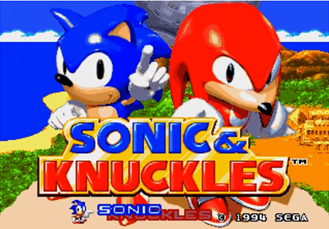
Title screen (screenshot taken by the author)

Sonic & Knuckles is a single-player platform game developed and published by Sega. It was released for the Mega Drive in 1994 and later on various compilations including:

  • Sonic Jam (1997) for the Sega Saturn
  • Sonic & Knuckles Collection (1997) for the PC
  • Sonic & Garfield Pack (1999) for the PC
  • Sonic Mega Collection (2002) for the GameCube
  • Sonic Mega Collection Plus (2004) for the PlayStation 2, Xbox, and PC
  • Sonic’s Ultimate Genesis Collection (2009) for the PlayStation 3 and Xbox 360
  • Sonic Classic Collection (2010) for the Nintendo DS

The game would also become available on the Wii’s Virtual Console, Xbox 360 Live Arcade, and Steam. For this review, I played the version found on the Sonic’s Ultimate Genesis Collection (2009) for the PlayStation 3.

Plot

No sooner had the events of Sonic the Hedgehog 3 (1994) been concluded, where once again Sonic thwarted Dr. Robotnik’s evil plans to steal the Chaos and Master Emeralds causing DeathEgg to crash land on Floating Island (Angel Island), Sonic must again act quickly to seek out the emeralds and recover them before Dr. Robotnik can find them. However, Sonic is now fighting a war on two fronts. He also needs to beat Knuckles to Echidna to them too. Knuckles is the Guardian of Angel Island and the Emeralds, and his mission is to stop any invasion by any means necessary.

You cannot fault this game’s beauty (screenshot taken by the author)

Gameplay

You can choose to play as Sonic, Tails, or Knuckles in this game. Sonic and Tails have the same skill set as before. However, if you play as Knuckles, you may not be as fast or be able to jump as high as Sonic, but you do have your advantages. For one, you can glide! Secondly, you can climb walls using the spikes on your fists.

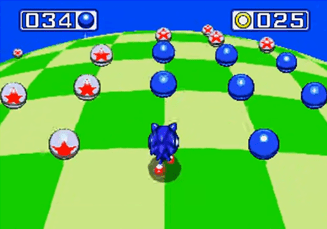
As is standard for Sonic games, you collect rings along the way. When you gain 50 rings you can enter the special and bonus stages. These are identical to those found in Sonic the Hedgehog 3 (1994) in that you must run around a globe and collect small blue spheres. The more you collect, the faster you run making it more difficult to control.

Another bonus stage is similar to the emerald stages of Sonic the Hedgehog (1991) in that Sonic is curled up in a ball and must navigate a rotating stage. The aim is to stay as central as possible and enter a slot that spins fruit machine reels to win rings. This continues until you touch the outer edges a few times revealing red circles in the wall that make you exit the game when you land on them. As before, every 100 rings you collect gains you an extra life.

A third bonus stage sees you use glowing electrical spheres to catapult yourself up the screen. However, you need to be quick. A horizontally spiralling laser beam slowly moves up the screen. if you fall into it, you will exit the bonus stage.

The special stage where you can win the Chaos Emeralds (screenshot taken by the author)

Sonic & Knuckles must traverse the following levels:

Mushroom Hill Zone

Flying Battery Zone

Sandopolis Zone

Lava Reef Zone

Hidden Palace Zone

Sky Sanctuary Zone

Death Egg Zone

Doomsday Zone

Throughout the levels you must try to find the Chaos Emeralds. As with Sonic the Hedgehog 3 (1994), these are found in hidden locations. Once you obtain all the emeralds, you gain access to special abilities.

The power-ups are exactly the same as found in Sonic the Hedgehog 3 (1994). The boxes contain:

  • Super Rings – 10 rings
  • 1-Up – Extra life
  • Invincibility – Invulnerability for a short time, however, you can still die if you are crushed.
  • Water Shield – Allows you to breathe underwater as well as bouncing on the heads of the badniks.
  • Lightning Shield – This magnetic shield attracts rings when nearby, can absorb energy ball attracts, and allows you to gain a little extra height with a double jump.
  • Flame Shield – Makes you impervious to lava and fireball attacks. You can also briefly turn into a fireball that will destroy badnisk.
  • Super Shoes – You can run at hyper speed for a short period of time.
  • Robotnik – Avoid these as they spell instant death if you break them.
Knuckles has the ability to climb and glide (screenshot taken by the author)

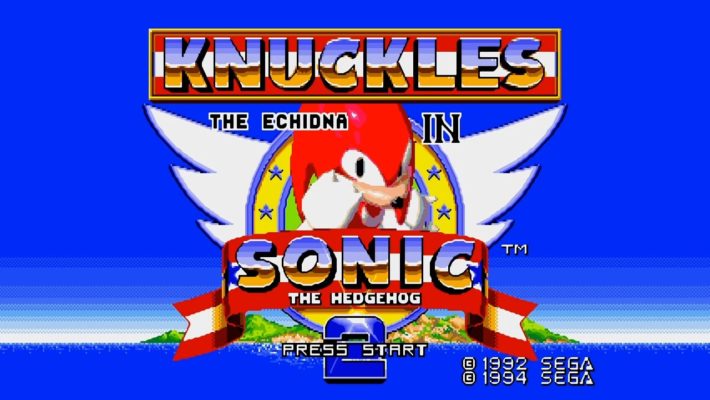
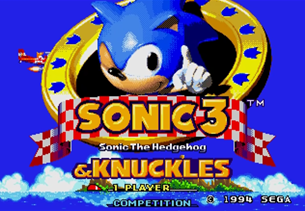
One of the biggest selling points of this game was that the cartridge was designed for you to attach Sonic the Hedgehog 2 (1992) and Sonic the Hedgehog 3 (1994) onto the top of the Sonic & Knuckles (1994) cartridge allowing you to play the previous games with Knuckles. This isn’t just a quirky feature either. It actually allows you to reach previously unattainable areas of the levels.

This is the title screen that appears when you attach the Sonic the Hedgehog 2 (1992) cartridge to the Sonic & Knuckles (1994) cartridge.
This is the title screen that appears when you attach the Sonic the Hedgehog 3 (1994) cartridge to the Sonic & Knuckles (1994) cartridge (screenshot taken by the author)

How Does It Handle?

Although the gameplay is unchanged from Sonic the Hedgehog 3, the game has added a few nice touches to make the gameplay a little more interesting. An example of this can be found in Sandopolis Zone 2 where you need to pull down bars to light up the level. When the lights start to dim, you will begin to be attacked by ghosts and so you need to find more levers to pull down to scare the ghosts off.

Graphics

Graphically, you can’t fault this game. Colourful, vibrant and detailed backgrounds, and gorgeous looking sprites. The levels have some nice touches too, such as Mushroom Hill Zone when you land on the green ground and what looks like yellowish pollen balls fly up.

Music & SFX

The theme tune is the same as Sonic the Hedgehog 3 (1994), and the music throughout the levels continue to be of a high standard as we have with previous Sonic games.

Replay Value

The replay value of the game is certainly there too. Not only do you have to ensure you gain all the Chaos Emeralds to earn the good ending, but some of bosses are different depending on if you play as Sonic or Knuckles which certainly warrants a play through as both characters.

Personal Thoughts

My only criticism of the game is that I question whether the format is now becoming a bit stale. This is Sonic’s fourth instalment, ignoring Sonic Spinball (1993), and it feels like it’s the same game being rehashed over and over again. I appreciate that Sonic the Hedgehog 3 (1994) and Sonic & Knuckles (1994) were originally meant to be one big game, but one could be forgiven for wishing Sonic the Hedgehog 3 (1994) had added something to differentiate itself more from Sonic the Hedgehog 2 (1992). Whilst the adding of a new character and creating a system where it can be played on older Sonic games is ingenious, I just think the format of the game needs a good shake up.

Did I complete the game?

Yes, I have completed the game with both Sonic and Knuckles and with both obtaining all the Chaos Emeralds.

What the critics said:

Computer & Video Games: “It’s over a year old now and you need to buy both Sonic 3 and Sonic and Knuckles to fully enjoy it. That’s why it’s here at the bottom. But in truth, Sonic 3 and Knuckles is the best platform experience ever. It’s what video games were invented for. Overall 97%.[1]

Electronic Gaming Monthly: “Sonic and Knuckles is the ultimate Sonic game. This is the best game of the series and the lock-on technology offers new life to older games. Many new games can be plugged in, too. Fantastic graphics, sound and game play make this Sega’s ultimate game and it gets my vote for Genesis Game of the Year! Overall 37/40“.[2]

Game Pro: “Sure, sure, it’s just another Sonic game. But this one’s got some revolutionary elements that make it another ground breaker for Sega. Overall 20/20.[3]

Next Generation: “A slot in the top accepts previous Sonic carts and enables you to play them starring Knuckles instead of (yawn) Sonic. Does this make Sonic 2 less Tedious? Well, no. But it is an impressive technical feat and if it points to a future where old games can be given a new lease on life with “mission carts” similar to the expansion disk that have long been available for PC titles, then NEXT Generation is all for it. Overall 4/5.[4]

Sega Magazine: “Slick and accomplished platformer which doesn’t quite catch the edge over the younger, fresher Headdy. Overall 92%.[5]

Sega Power:Excellent ideas, great game. A change in gameplay is needed soon. Overall 90%.[6]

My verdict:

“Another winning instalment from Sega. Fun, fast and furious, with great new bonus stages, plenty of replay value, and stunning graphics. I just fear that the format is begininng to grow stale. Let’s try something different next time.”

Rating:

What are your memories of Sonic & Knuckles? I would love to hear your thoughts, and don’t for get to follow and subscribe so that you don’t miss my latest reviews! You can also find me on Instagram: @nicklovestogame.


[1] ‘The Computer & Video Games Christmas Buyers Guide’. Computer & Video Games. (January 1996). Issue 170:9.

[2] ‘Review Crew – Game of the Month’. Electronic Gaming Monthly. (December 1994). Issue 65:34.

[3] ‘ProReview – Sonic and Knuckles’. Game Pro. (November 1994). Issue 64:72-3.

[4] ‘Rating Genesis – Sonic and Knuckles’. Next Generation. (January 1995). Issue 1:101.

[5] ‘Mega Drive Review – Sonic the Hedgehog’. Sega Magazine. (October 1994). Issue 10:81.

[6] ‘Mega Drive – Sonic and Knuckles’. Sega Power. (November 1994). Issue 60:35-6.

Shinobi III: Return of the Ninja Master – Review

Who hasn’t fantasised about being a ninja? The idea of being a highly skilled assassin infiltrating an enemy base and dispatching your enemies using an array of weapons like the shuriken, katana, and kusarigama is a hero fantasy that I certainly had (and still do at times). The Revenge of Shinobi (1989) was a popular game. Would a third instalment prove just as successful?

Title screen (screenshot taken by the author)

Shinobi III: Return of the Ninja Master (Super Shinobi II in Japan) is a single-player hack-and-slash action game and a sequel to The Revenge of Shinobi (1989). It was developed and published by Sega and released on the Mega Drive 1993. It would appear as part of the Sega Genesis Collection (2006) for the PlayStation 2 and PlayStation Portable, on the Wii Virtual Console (2007) and Sonic’s Ultimate Genesis Collection (2009) for the Xbox 360 and PlayStation 3. It would also be released for the PC on Steam (2010), iPhone (2011) and Nintendo 3DS eShop (2013).

After the events of The Revenge of Shinobi (1989), Joe Musashi also known as Shinobi, returned to Japan to recover from his battle with the Neo Zeed organisation. He soon learns that the Neo Zeed are rebuilding and that members of the organization have been sent to kill him. Once again Shinobi must prepare to battle for his life and stop the evil Neo Zeed once and for all!

Beautiful level and sprite design (screenshot taken by the author)

Shinobi must battle through seven Levels:

  • Zeed’s Resurrection – Battle through the forests and caves of Japan
  • Secret Entry – Infiltrate a high-tech facility
  • Body Weapon – Battle through a laboratory where biological weapons are being created
  • Destruction – Infiltrate a robotics factory
  • Electric Demon – Infiltrate and destroy a weapons facility
  • Traps – Descend into a gorge where Neo Zeed’s secret base is found
  • The Finial Confrontation – Battle through an air fortress to defeat the Shadow Master

As with the prequel, there are several items and power-ups to look out for:

  • 5 x shuriken
  • 20 x shuriken
  • Heart bonus (for health)
  • Extra Life
  • Ninjitsu – Adds a special ability for you to use
  • Time Bomb – Avoid these as they explode and cause damage to you

A new danger to look out for is mines and these aren’t always easy to see.

Throughout the game, Shinobi can use his sepcial powers:

  • Jutsu of Ikazuchi – Summons a bolt of lightning to create an electrical shield that gives you invulnerability for a short period of time.
  • Jutsu of Kariu – Summons four pillars of intense flame to incinerate your enemies
  • Jutsu of Fushin – Increases Shinobi’s jumping ability
  • Jutsu of Mijin – Shinobi explodes killing nearby enemies, however Shinobi will also lose a life.

These special powers can only be used once per level unless you find a box a Ninjitsu icon along the way.

My kingdom for a horse! (screenshot taken by the author)

New additions to traversing the levels that break up the monotony include a horse and jet-ski. On the horse you must be aware of enemies hanging from kites. You need to dispatch them whilst keeping an eye out for tripping hazards. The jet-ski level sees enemies riding futuristic hover bikes whilst you keep an eye out for ramps that allow you pick up goodies and avoid enemy mines.

The creators have added some nice new moves to the game to make things a little more interesting. For example, Shinobi can now perform a mid-air flying kick, can jump off walls to gain higher ground, can hang from the ceiling (which I don’t recall him doing in Revenge of Shinobi (1989), and a running slash that makes him temporarily invincible.

There are four difficulty settings: Easy, Normal, Hard and Expert offering plenty of replay value to the game. You can also choose how many shuriken to start with, adding a further layer of difficulty should you wish it.

That’s one ugly-assed monster! (screenshot taken by the author)

I think this game looks great! The sprites look fantastic and are very detailed. I particularly like how the enemy sprites explode, reminiscent of many arcade games. The levels are also incredibly detailed with many having multi-layered parallax scrolling. In Level 1 when you enter the cave, the transition in the background is very smooth. The background of the forest fades and after a brief black backdrop, the interior of the cave fades in. I also really liked Level 5 where you are battling through a forest that is ablaze. The oranges and reds of the background really give you a sense of heat from the inferno. You can almost feel it coming through your TV screen!

The music is actually pretty cool. There are some nice upbeat electronic tracks similar to what you’d find on Streets of Rage (1989).

One issue I have with the controls is that in order to perform a somersault, you need to press the jump button a second time when Shinobi is at the peak of his first jump, else he will just begin to fall as normal. I found this frustrating, especially when the levels scrolled up or when you had to jump onto the falling rocks. I lost many lives on these levels and I felt that the window with which you needed to perform the somersault was a little too narrow.

I also have an issue with the fact that Shinobi can still only through his shuriken in one direction…the way he is facing. I think it would be time for him to at least be able to throw them straight up by now. Sadly, this lack of progression in his move set loses them game some points for me.

Did I complete the game?

As of yet, I can’t get past Level 6.

What the critics said:

Computer and Video Games: “As good as Super Shinobi II is it just doesn’t have that awesome mix of action and graphical excellence that the first one was full of. The graphics look a little better with some topper backdrops and Joe himself has had a bit of a facelift and been given Ultimate Warrior type arm-ties. Once again the music is absolutely superb with some really hard thumping rock tracks and some brilliant effects. Game play has been made a little more involving with some new moves and other treats but there’s just something missing to make it a classic. Overall 84%.[1]

MegaTech: “One of the best MD action titles around. Great, fast-paced action, briliant graphics and sound and a few new tricks up Joe’s sleeve make this a must for all atcion fans. Overall 93%.[2]

Mega: “As much fun as the previous Shinobi games and a bit better besides. Why the, didn’t they make the bloody thing a bit harder? Overall 74%.[3]

Sega Power: “Shinobi is to predecessors what Kellogg’s Special K is to cornflakes – same ingredients but with a different shape. It’s very playable, but unremarkable, performing title. Overall 79%.[4]

GamePro: “Just when you’re getting bored with similar-looking-and-similar-playing action games, along comes Joe Musashi to shake things up. Mind-blowing backgrounds, great new moves, a horse-riding sequence, and hot music push this Genesis to the max. III cheers for Shinobi III. Overall 19/20.[5]

My Verdict:

“This game looks great with some stunning levels and backdrops. It is enjoyable to play too and contains some fab music. Although there are some new moves, I still think they could have allowed Shinobi to throw shuriken in more than on direction. Apart from a few small gameplay gripes though, it’s defiantly worth playing and I will not doubt return to conquer this game at a later date.”

Rating:

What are your memories of Shinobi III: Return of the Ninja Master? I would love to hear your thoughts, and don’t for get to follow and subscribe so that you don’t miss my latest reviews! You can also find me on Instagram: @nicklovestogame.


[1] Anglin, P., ‘Three Page Review – Super Shinobi II’. Computer and Video Games. (February 1993). 135:22-4.

[2] ‘Game Index – Shinobi III’. MegaTech. (June 1995). Issue 42:30.

[3] ‘Game Review – Shinobi 3’. Mega. (October 1993). Issue 13:34.

[4] ‘Mega Drive Review: Shinobi 3 – Return of the Ninja Master’. Sega Power. (September 1993). Issue 46:38-9.

[5] Slasher Quan., ‘Genesis ProReview: Shinobi: return of the Ninja Master‘. GamePro. (August 1993). Issue 49:58-9.

Ristar – Review

By 1995, 16-bit gaming was in its descendancy. The PlayStation and Sega Saturn had been released, demonstrating the future potential for video gaming to the world. The 32-bit era had arrived!!! Technology had finally reached a stage where 3D polygonal graphics were actually beginning to look good, and gamers were demanding longer more complex challenges. However, there were still a few gem 16-bit games in the wings, waiting to make their appearance.

Title screen (screenshot taken by the author)

Ristar is a single-player platform game developed and published by Sega and released on the Mega Drive for 1995. You can also find this game on various Sega compilations on systems such as the PlayStation 3 and 4. For this review, played the version found on Sonic’s Ultimate Genesis Collection (2009).

In a far-off galaxy, a band of space pirates led by their tyrannical leader Greedy is brainwashing the leaders of a nearby solar system and forcing them to do his bidding. On the planet Flora, Ristar, son of a captured space hero has pledged to travel from planet to planet to rescue his father and free all the brainwashed leaders which will in turn loosen Greedy’s power.

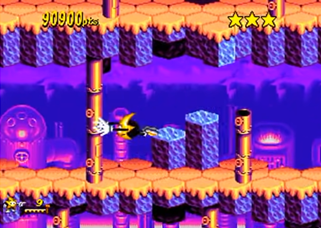
Superb graphics! (screenshot taken by the author)

There are seven worlds for you to save from Greedy:
 
Planet Flora
Planet Undertow
Planet Scorch
Planet Sonata
Planet Freon
Planet Automation
Greedy’s Space City

Ristar’s unique way of attacking any foe he encounters is by extending his arms to grab them and bring them towards him in what can only be described as a headbutt. Since his hands can be made to extend in all directions, this can make for some incredibly acrobatic gameplay.

There are times in the game where you will come across a Star Handle. By grabbing this, Ristar proceeds to swing like a gymnast. By pressing a direction button you can pick up speed until tiny stars start to appear. This indicates that Ristar is now a shooting star and when he lets go of the bar, will fly at great speed and will be able to reach very high places as well as kill any enemy he comes into contact with. You will find Star Handles at the end of each level where the higher you exit the screen the more points your earn.

There are also hidden Star Handles that allow you access to bonus stages. Each bonus stage has a treasure that you must find within a time limit. I’m unsure if collecting all these treasures makes a difference to the ending of the game.

Along the way you will find power-ups to help you on your journey:

Little Star – Yellow and black gives you an extra life, and black and white helps you through traps.
Restore Star – The gold star adds one more hit to your Gold Star count and a silver star resets your Gold Star count to four hit points.
Yellow Jewel – Collect these to gain points.

Ristar is an incredibly acrobatic sprite (screenshot taken by the author)

This game is fun and very enjoyable to play. Oddly there is no run button, so Ristar will always run at the same speed (unless using the Star Handle, of course). The controls are easy to learn but that doesn’t detract from the gameplay as there are plenty of enemies and handholds to grab thorughout the levels allowing Ristar to show off his agility. The controls are tight and the physics of the game are easy to get used to. However, one annoying aspect to the gameplay is that when you kill and enemy, Ristar backflips. You have no control over this and it leaves him vulnerable if another enemy is nearby.

For the most part the game is easy enough, although, I found the boss at the end of Planet Freon difficult to get past and it took me several attempts to defeat it.

Unlike many platformers which keep to the same formula of simply running and jumping through the levels, there is a puzzle aspect to Planet Sonata. You must find metronomes and take them to weird singing bird creatures that block your way.

There is little argument about it. This is one of the most beautiful Mega Drive games you will see. The levels are incredibly detailed and colourful with multi-layered parallax scrolling, and the sprites look superb. on occasion when Ristar is sliding on ice, or jumping from springs, he rotates which allows the Mega Drive to show of its graphics capability.

During the swimming levels when Ristar swims deeper, the screen becomes darker as it would in the real world adding a touch of realism to the game. Although, it would make sense to keep a circle around him which is brighter since he is a star and he emanates light. Ristar swims very well and doesn’t need to breath underwater either…which is a relief to platformer fans everywhere no doubt.

When Ristar has been standing still for too long, he begins to amuse himself in different ways depending on the planet you are on. For example, on Planet Freon, he will begin to make a snowman.

I can understand how this game has been criticised for being a Sonic the Hedgehog clone. The animations that appear at the beginning of every level telling you the stage are almost identical to what you would see in Sonic. The music, whilst being upbeat and enjoyable to listen to also reminds me of the Sonic franchise. This doesn’t bother me though as good music is good music.

Did I complete the game?

Not yet, I couldn’t get past Planet Automation.

What the critics said:
Computer & Video Games: “At first glance it just doesn’t have any original features, which is the real lifeblood of a decent jumpy game like Ristar. However, despite the absence of any real gaming inspiration so far as the format goes, Risatr is actually a pretty darned playable title. Overall 83%.[1]

Electronic Gaming Monthly: “An excellent new character, Ristar requires more technique than the typical run-and jump action titles. The stages are very colourful, with good graphics and control. The sounds could be a bit pumped up. Overall 38/50.[2]

Next Generation: “Ristar borrows heavily from Sega’s other budding mascot, Dynamite Headdy, but it still contains enough original gameplay, solid action, and fun to escape the ‘copy-cat’ labl and be one of 1995’s more promising games. Overall 3/5.[3]

Games World: “Beautiful and enjoyable platform adventure in true Sega style. No attempt is made to hide the fact that Ristar takes most of its influence and style – no all of its influence and style from the Sonic games. The idea for his telescopic arms has been lifted from Dynamite Headdy, (although he didn’t use his arms mush of course). Very playable but maybe a little easy to finish. Overall 83%.[4]

Mean Machines Sega: “Likeable, if not exactly lovable, and pretty interpretation of the old platform chestnut. Now does anyone have some new ideas? Overall 84%.[5]

Sega Magazine: “A highly polished platform game. Not up there with Headdy or Earthworm Jim, but Ristar has its own charms. Worth giving a try. Overall 87%”.[6]

Sega Power: “Far too close to Sonic to be judged on its own merits. It’s not as good as Sonic either – which doesn’t help. Overall 74%.[7]

Sega Pro: “A promising debut by RIstar, this guy will go far. Good stuff, but a touch more originality would have made it even better. Overall 90%.[8]

My Verdict:

“I really enjoyed playing this game. It looks gorgeous, is fun to play, and has a good soundtrack. It shows how incredible 16-bit games can look.”

Rating:

What are your memories of Ristar? I would love to hear your thoughts, and don’t for get to follow and subscribe so that you don’t miss my latest reviews! You can also find me on Instagram: @nicklovestogame.


[1] ‘CVG Review – Ristar’. Computer & Video Games. (February 1995). Issue 159:66-7.

[2] ‘Review Crew – Ristar’. Electronic Gaming Monthly. (February 1995). :36. 

[3] ‘Rating Genesis – Ristar’. Next Generation. (March 1995). Issue 3:101.

[4] Reviews – Ristar‘. Games World. (March 1995). Issue 9:12.

[5] ‘Mega Drive Review – Ristar’. Mean Machines Sega. (February 1995). Issue 28:60-2.

[6] Mega Drive Review – Ristar’. Sega Magazine. (January 1995). Issue 13:889.

[7] ‘Mega Drive – Ristar’. Sega Power. (March 1995). Issue 64:50-1.

[8] ‘Review Mega Drive – Ristar’. Sega Pro. (February 1995). Issue 41:40-1.

Fatal Labyrinth – Review

Some gamers love nothing better than to take control of an individual or a group of fighters and battle through endless dungeons gaining experience points, better armour, better weaponry and even stronger magic spells. To me, these games feel a tad monotonous and I rarely complete them purely because I don’t have the desire to spend hours fighting the same monsters to gain a few levels to help defeat a big boss only to have to do the same again soon after. It feels like a waste of time to me. Fatal Labyrinth, although containing RPG elements, is an alternative to these types of games. A sort of RPG-lite if you will. The question is, is it any good?

Title screen (Screenshot taken by the author)

Fatal Labyrinth is a single-player RPG developed and published by Sega. It was released on the Mega Drive in 1991 and appears on Sonic’s Ultimate genesis Collection (2009) for the Xbox 360 and PlayStation 3. It was also released for Microsoft Windows in 2010 and can also be found on the Nintendo Switch. For this review, I played the version found on Sonic’s Ultimate genesis Collection (2009) on the PlayStation 3.

Plot

One day, in an unnamed village in a faraway unnamed land, the monstrous castle of doom known as Dragonia rises from the earth. Ghouls from the castle pour out and head towards the village. They steal the Holy Goblet, a sacred artifact and source of light in the world, and take it back with them to the castle leaving the villagers in a state of terror.

One man, Trykaar, volunteers to take up arms and infiltrate the castle to steal back the goblet. To find the goblet, he must search through 30 levels of labyrinth that are filled with all manner of creatures hellbent on stopping him.

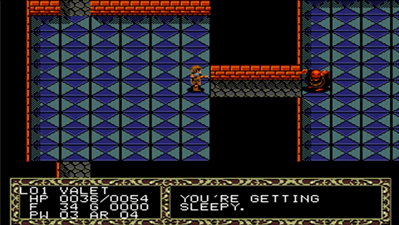
Beware the wizards, for they can paralyse you, leaving youu open to attack. (Screenshot taken by the author)

Gameplay

Throughout the labyrinth, you can pick up various weapons, shields, body armour, helmets and bows to defend yourself with. You can also find many magical items such as canes, potions, scrolls and rings. Initially, you don’t know how strong each weapon is or what each of these magical items do until you use them.

You do not automatically pick up these items though, and only have limited numbers you can carry. However, rather than just discarding them, you can choose to throw them at the enemy which I think is a nice, realistic touch. Afterall, having a metal helmet thrown at your face isn’t exactly going to tickle.

Like other RPGs, you gain experience points when you kill enemies. You start as “Beginner” and as you level-up progress onto “Valet” and countless other names. With each level you increase your attack, defence and HP also increase.

When battling the monsters, they will only move in response to you moving. When you take a step, they will take a step at the same time. Some need to be next to you to attack, and others can throw projectiles at you. This means that once one is chasing you, it’s incredibly difficult to lose them so you may have to simply fight them.

Every five levels is an automatic checkpoint so that if you die, you will go back to Level 5, 10, 15 etc. You seem to have infinite continues so in theory can play until you get tired of the game. If you stay on the same level for too long, then the screen flashes and the monsters will respawn.

Food is a vital part of the game. When fed, the hero slowly regenerates health. If unfed for extended periods of time, the hero becomes hungry and loses health. If too much food is eaten, the character’s movements become sluggish due of overeating. This is an unnecessary addition to making the game even harder.

Throughout the levels, you can pick up gold. This has very little benefit in the game other than when you die, your gravestone is more elaborate, and more mourners attend your funeral. It’s almost as if the game creators know you are going to die a lot during this game.

Features to watch out for:

Secret Doors – You actively have to press the ‘Pick Up’ button (the square button on the PlayStation joypad) when you are next to a wall to find these secret doors.

Trap Doors – Occasionally, you will fall through the floor to the level below. You simply have to find the stairs again to take you up.

Booby Traps – You may also set off an alarm which causes enemies to respawn and surround you.

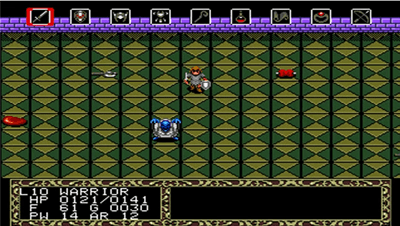
There are lots of items to search for and pick up throught the labyrinth. Beware, as not all items will aid you. Some are cursed! (Screenshot taken by the author)

How Does It Handle?

Disappointingly, There is very little intro to this game. You simply speak to a few people in the village before heading off to the castle. They don’t confide any information that is particularly helpful, and it all feels like a half-arsed afterthought.

This game is simple enough to play. The not knowing the strength of the weapons or what the magical items do works well as it forces you to experiment with your items and adds an element of danger and risk.

An annoying aspect to the game is that when you are approaching an enemy to attack, they will move aside one square and so you’ll turn to face them but they will move again meaning that you also move a square. It is as if you are engaging in a medieval dance with a monster. It’s very frustrating. Also, when you do get hit, you are frozen for a split second, and this makes it very difficult to escape, especially when surrounded by multiple enemies.

Graphics

Personally, I feel the graphics leave a lot to be desired. The initial top down view is similar to other games such as Phantasy Star III: Generations of Doom (1991), but that is all you get. There are no additional battle scenes where player and foes are seen with more elaborate illustrations and animations. The game also lacks the scary atmosphere of Shining in the Darkness (1991).

Music

The music in this game is very unassuming and very repetitive. You won’t need SFX or the music anyway for this game as they add very little to the atmosphere, so I just turned down the volume and listening to a podcast.

Replay Value

This game has plenty of replay value. Although it only has one difficulty setting, the levels are randomly generated so that every time you play, you are greeted with a new labyrinth, and the items will never be in the same place twice.

Did I Complete The Game?

No, I couldn’t get past Level 11.

What The Critics Thought:

Electronic Gaming Monthly: “Even though the mazes change constantly, the gameplay itself never changes, let alone the music! How Irritating! The price is right, however, for the Gauntlet fan who hates playing the same levels over and over. Since no passwords exist, you can only finish in one sitting. Yikes! Overall 20/40.[1]

Mean Machines Sega: “This Cross between a scrolling beat ‘em up and a role-playing game fails to deliver in both categories. The RPG aspect is dull and limited and slow, boring action fails to offer any thrills and spills. Overall 51%.”[2]

SegaPower: “Addictive roam around the labyrinth and collect the goodies RPG. Overhead graphics reveal themselves as you enter each room, which is nice, but it’s just too easy. Overall 2/5.[3]

My Verdict:

“Sadly, this game is rather monotonous and lacks atmosphere. The constant “swing and a miss” dynamic of the fighting is downright tedious. Mediocre graphics and dull music mean that you won’t be missing much if you give this game a miss. Pity really, as the concept had potential.”

My Rating:

What are your memories of Fatal Labyrinth? I would love to hear your thoughts, and don’t for get to follow and subscribe so that you don’t miss my latest reviews! You can also find me on Instagram: @nicklovestogame.


[1] ‘Review Crew – Fatal Labyrinth’. Electronic Gaming Monthly. (April 1991). Issue 21:22.

[2] ‘Review: Mega Drive – Fatal Labyrinth’. Mean Machines. (October 1992). Issue 1:138.

[3] ‘The Hard Line – Fatal Labyrinth’. SegaPower. (October 1991). Issue 23:53.

Ecco the Dolphin: The Tides of Time – Review

It is natural that the financial success and popularity of a video game should beg the question if a sequel (or prequel) will be wroth the investment. After all, I’m sure all game developers wish to be known for creating a successful franchise spanning generations of video gamers. The issue is that sequels are, more often than not, flops. Ecco the Dolphin was a huge success. So why not create a sequel?

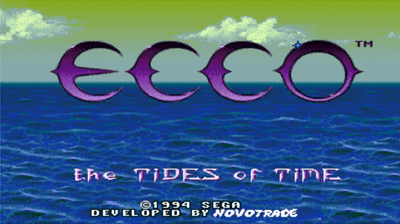
Title screen (Screenshot taken by the author)

Ecco the Dolphin: The Tides of Time is a single player action-adventure game. It was developed by Novotrade International and published by Sega for the Mega Drive, Game Gear and Sega CD in 1994, and for the Master System in 1996. The version I chose to review can be found on Sonic’s Ultimate Genesis Collection (2009) for the PlayStation 3.

Plot

Tides of Time picks up where the first Ecco game left off. Having saved his pod, and coincidently the world, from an alien vortex, Ecco retains the powers bestowed upon him by the Asterite that allow him to stay underwater indefinitely without the need for air. His sonar also produces a blast wave stunning enemy sea creatures. Things are peaceful in Home Bay.

One day, a powerful earthquake hits the underwater cave that Ecco is exploring. Unsure how, Ecco soon learns that his powers have left him and that the Asterite has been killed. Ecco soon meets an unusual dolphin named Trellia, who informs him that she is from the future and one of his descendants. She brings Ecco back to her future where he learns that the Vortex Queen survived, followed him back to Earth and killed the Asterite in Ecco’s time. After travelling back to his own time, Ecco must search for the globes of the Asterite that have been scattered throughout the ocean and bring them together. Only then can he learn how to defeat the Vortex Queen and save the Earth…again.

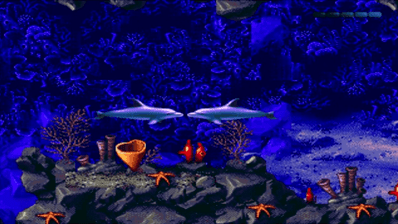
The graphics for the Mega Drive versions of the Ecco series are truly stunninig (Screenshot taken by the author).

Gameplay

The game play is the same as the original Ecco game. When pressing a direction, Ecco will swim in that direction. When you stop swimming, Ecco will drift, adding some realism to the game, since the sea is always moving with the tides. To increase speed, press the ‘C’ button, and Ecco will speed up, handy for when you’re almost out of oxygen or when you need to leap out of the water and over obstacles. The ‘B’ button makes Ecco dash (tap twice for double charge). This is mainly used to attack the many dangerous and deadly creatures he encounters, as well as, breaking down shelled walls.

The ‘A’ button is Ecco’s sonar ability and can be used in several ways:

  • Press and hold ‘A’ until the sonar bounces back. This opens a map segment, again very handy for when you are lost in caves.
  • Communicate with other friendly sea creatures such as other dolphins and killer whales. These friends can offer advice and hints to you.
  • Large glyphs are found dotted around the levels that offer tips or give Ecco a password so that when he comes across one that blocks his path, he can use his sonar to clear the way.
  • After the first few levels, Ecco gains the ability to use his sonar to stun enemy creatures.
  • Pressing ‘B’, followed by ‘A’, Ecco releases a sonar charge that will kill his enemies.

So What Is New About Tides Of Time?

In the first Ecco game, there were Key Glyphs that when you sang to them, would offer clues or give you a specific song to pass through Barrier Glyphs. Power Glyphs would give you invincibility for a short period of time. In Tides of Time, there are now:

Puzzle Glyphs – Join with others to help release their powers

Cracked Glyphs – Similar to Barrier Glyphs but will only open for a short period of time; Broken

Broken glyphs – Fit the pieces together to Ecco receives a gift

Milestone Glyphs – Act like save states

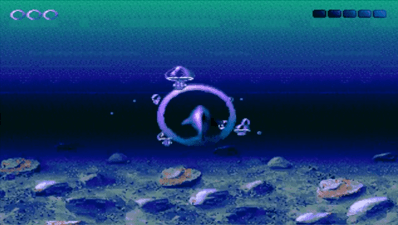
Another new addition to the game is the teleportation sub-stages. The view changes so that the camera is behind Ecco as he travels forward. Dodging seaweed and jellyfish, you must watch out for rings that Ecco must swim or jump through. If you miss too many, you will go back to the beginning of the level. It doesn’t really add that much to the game, but changes it up enough to be worth including as a new feature.

Several new features include new level types (Screenshot taken by the author)

How Does It Handle?

The game handles pretty much the same as it’s predecessor…and is just as difficult.

The Sky Tides level was tough because it is a scrolling level and there is lots of trial and error when it comes to finding the best way to navigate through the level. If you fall out of the sides of the tubes, you fall back to the ocean and back to the previous level.

On the next stage, Tube of Medusa, if you get grabbed by the Medusa’s and flung out of the tubes, you go back two stages!!! Luckily, the Barrier Glyph is still open so you can swim straight back to the Sky Tides level, but it is still incredibly frustrating.

On some of the levels, there are helium bubbles in the sky. When you leap into the air and use your sonar on them, they fling you across the screen to either a floating pool or another set of helium bubbles. On another level, when you leap out of the water to where a larger bubble is floating in the air. When you touch it, you turn into a seagull and need to fly over cliffs to another body of water. What on Earth were the creators smoking when they came up with ideas for this game?

Graphics

The graphics still look top rate. The sprites all look a little smoother and the colours and detail of the sprites and backgrounds still look incredible. Now, I may be crazy, but the game perspective feels like you have been zoomed in slightly…or am I imagining it?

Music

The music just does not fit the game. In the original you had either a soft Caribbean melody or a low-key track that almost buzzed, giving you the feeling of being along in a scary and unfamiliar environment. Some of the weird new music feels like it should fit better in a run-and-gun shooter.

Replay Value

To add to the replay value of this game, at the begining you can choose to swim in four directs. Left leads to the password screen, top left is difficult, top right is easy and right is normal. Normal adjust the game difficulty based on your ability and how well you’re doing.

Did I Complete The Game?

Not yet. At present, I am stuck on Four Islands where you need to follow a friendly dolphin who will show you the way. When following the dolphin, if it disappears off your screen, it will go back to where you found it. It is rather unforgiving.

What The Critics Thought:

GamePro: “There’s no doubt that Tides of Time offers a lot, providing a scenic variety of levels for the player to swim through and solve. Occasional control glitches do bring their share of frustration, but you still get a solid does of entertainment. This sequel proves that Ecco’s not washed up yet. Overall 85%.[1]

Electronic Gaming Monthly: “Ecco: Tides of Time really shows that Genesis games can be colourful, The backgrounds and animation are simply beautiful, with lots of eye-popping graphics. The quests are a lot harder than before, and sometimes you are left without a clue as to what to do. I like the fact that you can transform into different creatures I’d have to say that I really like Ecco and his adventures. Overall 7.25/10.[2]

Next Generation: “Taxing puzzles, RPG elements, shooting stsgaes, and some of the best Genesis graphics to date make you want to reel Ecco II in, but it’s certainly not a keeper. Overall 3/5”.[3]

My Verdict:

“I’m not sure what to make of this game. The graphics, as with the original, are glorious. The change in music doesn’t work well for me, and some of the new aspects of the game like the helium bubbles and turning into other creatures seems a bit dumb. Having said that, it’s a perfectly good game. Challenging, great to look at, and is certainly a worthy addition to the Sega Mega Drvie library.”

Rating:

What are your memories of Ecco the Dolphin: The Tides of Time? I would love to hear your thoughts, and don’t for get to follow and subscribe so that you don’t miss my latest reviews! You can also find me on Instagram: @nicklovestogame.


[1] LaMancha, M., ‘ProReview – Ecco the Dolphin: The Tides of Time’. (December 1994). GamePro. 75:86-7.

[2] ‘Review Crew – Ecco: Tides of Time’. (December 1994). 65:40.

[3] ‘Rating Genesis – Ecco: Tides of Time’. (February 1995). Next Generation. 2:100. (

ESWAT: City Under Siege – Review

Science-fiction movies have often toyed with the idea of a mechanised police officer battling huge crime syndicates in a dystopian future (1987s Robocop springs to mind). ESWAT: City Under Siege was one such game, with a storyline that felt like it came straight from a 1980s B-movie starring Jean Claude Van Damme or Dolph Lundgren.

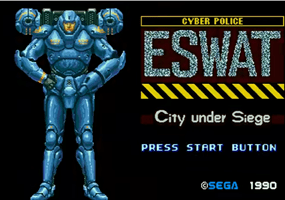
Titlescreen (Screenshot taken by the author)

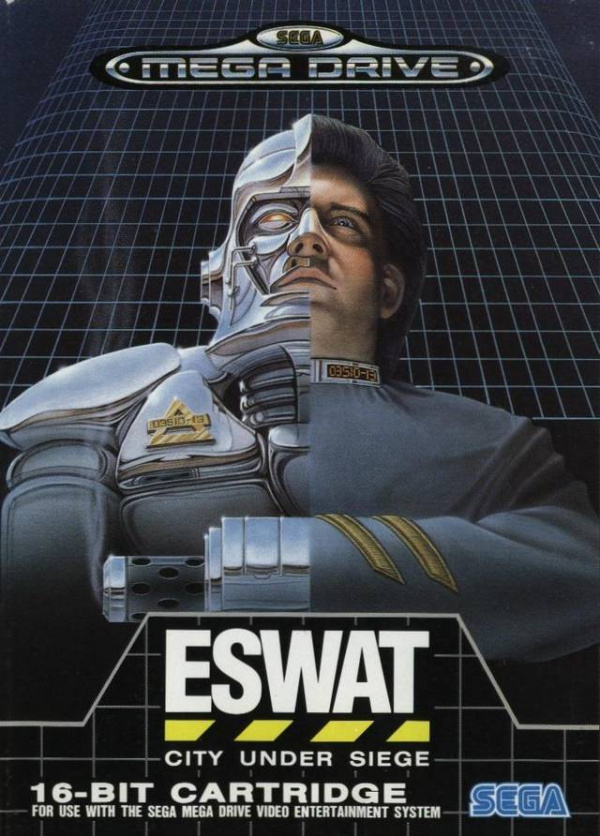
ESWAT: City Under Siege (Cyber Police ESWAT in Japan) is a side-scrolling action platform game developed and published by Sega. Based on the 1989 arcade game Cyber Police ESWAT, it was released in 1990 for the Mega Drive and Master System. It was later released on the Wii Virtual Console in 2007 and as part of Sonic’s Ultimate Genesis Collection (2009) found on the PlayStation 3 and Xbox 360.

Plot

Global terrorist organisation E.Y.E is wreaking havoc throughout the world. To combat this terrorist threat, the governments of the world launch their ESWAT (Enhanced Special Weapons and Tactics) initiative. Selected from the bravest police officers and sharpest shooters, these law enforcement officers don state-of-the-art ICE combat suits with advanced armour and weaponry.

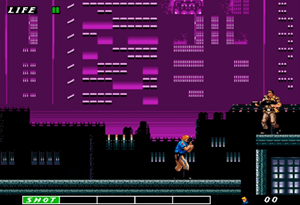
In the early missions, you are a plain clothes officer (screenshot taken by the author)

Gameplay

There are eight missions for you to battle through:

  • Guard Silent City!!
  • Infiltrate Cyber Prison!!
  • Defend Neo Three-Mile!!
  • Attack Mad Scientist!!
  • Destroy Dark Base!!
  • Penetrate Secret Sewer!!
  • Destroy Tactical Complex!
  • Break E.Y.E’s Plan!

You begin the game at the rank of Captain and are a uniformed police officer. Once you complete the first mission you gain a promotion to Chief. The completion of the second mission sees you promoted again to ESWAT and this is when you gain the ESWAT suit. The suit begins with your plain shot weapon but allows you to pick up a further four weapons:

  • Super – Shoots three shots at once instead of one, and includes rapid fire ability.
  • R.L. (Rocket Launcher) – Fire two powerful rockets in quick succession before needing a bit of time to reload.
  • P.C. (Plasma Charge) – Fires smaller shots but can charge up to fire a huge devastating ball of plasma.
  • Fire – The most powerful weapon in your arsenal, this weapon can only be used when your jetpack fuel is in the red zone (full power). You can also only use it once.
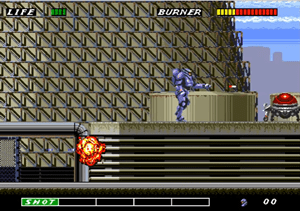
Once you reach the ESWAT rank, you gain the stat-of-the-art armour (screenshot taken by the author)

How Does It Handle?

In the first two levels, you only move a one speed: walking. As you progress and gain the ESWAT suit, you can also use your rocket pack to help evade hazards and enemy fire. My only criticism of the player’s movement is that I feel that your character walks a little too slowly for my liking and cannot shoot diagonally, which is a tad annoying at times. I also felt that the you are too zoomed in (if that makes sense). You are quite clsoe to the edge of the screen as you walk to progress. I’d have liked to have seen it zoomed out a bit more so that you can see a bit more of what’s going on around you and aren’t in a constant state of nervous surprise.

Graphics

I’d like to rave about the graphics of this game. The sprites look incredible! The detail on your character’s uniform and the initial human enemies is top rate for 1990 (there is a nice little explosion once you kill the enemies too). They are bright and colourful, and they have even captured the shadows on your attire (between the legs for example). The levels themselves, are also incredibly detailed and there is plenty that to attracts the eye. They really did go all in for this game.

Music

The music sounds great too. Upbeat and funky, it’s the sort of in-game music that you’d listen to as opposed to muting the sound and putting on your own tunes.

Replay Value

This is a tough game, and certainly not for the faint-hearted. If you complete the game and are a glutton for punishment, you can increase the difficulty and number of lives you begin with. This increases the replay value of the game.

Did I Compete The Game?

No, I could not get past mission five.

What The Critics Said:

Mean Machines Sega: “ESWAT is s super-slick platform shoot ‘em up that simply oozes quality. The parallax scrolling backdrops and sprites are excellent, and the sound is great. Combine those with challenging and highly addictive gameplay and you’ve got a game that’s a must for your collection. Overall 92%.[1]

Sega Power: At first this Shinobi-style shooter isn’t too hot. Later on, though, it displays some of the moodiest scenes on the MD. Tried and trusted gameplay, plus a few shocks! Overall 4/5.[2]

My Verdict:

“Graphically, a superb example of the capabilities of the Sega Mega Drive with a knock out soundtrack to boot. This is a challenging game and you won’t simply finish it in one sitting.”

Rating:

What are your memories of ESWAT? I would love to hear your thoughts, and don’t for get to follow and subscribe so that you don’t miss my latest reviews! You can also find me on Instagram: @nicklovestogame.


[1] ‘Review: Mega Drive – Eswat’. Mean Machines. (October 1992). Issue 1:138.

[2] ‘The Hard Line – E.S.W.A.T. City Under Siege’. Rage Magazine. (October 1991). Issue 23:53.

Batman: The Video Game – Review

In the sphere of TV and films, Tim Burton’s 1989 Batman film was a stark contrast to the colourful and campy 1960s TV show. The choice of Michael Keaton for the role of the Caped Crusader was controversial to say the least, but he acquitted himself admirably and, in my opinion, rivals Christian Bale as the definitive Batman.

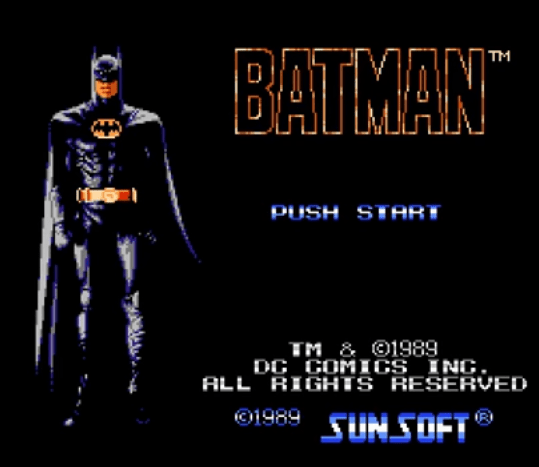
Title screen (screenshot taken by the author)

Batman: The Video Game is a side-scrolling platform game developed and published by Sunsoft. It was released on the NES in Japan in 1989, and North America and Europe, as well as for the Game Boy, in 1990 (oddly both games are actually different). I chose to review the NES version.

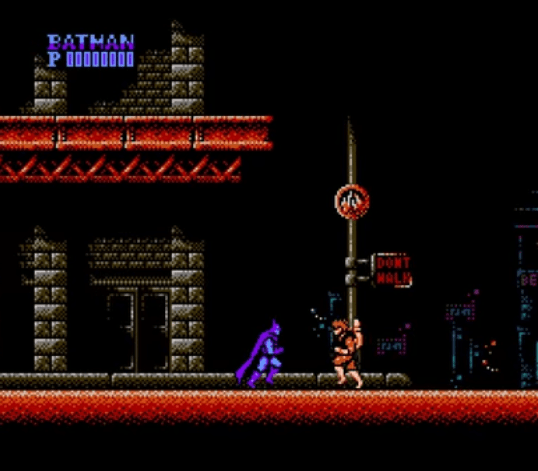
Fight your way through the City of Gotham (screenshot taken by the author)

Plot

The bicentenary of Gotham City is fast approaching, and the city’s officials are hard at work planning festivities for the event. However, the city is engulfed by a crime wave orchestrated and encouraged by the Joker. It is up to the Caped Crusader to stop the Joker’s evil plans and save the city.

Although based on the 1989 Tim Burton movie Batman, there are a few differences. Yes, you are pursuing the Joker and trying to save the City of Gotham, but the game contains enemies with rocket packs or that are mutants. These definitely do not appear in movie. However, these differences take nothing away from the game.

The in-between level animations look fantastic (screenshot taken by the author)

Gameplay

The game contains five levels (each level has four or five sub-levels):

Gotham City

AXIS Chemical Factory

Underground Conduit

Ruins of Laboratory

The Cathedral

Whilst battling his way through the levels, Batman utilises hand-to-hand combat as well as weapons such as a spear gun, Batarang and dirk (which is more like a shuriken) to defeat his enemies. The levels contain no time limit allowing your to take your time through the levels.

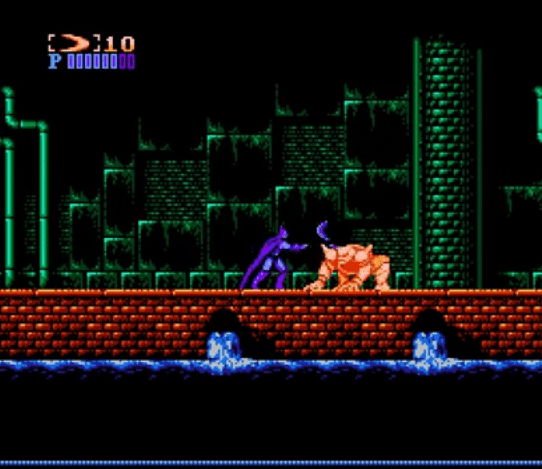
Beautifully detailed with an understated, dark colour scheme suits this game well (screenshot taken by the author)

How Does It Handle?

The controls are simple but they don’t need to be complicated. You can punch whilst standing and crouching, and select one of three weapons to use. You can jump to different heights, depending on how long you hold the ‘jump’ button for, and you can even use the walls to help you jump even higher and to avoid some nasty floor spikes.

Graphics

The game looks great! It begins with an awesome and intimidating looking title screen containing the figure of Batman looking menacing, and the game title in the same font used for the 1989 movie. Between each level, there is a short animated cutscene which again looks very cool.

For the in-game graphics, yes, Batman is coloured purple but that is purely so that you can see him clearly as the levels have a dark colour scheme. The levels themselves are very detailed. They help create a dark atmosphere for the game which fits well with Tim Burton’s vision. The sprites are beautifully illustrated, detailed and colourful. Throughout the game, I noticed that there was practically no flicker in the graphics at all.

Music

The music, although not from the movie, fits the game well and certainly has an arcade feel to it. It’s great for getting the adrenaline pumping.

Replay Value

Although this is an incredibly tough game, I had a lot of fun playing through it. The difficulty level is my only real gripe with this game. You are unable to change the difficulty level which is a pity as this would have given the game a bit more replay value.

Did I Complete The Game?

No, I was unable to get past level 3-1

What The Critics Said:

Mean Machines: “A classy license through and through. If you own a NES you’d be bats to miss this – so there! Overall 87%[1]

Awards:

Best Movie to Game – Electronic Gaming Monthly’s ‘Best and Worst of 1989’[2]

My Verdict:

“It looks great, sounds great, has tight controls and a challenge to test even the most hardened of gamers. The game proves that not all superhero games suck.”

Rating:

What are your memories of Batman: The Video Game? I would love to hear your thoughts, and don’t for get to follow and subscribe so that you don’t miss my latest reviews! You can also find me on Instagram: @nicklovestogame.


[1] ‘Nintendo Review – Batman’. (December 1990). Issue 3:78-9.

[2] ‘Best and Worst of 1989’. Electronic Gaming Monthly – 1990 Video Game Buyer’s guide. Issue 5:22.

Spider-Man: Return of the Sinister Six – Review

I love a superhero game. I imagine nearly everyone wishes they had some kind of superpower (although whether you’d use your powers for good or for evil I can only guess). Superhero games, although popular are, for the most part, disappointing. Why is it so hard to get superhero games right? Is it because they are difficult to translate into video games? Are they just a quick money grabbing scheme on an unsuspecting public? Are our expectations simply too high? I’d love to hear your thoughts on this.

Title screen (Screenshot taken by the author)

Spider-Man: Return of the Sinister Six is a single-player action-adventure game developed by Bits Studios. It was published by LJN for the NES in 1992, and Flying Edge for Master System and Game Gear in 1992 and 1993 respectively. For this review, I played the NES version.

Plot

The game is based off the story arc found in The Amazing Spider-Man #334-339. The plot sees Doctor Octopus attempting to take over the world with the Sinister Six (Electro, Sandman, Mysterio, Vulture, Hobgoblin and, of course, Doctor Octopus himself).

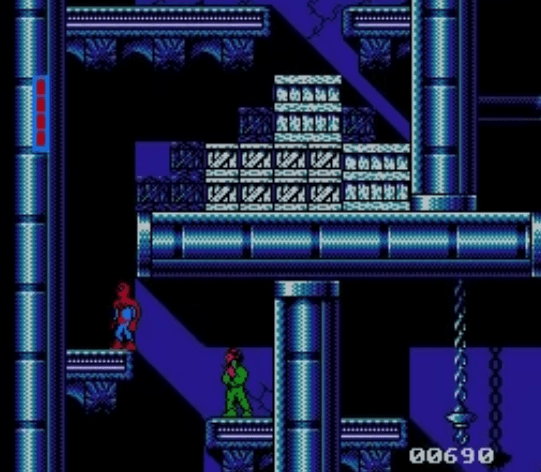
I think the graphics and animations are pretty darn good. Although when standing still, Spidey looks like he has developed a bit of a paunch (Screenshot taken by the author)

Gameplay

There are six levels which will see Spidey swing through. At the end of each level, you will face one of the Sinister Six:

Level 1: The Power Station

Level 2: Toxic Waste Dump

Level 3: The House of Illusion

Level 4: Streets and Rooftops

Level 5: The Forest & Hobgoblin’s Cave

Level 6: Doc Ock’s Castle

Throughout the levels, Spidey must swing and fight his way through a number of minions. There are two types of pick-ups available to you. Attack Web Fluid (which one can only assume is different from Swinging Web Fluid), and a special item which is different on every level. This item needs to be found for you to progress to the next level.

Spidey takes on The Sandman (Screenshot taken by the author)

How Does It Handle?

The gameplay is a let down. Firstly, the buttons have been mapped incorrectly. ‘A’ is punch and ‘B’ is jump. This may seem pedantic to some, but it makes the game feel “unnatural” and less intuitive. Spider-Man’s flying kick needs to be surprisingly accurate to cause damage. So many times you completely miss the enemy and fly straight past them.

Spidey is only able to shoot a web at his enemies when he picks up web packs…oddly, he seems to have an endless supply to swing around the levels. Whilst we’re on the subject of web-swinging, this is supposed to be a Spider-Man game, but you really don’t need to use your web-swinging or wall-climbing skills at all. Why Spidey can climb some walls and not others is anyone’s guess. At least the jumping is easy to control I guess.

For the most part, Spidey’s movements are very quick as one would expect, but he is quite slow when turning around. This frustrating, particularly when fighting The Sandman.

Interestingly, the enemies only inflict damage on you when they actively strike you. You can easily run and jump past them with no damage taken.

This game DOES win back points with me because the levels aren’t simply a case of running through, evading enemies and reaching the end. You actively need to find objects to help you progress in the level. For example, on Level 2, you need to find dynamite and a detonator in order to progress, adding a layer of complexity to the game.

Music

The music sucks! Nuff said!

Graphics

The graphics are pretty good. The backgrounds are incredibly detailed and the animation of Spidey is smooth, although oddly, when he stands still, it looks like he has bit of a paunch and not like the svelte superhero we are all used to.

Before each level, there is a very brief illustration letting you know which member of the Sinister Six you wil be facing next. The illustration looks good but I feel the cutscenes should have been a bit more in the comic-strip style with more than one slide, which in turn would give the story a bit more depth.

Replay Value

There is only one difficulty setting which limits its replay value.

I really didn’t spend that much time on this game, nor did I wish to. Where was the need for using your web to swing over large gaps or over pools of deadly lava or fire? Why couldn’t Spidey hang upside down on the ceiling to avoid enemies or crawl into small spaces? This game is not fun and I found it very disappointing.

Did I Complete The Game?

Nope, at present I’ve been unable to complete Level 3.

What The Critics Said:

Nintendo Power: “George: ‘The graphics are good and the villains are great, but play control is a little rough’; Rob: ‘You can release what looks like a perfect punch and end up releasing right past your enemy. That gets kind of frustrating, but otherwise it’s a fun game. Overall 2.925/5.[1]

Electronic Games: “The graphics are average for the NES, though the flicker is excessive in a few spots. The Spiderman figure is failry well animated and holds together during leaps, climbing, and somersaults. As in many 8bit cartridges, it isn’t always easy to tell three dimensional objects from non-interactive backgrounds. Overall 72%.[2]

My Verdict:

“Initially, I disliked this game outright. After revisiting it, it has gone up a little in my estimation. The game looks good, but is let down by the gameplay and the music. You really could take a character from another game and swap them for Spidey because his special skills of web-slinging and wall-climbing aren’t really needed for this game. It’s not a game you’ll be returning too. Unless you’re a Marvel fan, I’d not bother with this one.”

Rating:

What are your memories of Spider-Man: Return of the Sinister Six? I would love to hear your thoughts, and don’t for get to follow and subscribe so that you don’t miss my latest reviews! You can also find me on Instagram: @nicklovestogame.


[1] George & Rob., ‘Now Playing – Spider-Man: Return of the Sinister Six’. Nintendo Power. (October 1992). Issue 41:103 &105.

[2] Stevens, S., ‘Video Game Gallery: NES – Spiderman: Return of the Sinister Six’. Electronic Games. (December 1992). Volume 1 Issue 3:61-2.