Phantasy Star IV: The End of the Millennium – Review

After six years and four games, Phantasy Star IV sees the conclusion of the original Phantasy Star series. In the Phantasy Star universe, the games have spanned several thousand years and players were introduced to many different characters including Alis, one of the first female protagonists in computer game history. I have thoroughly enjoyed playing through the series but as George Harrison wrote, “All things must pass”.
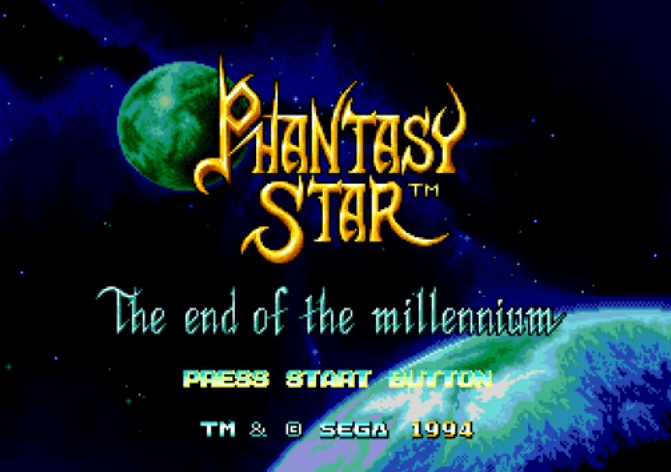
Title screen (screenshot taken by the author)

PSIV is a role-playing game that was developed and published by Sega and released for the Sega Genesis in Japan in 1993. It would not make an appearance in North America and Europe until 1995. It was later released on the Wii U Virtual Console in 2008. For this review, I played the version found on the Sonic’s Ultimate Genesis Collection (2009) for the PlayStation 3.

Plot

Taking place 1000 years after the events of Phantasy Star II (1989), a cataclysmic event known as the Great Collapse has turned Motavia back into a desert planet, and once again there is an increase in biomonsters appearing throughout the world. Chaz Ashley, a young hunter, learns of the link between the biomonsters and the ecological crisis on the planet. The computer system put in place to control the climate is malfunctioning, and the planet is reverting back to its original desert-like state. It also seems that Dark Force is back, hellbent on destroying the Algol system once and for all.

Gameplay

The gameplay has been kept the same as previous instalments – that is, top down view with the exception of battle mode. As you walk around you will have random battle encounters that allow you to earn money and gain experience points. The more points you earn, the higher each player’s stats will become. The view changes to a third person view fir the battles.
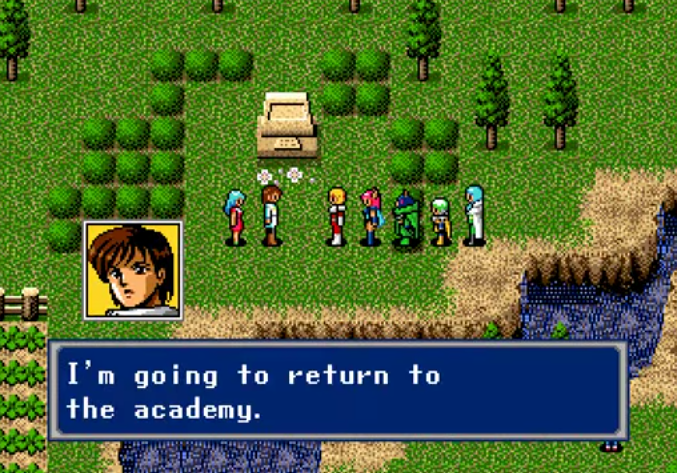
Sadly, the overworld graphics seem to have reverted back to the PSII model making it look a little dated (screenshot taken by the author)

How Does It Handle?

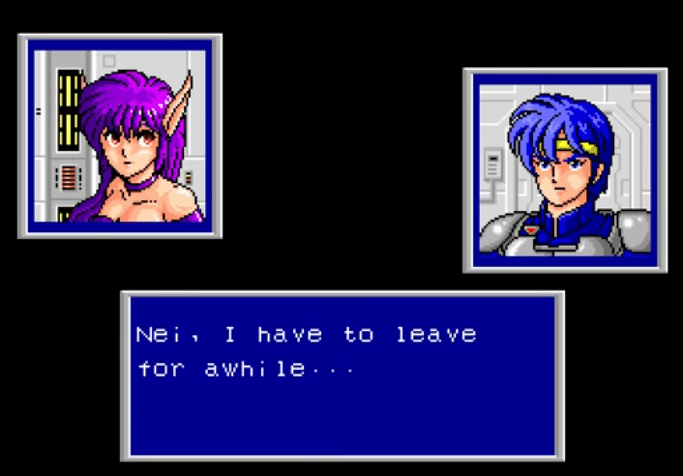
Firstly, the story is more fleshed out than it’s previous instalments, and a lot more engaging. The dialogue in general feels like there was a better translation of the original script. Additionally, during dialogue moments, character profile boxes appear which are beautifully illustrated. It also clarifies exactly who is speaking. During cutscenes, more illustrated boxes are added giving the illusion that you’re reading a comic book. There are also a few nice surprises in the form of characters from previous games reappearing, but I won’t spoil it by telling you who.

There is a significant increase in walking speed for the characters, meaning you can get from A to B a lot quicker. You are also able to increase the speed of the battles and text to help hurry the game along. One annoyance was that when you approach a person and/or object, whilst still pressing that direction, you walk around the target as oppose to stopping in front of it. When you play it, you’ll know what I mean.

The menu system is easy to access and straight forward to navigate. What made me particularly happy is that you no longer need to manually go into your menu and pass items between characters in order for them to equip or use them. The weapons and armour will automatically be available to those who can wield them.

Originally the game came with a very comprehensive 40-page manual explaining every aspect of the game including: Information on each character, what the main items are for, what all the spells and techniques do when used, what injuries you can incur, a map of Motavia, and information on weapons and armour.
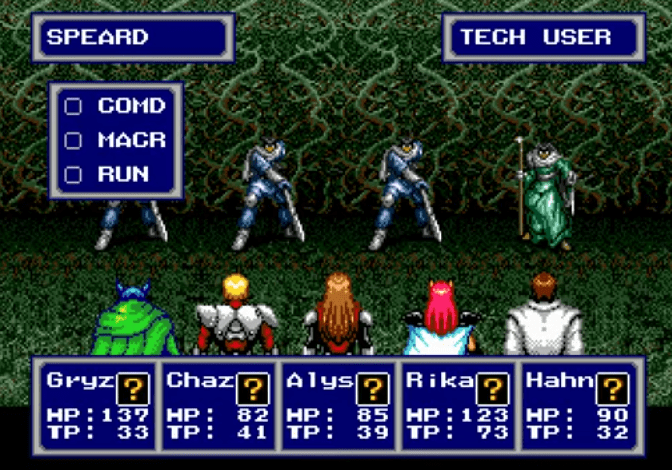
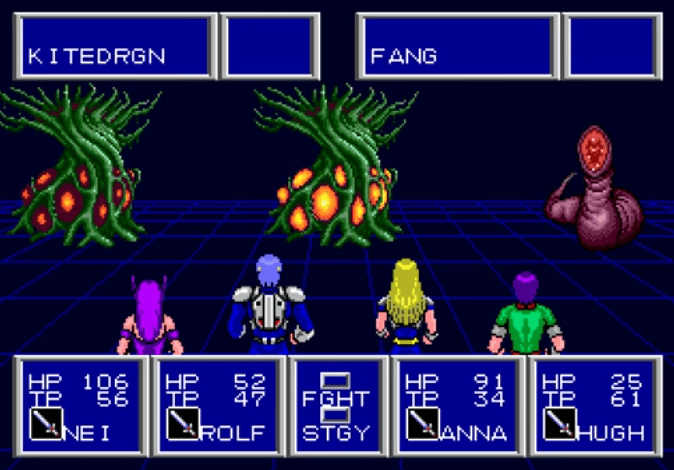
The graphics in battle mode have also reverted back to a similar style to PSII (1989), with the addition of illustared backgrounds (screenshot taken by the author)

Graphics

Oddly, the sprites in the overworld seem to have reverted to PSII (1989) style graphics as oppose to PSIII (1990) or creating newer, more improved graphics. Comparing the two, one could be forgiven for thinking PSIII (1990) was a later instalment. Sadly, these graphics look dated for the mid-90s, especially when compared to RPGs such as Al-Qadim: The Genie’s Curse (1994) and Shining Force 2 (1993). Also, the PlayStation had been released in 1994, upping the expected standard for games in general. When the PlayStation could produce RPGs like Suikoden (1995), what chance did the Mega Drive have?

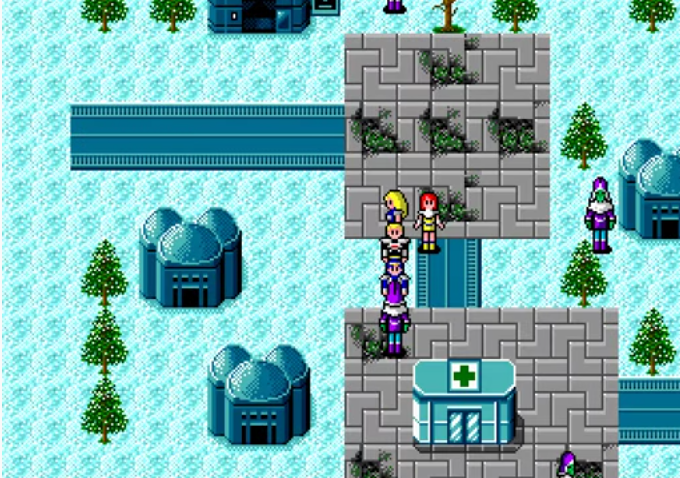
On Dezo – added snowy effects give the impression that you are in a blizzard. However, this effect is heavy on the eyes. (screenshot taken by the author)

Buying and equipping weapons and armour has been simplified, and for the better. When you buy a new weapon or piece of armour, arrows appear by the name of the individual who can wield it. Sadly, you cannot see if an item will improve the stats of that character until you buy it and equip it.

PSIV reintroduces fighting animations back into battle mode, similar to that of PSII. However, this time the backgrounds have also been kept. The animations of the physical attacks of the characters are the same as they were in PSII which is a little disappointing. The backgrounds during the battles are more detailed and, in some cases, animated. Additionally in PSIV, you can now use your transport vehicle during battles instead of using your characters.
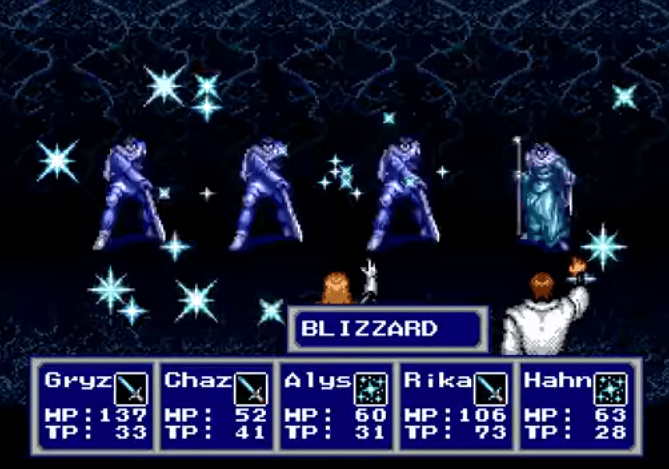
A nice new feature is that two or more characters can combine their spells and techniques to create bigger and more powerful attacks. Sadly, this is very trial and error and it doesn’t always work (screenshot taken by the author)

The enemies are beautifully illustrated and animated. There are some real ugly bastards in this game. A nice little extra is that sometimes, when two or more fighters use a certain technique or spell, it can combine to produce a stronger attack. Sadly, this doesn’t happen everytime you attempt it.

One added bonus is that you no longer need to  pay to restore a fallen comrade. You simply go to a hostel, and bed down for the night. In the morning, said comrade will be right as rain.

Finally, and thank Christ, the battle menu is now wonderfully intuitive. It is very easy to learn, and they have finally simplified the way you can chose which enemy to attack. This makes strategic attacks a hell of a lot easier.

Did I complete the game?

Yes, a walkthrough was needed on several occasions though.

What the critics said:

Electronic Gaming Monthly: “This is the fourth instalment in the Phantasy Star series with an improved magic system that allows you to combine spells for more power. Overall 7.75/10[1]

GameFan: “The graphics are gorgeous, the music is some of the best I’ve heard in a while on the Genesis., full of batchin’ samples, and the game exudes nothing but pure, joyous power. Overall 93/100.[2]

Mean Machines Sega: “The best pure RPG for the Megadrive…” Overall 88%.[3]

Sega Saturn Magazine: “The gameplay – controlling inventories, arming combatants, and using spells – is not to everyone’s taste. But the game succeeds by creating climactic moments, introducing new characters and powers, and taking many weird and wonderful plot turns. Overall 90%.[4]

Game Players: “Newer RPGs like Final Fantasy III make this game look ancient…this still feels like every other Phantasy Star Game…The game offers plenty of items while staying clear and user-friendly. Fighting every other step drives you crazy. Overall 70%.[5]

My verdict:

“Although the graphics are beginning to look a bit dated, they are still pleasing to look at for the most part. The story is compelling with some nice surprises, and they have simplified the menu systems making them easier to navigate. Personally I feel this is the best Phantasy Star in the series.”

Rating:

What are your memories of Phantasy Star IV? I would love to hear your thoughts, and don’t for get to follow and subscribe so that you don’t miss my latest reviews! You can also find me on Instagram: @nicklovestogame.


[1] ‘Review Crew: Genesis – Phantasy Star IV’. Electronic Gaming Monthly. (June 1995). Issue 71: 46.

[2] Rox, N., ‘Genesis Review – Phantasy Star IV: The End of the Millennium’. GameFan. (April 1995). Volume 3 Issue 4:19 & 27.

[3] ‘Megadrive Review – Phantasy Star IV’. Mean Machines Sega. (July 1995) Issue 33:76-7.

[4] ’16-bit Megadrive – Phantasy Star IV’. Sega Saturn Magazine. (December 1995). Issue 2:91.

[5] Slate, C., ’Genesis: Review – Phantasy Star IV: The End of the Millennium’. Game Players. (February 1995). Issue 49:38-9.

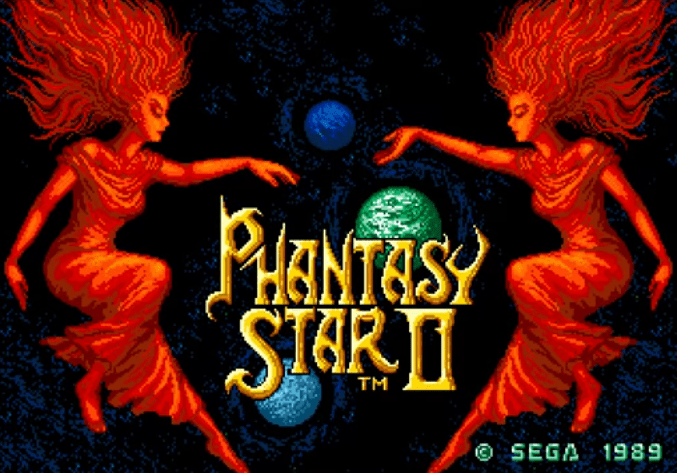
Phantasy Star II – Review

A picture containing text, book

Description automatically generated

Before the 1990s, RPGs were a niche genre in the video game world. They take a lot of time and effort to play, and not everyone has the patience or desire to attempt such gargantuan games. However, those that do play RPGs cherish every moment of their journeys through fantastical universes. They take great care in building up their warriors and magic users in order to defeat hordes of enemies. Phantasy Star was one such RPG which was highly praised by critics, even though it did push the Sega Master System to its limits.[1] The successor to the Master System, the Mega Drive, offered the creators of Phantasy Star II more to work with.

Title screen (screenshot taken by the author)

Phantasy Star II is a single-player RPG developed and published by Sega. It was released for the Mega Drive in 1989, but it wouldn’t reach North America and Europe until 1990. It was later re-released on the Sega Saturn and Game Boy Advance as part of the Phantasy Star Collection, and the Dreamcast as part of the Smash Pack Volume 1. In 2005, an updated remake was released in Japan for the PlayStation 2 and PlayStation Portable. For this review, I played was the Mega Drive version on Sonic’s Ultimate Genesis Collection (2009) on the PlayStation 3 (also available on the Xbox).

Walking around the overworld (screenshot taken by the author)

Plot

The game is set 1000 years after the events of Phantasy Star and takes us back to the Andromeda galaxy and the Algo star system. Orbiting the Algo sun are three planets: Palma – where the government reside; Mota – once an arid desert planet that has since been transformed into a tropical paradise; and Dezo – an inhospitable ice planet.

The Algo star system has prospered under the control of Mother Brain, a computer that regulates the climate, and is responsible for terraforming Mota. However, Mother Brain has started malfunctioning, producing increasingly strong monsters. One night, Rolf (our main protagonist) awakes from a nightmare, where a young girl whom he doesn’t recognise is battling a demon. It is suggested that this girl is Alis from Phantasy Star. After being informed of Mother Brain’s malfunction, Rolf, along with Nei, a humanoid with cat-like features, sets off to investigate why Mother Brain has seemingly turned against its creators.

Gameplay

Phantasy Star II is first video game to use a mega 6-bit cartridge. This enabled the designers to create the largest world yet seen in a video game.[2] They have dispensed with the dungeon crawling parts of the game (much to the chagrin of many who love dungeon crawlers), and have focussed on the overworld views when trawling through the dungeons.

The screens for dialogue have been greatly improved (screenshot taken by the author)

How Does It Handle?

They have still yet to fix the fighting menu. Annoyingly, you still need to scroll through the menus to target individual monsters which is tiresome.

There are two further irritating aspects to this game which I would have hoped they’d have resolved by now. The first is that many of the names of the plethora of spells you are able to use do not indicate what type of spell it is. The manual doesn’t have any information on this either, so you need to experiment during battles to find out what the oddly named spells do.

“That’s part of the fun!”, I hear some of you cry. Not really. One would assume that a magic user would know what the spell was they were using. Hopefully this will be resolved in Phantasy Star III.

The second irritating aspect is that you do not have a combined inventory, so you need to constantly scroll through the menus in order to exchange items between your fighters. Its exasperating!

Where did the beautiful backgrounds go? (screenshot taken by the author)

Graphics

As expected, the overall graphics have been improved, creating three very distinct worlds. The sprites in the overworld maps are more individualised and are brightly coloured. The dialogue screens have also been greatly updated to anime-style character screens.

The battles screens are greatly improved. Firstly, you can now see your characters attacking animations, and the enemies are more varied and detailed. Sadly, they decided to take away the scenic backgrounds and replace them with a blue grid. I’m not sure what the thinking was behind that decision.

Overworld view on Dezo world (screenshot taken by the author)

Music & SFX

I don’t really recall much about either. They clearly aren’t very memorable.

Did I Complete The Game?

Yes, it felt like a slog at times, and needed a walkthrough on occasion.

Dragon: “The animation, especially for battles, is superb. There are over 50 spells available. Even weapons and armor can give benefits to characters beyond their normal effects. For example, special armor found in one dungeon allows the wearer to cast a healing spell every so often. The battle system enables more than one type of creature to attack and allows the characters to attack specific creatures instead of idiotically going after one creature at a time. This game is definitely a winner. Overall 5/5”.[3]

Electronic Gaming Monthly: Martin – “RPG’s aren’t my thing., but this one has a monstrous quest anyone can get involved with and lost in…I wish the battle scenes were on landscapes instead of boring blue grid, but all in all PS2 is presented well. Overall 8/10”.[4]

Raze: “Large combat sprites, wonderful scenes and backdrops. Great in-game effects and unobtrusive background music. A challenging quest packed with gameplay. Overall 90%”.[5]

Video Games and Computer Entertainment: “It’s very user friendly, with a simple but extensive menu system, and a battery back-up that allows you to save numerous games in progress. The plot advances quickly, providing a constant stream of new subplots…Phantasy Star II is a complex and eminently enjoyable game that will give you more variety and challenge for your buck than any other video game. Overall 9/10”.[6]

Zero: “Phantasy Star II is definitely not just any old thing. In fact, it’s just about everything you could want from this kind of game – big (very big), involved, exciting and challenging. Overall 89%”.[7]

Sega Power: “Long-awaited sequel to the MS RPG. With a massive quest set over different worlds and four characters to control, you should be thankful for your battery back-up! Overall 5/5.[8]

My Verdict:

“Graphically, a great improvement on the first, with an engaging story and plenty of action to keep you quiet for many hours. They just need to sort out that poxy battle menu! RPG fans will love this game!”

Rating:

What are your memories of Phantasy Star II? I would love to hear your thoughts, and don’t for get to follow and subscribe so that you don’t miss my latest reviews! You can also find me on Instagram: @nicklovestogame.


[1] Tracy, T., (16th December 2002). ‘Phantasy Star Collection Review’. Gamespot.com.  (https://www.gamespot.com/reviews/phantasy-star-collection-review/1900-2901862/ Accessed 15th March 2020).

[2] Adams, R., ‘Wishing on a Phantasy Star II’. Computer Gaming World. (November 1990). Issue 76:85.

[3] ‘Phantasy Star II’. Dragon. (August 1990). Issue 160:51.

[4] ‘Phantasy Star 2’. Electronic Gaming Monthly. (April 1990). Issue 9:18.

[5] ‘Reviews: Phantasy Star 2’. Raze. (April 1991). Issue 6:34-5.

[6] ‘Sega Genesis – Phantasy Star 2’. Video Games and Computer Entertainment. (March 1990) Issue :34 & 49.

[7] ‘Review Console: Mega Drive – Phantasy Star II’. Zero. (March 1991). Issue 17:88.

[8] Jarrett, S., ‘The Hard Line – Phantasy Star II’. Sega Power. (April 1991). Issue 23:54.

Myst – Review

Adventure game creators have always sought to immerse gamers into their imaginary worlds but have sometimes been limited by technology. For example, I remember some early Spectrum games that were simply text based. Although they were fun, I never felt immersed in the game. Myst was the first game I played where I felt that the immersion experience was successful on me. Other people’s opinions may differ, of course, but I can only tell you how I felt about it. I should also warn you that there is a spoiler near the end of the review.

A plain and mysterious title screen, giving little away. Much like the game itself. (screenshot taken by the author)

Myst is a graphics adventure puzzle game developed by Cyan Inc. and published by Brøderbund Software. It was released for the Macintosh in 1993, Windows in 1994, 3DO in 1995, and PlayStation in 1996. A remake was released for Windows in 2000 and Macintosh in 2002, and the realMyst: Masterpiece Edition was released on Steam in 2014. The game was ported to many other platforms including Sega Saturn, PlayStation 3, PlayStation Portable, Android, iPhone, Nintendo 3DS, Jaguar CD, Amiga OS, CD-I, For this review, I replayed the original Windows version.

Your view as you explore this mysterious world

Plot

You play as an unnamed protagonist who has fallen into a fissure and appeared on a mysterious island. Where are you and how the hell do you leave?

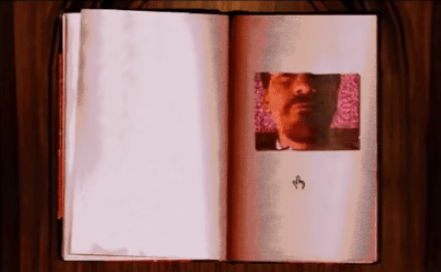
As you explore the island you learn more about its history and the worlds you will soon visit. Some notes also offer hints to help you progress through the game. You soon learn that you need to gather blue and red pages and restore them to two books found in the observatory. Two brothers, Sirrus and Achenar, have been trapped inside these books. As each one speaks to you through garbled transmissions, they explain that the other brother is mad and has imprisoned them in their respective books. They both try to convince you to free them instead of the other brother, both claiming that the other brother murdered their father. To find the pages you must explore several other worlds and solve various puzzles.

One of several notes found on the island to assist you in working out what you are supposed to do. (screenshot taken by the author)

Gameplay

Based on the point and click format, you move your cursor, a pointing hand, which only seeks to change when indicating you an turn left or right. Other than that, it is trial and error to see what objects you can interact with.

Both brothers are trapped in separate books…but which on whould you free? (screenshot taken by the author)

How Does It Handle?

You are able to move and turn by using a cursor to click the route you wish to take or the direction you wish to turn. You can also interact with objects by clicking and dragging them.

One of the more interesting aspects of this game is that you are simply thrust into this game with virtually no back story and no idea what you have to do, and oddly, you cannot die! At first you are simply wandering around, searching for buildings to enter and objects to interact with. This can be quite off putting to some as it can take a while to understand what the hell is going on. Some of the puzzles are fun and challenging. Others are less obvious to solve. One annoying aspect of the game is having to return to the same worlds to collect the other page you didn’t collect on your first visit, as you can only pick up one at a time. For me, this is a cheap way of extending the life of the game.

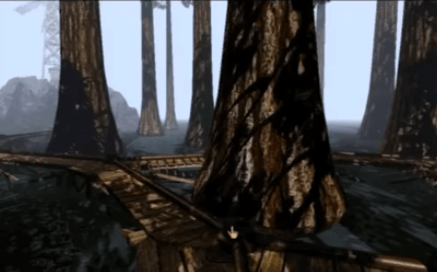
One of the other worlds you visit to find the blue and red pages is Channelwood. (screenshot taken by the author)

Graphics

The animations are not as smooth as modern games, and the 3D design of the worlds look dated now, but at the time of release were amazing. I think the game has held up pretty well. The graphics really draw you in.

Music & SFX

The music over the title screen and intro has a creepy/dramatic feel which fits the game well. As I recall, there is no music in the game itself, but I think this is a good thing, as it adds to the feeling of isolation,

I loved the narration over the intro. The minimalistic SFX consist of ambient sounds of the wind blowing, running water, and waves of the sea breaking. Apart from the noises of actions being performed like machinery being switched on, the lack of SFX gives an eerie atmosphere to the game adding to the feeling of being truly alone.

The static videos of the brothers talking to you are great and quite creepy. A great idea for the game.

Personal Memories

I remember when this game was released, and I played it with a school friend. However, we never got that far as it was a bit too difficult for our teenage brains. When I came back to it years later, I fared better having gained much experience with these sorts of games. Back then, I thought the graphics were out of this world.

SPOILER ALERT!!!

There are four possible endings, with one of them being the true ending. However, the true ending is frustratingly and unsatisfyingly none existent and I found myself wandering Myst for some time before searching online to see if I had missed something. Nope, sure enough there is no ending. I guess I will have to play the sequel Myst: Riven, to see what happens next.

Did I Complete The Game?

Yes, but definitely needed help from the walkthrough on this on!

What The Critics Said:

Gamespot.com: “Myst is an immersive experience that draws you in and won’t let you go. Overall 8.9/10[1]

My Verdict:

“This is a tough game and seems to be aimed towards more experience adventure gamers. However, I loved the concept of the game, and the intro music and SFX immerses you into the game. I just feel it could have been so much better if more story was included. I also felt the way you can only carry one coloured page at a time, meaning you have to go through each world twice, was a cheap way to prolong the game. I mean, who can’t carry two pages!”

Rating:

What are your memories of Myst? I would love to hear your thoughts, and don’t for get to follow and subscribe so that you don’t miss my latest reviews! You can also find me on Instagram: @nicklovestogame.


[1] Sengstack, J., (May 1, 1996). ‘Myst Review’. www.gamespot.com. (https://www.gamespot.com/reviews/myst-review/1900-2542724/ Accessed on 17th February 2020).

Columns – Review

In 1989, Nintendo released Tetris on the Game Boy, and it proved to be an instant hit. By its 25-year anniversary Tetris had sold over 70 million copies worldwide.[1] Sega, eager to compete, needed a puzzle game of their own. Blockout (1989) has failed to be a success like Tetris (1989) so Sega tried a different tack with Columns. Similar enough not to deter Tetris fans, but different enough to try and attract a new audience. Sadly, Columns couldn’t imitate Tetris’ success.

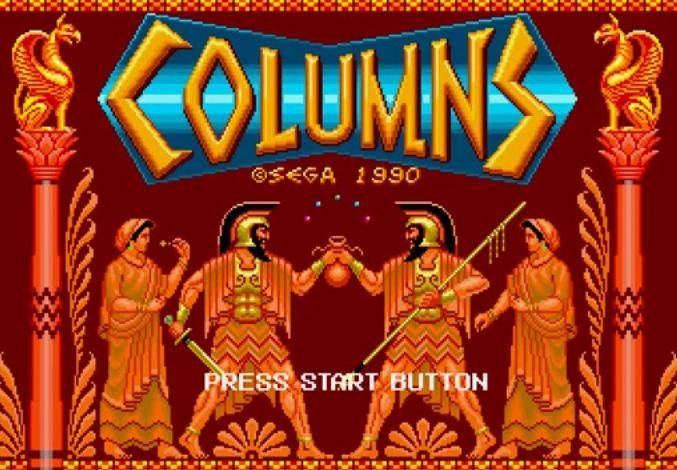
Title screen (screenshot taken by the author)

Columns is a puzzle game created by Jay Geertsen for the arcade in 1989 and was originally developed and published by Sega in 1990. Its success led to it being ported to many other platforms. The version I chose to review was from the Sonic’s Ultimate Sega Collection (2009) on the PlayStation 3.

Gameplay

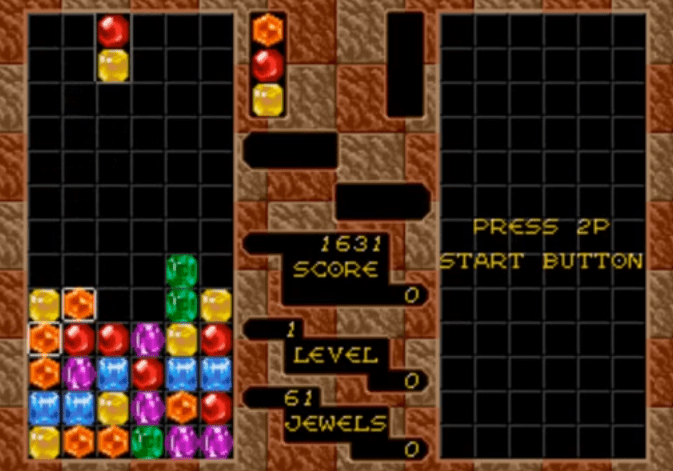
The game consists of three coloured jewels being dropped to the bottom of a rectangular screen, similar to Tetris. However, instead of aiming to complete horizontal lines, you must match three or more of the same coloured jewels in either a vertical, horizontal or diagonal line. Once lined up, the jewels will disappear allowing any jewels above to fall down to the lowest point possible. You will also be awarded points. You are able to cycle the order of the jewels to aid in your organisation of landed jewels. If a multi-coloured, flashing set of jewels appears, you can land any colour of jewel that you wish and all of that type of jewel will disappear. The higher your score, the faster the jewels will fall.

The jewels are all unique and easily discernible from the others (screenshot taken by the author)

How Does It Handle?

The controls are very straight forward and easy to just pick up and play. By the time the game becomes harder, you will have a full understanding of how to play the game.

Graphics

I have a real soft spot for this game and prefer it to Tetris, possibly because of the beautifully coloured jewels. The overall graphics in general have a classical Greek/Roman feel to them, and each jewel is brightly coloured and easily distinguishable from the others.

Music & SFX

The music is rather basic. There are three themes to choose from: Clotho, Lathesis, and Atropos. Clotho is my favourite and does have a tendency to get stuck in your head, but mostly you will find that you’ll turn the sound down and listen to your own music, podcast or an audiobook.

The SFX mainly consist of a thud when block of jewels are placed and a sort of sparkly sound when you get a set of three or more and they disappear. It can become a bit jarring after a while.

Replay Value

Columns can be played in one-player and multiplayer modes, flash-modes and a time trial mode which add to the replay value of such a seemingly simple but highly addictive game. There are also three difficulty settings.

Personal Memories

I used to play this game a lot and got pretty damn good at it. As you can see from the photograph below, the highest score I achieved was 5408848 at level 121. I would have continued but I had been playing for a while and was due to go out for the evening. I could have paused and come back to it but I feel that I had proved my aptitude for the game.

A photograph of my highest ever score (photo taken by the author)

Did I Complete The Game?

No one seems to know how high the score or levels go, and I don’t know of anyone who has “completed” this game, so I’m going to assume this is a game that cannot be completed.

What The Critics Said:

Mean Machines Index: “Sega’s answer to Tetris, this puzzle game is excellent. There’s a huge variety of options, including arcade-style time trials, three different difficulty settings, nine different starting levels, and a two-plater head-to-head made which adds to the game’s lasting appeal. Overall 88%.[2]

Sega Power: “A Tetris clone with a superb challenge mode. Simple and addictive. Overall 4/5.[3]

Sega Power: “A Tetris clone with superb one-on-one challenge mode. More of an end-of-blast relaxer than a main game. Simple, addictive , but expensive for what it is. Overall 4/5.[4]

Wizard: “Good puzzle game, drop jewels, like Tetris but a bit better. Overall B+.[5]

My Verdict:

“It’s like Tetris, but better in my opinion. Colourful, challenging and surprisingly addictive.”

Ratings:

What are your memories of Columns? I would love to hear your thoughts, and don’t for get to follow and subscribe so that you don’t miss my latest reviews! You can also find me on Instagram: @nicklovestogame.


[1] Johnson, Bobbie, (June 2009) ‘How Tetris Conquered the World, Block by Block’. The Guardian. (https://www.theguardian.com/technology/gamesblog/2009/jun/02/tetris-25anniversary-alexey-pajitnov Accessed on 10th February 2020).

[2] ‘Review Index: Mega Drive – Columns’. Mean Machines. (October 1992). Issue 1:138.

[3] ‘The Hard Line – Review: Mega Drive – Columns’. Sega Power. (September 1993). Issue 46:96.

[4] Jarrett, S., ‘The Hard Line – Columns’. Sega Power. (April 1991). Issue 23:53.

[5] ‘Game Reviews – Columns’. Wizard. (January 1993). Issue 17:24.

Monkey Island 2: LeChuck’s Revenge – Special Edition – Review

Avast me hearties! Guybrush Threepwood be back with a new adventure for ye. So, grab your mouse and be ready for more whacky adventures says I.

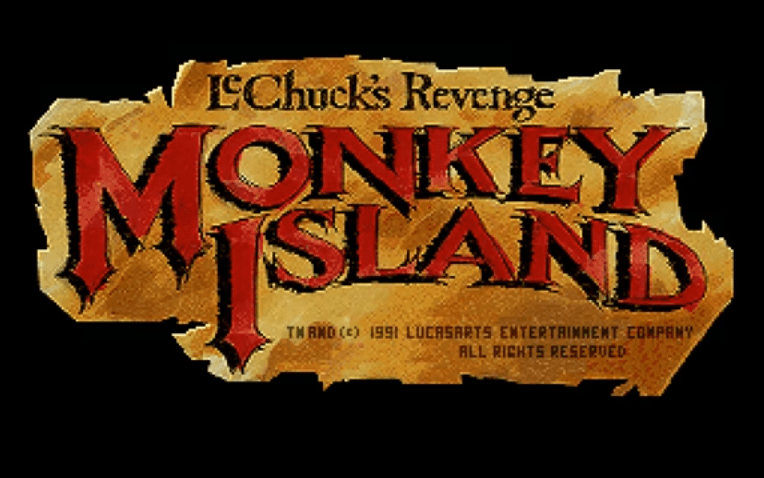
Original title screen (screenshot taken by the author)
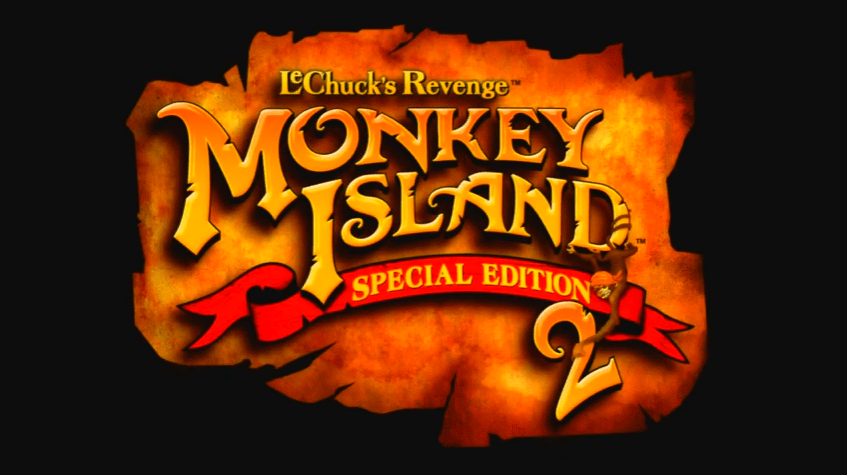
Special Edition title screen (screenshot taken by the author)

Monkey Island 2: LeChuck’s Revenge is a single-player point-and-click adventure game, and the second game in the Monkey Island series. It was developed and released by Lucasart in 1991 for the Amiga, FM Towns, Mac OS, and MS-DOS. The special edition was released in 2010 for iOS, Microsoft Windows, Playstation 3, Xbox 360, and Xbox One. I chose to review the version downloaded from Steam.

Now I realise that I only recently reviewed The Secret of Monkey Island: Special Edition, but I felt that I had to play this second instalment straight way.

Plot

Seven months after defeating the pirate LeChuck, wannabe pirate Guybrush Threepwood finds himself back in the Caribbean in an attempt to locate the treasure of Big Whoop. From finding ingredients to make a voodoo doll, to attending fancy dress parties, rigged gambling, and drinking and spitting contests, Threepwood attempts to locate the map that’ll lead him to Big whoop.

Gameplay

The gameplay is identical to The Secret of Monkey Island. So I have copied and pasted what I wrote from there: You control the cursor and must search the environment for people and items that you can interact with. The screen is broken into four parts:

  1. Animation Window – Where the action happens
  2. Sentence Line – When you cursor hovers over something you can interact with, a sentence will appear such as ‘Talk to pirate’.
  3. Command List – Click on a command and then interact with a character or the environment. There are 12 different commands to perform which are: open, close, push, pull, walk to, pick up, talk to, give, use look at, turn on, and turn off. You can alternatively use the keyboard hot keys.
  4. Inventory – List where you can find the items you have collected.

When talking to a character, a list of questions and conversation starters will appear at the bottom of the screen.

How Does It Handle?

The option to use the hot keys is a bit of a God send else it would be very tiring having to use the mouse to click on the command list every time. The controls are simple and easy to use, you just have to make sure you are precise with your commands.

In the Special Edition, they have simplified the command list even more by doing away with the list completely. When hovering over a character or a bit of the environment you can interact with, an icon appears depicting the action.

However, for some reason that I can’t put my finger on, I didn’t enjoy this game quite as much as The Secret of Monkey Island, and that may be because there was nothing new to learn. Then again, that may just be me being very picky.

Graphics

The graphics are also identical to The Secret of Monkey Island:

Although cartoonish, and originally in 8-bit graphics, the backgrounds and characters are very colourful and incredibly detailed with a large number of internal and external scenes. When moving around, the characters move surprisingly fast which is a relief as some point and clicks have very slow moving characters making the game drag. Oddly enough, when close-ups of characters occur, they look very life-like, which is the opposite of the Special Edition. For me, the Special Edition graphics adds more life to the environment.

The scrolling not as smooth as it could be but that tends to be standard for these sorts of point and clicks.

Music and SFX

The introduction music is quite jaunty new take on the original Monkey Island (1990) theme but I didn’t like it as much as the original. This is one of the first adventure games with music throughout the gameplay. The music throughout fits the game well. It is quite understated but fits well with the game.

There is still no vocalization and the SFX are few and far between but it doesn’t take away from the experience of the game.

In the Special Edition, the music has been updated. The speech is now vocalised and the SFX are more ambient (lightning strikes, birds tweeting, and water running). These new SFX really add to the experience.

Replay Value

All point and clicks have limited replay value as they tend to be single-player games with on difficulty setting. You may revisit it annually, but not as often as you would other genres.

Did I Complete The Game?

Yes, I did complete the game with the assistance of a walkthrough on several occasions.

What The Critics Said About The Original:

Amiga Computing: “…horribly close to being a perfect game. It’s certainly the best adventure game I’ve seen in ages… Overall 95%[1]

Computer and Video Games Magazine: “Already Monkey Island has staked a claim to the best game of this year…. Overall 96%.”[2]

What The Critics Said About The Special Edition:

“…good, but the lack of keyboard support took something away for me. That said, the game picked up on the problems I had with the first and changed it for the better. I did feel that this game took away some experiences, so that brought its score down a little. There are things you should be told but you should also learn on your own, and they gave away too much to the player this time around. Overall B+.”[3]

Awards:

Winner – 1992 Computer Gaming World ‘Best Adventure Game of the Year’[4]

My Verdict:

“Lucasart have done it again. They have produced a worthy sequel with plenty of humour, challenging puzzles and plenty of head scratching moments. The animation is smooth, the characters and the backgrounds are colourful and detailed”

Rating:

What are your memories of Monkey Island 2: LeChuck’s Revenge? I would love to hear your thoughts, and don’t for get to follow and subscribe so that you don’t miss my latest reviews! You can also find me on Instagram: @nicklovestogame.


[1] Whitehead, D., . ‘Review: Amiga – Monkey Island 2: LeChuck’s Revenge’. Amiga Computing. (August 1992). Issue 51:10-1.

[2] Boone, T., ‘Review: PC – Monkey Island 2: LeChuck’s Revenge’ Computer and Video Games Magazine. (February 1992). Issue 123: 15-7.

[3] Meitzner, B., (Sept 19, 2011). ‘Review: Monkey Island 1 and 2 Special Edition’. Gaming Bus. (https://web.archive.org/web/20110927164615/http://www.gamingbus.com/2011/09/19/review-monkey-island-1-and-2-special-edition/ Accessed 14th December 2019).

[4] ‘CGW Salutes the Games of the Year – Best Adventure Game of the Year’. Computer Gaming World: Collector’s Edition. (November 1992). Issue 100: 110. (https://archive.org/details/Computer_Gaming_World_Issue_100/page/n109/mode/2up Accessed on 6th February 2020).