Alex Kidd proved to be a hit on the Sega Master System throughout the eighties, and was arguably the console’s mascot. The question was, could he continue to be their main draw for Sega’s latest console, the Mega Drive? Clearly not, as this was his only outing on the 16-bit console.
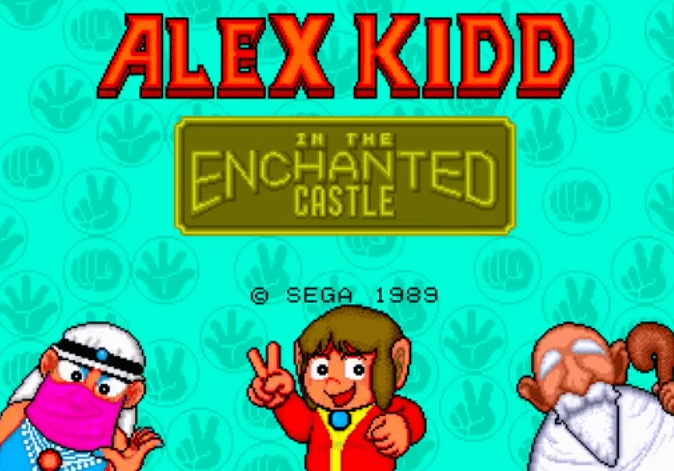
Title screen (screenshot taken by the author)
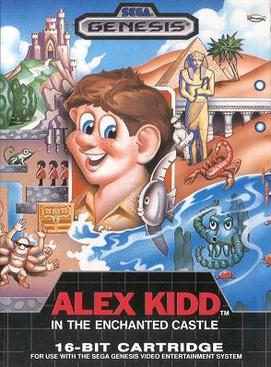
Alex Kidd and the Enchanted Castle is a single-player platform game developed and published by Sega. It was released for the Mega Drive in Japan in 1989, Europe in 1990, and the US in 1991. It was later released on the Wii Virtual Console, Mega Drive Handheld, Cloud Online, and Steam. I chose to review the original Mega Drive version.
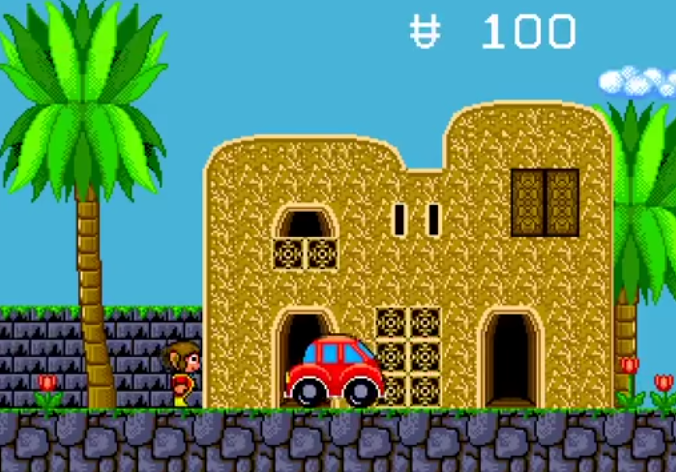
Rookie Town (screenshot taken by the author)
Plot
On the planet Aries, Alex Kidd’s father, King Thor, has been kidnapped by Ashra, the ruler of planet Paperrock. Alex travels to Paperrock in a bid to rescue his father. He must navigate through 11 stages:
1. Rookie Town
2. The Prairie
3. The Splashy Sea
4. Scorpion Desert
5. The Pyramid
6. The Hiho Forest
7. Tropics Town
8. Rocky Mountain #1
9. Rocky Mountain #2
10. In the Sky
11. Sky Castle
Gameplay
The gameplay is simple: Run, jump, punch, kick, crawl and swim. When breaking into red treasure chests, coins will spill out for Alex to collect. Grey treasure chests contain lives and power-ups. Beware, however, as some chests, some contain bombs that explode and will kill Alex.
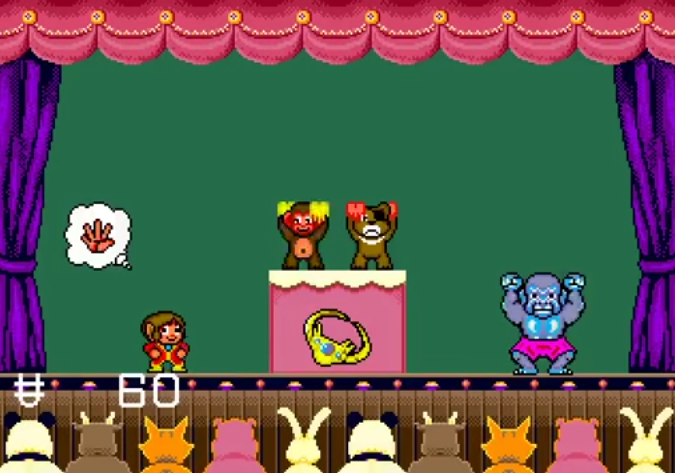
Jan-Ken-Pon (screenshot taken by the author)
Along the way, Alex can pay to compete in Janken fights (paper, scissor and rock) with shopkeepers to win equipment and power-ups. These include motorcycles, helicopters, a pogo stick, a wizard’s cane, a cape, and a necklace that helps Alex to see the thoughts of his opponent. This item gives you a better chance at winning Janken. At the end of every level, Alex must collect a piece of cake to progress.
Alex can swim and, thankfully, seems to be able to breathe underwater (screenshot taken by the author)
The power bracelet is very useful and allows alex to shoot a crescent-shaped band of light that kills the baddies.
Spoiler alert!!!
You need to have the power bracelet equipped after beating Ashra at Janken so that you can fire at him from a distance. This is the only way to defeat him.
How Does It Handle?
The physics of the game take a bit of getting used to. Alex will slide around a bit when quickly changing direction, and is a bit floaty when jumping, which takes a bit of getting used to, so be careful near enemies.
Graphics
Graphically, the Mega Drive is capable of so much more. The sprites are nicely drawn, if a little cutsie, suggesting this game was meant for a younger audience. Sadly, the levels and backgrounds are rather basic.
Music
The music, however, is very catchy and will get stuck in your head. When revisiting this game after 20 odd years, I still remembered the tunes instantly and began to hum along.
Replay Value
There are three difficulty settings: easy, medium and hard. With increased difficulty, you are given less lives to start with and the Janken opponents are harder to defeat, adding to the game’s replay value.
Did I Complete The Game?
Yes, but I have only played through on easy mode.
What The Critics Said:
Mean Machines Sega:“The graphics and sound are almost Master System Standard, and while it’s fun to play, with plenty of secret rooms and things to work out, it lacks that really addictive spark that makes the 8-bit Sega Alex Kidd games so much fun to play. For ardent Alex Kidd fans only. Overall 68%”[1]
Sega Pro: “Alex’s only appearance on the Mega Drive is not a bad attempt…although it can get repetitive. Overall 77%”.[2]
The Games Machine:“It goes without saying that Alex Kidd highly playable and incredibly addictive. Overall 82%”.[3]
Sega Power:“Alex goes 16-bit in this colourful platform exploration romp. As with previous Alex Kidd games, the jolly atmosphere belies the testing gameplay. Fun and very polished. Overall 3/5”.[4]
My Verdict:
“Definitely one for the younger gamer. It can be completed very easily without too much hassle, but there is little to keep you coming back for more. Catchy music, nice sprites and bright colours, but the level design and backgrounds are a bit basic and could be more visually pleasing. However, I do have a softspot for this game and feel it’s been harshly judged by critics. I certainly keep it in my collection and revisit it every year or so. It’s also handy to keep around for my niblings.”
Rating:
What are your memories of Alex Kidd in the Enchanted Castle? I would love to hear your thoughts, and don’t for get to follow and subscribe so that you don’t miss my latest reviews! You can also find me on Instagram: @nicklovestogame.
[1] ‘Game Index: Mega Drive – Alex Kidd and the Enchanted Castle’. Mean Machines Sega. (October 1992). Issue 1:137.
[2] ‘Sega Showdown – Alex Kidd and the Enchanted Castle.’ Sega Pro. (November 1991). Issue 1:18.
[3] ‘Alex Kidd and the Enchanted Castle’. The Games Machine. (June 1989). Issue 19:18-9.
[4] Jarrett, S., ‘The Hard Line – Alex Kidd and the Enchanted Castle’. Sega Power. (April 1991). Issue 23:52.
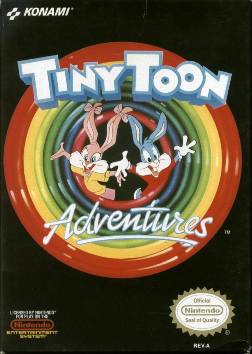
“We’re tiny, we’re toony. We’re all a little looney. And in this cartoony we’re invading your TV. We’re comic dispensers. We crack up all the censors. On Tiny Toon Adventures get a dose of comedy.”
Title screen (screenshot taken by the author)
Tiny Toons Adventure is a single-player platform game developed and published by Konami. It was released on the NES in 1991 and it was this version I chose to review.
Plot
Not all is well in Acme Acres. The spoilt rich kid Montana Max is angry because he was unable to bribe the judges of the Animation Festival at Acme Looniversity. Now in a sulk, and wanting to get back at the winner, Buster Bunny, he kidnaps Babs Bunny. Buster, along with pals Dizzy Devil, Furrball, Plucky Duck and Hampton, sets out to rescue Babs.
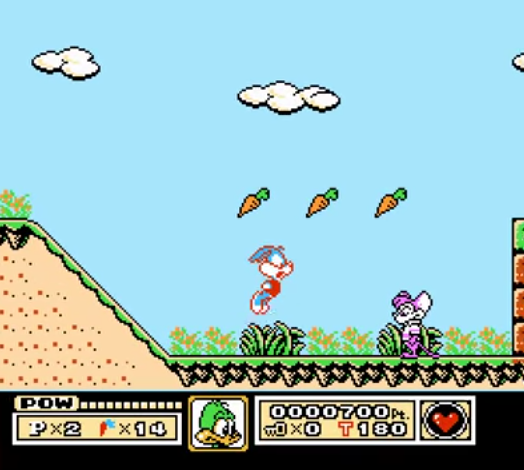
A cute little platform game (screenshot taken by the author)
Gameplay
You initially start as Buster Bunny, but can also select Dizzy Devil, Furrball and Plucky Duck, each with their own unique abilities, to assist Buster. You will become your selected character when you collect the star icon. Using these characters, you must complete six worlds each with three levels (except the last two worlds which need to be completed in one go). These include:
1. Field of Screamz
2. Motion Ocean
3. Sure Weird Forest
4. Boomtown
5. Wacklyland
6. Monty’s Mansion
Each world ends with a boss battle. Throughout the levels you have the chance to collect carrots which can be exchanged with Hampton for extra lives.
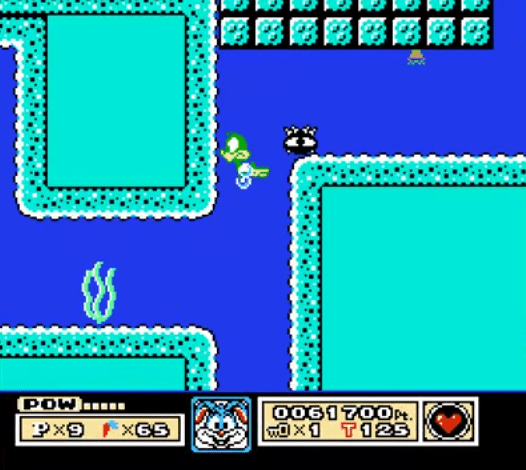
You can only choose one character to assist Buster at the beginning of each world. It is disappointing that in order to change characters, you need to find the star icon as it would have been a nice opportunity to put in some more complex puzzles where each character is needed to use their unique skill. My preferred sidekick was Plucky Duck as he is the best swimmer and can glide whilst jumping.
How Does It Handle?
This is a cute little game, and it’s quite fun to play as the different characters. The controls are easy to learn and are very responsive. Each level has a time limit, which gives you a warning if the timer goes below 30 seconds. You also have unlimited continues. However, if you do use a continue, it takes you back to the beginning of the world.
Each character has unique abilities. Plucky Duck is the best swimmer (screenshot taken by the author)
It is also frustrating that if you die in the boss battle, you are sent back to the beginning of the level, but I guess they need to give the game some longevity.
Graphics
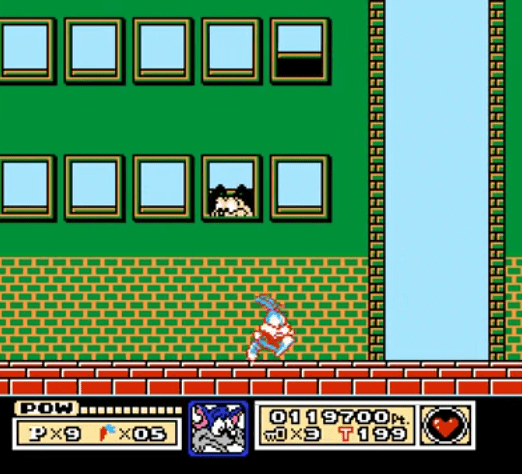
The Graphics for the levels and backgrounds are good…not great, just good. Then again, they don’t need to be ground-breaking. This is based on a children’s cartoon after all. The sprites are nicely drawn, although, it is a bit peculiar how Buster Bunny and Plucky Duck don’t have a nice clear black outline like the other sprites.M
Music
Oddly, there is no music over the title screen, but the in-game music is an 8-bit version of the Tiny Toon theme from the animated series. There is some musical variety through the different levels, but it is the main theme that is most often heard throughout the game.
I’m confused as to why Plucky Duck and Buster Bunny don’t have a nice clear black outline like all the other sprites (screenshot taken by the author)
Did I Complete The Game?
Yes, although I think I used approximately 20 continues for the last two worlds alone.
What The Critics Said:
GamePro:“Strip away that popularity, however, and you’ve still got a solid game with decent challenge. Konami’s given the Toons’ graphics their 8-bit best. Overall 3.4/5”.[1]
Entertainment Weekly:“This multilevel action game is easy enough for even small children to master, although older kids may be challenged by the higher levels. Overall A-“.[2]
N-Force:“The funky fluffy sounds, perfectly compliment the graphics, and gameplay’s as brilliant as ever, with six massive levels and a multitude of sub-levels, the lastability factor’s excellent. Overall 89%”.[3]
My Verdict:
“Nice graphics and a fun little game which is diverting in its own way. The last two worlds in particular are quite challenging. Sadly, with one difficulty setting, there is a real lack of replay value. Definitely one for the younger gamers out there.”
Rating:
What are your memories of Tiny Toons Adventure? I would love to hear your thoughts, and don’t for get to follow and subscribe so that you don’t miss my latest reviews! You can also find me on Instagram: @nicklovestogame.
[1] The Missing Link. ‘Nintendo Pro Review – Tiny Toon Adventure’. GamePro. (December 1991). Issue 29:38.
What makes a great video game? Graphics, music, replay value, multiplayer options…there is no correct answer. Personally, I feel that gameplay is more important than the others. If a game doesn’t play well, the rest is pointless. That’s just my opinion of course.
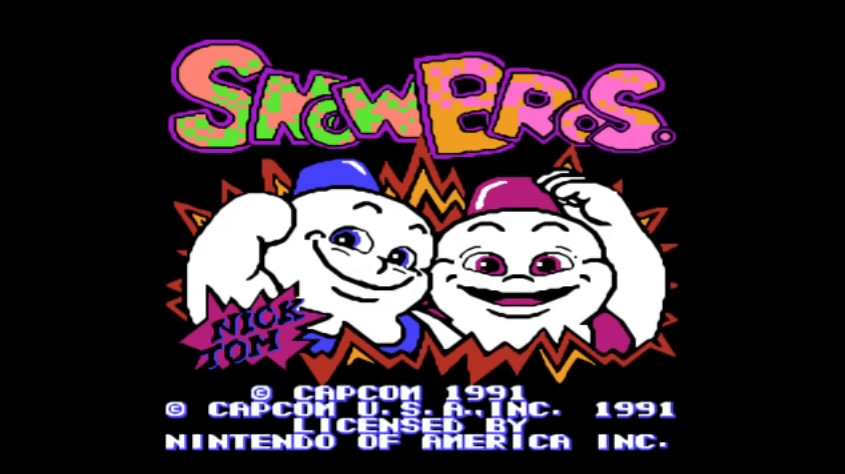
Title screen (screenshot taken by the author)
Snow Bros. was developed and published by Toaplan for the arcade in North America, Japan and Europe in 1990. Over the next few years it was released for home consoles on the NES, Game Boy and Mega Drive in North America and Japan but wasn’t officially released in Europe until the Android and iOS versions in 2012. For this review, I played the NES version.
Plot
In this platform game you play as Prince Nick and/or Prince Tom who are cursed and turned into snowmen by King Scorch whilst he captures Princesses Teri and Tina. Naturally, the two princes pursue King Scorch in order to rescue the princesses.
(screenshot taken by the author)
Gameplay
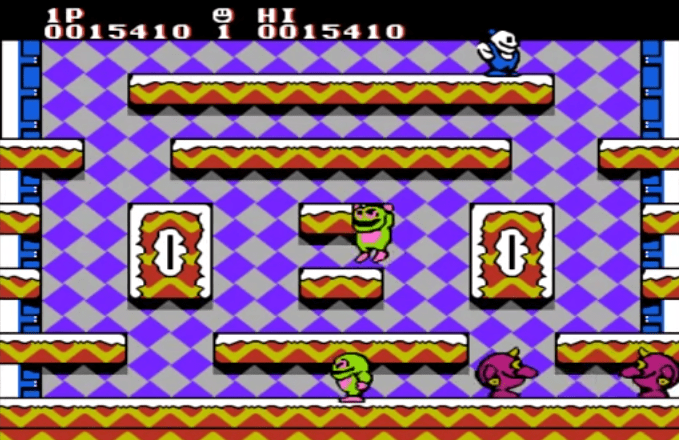
To progress through each level, you must turn monsters into snowballs by throwing snow at them. Once they are transformed into snowballs, you need to push them into each other or to the bottom of the screen where they smash against the wall and die. Once all monsters are defeated, you progress to the next level. There are several power-ups to help you along the way.
The power-ups are:
Red – increases walking speed
Blue – increases amount of snow you throw
Yellow – increases the distance snow can be thrown
Green – inflates you like a balloon where you can fly around the level killing anything you come into contact with.
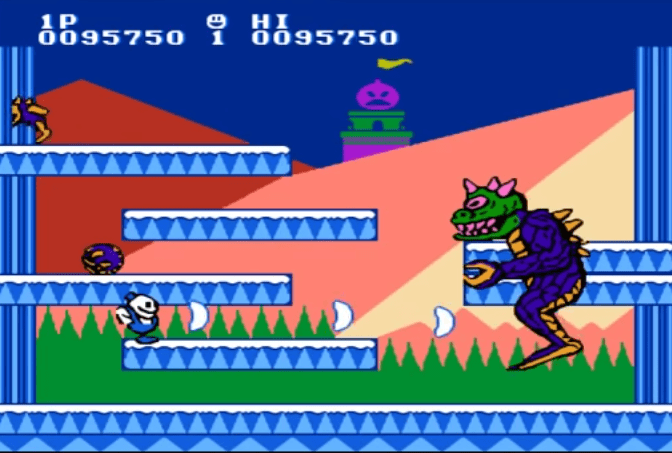
There are 50 levels in total, with a boss battle occuring every 10 levels.
Every ten levels, there is a big, bad boss to defeat (screenshot taken by the author)
How Does It Handle?
The controls are simple…move left or right, jump and throw. They are night and the game is easy to play. This game may seem simple, and older gamers may think this is for children…it is not! It’s challenging and it’ll take you several tries before you can complete the game.
This is a fun game to play, especially in two-player mode. Thankfully, you cannot harm each other when you are throwing snow, which could get extremely frustrating if that was a feature.
Graphics
The levels are very colourful, sometimes so much that it hurts the eyes. The game also tends to flicker a little when the screen is busy.
Replay Value
The game has limited replay value, but I think you will come back to it more than once after you have beaten the game, especially to play it in two-player mode.
You must throw snow at the enemy to turn them into snowballs (screenshot taken by the author)
Did I Complete The Game?
Although I did play this several times with Mrs. L, I completed it by myself.
What The Critics Said?
At present I have been unable to find a contemporary review of this game.
My Verdict:
“This game is fun! It’s easy to control but challenging. It has the added bonus of being two player, and even after you have beaten the game, you’ll want to play through it again and again.”
Rating:
What are your memories of Snow Bros.? I would love to hear your thoughts, and don’t for get to follow and subscribe so that you don’t miss my latest reviews! You can also find me on Instagram: @nicklovestogame.
Kirby Super Star is a platform game developed by HAL Laboratory and released by Nintendo for the SNES in Japan and North America in 1996. It was released in 1997 in Europe under the name of Kirby’s Fun Pak. Between 2009-2010, it was re-released on the Wii and Wii U Virtual Consoles. In 2008, an enhanced version was released on the Nintendo DS. It was released on the Nintendo Switch in 2019. For this review, I played the version found on the SNES Mini.
Title screen (screenshot taken by the author)
Who Is Kirby?
This action platformer contains several games featuring Kirby, a weird, round, pink puffy-type character; that can float, inhale enemies and copy their abilities, or alternatively, inhale and spit out blocks to attack the enemies.
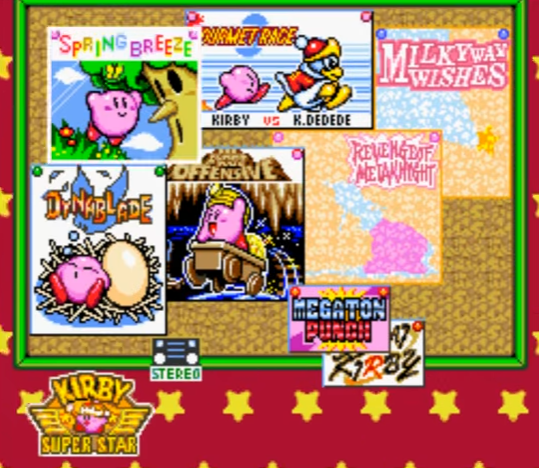
The menu screen where you can select and unlock new games (screenshot taken by the author)
So what are the games:
Spring Breeze: Similar to Kirby’s Dream Land, although with some differences. King Dedede has stolen all the food from the citizens of Dream Land. Kirby must battle his way to the castle to defeat him and regain the food.
The bright, colourful graphics of the Spring Breeze game (screenshot taken by the author)
Dyna Blade: Dyna Blade is a giant bird, who is attacking the crops of Dream Land. Kirby must make his way through four levels before he fights Dyna Blade.
Gourmet Race: Kirby must race against King Dedede whilst eating as much food as possible. These races take place across three levels. You earn points during the race by eating food, and you can gain bonus points by coming first. Whoever has most points after all three races is the winner. You have the option to either race King Dedede or his ghost (the player’s best attempt at a race). You can also race alone in a time-trial style mode.
The Great Cave Offensive: An action-adventure type game where Kirby must explore caves to find treasure. There are four areas and 60 treasure chests to find. Some of the treasures are nods to previous Nintendo games, but I won’t spoil the surprise here.
Revenge of Meta Knight: The Meta Knight is attempting to conquer Dream Land in his battleship, the Halberd. Kirby must stop the Meta Knight by defeating him in a duel. Unlike the other games, this one has a time-limit. Naturally when the time runs out, Kirby loses a life.
Milky Way Wishes: The Sun and Moon have engaged in a battle around planet Popstar with a creature named Marx. Kirby must travel to different planets in a bid to fix a giant wish-giving clock called NOVA. Unlike the other games, Kirby cannot adopt the abilities of the enemies he swallows. To adopt different abilities, he must collect items called Copy Essence Deluxes. These allow Kirby to select an ability from a list.
The Arena: This mode challenges Kirby to fight every boss in the game (26 bosses in 19 rounds). Between each fight, you find yourself in a room where you can collect five tomatoes (each one can only be used once), and two random pedestals that will grant you certain powers.
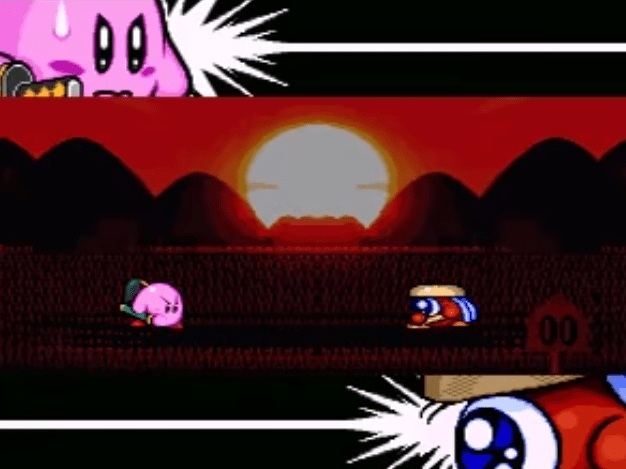
Samurai Kirby: Similar to Kirby’s Adventure’s: Quick Draw, you must wait for the signal before pressing a button to draw. If you draw quicker than your opponent, then you win. If not, you lose.
Draw you scum sucking mollusc! (screenshot taken by the author)
Megaton Punch: This is another timing-based game. You face one opponent at a time and must press the button at certain times to gain power before Kirby attempts to punch the ground and crack a star. The person who produces the biggest crack wins.
Megaton Punch is a great game in two-player mode (screenshot taken by the author)
Preconceived Thoughts
I’ll have to be honest. The thought of playing this game didn’t inspire me with confidence. If I were in a shop browsing games to buy, I would not gravitate towards this one simply because it looks like it is a game for younger gamers.
How Does It Handle?
That being said, the gameplay is quite fun. I like the idea of being able to adopt different abilities from your enemies, each with their advantages and disadvantages. Kirby can also fly and swim, and has a defensive pose that makes him virtually invincible. An annoying feature of the gameplay is that when you attack, you cannot turn around until your attack has been completed, which sounds odd when I write it, but it will make sense when you play the game.
Graphics
The graphics are bright, sharp, and colourful, and sickeningly cute. There are some nice little animations too, such as when Kirby enters water, he wears a goggle and snorkel kit.
Music
The music is upbeat and fitting for the game, but as I sit hear writing this, I can’t recite the tune in my head. Sadly, this game couldn’t hold my attention for long.
Personal Favourites
Spring Breeze and Dyna Blade are very easy games and would be perfect for younger gamers. The Great Cave Offensive and Revenge of the Meta Knight are more difficult and may hold the attention of an adult for a while. Personally, I think the two best games to play are Samurai Kirby and Megaton Punch. They are pretty fun in one-player mode, but are so much better in two-player mode, and would definitely recommend you play these with a friend.
Did I Complete The Game?
I completed Spring Breeze and Dyna Blade, but not any of the others.
What The Critics Said:
Electronic Gaming Monthly: Dan – “I don’t understand why I like this game. I’m almost ashamed of it. It’s just that the cart is a piñata packed full of little goodies. You’ll just have to experience it to understand what I mean. Once you play it with a friend, you’ll be hooked. Overall 7.25/10“.[1]
Gamepro: “Everything’s improved from the 8-bit games (32 megs will do that). The graphics are sharp and colourful, and the spirited music changes constantly. If you haven’t gone Kirbying lately, bask in the light of this superstar. Overall 4.87/5“.[2]
My Verdict:
“The truth is, not everyone is going to like this game. The graphics and music are great but this game gets boring very quickly, and I can’t recommend it for adult gamers, even for the Samurai Kirby and Megaton Punch games, which, for me, are the best feature of this cart.”
Rating:
What are your memories of Kirby’s Super Star? I would love to hear your thoughts, and don’t for get to follow and subscribe so that you don’t miss my latest reviews! You can also find me on Instagram: @nicklovestogame.
[1] ‘Review Crew: Playstation – Kirby’s Super Star’. Electronic Gaming Monthly. (September 1996). Issue 86:30.
The Super Mario Bros. franchise is one of the most popular series of games ever to grace the planet. The brothers, who are plumbers by trade, seem to be regularly called upon to defeat the evil Bowser, and rescue Princess Toadstool (Super Mario 2 is different, as it was originally intended to be a different game). So get ready for a whole new adventure, of sliding down drainpipes, squashing Goombas, dodging Bullet Bills, discovering the secrets of the Ghost Houses, and the introduction of a new ally named Yoshi.
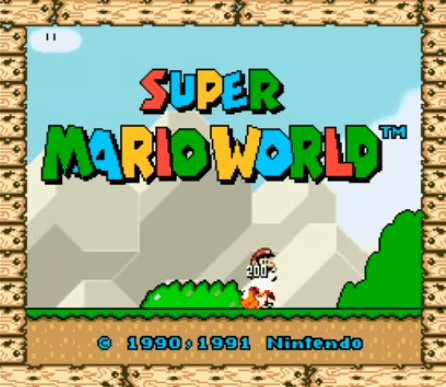
Title Screen (screenshot taken by the author)
Super Mario World is a side-scrolling platform game developed and published by Nintendo, and released for the SNES in Japan in 1990, North America in 1991, and Europe in 1992. It would later be released for the Game Boy Advance in 1991/2. The version I chose to review can be found on the SNES Mini.
Plot
In Super Mario 3, Mario and Luigi saved the Mushroom Kingdom from King Bowser. In need of a vacation, they visit Dinosaur Land for some much needed R&R. During their vacation, Princess Toadstool disappears…again! While searching for her, the brothers find a dinosaur egg which soon hatches, and they are introduced to Yoshi.
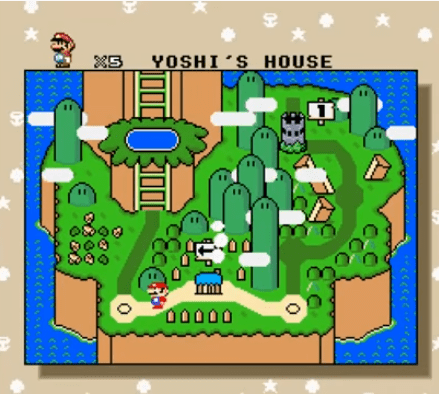
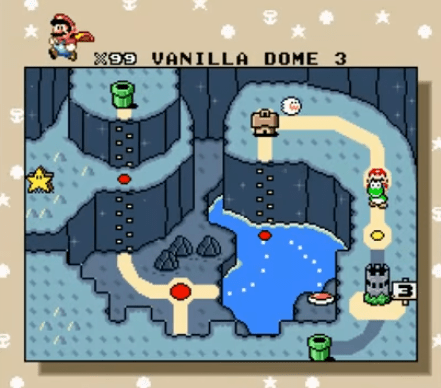
The Overworld Map at the beginining of the game (screenshot taken by the author)
Gameplay
The game begins on a map of the Dinosaur Land where yellow and red dots indicate the levels that need to be traversed before you can progress. If the dot is red, it means that there is a secret area or alternative route that once found, will open up another secret area. Ghost Houses also tend to have secret areas too.
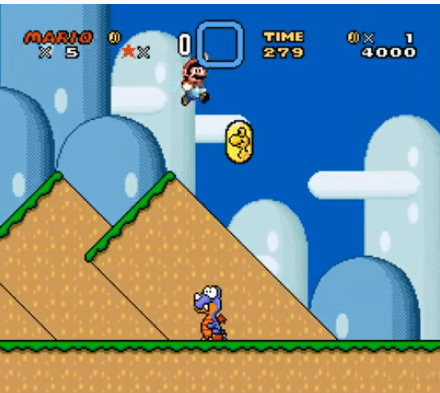
Collect 5 Yoshi coins in one level to gain a 1-up (screenshot taken by the author)
The game follows the standard Mario gameplay of running from left to right and jumping over obstacles, and either evading or killing a variety of enemies. Power-Ups include the standard Super Mushroom, Star of Invincibility, Fire Flower that allows you to throw fireballs, and a cape that allows Mario to fly and/or descend slowly. Mario and Luigi can also perform a new spin and jump move which allows you to destroy blocks you are standing on (or next to if you’re wearing the cape).
Yoshi has his uses too. He can eat pretty much anything. Some of the enemies he eats will stay in his mouth and can be spat out at other enemies. Depending on what he eats will depend on what he spits out. If he eats a Koopa Troopa (green shelled turtle), he will simply spit out a green shell, but if he eats a Koopa Paratroopa (red shelled turtle), he will spit out fire balls. If you are hit when riding Yoshi, he will squeal and you will simply dismount him without losing any power-ups you have. Yoshi will continue to run until you re-mount him or he runs off screen.
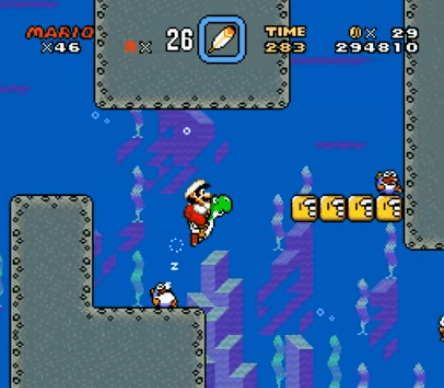
There are several underwater levels to challenge you but, unlike Sonic, Mario doesn’t need to find air bubbles to survive (screenshot taken by the author)
Another new feature means you can now store a power-up in a blue box at the top of the screen. You can make the power-up drop down manually to change your ability, or it will automatically drop when you are struck by an enemy.
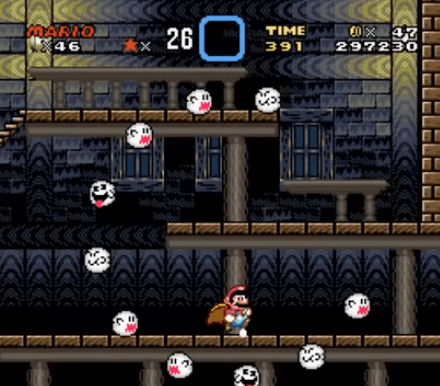
Evading ghosts in the one of the many Ghost Houses (screenshot taken by the author)
Coins and Yoshi tokens can be collected as usual to increase point and gain extra lives. Every time you collect 100 coins you will gain an extra life. Each level contains five Yoshi tokens. If you collect all five in one level, you gain an extra life.
Once a level is completed, you can still play it again, but with an addition that if you wish to exit the level before making it to the end, you simply pause the game and press select. You will then be taken back to the Overworld Map.
More of the Overworld Map (screenshot taken by the author)
How Does It Handle?
It is not difficult to see why this game is considered one of the greatest. The controls are tight and there’s plenty of secrets to find. The game is easy to learn and fun for all ages to play. You will be drawn back to revisit the game time and again.
Graphics
Brightly coloured levels with beautifully illustrated and animated sprites. Even today, the game still looks awesome! The levels are challenging but fun, and look great.
Musicand SFX
The music is so iconic and will get stuck on a loop in your head. Interestingly, when riding Yoshi, extra drum beats are added to the music which is a cool little addition.
Ah, the SFX. The familiar sound of Mario collecting coins, descending a pipe, or when he is hit by an enemy and shrinks. My childhood right there! When you go into cave levels, a slight echo is added to the SFX which is a great touch.
Replay Value
Super Mario World can be played in one and two-player modes which allow you to take it in turns to complete levels. As you progress through the game you will be given a percentage of how much the game is completed. However, you don’t need to have played all the levels and/or found all the secret areas to complete the game. For those of us that simply must find every secret of a game, this will add to the replay value, as you will be replaying levels trying to find alternative routes and secret areas.
Did I Complete The Game?
I have completed the story but have yet to achieve 100% on the game.
What The Critics Said:
Computer & Video Games: “What a truly terrific game! With seven worlds and over a hundred sub-levels, Mario IV has incredible depth of gameplay. Overall 96%.”[1]
Electronic Gaming Monthly: “The ultimate Mario adventure! Super Mario World is a perfect subtitle, with 96 areas to explore. Everything just plain blew me away! Overall 9/10.”[2]
Super Play: “An amazingly deep and playable platform game, and a credit to Nintendo. Unmissable. Overall 94%.”[3]
Awards:
Best Graphics and Sound (SNES) – Nintendo Power Awards 1991[4]
My Verdict:
“I had so much fun revisiting this game. It holds up very well. Beautifully illustrated and animated, and I love the music! There are loads of fun new features, and the game has great replay value. A true landmark of a game in the side-scrolling platform genre.”
Rating:
What are your memories of Super Mario World? I would love to hear your thoughts, and don’t for get to follow and subscribe so that you don’t miss my latest reviews! You can also find me on Instagram: @nicklovestogame.
[1] Glancey, P., ‘Review: Super Mario World’. Computer & Video Games. (March 1991). Issue 112:48-50.
[2] ‘Review Crew – Super Mario 4’. Electronic Gaming Monthly. (August 1991). 25:18.
[3] Brookes, J., ‘UK Review – Super Mario World’. Superplay. (December 1992). 2:84.
[4] ‘Nintendo Power Awards ’91 – For Graphics and Sound (SNES)’. Nintendo Power. (May 1992). 36:58.
The lightning quick blue ball of spikes has returned, and this time he has speedy side-kick. Yes, Sonic is back with a faster, bigger, and more challenging game for those with quick reflexes.
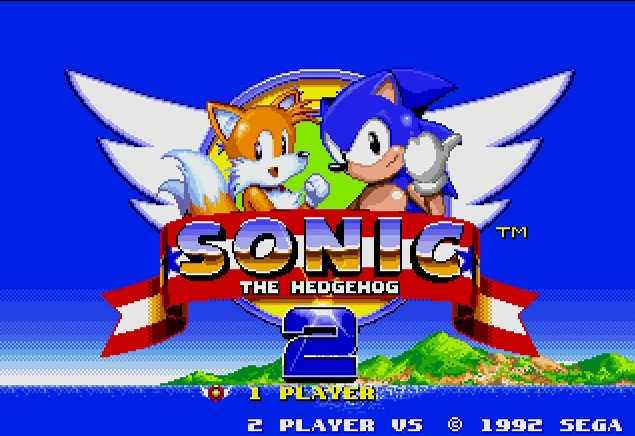
Title screen (Screenshot taken by the author)
Sonic the Hedgehog 2 is a platform game developed and published by Sega for the Megadrive in 1992. It is the sequel to Sonic the Hedgehog with 8-bit versions being released on the Master System and Game Gear. In recent years, versions were released for multiple mobile platforms as well as part of a number of Sega collection packages for the PlayStation and Xbox systems. I chose to review the Mega Drive version of Sonic 2.
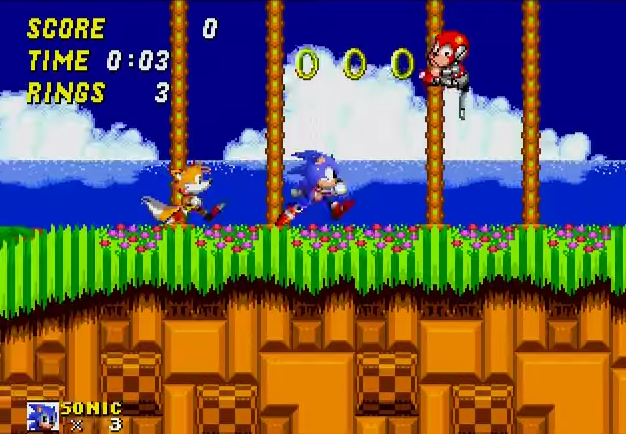
Sonic is accompanied by Tails (Screenshot taken by the author)
Plot
Sonic is back, and this time he has assistance from his trusty sidekick Miles “Tails” Prower, a two-tailed fox. Dr. Robotnik is also back, and again plans to steal the Chaos Emeralds to power his space station known as the Death Egg. Sonic must make his way through an array of different levels evading the robotic minions of Dr. Robotnik. Like the first instalment, Sonic has the option to destroy the minions to release the animals that Dr. Robotnik has trapped inside them.
Gameplay
At the start you can choose to play as Sonic, Tails, or as Sonic with Tails (a second player can control Tails but the camera will always follow Sonic). There is no real difference between Sonic and Tails.
The zones you will travel through are:
Emerald Hill Zone
Chemical Plant Zone
Aquatic Ruin Zone
Casino Night Zone
Hill Top Zone
Mystic Cave Zone
Oil Ocean Zone
Metropolis Zone
Sky Chase Zone
Wing Fortress Zone
To traverse the levels, Sonic (and Tails) can run at incredibly high speeds, jump, and spin. Along the way you can collect as many coins. These act as a life bar. If you get hit whilst holding coins, they will spill out and you have only a second or two to recover them before they disappear. When jumping, our protagonists will curl into a ball allowing them to attack and destroy the enemies. However, enemies with spikes will cause them to lose their coins or die if they aren’t holding any. If you pass the Star Post and it turns from blue to red, you will return to this point if you die. If you have 50 coins of over when you pass one, a horizontal circle will appear and expand. Jump into this and it will take you to a Special Stage for a chance to win a Chaos Emerald. If you collect 100 coins, you will gain an extra life.
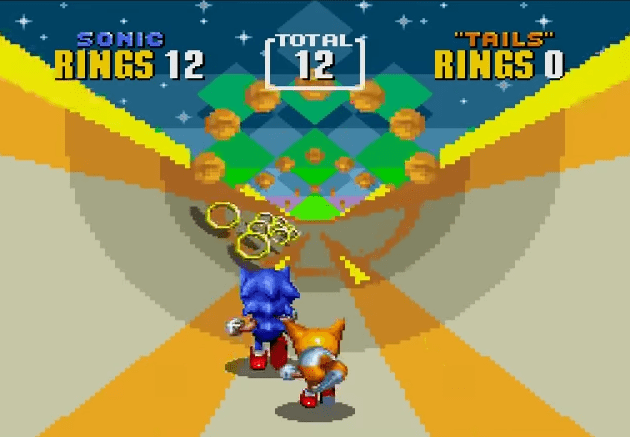
The Special Stages are now designed like a half-pipe run and are broken into stages. You must gain ‘X’ amount of rings to progress to the next stage, all the while dodging obstacles that will make you lose rings if you hit them. I would recommend playing as one or the other alone because if you have Tails with you, he will often get hit by an obstacle and will lose you rings.
As with the original Sonic the Hedgehog (1991), there are goodies to look out for:
Power Sneakers – These allow Sonic and Tails to run and even faster speeds for a short time
Super Rings – Earn 10 rings
One-Ups – Gain a life
Invincibility – Sonic becomes impervious to harm for a short time
Shield – Protect Sonic for one hit
A new feature is the introduction of the Spin Dash. This allows sonic and Tails to curl into a ball and build up a head of speed on the spot before an explosive release where he is propelled forward at high speed.
The new half-pipe special stages (Screenshot taken by the author)
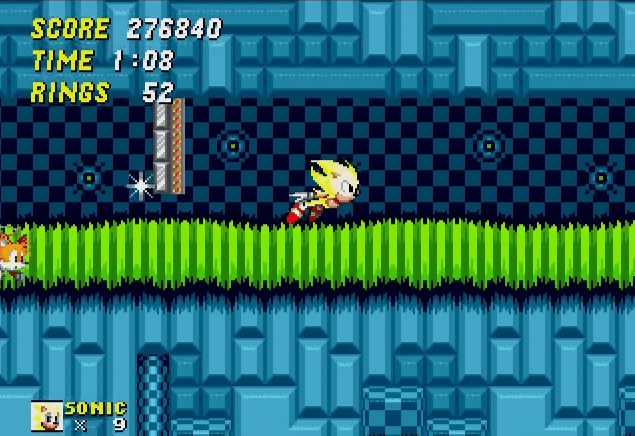
Once you have won all the Chaos Emeralds, Sonic gains the ability to transform into Super Sonic by gaining 50 rings and jumping into the air. As Super Sonic you are invincible, can run faster and jump higher. However, it uses up your rings at a rate of one per second. Once they are gone, Sonic reverts back to his normal self.
After you collect all the Chaos Emeralds, Sonic will be able to temporarily transform into Super Sonic (Screenshot taken by the author)
The addition of a competitive two-player mode where you can race another player through certain levels and special stages adds an extra element of fun which I know myself and my buddies found particularly diverting.
With the release of Sonic and Knuckles (1994), the two cartridges could be interlocked, enabling you to play through Sonic 2 as Knuckles the Echidna. Knuckles can glide and climb walls, enabling you find alternative routes through the levels. However, he cannot jump as high as Sonic and Tails, making some of the boss fights a bit more difficult.
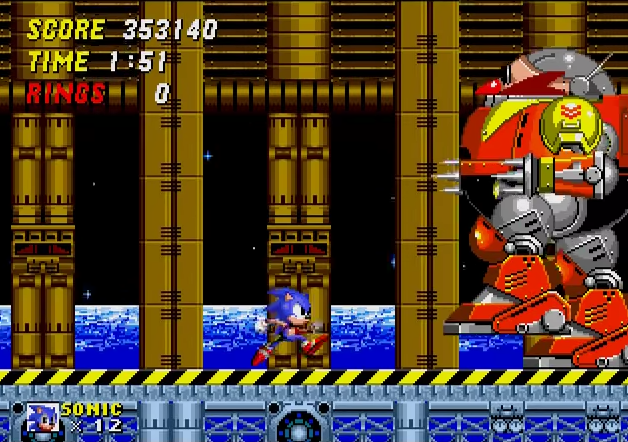
Sonic and Tails must fight their way through an array of new machines built by Dr. Robotnik (Screenshot taken by the author)
How Does It Handle?
The controls are tight, no complaints there, and the game feels faster than it’s predecessor. The levels are longer, less linear (you sometimes have to go back on yourself to find the correct route) and more intricately designed, making traversing the levels more challenging. Some of the evil minions are harder to destroy and the end of level bosses are certainly more challenging and inventive too.
Having revisited the game I noticed that in both one and two-player mode, the game has a tendency to slow down and the sprites flicker a bit when Sonic and Tails are going top speed, and in particularly when you are hit by an enemy and lose lots of rings.
Graphics
The graphics haven’t changed that much since the first Sonic game. The Sonic sprite is a slightly darker shade of blue, and the enemy sprites are designed to have a more mechanical look. Lots of colour, great looking levels, and beautifully designed sprites. The game still looks awesome.
Music& SFX
The music is still great, but I don’t think its quite as memorable as the first game for me. I don’t think I would be able to tell you the stage the music comes from like I can with the first. In fact, I mostly remember the Special Stages music.
The SFX are also in keeping with the Sonic sound from the original. When doing a Spin Dash, you can really rev up the speed and the sound that accompanies it really emphasizes the speed at which Sonic is going.
Personal Memories
The two-player mode is what my friends and I played alot when we got this game. I remember distinctly arriving at my buddy’s house and eagerly turning the game on for the first time. We played for hours.
I did feel that the way you have no rings or means to get them for the last two bosses is a cheap way to make the bosses harder, and I found that frustrating.
Did I Complete The Game?
Yes, I have completed this game a few times through whilst winning all the Chaos Emeralds.
What The Critics Said:
Gamepro: “Its tough to follow a classic but Sonic the Hedgehog 2 earns top honours. There’s enough stuff that’s new and different in Sonic 2 to make it a must-have cart for fans of the original. Overall 19.5/20”.[1]
Gamesmaster:“The changes are there, but they’re just not profound enough to transform the game into an essential buy for owners of the original. Overall 65%”.[2]
Computer & Video Games: Paul Anglin – “At first glance Sonic may not look radically different to the original, but it packs a lot more punch than Bluey’s first outing. The levels are absolutely massive, with so much to do and so much to find that you’ll bust a gut trying. Overall 94%“.[3]
Computer & Video Games: Tim Boone –“For a start it’s all a tad faster, and the addition of Tails is a real master stroke to beef up the gameplay. Graphics are no great improvement over the original, but seeing as the first game’s were about the best you’ll find that’s no bad thing! Sound is ace too. Overall 94%”.[4]
Gamer Fan:“Sonic 2 is amazing, faster and nastier than ever spinning through awesome new zones that will make your eyes bug out! The creativity and attention to detail is remarkable and to finish with all the chaos emeralds is a worthy challenge for even the best players. Overall 98.5%”.[5]
Mean Machines Sega:“Sonic has outdone itself. An absolute gem of a game which your Megadrive will be screaming out for. Overall 96%”.[6]
Mega: “Sonic 2 is pure, top grade video game entertainment. No one should miss it. Fight for a copy. Overall 94%”.[7]
Megazone:“Sonic 2 is a brilliant sequel, and does what most sequels don’t do – improve and expand on the original. Overall 96%”.[8]
Sega Force: “One of the best games of the year and definitely worth the wait! Overall 97%”.[9]
Electronic Games: “Sonic the Hedgehog 2 offers the same exciting play as the first, but the welcome additions of two-player simultaneous play and more levels only enhance this exciting title. Sonic shows no signs of slowing down! Overall 91%”.[10]
Awards:
Best Game of the Year (Sega Genesis) – Electronic Gaming Monthly Best and Worst of 1992[11]
Game of the Year – Megazone Games of the Year 1992[12]
Hottest New Character in a Video Game (All Systems) – Electronic Gaming Monthly’s Best and Worst of 1992[13]
My Verdict:
“There was something about this game that I didn’t like, but I can’t quite put my finger on what it was. I just didn’t enjoy it as much as I did the first. That being said, this is a solid sequel, and I did have fun revisiting the game. There are plenty of new features, to make it worth playing, and the addition of a two-player mode adds to the overall enjoyment of the game”
Rating:
What are your memories of Sonic the Hedgehog 2? I would love to hear your thoughts, and don’t for get to follow and subscribe so that you don’t miss my latest reviews! You can also find me on Instagram: @nicklovestogame.
[1] The Unknown Gamer. ‘Pro Review: Megadrive – Sonic the Hedgehog 2’. Gamerpro. (January 1993). 43:46-50.
[2] Lowe, A., ‘Game Review: Mega Drive – Sonic the Hedgehog 2’. Gamemaster Magazine. (January 1993). Issue 1:56-8.
[3] Anglin. P., ’Review: Mega Drive – Sonic the Hedgehog 2’. Computer & Video Games. (November 1992). issue 132:22-3.
[4] Boone, T., ‘Review: Mega Drive – Sonic the Hedgehog 2’. Computer & Video Games. (November 1992). Issue 132:22-3.
[5] ‘Viewpoint: Mega Drive: Sonic the Hedgehog 2’. Gamer Fan. (December 1992). Volume 1 Issue 2:9.
[6] ‘Review: Mega Drive – Sonic the Hedgehog 2’. Mean Machines Sega. (November 1992). Issue 2:60-3.
[7] ‘Review: Mega Drive – Sonic the Hedgehog 2’. Mega. (November 1992). Issue 2:36-41.
[8] Clarke, S., ‘Review: Mega Drive – Sonic the Hedgehog 2’. Megazone. (December 1992/January 1993). Issue 25:31-33.
[9] ‘Review: Mega Drive – Sonic the Hedgehog 2’. Sega Force. Issue 12:14-16.
[10] Carpenter, D., ‘Video Game Gallery: Genesis – Sonic the Hedgehog 2’. Electronic Games. (December 1992). Volume 1 Issue 3:72-4.
[11] ‘EGM Best and Worst of 1992 Video Game of the Year’. Electronic Gaming Monthly1993 Video Game Buyer’s Guide. (1993). :14.
[12] ‘Game of the Year Awards 1992 – Sonic the Hedgehog 2’. Megazone. (December 1992/January 1993). Issue 25:21.
[13] ‘EGM’s Best and Worst of 1992: Hottest New Character in a Video Game (All Systems) – Sonic The Hedgehog 2‘. Electronic Gaming Monthly’s 1993 Video Game Buyer’s Guide. (1993). :20.
He may not be the sharpest flint in pre-history, but Chuck Rock has a head as hard as a granite and a belly that is deadly. So get ready to navigate jungles and swamps, battle dinosaurs, and rescue your wife before Garry Gritter has his way with her. Unga Bunga!!!
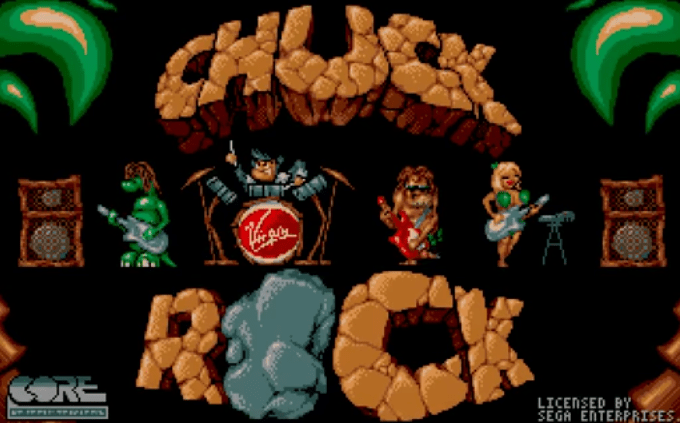
Title screen (screenshot taken by author)
Chuck Rock is a single-player side-scrolling platform game developed by Core Design. It has been published and ported to many other platforms including:
Core Design – Atari St and Amiga (1991), Commodore 64 (1992), and Amiga CD32 (1994)
Krisalis Software – Acorn Archimedes (1991)
Virgin Interactive – Sega Megadrive (1991), Sega Master System (1993) and Game Gear (1992)
Sony Imagesoft – Sega Mega-CD (1993), SNES (1992) and Game Boy (1993).
I chose to review the Mega Drive version.
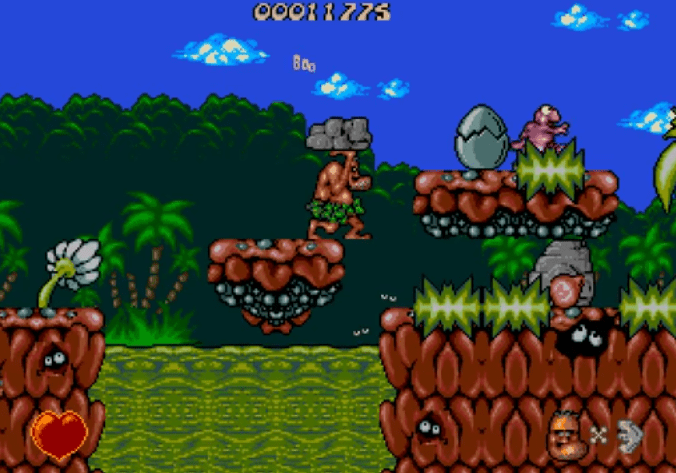
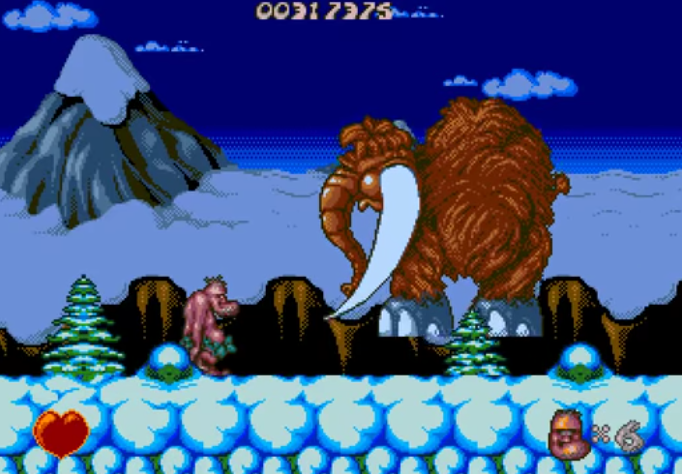
Beautiful level design (screenshot taken by author)
Plot
Set in a fantasy prehistoric Stone Age, Chuck is enjoying a lazy day in front of his TV drinking beer (root beer that is). His wife, Ophelia, is going about her daily chores unaware that she will soon be kidnapped by the evil Gary Gritter, who has designs on her. Chuck hears the commotion and investigates, only to find a pile of crumpled, dirty clothes and signs that something heavy has been dragged away. Since he has no clothes to wear, he ducks behind some nearby bushes and fashions some leafy pants to cover his modesty. He must now rescue his wife.
Gameplay
Chuck must navigate his way through five levels, each with three-five stages, all the while evading various dinosaurs and prehistoric animals; or if you are feeling brave, barging them out the way with your belly, performing flying kicks, or picking up huge boulders and throwing them. I’d recommend using the latter two to kill your enemies.
The levels are:
The jungle scene
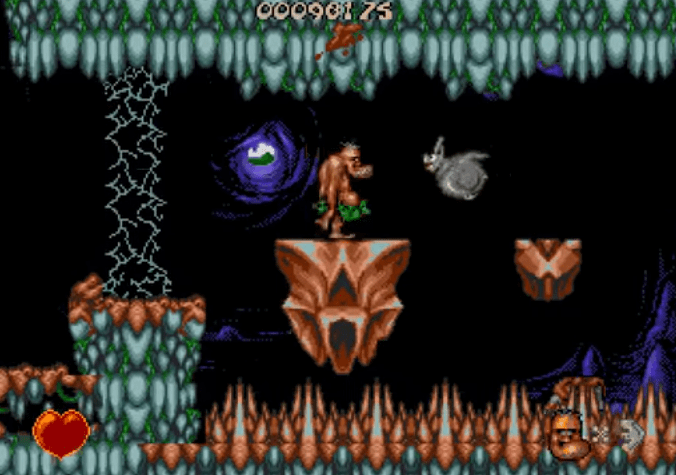
The caves scene
The water scene
The Ice scene
The Graveyard scene
Chuck may look like a everyone’s least favourite uncle, but he is the hero of this tale (screenshot taken by author)
How Does It Handle?
The controls are easy to learn and are nice and responsive. The game is challenging with some tough levels. Oddly, the end of level bosses are all very easy to defeat with the exception of the third boss. The only boss that you need a strategy to defeat is the first boss, but other than that, it is simply a case of button mashing. One nice little touch is that when Chuck is carrying a large rock, he won’t move as fast.
Graphics
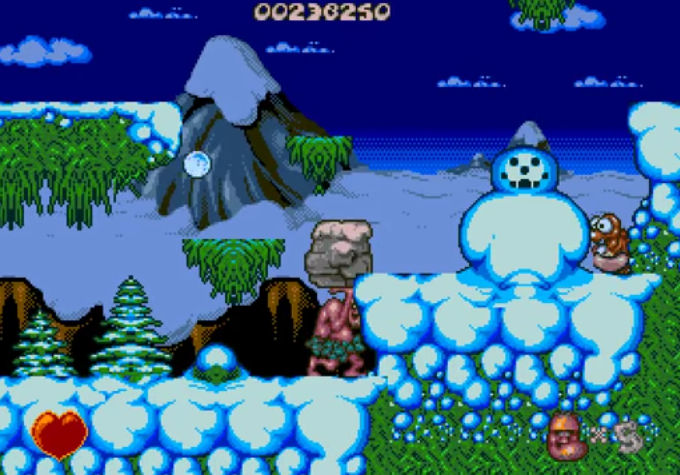
Throughout the entire game the graphics look fab. The overall feel of the graphics is more on the whacky side than the realistic side. The background look great, and I particularly like the snowman on The Ice scene level. There’s plenty to catch the eye and make you think “That looks cool!”, like a T-rex with boxing gloves…awesome!
The levels look gorgeous (screenshot taken by author)
Music& SFX
The music is good throughout the game. The opening musical number on the title screen is awesome and I found myself delaying playing the game in order to listen to the song the whole way through. It seems that even though Chuck isn’t the sharpest tool in the box, he has aspired to lead singer of a rock band. The music speeds up during the boss battles.
There are plenty of SFX throughout the game as Chuck jumps, throws rocks, and bounces enemies of his belly.
Replay Value
Sadly, this game lacks replay value. There is only one difficulty setting and once completed you may only wish to revisit it once or twice before turning your attention to the next challenge.
(screenshot taken by author)
Did I Complete The Game?
Yes, I completed the game without the use of cheats. Sadly, upon completing the game you are met another example of an anti-climatic ending to a game that deserved more.
What The Critics Said:
Mean Machines: “An excellent and quite original platform game that’s highly recommended to all Megadrive players. Overall 91%.”[1]
Mean Machines Index: “A brilliant, humorous Megadrive platform game with real character. Its graphics are out-of-this-world, the sound completely brilliant, and the game play pretty good too! A must have for your Megadrive collection. Overall91%”[2]
Sega Power: “Groovy goings-on 100 million years B.C. with wild sonics and graphics as Chuck rescues his wife from the evil Garry Glitter. Overall4/5.”[3]
Electronic Gaming Monthly: “The gameplay could use a little fine tuning, but it is still very fun to play. The graphics are comical and the music jams. Overall7.75/10”.[4]
Megazone:“Graphics wise this game is a hit (as good as the Amiga on the Mega Drive), the sound is pretty good (not quite up to the Amiga, but still pretty hot) and some imaginative sprite drawings have been added to this game. Overall85%”.[5]
GamePro:“The game’s worth the bucks for the music and graphics alone. From standpoint of challenge and gameplay, it’s middle of the road – not too hard and not too easy. Overall4.6/5.”[6]
My Verdict:
“Unga Bunga – The game has nice graphics and is fun to play. The simple button mashing as oppose to a strategy needed to defeat end of level bosses, is a mark against this game. The lack of replay value means that once completed I doubt you will want to play through again.”
Rating:
What are your memories of Chuck Rock? I would love to hear your thoughts, and don’t for get to follow and subscribe so that you don’t miss my latest reviews! You can also find me on Instagram: @nicklovestogame.
[1] ‘Review: Mega Drive – Chuck Rock’. Mean Machines. (June 1992). Issue 21:76-8.
[2] ‘Review: Mega Drive – Chuck Rock’. Mean Machines. (October 1992). Issue 1:137.
[3] ‘The Hard Line – Review: Mega Drive – Chuck Rock’. Sega Power. (September 1993). Issue 46:96.
In a bid to compete with the popularity of Nintendo’s Super Mario Bros. series, the early 1990s saw Sega introduce a new hero for their latest console, the Sega Mega Drive. Whilst it was still a platform game with a recurring antagonist, it was unique enough so as not to be accused of copying Mario’s format. In 1991, Sonic the Hedgehog burst onto our screens and has maintained a place in the hearts of retrogamers everywhere.
Title screen (screenshot taken by the author)
Sonic the Hedgehog is a side-scrolling platform game developed by Sonic Team and published by Sega. It was released on the Sega Megadrive in 1991, spawning one of the most successful videogame series of all time. 8-bit versions were released on the Master System and Game Gear but with a few amendments. and the game greatly simplified. Laster re-releases include:
Sega Saturn as part of Sonic Jam (1997)
Nintendo GameCube as part of Sonic Mega Collection (2002)
PlayStation 2 and Xbox as part of Sonic Mega Collection Plus (2003)
GameBoy Advance (2006)
PlayStation 2 and PSP as part of the Sega Genesis Collection (2009)
PlayStation 3 and Xbox 360 as part of Sonic’s Ultimate Genesis Collection (2009)
Nintendo DS as part of Sonic Classic Collection (2010)
iOS, Android, and Nintendo 3DS (2013)
Oculus Rift as part of Oculus Arcade (2018)
Microsoft Windows, PlayStation 4, Xbox One and Nintendo Switch as part of Sonic Origins (2022)
This review is based on the Mega Drive version.
Plot
Sonic is a blue hedgehog who can run at incredible speeds. This speed, and the ability to defend himself by curling into a ball, allowing his spikes to damage his enemies, is put to use when the evil Dr. Ivo Robotnik arrives in Sonic’s homeland. He proceeds to steal the six Chaos Emeralds (which allows the user to warp time and space), and capture the local wildlife, transforming them into evil robotic animals.
Gameplay
Sonic must navigate through six zones, evading Robotnik’s minions whilst attempting to steal back the Chaos Emeralds which are found via special stages. The zones include:
Green Hill Zone
Marble Zone
Spring Yard Zone
Labyrinth Zone
Star Light Zone
Scrap Brain Zone
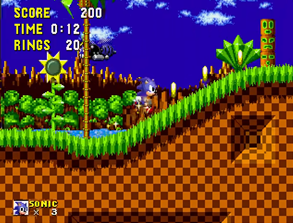
Spring Hill Zone (screenshot taken by the author)
Along the way, you collect gold rings which act both as health and a way to access the special stages where the Chaos Emeralds are. If you get hit by an enemy or land on spikes or lava, your coins will spill out all around you. However, you can instantly retrieve a small number before they disappear. If you take damage whilst holding no rings, you die. Should you still have 50 rings or more by the end of stages one and/or two of each zone, a large gold ring will appear that you must jump through to warp to the special stages. Gaining 100 rings will give Sonic an extra life.
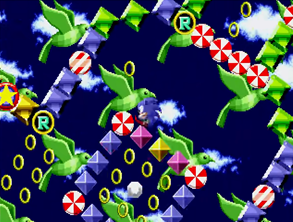
There are six special stages in all, each one different and consisting of Sonic constantly spinning in a ball whilst navigating a rotating semi-labyrinth. Throughout these stages you will encounter buttons that make the stages spin in the opposite direction, circular bumpers that ping you aggressively in all directions, flashing red buttons that make you exit prematurely from that bonus stage, and, of course, the Chaos Emeralds themselves.
Occasionally you will see what look like computer monitors showing either a ring, a blue sphere, red boots or stars on them. Depending on what is shown on the screens, destroying these will give you 10 rings, a protective shield, temporary super speed, and temporary invulnerability respectively.
The special stages can be somewhat nausea inducing (screenshot taken by the author)
How Does It Handle?
The controls are tight, consist of running, jumping, and spinning, and allow you to evade hazards and attack your enemies in the manner you intend. There are the realistic physics of skidding to stop when running at speed. You need to spin when attacking your enemies. When you destroy one of the enemy robots, a little animal is released and quickly scurries off, finally free from Robotnik’s clutches. The game can move incredibly fast at times so it is advised to play through it carefully at first. Once you memorize the levels and their hazards, you can use Sonic’s top speed to blitz the levels. The high speed at which Sonic can achieve makes for exciting gameplay.
Graphics
Sonic really was revolutionary for its time, and still holds up well today. The sprites, levels and backgrounds are beautifully illustrated and coloured, and are all unique, crisp and well defined. From the beautiful bright blues and greens of Green Hill Zone through to the muted industrial greys of Scrap Brain Zone, the levels look gorgeous. Each zone contains unique enemies and unique end of zone bosses. For the most part, the scrolling is very smooth. Although, when at top speeds the game does have a tendency to flicker and lag a bit.
When Sonic has been stationary for a certain period of time, he will look at the camera with his hands on his hips and tap his foot in frustration. I though this was a nice touch as it emphasizes his personality.
Music& SFX
The music is very memorable and even when I hear it now, I can recite every note and instantly know which level it belongs to. I very much like the change in music that sparks danger when you have been under water too long and the increase in tempo when you gain invincibility.
The SFX are so familiar to me that I would wager I could spot them if someone replayed one out of context of the game. The ‘tring’ when you collect a ring, the ‘twang’ when you use a spring pad, the ‘ding’ when you hit a bumper and, of course, the bassy ‘uh-oh’ sounding noise when you die, will be etched into my brain for the rest of my life.
Replay Value
There are two endings depending on if you manage to collect all the Chaos Emeralds which adds a little replay value. However, the game is so enjoyable that you’ll find yourself returning again and again.
Personal Memories
We bought our Sega Mega Drive for Christmas 1991, and Sonic came with the package. I have very fond memories of this game and have spent many an hour playing through it (it only takes about 30 minutes to complete). It’s an easy game to play but still challenging when trying to attain all Chaos Emeralds. The game appeals to all ages of gamer.
Did I Complete The Game?
Over the years I have completed Sonic the Hedgehog many times (including with all Chaos Emeralds collected) without the use of cheats, and will no doubt re-visit the game in the future to make sure I still can.
What The Critics Said:
Mean Machines: “Yep, it’s true – Sonic is really great! I can’t think of a Megadrive game with more spectacular graphics…”. Overall92%.[1]
Entertainment Weekly:“Dazzlingly fast yet never chaotic, consistently challenging but never impossible, Sonic the Hedgehog is quite simply one of the best video games I’ve ever played. A+.”[2]
Mean Machines Index: “Sega’s hyped-beyond belief character stars in a game inspired by Nintendo’s Mario platform game series. It’s very addictive with brilliant graphics and speed. However, the gameplay is frustrating at times and experienced gamers should have this one licked within days. Overall90%”[3]
Sega Power: “World famous and rightly so. This is almost certainly the game that has sold more Sega systems than anything else. It’s a bit easy and looks slightly dated now, but it’s still one of the best games around. Overall5/5”.[4]
Sega Power: “Sega’s answer to Super Mario Bros, Sonic is the fastest parallax scrolling collect-‘em-up ever! A stunning rotating bonus round and a feast of visual effects – a classic. Overall 5/5”.[5]
Awards:
Overall Game of the Year – EMAP’s Golden Joystick Awards[6]
Game of the Year (Overall) – Electronic Gaming Monthly[7]
Game of the Year (Genesis) – Electronic Gaming Monthly[8]
Best Graphics in a Video Game – Electronic Gaming Monthly[9]
Hottest Character in a Game – Electronic Gaming Monthly[10]
My Verdict: “A revolutionary riposte to Nintendo’s Super Mario Bros. series. It’s beautiful, colourful, fun, challenging, and has great music. Every gamer should play this game as a rite of passage.”
Rating:
What are your memories of Sonic the Hedgehog? I would love to hear your thoughts, and don’t for get to follow and subscribe so that you don’t miss my latest reviews! You can also find me on Instagram: @nicklovestogame.
[1] ‘Review: Mega Drive – Sonic the Hedgehog’. Mean Machines. (July 1991). Issue 10:42-44.















 Nick Loves to Game