Snow Bros. – Review

What makes a great video game? Graphics, music, replay value, multiplayer options…there is no correct answer. Personally, I feel that gameplay is more important than the others. If a game doesn’t play well, the rest is pointless. That’s just my opinion of course.
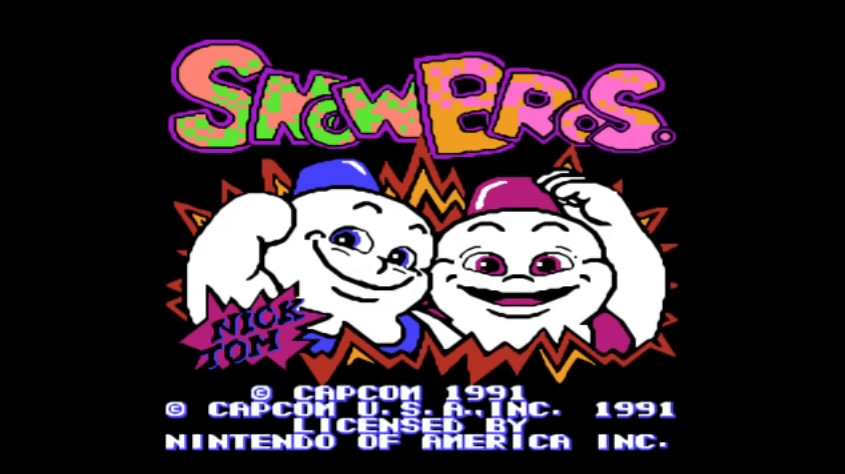
Title screen (screenshot taken by the author)

Snow Bros. was developed and published by Toaplan for the arcade in North America, Japan and Europe in 1990. Over the next few years it was released for home consoles on the NES, Game Boy and Mega Drive in North America and Japan but wasn’t officially released in Europe until the Android and iOS versions in 2012. For this review, I played the NES version.

Plot

In this platform game you play as Prince Nick and/or Prince Tom who are cursed and turned into snowmen by King Scorch whilst he captures Princesses Teri and Tina. Naturally, the two princes pursue King Scorch in order to rescue the princesses.
(screenshot taken by the author)

Gameplay

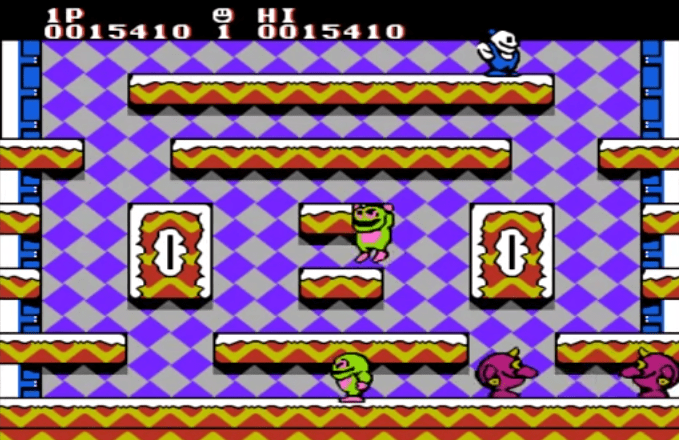
To progress through each level, you must turn monsters into snowballs by throwing snow at them. Once they are transformed into snowballs, you need to push them into each other or to the bottom of the screen where they smash against the wall and die. Once all monsters are defeated, you progress to the next level. There are several power-ups to help you along the way.

The power-ups are:

Red – increases walking speed

Blue – increases amount of snow you throw

Yellow – increases the distance snow can be thrown

Green – inflates you like a balloon where you can fly around the level killing anything you come into contact with.

There are 50 levels in total, with a boss battle occuring every 10 levels.
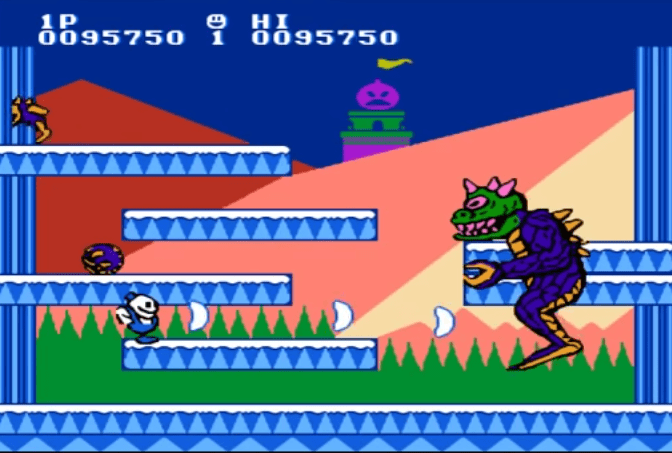
Every ten levels, there is a big, bad boss to defeat (screenshot taken by the author)

How Does It Handle?

The controls are simple…move left or right, jump and throw. They are night and the game is easy to play. This game may seem simple, and older gamers may think this is for children…it is not! It’s challenging and it’ll take you several tries before you can complete the game.

This is a fun game to play, especially in two-player mode. Thankfully, you cannot harm each other when you are throwing snow, which could get extremely frustrating if that was a feature.

Graphics

The levels are very colourful, sometimes so much that it hurts the eyes. The game also tends to flicker a little when the screen is busy.

Replay Value

The game has limited replay value, but I think you will come back to it more than once after you have beaten the game, especially to play it in two-player mode.

You must throw snow at the enemy to turn them into snowballs (screenshot taken by the author)

Did I Complete The Game?

Although I did play this several times with Mrs. L, I completed it by myself.

What The Critics Said?

At present I have been unable to find a contemporary review of this game.

My Verdict:

“This game is fun! It’s easy to control but challenging. It has the added bonus of being two player, and even after you have beaten the game, you’ll want to play through it again and again.”

Rating:

What are your memories of Snow Bros.? I would love to hear your thoughts, and don’t for get to follow and subscribe so that you don’t miss my latest reviews! You can also find me on Instagram: @nicklovestogame.

Contra (Probotector & Gryzor) – Review

A picture containing man, holding, people

Description automatically generated

Arcade games were designed to be nigh on impossible to complete. This was because not only did the creators want to challenge gamers, but they also needed to be able to sell a product to arcade owners who in turn wanted games that gamers would repeatedly pump their pocket money in to continue playing…it is a business after all. When arcade games were ported to home consoles, it often seems that the creators failed to adjust the difficulty levels. Young gamers today have no idea how easy they have it all with constant automatic saving, online walkthroughs and cheat pages close-by, at the touch of a button.

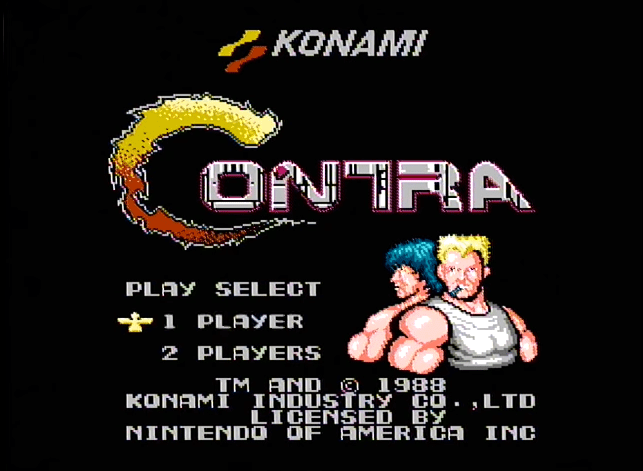
Title screen (screenshot taken by the author)

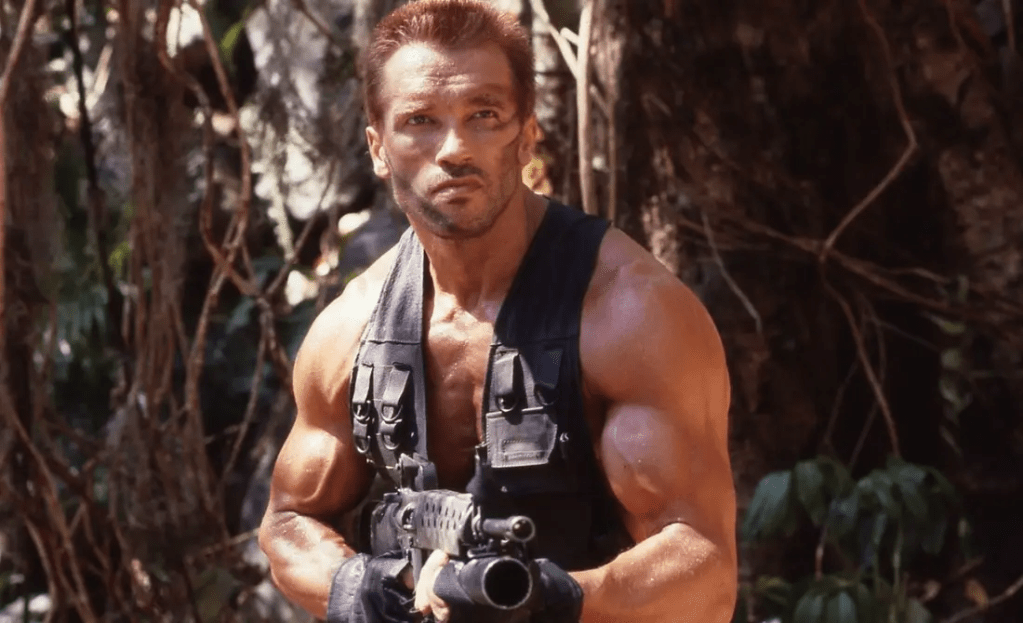
Contra is a run and gun video game developed and published by Konami for the Arcade in 1987. A home version was released on the NES in 1988 (in Europe, Contra was known as Probotector). Ocean Software ported the game to the ZX Spectrum, Commodore 64 and Amstrad CPC in Europe in 1988 under the name Gryzor. Interestingly, Ocean’s cover art for the game was a clearly influenced by a photograph of Arnold Schwarzenegger in the film Predator. For this review, I played the NES version of this game.

The cover art was clearly influenced by Arnold Schwarzenegger in the film Predator (1987).

Plot

According to the NES manual, in 1957, a large object crashed into the Amazon near some Mayan ruins. Nothing further seemed to have happened and the incident was forgotten about. 30 years later, reports of weird alien monsters terrorising the local villages have been received by the Pentagon. Rather than create a political incident by sending in an army, the US send in two commandos, Lance and Bill, to find and destroy the aliens.[1]

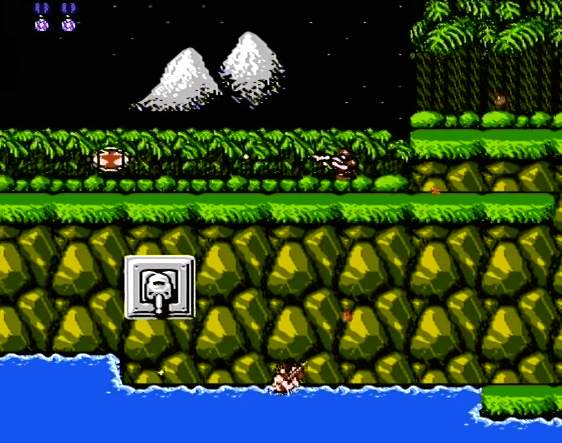
Bright colours, clearly defined sprites, and excellent gameplay (screenshot taken by the author)

Gameplay

Contra is easy to play but tough to master. You mainly run, jump, lay down, and shoot. The controls are nice and responsive, and you can shoot in all directions. However, if you want to shoot directly down, then you need to jump. You can jump down to a lower platform simply by pressing down and jump. Be careful though…one shot can kill you and you only get a finite amount of lives and continues.

The manual describes all the levels you will fight through as well as what all the power-ups do. The power-ups are greatly appreciated as you progress through the games and the enemies begin to increase in number and strength. They also make defeating the end of level bosses much easier.

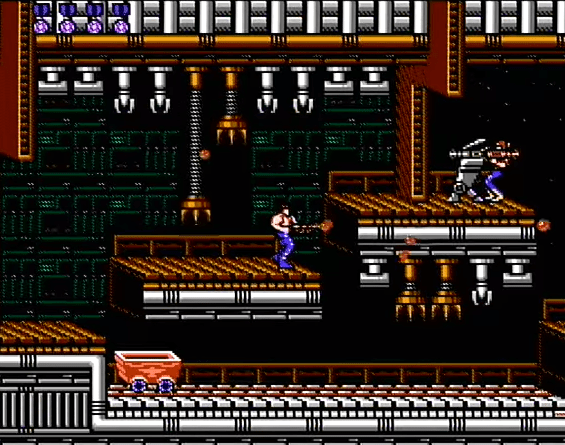
After every level, the perspective changes and your character begins in the foreground firing at enemies and defensive weapons in the background. Once you destroy the circular flashing light, which powers the electrical fence stopping you from moving forward, the rear wall explodes and you can progress to the next room. This must be done several times before you complete the level.

After every level you must battle your way through a series of rooms by destroying a flashing button to lower the electrical field (screenshot taken by the author)

How Does It Handle?

The controls are tight and easy to learn. Being able to fire in all directions, and jump up and down to platforms really makes you feel like you’re at the arcades.

Graphics

The levels are very well designed and very detailed. They are brightly coloured with many different platforms for you to jump up to and down from.

Music

The music fits the game well, and the sprites are clean and nicely animated. The overall graphics are pretty damn good for a home console in 1988.

(screenshot taken by the author)

Replay Value

The game becomes a lot more fun in two-player mode. Although you are competing for points, you are actually co-operating to beat the game, and it certainly makes the game easier. Mrs. L was my co-op buddy for this run through.

Did I Complete The Game?

Mrs. L and I did complete the game, but we needed the cheat that gave us 30 odd lives each. Without the cheat we could only get past the first few levels. On YouTube I did see one video where someone completed the game without dying once. Fair play to them.

What The Critics Said:

Computer Gaming World: “Two player contests are always in demand, because most video games are designed for a solo gamer. Contra is doubly welcome, because it is a truly outstanding action epic.” No rating given.[2]

Joystick: ”Overall 92%”.[3]

Awards:

Best Action Game – 1989 Player’s Choice Awards[4]

My Verdict:

“Although this game is tough, it is also a lot of fun, especially in two player mode. Great graphics, tight controls, and adrenalin inducing levels. I think that you will find yourself returning to this game again and again.”

Rating:

What are your memories of Contra? I would love to hear your thoughts, and don’t for get to follow and subscribe so that you don’t miss my latest reviews! You can also find me on Instagram: @nicklovestogame.


[1] ‘How to Play Contra’. NES Contra Manual. :4 (https://www.gamesdatabase.org/Media/SYSTEM/Nintendo_NES/manual/Formated/Contra_-_1988_-_Konami.pdf Accessed 28th March 2020)

[2] Katz, A., ‘Video Gaming World – Contra’. Computer Gaming World. (June 1988). 48:40.

[3] Huyghues-Lacour, A., ‘Probotector’. Joystick. (April 1991). 15:118.

[4] ‘The 1989 “Player’s Choice Awards” – Best Action Game: Contra’. Electronic Gaming Monthly – 1989 Annual. (March 31 1989). :20.

Saboteur – Review

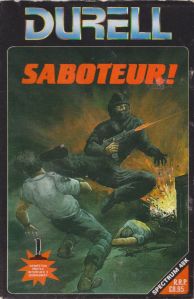
I was born in 1983, and had an older brother and father who were interested in video games. Although I vaguely remember some sort of computer system that we played Pong (1972) on, the first computer system that we owned that I really remember was the Sinclair ZX Spectrum. Games on cassette tapes that would crash frustratingly often and multi-coloured loading screens were my childhood memories of this system. One game that holds a special place in my heart is Saboteur (1985), as it was the first game that I completed. I remember playing it a lot as a child. My dad even spent time creating a map showing every room and all the features. Those were the days!

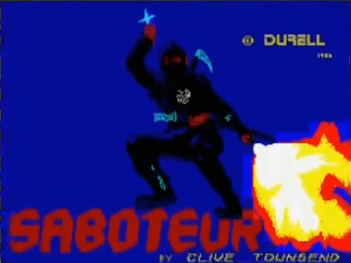
The title screen is a rip-off of the cover art for the 1983 film Revenge of the Ninja (screenshot taken by the author)

Saboteur is a single-player stealth action-adventure game. It was developed by Clive Townsend and published by Durell Software in 1985 for the ZX Spectrum, Commodore 64, Amstrad CPC and Commodore 16. Enhanced versions were released for the PC, iOS and Android in 2017, and the Nintendo Switch in 2018. For this review, I revisited the ZX Spectrum 128 version.

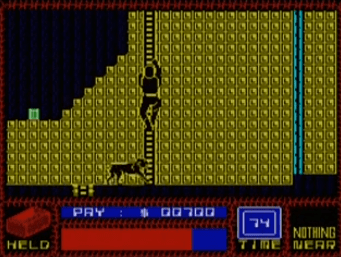
Beware of the Dog! (screenshot taken by the author)

Plot

You play as a ninja who must infiltrate a warehouse to steal a floppy disk, which contains names of rebel leaders, before escaping in a helicopter.

Gameplay

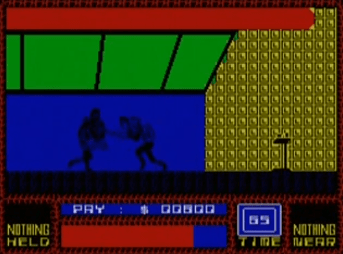
Along the way you may have to evade or engage in hand to hand combat with guards and guard dogs. You can also pick up and throw projectiles such as shurikens, knives and bricks. To add to the excitement, you’re given a time limit with which to complete the mission.

How Does It Handle?

The game is easy to learn and control, and there are plenty of places to explore, even if you don’t necessarily need to visit them to complete the mission.

Graphics

The graphics are smooth, and I like the way that there is a stark difference between rooms that are lit and rooms that are supposed to be in darkness. The sprites are clear and well defined, and there is virtually no colour bleed between sprites, and the backgrounds.

Music & SFX

The music is only existent once the game has loaded, and you see the first option screen where you can opt to play with a joystick, keyboard or Kempton interface. You also have the option to redefine the command keys. The music that plays over this menu is actually pretty good. It reminds me of the sort of music melody that might be played over any number of 80s action movies. It tells the player that the game is serious and means business. Sadly, there is no in-game music.

Use your kung-fu skills to take out the guards (screenshot taken by the author)

As far as SFX goes, the game is quiet. I don’t know whether the lack of in-game music and SFX was intentional or not, bearing in mind that this is supposed to be a stealth game. You can hear the boat as it arrives at the dock and your saboteur’s footsteps as he runs. There is a noise when you’re being fired at and when you attack a guard, but other than that the game is eerily silent. This silence, intentional or not, actually adds to the atmosphere of the game.

Replay Value

There are nine skill levels which increase the difficulty of the mission by including more guards, more locked security doors and giving the player less time to complete the mission. This feature adds a lot to the overall replay value of the game.

Did I Complete The Game?

Yes, I’ve completed the game several times and I’m working my way through the harder settings.

What The Critics Said:

Computer & Video Games: “Saboteur is an addictive, exciting and challenging game. A mixture of Exploding Fist and Impossible Mission. It’s a winner – watch it climb the charts! Overall 9.25/10.[1]

Sinclair User: “The game is very realistic, the graphics are outsnaindgly smooth and there is no colour clash or flicker to speak of. There are nin levels of play, ranging from extremely easy to extremely difficult. Overall 5/5“.[2]

Your Sinclair: “Saboteur manags to combine the good graphical representations of the other kung-fu games with a solid background of an action-packed story. One to be recommended. Overall 9/10”.[3]

Computer Gamer: “An exceptional game that takes the kung-fu game a stage further to perfection. Overall 4.75/5.[4]

My Verdict:

“Modern gamers, don’t be fooled by the seemingly crude graphics and lack of music and SFX. This game is challenging and fun, and there is enough here to have you wanting to continue playing on harder difficulty settings.”

Rating:

What are your memories of Saboteur? I would love to hear your thoughts, and don’t for get to follow and subscribe so that you don’t miss my latest reviews! You can also find me on Instagram: @nicklovestogame.


[1] ‘Software Review: Saboteur’. Computer & Video Games. (January 1986). :23.

[2] Edgely, C., ‘Spectrum Software Scene: Saboteur’. Sinclair User. (January 1986). Issue 46:20.

[3] ‘Review: Saboteur’. Your Sinclair. (January 1986). Issue 1:66-7.

[4] ‘Reviews: Saboteur’. Computer Gamer. (December 1986). Issue 9:74.