Super Mario Kart – Review

Racing games aren’t everyone’s cup of tea, as gamers usually expect realism and serious competition. Super Mario Kart (1992) took already established and loved characters and put them in a family-friendly racing game. The result was the beginning of a huge series of games that saw children and adults alike competing for hours in heated but fun and entertaining tournaments. Ladies and gentlemen, I give you Super Mario Kart!
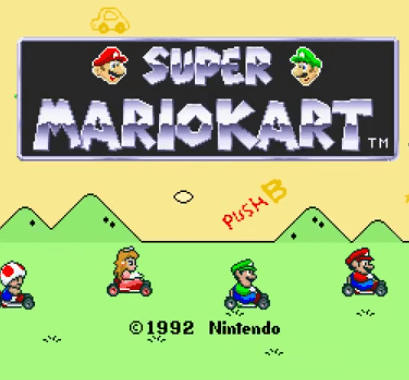
Title screen (screenshot taken by the author)

SMK is a kart racing game developed and published by Nintendo. It was released in North America and Japan in 1992, and Europe in 1993 on the SNES. It was later released on the Wii Virtual Console in 2009, and the Wii U Virtual Console in 2013. For this review, I played the version found on the SNES Mini.

Gameplay

This is a racing game with a difference. You can choose from eight classic Mario characters including Mario, Luigi, Toad, Donkey Kong Jr, Bowser, Princess Peach, Yoshi, and Koopa Troopa. Each character has different characteristics, e.g., Top speed, acceleration, and handling. You then race on a number of tracks based on Super Mario World (Donut Plains, Ghost House, and Bowser’s Castle etc.). Throughout the race you can pick up various weapons and power-ups such as turtle shells, banana skins, and super stars to assist you.

One of the tracks from Donut Land

SMK has two, one-player modes. The first is Mario Kart GP which is divided into two kart speeds: 50cc and 100cc. You can also unlock a 150cc mode when you win all the trophies from 100cc mode. Each kart speed has three trophies to attain: The Mushroom Cup, The Flower Cup and The Star Cup. The more challenging 100cc option also adds The Special Cup which contains tougher race tracks. Each cup consists of five, five-lap races. Depending on where you finish in the races will depend on how many points you accrue. The racer with the highest amount of points at the end of the cup competition will determine who wins the trophy. If a racer finishes between 5th to 8th then the player will lose a life and will have to race that track again. You can gain extra lives by finishing in the same position three races in a row.

The second one-player mode is the Time Trial Mode. It’s pretty self-explanatory, you simply race each track and try to gain the fastest time possible.
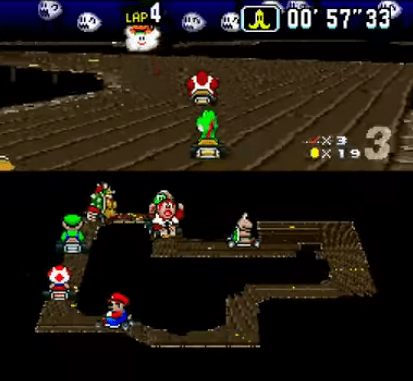
One of the Ghost House tracks (screenshot taken by the author)

Although one-player mode is fun and challenging, this game really comes into its own in two-player mode. Hours of swearing at your best mate and calling them “cheating bastards” as I recall from my youth when I’d lose.

In two-player mode, you and a friend can compete in Mario Kart GP, Match Race, and Battle Mode. In two-player mode, the same rules apply for Mario Kart GP as in one-player mode, but you compete simultaneously via split-screen. In Match Race you can pick and choose which tracks you wish to compete on for a single race without other CPU racers.

Battle mode is also head to head and sees each racer begin with three balloons spinning around their kart. You have a choice of four arenas in which you can pick up weapons and power-ups and attack your opponent. The first player that has all their balloons popped, loses.
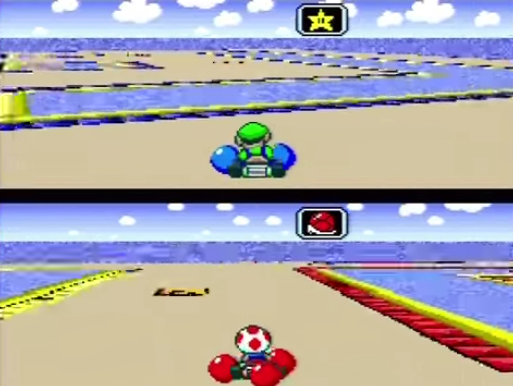
Battle Mode (screenshot taken by the author)

Game Development

Wikipedia claims that in an interview with Super Mario Kart creator Shigeru Miyamoto, that SMK was originally developed as an experiment to see if they could create a game capable of displaying the same game on the same screen simultaneously. Whilst I have heard this before, sadly, I haven’t been able to verify this quote, as Wikipedia’s links are broken. If this is true, then this experiment was fortuitous for Nintendo because it culminated in the creation of one of the most popular series of spin-offs ever created, with the initial instalment selling over 8 million copies.[1]

If you would like to learn more about the origins of Super Mario Kart, I can recommended listening to episode 17 of season 2 of The Life and Times of Video Games podcast.

How Does It Handle?

What can I say? This game is great! The gameplay is easy to learn. A nice little touch, to stop you dominating the grid all the time, is that if you are in first place, you will get less effective power-ups and weapons. The further back in the pack your are, the better your weapons and power-ups.

Graphics

The graphics are bright and colourful. Each character is unique and easily identifiable. The tracks are designed in Mode 7 which lends itself very well to these types of games (although nowadays looks a bit low-res). The lands that the race courses are set in will be familiar to all who have played Super Mario World (1990).

Music & SFX

The music sounds perfect for the game. The title music has a fun Caribbean beat to it.

Personal Memories

I had a blast revisiting this game, and it was as fun as I remembered. My blood was pumping as I scraped wins, and dodged banana skins. My favourite character to play with is Yoshi. I tried other players too (I really dislike playing with Bowser and Donkey Kong Jr) and found that I also like playing with Mario and Koopa Troopa.

Did I Complete The Game?

Although I completed 50cc mode, as of yet I cannot seem to win the Star Cup in 100cc mode.

What The Critics Said:

Electronic Gaming Monthly: “This is the best driving game to come along for some time. Mario Kart may look like an F-Zero clone on the surface, but there are many interesting upgrades ranging from power-ups to special combat battle modes using a split-screen layout. Replay options and plenty of tracks add to the appeal of this super game. Overall 8.5/10.[2]

Gamerpro: “Here’s one that’s a winner. Super Mario Kart makes wheel-spinning, bumper-grinding, motor racing actually cute! The little guys definitely have a lot of drive. Overall 4.75/5.[3]

Electronic Games: “Super Mario Kart has a fast-paced feelwith plenty of in-depth play. While the gameplay isn’t totally revolutionary, the action does deviate from what we’ve been exposed to in the past to make this new driving adventure something worthwhile to add to the collection, whether you’re a fan of driving titles, or Mario. Overall 93%.[4]

Superplay: Matt Bielby – “Quite simply the best racing game yet on the Super Nintendo, and one of the funniest, most playable ones on any system. The balloon-bursting option is a delight! Guaranteed to be one of the most played carts in the Superplay office for the rest of the year. Overall 93%.[5]

Superplay: Jonathon Davies – “Everything we could have hoped for, and more. It’s completely impossible to fault. In fact, this is the sort of thing the Super Nintendo is all about –  sheer perfection (ahem). (Make sure you find yourself a decent opponent, though). Overall 93%.[6]

My Verdict:

“A simple concept but a fantastically fun game, especially in two-player mode, that will keep you coming back for more. Tons of replay value, with countless evenings with friends and family is what this game is all about.”

Rating:

What are your memories of Super Mario Kart? I would love to hear your thoughts, and don’t for get to follow and subscribe so that you don’t miss my latest reviews! You can also find me on Instagram: @nicklovestogame.


[1] (14th April 2010). ‘IGN’s Top 100 Games of All Time – Super Mario Kart’. http://www.top1ign.100.com. https://web.archive.org/web/20120414133232/http://top100.ign.com/2007/ign_top_game_23.html Accessed 24th February 2020).

[2] ‘Review Crew: SNES – Super Mario Kart’. Electronic Gaming Monthly. (November 1992). Volume 5 Issue 11:26.

[3] ‘Bro. Buzz, ‘Pro Review: Super Nes – Super Mario Kart’. Gamerpro. (December 1992). :80-2.

[4] Stevens, S., ‘Video Game Gallery: SNES – Super Mario Kart’. Electronic Games. (December 1992). Volume 1 Issue 3:79-80.

[5] Import Review: SNES – Super Mario Kart. Superplay. (November 1992). Issue 1:29-30.

[6] Davies, J., Import Review: SNES – Super Mario Kart. Superplay. (November 1992). Issue 1:29-30.
Saboteur – Review

I was born in 1983, and had an older brother and father who were interested in video games. Although I vaguely remember some sort of computer system that we played Pong (1972) on, the first computer system that we owned that I really remember was the Sinclair ZX Spectrum. Games on cassette tapes that would crash frustratingly often and multi-coloured loading screens were my childhood memories of this system. One game that holds a special place in my heart is Saboteur (1985), as it was the first game that I completed. I remember playing it a lot as a child. My dad even spent time creating a map showing every room and all the features. Those were the days!

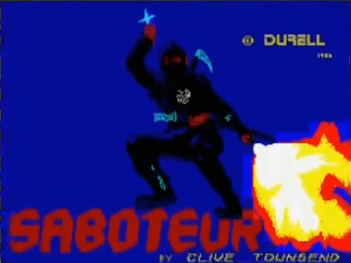
The title screen is a rip-off of the cover art for the 1983 film Revenge of the Ninja (screenshot taken by the author)

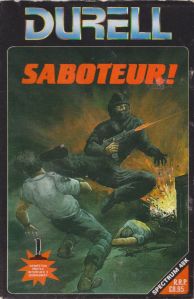
Saboteur is a single-player stealth action-adventure game. It was developed by Clive Townsend and published by Durell Software in 1985 for the ZX Spectrum, Commodore 64, Amstrad CPC and Commodore 16. Enhanced versions were released for the PC, iOS and Android in 2017, and the Nintendo Switch in 2018. For this review, I revisited the ZX Spectrum 128 version.

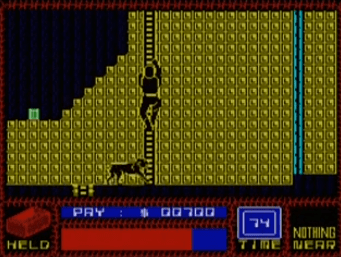
Beware of the Dog! (screenshot taken by the author)

Plot

You play as a ninja who must infiltrate a warehouse to steal a floppy disk, which contains names of rebel leaders, before escaping in a helicopter.

Gameplay

Along the way you may have to evade or engage in hand to hand combat with guards and guard dogs. You can also pick up and throw projectiles such as shurikens, knives and bricks. To add to the excitement, you’re given a time limit with which to complete the mission.

How Does It Handle?

The game is easy to learn and control, and there are plenty of places to explore, even if you don’t necessarily need to visit them to complete the mission.

Graphics

The graphics are smooth, and I like the way that there is a stark difference between rooms that are lit and rooms that are supposed to be in darkness. The sprites are clear and well defined, and there is virtually no colour bleed between sprites, and the backgrounds.

Music & SFX

The music is only existent once the game has loaded, and you see the first option screen where you can opt to play with a joystick, keyboard or Kempton interface. You also have the option to redefine the command keys. The music that plays over this menu is actually pretty good. It reminds me of the sort of music melody that might be played over any number of 80s action movies. It tells the player that the game is serious and means business. Sadly, there is no in-game music.

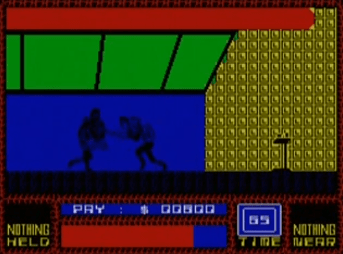
Use your kung-fu skills to take out the guards (screenshot taken by the author)

As far as SFX goes, the game is quiet. I don’t know whether the lack of in-game music and SFX was intentional or not, bearing in mind that this is supposed to be a stealth game. You can hear the boat as it arrives at the dock and your saboteur’s footsteps as he runs. There is a noise when you’re being fired at and when you attack a guard, but other than that the game is eerily silent. This silence, intentional or not, actually adds to the atmosphere of the game.

Replay Value

There are nine skill levels which increase the difficulty of the mission by including more guards, more locked security doors and giving the player less time to complete the mission. This feature adds a lot to the overall replay value of the game.

Did I Complete The Game?

Yes, I’ve completed the game several times and I’m working my way through the harder settings.

What The Critics Said:

Computer & Video Games: “Saboteur is an addictive, exciting and challenging game. A mixture of Exploding Fist and Impossible Mission. It’s a winner – watch it climb the charts! Overall 9.25/10.[1]

Sinclair User: “The game is very realistic, the graphics are outsnaindgly smooth and there is no colour clash or flicker to speak of. There are nin levels of play, ranging from extremely easy to extremely difficult. Overall 5/5“.[2]

Your Sinclair: “Saboteur manags to combine the good graphical representations of the other kung-fu games with a solid background of an action-packed story. One to be recommended. Overall 9/10”.[3]

Computer Gamer: “An exceptional game that takes the kung-fu game a stage further to perfection. Overall 4.75/5.[4]

My Verdict:

“Modern gamers, don’t be fooled by the seemingly crude graphics and lack of music and SFX. This game is challenging and fun, and there is enough here to have you wanting to continue playing on harder difficulty settings.”

Rating:

What are your memories of Saboteur? I would love to hear your thoughts, and don’t for get to follow and subscribe so that you don’t miss my latest reviews! You can also find me on Instagram: @nicklovestogame.


[1] ‘Software Review: Saboteur’. Computer & Video Games. (January 1986). :23.

[2] Edgely, C., ‘Spectrum Software Scene: Saboteur’. Sinclair User. (January 1986). Issue 46:20.

[3] ‘Review: Saboteur’. Your Sinclair. (January 1986). Issue 1:66-7.

[4] ‘Reviews: Saboteur’. Computer Gamer. (December 1986). Issue 9:74.

Phantasy Star II – Review

A picture containing text, book

Description automatically generated

Before the 1990s, RPGs were a niche genre in the video game world. They take a lot of time and effort to play, and not everyone has the patience or desire to attempt such gargantuan games. However, those that do play RPGs cherish every moment of their journeys through fantastical universes. They take great care in building up their warriors and magic users in order to defeat hordes of enemies. Phantasy Star was one such RPG which was highly praised by critics, even though it did push the Sega Master System to its limits.[1] The successor to the Master System, the Mega Drive, offered the creators of Phantasy Star II more to work with.

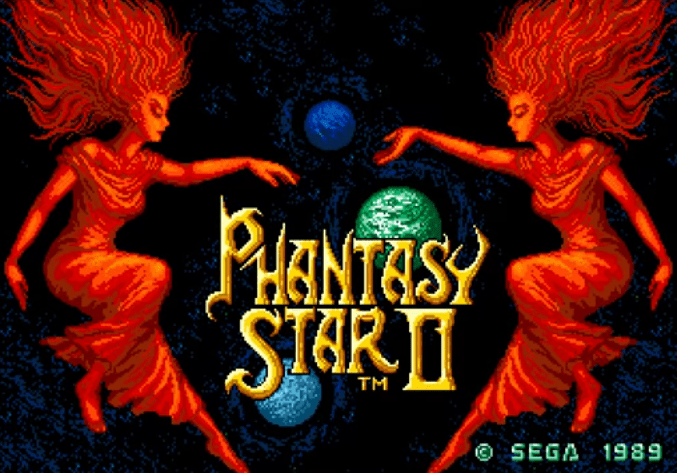
Title screen (screenshot taken by the author)

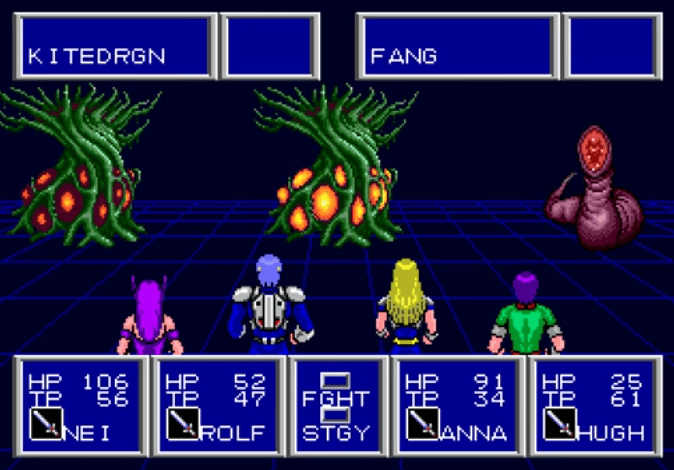
Phantasy Star II is a single-player RPG developed and published by Sega. It was released for the Mega Drive in 1989, but it wouldn’t reach North America and Europe until 1990. It was later re-released on the Sega Saturn and Game Boy Advance as part of the Phantasy Star Collection, and the Dreamcast as part of the Smash Pack Volume 1. In 2005, an updated remake was released in Japan for the PlayStation 2 and PlayStation Portable. For this review, I played was the Mega Drive version on Sonic’s Ultimate Genesis Collection (2009) on the PlayStation 3 (also available on the Xbox).

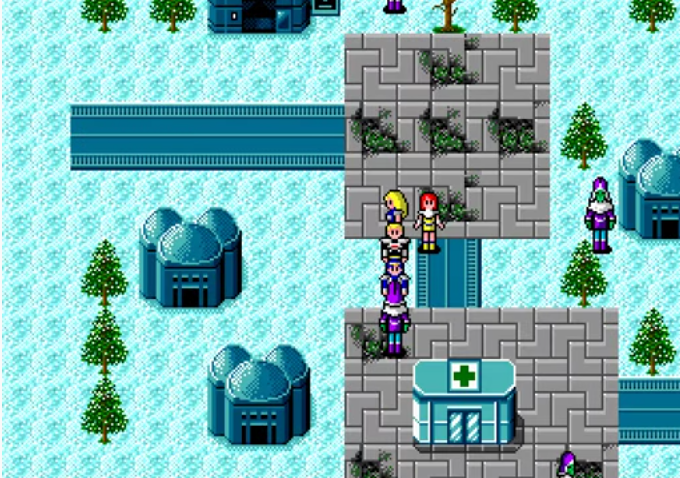
Walking around the overworld (screenshot taken by the author)

Plot

The game is set 1000 years after the events of Phantasy Star and takes us back to the Andromeda galaxy and the Algo star system. Orbiting the Algo sun are three planets: Palma – where the government reside; Mota – once an arid desert planet that has since been transformed into a tropical paradise; and Dezo – an inhospitable ice planet.

The Algo star system has prospered under the control of Mother Brain, a computer that regulates the climate, and is responsible for terraforming Mota. However, Mother Brain has started malfunctioning, producing increasingly strong monsters. One night, Rolf (our main protagonist) awakes from a nightmare, where a young girl whom he doesn’t recognise is battling a demon. It is suggested that this girl is Alis from Phantasy Star. After being informed of Mother Brain’s malfunction, Rolf, along with Nei, a humanoid with cat-like features, sets off to investigate why Mother Brain has seemingly turned against its creators.

Gameplay

Phantasy Star II is first video game to use a mega 6-bit cartridge. This enabled the designers to create the largest world yet seen in a video game.[2] They have dispensed with the dungeon crawling parts of the game (much to the chagrin of many who love dungeon crawlers), and have focussed on the overworld views when trawling through the dungeons.

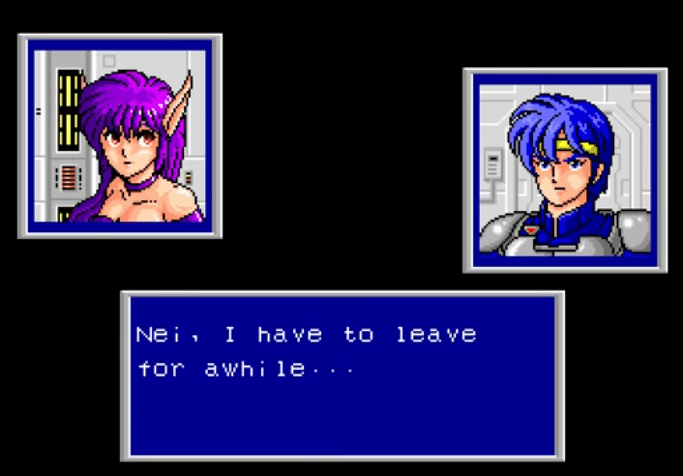
The screens for dialogue have been greatly improved (screenshot taken by the author)

How Does It Handle?

They have still yet to fix the fighting menu. Annoyingly, you still need to scroll through the menus to target individual monsters which is tiresome.

There are two further irritating aspects to this game which I would have hoped they’d have resolved by now. The first is that many of the names of the plethora of spells you are able to use do not indicate what type of spell it is. The manual doesn’t have any information on this either, so you need to experiment during battles to find out what the oddly named spells do.

“That’s part of the fun!”, I hear some of you cry. Not really. One would assume that a magic user would know what the spell was they were using. Hopefully this will be resolved in Phantasy Star III.

The second irritating aspect is that you do not have a combined inventory, so you need to constantly scroll through the menus in order to exchange items between your fighters. Its exasperating!

Where did the beautiful backgrounds go? (screenshot taken by the author)

Graphics

As expected, the overall graphics have been improved, creating three very distinct worlds. The sprites in the overworld maps are more individualised and are brightly coloured. The dialogue screens have also been greatly updated to anime-style character screens.

The battles screens are greatly improved. Firstly, you can now see your characters attacking animations, and the enemies are more varied and detailed. Sadly, they decided to take away the scenic backgrounds and replace them with a blue grid. I’m not sure what the thinking was behind that decision.

Overworld view on Dezo world (screenshot taken by the author)

Music & SFX

I don’t really recall much about either. They clearly aren’t very memorable.

Did I Complete The Game?

Yes, it felt like a slog at times, and needed a walkthrough on occasion.

Dragon: “The animation, especially for battles, is superb. There are over 50 spells available. Even weapons and armor can give benefits to characters beyond their normal effects. For example, special armor found in one dungeon allows the wearer to cast a healing spell every so often. The battle system enables more than one type of creature to attack and allows the characters to attack specific creatures instead of idiotically going after one creature at a time. This game is definitely a winner. Overall 5/5”.[3]

Electronic Gaming Monthly: Martin – “RPG’s aren’t my thing., but this one has a monstrous quest anyone can get involved with and lost in…I wish the battle scenes were on landscapes instead of boring blue grid, but all in all PS2 is presented well. Overall 8/10”.[4]

Raze: “Large combat sprites, wonderful scenes and backdrops. Great in-game effects and unobtrusive background music. A challenging quest packed with gameplay. Overall 90%”.[5]

Video Games and Computer Entertainment: “It’s very user friendly, with a simple but extensive menu system, and a battery back-up that allows you to save numerous games in progress. The plot advances quickly, providing a constant stream of new subplots…Phantasy Star II is a complex and eminently enjoyable game that will give you more variety and challenge for your buck than any other video game. Overall 9/10”.[6]

Zero: “Phantasy Star II is definitely not just any old thing. In fact, it’s just about everything you could want from this kind of game – big (very big), involved, exciting and challenging. Overall 89%”.[7]

Sega Power: “Long-awaited sequel to the MS RPG. With a massive quest set over different worlds and four characters to control, you should be thankful for your battery back-up! Overall 5/5.[8]

My Verdict:

“Graphically, a great improvement on the first, with an engaging story and plenty of action to keep you quiet for many hours. They just need to sort out that poxy battle menu! RPG fans will love this game!”

Rating:

What are your memories of Phantasy Star II? I would love to hear your thoughts, and don’t for get to follow and subscribe so that you don’t miss my latest reviews! You can also find me on Instagram: @nicklovestogame.


[1] Tracy, T., (16th December 2002). ‘Phantasy Star Collection Review’. Gamespot.com.  (https://www.gamespot.com/reviews/phantasy-star-collection-review/1900-2901862/ Accessed 15th March 2020).

[2] Adams, R., ‘Wishing on a Phantasy Star II’. Computer Gaming World. (November 1990). Issue 76:85.

[3] ‘Phantasy Star II’. Dragon. (August 1990). Issue 160:51.

[4] ‘Phantasy Star 2’. Electronic Gaming Monthly. (April 1990). Issue 9:18.

[5] ‘Reviews: Phantasy Star 2’. Raze. (April 1991). Issue 6:34-5.

[6] ‘Sega Genesis – Phantasy Star 2’. Video Games and Computer Entertainment. (March 1990) Issue :34 & 49.

[7] ‘Review Console: Mega Drive – Phantasy Star II’. Zero. (March 1991). Issue 17:88.

[8] Jarrett, S., ‘The Hard Line – Phantasy Star II’. Sega Power. (April 1991). Issue 23:54.

The Legend of Zelda: A Link to the Past – Review

In 1986, The Legend of Zelda was released for the NES and sold over 6 million copies.[1] Its success spawned a whole series of video games that continue today, with every instalment being much anticipated by fans all over the world. A Link to the Past was one of the SNES’s earliest games in Europe, but sadly I wouldn’t get to play it through properly until 2019.

Title screen (screenshot taken by the author)

The Legend of Zelda: Link to the Past is the third game in the Zelda series. It is an action-adventure game developed and published by Nintendo. It released for the SNES in Japan in 1991, and Europe and North America in 1992. It was ported to the Game Boy Advance as A link to the Past and Four Swords, as well as the Wii, Wii U. It was accessible for the Nintendo 3DS through the Virtual console and the Nintendo Switch through Nintendo Switch Online. The chose to review the version which came with the SNES Mini.

Plot

You play as young adventurer Link who must defeat the evil Ganon from gaining the power of the Triforce which would allow him to turn the world dark and evil. Link must save the Kingdom of Hyrule and stop Ganon by rescuing several maidens who are the descendants of the Seven Sages. To do this he must scour the dungeons and defeat a plethora of enemies and end of dungeon bosses.

Gameplay

Link is armed with a sword, shield, and bow and arrow with which to fight his enemies. By killing the many minions throughout the worlds, you can gain rupees, arrows and health. Your sword has two actions: You can swing it to attack or if you hold the attack button, your sword will charge and will produce a 360 degree swing, which is handy if you are surrounded by enemies. Once you gain the Pegasus Boots you can charge your enemies and stab them with your sword. Along the way, you can acquire upgrades for your armour, sword and shield as well as many magical items to aid you in your quest.

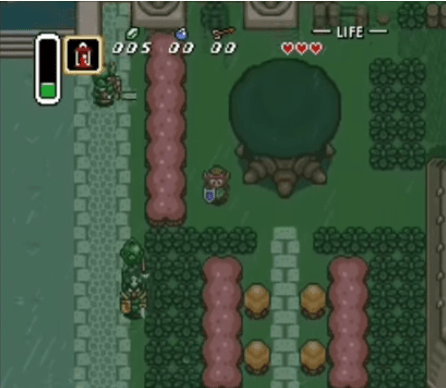
Link can slash or pick up bushes and stones to find health and rupees (screenshot taken by the author)

How Does It Handle?

The open world design enables you to explore every inch of the Light and Dark worlds. However, you need to warp from the Light and Dark worlds in different parts of the map in order to access areas that are inaccessible in the other world (it’ll make sense when you play it). The enemies re-spawn which can be annoying at times, but it also gives you the opportunities to gain more health, rupees and magic.

It would be very easy to get lost in this game. Thankfully you have a map to refer to. The map screen has a Mode 7 design which is a layer that can be easily rotated and scaled, and lends itself very well to racing games such as Super Mario Kart (1992).

The increasing difficulty of the dungeons and end bosses adds a challenging aspect to the game. You will find yourself spending many hours on this game as there is so much to explore. Don’t feel bad if you use a walkthrough, as some items are hard to find.

Link must warp from the Light to the Dark worlds and back again to gain access to certain areas

Graphics

This game looks fab. The graphics are bright in the Light World but not garish. The darker tones of the Dark World differentiate the two worlds very well. The overhead perspective offers a more 3D feel to the game and allows more detail and colour to the backgrounds and sprites.

Music and SFX

The main music for the Light World, known as the Hyrule Overture, is dramatic and fitting for the game. It is the music of a hero! I also like the little riff you hear when you find a secret.

The SFX sound great too. Like the sound of coins clinking together when you collect rupees. The SFX work really well.

The dungeons increase in difficulty, so make sure you are well prepared before attempting them (screenshot taken by the author)

Personal Memories

My little brother had a SNES growing up, but he didn’t buy Link to the Past. The first time I saw it was at my friend Graeme’s house. I never really got to play it, but I watched the very early bits of it and was amazed by how great it looked. When I bought the SNES Mini, I was excited that I would finally get to play it. Was it as good as I’d hoped? Hell yes! My only gripe was that by the end of the game I was a bit bored as I felt it had become monotonous, and I should have been wanting more. Other than that, this is a great game and I would recommend it to all.

Did I Complete The Game?

Yes, but I did have some assistance from a walkthrough to find certain items.

What The Critics Said:

Nintendo Power: George: “This game is amazing. Its got incredible graphics, great sound effects, and it’s a well thought out adventure. Overall 4.675/5.[2]

Electronic Gaming Monthly: “Wow! This is the closest a game has ever come to being perfect. Everything except the graphics gets the best score possible. Unfortunately, Nintendo let us down when it comes to the graphics as there is nothing spectacular here. Overall 8.75/10.[3]

Computer and Video Games: “The graphics are very simple, but the animation is fluid and the game is packed full of colour. Sound-wise, Zelda III is spot on. It has some great orchestral scores and lovely sound effects throughout. If you liked the first two games, or you fancy a spot of RPG related malarkey, the get this straight away. It’s a corker! Overall 89%”.[4]

Superplay: “The long awaited 16-bit Zelda is a brilliantly designed and implemented adventure that puts similar games to shame, in much the same way as Mario dominates the platform world – Nintendo’s top programmer was involved in both games. Overall 9/10.[5]

Awards:

Best Video Game Sequel (All Systems) – Electronic Gaming Monthly’s Best and Worst of 1992[6]

My Verdict:

“It was worth the 27 year wait!!! Beatutiful to look at, excellent gameplay, and an engaging story. Frustratingly lengthy at times, but a classic of the genre, and every gamer must at least attempt to play this game.”

Rating:

What are your memories of Zelda: A Link to the Past? I would love to hear your thoughts, and don’t for get to follow and subscribe so that you don’t miss my latest reviews! You can also find me on Instagram: @nicklovestogame.


[1] Sahdev, I., (November 12th, 2019). ‘The Legend of Zelda – Global Sales’. http://www.gamedesigngazette.com. http://www.gamedesigngazette.com/2018/01/the-legend-of-zelda-global-sales.html Accessed 19th February 2020).

[2] George & Rob. ‘Now Playing: SNES – The Legend of Zelda: A Link to the Past’. Nintendo Power. (March 1992). Issue 34:105.

[3] ‘Review Crew: SNES – Zelda III’. Electronic Gaming Monthly. (March 1992). Issue 32:24.

[4] O’Connor, F., ‘Review: Famicom – The Legend of Zelda III’ Computer and Video Games Magazine. (February 1992). Issue 123: 68.

[5] ‘What Cart? RPG/Adventure Games: SNES – Zelda III: A Link to the Past’. Superplay. (November 1992). Issue 1:90.

[6] ‘EGM’s Best and Worst of 1992: Best Video Game Sequel (All Game Systems) – Legend of Zelda III‘. Electronic Gaming Monthly’s 1993 Video Game Buyer’s Guide. (1993). :17.