
Tetris (1988) is one of the most popular puzzle games of all time. The learning curve is steep, and the game is highly addictive. Although Sega owned arcade cabinets of Tetris (1988), licensing issues meant their Mega Drive release in 1989 had to be abandoned. This may account for the development of Blockout as a potential rival. The question soon became: would it be just as successful?

Blockout is a 3D puzzle game developed by P.Z. Karen Co. Development Group and published by American Technos for the arcade in 1989. That same year, it was also released for Amiga, Apple IIGS, Commodore 64, Mac OS, MS-DOS, PC-98 (California Dreams). It was later released for Atari ST (California Dreams) and NES (Technos Japan Corp.) in 1990, Atari Lynx (Atari Corporation) and Sega Mega Drive (Electronic Arts) in 1991, and Virtual Boy (as 3D Tetris) in 1996. For this review, I played the Sega Mega Drive version.
Plot
There is no plot other than to earn the maximum points you can.
Gameplay
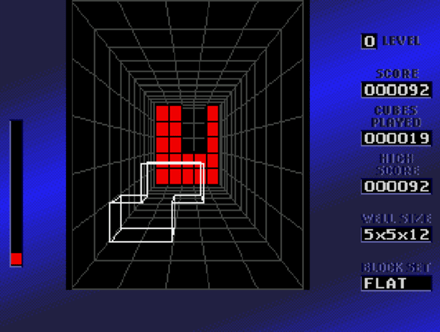
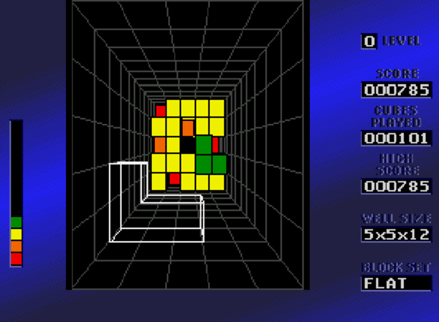
Played in single or two-player mode, you play by looking down a 3D “well” where blocks of varying shapes and sizes slowly descend. The slow descent rate gives you time to rotate the block around three coordinate axes and place it into your desired position. When a facet of the block touches the floor (or the lowest point of the well where a previous block has been placed), it will fill with colour, meaning you can no longer move or rotate that block. Every block you place earns you points. Once you have filled an entire layer (known as a “face”) and there are no gaps in that layer, it will disappear, earning you a bonus, and the rest of the cubes drop down as far as they can go. If you are able to empty the well, you will receive a “Block Out Bonus”.
Like Tetris, as the game progresses and the levels increase, the speed with which the blocks fall gradually increases. The game continues until you fail, and the blocks fill the well.
How Does It Handle?
The 3D element and three coordinate axes rotation format adds an extra degree of difficulty that you wouldn’t find in Tetris. It definitely takes a lot of practice. Being able to change the dimensions of the well is a nice feature too adding an extra challenge to the game.
Graphics
The graphics are basic, but they don’t need to be complicated for this game. Having different colours to differentiate each layer is sufficient for the game.
Music and SFX
The intro music is quite aggressive for a puzzle game. It remined me of the fuzzy musical notes of Road Rash (1991). There is no in-game music and minimal SFX when you place a block or complete a Face. I think some light music would not have gone amiss here.
Replay Value
For fans of Tetris and the like, I imagine this would be an addictive game, especially with a two-player mode.
Did I Complete The Game?
I’m not sure that you can complete this game but I didn’t spend too much time trying to find out. I don’t enjoy these sorts of games so don’t put in the time to become a good player. My highest score so far is a pitiful 18242.
What The Critics Said:
MegaTech: “This sort of 3D Tetris is surely the finest Megadrive puzzle game available, packed with tons of options (including a simultaneous two-player mode) and featuring highly addictive gameplay, this is a must for your collection. Overall 91%”.[1]
Mean Machines: “This sort of 3D Tetris is surely the finest Megadrive puzzle game available. Packed with tons of options (including simultaneous two-player mode) and featuring highly addictive gameplay, this is a must for your collection. Overall 91%”.[2]
My Verdict:
“It’s Tetris in 3D. Personally, I’m not a huge fan of these sorts of games and but can appreciate their appeal and the skill and practice that goes into being able to achieve high scores. Ardent fans will play for hours and return time and time again.”
Rating:

What are your memories of Blockout? I would love to hear your thoughts, and don’t forget to follow and subscribe so that you don’t miss my latest reviews! You can also find me on Instagram: @nicklovestogame.
[1] ‘Game Index – Block Out’. MegaTech. (May 1992). Issue 6:76.
[2]’Review: Mega Drive – Block Out’. Mean Machines. (October 1992). Issue 1:137.





#/media/File:Columns.jpeg)

 Nick Loves to Game