Broken Sword II: The Smoking Mirror – Remastered – Review

With the success of Broken Sword: The Shadow of the Templars, it was inevitable that a sequel would follow…but how do you follow up such a compelling story of conspiracy and murder?
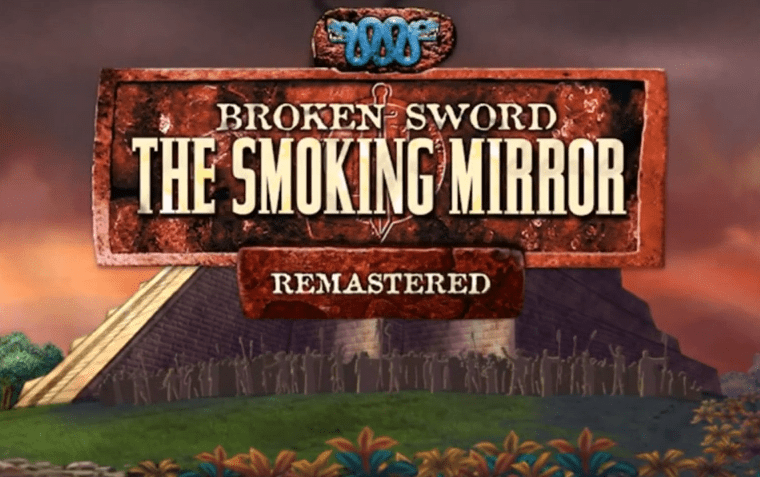
Title screen (screenshot taken by the author)

Broken Sword 2: The Smoking Mirror is a point-and-click adventure game developed by Revolution Software and published by Virgin Interactive. It was released in 1997 on Microsoft Windows and the PlayStation. A remastered edition was released in 2010 on Microsoft Windows, OSX and iOS. For this review, I looked at the original version on the Playstation and PC, and the remastered version on the PC.

Plot

It has been six months since George Stobbart and Nico Collard stopped the Templar plot. Stobbart has returned to France from the US, where he was visiting his ill father, and plans to resume his relationship with Nico. Together they visit the house of archaeologist Professor Oubier in order to learn about a Mayan artefact that Collard has been researching. After arriving at Oubier’s house, they are ambushed, and Nico is kidnapped. Stobbart must rescue her whilst learning about, and preventing, a conspiracy to release the Mayan God Tezcatlipoca during an imminent eclipse.

Gameplay

The gameplay is unchanged from its predecessor, that is, you can control George and Nico (at separate times during the game) and direct them to walk or interact with objects by using a cursor. The cursor icon will change depending on what action you can do. For example, if you place the cursor over an item you are able to pick up, the icon will turn into an animated hand that motions as if to pick up an object. It’s all very clear and straight forward. You are also able access your items from your inventory by moving your cursor to the top of the screen, where your collected items will appear. Similarly, when talking to another character, icons will appear at the bottom of the screen, indicating that more information can be gleaned from that person.
A large brick building

Description automatically generated
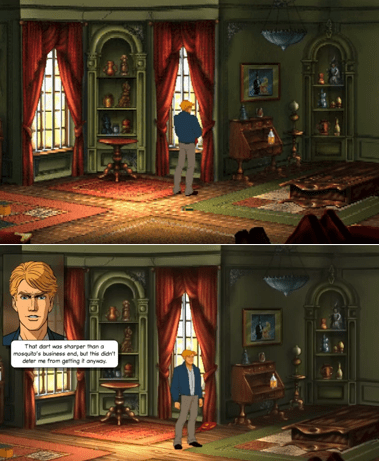
A comparison between the original (top) and the remastered (bottom) versions (screenshot taken by the author)

How Does It Handle?

The game easy to learn and play. I think if I had one criticism though, it’d be that I think the action is a little slow when you get George or Nico to interact with an object.

Graphics

“If it ain’t broke, don’t fix it!”, or so the old saying goes. The graphics have remained in the classic animated film style, which I am a fan of.

Music

The music, whilst subtle, is atmospheric and fitting, and usually indicates either danger or that an important puzzle has been solved.

The Remastered Version

After replaying the game years after its release, Charles Cecil, who originally designed the game, wished to fix several issues he noted about the original version. He felt that the backgrounds were too pixelated, the movies were of poor quality, the audio needed sharpening up and that some of the dialogue seemed a bit out of place. With these issues addressed, Cecil explains that they decided to add a diary and a hint system. He also enlisted the help of illustrator Dave Gibbons to create new artwork for an interactive-comic bonus.[1]

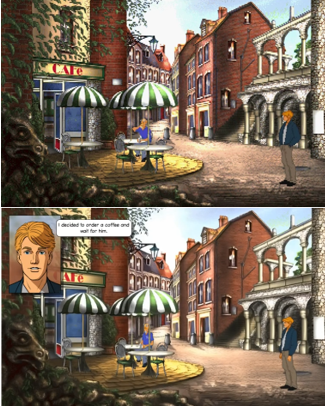
There is a small difference with the original in how you gain access to your items. In the corners of the screen are slightly translucent icons. The bottom left is a satchel where your can find your collected items; the bottom right is the diary, reminding you of your journey; top left is the option menu, and top right is a question mark for when you need help. When talking to another character, a box will appear onscreen with icons that you can click on to gather information from that person.
A person standing in front of a building

Description automatically generated
A comparison between the original (top) and the remastered (bottom) versions (screenshot taken by the author)

Remastered Graphics

In the remastered version, the graphics do look a lot smoother, and the colours have been toned down a bit to add more realism to the scenes. The little portrait character boxes that appear during conversations is a nice new touch too.

Personal Memories

I enjoyed playing this game, but I think I still prefer the first instalment. It was great to see some familiar faces from the first game, and there were some interesting new characters added too. For me, there are two things that let this game down. Firstly, I felt that they didn’t provide enough information on the Maya and Tezcatlipoca. Other players may not feel they needed more information but I’m an archaeologist and a historian by trade, and so my curiosity naturally seeks more information on such subjects. My second gripe was slightly rectified in the remastered version in that I wish they had added something new to the game too.

Did I Complete The Game?:

Yes, but I found this game tougher than the first and so probably used hints more often.

What The Critics Said Of The Original Version:

Gamespot: (Playstation) “The horrendous loading times that plagued the original have been trimmed a great deal, and the animation runs a lot smoother. Still, the game is not for everyone. Earfuls of semi-relevant conversation and the digital pad’s inability to properly replicate a mouse make Broken Sword II tedious at times. But while Broken Sword II certainly isn’t revolutionary, it’s still refreshing to see a game of this nature done well. A compelling story, plot twists, offbeat humour, great graphics, and solid sound makes Broken Sword II a game with great aspirations. It’s simply too bad the game’s format and the Playstation’s limited capabilities keep Broken Sword II from fully realizing them. Overall 6.9/10.[2]

Gamespsot: (PC) “George is slightly more sophisticated (a consequence of all that traveling he did in Circle of Blood no doubt), Nico has been fleshed out a bit and takes on a few adventures of her own, and the quirky humour of Circle of Blood raises its oddball head once more (i.e., the minor character who gets up from his desk only to reveal that he works in bikini underwear – not pants – because it makes him feel friskier). It’s Circle of Blood with new characters, a new storyline, a new threat to world harmony, and a few omissions and additions that help to streamline the adventure. Overall 7.9/10.[3]

Next Generation: (PC) “What’s new helps the game immensely, and the already intuitive interface is still there. Smoking Mirror may not be an outstanding leap in graphics adventures, but much like the sequel to a good book, it’s a fun romp with familiar characters and well-worth the price of purchase. Overall 3/5.[4]

Computer Gaming World: (PC) “All in all, Broken Sword: The Smoking Mirror is above average, but it’s not great. While the engine and the graphics have been refined, there are some minor slips in plot, dialogue, puzzles that bring the whole experience down a bit. Overall 3.5/5.[5]

What The Critics Said Of The Remastered Version:

Gamezone: (PC) “Among the most impressive things about the Broken Sword series are its animated cut scenes, which look fantastic on the iPad. The animation itself is a bit dated, but it also brings a sense of nostalgia, reminiscent of cartoons and animated movies of the same time period. The voice acting is solid, and the game sounds great on the iPad. The remastered version of The Smoking Mirror is compatible with both the iPad and iPhone, and though the game can look a bit stretched and blurry at times on the iPad, the bigger screen is preferable for gameplay purposes. Overall 8/10.[6]

My Verdict:

“A great sequel and enthralling storyline. Great graphics, and tougher puzzles than the first instalment. Pity about the lack of innovation in gameplay, and information regarding the Mayan culture”

Rating:

What are your memories of Broken Sword II? I would love to hear your thoughts, and don’t for get to follow and subscribe so that you don’t miss my latest reviews! You can also find me on Instagram: @nicklovestogame.


[1] Hoggins, T., (January 4th 2011). ‘Broken Sword II: The Smoking Mirror Interview’. The Telegraph. (https://www.telegraph.co.uk/technology/video-games/8238685/Broken-Sword-II-The-Smoking-Mirror-interview.html Accessed 7th March 2020).

[2] Stohl, B., (May 5th 2000). ‘Broken Sword II Review – Playstation’. http://www.gamespot.com. (https://www.gamespot.com/reviews/broken-sword-ii-review/1900-2545928/ Accessed on 7th March 2020).

[3] Muldoon, M., (May 1st 2000). ‘Broken Sword II Review – PC’. http://www.gamespot.com. (https://www.gamespot.com/reviews/broken-sword-the-smoking-mirror-review/1900-2538230/ Accessed on 7th March 2020).

[4] ‘Rating: PC – Broken Sword: The Smoking Mirror’. Next Generation. (December 1997). Issue 36:170.

[5] Nguyen, T., ‘Review: PC – Broken Sword: The Smoking Mirror’. Computer Gaming World. (March 1998). Issue 164:162.

[6] Chase, S., (May 4th 2012). ‘Broken Sword II: The Smoking Mirror – Remastered Review’ Gamezone.com. (https://www.gamezone.com/reviews/broken_sword_ii_the_smoking_mirror_-_remastered/ Accessed 7th March 2020).
Saboteur – Review

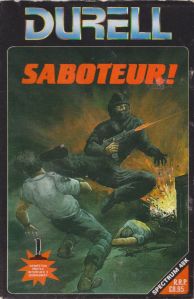
I was born in 1983, and had an older brother and father who were interested in video games. Although I vaguely remember some sort of computer system that we played Pong (1972) on, the first computer system that we owned that I really remember was the Sinclair ZX Spectrum. Games on cassette tapes that would crash frustratingly often and multi-coloured loading screens were my childhood memories of this system. One game that holds a special place in my heart is Saboteur (1985), as it was the first game that I completed. I remember playing it a lot as a child. My dad even spent time creating a map showing every room and all the features. Those were the days!

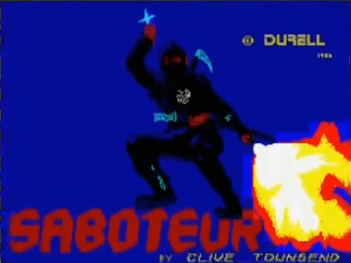
The title screen is a rip-off of the cover art for the 1983 film Revenge of the Ninja (screenshot taken by the author)

Saboteur is a single-player stealth action-adventure game. It was developed by Clive Townsend and published by Durell Software in 1985 for the ZX Spectrum, Commodore 64, Amstrad CPC and Commodore 16. Enhanced versions were released for the PC, iOS and Android in 2017, and the Nintendo Switch in 2018. For this review, I revisited the ZX Spectrum 128 version.

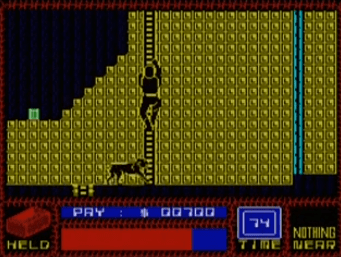
Beware of the Dog! (screenshot taken by the author)

Plot

You play as a ninja who must infiltrate a warehouse to steal a floppy disk, which contains names of rebel leaders, before escaping in a helicopter.

Gameplay

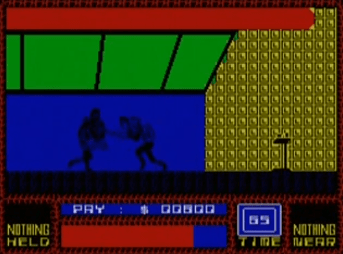
Along the way you may have to evade or engage in hand to hand combat with guards and guard dogs. You can also pick up and throw projectiles such as shurikens, knives and bricks. To add to the excitement, you’re given a time limit with which to complete the mission.

How Does It Handle?

The game is easy to learn and control, and there are plenty of places to explore, even if you don’t necessarily need to visit them to complete the mission.

Graphics

The graphics are smooth, and I like the way that there is a stark difference between rooms that are lit and rooms that are supposed to be in darkness. The sprites are clear and well defined, and there is virtually no colour bleed between sprites, and the backgrounds.

Music & SFX

The music is only existent once the game has loaded, and you see the first option screen where you can opt to play with a joystick, keyboard or Kempton interface. You also have the option to redefine the command keys. The music that plays over this menu is actually pretty good. It reminds me of the sort of music melody that might be played over any number of 80s action movies. It tells the player that the game is serious and means business. Sadly, there is no in-game music.

Use your kung-fu skills to take out the guards (screenshot taken by the author)

As far as SFX goes, the game is quiet. I don’t know whether the lack of in-game music and SFX was intentional or not, bearing in mind that this is supposed to be a stealth game. You can hear the boat as it arrives at the dock and your saboteur’s footsteps as he runs. There is a noise when you’re being fired at and when you attack a guard, but other than that the game is eerily silent. This silence, intentional or not, actually adds to the atmosphere of the game.

Replay Value

There are nine skill levels which increase the difficulty of the mission by including more guards, more locked security doors and giving the player less time to complete the mission. This feature adds a lot to the overall replay value of the game.

Did I Complete The Game?

Yes, I’ve completed the game several times and I’m working my way through the harder settings.

What The Critics Said:

Computer & Video Games: “Saboteur is an addictive, exciting and challenging game. A mixture of Exploding Fist and Impossible Mission. It’s a winner – watch it climb the charts! Overall 9.25/10.[1]

Sinclair User: “The game is very realistic, the graphics are outsnaindgly smooth and there is no colour clash or flicker to speak of. There are nin levels of play, ranging from extremely easy to extremely difficult. Overall 5/5“.[2]

Your Sinclair: “Saboteur manags to combine the good graphical representations of the other kung-fu games with a solid background of an action-packed story. One to be recommended. Overall 9/10”.[3]

Computer Gamer: “An exceptional game that takes the kung-fu game a stage further to perfection. Overall 4.75/5.[4]

My Verdict:

“Modern gamers, don’t be fooled by the seemingly crude graphics and lack of music and SFX. This game is challenging and fun, and there is enough here to have you wanting to continue playing on harder difficulty settings.”

Rating:

What are your memories of Saboteur? I would love to hear your thoughts, and don’t for get to follow and subscribe so that you don’t miss my latest reviews! You can also find me on Instagram: @nicklovestogame.


[1] ‘Software Review: Saboteur’. Computer & Video Games. (January 1986). :23.

[2] Edgely, C., ‘Spectrum Software Scene: Saboteur’. Sinclair User. (January 1986). Issue 46:20.

[3] ‘Review: Saboteur’. Your Sinclair. (January 1986). Issue 1:66-7.

[4] ‘Reviews: Saboteur’. Computer Gamer. (December 1986). Issue 9:74.

Phantasy Star II – Review

A picture containing text, book

Description automatically generated

Before the 1990s, RPGs were a niche genre in the video game world. They take a lot of time and effort to play, and not everyone has the patience or desire to attempt such gargantuan games. However, those that do play RPGs cherish every moment of their journeys through fantastical universes. They take great care in building up their warriors and magic users in order to defeat hordes of enemies. Phantasy Star was one such RPG which was highly praised by critics, even though it did push the Sega Master System to its limits.[1] The successor to the Master System, the Mega Drive, offered the creators of Phantasy Star II more to work with.

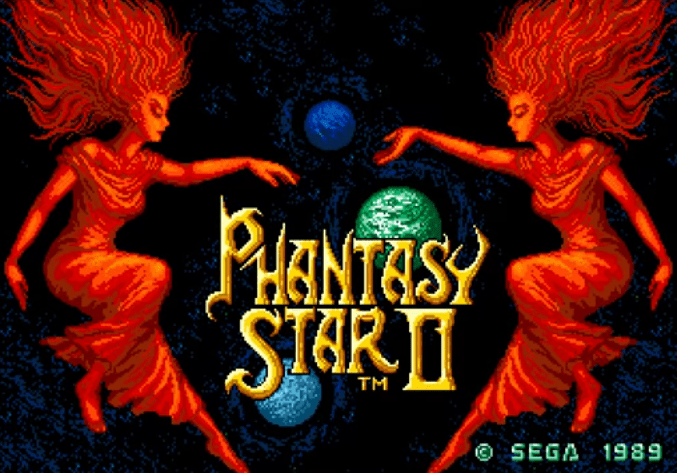
Title screen (screenshot taken by the author)

Phantasy Star II is a single-player RPG developed and published by Sega. It was released for the Mega Drive in 1989, but it wouldn’t reach North America and Europe until 1990. It was later re-released on the Sega Saturn and Game Boy Advance as part of the Phantasy Star Collection, and the Dreamcast as part of the Smash Pack Volume 1. In 2005, an updated remake was released in Japan for the PlayStation 2 and PlayStation Portable. For this review, I played was the Mega Drive version on Sonic’s Ultimate Genesis Collection (2009) on the PlayStation 3 (also available on the Xbox).

Walking around the overworld (screenshot taken by the author)

Plot

The game is set 1000 years after the events of Phantasy Star and takes us back to the Andromeda galaxy and the Algo star system. Orbiting the Algo sun are three planets: Palma – where the government reside; Mota – once an arid desert planet that has since been transformed into a tropical paradise; and Dezo – an inhospitable ice planet.

The Algo star system has prospered under the control of Mother Brain, a computer that regulates the climate, and is responsible for terraforming Mota. However, Mother Brain has started malfunctioning, producing increasingly strong monsters. One night, Rolf (our main protagonist) awakes from a nightmare, where a young girl whom he doesn’t recognise is battling a demon. It is suggested that this girl is Alis from Phantasy Star. After being informed of Mother Brain’s malfunction, Rolf, along with Nei, a humanoid with cat-like features, sets off to investigate why Mother Brain has seemingly turned against its creators.

Gameplay

Phantasy Star II is first video game to use a mega 6-bit cartridge. This enabled the designers to create the largest world yet seen in a video game.[2] They have dispensed with the dungeon crawling parts of the game (much to the chagrin of many who love dungeon crawlers), and have focussed on the overworld views when trawling through the dungeons.

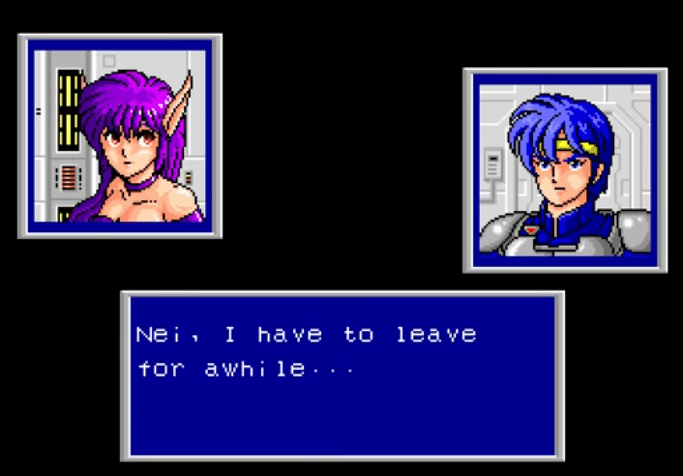
The screens for dialogue have been greatly improved (screenshot taken by the author)

How Does It Handle?

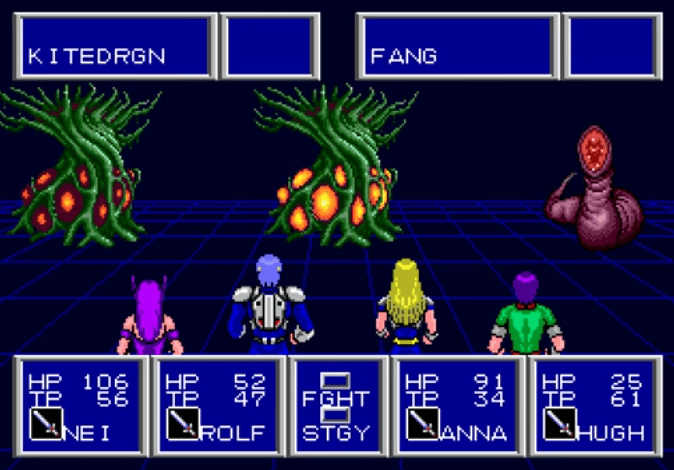
They have still yet to fix the fighting menu. Annoyingly, you still need to scroll through the menus to target individual monsters which is tiresome.

There are two further irritating aspects to this game which I would have hoped they’d have resolved by now. The first is that many of the names of the plethora of spells you are able to use do not indicate what type of spell it is. The manual doesn’t have any information on this either, so you need to experiment during battles to find out what the oddly named spells do.

“That’s part of the fun!”, I hear some of you cry. Not really. One would assume that a magic user would know what the spell was they were using. Hopefully this will be resolved in Phantasy Star III.

The second irritating aspect is that you do not have a combined inventory, so you need to constantly scroll through the menus in order to exchange items between your fighters. Its exasperating!

Where did the beautiful backgrounds go? (screenshot taken by the author)

Graphics

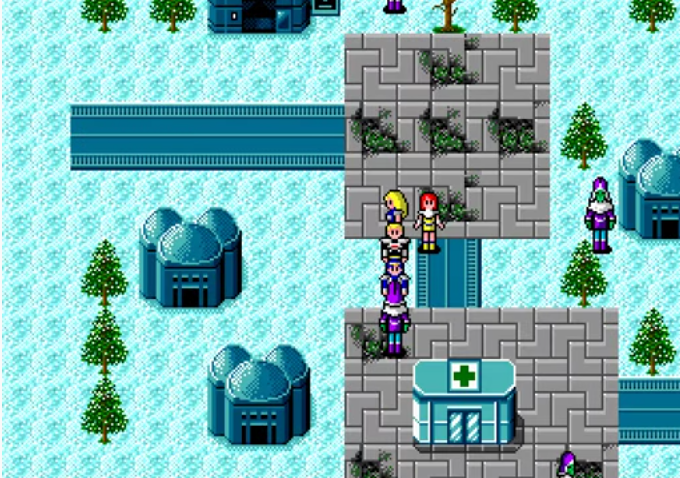
As expected, the overall graphics have been improved, creating three very distinct worlds. The sprites in the overworld maps are more individualised and are brightly coloured. The dialogue screens have also been greatly updated to anime-style character screens.

The battles screens are greatly improved. Firstly, you can now see your characters attacking animations, and the enemies are more varied and detailed. Sadly, they decided to take away the scenic backgrounds and replace them with a blue grid. I’m not sure what the thinking was behind that decision.

Overworld view on Dezo world (screenshot taken by the author)

Music & SFX

I don’t really recall much about either. They clearly aren’t very memorable.

Did I Complete The Game?

Yes, it felt like a slog at times, and needed a walkthrough on occasion.

Dragon: “The animation, especially for battles, is superb. There are over 50 spells available. Even weapons and armor can give benefits to characters beyond their normal effects. For example, special armor found in one dungeon allows the wearer to cast a healing spell every so often. The battle system enables more than one type of creature to attack and allows the characters to attack specific creatures instead of idiotically going after one creature at a time. This game is definitely a winner. Overall 5/5”.[3]

Electronic Gaming Monthly: Martin – “RPG’s aren’t my thing., but this one has a monstrous quest anyone can get involved with and lost in…I wish the battle scenes were on landscapes instead of boring blue grid, but all in all PS2 is presented well. Overall 8/10”.[4]

Raze: “Large combat sprites, wonderful scenes and backdrops. Great in-game effects and unobtrusive background music. A challenging quest packed with gameplay. Overall 90%”.[5]

Video Games and Computer Entertainment: “It’s very user friendly, with a simple but extensive menu system, and a battery back-up that allows you to save numerous games in progress. The plot advances quickly, providing a constant stream of new subplots…Phantasy Star II is a complex and eminently enjoyable game that will give you more variety and challenge for your buck than any other video game. Overall 9/10”.[6]

Zero: “Phantasy Star II is definitely not just any old thing. In fact, it’s just about everything you could want from this kind of game – big (very big), involved, exciting and challenging. Overall 89%”.[7]

Sega Power: “Long-awaited sequel to the MS RPG. With a massive quest set over different worlds and four characters to control, you should be thankful for your battery back-up! Overall 5/5.[8]

My Verdict:

“Graphically, a great improvement on the first, with an engaging story and plenty of action to keep you quiet for many hours. They just need to sort out that poxy battle menu! RPG fans will love this game!”

Rating:

What are your memories of Phantasy Star II? I would love to hear your thoughts, and don’t for get to follow and subscribe so that you don’t miss my latest reviews! You can also find me on Instagram: @nicklovestogame.


[1] Tracy, T., (16th December 2002). ‘Phantasy Star Collection Review’. Gamespot.com.  (https://www.gamespot.com/reviews/phantasy-star-collection-review/1900-2901862/ Accessed 15th March 2020).

[2] Adams, R., ‘Wishing on a Phantasy Star II’. Computer Gaming World. (November 1990). Issue 76:85.

[3] ‘Phantasy Star II’. Dragon. (August 1990). Issue 160:51.

[4] ‘Phantasy Star 2’. Electronic Gaming Monthly. (April 1990). Issue 9:18.

[5] ‘Reviews: Phantasy Star 2’. Raze. (April 1991). Issue 6:34-5.

[6] ‘Sega Genesis – Phantasy Star 2’. Video Games and Computer Entertainment. (March 1990) Issue :34 & 49.

[7] ‘Review Console: Mega Drive – Phantasy Star II’. Zero. (March 1991). Issue 17:88.

[8] Jarrett, S., ‘The Hard Line – Phantasy Star II’. Sega Power. (April 1991). Issue 23:54.