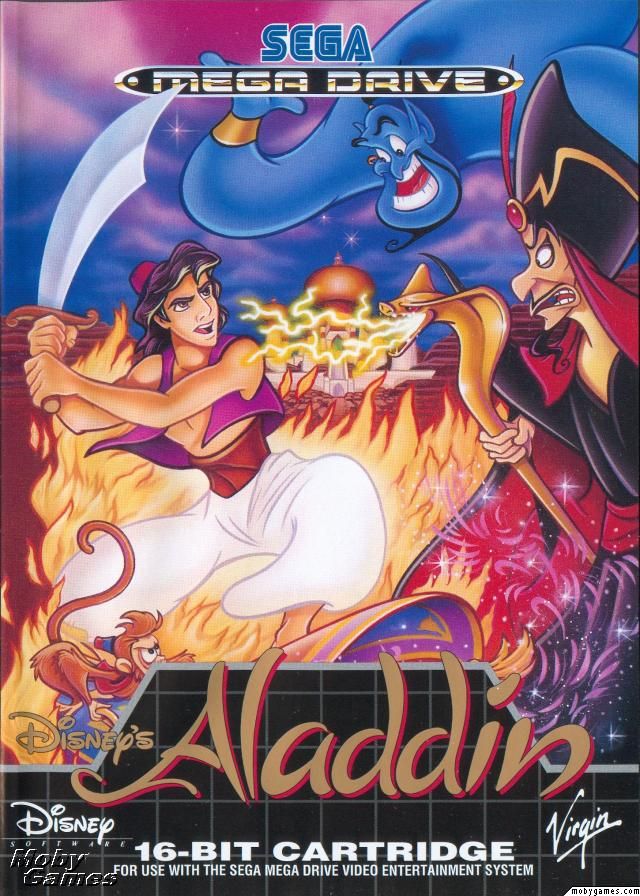
Aladdin is a Middle-Eastern folk tale about a boy who went from rags to riches with the help of a genie. It is one of the more well-known stories from the Arabic world. The western world embraced this tale and in 1992, Disney released their animated film version, bringing Aladdin to a “whole new world”…er…I mean generation. Its popularity, due to a great soundtrack and an award winning performance by Robin Williams, saw a video game released a year after the films hit the cinemas.
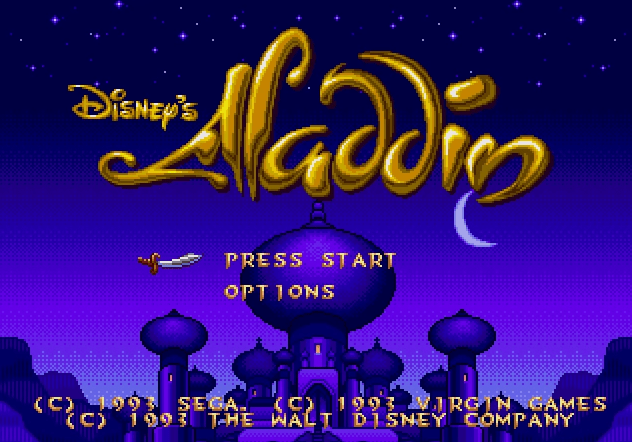
Aladdin is a single-player side-scrolling action platformer which was developed by Virgin Games. It was published in 1993 by Sega and Disney Software for the Sega Megadrive, and by Capcom for the SNES. It was later ported to the NES, Game Boy, Amiga and DOS formats. I chose to review the Mega Drive Version.
Plot
The game is not identical to, but still has the same storyline as the film. In the Arabic city of Agrabah, a lovable street rat called Aladdin lives with his monkey companion Abu. One day, he stops a stranger from getting her hand chopped off for giving a starving child an apple. This stranger turns out to be Princess Jasmine, and Aladdin is smitten.
Meanwhile, the Sultan’s evil adviser Jafar is plotting to overthrow the Sultan and marry Jasmine. Aladdin must must rescue the Princess Jasmine from the evil Jafar.
Gameplay
You can choose from three difficulties: Practice, Normal or Difficult. Once the game begins, prepare to navigate the following levels:
Agraban Street
The Desert
Agraban Rooftops
Sultan’s Dungeon
Cave of Wonders
The Escape
Rug Ride
Inside the Lamp
Sultan’s Palace
Jafar’s Palace
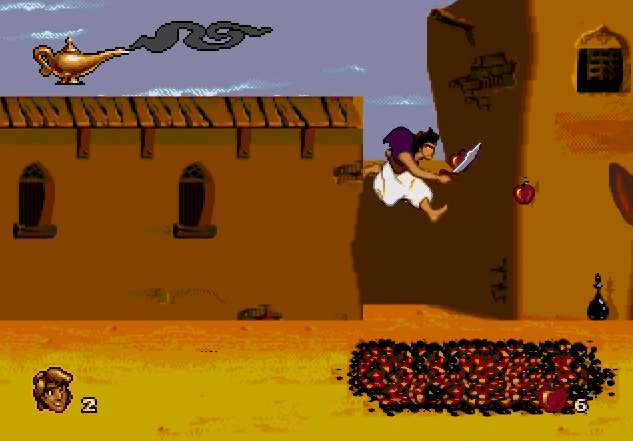
Whilst traversing the levels you are able to jump, crouch, and climb ropes. To defeat enemies, you have the choice of a scimitar with which to slash your opponent or you can collect apples to use as projectiles. If you collect tokens of the Genie’s head or Abu’s head, you will gain access to bonus stages to gain extra lives and such. Gems can also be acquired to buy extra continues and wishes from the peddler.
Clearing a level with one or more of the Genie’s tokens takes you to the Genie’s Bonus Machine where you can win gems, apples, and extra tries. The amount of spins you get depends on the number of Genie tokens you have.
If you find an Abu token, you gain access to his bonus stage. He must run back and forth, wielding a scimitar, and trying to pick up special objects that are dropped from the sky whilst avoiding rocks and pots that are also falling. Again, your aim is to collect gems, extra tries, and apples.
There are cut scenes between the levels allowing the storyline to move along, but you do not need to have seen the film in order to enjoy the game.
How Does The Game Handle?
The controls are tight, and the physics of the game are easy to get used to. One level which sees our hero trying to escape the Cave of Wonders is particularly hard and had me swearing many times at the TV and/or controller pad.
Graphics
The graphics are incredible! They are bright and colourful, and the animation is excellent and fun to watch. I particularly liked the smoke from the genie’s lamp being used as a health meter and the way little Abu runs around in his bonus stage.
All the levels are detailed, look beautiful and make you feel like you’re playing the movie. The parallax scrolling of the chains in the foreground of the Sultan’s Dungeon really helped with the feeling of being locked inside. To be fair, all the levels look amazing.
Music & SFX
The music consists of songs from the movie soundtrack so no doubt you will be humming along. For example, over the title screen you will hear “A Whole New World” and over the first level it is “Prince Ali”.
The main SFX you will hear is the sound of air being cut as Aladdin swinging his sword and little ‘trings’ as he picks up items. There are lots of SFX in this gave and it’s awesome.
SPOILER ALERT!!!
Frustratingly, at the end of the game you can only defeat Jafar by throwing apples at him. What the game doesn’t tell you is that you need 36 apples to defeat him. If you don’t have enough there is little else you can do other than restart the entire game, and ensure you use the apples sparingly.

Replay Value
When the game is completed the ending is practically non-existant, which begs the question, should one have bothered to complete it in the first place. The answer, of course, is yes as this is a good game and worth playing again.
Did I Complete The Game?
Yes, but I wasn’t happy about getting all the way to the end before realising that I had to restart and play through again to ensure I had enough apples to defeat Jafar.
What The Critics Said:
Edge Magazine: “…almost perfect. The sound could have been better – but that’s a minor quibble. Anyway, at last the Mega Drive has a new platform king. Move over spiky blue one, Aladdin’s in town. Overall 8/10.”[1]
My Verdict: “Prince Ali! Fabulous He! Ali Ababwa. A fun little game that is well worth your time. Great graphics and music, however older generations might get bored a little easily with this one.”
Rating:

What are your memories of Aladdin? I would love to hear your thoughts, and don’t for get to follow and subscribe so that you don’t miss my latest reviews! You can also find me on Instagram: @nicklovestogame.
[1] ‘Review Mega Drive: Aladdin’. Edge Magazine. (November 1993). Issue 2:92-3.
 Nick Loves to Game