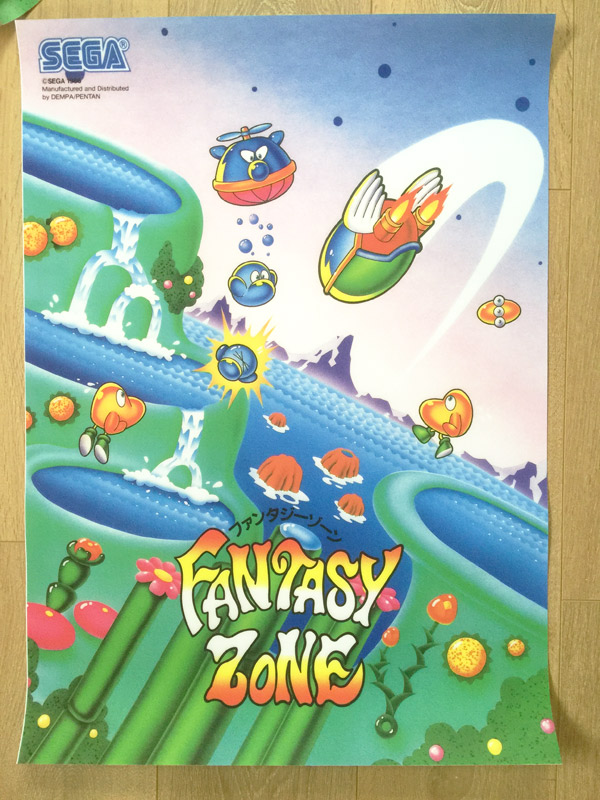
Fantasy Zone – Review

In this world of almost unlimited access to video games through emulation, we forget sometimes that once certain games were only released in selected countries. I myself used to own a Honey Bee, which allowed me to play Japanese games on my Mega Drive. Although ported to consoles around the world, as far as I can tell, the Fantasy Zone arcade cabinet could only be found in Japan. It proved very popular in Japan and so it is anyone’s guess as to why it was never exported to Europe or the US.
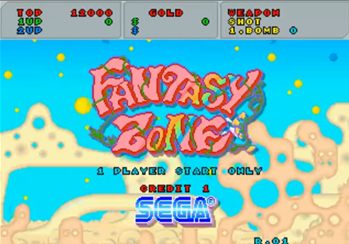
Title screen (screenshot taken by the author)

Fantasy Zone is a side-scrolling shooter developed and released by Sega. It was released for the arcade in 1986 and was later ported to the Master System, MSX, NES, Sharp X68000 and PC Engine. Each port contained slight alterations to the game. Later releases include:

  • PlayStation 2 as part of Sega Classics Collection (1996), although there were some very noticeable changes to the graphics.
  • Sega Saturn as part of Sega Ages (1997)
  • Mobile devices in 2002 and 2003
  • Virtual Console (2008)
  • PlayStation 3 and Xbox 360 as part of Sonic’s Ultimate Genesis Collection (2009)
  • Nintendo 3DS (3D port) as part of 3D Fantasy Zone: Opa-Opa Bros. (2014).

For this review, I played the version found onSonic’s Ultimate Genesis Collection (2009).
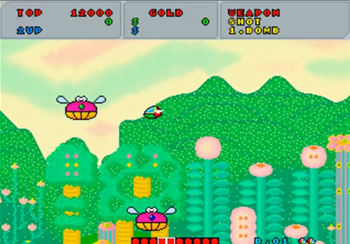
Unlike many other side-scrolling shoot ’em ups, you can turn and fly in the other direction (screenshot taken by the author)

Plot

The Fantasy Zone, a solar system with 8 planets, is under threat from the evil Menons who are using foreign money, acquired by illicit means, to build a force of flying monsters. You must destroy the Menons and recover as many coins as possible along the way.

Gameplay

You control a sentient spaceship called Opa-Opa. Armed with your Twin Shot gun and single bombs, you have 8 stages to conquer. In each stage you must destroy 10 specific ships in order to collect the coins they drop. Once you have collected all the coins from one planet, you can move on to the next…after a boss battle, of course. Oh, and unlike many shooters I’ve played, this one allows you to turn around and fly in the opposite direction.

Throughout the stages, you will occasionally see a balloon which has the word ‘Shop’ written across it. Flying into these balloons will allow you access the shop where you can spend your hard-earned coins on upgrades and weapons:

Shot Type Upgrades:

  • Wide Beam – Damages over a wider area than your Twin Shot
  • Laser Beam – Incredibly powerful laser
  • 7-Way Shot – Shoots in 7 directions at once

Bomb Type Upgrades:

  • Twin Bombs – Launches two bombs at once
  • Fire Bombs – When it hits its target, it fires out a blast in two directions destroying everything in its path
  • Smart Bomb – Damages every enemy on the screen
  • Heavy Bomb – Drop to smash through anything it comes into contact with.

Speedup Parts (Each upgrade allows your ship to fly faster):

  • Big Wings
  • Jet Engine
  • Turbo Engine
  • Rocket Engine

Other:

  • Extra Life

Weapons and bomb power-ups contain a limited number of ammo. When they run out, your ship will revert back to your default weapon.

Beware, one hit from an enemy and your ship will get destroyed, losing any power-ups you have bought!
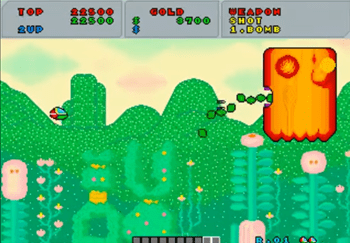
Don’t be fooled by the cutsie appearance, this game is tough (screenshot taken by the author)

How Does It Handle?

The controls are very responsive, allowing you to quickly evade enemies. You can keep your thumb on the fire button to release a steady stream of fire, or quickly tap the fire button for more rapid fire.

As the levels progress, the main enemies you need to kill require more hits to be destroyed and the screen becomes busier with smaller enemies increasing the level difficulty.

Graphics

This game is very bright and colourful. There is plenty to look at and take in and the many enemy creatures are nicely illustrated and animated. At first glance, you can be forgiven for thinking this is aimed at kids. After all, compared to the likes of Alcon, Darius and Lifeforce (also released in 1986) the graphics have a very cartoon-like feel. These graphics will sit well with some but not with others who may desire a more adult look to their games.

Music and SFX

I quite like the music. It has a good beat and I found myself bopping along to it as I attempted to evade the many flying enemies. The change in tone to a lower register for the boss battles adds a feeling of danger. You find yourself saying “Right, here we go”.

When shooting the enemies where you gain the main coins from, the noise changes slightly which I thought was a nice touch, and there is a satisfying ‘boing’ sound when you blow up the smaller flying enemies.

Replay Value

There is an addictiveness to this game as well as an element of competition in two-player mode. It is a pity that two players can’t play at the same time but it is understandable as it would likely take away the option to scroll the screen in both directions.

As the levels progress, the main enemies take more shots to kill (screenshot taken by the author)

Did I Complete The Game?

At present, I can only get to the third planet.

What The Critics Said:

At present, I have been unable to find a contemporary review for the arcade version.

Verdict

“It may look cute, but it doesn’t play cute. This game is a real challenge! Bright and colourful, with nice music, its simplicity is also its appeal.”

Rating

What are your memories of Fantasy Zone? I would love to hear your thoughts, and don’t for get to follow and subscribe so that you don’t miss my latest reviews! You can also find me on Instagram: @nicklovestogame.

Congo Bongo – Review

There will always be a debate about emulation vs original hardware. Some argue that you can only experience the true essence of a game upon playing the original. Others aren’t that fussed or simply can’t afford or access the original hardware. Why should they miss out? I tend to fall into the later category. I would never have played Congo Bongo had it not been for emulation…and I’m glad I did.

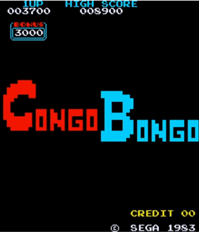
Title screen (screenshot taken by the author)

Congo Bongo (also known as Tip Top) is a platform game developed and released by Sega for the arcade in 1983. For this review, I played the version found on Sonic’s Ultimate Genesis Collection (2009) for the PlayStation 3.

Plot

One night, deep in the jungle, an unnamed safari explorer has his tent set on fire by a huge ape named Bongo. The explorer then proceeds to chase Bongo to try and capture him.

Gameplay

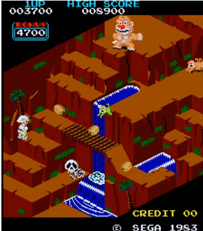
The explorer must pursue Bongo across four screens. Whilst in pursuit, there are a number of obstacles for you to evade and conquer. These include jumping across water, dodging other jungle creatures who wish you harm, or evading coconuts thrown by Bongo. You are unable to attack any of the other jungle animals, but you can jump over them to avoid being hit by them.

The four stages include:

  • Stage 1 – The hunter must climb a series of cliffs whilst dodging coconuts thrown at him by Bongo and avoiding the smaller monkeys who try to throw him off the ledges.
  • Stage 2 – The hunter must cross a swamp by riding on the backs of diving and swimming hippos. There are also poisonous snakes and scorpions to avoid.
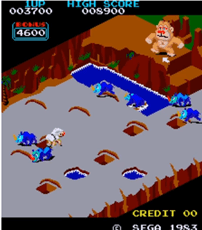
  • Stage 3 – The hunter must cross a plain and crouch into holes to evade the horns of charging rhinos. He must then climb more ledges to get to the next stage.
  • Stage 4 – The hunter crosses a second swamp with lily pads, fish, and hippos. Once you reach the other side of the swamp, you must dodge more charging rhinos that are blocking the ledges where you can capture bongo.

One you reach the end of level four the game repeats from the first level with increased difficulty.

Watch out for the cocnuts! (screenshot taken by the author)

How Does It Handle?

I think our hero moves at a good speed and is easy to control once you get used to the isometric view. I find it helps to rotate my controller to match the directions he will go on the screen. The jumping is tight too. No complaints there. As you can imagine from old arcade games, this is a tough game to master. I think I’ve only ever managed to get to level five or six before losing all my lives.

Graphics

I think this game looks great for 1983. I love the blue of the water, and the animation of our hero as he climbs out of the holes and climbs up the ledges of the mountains. I think the animals are nicely animated too. No issues for me here.

Music & SFX

There is no intro music or in-game music, but there is a nice little piece of celebration music as you pass each level which for some reason reminds me more of a wild west game than it does a jungle game. There is also a strange little riff when you die and float up to heaven.

The noise that the coconuts make as they are being thrown and bounce down the mountains is annoying, as is the low level bassy noise when the rhinos are on screen.

Replay Value

I can imagine that when this game was released it had tons of replay value. I can envisage groups of friends hanging around the machine seeing who could get the highest score. I can also see this game being quite addictive too. There is something about it which draws you back to it.

Did I Complete The Game?

I don’t think this the sort of game you can complete but I only reached level five or six before losing all my lives.

I didn’t know there rhinoceroses in the jungle?! (screenshot taken by the author)

What The Critics Said:

Computer and Video Games:  “Donkey Kong in three dimensions is the fascinating idea behind Tip Top. (No rating)“.[1]

My Verdict:

“I think this would have been a good game in its day. I like the look of it, but the music just doesn’t fit for me. It is also incredibly difficult. Other than that, I can see this game becoming addictive.”

Rating:

What are your memories of Congo Bongo? I would love to hear your thoughts, and don’t for get to follow and subscribe so that you don’t miss my latest reviews! You can also find me on Instagram: @nicklovestogame.


[1] ‘Arcade: Jungle Revenge in 3D – Tip Top’. Computer and Video Games. (July 1983). Issue 21:30.

Altered Beast (Arcade) – Review

One of the great things about emulation is that you get to play arcade games that you didn’t get the chance to experience first time around. Compared to their console ports, the arcade versions usually had better graphics and sound…but were a lot harder!

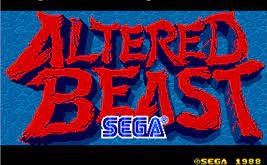
Title screen (screenshot taken by the author)

Altered Beast is a side-scrolling beat ‘em up with some platform gaming elements. It was developed and published by Sega, and released in the arcade in 1988. I have already reviewed the Mega Drive version of Altered Beast (1989), but for this review, I played the arcade version found on Sonic’s Ultimate Genesis Collection (2009).

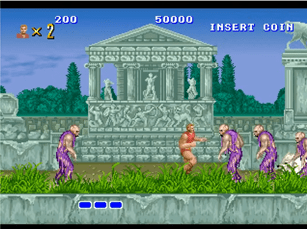
Smash your way through a graveyard filled with the undead (Screenshot taken by the author)

Plot

“Rise from your grave!” commands Zeus, as you emerge from your tomb. You play as a Roman Centurion who is resurrected by Zeus (I know Zeus was a Greek God and the Roman equivalent was Jupiter, but let’s overlook the mythological inaccuracies). Your mission is to rescue Zeus’ daughter, Athena, (Minerva for the Romans) from the evil Demon God known as Neff who has taken her to the Underworld.

Gameplay

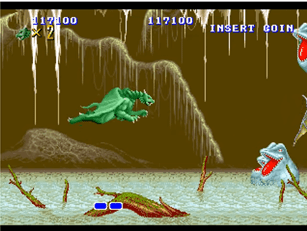
You must punch and kick your way through graveyards and caverns to reach the Underworld, all the while fighting numerous undead minions and monsters. In order to meet and defeat the end of level bosses, you need to collect three orbs which increase your strength and eventually morph you into anthropomorphised animals such as wolves, bears, tigers and dragons, each with unique abilities.

The Gothic organ that plays over the cutscenes is awesome (Screenshot taken by the author)

How Does It Handle?

Interestingly, there are one or two differences between the Mega Drive version and the arcade version. For example, the punching and kicking is noticeably slower in the arcade version. This all changes, however, once you transform into your beastie. Your speed increases significantly and you pretty much whizz around the screen destroying everything you com into contact with, which you don’t do when playing the Mega Drive version. The arcade version also sees a slight delay when you try to jump higher because our hero crouches briefly before leaping. This adds an element of realism to the game but takes some getting used to.

Graphics

Being an arcade version, the graphics are obviously superior to any of the console ports, especially where the backgrounds are concerned. The sky on level one, for example, blends the different shades of blue seamlessly, and the sprites themselves are smoother and more detailed with more vibrant colours. The two-headed dogs, for instance, are more defined and you can actually see what they are. As a kid, I thought they were some kind of bull.

When you kill an enemy, rather than just explode, bits of their broken torso fly at the screen towards you which is a gory but cool touch. The animations for when you transform into your beast look great and your attacks are better illustrated and animated. I also like the fact that when you are greeted by Neff at the end of the level, you actually see him grow before he turns into the boss which is a nice addition. After the boss fight, Neff’s head appears and sucks the orbs out from you, returning you to your puny former self. The blue field that surrounds you whilst he does this looks great.

Music and SFX

The music itself isn’t all that memorable but I do like the way that for each level, it starts off quite understated but jacks up when you transform into your beast, and for when you fight the boss battle. The best music from this game, though, comes during the cut scenes. When the purple disc appears showing the various stages of Neff’s ritual, a creepy, Gothic organ plays over the top. It’ll certainly send a shiver down your spine.

When you collect an orb, your hero proclaims “power up” as he grows into a more muscular version of himself. This is so iconic that I’d wager any gamer worth their salt upon hearing that soundbite would be able to tell you what game it came from.

I also like how when you meet Neff and he states, “Welcome to your doom!”. In the arcade version he actually sounds scary, as oppose to the raspy greeting you get on the Mega Drive.

Collect three orbs and become magical beast (Screenshot taken by the author)

Did I Complete The Game?

Yes, but only because the version played had infinite continues.

What The Critics Said:

The Games Machine: “Altered Beast is an interesting coin-op in that while not being a highly visual game like Space Harrier, Out Run and the like, it offers enough in its gameplay warrant a good play. Overall Positive.[1]

Commodore User: “…the gameplay really doesn’t vary greatly, or increase markedly in toughness. Still, a cleaver game, and still worth a few tens of anybody’s money.  Overall 7/10.[2]

My Verdict:

“Although the graphics are clearly superior to any port version, the action when you’re human is slowed down and gives the game a laboured pace. Disappointing really as even the arcade version falls short of what could’ve been so much better.”

Rating:

What are your memories of Altered Beast? I would love to hear your thoughts, and don’t for get to follow and subscribe so that you don’t miss my latest reviews! You can also find me on Instagram: @nicklovestogame.

[1] ‘Confrontation Co-op – Altered Beast’. The Games Machine. (November 1988). Issue 12:30-1.

[2] Kelly, N., ‘Arcades – Altered Beast’. Commodore User. (September 1988). Issue 60:94-5.

Monkey Island 3: The Curse of Monkey Island – Review

After the success of The Secret of Monkey Island (1990) and Monkey Island 2: LeChuck’s Revenge (1991), is it any wonder that LucasArt would continue with the franchise? However, fans would have to wait another six years before the third instalment appeared…The Curse of Monkey Island!

Title screen (screenshot taken by the author)

The Curse of Monkey Island is a point and click adventure game develop and publish by LucasArt. It was released in 1997 for Microsfit Windows. For this review, I played the version downloaded from Steam.

Plot

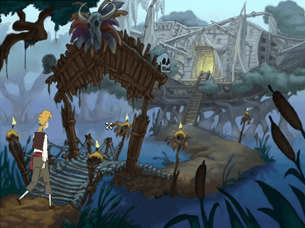
Once again, we follow our hero Guybrush Threepwood. After being stranded at sea for many days in a bumper car, the tides drift him to Plunder Island where he is instantly caught in the middle of LeChuck’s bombardment of Elaine’s fort. It seems LeChuck still wants to marry her and won’t take no for an answer. After foiling LeChuck’s assault, Threepwood finds a diamond ring amongst the pirate treasure. He then formally proposes to Elaine, who accepts. As soon as she puts the ring on, she transforms into a gold statue…the ring is cursed! She is stolen soon after. Threepwood must save Elaine and find a way to lift the curse. Easy right?

Gameplay

The game continues in the point and click format. Your cursor is an ‘X’. When you hover over items, characters, or scenery, that you can interact with, the name of what you can interact with will appear on the screen. The interface is in the style of a gold pirate doubloon. To access it, simply hold the left mouse button over an item and the interface will appear. The hand icon instructs Threepwood to pick up, use, or hit someone; the eyes allow you to examine something; and the parrot head instructs Threepwood to talk to or bite/eat something. To access your inventory, you simply click the right mouse button.

When talking to characters, there are usually several options that appear which usually involves comical quips or questions that help you progress.

A new feature in the series are the sea battles. Using left click to steer and right click to fire, you must learn to manoeuvre your ship into range before firing a volley broadside into the enemy whilst evading their fire.

The new graphics look fab! (screenshot taken by the author)

How Does It Handle?

The user interface and the number of commands has been simplified to make the game more enjoyable (in my opinion). This game is easy to learn and easy to navigate. No complaints here. The ship battles are easy, but fun and a good way to mix up the action. They may not be everyone’s bottle of rum though.

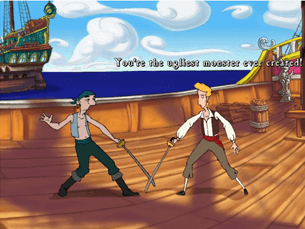
Apart from the usual: examine everything on screen tactic used by point and click fans everywhere, which offers quips from Guybrush, there are two other aspects to the game that add to this gaming experience. The first is by adding a banjo duelling scene where you must compete with another banjo player by plucking the correct strings in order. The second is sword battles where you win by hurling verbal insults at your opponent or countering their insults with even bigger burns. These two aspects of the game are alot of fun!

Graphics

As one may expect after such a long hiatus, the graphics are vastly improved. Not everyone was happy with the more comical style that the characters took on, but I loved it. The scenes are quirky an colourful with plenty to investigate, and the characters are larger than life. Bravo!

Music and SFX

Once you’ve selected your difficulty setting, you begin to hear a few primates chattering away. Over the next few seconds there is clearly some excitement as the voices become louder and more animated. I loved this intro to the game…but then again, I love chimps too.

During the story introduction, you are met with a beautifully animated introduction to the game with some fab Caribbean-style music played over the top. The in-game music doesn’t grab your attention, but its subtlety really works and is fitting for the game.

This game is the first in the series to have voice acting. It stars Dominic Armato as Guybrush Threepwood, Alexandra Boyd as Elaine Marley, and Earl Boen as Ghost Pirate LeChuck.

Replay Value

You have the option of playing a simpler game with less puzzles for a harder game with more puzzles. This is a neat feature and adds replay value to the game. This game is certainly worth revisiting and I know many of my firends who have played through this more than once.

“I am rubber, you are glue!” (screenshot taken by the author)

Did I Complete The Game?

Yes, but I probably used more hints from a walkthrough than I should have. Oh, the impatience of age!

What the Critics Said:

Computer Gaming World: Outstanding animation, plot, dialogue, and puzzles add up to the most satisfying adventure game of the year. Overall 5/5.[1]

Next Generation: “…despite its flaws, Curse, like its two predecessors, is still fun enough to remain a satisfying experience. The Monkey Island games are massively popular for a reason: people enjoy playing them. So it’s hard to find too much fault with LucasArt for epitomizing the axiom, “If it ain’t broke, don’t fix it. Overall 3/5.[2]

Gamespot: “There simply isn’t much to dislike about this game, except possibly the ending, which seemed a bit abrupt and anticlimactic after 20 hours of gameplay. Still, The Curse of Monkey Island should more than satisfy the cravings of the Monkey Island faithful and even appeal to gamers who don’t typically go in for graphic adventures. Overall 9/10”.[3]

PC Gamer US: “If this isn’t destined to be a classic, I’ll swallow a cutlass. Overall 95%”.[4]

PC Zone: “Essentially, then, The Curse Of Monkey Island offers more of the same. That’s no bad thing because there are still mad fools out there who’ve never laid their eyes on Monkey 2, but of course to us old ape hands, Monkey 3 is no longer startlingly ‘new’. It’s far more polished than its prequel, yet at the same time familiar and reassuringly tip-top territory. Overall 9.2/10.[5]

PC Games: The Secret of Monkey Island was an enormous success. By contrast, LeChuck’s Revenge seemed weak, and the laughs intermittent. The Curse of Monkey Island, though, features all the vitality of the original release. If you want inventive puzzles, fine graphics, and, above all, enough wit to power an entire season of prime-time television, don’t miss this game. Overall A.[6]

Awards:

Adventure Game of the Year 1997 – Computer Gaming World[7]

Adventure Game of the Year 1997 – Computer Games[8]

Best Adventure Game 1997 – Gamespot[9]

My Verdict:

“What’s not to like? This game looks awesome, has fab music with great SFX and voice acting with larger than life characters. It is also incredibly fun to play and is a worthy sequel to the ever-popular Monkey Island series. I’m now itching to play the next instalment.”

Rating:

What are your memories of The Curse of Monkey Island? I would love to hear your thoughts, and don’t for get to follow and subscribe so that you don’t miss my latest reviews! You can also find me on Instagram: @nicklovestogame.

[1] Green, J., ‘Review: The Curse of Monkey Island’. Computer Gaming World. (March 1998). Issue 164:152-3.

[2] ‘Rating – The Curse of Monkey Island’. Next Generation. (March 1998). Issue 39:113.

[3] Ryan, M.E., (Nov 25 1997) ‘The Curse of Monkey Island’. Gamespot. (http://www.gamespot.com/pc/adventure/curseofmonkeyisland/review.html Accessed 18th April 2022).

[4] ‘Curse of Monkey Island, The,’ PC Gamer US. (February 1998). (https://web.archive.org/web/19991206173715/http://www.pcgamer.com/reviews/289.html Accessed on 18th April 2022).

[5] ‘PC Reviews – Monkey Island 3: The Curse of Monkey Island’. PC Zone. (https://web.archive.org/web/20080407171909/http://www.computerandvideogames.com/article.php?id=3210 Accessed on 18th April 2022).

[6] Brenesal, B., (01/05/1998). ‘The Curse of Monkey Island’. PC Games. http://www.games.net/pcgames/articles/0%2C1034%2C1211%2C00.html?CHANNEL=pcgames&AD_SECTION=review Accessed on 18th April 2022).

[7] ‘CGW 1998 Premier Awards: Adventure Game of the Year’. Computer Gaming World. (March 1998). Issue 164:76.

[8] ‘The winners of 1997 Computer Games Award’. Computer Games Strategy Plus. (https://web.archive.org/web/20050206152953/http://www.cdmag.com/articles/009/194/1997_cgsp_awards.html Accessed on 18th April 2022).

[9] ‘Best & Worst Awards 1997 – Best Adventure Game’. Gamespot. (https://web.archive.org/web/20010210224852/http://www.gamespot.com/features/awards97/adven.html Accessed on 18th April 2022).

Vectorman 2 – Review

By 1996, there had been a sharp decline in the titles being released for the Mega Drive. Creators were clearly favouring the next generation of consoles such as the PlayStation, Sega Saturn, and Nintendo 64. However, due to the success of its predecessor, Vectorman returns for a second adventure. The question is, will it receive the same plaudits as the first instalment?

Title screen (screenshot taken by the author)

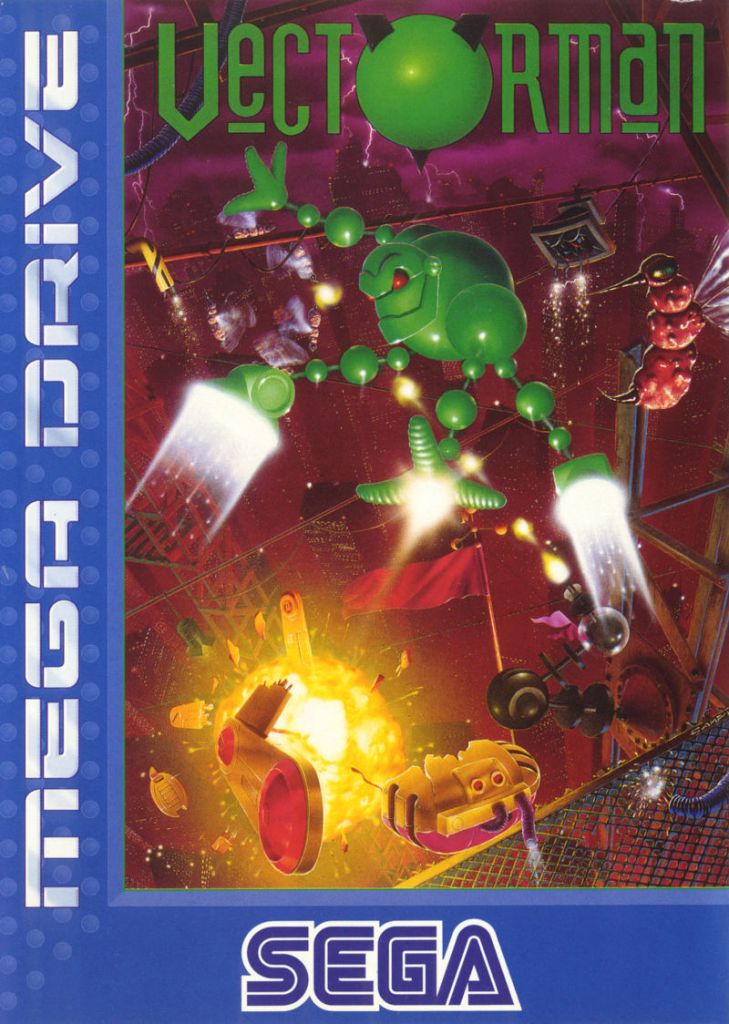
Vectorman 2 is a single player run and gun platform game and the sequel to Vectorman (1995). It was developed by BlueSky Software and published by Sega for the Mega Drive in 1996. For this review, I played the version found on Sonic’s Ultimate Genesis Collection (2009).

Plot

After defeating Warhead and foiling its plans to kill the humans when they returned to Earth, Vectorman resumes his normal duties. One day whilst completing the routine task of accompanying a sludge barge, his ship is hit by a missile of unknown origin. Vectorman survives the crash landing and finds himself near a research facility. As he investigates the origin of the missile, he discovers a population of mutant insects that have taken up residence in the research facility. The insects show clear signs of a destructive nature towards the Earth, but it is unclear who is controlling them. Vectorman must destroy the insects to once again save Earth.

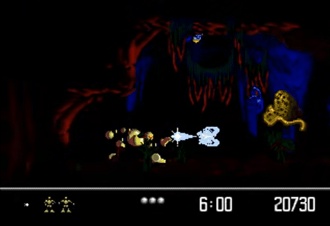
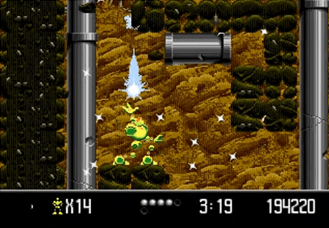
Use Vectorman’s built-in weapon to destroy the mustant insects (screenshot taken by the author)

Gameplay

Vectoman can run and jump, and fire a weapon from his hand. Whilst at the apex of his jump, he can use his Boot-Blasts to gain even more height. These Boot-Blasts can also be used to cause damage to enemies when ignited. The game consists of seven parts, divided into 22 scenes.

Weapons

Whilst battling through the levels, Vectorman can temporarily acquire other weapons including:

  • Laser – Allows rapid fire.
  • Energy Shot – Solid beam of incredible power.
  • Super Energy Shot – More powerful than the Energy Shot, can ricochet of walls and also break through tiles.
  • Pulse – Fires in a more dispersed range. The second most powerful weapon Vectorman can use.
  • Overkill – A single shot which destroys everything onscreen.

Morphs

At times, Vectorman can also morph into the following:

  • Helicopter – Helps him hover and control his descent.
  • Skates – Enables him to travel through level at high speed.
  • Tornado – Helps Vectorman spin very fast for a limited time causing destruction to whoever comes into contact with him.
  • Tank – Pure firepower.

Power-Ups

Some enemies drop Assimilation icons which temporarily allows Vectorman to take on the characteristics of that enemy:

  • Shell Bug – Shield.
  • Scorpion – Attack using a deadly stinger.
  • Rhino Beetle – Charge through walls and into enemies.
  • Tick – Destroy your enemies by giving them a mighty wallop.
  • Fireant – Fireball.

Other Power-Ups include:

  • Multipliers x2, x3, x5, x10 – Multiplies points earned respectively.
  • Health Point – Restores one health ball.
  • Full Health – Fully restores health.
  • Max Health – Increases number of health balls.
  • 1-Up – Extra life.
  • Milestone – If you die, you will restart the level from this point.
  • Extra Time – Gives you extra time on the level.
  • Power Sacks – Destroy these to get power-ups inside.
  • Photons – Collect these for points. If enough are collected, you will be taken to a bonus round.
(screenshot taken by the author)

How Does It Handle?

The controls are exactly the same as its predecessor. They are tight, and responsive and the game is easy to just pick up and play. I really liked the changes in enemies from the robotic minions of the first game to the mutant insects of this game. It emphasises that you are facing a different challenge and helps differentiate the two games. The addition of different morphs and the ability to take on the characteristics of some of your enemies makes for a more interesting game too.

Graphics

The graphics of the Vectorman’s sprite look a little more refined in my opinion. There seems to be a new sheen to our hero. The levels look good…not spectacular but good. The mutant insect’s look ok, and the bosses look pretty good. One nice touch is that when you are in dark caves and Vectorman fires his gun, the area around him lights up.

Music and SFX

The music was ok, but it was quite forgettable. What I did like was the introduction of Vectorman’s robotic voice which I can’t remember from the first game. When he picks up new weapons and power-ups, he speaks but I couldn’t for the life of me understand what he was saying. It was still cool to hear though. There is also more differentiation between the sounds of the weapons when fired.

Replay Value

Vectorman 2 has three diffficulty settings but other than that, and there isn’t much to keep you coming back time and time again fter completing it a few times.

Did I Complete The Game?

No, I got to the last boss and died.

What The Critics Said:
Electronic Gaming Monthly: “No surprises here. Vectorman 2 is a solid side-scrolling platform game that will keep players busy for a few weekends. It’s levels-which include above-and below-ground areas-are huge and allow for a lot of exploration. Although the graphics are rarely outstanding, they’re always decent (and often very dark, as well). Boss monsters look especially good Many are so huge they fill the screen in fact, most of the game’s enemies look pretty cool. What really calls attention to this title, though, is its soundtrack, a booming techno-beat that sounds nothing like the static-ridden music pumped out by most genesis games. Overall 29/40.[1]

GamePro: “It’s simple mindless fun – just like the good old days. Vectorman 2 is the most addicting Genesis game this year…and it may be one of the last, so enjoy! Overall 19.5/20.[2]

Awards:

Electronic Gaming Monthly – Genesis Game of the Year 1996[3]

My Verdict:

This is another solid action-platformer. Very fun to play and challenging enough more experienced gamers. There is enough to make this game different enough from its predecessor

Rating:

What are your memories of Vectorman 2? I would love to hear your thoughts, and don’t for get to follow and subscribe so that you don’t miss my latest reviews! You can also find me on Instagram: @nicklovestogame.


[1] ‘Review Crew – Vectorman 2′. Electronic Gaming Monthly. (November 1996) Issue 88:90.

[2] Scary Larry. ‘Genesis Proreview – Vectorman 2 GamePro. (December 1996). Volume 09 Number 12 Issue 99:154.

[3] ”The Best of 96′.  Electronic Gaming Monthly. (March 1997). Number 92:86.

Vectorman – Review

It is always confusing when you come across a game that you’ve never heard of before and it’s awesome. Why? Because you begin to wonder why you haven’t heard of it before! Why were these games not championed more by creators, critics, and gamers alike? I wonder whether Vectorman’s late arrival to the scene was simply overshadowed by the focus on the next generation of consoles. Had Vectorman been released just a year or two earlier, it may have been given higher regard by the gamer community.

Title screen (Screenshot taken by the author)

Vectorman is a single player run and gun platform game developed by BlueSky Software and published by Sega. It was released on the Mega Drive in 1995 and would later appear on a number of compilations such as Sonic Gems Collection (2005) for the GameCube, Sega Genesis Collection (2006/7) for the PlayStation 2 and PlayStation Portable, and Sonic’s Ultimate Genesis Collection (2009) for the PlayStation 3 and Xbox 360. It was also released on the Wii Virtual Console in 2007 and on Steam in 2018 as part of the Sega Genesis Classics Pack. It was also included on the Mega Drive Mini in 2019. For this review, I played dthe version found on Sonic’s Ultimate Genesis Collection (2009).

Plot

In the year 2049, the Earth is one big cesspit of pollution and toxic waste. Humans decide to leave Earth and seek a new home to colonise. In the meantime, they create robots known as “orbots”, designed to clean up the mess whilst the humans are away. Raster, a highly advanced orbot, is accidentally connected to a nuclear weapon by a lesser orbot. This turns Raster from a benevolent orbot into the psychopathic machine known as Warhead. He is hellbent on ruling Earth himself and plans the execution of humans once they return to Earth.

Vectorman is a lesser orbot whose job is to clean up toxic waste and dispose of it in the sun. He was off planet when Raster became Warhead and returns to find the planet in a state of chaos. Vectorman decides that he should try to stop Warhead’s evil plans.

Vectorman has a built-in gun in his hand (Screenshot taken by the author)

Gameplay

The game consists of Vectorman fighting his way through 16 levels, battling Warhead’s minions on the way. At his disposal is his built-in gun, which he uses to destroy the baddies or to blow-up the TV screens that offer power-ups. The weapon power-ups include:

  • Rapid Fire: Keep the fire button held down to produce a continuous stream of bullets.
  • Wave: Useful for killing enemies not directly in your line of sight.
  • Bolo: Fires a bit rotating ball.
  • Orb: Can be used only one and designed to kill all nearby orbots in a huge explosion.
  • Nucleus Shield: Temporary invincibility. Once it runs out, you also lose your previous weapon power-ups.

Note: Shooting downwards whilst falling, will slow your descent.

Other power-ups include:

  • Health Point: Fills one ball on your health indicator.
  • Full Health: Fills all balls on your health indicator.
  • Max Health: Increases number of balls on your health indicator.
  • 1-Up: Gives you an extra life.
  • Milestone: Should you die, you restart the level where you picked this up.
  • Extra Time: Adds time to the count down.
  • Photons: Pick these up for extra points.
  • x2: Multiples points by 2.
  • x3: Multiples points by 3.
  • x5: Multiples points by 5.
  • x10: Multiples points by 10.

Vectorman can also pick up morph icons that will transform him into other types of robots to help him advance in the level:

  • Drill: Allows you to break through certain floors.
  • Bomb: Explosion will kill nearby enemies and destroy certain walls and floors.
  • Jet: Enables you to fly higher than you can jump.
  • Fish: Enables you to swim faster than you can run.
  • Missile: Enables you to break through certain ceilings.
  • Parachute: Allows you to slowly descend with greater manoeuvrability.
  • Buggy: Can be used as a battering ram to break through certain walls.

Vectorman has the ability to jump a little higher by tapping the jump button again whilst when he reaches the top of his initial jump. This will briefly ignite rockets in his feet which also causes damage to enemies.

Destroying satellite dishes allow you access to bonus stages. However, to destroy these you first need to find and destroy the shield generators which are hidden throughout the levels.

(Screenshot taken by the author)

How Does It Handle?

The game is quite chaotic at times and there is a lot on the screen to take in, and at first, I had no idea what was going on. However, there is lots of fun to be had charging through the levels and blasting all the baddies. I feel it would have been better to have the view zoomed out a little more so that you can take in more of the level.

Graphics

The Vectorman sprite looks awesome and the movements are incredibly fluid. When you move into dark areas, your sprite also goes dark, but you can still see red flashing lights on his body, face and extremities that remind us that he is a robot. This was a nice touch. I also liked the lightning flashes on Day 12.

Most of the backgrounds for the levels looked good, but I just felt that they lacked something. Maybe they just weren’t full of vibrant colour that I have been used to with so many Mega Drive games. Then again, maybe the drabness was to emphasise the polluted state the Earth is in. Even so, the flags flying in the breeze in particular look very realistic.

Music

The game contains electronic techno dance music throughout which I though suited the game very well.

Replay Value

The game has three difficulty settings Lame, wicked, and insane which offers some relay value. However, although the end of level scores state whether you picked up all the photons and destroyed all the TV screens, there is no difference to the outcome of the game if you do destroy all TV screens and pick up all the photons. I think this is a missed opportunity to add something more to the game encouraging gamers to return to it.

Did I Complete The Game?

Yes, but so far, only on the Lame setting.

What The Critics Thought?

Electronic Gaming Monthly: “It seems like Sega has a new mascot. Vectorman offers graphics that make it look like it’s on a system other than the Genesis. The animation is really smooth. Surprisingly, VM excels in the control department. It doesn’t have anything really new, but it plays well. The gameplay is fast, and the action generally is intense but not frustrating. Think of Strider with a gun. The audio is just right. Overall 33/40.[1]

GamePro: “Your 16-bit system isn’t dead yet, and Vectorman is the reason why! This entertaining platform game is tough, but it rewards you with tons of fun. Overall 19.5/20.[2]

Awards:

GamePro Editor’s Choice Awards 1995 – Best Genesis Game[3]

GameFan’s 1995 Megawards – Genesis Game of the Year[4]

GameFan’s 1995 Megawards – Best Genesis Action Platformer[5]

My Verdict:

“This is a fun game. Lots of charging through levels blasting everything in sight with an array of weapons. It’s a beautiful looking game with a solid soundtrack. My only criticism is the lack of replay value for me. Definitely worth your time though!”.

Rating:

What are your memories of Vectorman? I would love to hear your thoughts, and don’t for get to follow and subscribe so that you don’t miss my latest reviews! You can also find me on Instagram: @nicklovestogame.

[1] ‘Vectorman’. Electronic Gaming Monthly. (November 1995). Number 76:42.

[2] ProReview – Vectorman‘.GamePro. (November 1995). Issue 76:70-1.

[3] Editor’s Choice Awards 1995‘. GamePro. (February 1996). Issue 79:26.

[4] ‘GameFan’s 1995 Megawards’ GameFan. (January 1996). Volume 4 Issue 1:106.

[5] ‘GameFan’s 1995 Megawards’ GameFan. (January 1996). Volume 4 Issue 1:104.

Streets of Rage 3 – Review

Streets of Rage (1991) and Streets of Rage 2 (1992) were both awesome games worthy of the highest accolades. Their success would naturally spawn a third in the series. The question is, would the creators be able to make the game unique enough to stand on its own whilst at the same time staying true to what made the first two instalments so successful?

Title screen (Screenshot taken by the author)

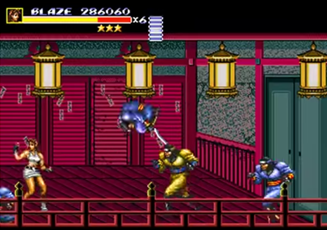
Streets of Rage 3 (known as Bare knuckle 3 in Japan) is a side-scrolling beat ‘em up developed and published by Sega. It was released in 1994 for the Mega Drive and would appear on later compilation packs including Sonic’s Ultimate Genesis Collection (2009) for the PlayStation 3 and Xbox 360 and Sega Genesis Classics (2010) which is available for Microsoft Windows, Linux, MacOS, PlayStation 4, Xbox One and Nintendo Switch. In 2012, it was released on Steam as a stand-alone game as well as with Sega Genesis Classics Pack 5. For this review, I replayed the version for the Mega Drive found on Sonic’s Ultimate Genesis Collection (2009).

Plot

Streets of Rage 3 is a direct sequel to Streets of Rage 2 (1992). It has been Several years since Axel Stone, Blaze Fielding, Eddie “Skate” Hunter and Max Thunder defeated Mr. X and rescued Adam Hunter. However, Mr. X, head of an organised crime group known as The Syndicate has returned. Since his last defeat he founded RoboCy Corporation, a legitimate robotics company that acts as a cover for his illegal activities. He has hired the world’s foremost expert on robotics (Dr. Dahm) to create an army of androids under his command to secretly replace important city officials with a view to controlling the city. Whilst this operation comes into effect, he plants bombs throughout the city to distract the police while the city officials are replaced.

After realising what Dr. Dahm’s research as really been used for, Dr. Zan, a cyborg himself, contacts Blaze Fielding and explains Mr. X’s plans for the city officials. Upon learning of the severity of the situation, Blaze contacts her old police partners Axel Stone and Adam Hunter. Axel agrees to join the task force, but Adam is unable to because of his own commitments within the police force. However, his younger brother Eddie “Skate” Hunter agrees to join the task force in his place.

It is unclear what happened to Max Thunder but Dr. Zan takes his place (Screenshot taken by the author)

Gameplay

Consistent with the previous two instalments, Streets of Rage 3 follows suit. The game can be played in one-player or two-player co-op mode. Each fighter has different stats depending on who you prefer to play with. Some are faster, some are more powerful, but none are considered the ultimate fighter.

The fighting is much the same. You must fight your way through a number of levels fighting baddies of varying strengths. Along the way you can pick up money and gold bars which increase your points tally, and food to help restore your life gauge. Occasionally, you will spot a 1-up.

As well as the usual weapons of knives, pipes, baseball batts and swords, you can also pick up grenades. Just be sure to not hold on to them too long else they will explode, and you will suffer damage.

There are a few differences from previous games, however. This is the first game in the series to utilise the six-button controller allowing for a larger move set. For special moves, you have a power bar consisting of six segments. The higher the gauge the more damage you will do to the baddies. One you perform a special move, the bars will empty and you will need to wait a few seconds for them to recharge. If the gauge is empty when you perform a special move, your life gauge will deplete slightly. With every 40,000 points you accrue, a star appears below your fighter’s life gauge. Each star you earn increases the strength of your Blitz attack. You can earn up to three stars but if you lose a life, you will lose a star.

Whereas in Streets of Rage 2 (1992) only Skate could run, Streets of Rage 3 allows all characters to run as well as roll up or down to screen to evade enemy attacks.

The story itself is more complex, with dialogue between the characters after each level, adding another layer to the story telling.

Characters:

Dr. Zan – After discovering what The Syndicate are planninng with their androids, Dr. Zan contacts Blaze Fielding in a bid to acquire her help in stopping Mr. X.

Blaze Fielding – Since defeating The Syndicate a second time, she now works as a private detective. She agrees to help when she is informed that the next victim of this dastardly plan will be her old friend the Chief of Police.

Axel Stone – After defeating Mr. X a second time, Axel moved far from the city to start up his own martial arts school. Blaze convinces him to return to fight Mr. X one more time.

Eddie “Skate” Hunter – Since helping the others defeat Mr. X and rescue his older brother Adam, Skate has grown in strength and speed. He agrees to join the task force to take down Mr. X once and for all.

The Duel Mode has been made more interesting. It is no longer just a one-on-one fight. For example, on one fight stage, the floor contains sparks that travel along a line on the floor. If it touches you, you get electrocuted. Another has holes for you to fall down which will make you lose health.

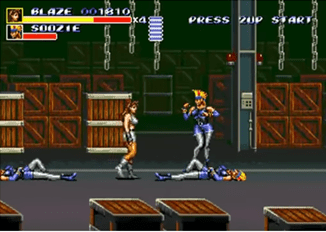
New sprites have been introduced… (Screenshot taken by the author)

How Does It Handle?

This game has tight controls, and the increase in the number of moves ensures that the fighting does not get monotonous. I did think that the hit detection was off a little though. There were instances where an enemy is slightly to the back or to the fore of the line I was on, and I was unable to hit them, but they were able to hit me. That was frustrating! There were two bosses that I felt were annoyingly difficult. The two women in the bar, and the three samurai. Even on Easy Mode I struggled with these bosses. I appreciate this may simply be a case of finding a strategy, but these fights are where I lost most of my lives.

There was an interesting level consisting of our heroes moving from right to left and having to punch through concrete walls whilst being chased by a bulldozer. This level is easy and just seems to slow down the gameplay. It was a good idea, I’m just not sure it worked.

Graphics

Even though the levels and sprites were highly detailed and well animated, I did think that the levels and sprites of four protagonists were not as good as Streets of Rage 2 (1992). There were plenty of enemy sprites who were still around from the previous two games to make it feel familiar, but I did question the reliance on sprites from previous game. Having said that, I still think the game looks pretty darn good.

One level I though was particularly good was the disco stage. The lighting occasionally flashes, making the level feel really authentic.

Music

The music was criticised by several contemporary critics (see below). Although not necessarily as memorable as the previous games, the music is still that adrenaline fuelled upbeat techno/electronic music which fits this game well.

Replay Value

There are three difficulty levels: Easy, Normal and Hard, as well as the option to alter the number of lives you begin with. Initially, when I completed the game on Easy, the game ends after five stages and I thought the game was very short. However, completing the game on harder settings reveals several more stages and a continuation of the story. Apparently, there are four endings depending on which difficulty level you complete the game on and the time it takes for you to do it. The Duel Mode has been improved too, but again, it will never compare to fighitng games such as Street Fighter II (1992).

…and some old sprites resurrected (Screenshot taken by the author)

Did I Complete The Game?

I have completed the game on the Easy setting, but whilst looking into this game, I have discovered that there are more levels when played on harder settings. Clearly, I will have to re-visit this game.

What The Critics Said:

Electronic Gaming Monthly: “This has always been a good series, and I really enjoyed this cart. A few things bothered me. The music wasn’t up to par with what Yuzo Koshiro normally does, and the sounds were sub-standard. The background animations were really good, and the diversity of game play adds tremendously. One question: Why did Sega change the characters’ outfits to gender neutral colours? It is still a great Sega fighter. Overall 29/40.[1]

Gamefan: “I’m usually blown away with any of the SOR games, but part 3 just didn’t do it for me. The graphics and control are very good, but the music is horrible compared to previous versions. It’s as if the person who composed the music in Chakan did the BGM in SOR 3. What were you thinking Yuzo?” Overall 234/300.[2]

Hyper: “If you liked the rest of the series then you’ll love this game. If you’re a sensitive new age type I’d steer clear though…stick to Ecco. Overall 83%.[3]

Mean Machines Sega: “A stylish continuation of the series, but not all it could – and should – be. A classic case of ‘If only they had…’. Overall 83%.[4]

Sega Magazine: “Expensive, but you’re paying for the best scrolling combat game in existence. Only Streets of rage 2 is anywhere near as good as this. Overall 90%.[5]

My Verdict:

“Don’t get me wrong, this is a solid third instalment of the franchise. Great graphics and gameplay with a more complex story…I just wasn’t feeling it. The music was less memorable, I didn’t like Dr. Zan as a new character and I felt the protagonist sprites didn’t look as good as in previous games. I felt the hit detection was slightly off and some of the bosses were insanely hard, even on Easy. If I had a choice, I would much rather revisit the first two instalments.”

Rating:

What are your memories of Streets of Rage 3? I would love to hear your thoughts, and don’t for get to follow and subscribe so that you don’t miss my latest reviews! You can also find me on Instagram: @nicklovestogame.

[1] ‘Review Crew – Streets of Rage 3’. Electronic Gaming Monthly. (July 1994). Number 60 Volume 7 Issue 7:34.

[2] Viewpoint – Streets of Rage 3’. Gamefan. (June 1994). Volume 2 Issue 7:24.

[3] ‘Review – Streets of Rage 3’. Hyper. (June 1994). 7:30-33.

[4] ‘Megadrive Review – Streets of Rage 3’. Mean Machines Sega. (March 1994). Issue 17:42-45.

[5] ‘Megadrive Review – Streets of Rage 3’. Sega Magazine. (May 1994). Issue 5:78-9.

Streets of Rage 2 – Review

There’s very little argument to be had. Streets of Rage (1991) was one of the finest beat ’em ups produced on the 16-bit console in the early 1990s, and I will not hear a bad word against it! Wanting to cash in on it’s success, Sega produced a sequel and released it the following year. Surely the creators couldn’t improve on such a near perfect game…or could they?

Title screen (screenshot taken by the author)

Streets of Rage 2 (known as Bar Knuckle II in Japan) is a side-scrolling beat ‘em up. The sequel to Streets of Rage (1991), it was developed by Sega, Ancient Corp., MNM Software and H.I.C.. It was published by Sega in 1992 and was released for the Sega Mega Drive in North America in 1992 and Europe and Japan in 1993; the Game Gear and Master System in 1993, and the Nintendo 3DS in 2015. For this review, I revisited the Mega Drive version.

Plot

It has been a year since ex-law enforcement officers Axel Stone, Blaze Fielding and Adam Hunter defeated the Syndicate and restored peace to their city streets once more. The morning after the one year anniversary of their bringing down of the Syndicate, Axel receives a phone call from Adam’s younger brother, Eddie “Skate” Hunter. He tells Axel that upon returning from school, he found that the house had been trashed and that Adam was missing. Axel and Blaze visited Adam’s house and sure enough, the place had been wrecked. Whilst looking for clues as to the culprit, Axel and Blaze find a photo showing Adam in chains lying at the feet of the Syndicate boss who they thought they had defeated the previous year. That very day, swarms of the Syndicate’s henchmen returned to the streets wreaking havoc once more. Axel and Blaze contacted their old friends at the Police Department, but they had either been fired or transferred to another department and so could not assist. Luckily, one of Axel’s friends, Max, agrees to help them rescue Adam. Skate also joins the trio to help rescue his brother.

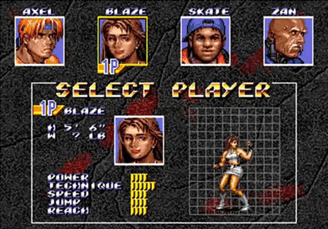
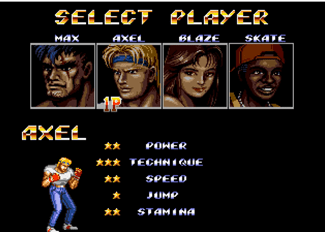
There are four characters to choose from each with differing stats (screenshot taken by the author)

Gameplay

Very little has changed from the first instalment. The game can be played in single or two-player mode and you must use your hand-to-hand combat skills to battle through hordes of Syndicate gang members. Along the way you can pick up and use weapons such as metal pipes and knives. These have limited use and will disappear once they are used up. When smashing up items such as sandwich boards and bins, you will also find money which goes towards your overall score, and apples and turkeys which help restore your energy.

What’s New?

The special attack has been changed for this game. Instead of a back-up Police car raining down fire in the form of napalm or bullets from a gatling gun, you perform a special move. However, every time you use this move, you will lose a bit of energy.

SOR 2 also introduces a Duel Mode where you can fight other characters one on one. If you choose the same character, a colour palette change distinguishes the two of you. This is a nice little addition to the game but cannot compare to the likes of Street Fighter II (1992).

Characters:

Axel Stone – Ex-Police Officer and skilled martial artist. Currently working as a bodyguard. A good all-rounder.

Blaze Fielding – Ex-Police Officer and Judo expert. She is currently teaching dance. Agile, but not as strong as Axel and Max.

Eddie “Skate” Hunter – Teenage brother of Adam Hunter. He is an inline skater and break-dancer which allows him speed and agility but also the weakest character.

Max Thunder – Friend of Axel, Max is a former wrestler and extremely strong. His size does make him the slowest character though.

Axel giving a baddie a knuckle sandwich (screenshot taken by the author)

How Does It Handle?

The game plays very well. The controls are responsive and the differences between the characters are very apparent meaning you will need to change your fighting tactics based on who you are. You can still hit your team mate so be careful when you’re swinging that metal pipe.

The game also has a flatter perspective, so it feels as though there is less room to move around, encouraging you to engage in fighting quickly.

I like the fact that the energy bars of the enemies are now shown. It enables you to tactically work your way through enemies, perhaps killing the lesser henchmen before moving on to the tougher ones so that you are not so overwhelmed by their number.

One annoying aspect to the game is the once you are at the end of the level and have beaten the last enemy henchman, your player will automatically walk to the exit. This can be annoying if you’ve been trying to save an apple or turkey for health and it ends up just being left behind.

Graphics

As with the Streets of Rage (1991) the graphics look awesome. The levels are incredibly detailed and colourful (some with parallax scrolling in the background and foreground). The sprites are also larger, allowing for more detail to their design. One nice little touch is the slight up and down motion when on the boat level.

Many of the baddies have been lifted directly from the original which is a little cheap I guess, but they still look great so, I’m my opinion, the creators can be forgiven. Maybe this was a case of If it ain’t broke, don’t fix!

Beware…these buggers can breathe fire (screenshot taken by the author)

Music

The music takes on a similar style to the original game. It is upbeat and fits well into this style of game. I can’t say that the music is as memorable for me as the original but this is just a personal preference.

Replay Value

The fact that the characters have very different stats and move sets, as well as the difficulty settings, two-player option and Duel Mode, adds lots of replay value. This game will become a staple for Friday night gaming with your friends.

Personal Thoughts

Throughout many of the reviews below, there seemed ot be a constant comparison with Street Fighter II (1992), which I found odd. They are two different styles of game. To compare them is to compare apples to oranges. I appreciate that this was at the height of the Sega/Nintendo wars, but the comparison is a nonsense.

Did I Complete The Game?

Yes, I have completed the game many times on Easy. I will no have to try it on Normal.

What The Critics Said?

Computer & Video Games: “The hyper-violent gameplay grabs you by the throat from the very moment you pummel your first bad guy, and don’t expect it to end there. Overall 95%.[1]

Mean Machines Sega: “Let’s make no bones about it, Streets of Rage 2 is the greatest sequel we’ve seen for ages and is certainly the best scrolling beat ‘em up to ever hit a home console! Overall 90%”.[2]

Bad Influence!Overall 9/10”.[3]

Mean Machines – The Essential Sega Guide: “The Megadrive really shows off with Streets of Rage 2. Cool beat ‘em up action, about double the size of the average Megadrive game. Overall 92%.[4]

Mega Play: “The graphics are very good and the animation superb. The music is complex and upbeat, and the sound effects are great. The moves are simple and there are enough techniques to keep it from getting repetitive. Overall 84%.[5]

Mega Play: “This is a solid action fighter with a good variety of moves. However, I found that the special moves gave you too much strength and made the game too easy. Less power and more technique would have made it more challenging. Still, It’s a solid two player game. Overall 80%.[6]

Sega Force: “Sega have come up with the goods! Wipes the floor with Street Fighter II. Overall 93%”.[7]

Sega Power: “The best scrolling beat-‘em up around – and big improvement on the original. Time will tell whether it’s the best yet though (Street Fighter 2 is on its way, after all). Overall 92%.[8]

Sega Pro: “Forget Sonic 2, this has to be the best game to date. Overall 96%.”[9]

Awards:

EGM’s Best and Worst of 1992 – Hottest Video Game Babe (Blaze)[10]

Mega Reader Awards ’92 – Beast Beat ‘Em Up[11]

Golden Megawards Game Fan’s Best of 1992 – Best Game

Golden Megawards Game Fan’s Best of 1992 – Best Game Music

Golden Megawards Game Fan’s Best of 1992 – Best Action Fighting[12]

My Verdict:

“Although I still prefer the original (purely from a nostalgic point of view), I have to confess that SOR 2 is a superior game. More moves, slightly better graphics, and more characters, it is easy to see why this has gone down as one of the greatest 16-bit beat ‘em ups of all time.”

Rating:

What are your memories of Streets of Rage 2? I would love to hear your thoughts, and don’t for get to follow and subscribe so that you don’t miss my latest reviews! You can also find me on Instagram: @nicklovestogame.


[1] ‘Review – Streets of Rage 2’. Computer & Video Games. (February 1993). Issue 135:26-28.

[2] ‘Streets of Rage 2’. Mean Machines Sega. (December 1992). Issue 3:136-139.

[2] Bad Influence!. ‘Bad Influence! Series 1 Episode 11’. Bibilography.com. Uploaded by retro Pixels. Wed, 01 Nov 2017. https://ghostarchive.org/varchive/JgNu9HIEXEI.

[4] Rignall, J., & Leadbetter, R., ‘Streets of Rage 2’ Mean Machines: The Essential Sega Guide. :97.

[5] Alessi, M., ‘Streets of Rage 2’. Mega Play. (February 1993). Volume 4 Number 1:52.

[6] Grossman, H., ‘Streets of Rage 2’. Mega Play. (February 1993). Volume 4 Number 1:53.

[7] ‘Streets of Rage 2’. Sega Force. (April 1993). Number 16:28-31.

[8] ‘Streets of Rage 2’. Sega Power. (April 1993). Issue 41:30-1.

[9] ‘Streets of rage 2’. Sega Pro. (February 1993). Issue 16:28-9.

[10] ‘EGM’s Best and Worst of 1992: Best Video Game Babe (All Systems) – Streets of Rage 2‘. Electronic Gaming Monthly’s 1993 Video Game Buyer’s Guide. (1993). :20.

[11] ‘It’s The Mega Reader Awards ‘92’. Mega. (March 1993). Issue 6:20.

[12] ‘Golden Megawards Game Fan’s Best of 1992’. Game Fan. Issue 16:28-9.

Sonic Spinball – Review

In a bid to cash in a franchise’s success, creators will often produce spin-off games that are usually inferior in quality to the main releases. Many would argue that these games are simply cheap and awful. However, occasionally you will find spin-offs such as Dr. Mario (1990) and Dr Robotnik’s Mean Bean Machine (1993) that are actually worth owning (although this is likely because the Tetris (1984) like format had already been tried and tested and found to be successful). How would a Sonic themed pinball game fare?

Title screen (screenshot taken by the author)

Sonic the Hedgehog Spinball is cross between a platformer and a pinball game. It was developed by Sega Technical Institute and published by Sega. It was released in 1993 for the Sega Mega Drive and in 1994 for the Game Gear and Master System. It has also had multiple re-releases on the following:

  • Sonic Mega Collection (2002) – GameCube, PlayStation 2, Xbox and PC
  • Sonic’s Ultimate Genesis Collection (2009) – PlayStation 3 and Xbox 360
  • Sega Smash Pack – PC (1999), Dreamcast (2001), and Game Boy Advance (2002)
  • Sonic Gems Collection (2005) – GameCube and PlayStation 2
  • Wii Virtual Console (2007)
  • iOS and Steam (2010)

For this review, I played the Mega Drive version found on the Sonic’s Ultimate Genesis Collection (2009).

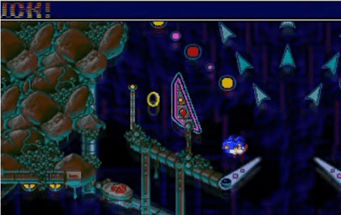
Sonic acts like a pinball throughout most of the game (screenshot taken by the author)

Plot

On the Planet Mobius, the evil Dr. Robotnik is putting his latest dastardly scheme into action. He has created the Veg-O-Fortress, a monstrous machine built into Mount Mobius so that it can draw energy from the volcano via the lava flow. His plan is to trap the wildlife of Planet Mobius and convert them into mindless machines. Knowing that Sonic and his friends may soon try to foil his plans, he has created a Pinball Defense System to protect his latest invention. As Sonic and Tails approach the mountain in their plane, they are shot down. After escaping a watery grave, Sonic must play the Pinball Defense System to destroy the Veg-O-Fortress and save Planet Mobius.

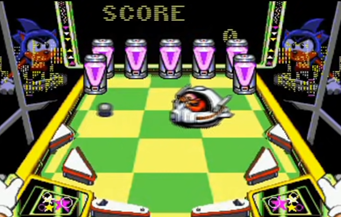
Although I think Sonic’s moving reflection is good, these bonus stages are a bit pointless (no pun intended) (screenshot taken by the author)

Gameplay

The levels are designed to simulate a pinball machine. You control Sonic and although he acts like a pinball for most of the game, there are times when you can walk/run. The aim of the game is to collect the Chaos Emeralds which will destabilize Mount Mobius and destroy the Veg-O-Fortress. After gaining all the Chaos Emeralds from one level, you must then fight and destroy one of Robotnik’s many boss machines.

There are only four levels:

The Toxic Caves – This is where Robotnik dumps his industrial waste. When you gain the Chaos Emeralds, Scorpius awaits. 

Lava Powerhouse – The heart of the Veg-O-Fortress where the lava-powered generators lie.

The Machine – This is where the inhabitants of Planet Mobius are held captive and where they are transformed into machines.

Showdown – Grab the last of the Chaos Emeralds and flee before the Veg-O-Fortress explodes.

At the end of every level, Sonic will enter a bonus stage which is also designed like a pinball machine. but where the view is different, and the object is to simply score as many points until you lose all three balls.

Up to four players can join in the fun but like pinball machines in real life, each player must wait their turn until the previous player loses a ball (Sonic dies).

The game also features some play firming elements too (screenshot taken by the author)

How Does It Handle?

Sonic’s move set is the same as it would have been in Sonic the Hedgehog 2, in that can still do the Spin Dash. However, when falling off an edge, Sonic will perform a Cliffhanger Flip that allows him to pull himself to safety. You can even control Sonic’s trajectory to a certain extent. For example, if he is falling back to the flippers, you can press left or right to make him veer in that direction which is incredibly helpful at times.

One incredibly annoying aspect to the game is that if Sonic dies, the level is reset and so you have to go through the whole rigmarole of pulling levels or opening doors again. I understand that arcade pinball machines are like this, but I think the realism actually is a detriment to the video game.

Graphics

I think the game looks great! The levels and sprites are colourful and very detailed. I particularly like the bonus stage where you can see Sonic move in the reflection which is a nice touch. However, when you defeat a boss and they begin to explode, the explosions can make the game slow down and blocks of exploding graphics can disappear.

Music & SFX

The music is pretty good and fits the game well. The funky music of first level in particular is distinctive enough to get stuck in your head.

Oddly, the sound Sonic makes when he performs a Spin Dash has changed. It no longer sounds like a bandsaw speeding up but more the sort of sound one would associate with a jumping action. You’ll know what I mean when you hear it.

Replay Value

This game does have some replay value. As well as the multi-player option, you can also change the speed of the game. I also find myself returning to this game generally. There is something about it which draws you back.

Did I Complete The Game?

No, I haven’t yet gotten past Level 3.

What The Critics Said:

Electronic Gaming Monthly: “Sonic Spinball is definitely a new setting for the hedgehog and there are points for originality, but the overall execution of the game seems like an afterthought. The scrolling of the pinball boards is choppy and it’s hard to control what you want to do. As a plus, the boards are huge with lots of nooks and crannies with items to seek out. It’s worth a look. Overall 28/40.[1]

GamePro: “Some animals just refuse to walk out into the roadway when their time is up. Sonic is one of those critters, but, fortunately, the wizards of Sega have come up with a fun, fast and frenetic pinball game to offset all that running and jumping. Overall 17.5/20.[2] 

Mean Machines Sega: “Eminently playable, and full marks for the ingenious approach to pinball, but Sonic Spinball is not the Twix of Megadrive games. One bite and it’s gone. Overall 81%” .[3] 

Electronic Games: “Spinball’s graphics and sound, while not as impressive as Sonic 2, are very good…The sound and music effects not only maintain the game’s internal rhythm but also provide audio game clues. No Rating.[4]

Entertainment Weekly: The first, a video pinball game in which Sonic is the ball, boasts a terrific concept but an ultimately flawed execution — Sonic often moves like a leaden marble. Overall C.[5] 

MegaTech: “Sonic Goes Pinball with five huge levels and a good feel from the flippers and Sonic-ball. Fun and very addictive – the first four levels are pretty easy, but the last one’s dead hard. Not really enough there to warrant the asking price. Overall 86%”.[6]

My Verdict:

“I must confess, I actually like this game even though I can’t complete it and find it incredibly frustrating and cheap at times. It looks great, sounds great, and although the scrolling isn’t as smooth as it could be, I find that this game draws me back again and again. It has a certain charm that warrants a better reputation.”

Rating:

What are your memories of Sonic Spinball? I would love to hear your thoughts, and don’t for get to follow and subscribe so that you don’t miss my latest reviews! You can also find me on Instagram: @nicklovestogame.

[1] ‘Review Crew – Sonic Spinball’. Electronic Gaming Monthly. (December 1993). Number 53 Volume 6 Issue 12:48.

[2] Scary Larry. ‘Genesis ProReview – Sonic Spinball‘. GamePro. (January 1994). Volume 6 Number 1:48-9.

[3] ‘Megadrive Review – Sonic Spinball’.  (December 1993). Number 14:70-2.

[4] ‘Video Game Gallery – Sonic Spinball’. Electronic Games. (January 1994). Volume 2 Number 4:90.

[5] Strauss, B., (February 11, 1994). Entertainment Weekly. (https://ew.com/article/1994/02/11/sonic-cd-sonic-chaos-sonic-spinball-sonic-3/ Accessed 13th January 2022).

[6] ‘Game Index – Sonic Spinball’ MegaTech. (May 1995). Issue 42:30-1.

Sonic 3D Blast – Review

By the end of 1996, the Sega Mega Drive was nearing the end of its life. The PlayStation, Sega Saturn and N64 were leading the way to the future of gaming and were far more powerful machines. After 1996, the number of games released on the Mega Drive would be greatly reduced as creators focussed more and more on the newer systems. Sega decided to release one more Sonic game for the Mega Drive. Sonic 3D Blast was that game.

Title screen (screenshot taken by the author)

Sonic 3D Blast (Sonic 3D: Flickies’ Island in Japan) is a single-player platform game developed and published by Sega. It was released for the Sega Mega Drive and Sega Saturn in 1996, with a Windows port being released in 1997. The Mega Drive It would be re-released as part of the following compilations:

  • Sonic Mega Collection (2002) for the GameCube
  • Sonic Mega Collection Plus (2002) for the PlayStation 2, Xbox, and Windows
  • Sonic’s Ultimate Genesis Collection (2009) for the PlayStation 3 and Xbox 360
  • Wii Virtual Console in 2007
  • Steam in 2010

For this review, I played the version found on the Sonic’s Ultimate Genesis Collection (2009) for the PlayStation 3.

Plot

Whilst ever pursuing the elusive Chaos Emeralds, Dr. Robotnik discovers Flicky Island. The island is home to the Flickies, a genus of bird that are able to teleport using Dimension Rings. As is his usual custom, Dr. Robotnik proceeds to capture the Flickies and encase them inside his evil machines known as Badniks. He plans to use them to help him capture the Chaos Emeralds. It is up to Sonic to rescue the Flickies and defeat Robotnik’s evil machines yet again before they can find the Chaos Emeralds.

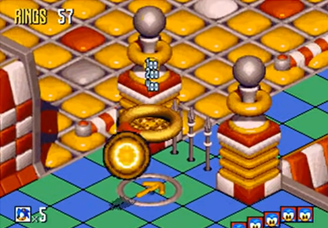
Perspective has now changed from 2D side-scrolling to 3D isometric (screenshot taken by the author)

Gameplay

Thus far, all Sonic the Hedgehog games in the franchise have been 2D (which the exception of some of the bonus stages which ventured into 3D). Sonic 3D Blast moves from side-scrolling platformer to isometric platformer. You still need to collect rings (which act like health). If you take damage without any rings, Sonic dies. Collecting 100 rings will gain Sonic an extra life.

Sonic must navigate his way through the following levels:

  • Green Grove Zone
  • Rusty Ruin Zone
  • Spring Stadium Zone
  • Diamond Dust Zone
  • Volcano Valley Zone
  • Panic Puppet Zone
  • The Final Fight

As with all Sonic games, there is a boss battle at the end of each zone consisting of one of Dr. Robotnik’s contraptions.

To progress through the stages, you need to rescue the Flickies that are trapped inside the Badniks. Once you destroy a Badnik, a Flicky will jump out. When you run near them, they will latch on and instantly start following you. You must then escort them to the Dimension Ring. You will need to find five Flickies in total per Dimension Ring. You can then progress to the next part of the level or the next stage. Beware, if you take damage, not only will you lose rings, but the Flickies will stop following you, so you’ll need to round them up again.

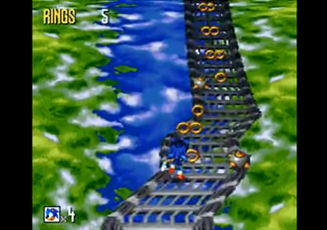
Throughout these levels, you will encounter Knuckles and Tails (sometimes in secret areas). If you hold 50 rings when you approach them, you will be transported to a special stage where you can win a Chaos Emerald. I was interested to note that the special stages have reverted to a similar style found in Sonic the Hedgehog 2 (1992). Only this time, Sonic is not running along a halfpipe, but a simple platform. You must still evade bombs and collect rings to progress to the next stage and win a Chaos Emerald.

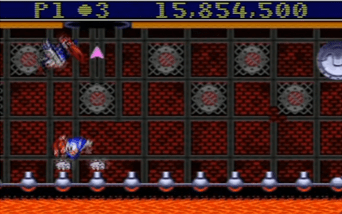
The Chaos Emerald stages have reverted to a similar format as Sonic the Hedgehog 2 (1992) (screenshot taken by the author)

There are also plenty of items for you to pick up along the way to assist you:

  • Rings – Necessary for health, extra lives and to access special stages.
  • Super Ring Box – Gain 10 rings.
  • Invincibility Box – Makes Sonic invulnerable for a short period of time.
  • Power Sneakers Box – Makes Sonic extra quick for a short period of time.
  • Red Shield Box – Sonic gains a shield that makes him impervious to heat.
  • Blue Shield Box – Sonic gains a shield that makes him impervious to electrical attacks.
  • Gold Shield Box – Protects Sonic from one normal attack and allows Sonic to use the Sonic Blast attack.
  • 1-Up – Gives Sonic an extra life.
  • Sonic Icon – Gives Sonic a continue.

Hint: When Sonic has the Flickies following him and he jumps on a spring, you’ll notice that the Flickies will fly even higher. Use this to gain difficult to reach goodies.

You need to rescue to the Flickies and take them to the large golden rings to progress (screenshot taken by the author)

How does the game handle?

For those of you who have played the arcade games Marble Madness (1984) and Flicky (1984), will recognise that the two games have basically been amalgamated to create this game, and that is not a criticism.

The controls are very difficult to get used to. Sonic is very fast on screen and the camera angle is zoomed in so far that one is reluctant to use Sonic’s speed because you cannot see enough around you. Not being able to use Sonic’s speed defeats what gamers love about Sonic. Once you memorise the levels, I’m sure you can increase your speed and whizz through the levels. The Isometric view also makes it incredibly difficult to judge when Sonic is jumping. The shadow that Sonic casts doesn’t help either. A part of the game I found particularly frustrating was when Sonic must jump on platforms whilst trying to ascend a steep ramp or cliff. The physics of the game make this incredibly difficult to judge where Sonic will land before it is too late, and you fall to the bottom of the slope/cliff again. I’m afraid I may have dropped the C-Bomb once or twice during these parts of the game.

If you take damage while guiding the Flickies to safety and they scatter, you’ll need to round them up quickly as they have a habit of wandering off and are not easy to find again. This an extra layer of difficulty to the game, but a welcome one.

Graphics

Graphically, I think the game looks great. I’m pleased to see the creators try something different, but it is still easy at first glance to recognise this is a Sonic game. I think it was a good idea to alternate the colours of the ground, making it look more like a chess board as this is more pleasing to the eye. I also think that the theme of each level was very distinctive, if a little predictable as with previous Sonic games. The addition of an ice level allowed the creators to really utilise the slipping and sliding mechanic was a good call. Interestingly, the platform that Sonic runs along during the special stages has been created in Mode 7 style. Different from the rest of the game style.

Music

I think this game is let down by the music. The main theme and the in-level pieces of music are just very…”meh!”…and fail to be as memorable as the music from previous games.

Did I Complete The Game? (Spoiler Alert)

Yes, I completed the game twice. Once with all the Chaos Emeralds and one without. The so called “Good Ending” is very poor! It is simply four or five slides showing Sonic and his friends free from the clutches of Dr. Robotnik. It is very underwhelming. Oddly, the bad ending is animated and has much more about it.

What The Critics Said:

Electronic Gaming Monthly: “Blast has some of the best, most colourful graphics this old machine has ever seen. The action is fast, yet smoothed and refined. The levels are a bit too similar in design for my taste, but a couple of them will surprise you. The control takes a little bit of getting used to, but so are most games that are viewed from three-fourths perspective. I would’ve liked a map of some sort (I know – Sonic games don’t need a map), but the levels are bi; I’ve gotten side-tracked on a couple of occasions. Is this the Genesis’ last call? Overall 25/40.[1]

Entertainment Weekly: “Sonic the Hedgehog, whose sequel-spawning cartridge ignited sales of the 16-bit Genesis in the early ’90s, has been a conspicuous no-show on Sega’s 32-bit Saturn system. He’s back in Sonic 3D Blast, but he’s showing his age. The Genesis and Saturn versions are essentially the same: Rescue birds called flickies, collect golden rings, and bring down Dr. Robotnik. Problem is, while 3D Blast is super by 16-bit standards, it falls flat on Saturn, where 32-bit games with far more sophisticated 3-D graphics and gameplay are the norm. Genesis: B”.[2]

My Verdict:

“I actually quite like this game. It’s Marble Madness meets Flicky. A fun concept which is only let down by the music and parts where Sonic is difficult to control. Impressive graphics and a thumbs up for trying something new.”

Rating:

What are your memories of Sonic 3D Blast? I would love to hear your thoughts, and don’t for get to follow and subscribe so that you don’t miss my latest reviews! You can also find me on Instagram: @nicklovestogame.


[1] Dan., ‘Review Crew – Sonic 3D Blast’. Electronic Gaming Monthly. (November 1996). Number 88:90.

[2] Walk, G.E., (December 13th, 1996). ‘Sonic 3D Blast’. Entertainment Weekly. (https://ew.com/article/1996/12/13/sonic-3d-blast/ Accessed 12/01/2022).