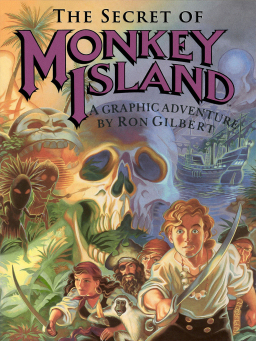
Get ready for a swashbuckling adventure and set your wits against the cream…well the dregs, of the Caribbean. Only by solving mind-boggling puzzles and matching your witty repartee with your enemies will you win the day.
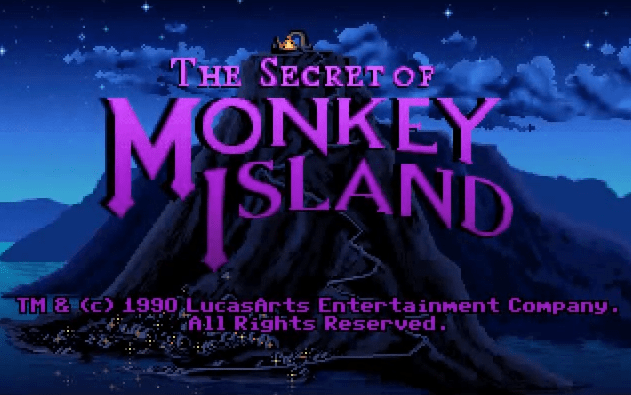
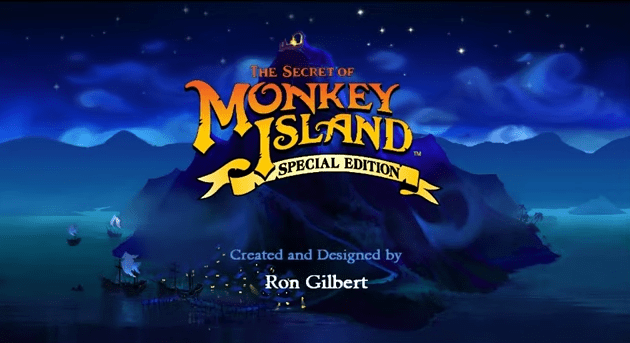
The first in a popular franchise, The Secret of Monkey Island was developed and published by Lucasfilm Games in 1990. The Special Edition was released in 2009. It can be found on many platforms including the Amiga, MS-DOS, Atari ST, Macintosh, CDTV, FM Towns, Sega CD, OS X, Playstation 3 and Xbox 360. I chose to review the version downloaded from Steam.
Plot
This single-player point-and-click adventure game starts with Guybrush Threepwood declaring “I want to be a pirate!”. What ensues is an adventure full of humour, perilous pirate trials, the rescue of a damsel in distress and the defeat of the ghost pirate LeChuck, all set in the Caribbean. Along the way Threepwood must complete tasks to progress in his adventure, many of the tasks are peculiar and to solve them involves thinking not just outside the box, but outside of any other shape you can think of as well.
Gameplay
You control the cursor and must search the environment for people and items that you can interact with. The screen is broken into four parts:
- Animation Window – Where the action happens
- Sentence Line – When you cursor hovers over something you can interact with, a sentence will appear such as ‘Talk to pirate’.
- Command List – Click on a command and then interact with a character or the environment. There are 12 different commands to perform which are: open, close, push, pull, walk to, pick up, talk to, give, use look at, turn on, and turn off. You can alternatively use the keyboard hot keys.
- Inventory – List where you can find the items you have collected.
When talking to a character, a list of questions and conversation starters will appear at the bottom of the screen.
What’s New?
The Special Edition sees the game get a makeover with slick new graphics, improved music and sound, and vocalisation which adds to the humour of the gags. However, for the purists you are able to revert back to the original music and graphics at the click of a button. On many of the screens you can opt to hear commentary from the games creators explaining how they created the graphics and music, which I think should be incorporated into more games.


How Does It Handle?
The option to use the hot keys is a bit of a God send else it would be very tiring having to use the mouse to click on the command list every time. The controls are simple and easy to use, you just have to make sure you are precise with your commands.
In the Special Edition, they have simplified the command list even more by doing away with the list completely. When hovering over a character or a bit of the environment you can interact with, an icon appears depicting the action.
Graphics
Although cartoonish, and originally in 8-bit graphics, the backgrounds and characters are very colourful and incredibly detailed with a large number of internal and external scenes. When moving around, the characters move surprisingly fast which is a relief as some point and clicks have very slow moving characters making the game drag. Oddly enough, when close-ups of characters occur, they look very life-like, which is the opposite of the Special Edition. For me, the Special Edition graphics adds more life to the environment.
The scrolling not as smooth as it could be but that tends to be standard for these sorts of point and clicks.


Music & SFX
The main theme is incredibly distinctive and will get stuck your head very quickly. The cartoonish pirate style in-game music works well too but for the most part, there is no music in the game.
SFX are very limited to a few noises when actions are performed and there is no voice acting.
In the Special Edition, the music is now a beautifully updated full musical score as well as a lot more in-game music.
The speech is now vocalised and the SFX are more ambient (the low murmur of pirate voices in the pub, or the sea lapping against the shore, or the owls hooting in the forest). These new SFX really add to the experience.
Replay Value
All point and clicks have limited replay value as they tend to be single-player games with on difficulty setting. You may revisit it annually, but not as often as you would other genres.
SPOILER ALERT!!!
The only thing that let’s this game down, and it is only one thing, is that some of the puzzles are so convoluted that you will need to use a walkthrough to find the solutions to many of the them.
Did I Complete The Game?
I did finish the game, but there were many times that I needed assistance from walkthroughs.
What The Critics Said Of The Original Version:
Computer and Video Game Magazine – “Usually the entertainment you get from an adventure is derived solely from solving puzzles, but the hilarious characters and situations, and the movie-like presentations make playing this more like taking part in a comedy film so it’s much more enjoyable. Overall 94%”[1]
Dragon Magazine: “If you enjoy a great graphic adventure spiced with humour top-notch graphics, and a soundtrack filled with really good, original compositions, this is a must buy for you. We haven’t stopped laughing yet! 5/5”.[2]
Zero Magazine: “At last an adventure game that’s enjoyable rather than frustrating. Overall 84%”[3].
What The Critics Said Of The Special Edition:
Eurogamer.net: “Few games can stand the test of time with such confidence, and whether your interest stems from its genre-defining significance or its reputation as an unforgettable game, you won’t be disappointed by time spent on Monkey Island. Anyone who disagrees probably fights like a cow. Overall 9/10.”[4]
IGN.com: “The Secret of Monkey Island has a special place in the museum of videogames for its quick wit, its personality, and the way it surprises us at every turn. Playing this adventure will take you back to a simpler, more innocent time before games needed to bash us over the head with ultra-violence to get our attention. They definitely don’t make ’em like this anymore. The Special Edition doesn’t offer any new gameplay, so its appeal may be limited if you’ve already been initiated. But if you’ve never seen a three-headed monkey, download this now. Overall 8.7/10”.[5]
Gamespot.com: “If you’ve got opposable thumbs, a sense of humour, and a brain that you’re not afraid to use, this puzzle-filled adventure is one well worth taking. Overall 8/10.”[6]
My Verdict:
“Avast me hearties, here be a fun, classic point and click pirate game for ye. The puzzles be tough, but there be plenty of laughs for a landlubber such as yourself. Now pass me the grog!”
Rating:

What are your memories of The Secret of Monkey Island? I would love to hear your thoughts, and don’t for get to follow and subscribe so that you don’t miss my latest reviews! You can also find me on Instagram: @nicklovestogame.
[1] Glancey, P., ‘Review: PC – The Secret of Monkey Island’. Computer and Video Games Magazine. (December 1990). Issue 109:112-4.
[2] ‘Review: PC/MS-DOS – Secret of Monkey Island’. Dragon Magazine. (April 1991). Issue 168:49-50.
[3] ‘Review: PC – The Secret of Monkey Island’. Zero Magazine. (November 1990). Issue 13:58.
[4] Whitehead, D., (16th July 2009). ‘Secret of Monkey Island: Special Edition’. Eurogamer.net. (https://www.eurogamer.net/articles/the-secret-of-monkey-island-special-edition-review?page=2 Accessed 13th December 2019).
[5] Hatfield, D., (Jun 14th, 2009). ‘The Secret of Monkey Island: Special Edition Review’. IGN.com. (https://web.archive.org/web/20111208163158/http://xboxlive.ign.com/articles/100/1003651p1.html Accessed 14th December 2019).
[6] Calvert, J., (April 23, 2010). ‘The Secret of Monkey Island: Special Edition Review’. Gamespot.com. (https://web.archive.org/web/20120804010019/http://www.gamespot.com/the-secret-of-monkey-island-special-edition/reviews/the-secret-of-monkey-island-special-edition-review-6260007/ Accessed on 13th December 2019).


 Nick Loves to Game

