Chuck Rock – Review

He may not be the sharpest flint in pre-history, but Chuck Rock has a head as hard as a granite and a belly that is deadly. So get ready to navigate jungles and swamps, battle dinosaurs, and rescue your wife before Garry Gritter has his way with her. Unga Bunga!!!
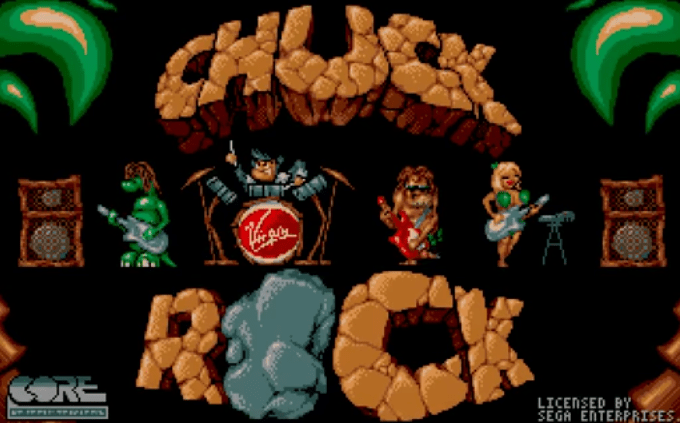
Title screen (screenshot taken by author)

Chuck Rock is a single-player side-scrolling platform game developed by Core Design. It has been published and ported to many other platforms including:

  • Core Design – Atari St and Amiga (1991), Commodore 64 (1992), and Amiga CD32 (1994)
  • Krisalis Software – Acorn Archimedes (1991)
  • Virgin Interactive – Sega Megadrive (1991), Sega Master System (1993) and Game Gear (1992)
  • Sony Imagesoft – Sega Mega-CD (1993), SNES (1992) and Game Boy (1993).

I chose to review the Mega Drive version.
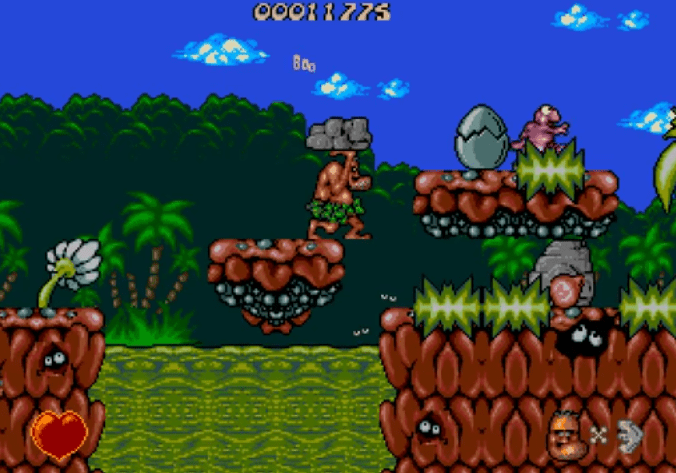
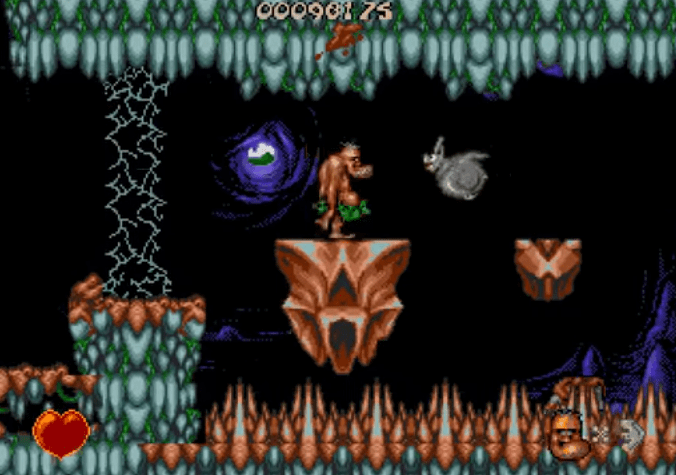
Beautiful level design (screenshot taken by author)

Plot

Set in a fantasy prehistoric Stone Age, Chuck is enjoying a lazy day in front of his TV drinking beer (root beer that is). His wife, Ophelia, is going about her daily chores unaware that she will soon be kidnapped by the evil Gary Gritter, who has designs on her. Chuck hears the commotion and investigates, only to find a pile of crumpled, dirty clothes and signs that something heavy has been dragged away. Since he has no clothes to wear, he ducks behind some nearby bushes and fashions some leafy pants to cover his modesty. He must now rescue his wife.

Gameplay

Chuck must navigate his way through five levels, each with three-five stages, all the while evading various dinosaurs and prehistoric animals; or if you are feeling brave, barging them out the way with your belly, performing flying kicks, or picking up huge boulders and throwing them. I’d recommend using the latter two to kill your enemies.

The levels are:

  1. The jungle scene
  2. The caves scene
  3. The water scene
  4. The Ice scene
  5. The Graveyard scene
Chuck may look like a everyone’s least favourite uncle, but he is the hero of this tale (screenshot taken by author)

How Does It Handle?

The controls are easy to learn and are nice and responsive. The game is challenging with some tough levels. Oddly, the end of level bosses are all very easy to defeat with the exception of the third boss. The only boss that you need a strategy to defeat is the first boss, but other than that, it is simply a case of button mashing. One nice little touch is that when Chuck is carrying a large rock, he won’t move as fast.

Graphics

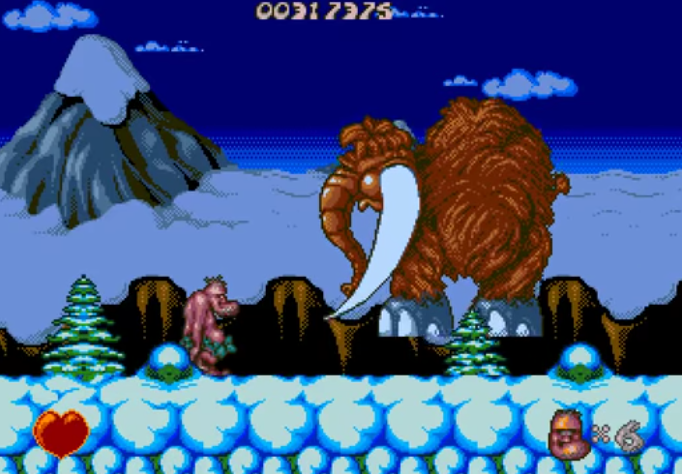
Throughout the entire game the graphics look fab. The overall feel of the graphics is more on the whacky side than the realistic side. The background look great, and I particularly like the snowman on The Ice scene level. There’s plenty to catch the eye and make you think “That looks cool!”, like a T-rex with boxing gloves…awesome!
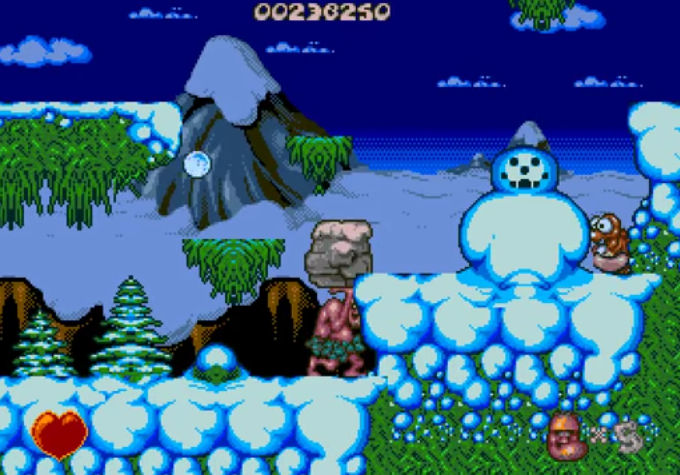
The levels look gorgeous (screenshot taken by author)

Music & SFX

The music is good throughout the game. The opening musical number on the title screen is awesome and I found myself delaying playing the game in order to listen to the song the whole way through. It seems that even though Chuck isn’t the sharpest tool in the box, he has aspired to lead singer of a rock band. The music speeds up during the boss battles.

There are plenty of SFX throughout the game as Chuck jumps, throws rocks, and bounces enemies of his belly.

Replay Value

Sadly, this game lacks replay value. There is only one difficulty setting and once completed you may only wish to revisit it once or twice before turning your attention to the next challenge.
(screenshot taken by author)

Did I Complete The Game?

Yes, I completed the game without the use of cheats. Sadly, upon completing the game you are met another example of an anti-climatic ending to a game that deserved more.

What The Critics Said:

Mean Machines: An excellent and quite original platform game that’s highly recommended to all Megadrive players. Overall 91%.[1]

Mean Machines Index: “A brilliant, humorous Megadrive platform game with real character. Its graphics are out-of-this-world, the sound completely brilliant, and the game play pretty good too! A must have for your Megadrive collection. Overall 91%[2]

Sega Power: Groovy goings-on 100 million years B.C. with wild sonics and graphics as Chuck rescues his wife from the evil Garry Glitter. Overall 4/5.”[3]

Electronic Gaming Monthly: “The gameplay could use a little fine tuning, but it is still very fun to play. The graphics are comical and the music jams. Overall 7.75/10.[4]

Megazone: “Graphics wise this game is a hit (as good as the Amiga on the Mega Drive), the sound is pretty good (not quite up to the Amiga, but still pretty hot) and some imaginative sprite drawings have been added to this game. Overall 85%.[5]

GamePro: “The game’s worth the bucks for the music and graphics alone. From standpoint of challenge and gameplay, it’s middle of the road – not too hard and not too easy. Overall 4.6/5.”[6]

My Verdict:

“Unga Bunga – The game has nice graphics and is fun to play. The simple button mashing as oppose to a strategy needed to defeat end of level bosses, is a mark against this game. The lack of replay value means that once completed I doubt you will want to play through again.”

Rating:

What are your memories of Chuck Rock? I would love to hear your thoughts, and don’t for get to follow and subscribe so that you don’t miss my latest reviews! You can also find me on Instagram: @nicklovestogame.


[1] ‘Review: Mega Drive – Chuck Rock’. Mean Machines. (June 1992). Issue 21:76-8.

[2] ‘Review: Mega Drive – Chuck Rock’. Mean Machines. (October 1992). Issue 1:137.

[3] ‘The Hard Line – Review: Mega Drive – Chuck Rock’. Sega Power. (September 1993). Issue 46:96.

[4] ‘Review Crew: Genesis – Chuck Rock’. Electronic Gaming Monthly. (March 1992). 32:26.

[5] ‘Review: Mega Drive – Chuck Rock’. Megazone. (December 1992/January 1993). Issue 25:36.

[6] Feline Groovy. ‘Genesis Pro Review – Chuck Rock’. GamePro. (December 1991). 29:70.

Sonic the Hedgehog – Review

In a bid to compete with the popularity of Nintendo’s Super Mario Bros. series, the early 1990s saw Sega introduce a new hero for their latest console, the Sega Mega Drive. Whilst it was still a platform game with a recurring antagonist, it was unique enough so as not to be accused of copying Mario’s format. In 1991, Sonic the Hedgehog burst onto our screens and has maintained a place in the hearts of retrogamers everywhere.

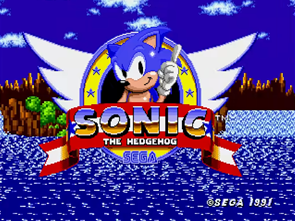
Title screen (screenshot taken by the author)

Sonic the Hedgehog is a side-scrolling platform game developed by Sonic Team and published by Sega. It was released on the Sega Megadrive in 1991, spawning one of the most successful videogame series of all time. 8-bit versions were released on the Master System and Game Gear but with a few amendments. and the game greatly simplified. Laster re-releases include:

  • Sega Saturn as part of Sonic Jam (1997)
  • Nintendo GameCube as part of Sonic Mega Collection (2002)
  • PlayStation 2 and Xbox as part of Sonic Mega Collection Plus (2003)
  • GameBoy Advance (2006)
  • PlayStation 2 and PSP as part of the Sega Genesis Collection (2009)
  • PlayStation 3 and Xbox 360 as part of Sonic’s Ultimate Genesis Collection (2009)
  • Nintendo DS as part of Sonic Classic Collection (2010)
  • iOS, Android, and Nintendo 3DS (2013)
  • Oculus Rift as part of Oculus Arcade (2018)
  • Microsoft Windows, PlayStation 4, Xbox One and Nintendo Switch as part of Sonic Origins (2022)

This review is based on the Mega Drive version.

Plot

Sonic is a blue hedgehog who can run at incredible speeds. This speed, and the ability to defend himself by curling into a ball, allowing his spikes to damage his enemies, is put to use when the evil Dr. Ivo Robotnik arrives in Sonic’s homeland. He proceeds to steal the six Chaos Emeralds (which allows the user to warp time and space), and capture the local wildlife, transforming them into evil robotic animals.

Gameplay

Sonic must navigate through six zones, evading Robotnik’s minions whilst attempting to steal back the Chaos Emeralds which are found via special stages. The zones include:

  • Green Hill Zone
  • Marble Zone
  • Spring Yard Zone
  • Labyrinth Zone
  • Star Light Zone
  • Scrap Brain Zone
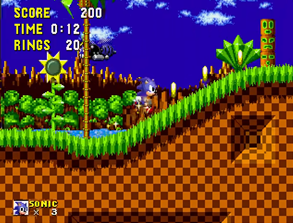
Spring Hill Zone (screenshot taken by the author)

Along the way, you collect gold rings which act both as health and a way to access the special stages where the Chaos Emeralds are. If you get hit by an enemy or land on spikes or lava, your coins will spill out all around you. However, you can instantly retrieve a small number before they disappear. If you take damage whilst holding no rings, you die. Should you still have 50 rings or more by the end of stages one and/or two of each zone, a large gold ring will appear that you must jump through to warp to the special stages. Gaining 100 rings will give Sonic an extra life.

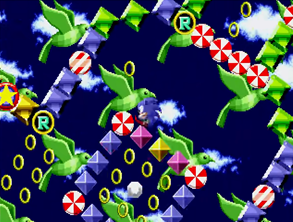
There are six special stages in all, each one different and consisting of Sonic constantly spinning in a ball whilst navigating a rotating semi-labyrinth. Throughout these stages you will encounter buttons that make the stages spin in the opposite direction, circular bumpers that ping you aggressively in all directions, flashing red buttons that make you exit prematurely from that bonus stage, and, of course, the Chaos Emeralds themselves.

Occasionally you will see what look like computer monitors showing either a ring, a blue sphere, red boots or stars on them. Depending on what is shown on the screens, destroying these will give you 10 rings, a protective shield, temporary super speed, and temporary invulnerability respectively.

The special stages can be somewhat nausea inducing (screenshot taken by the author)

How Does It Handle?

The controls are tight, consist of running, jumping, and spinning, and allow you to evade hazards and attack your enemies in the manner you intend. There are the realistic physics of skidding to stop when running at speed. You need to spin when attacking your enemies. When you destroy one of the enemy robots, a little animal is released and quickly scurries off, finally free from Robotnik’s clutches. The game can move incredibly fast at times so it is advised to play through it carefully at first. Once you memorize the levels and their hazards, you can use Sonic’s top speed to blitz the levels. The high speed at which Sonic can achieve makes for exciting gameplay.

Graphics

Sonic really was revolutionary for its time, and still holds up well today. The sprites, levels and backgrounds are beautifully illustrated and coloured, and are all unique, crisp and well defined. From the beautiful bright blues and greens of Green Hill Zone through to the muted industrial greys of Scrap Brain Zone, the levels look gorgeous. Each zone contains unique enemies and unique end of zone bosses. For the most part, the scrolling is very smooth. Although, when at top speeds the game does have a tendency to flicker and lag a bit.

When Sonic has been stationary for a certain period of time, he will look at the camera with his hands on his hips and tap his foot in frustration. I though this was a nice touch as it emphasizes his personality.

Music & SFX

The music is very memorable and even when I hear it now, I can recite every note and instantly know which level it belongs to. I very much like the change in music that sparks danger when you have been under water too long and the increase in tempo when you gain invincibility.

The SFX are so familiar to me that I would wager I could spot them if someone replayed one out of context of the game. The ‘tring’ when you collect a ring, the ‘twang’ when you use a spring pad, the ‘ding’ when you hit a bumper and, of course, the bassy ‘uh-oh’ sounding noise when you die, will be etched into my brain for the rest of my life.

Replay Value

There are two endings depending on if you manage to collect all the Chaos Emeralds which adds a little replay value. However, the game is so enjoyable that you’ll find yourself returning again and again.

Personal Memories

We bought our Sega Mega Drive for Christmas 1991, and Sonic came with the package. I have very fond memories of this game and have spent many an hour playing through it (it only takes about 30 minutes to complete). It’s an easy game to play but still challenging when trying to attain all Chaos Emeralds. The game appeals to all ages of gamer.

Did I Complete The Game?

Over the years I have completed Sonic the Hedgehog many times (including with all Chaos Emeralds collected) without the use of cheats, and will no doubt re-visit the game in the future to make sure I still can.

What The Critics Said:

Mean Machines:Yep, it’s true – Sonic is really great! I can’t think of a Megadrive game with more spectacular graphics…”. Overall 92%.[1]

Entertainment Weekly: “Dazzlingly fast yet never chaotic, consistently challenging but never impossible, Sonic the Hedgehog is quite simply one of the best video games I’ve ever played. A+.”[2]

Mean Machines Index: “Sega’s hyped-beyond belief character stars in a game inspired by Nintendo’s Mario platform game series. It’s very addictive with brilliant graphics and speed. However, the gameplay is frustrating at times and experienced gamers should have this one licked within days. Overall 90%[3]

Sega Power: “World famous and rightly so. This is almost certainly the game that has sold more Sega systems than anything else. It’s a bit easy and looks slightly dated now, but it’s still one of the best games around. Overall 5/5”.[4]

Sega Power: “Sega’s answer to Super Mario Bros, Sonic is the fastest parallax scrolling collect-‘em-up ever! A stunning rotating bonus round and a feast of visual effects – a classic. Overall 5/5.[5]

Awards:

Overall Game of the Year – EMAP’s Golden Joystick Awards[6]

Game of the Year (Overall) – Electronic Gaming Monthly[7]

Game of the Year (Genesis) – Electronic Gaming Monthly[8]

Best Graphics in a Video Game – Electronic Gaming Monthly[9]

Hottest Character in a Game – Electronic Gaming Monthly[10]

My Verdict:A revolutionary riposte to Nintendo’s Super Mario Bros. series. It’s beautiful, colourful, fun, challenging, and has great music. Every gamer should play this game as a rite of passage.”

Rating:

What are your memories of Sonic the Hedgehog? I would love to hear your thoughts, and don’t for get to follow and subscribe so that you don’t miss my latest reviews! You can also find me on Instagram: @nicklovestogame.


[1] ‘Review: Mega Drive – Sonic the Hedgehog’. Mean Machines. (July 1991). Issue 10:42-44.

[2] Strauss, B., (August 1991). ‘Review: Mega Drive – Sonic the Hedgehog’. Entertainment Weekly. (https://ew.com/article/1991/08/23/sonic-hedgehog/ Accessed 10th December 2019).

[3] ‘Review Index: Mega Drive – Sonic the Hedgehog’. Mean Machines. (October 1992). Issue 1:140.

[4] ‘The Hard Line – Review: Mega Drive – Sonic the Hedgehog’. Sega Power. (September 1993). Issue 46:98.

[5] Jarrett, S., ‘The Hard Line – Sonic the Hedgehog’. Sega Power. (April 1991). Issue 23:54.

[6] ‘News – Luvvies! Dahlings!’. The One. (May 1992). Issue 44:17.

[7] ‘EGM’s Best and Worst of 1991’. Electronic Gaming Monthly’s 1992 Video Game Buyers Guide. (January 1992). :61.

[8] ibid,. :61.

[9] ibid,. :62.

[10] Ibid,. :65.