Sword of Vermilion – Review

I have mixed feelings toward RPGs. On the one hand, I love the extended adventure, and stories of derring-do, but I dislike the grind and monotony of fighting the same demons over and over again to gain experience points to “level up” your characters. Sword of Vermilion (1989) decided to mix things up a little. The question is, were the innovations novel and interesting, or were they a misstep for the game creators?

Title screen (screenshot taken by the author)

Sword of Vermilion is a single-player action RPG developed and published by Sega, and released for the Mega Drive in 1989 (1990 in North America and 1991 in Europe). It was later released with the PlayStation 2 and PlayStation Portable’s Sega Genesis Collection (2006), and was available on the Wii Virtual Console (2006), the PlayStation 4 as part of Sega Genesis Classics (2018), and Nintendo Switch Online in 2021. For this review, I played the version found on PlayStation 4’s Sega Genesis Classics (2018).

Plot

Life was good in the peaceful Kingdom of Excalabria. That was until the evil King Tsarkon of Cartahena invaded, destroying all their farmland, and laying waste to this once-prosperous land. Seeing that nothing could be done to save his kingdom, King Erik of Excalabria entrusted his only son to his most loyal knight, Blade, and ordered him to take his son far away to safety. After a long journey, Blade finally found a home in the village of Wyclif where he raised the king’s son as his own but never told him of his royal lineage. After 18 years had passed, Blade’s health began to fail. On his deathbed, he reveals the, now-adult, prince’s identity and retells the story of his father’s fate. The prince, who has grown into a strong and skilled warrior swears vengeance upon King Tsarkon and sets off to avenge his father and retake his kingdom. To defeat King Tsarkon, the prince must travel the land of Vermilion to find and obtain eight Rings of Good. However, King Tsarkon already possesses the Rings of Evil…and plans to use them to devastating effect.

Gameplay

There are four different views in this game:

  • Town View – Typical RPG view from overhead with a slight angle.
  • Battle View – Sparked by random map encounters, it is similar to the Golden Axe (1989) style view and allows you to take full control of your character. Using weapons and magic, you can opt to engage the monsters or flee.
  • Dungeon View – First person perspective similar to Shining in the Darkness (1991).
  • Boss View – Sideways viewpoint where you must defeat a powerful boss.

In Town View, you use the D-pad to move around the towns. When you wish to interact with someone or something, you press ‘C’ to bring up a menu with the following options:

  • Talk – Talk to a character
  • Item – Select an item to use
  • Str – See your characters stats
  • Open – Open a treasure chest or door in a cave/dungeon
  • Magic – Select a magic spell to use or to ready for use in battle (some spells require more magic points per use than others). You cannot change your choice of spell during a battle.
  • Equip – Equip a new weapon or piece of armour
  • Seek – Search directly in front of you
  • Take – Take an item from an opened treasure chest.

To cancel, or return to the previous screen, press ‘B’.

In the towns, you will find armourers (to upgrade your weapons), potion shops (for healing and egress items), and magic shops (spells).

Town View (Screenshot taken by the author)

In Battle View, you will fight up to eight enemies at a time. Enemies have of varying degrees of strength and speed. You can run around the screen evading their attacks, slash at them with your sword, cast a magic spell on them, or flee. Naturally, the better your armour the less damage you take, and the better your weapons and spells, the more damage you inflict on the enemy. When you defeat an enemy or group of enemies, you earn experience points and Kims (money) proportionate to the difficulty of the battle. Once you earn a certain amount of experience points, your level and stats increase.
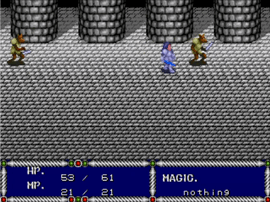
Battle View (Screenshot taken by the author)

In Dungeon View, when in a cave or dungeon, the HUD splits into five boxes. The largest one in the top left shows your first-person perspective. The slightly smaller one in the top right shows a map of the dungeon level or the area of the overworld. The three smaller rectangular boxes show your hit and magic points; your experience and Kims totals, and the last is which magic spell you have equipped. You move by pressing up on the D-pad to go forward, down to go backward, and left or right to turn 90 degrees either way. It is during these parts of the game that you will have random map encounters.
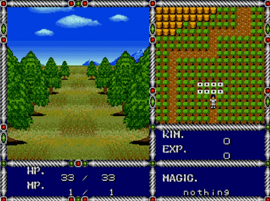
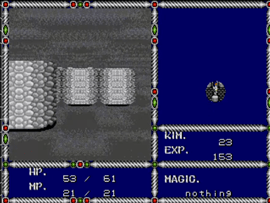
Overworld View (Screenshot taken by the author)
Dungeon View (Screenshot taken by the author)

In Boss View, you can only move left or right. However, you can crouch to evade boss attacks and swing your sword when both crouched and standing. You cannot jump or block, but swinging your sword will destroy any fireballs thrown at you by the boss.
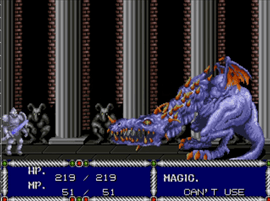
Boss View (Screenshot taken by the author)

How Does It Handle?

The Town View is standard for most RPGs. It is simple to navigate and the menu system is easy to use.

The Battle View is quite novel for these sorts of games. Usually, they are turn-based affairs. I actually prefer this more involved form of battle. I like how you can easily choose to flee random map encounters without having to go through a menu system. However, I dislike the fact that you cannot block an enemy’s attack. What is the point of having a shield if you cannot block with it? I also dislike that you cannot change your magic spell during the battle. Since different spells are more effective against different enemies, and you cannot predict which you will fight.

The Dungeon View will be familiar to fans of dungeon crawlers. I like how the map is in darkness until you use a candle (which has a time limit on the light), or a lantern (unlimited light) and that you need to find a map to open up the whole dungeon/cave.

The Boss View is, again, quite novel for this sort of game. I just wish you were able to use your shield to block the boss’s attacks and that your player was more manoeuvrable.

Another annoyance was when coming across treasure chests, you have to select open, and then select take if you want to take the item. These actions are pointless as far as I can see because none of the treasure chests contain booby traps or anything else to your detriment, and there are no items that you wouldn’t want to pick up. It would make more sense to have the option to replace an item you’re carrying (if your inventory is full) or decline to pick it up.

Overall, the changing views, which change the gameplay, are a great idea and stops the game from becoming monotonous too quickly.

Graphics

Let’s start with Town View and Overworld/Dungeon Views. Although the colours are not as vibrant as Phantasy Star II (1989), they are a bit more detailed and mature. It looks a bit less childlike, in my opinion. Oh, and why do the characters all look like they have green face paint on? Weird!

The Battle View, however, pales in comparison with Phantasy Star II (1989) which is much more detailed and interesting to look at. The Boss View offers the opportunity to be really detailed with the sprites and it does just that. It’s just a pity that the sprite movement is labouriously slow.

Music & SFX

The music is ok, but for me not very memorable. The piece that plays over the Town View has an eerie/spooky feel and would be more fitting in a game like Addam’s Family (1993). It’s not the heroic sort of tune I’ve become accustomed to whilst playing RPGs. The music for the Overworld View is more appropriate and adds a feeling of dread to your travels.

I like the sound the sword makes when you swing it during Boss View (Oddly, this sound is not in Battle View) and the dying sounds the beasts make when you slay them. Feels very arcadey to my mind. Other than that, SFX are quite minimal in this game.

Replay Value

Unless you’re an RPG fan and a glutton for punishment, I don’t think this game has much replay value. There are no extra difficulty settings or alternate endings.

Did I Complete The Game:

No, I got as far as Cartahena and was just done with the game. I could not be bothered to finish it.

What The Critics Said:

Computer and Video Games: “…Sword of Vermilion offers a vast, sprawling adventure that’ll have you up burning the midnight oil for many a month before the before the quest is finally complete…The combat screens may not be complex, but it’s great fun whipping out your sword, chopping up all-and-sundry, and testing out your new magical powers as well. Graphically, Sword of Vermilion is a mixed bag, with 3D screens looking decidedly rough, but this is more than made up for with the excellent town graphics and detailed sprites. It’s the sound that lends a perfect atmosphere to the proceedings with some of the best music ever heard on the Megadrive. Overall 91%.[1]

MegaTech: “What makes this vast RPG so attractive are the great graphics, excellent sound and the arcade-type combat system which replaces the boring exchange of hit-points found on most RPGs. Overall 93%.[2]

My Verdict:

“I think the game has a good story and a great mix of different aspects to keep it interesting. Even if it doesn’t quite work as well as it should. I just got bored with it in the end and had no desire to finish it. RPG fans may have more patience than me.”

Rating:

What are your memories of Sword of Vermilion? I would love to hear your thoughts, and don’t forget to follow and subscribe so that you don’t miss my latest reviews! You can also find me on Instagram: @nicklovestogame.


[1] Leadbetter, R., ‘Review – Sword of Vermilion’. Computer and Video Games. (June 1991). Issue 115:114-116.

[2] ‘Alternatives – Sword of Vermilion’. MegaTech. (Xmas 1991)Issue 1:30.

PGA Tour Golf III – Review

By the mid-90s, Electronic Arts, under EA Sports, seemed to have established themselves as the number one developers of sports simulations. American football, football, rugby, ice hockey, golf, cricket and basketball, their games were lauded for their realism, gameplay, graphics, and ability to get licenses of sports personalities and teams to incorporate into their games. With the critical and commercial success of PGA Tour Golf II (1992), it made sense for EA to continue the franchise. Would PGA Tour Golf III garner the same praise from critics and achieve commercial success as well?

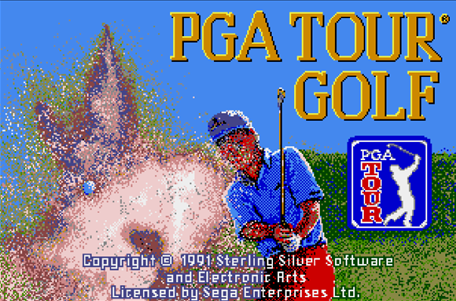
Title screen (screenshot taken by the author)

PGA Tour Golf III is a sports simulation video game. It was developed by Hitmen Productions and published by EA Sports for the Sega Mega Drive in 1994.

Gameplay

There are three modes to choose from:

Practice Round – Play 18 holes on any course just for fun. You can also just practice your long game on the driving range and/or short game on the putting green.

Tournament – Compete in any tournament which consists of 4 rounds of 18-hole rounds. However, to qualify for the next round, you must make the cut by ensuring you score low enough on your round. If you successfully compete the final round, you earn money and may even win the tournament if you consistently score the lowest numbers of strokes per round.

Skins Challenge – Two to four players can compete in an 18-hole match where each hole is assigned a monetary value. To win the hole, simply complete the hole in the least strokes. The winner takes the pot for that hole. The value of the holes increase as the match progresses. If a hole is tied, the money rolls over to the next hole. To make it more interesting, you can also opt to have pros join the game controlled by the computer.

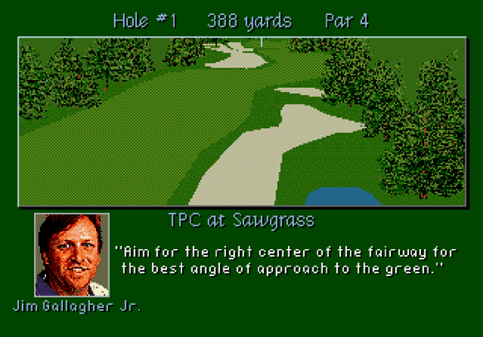
The portraits of the players and commentator as well as the background images have now been digitized. (screenshot taken by the author)

You can play eight courses including:

TPC at Avenel

TPC at Las Colinas (New)

TPC at River Highlands (New)

TPC at Scottsdale

TPC at Southwind

TPC at Summerlin (New)

TPC at The Woodlands (New)

Advice from the professionals before every hole (screenshot taken by the author)

Unlike previous PGA Tour Golf games, you can play as one of eleven professional golfers who had won the following accolades at the time of the game’s release:

Brad Faxon – Three professional tournament wins

Jim Gallagher Jr. – Three professional tournament wins including The Tour Championship (1993)

Lee Janzen – Three professional tournament wins including the US Open (1993)

Tom Kite – Nineteen professional tournament wins including The Players Championship (1989), Nabisco Championship (1989), and the US Open (1992)

Bruce Lietzke – Twelve professional tournament wins including the Canadian Open (1978 & 1982)

Davis Love III – Eight professional tournament wins including The Players Championship (1992)

Mark O’Meara – Eight professional tournament wins

Jeff Sluman – One professional tournament win which was the PGA Championship (1988)

Craig Stadler – Ten professional tournament wins including the Masters Tournament (1982) and The Tour Championship (1991)

Fuzzy Zoeller – Ten professional tournament wins including the Masters Tournament (1979) and the US Open (1984)

Other than that, the gameplay hasn’t changed much. At the beginning of each hole, there is a slow flyover approach to the green with advice from one of the professional golfers on how to approach the hole.  Before each stroke, a bird’s eye view of the hole with a cross hair over the pin will appear. You can move the cursor and it tells you the distance from your golfer to the cursor. You can go back to the overview at any time by pressing ‘A’ button.

There has been a slight change to the gameplay. For example, when addressing the ball, a box with the lie of the ball appears where you can move a cursor allowing you effect the flight of the ball by adding a draw or fade to the flight or affect the arc of the ball. You can also change your type of shot from Normal, to Chip to Punch shot.

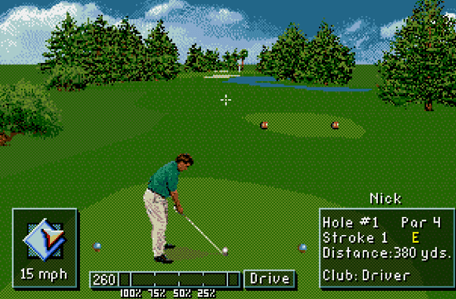
The information shown on the HUD has not changed. The wind speed and direction box is still on the bottom left, the power gauge remains in the middle, and the hole number, hole par, stroke number, current score, distance to pin and club are still bottom right. On the horizon is the cross hair which shows you were you are aiming your shot. You can move this cursor left or right. Your caddy will automatically select the club they think you should use but you can change clubs yourself by pushing up or down on the D-pad. As you do this, you will notice the number to the left of the power gauge will increase or decrease. This is the maximum number of yards the club will hit the ball if the ball was unaffected by wind or how the ball lies.

When you are ready to hit the ball, press ‘B’ and the power gauge begins to fill from right to left. When you have reached your desired power, press ‘B’ again and the power bar begins to descend having left a mark when you stopped the power gauge rising. You then need to press ‘B’ a third time as the power bar reaches the Stroke Bar. If you are accurate, you will hit the ball without a slice or draw. The earlier or later your stop the power gauge either side of the stroke bar will determine the degree of which you slice or draw the ball. After striking the ball, and when the ball begins to descend, the camera angle changes, and you will see where the ball lands.

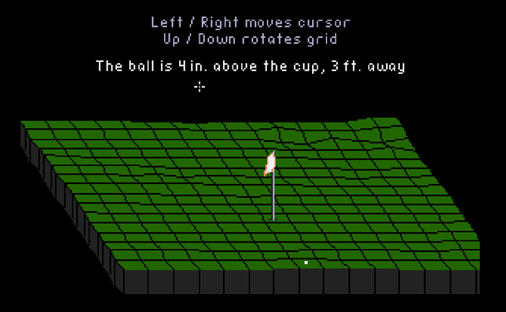
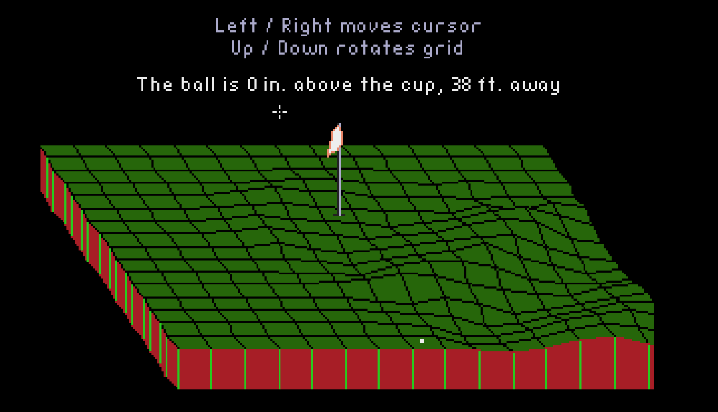
When you reach the green, a 3D square grid will appear showing you the lie of the green. This allows you to judge the slopes of the green when attempting to putt. Again, by pressing up and down on the D-pad when you are on the green increases and decreases the maximum power of the putt. The 3D view when observing the putting green is unaltered from PGA Tour II (1992). I guess if it ain’t broke, why fix it?

PGA Tour Golf II (1992) (screenshot taken by the author)
PGA Tour Golf III (screenshot taken by the author)

How Does It Handle?

Again, little has changed from the first two PGA Tour instalments. The game is easy to pick up and play but mastering it will take patience and practice. It might just be me, but I found this game harder than its predecessors. I can’t seem to place very high in any of tournaments. Clearly, I need more practice.

You have to be incredibly precise (maybe too precise) when you try to stop the descending gauge at the Stoke Bar else you can very easily draw or slice the shot. If you’re not accurate with your timings, you will inadvertently put your next shot in a place that puts you at a big disadvantage. It is very unforgiving.

They have kept the power gauge and method of changing clubs which is simpler than other golf games.

When putting, I like the fact that you can change the maximum strength of the putter as this allows you to more accurately gauge the strength of your putt. That is not to say that putting is easy, of course. I found the putting to be very unforgiving with little margin for error. I still think the putting is the best and most accurate method to date. With regard to the 3D view of the green, it becomes a tad annoying when you need to keep rotate the view in order to check the line of your shot. One would think this would be done automatically.

Graphics

The first thing to notice is that they have moved away from illustrated pictures of courses and headshots of pros and have moved to digitized photos…and I have to say it looks great! The sprites have been rotoscoped too, allowing the addition of extra frames to ensure a more realistic golf swings. The courses themselves are also more detailed. The trees look a lot more realistic and the horizon contains detailed clouds in the skies and even some mountainous terrain.

However, I didn’t like that the fairways have been pixelated in two shades of green. I found it an attack on the eyes. I also didn’t like the new wind indicator, but overall, the HUD looks a bit slicker.

When comparing the game to its contemporaries, I think it looks much better than PGA European Tour (1994) (which is basically the same as PGA Tour Golf II (1992). I also prefer this instalment’s sprites over those of Pebble Beach Golf Links (1994). When it comes to the colouring of the courses, I also prefer the more muted, realistic palette of colours of PGA Tour Golf III than that of Pebble Beach Golf Links (1994). The edges of the sand bunkers and fairways are better too as on Pebble Beach Golf Links (1994), they look too angular rather than smooth curves.

Music & SFX

The only music that I recall is a slow piano like melody that is played over the leaderboard. I’m surprised there wasn’t any music played over the title screen.

Again, the minimalist sound creates a laid back and relaxing environment. The occasional thwack of the ball, the gentle ripple of applause from the crowd, and the infrequent bird tweets, does well to capture the atmosphere of the game.

Replay Value

The desire to do better draws you back in to play again and again. Having more courses also encourages further forays into the world of golf. Definitely a game enjoyed more in two-player mode.

Viewing the putting green has not changed at all. I guess if it ain’t broke…(screenshot taken by the author)

Did I Complete The Game?

I didn’t spend as much time on this game as I did on PGA Tour Golf II (1992) because I felt I grasped quickly what the game had to offer. I did not come anywhere near winning a tournament yet.

What The Critics Said:

Next Generation: “Other Genesis golf games have looked better (like the first Genesis golf game, Arnold Palmer Golf), but none maintain the depth of play or the true PGA experience like PGA III has been improved with an arc meter that helps control backspin. Golf fans put down that Golf Digest, keep your eye on the ball, keep your left arm straight, and pick up this game. Overall 4/5.[1]

Liverpool Post: “Evolution not revolution, but PGA addicts will want it anyway. Overall 16/20.”[2]

My Verdict:

“Arguably, the most realistic golf game to date with regard to graphics and gameplay. Addictive and tough to beat, though, casual gamers may be deterred by its difficulty.”

Rating:

What are your memories of PGA Tour Golf III? I would love to hear your thoughts, and don’t for get to follow and subscribe so that you don’t miss my latest reviews! You can also find me on Instagram: @nicklovestogame.


[1] ‘Sega Genesis – Hole In One’. Next Generation. (March 1995). Issue 3:102.

[2] (Jan 7, 1995) ‘Fairway to go for revolution’. Liverpool Daily Post. p29.

Blockout – Review

Tetris (1988) is one of the most popular puzzle games of all time. The learning curve is steep, and the game is highly addictive. Although Sega owned arcade cabinets of Tetris (1988), licensing issues meant their Mega Drive release in 1989 had to be abandoned. This may account for the development of Blockout as a potential rival. The question soon became: would it be just as successful?

Title screen (screenshot taken by author)

Blockout is a 3D puzzle game developed by P.Z. Karen Co. Development Group and published by American Technos for the arcade in 1989. That same year, it was also released for Amiga, Apple IIGS, Commodore 64, Mac OS, MS-DOS, PC-98 (California Dreams). It was later released for Atari ST (California Dreams) and NES (Technos Japan Corp.) in 1990, Atari Lynx (Atari Corporation) and Sega Mega Drive (Electronic Arts) in 1991, and Virtual Boy (as 3D Tetris) in 1996. For this review, I played the Sega Mega Drive version.

Plot

There is no plot other than to earn the maximum points you can.

Gameplay

Played in single or two-player mode, you play by looking down a 3D “well” where blocks of varying shapes and sizes slowly descend. The slow descent rate gives you time to rotate the block around three coordinate axes and place it into your desired position. When a facet of the block touches the floor (or the lowest point of the well where a previous block has been placed), it will fill with colour, meaning you can no longer move or rotate that block. Every block you place earns you points. Once you have filled an entire layer (known as a “face”) and there are no gaps in that layer, it will disappear, earning you a bonus, and the rest of the cubes drop down as far as they can go. If you are able to empty the well, you will receive a “Block Out Bonus”. 

Like Tetris, as the game progresses and the levels increase, the speed with which the blocks fall gradually increases. The game continues until you fail, and the blocks fill the well.

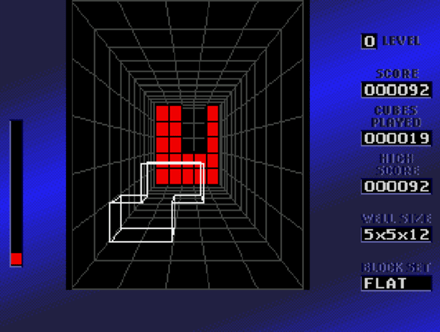
It’s tetris but in 3D! (screenshot taken by author)

How Does It Handle?

The 3D element and three coordinate axes rotation format adds an extra degree of difficulty that you wouldn’t find in Tetris. It definitely takes a lot of practice. Being able to change the dimensions of the well is a nice feature too adding an extra challenge to the game.

Graphics

The graphics are basic, but they don’t need to be complicated for this game. Having different colours to differentiate each layer is sufficient for the game.

Music and SFX

The intro music is quite aggressive for a puzzle game. It remined me of the fuzzy musical notes of Road Rash (1991). There is no in-game music and minimal SFX when you place a block or complete a Face. I think some light music would not have gone amiss here.

Replay Value

For fans of Tetris and the like, I imagine this would be an addictive game, especially with a two-player mode.

Did I Complete The Game?

I’m not sure that you can complete this game but I didn’t spend too much time trying to find out. I don’t enjoy these sorts of games so don’t put in the time to become a good player. My highest score so far is a pitiful 18242.

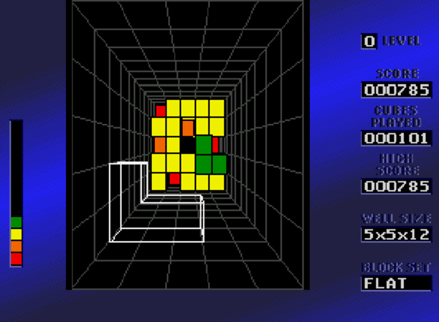
Different colours help differentiate the layer (screenshot taken by author)

What The Critics Said:

MegaTech: “This sort of 3D Tetris is surely the finest Megadrive puzzle game available, packed with tons of options (including a simultaneous two-player mode) and featuring highly addictive gameplay, this is a must for your collection. Overall 91%.[1]

Mean Machines: “This sort of 3D Tetris is surely the finest Megadrive puzzle game available. Packed with tons of options (including simultaneous two-player mode) and featuring highly addictive gameplay, this is a must for your collection. Overall 91%.[2]

My Verdict:

“It’s Tetris in 3D. Personally, I’m not a huge fan of these sorts of games and but can appreciate their appeal and the skill and practice that goes into being able to achieve high scores. Ardent fans will play for hours and return time and time again.”

Rating:

What are your memories of Blockout? I would love to hear your thoughts, and don’t forget to follow and subscribe so that you don’t miss my latest reviews! You can also find me on Instagram: @nicklovestogame.


[1] ‘Game Index – Block Out’. MegaTech. (May 1992). Issue 6:76.

[2]’Review: Mega Drive – Block Out’. Mean Machines. (October 1992). Issue 1:137.

Alien Soldier – Review

Ah, emulation vs original hardware. There are very good arguments for both sides of this divisive coins. Personally, I do not have the funds, or patience, to seek out games I wish to play on original hardware due to the prices have been inflated by collectors, the scarcity of the original hardware and pure laziness. So, I say, thank God for emulation. Without emulation there are many, many games that I would never have heard of and would never have had the opportunity to play. Alien Soldier is one such game.

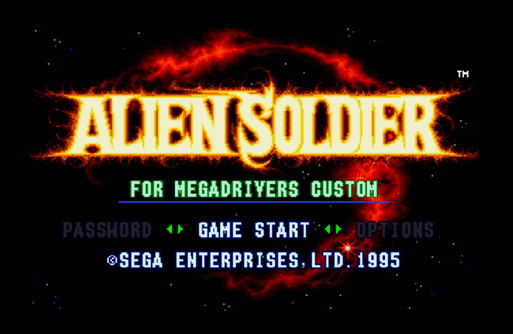
Title screen (Screenshot taken by the author)

Alien Soldier is a single-player side-scrolling run and gun video game developed by Treasure Co., LTD. and published by Sega. It was released for the Mega Drive in 1995 and would be re-released on PlayStation 2’s as part of the Gunstar Heroes Treasure Box (2006), Volume 25 of the Sega Ages 2500 series. It would go on to be re-released on the Wii Virtual Console (2007), Steam (2011), Nintendo Switch Online (2022) and the Sega Genesis Mini 2 (2022). For this review, I played the version found on Sega Mega Drive Classics (2010) for the PlayStation 4.

Plot

The plot to this game is a weird one. Basically, it’s 2015 and the planet Sierra is under attack by a terrorist group known as Scarlet. Led by the evil Xi-Tiger, they plan to destroy the human race. Scarlet’s former leader, Epilson-Eagle has sworn to defeat the terrorist group putting and end to Xi-Tiger’s evil scheming once and for all. (Bearing in mind, Epsilon-Eagle is not trying to save humanity but simply seeking revenge on Xi-Tiger).

Gameplay

Epsilon-Eagle must battle his way through 25 stages, defeating 26 bosses along the way. Before embarking on your mission, you must arm yourself with four out of a potential six weapons, each with their own advantages and disadvantages:

Select your weapons! (Screenshot taken by the author)

Buster Force – Firing bright yellow blasts at your enemy, this weapon has a weak attack but uses less ammo and has a good range.

Flame Force – A deadly flame that uses less ammo but is limited in range.

Sword Force – A deadly laser beam with a good range but that guzzles your ammo.

Ranger Force – Three way shot that is a bit of an all-rounder. Not as strong as the Sword or Lancer Forces but uses less ammo than them.

Homing Force – Flame thrower that seeks out the enemies’ weak spots. Great for bosses but not as strong as the Sword or Lancer Forces. It does use less ammo though.

Lancer Force – Another deadly laser beam with a good range but that guzzles your ammo.

To change weapons in game, please ‘A’ and cycle through the wheel until you find your desired weapon. press ‘A’ again to close the wheel.

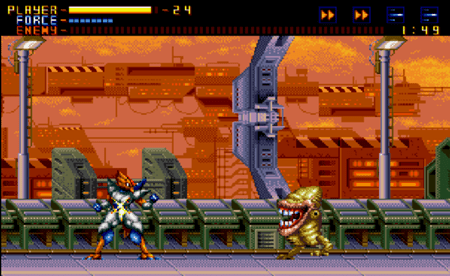
Awesome graphics (Screenshot taken by the author)

How Does It Handle?

The controls are nice and responsive but take a little getting used to. You need to be super quick when changing weapons as the game will continue to play. Since there are only four weapons, I think it would have been better to simply press ‘A’ to cycle to the next weapon on the list. This would enable you to continue to evade your enemies rather than be a sitting duck.

Although you can block by double tapping the fire button but I don’t think this works very well. The six-button controller was around by this time so why not utilise it?

I like the idea tht there is a target on the bosses body so that you know where to shoot. Hardened gamers may disagree but this is a personal preference.

I don’t think I used the hover function until stage 11, but I certainly used the Zero Teleport. In fact, spoiler alert, using the Zero Teleport was the easiest way to defeat most bosses which made them a little monotonous after a while. Having said that, I’m yet to get past the boss on Stage 11 and you can’t use the Zero Teleport much on it.

Graphics

I think the game looks great. Epsilon-Eagle is well illustrated and animated and there is plenty of variation between the enemies and each boss is noticeably different. Lots of big explosions, screen shakes when the bosses have been defeated. I think the levels look great too with a nice variation of backgrounds which are very detailed and modestly coloured so as not to draw the eye away too much from the action.

Music and SFX

The music is very high-octane stuff which fits a game like this well. The issue is that I was so engrossed in what I was doing, I never noticed the music. I had to play through again and really pay attention to it. SFX-wise, again lots of explosions and laser noises but they get lost amid the chaos of the game. Although I do like the siren going off and the vocalised “Emergency” when you are coming to a boss battle.

Replay Value:

Having more than one difficulty setting always adds a little to the replay value but I think the game is very samey and did not make me want to continue playing.

The game focusses on boss battles more than level length (Screenshot taken by the author)

Did I Complete The Game?

No. At present, I got to stage 10 or 11 before I felt I had seen all the game has to offer. I will continue to play at a later date though.

What The Critics Said:

Consoles +: “A good shoot ’em up for the MD. Overall 88%.[1]

Computer and Video Games: “This is a well worn genre and there aren’t many roads forward. Alien Soldier doesn’t exactly build a new orbital motorway, but it does lead you down quite an interesting road. Basing play on boss fighting isn’t a new idea, but Alien Soldier does quite a tidy job of delivering the goods. Alien Soldier will take any budding sadist a lot of determination to complete, my only worry is that your blood lust may dry and your interest shrivel into repetitive stress syndrome before you kill the final infernal boss. Overall 80%.[2]

Mean Machines Sega: “A modern classic that turns the concept of platform blasting inside-out, but that suffers from being a bit samey. Overall 85%.[3]

Verdict:

“Alien Soldier looks great and is exciting to play…at first. As the levels progress, the game becomes a bit monotonous.”

Rating:

What are your memories of Alien Soldier? I would love to hear your thoughts, and don’t for get to follow and subscribe so that you don’t miss my latest reviews! You can also find me on Instagram: @nicklovestogame.


[1] ‘Mega Driver Review – Alien Soldier’. Consoles +. (April 1995). No. 42. :131.

[2] ‘CVG Review/Showcase – Alien Soldier’. Computer and Video Games. (June 1995). Issue 163:52-57. 

[3] ‘Megadrive Review – Alien Soldier’ – Mean Machine Sega. (July 1995). Issue 33:80-81. 

PGA Tour Golf II – Review

In the early 1990s, EA Sports quickly made a name for themselves as the producers of the most realistic sports videogames. Their PGA Tour Golf (1990) release set the standard for how realistic and additive a golf videogame could be. The question was: could EA Sports produce a sequel to PGA Tour Golf (1990) that maintained the high standard set by the first instalment but have enough differences to make purchasing copy worthwhile?

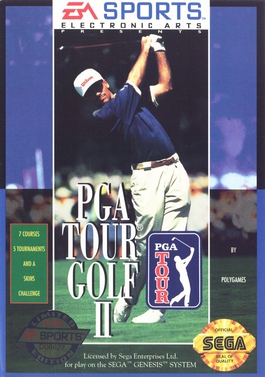
PGA Tour Golf II is a sports simulation game developed by Polygon Games and published by EA Sports for the Mega Drive in 1992. A version was released on the Game Gear by Time Warner Interactive in 1995. For this review, I played the Sega Mega Drive version.

(screenshot taken by the author)

Plot

As with most sport sims, there is no plot per se. The object of the game is to compete in and win six tournaments whilst competing against other professional golfers.

Gameplay

With up to four players, there are several modes to play:

Practice Round – Play 18 holes on any course just for fun. You can also just practice your long game on the driving range and/or short game on the putting green.

Tournament – Compete in any tournament which consists of 4 rounds of 18-hole rounds. However, to qualify for the next round, you must make the cut by ensuring you score low enough on your round. If you successfully compete the final round, you earn money and may even win the tournament if you consistently score the lowest numbers of strokes per round.

Skins Challenge – A nice addition to the game. Two to four players can compete in an 18-hole match where each hole is assigned a monetary value. To win the hole, simply complete the hole in the least strokes. The winner takes the pot for that hole. The value of the holes increase as the match progresses. If a hole is tied, the money rolls over to the next hole. To make it more interesting, you can also opt to have pros join the game controlled by the computer.

The courses you can choose to play include:

TPC at Avenel

TPC at Eagle Trace (New)

TPC at Sawgrass

TPC at Scottsdale (New)

TPC at Southwind (New)

PGA West Stadium

At the beginning of each hole, you are greeted with a rotating 3D view of the green and advice from one of the professional golfers on how to approach the hole.  Before each stroke, a bird’s eye view of the hole with a cross hair over the pin will appear. You can move the cursor and it tells you the distance from your golfer to the cursor. You can go back to the overview at any time by pressing ‘A’ button.

As you address the ball, a small window will appear showing you how the ball lies, allowing you to select the most appropriate club. The HUD contains all the information you need. You have the wind speed and direction in a box on the bottom left, the power gauge in the middle, and the hole number, hole par, stroke number, current score, distance to pin and club you are using in a box on the bottom right. On the horizon is the cross hair which shows you were you are aiming your shot. You can move this cursor left or right. Your caddy will automatically select the club they think you should use but you can change clubs yourself by pushing up or down on the D-pad. As you do this, you will notice the number to the left of the power gauge will increase or decrease. This is the maximum number of yards the club will hit the ball if the ball was unaffected by wind or how the ball lies.

When you are ready to hit the ball, press ‘B’ and the power gauge begins to fill from right to left. When you have reached your desired power, press ‘B’ again and the power bar begins to descend having left a mark when you stopped the power gauge rising. You then need to press ‘B’ a third time as the power bar reaches the Stroke Bar. If you are accurate, you will hit the ball without a slice or draw. The earlier or later your stop the power gauge either side of the stroke bar will determine the degree of which you slice or draw the ball. After striking the ball, and when the ball begins to descend, the camera angle changes, and you will see where the ball lands.

When you reach the green, a 3D square grid will appear showing you the lie of the green. This allows you to judge the slopes of the green when attempting to putt. Again, by pressing up and down on the D-pad when you are on the green increases and decreases the maximum power of the putt.

A new feature includes a Draw/Fade option allowing you more control over your ball when evading sand bunkers and water hazards.

There is also the new “Hole Browser” feature which allows you to really inspect the course, scrutinize the hazards, and plan the best approach to the green.

PGA Tour Golf (1990) (screenshot taken by the author)
PGA Tour Golf II (screenshot taken by the author)

How Does It Handle?

Very little has changed from PGA Tour Golf (1990). The controls are easy to learn. It’s the execution that proves difficult, but that is what makes the game so frustrating yet addictive.

Graphics

The graphics have improved since PGA Tour Golf (1990). The sprites are more detailed, and the swing animation is smoother and looks more realistic. The courses look better too with more differentiation between the light rough and heavy rough. I also think there are more varieties of trees of which are more detailed. The HUD looks slicker too.

When compare to its 16-bit console contemporaries, I think the sprites and courses look much better than Pebble Beach Golf Links (1992).

Music and SFX

Nice, upbeat pieces of music can be heard over the title screen, at the beginning of each tournament, and at the start of each hole which suits the game. In my mind, it is reminiscent of music that would be heard on Prime Time TV over the intro montages to sports TV programmes. There is no music whilst playing your rounds of golf which I prefer.

SFX are very minimal too. You’ll hear the occasional bird tweeting, the ‘thwack’ as you strike the ball, when ball when it lands, an applause when you putt in the hole, and the frustrating splash as the water lands in a water hazard. You don’t need more than this for a golf game. Less is more in this case.

Use the 3D mapping to read the green (screenshot taken by the author)

Replay Value

Like most sports games, this really comes into its own in multiplayer mode. The addition of the Skins Challenge is certainly something that will have you returning time and again. Add to that, the game is tough but strangely addictive. It is also a relaxing game which can be played in a semi-sedate manner.

Did I Complete The Game?

You can’t complete this game as such. I guess “completing” it would be winning all the tournaments. The best I ever did was place third in the TPC at Scottsdale.

Personal Memories

I used to own this game as a kid, and my father and I would regularly play the Skins Challenge. I was also better than my father at this game and after a few holes…and a few bogeys on his part…he would make an excuse along the lines of “I better get on with some jobs your mum wants me to do.” and would resign from the game, a little to my annoyance.

What The Critics Said:

MegaTech: “Seven 3D courses based on real-life PGA Tour venues are the setting for this prime golf simulation. Multi-player and skins tournaments, on-screen advice form the pros, battery game save – this cartridge is just loaded with features. Overall 94%.[1]

My Verdict

“Arguably, one of the best 16-bit golf games of its time. It looks great but don’t be fooled by its serene atmosphere. It is challenging enough so that you won’t get bored easily, and addictive enough to keep you coming back for more, especially in multiplayer mode.”

Rating

What are your memories of PGA Tour Golf II? I would love to hear your thoughts, and don’t for get to follow and subscribe so that you don’t miss my latest reviews! You can also find me on Instagram: @nicklovestogame


[1] Game Index – PGA Tour Golf 2‘. MegaTech. (October 1993). Issue 22:101.

PGA Tour Golf – Review

In real life, I enjoy playing golf. I’m not very good, and I’ve never scored a birdie, but it is hard not to love being surrounded by greenery and, in some cases, wildlife. I have played in scorching heat in Canada (Alberta and Ontario), fighting off mosquitoes but receiving regular visits from the cart girls selling refreshments, and I have played in rainy, gusty conditions in England where there are no cart girls but it’s easy to sneak your own drinks onto the course.

Title screen (screenshot taken by the author)

PGA Tour Golf is a sports simulation game developed by Sterling Silver Software and published by Electronic Arts. The first of a franchise, it was released in 1990 for MS-DOS. It was later released for the Mega Drive and Amiga in 1991, and SNES in 1992. Later releases for the Master System and Game Gear were published by Tengen in 1994. For this review, I played the Mega Drive version.

Plot

As with most sport sims, there is no plot per se. The object of the game is to compete in and win four tournaments whilst competing against other professional golfers.

Gameplay

With up to four players, you have the option to play a Practice Round or a Tournament, or you can simply practice on the Driving Range and/or Putting Greens. The practice modes are self-explanatory, but they are handy for people unacquainted with the game.

In Tournament Mode, each tournament consists of four rounds of 18 holes competing against 60 other golfers, of which all are real-life professionals.

The game contains three real courses from the US and one fictional course:

TPC at Sawgrass (Florida)

TPC at Avenel (Maryland)

PGA West Stadium (California)

Sterling Shores (Fictional)

At the beginning of each hole, you are greeted with a  rotating 3D view of the green and advice from one of the professional golfers on how to approach the hole.  Before each stroke, a bird’s eye view of the hole with a cross hair over the pin will appear. You can move the curser and it tells you  the distance from your golfer to the cursor. You can go back to the overview at any time by pressing ‘A’ button.

As you address the ball, a small window will appear showing you how the ball lies, allowing you to select the most appropriate club. The HUD contains all the information you need. You have the wind speed and direction in a box on the bottom left, the power gauge in the middle, and the hole number, hole par, stroke number, current score, distance to pin and club you are using in a box on the bottom right. On the horizon is the cross hair which shows you were you are aiming your shot. You can move this cursor left or right. Your caddy will automatically select the club they think you should use but you can change clubs yourself by pushing up or down on the D-pad. As you do this, you will notice the number to the left of the power gauge will increase or decrease. This is the maximum number of yards the club will hit the ball if the ball was unaffected by wind or how the ball lies.

When you are ready to hit the ball, press ‘B’ and the power gauge begins to fill from right to left. When you have reached your desired power, press ‘B’ again and the power bar begins to descend having left a mark when you stopped the power gauge rising. You then need to press ‘B’ a third time as the power bar reaches the Stroke Bar. If you are accurate, you will hit the ball without a slice or draw. The earlier or later your stop the power gauge either side of the stroke bar will determine the degree of which you slice or draw the ball. After striking the ball, and when the ball begins to descend, the camera angle changes, and you will see where the ball lands.

When you reach the green, a 3D square grid will appear showing you the lie of the green. This allows you to judge the slopes of the green when attempting to putt. Again, by pressing up and down on the D-pad when you are on the green increases and decreases the maximum power of the putt.

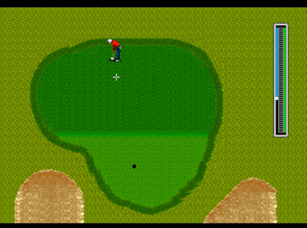
An overview of on of the four courses you can play (screenshot taken by the author)

How Does It Handle?

PGA Tour Golf is not for the feint hearted. It is clearly designed for golf fans and is very challenging, much more challenging and unforgiving than Arnold Palmer Tournament Golf (1989). I wonder if the game is a bit too difficult. You have to be incredibly precise (maybe too precise) when you try to stop the descending gauge at the Stoke Bar else you can very easily draw or slice the shot. That being said, I really like the power gauge for this game. The ease of which you can change clubs and use the percentages of the power bar to estimate shots is a much simpler and user-friendly way of playing than Arnold Palmer Tournament Golf (1989).

When putting, I like the fact that you can change the maximum strength of the putter as this allows you to more accurately gauge the strength of your putt. That is not to say that putting is easy, of course. I found the putting to be very unforgiving with little margin for error.

Unlike Arnold Palmer Tournament Golf (1989) where you have to keep pressing ‘A’ to scroll through wind, distance, club selection etc., I love how all that information is one the main HUD. This speeds up the game and means you don’t keep having to go back a screen because you’ve forgotten the distance to the pin.

All the information you need on one screen (screenshot taken by the author)

Graphics

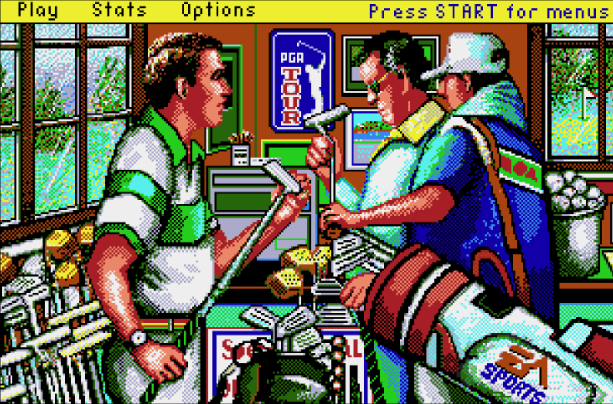
I love the design of the main menu. The picture of the Pro Shop is very colourful and nicely illustrated, and it really adds to the feeling of getting ready for a round of golf. The drop down menus show that the game was designed for MS-DOS/PC.

The in-game graphics aren’t as realistic as Arnold Palmer Tournament Golf (1989) and the courses themselves are far less detailed when it comes to the trees, sky, and differentiation between the fairway and the rough. The bitty graphics become even more apparent the larger your TV screen. The sprite also pales in comparison. Oddly, there is no difference in the look of the clubs or the stance of the golfer whilst using them with the exception of the putter which is disappointing. However, I do prefer the graphics of PGA Tour Golf to Jack Nicklaus’ Unlimited Golf & Course Design (1990).

The innovative 3D overview of the greens is awesome. It is a simple design, but is a great way to display the lie of the green. It allows the player to read the greens more accurately that previous methods. Bravo!

I also like the way the camera angle changes a few seconds after you have hit your shot so that you view the ball coming into land is a nice touch. This really helps with the feel of professional golf you see on television. 

Music and SFX

The only music you hear in the game is the cheap 8-bit ear-offending tune that plays over the introduction to each hole where a professional golfer offers advice on how to play the hole. I appreciate this game is ported from MS-DOS but one would expect the music to be of better quality for the Mega Drive. 

The sound is very minimalist. You hear a few birds tweets, the sound of the ball as you strike it and as it lands, and a ripple of applause when you putt the ball. It is how golf should be. Peaceful and relaxing…at least for the spectators anyway.

Replay Value

The main replay value of this game is the multiplayer mode. Each of the tournaments are individual titles and so once you have won them, you have won them. The money accrued means very little other than to be kept as a bragging statistic which is a shame. It would have been nice to be able to buy some different clubs like you can in Arnold Palmer Tournament Golf (1989). That is not to say that the game will be cast aside quickly. The tournaments are incredibly hard to win and mastering the game will take some time.

Did I Complete The Game?

At present, I have not won a tournament…in fact, after several attempts, I have only ever qualified for the third round once whilst competing in the Sterling Shores tournament and the second round of the TPC at Sawgrass.

The 3D view allows for more challenging green designs (screenshot taken by the author)

What The Critics Said:

Mean Machines: “A superb sports simulation which will appeal massively to golf fans, and will even be enjoyed by those who normally wouldn’t play this type of game. Overall 91%.[1]

Raze: “PGA Tour Golf is a very accomplished piece of programming on the Amiga, and even more so on the Mega Drive, putting Arnold Palmer in the rough. The slick presentation on both versions gives the game a very professional look and a lot of appeal. To casual players or more serious golf devotees it will provide an ideal opportunity for long term entertainment. Overall 87%.[2]

Video Games and Computer Entertainment: “The computer plays a good game, but this is one of those that really shines when you play with one, two or three other people. If the graphics, which would seem to be no more than 32 colours, were on a level with Arnold Palmer Tournament Golf (or even the celebrated Links 256-colour golf game from Access), it’d be a truly remarkable achievement. As it is, PGA Tour Golf is still a thoroughly entertaining, challenging and complex golf simulation. Overall 26/40“.[3]

Sega Power: Possibly the best golf game to appear on the MD! Good 3D views, loads of options, a multiplayer mode, a Save Game option, and classic golfing play. A must for all golfers. Overall 5/5.[4]

My Verdict:

“Although the graphics are a bit sub-par (pun intended), PGA Tour Golf is fun and easy to learn but challenging to master. It has plenty of replay value, especially in multiplayer mode, and the creators have captured the atmosphere of the sport nicely.”

Rating:

What are your memories of PGA Tour Golf? I would love to hear your thoughts, and don’t for get to follow and subscribe so that you don’t miss my latest reviews! You can also find me on Instagram: @nicklovestogame.


[1] ‘Mega Drive Review: PGA Tour Golf’. Mean Machines. (April 1991). Issue 7:40-42.

[2] ‘Reviews – PGA Tour Golf’. (May 1991). Raze. Issue 7:38.

[3] Mandel, J., ‘PGA Tour Golf’. Video Games and Computer Entertainment. (May 1991). :47-8.

[4] The Hard Line – PGA Tour Golf’. Sega Power. (October 1991). 23:54.

Arnold Palmer Tournament Golf – Review

In the 1980s, game developers cottoned on to the fact that celebrity endorsements help increase game sales. Beginning with Atari’s Pele’s Soccer (1980), it wasn’t long before names and likenesses of other celebrities such as Bruce Lee (albeit posthumously) and Daley Thompson soon appeared on video games. The quality would vary, however, and a celebrity endorsement was not always a guarantee of a good game.

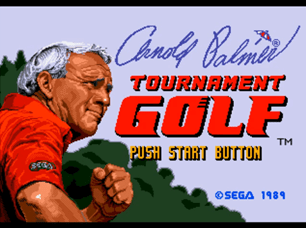
Title screen (screenshot taken by the author)

Arnold Palmer Tournament Golf (Naomichi Ozaki Super Masters in Japan) is a golf game developed and published by Sega and released in 1989. AS far as I know, the game has not been ported or re-released at a later date and so the Mega Drive version was the only option I have to review the game. 

Plot

As with most sports games, there is no plot other than you must compete against other golfers to win the tournament. To win the tournaments, you must finish each hole in the least number of shots.

Gameplay

Played in single or two-player modes, you can choose to play practice rounds or full Tournament Mode. Practice Mode can be played with one or two players, and you have a choice to play any of the three courses. The Tournament consist of 12 rounds of 18 holes played over three different courses located in the US, Japan and Great Britain. As you progress, you earn money based on your standings at the end of each round. This money can be used to upgrade your clubs from the default black carbon to the better glass fibre and ceramic clubs. Your skill level also increases allowing for greater distances with your shots and your caddy offers better advice for each shot.

Most of the rounds of are played as normal stroke play golf, in that you simply have to get around the course in the least number of shots. However, rounds seven and eleven are played as match games where you play against one other golfer. All you need to do is finish the hole in less shots than it takes your opponent. If, at the end of the tournament you are tied, you will play a sudden death game where the first golfer to win a hole, wins the match.

When it is your turn to address the ball, the HUD becomes split. On the left, you’ll see an overview of the hole and on the right, you’ll see your golfer and the caddy standing with their golf bag. There are three black boxes on the screen displaying various pieces of information. The top left box consists of the number of the hole, distance from the pin, and the hole’s par length; the top right box is the caddy’s advice; and the bottom right box displays your name, the number shot you are on and the club you are going to select. When you press ‘A’, a fourth black box will appear with the options to get Advice, to see the Green, or to see the Score. Press ‘A’ again, and all the black boxes will disappear, and a weathervane will appear showing the wind speed and direction. Press ‘A’ again and the weathervane disappears and an image of how the ball lies appears. Press ‘A’ again and the lie of the ball disappears, and picture of your club appears. You can use the direction button to search for the club you wish to choose. Press ‘A’ again and you will then be shown the stance of your golfer. Again, using the direction button you can adjust the stance allowing your golfer to deliberately ‘slice’ or ‘draw’ the ball. Press ‘A’ again, and the weathervane will appear once more as will the power gauge, and a small yellow arrow on the horizon. The direction button controls the yellow arrow and allows you to aim where you wish to hit the ball. You then press ‘A’ and two white markers begin to ascend on the power gauge. A third white marker will remain in the bottom third of the power gauge. Once they reach your desired power, you press ‘A’ again. The left marker will stop, and the right marker will begin to descend. You then press ‘A’ a third time to stop the descending marker in line with the stationary marker in the bottom third of the power gauge. Your player will then strike the ball. The progress of your hit ball can be seen on the overview map on the left. You will then be told where the ball lands (E.g., fairway, rough, sand bunker), and the process starts all over again. When you land on the green, the view changes to a near bird’s eye view. The lighter areas of the greens are higher than the darker areas of the green. Pressing ‘A’ will make arrows appear on parts of the green which shows you the direction of the slopes.

To help you during the rounds, you have a caddy who offers advice to you before you take a shot. At first, the advice simply states distance left to the hole. As you progress through the game, the caddy begins to offer more advice regarding how the ball lie and various landmarks and hazards on each hole of the course.

Excellent graphics and beautifully detailed (screenshot taken by the author)

How Does It Handle?

For the most part, the game is easy to pick up and play, but you will need the instruction manual to remind yourself of the maximum distance of each club. Adjusting your strength of shot and direction based on wind speed and direction takes some getting used to but adds a sense of realism to the game. Sometimes the wind works in your favour, other times it works against you. The putting is the hardest part as each increment of the putting gauge equals one yard. Add slopes into the mix and the speed with which the power increases in the power gauge, and you can be forgiven for missing some seemingly straightforward puts. I much prefer the way the greens can be viewed in PGA Tour Golf (1991) but I still prefer it to Power Golf (1989).

One of the things I found frustrating was the HUD display. The remaining distance to the hole wasn’t displayed at all times. Once you play your first stroke, you only need to know the remaining distance and to be reminded of the par of the hole. You don’t need reminded of the hole length. The annoyance of having to constantly click the ‘A’ button and then the ‘B’ button to go back and forth does become tiresome after a while. I actually prefer the HUD display for PGA Tour Golf (1991) and Power Golf (1989) which displays all the information all the time.

Oddly, there is an inaccuracy between the map of the hole and what you can see on the right screen when the ball has struck. Many a time I have struck a ball into an area and the ball is seemingly on the fairway but it is in fact in a bunker or in the rough. For example, on hole 13 of one of the courses, I forget which, the ball was lying on the fairway according to the right section of the screen but on the map sections, it showed I was in the bunker. It was rather annoying at times.

Graphics

I think the game looks great. The colours are vibrant, and the sprites move in a very realistic way. The courses are clearly defined so that you can differentiate between the fairway, rough, sand bunkers and trees. I think I actually prefer the way the courses look here than I do with PGA Tour Golf (1991), which looks a tad bland for me, or Power Golf (1989), which looks a bit too cartoony for me.

Halfway through each course, you have a tea break where you are greeted with one of several animations of Sega Master System hero Alex Kidd playing golf. He is joined by Opa-Opa of Fantasy Zone fame.

Oddly, the backgrounds of the courses do not vary and so the courses are not visually distinctive. This is very disappointing as it would have been a great opportunity to design courses based around styles and fashions from those nations: mountains for the USA and cherry blossom trees and some pagodas for Japan. These may come across as stereotypical, but the visuals would have been a nice way to differentiate the courses.

It is also disaapointing that there is only one player face to choose from and that you cannot change the colour of the jersey. The only colour change is a palette change when you compete against another opponent.

Music & SFX

Music plays throughout in the form of an upbeat and bouncy number which doesn’t really lend itself to the sedate nature of a golf game. I do like the music, but If I’m honest, I prefer silence with the occasional bird tweeting and the gentle ripple of applause from the crowd as you bag another birdie. There is a satisfying noise as you sink your ball and a nice little applause from the crowd, but I found that I just turned down the sound and listened to my own music or podcasts as the music and noise aren’t really needed for the game. Weirdly, there is a slight delay of sound when you hit the ball.

Replay Value

For golfing fans in particular, I think this game has lots of replay value. Picture a relaxing evening with a beer or cup of tea, maybe a bit of light music on in the background whilst you play a genial game of golf. Two-player mode will also ensure that level of competitiveness amongst friends remains ignited.

Apparently, there is a secret Fantasy Zone level hidden within the game. To find it, allegedly hit the ball 100 times on the first hole without putting in. You then enter up, up, down, down, left, right, left, right, B and A on the game over screen. However, I’ve never had the patience to do this and so cannot confirm if this is true.

Did I Complete The Game?

As of yet, I have never won the overall tournament but I have won the GB Pro Tournament and earned a nice set of fibre glass clubs for my troubles.

“Driving for show, putting for dough” (screenshot taken by the author)

What The Critics Said:

Mean Machines: “More fun than Bruce Forsyth, better looking than Tarby, and more strokes than Cecil Parkinson. Overall 83%.[1]

Raze: “The whole game is slickly designed and beautifully executed. Arnold Palmer may sound like a boring old fart to you, but he’s got one hell of a game to play. Overall 89%.[2]

Sega Pro: “One of the first and still one of the best. Accurate graphics, good sound and heaps of playability make this an impressive golf simulation, but PGA Tour Golf plays a lot better. Overall 83%.[3]

Sega Power: “Impressive looking game with convincing 3D courses, good player animation and a hidden Fantasy Zone Game! Simple play-style grows dull so seasoned golfers should go for PGA Tour Golf instead. Overall 3/5.[4]

Verdict:

“I think this is a solid golf game. Lovely colours and animation, and the game is surprisingly addictive. There is a fair amount of replay value and I’d wager than you’ll be paying your golf fees again and again with this one.”

Rating:

What are your memories of Arnold Palmer Tournament Golf? I would love to hear your thoughts, and don’t for get to follow and subscribe so that you don’t miss my latest reviews! You can also find me on Instagram: @nicklovestogame.


[1] ‘Mega Drive Review – Arnold Palmer’s Golf’. Mean Machines. (December 1990). 3:58-60.

[2] Ellis, L., ‘Reviews – Arnold Palmer’s Tournament Golf’. Raze. (February 1991)4:60-61.

[3] Proview – Arnold Palmer’s Tournament Golf’. Sega Pro. (November 1991). 1:37.

[4] ‘The Hard Line – Arnold Palmer Tournament Golf’. Sega Power. (October 1991). 23:52.

Congo Bongo – Review

There will always be a debate about emulation vs original hardware. Some argue that you can only experience the true essence of a game upon playing the original. Others aren’t that fussed or simply can’t afford or access the original hardware. Why should they miss out? I tend to fall into the later category. I would never have played Congo Bongo had it not been for emulation…and I’m glad I did.

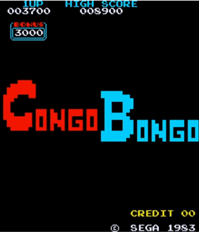
Title screen (screenshot taken by the author)

Congo Bongo (also known as Tip Top) is a platform game developed and released by Sega for the arcade in 1983. For this review, I played the version found on Sonic’s Ultimate Genesis Collection (2009) for the PlayStation 3.

Plot

One night, deep in the jungle, an unnamed safari explorer has his tent set on fire by a huge ape named Bongo. The explorer then proceeds to chase Bongo to try and capture him.

Gameplay

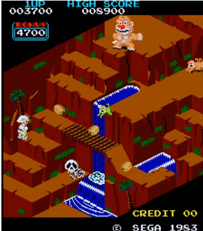
The explorer must pursue Bongo across four screens. Whilst in pursuit, there are a number of obstacles for you to evade and conquer. These include jumping across water, dodging other jungle creatures who wish you harm, or evading coconuts thrown by Bongo. You are unable to attack any of the other jungle animals, but you can jump over them to avoid being hit by them.

The four stages include:

  • Stage 1 – The hunter must climb a series of cliffs whilst dodging coconuts thrown at him by Bongo and avoiding the smaller monkeys who try to throw him off the ledges.
  • Stage 2 – The hunter must cross a swamp by riding on the backs of diving and swimming hippos. There are also poisonous snakes and scorpions to avoid.
  • Stage 3 – The hunter must cross a plain and crouch into holes to evade the horns of charging rhinos. He must then climb more ledges to get to the next stage.
  • Stage 4 – The hunter crosses a second swamp with lily pads, fish, and hippos. Once you reach the other side of the swamp, you must dodge more charging rhinos that are blocking the ledges where you can capture bongo.

One you reach the end of level four the game repeats from the first level with increased difficulty.

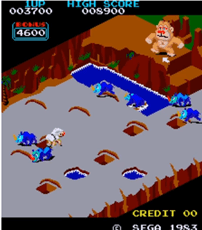
Watch out for the cocnuts! (screenshot taken by the author)

How Does It Handle?

I think our hero moves at a good speed and is easy to control once you get used to the isometric view. I find it helps to rotate my controller to match the directions he will go on the screen. The jumping is tight too. No complaints there. As you can imagine from old arcade games, this is a tough game to master. I think I’ve only ever managed to get to level five or six before losing all my lives.

Graphics

I think this game looks great for 1983. I love the blue of the water, and the animation of our hero as he climbs out of the holes and climbs up the ledges of the mountains. I think the animals are nicely animated too. No issues for me here.

Music & SFX

There is no intro music or in-game music, but there is a nice little piece of celebration music as you pass each level which for some reason reminds me more of a wild west game than it does a jungle game. There is also a strange little riff when you die and float up to heaven.

The noise that the coconuts make as they are being thrown and bounce down the mountains is annoying, as is the low level bassy noise when the rhinos are on screen.

Replay Value

I can imagine that when this game was released it had tons of replay value. I can envisage groups of friends hanging around the machine seeing who could get the highest score. I can also see this game being quite addictive too. There is something about it which draws you back to it.

Did I Complete The Game?

I don’t think this the sort of game you can complete but I only reached level five or six before losing all my lives.

I didn’t know there rhinoceroses in the jungle?! (screenshot taken by the author)

What The Critics Said:

Computer and Video Games:  “Donkey Kong in three dimensions is the fascinating idea behind Tip Top. (No rating)“.[1]

My Verdict:

“I think this would have been a good game in its day. I like the look of it, but the music just doesn’t fit for me. It is also incredibly difficult. Other than that, I can see this game becoming addictive.”

Rating:

What are your memories of Congo Bongo? I would love to hear your thoughts, and don’t for get to follow and subscribe so that you don’t miss my latest reviews! You can also find me on Instagram: @nicklovestogame.


[1] ‘Arcade: Jungle Revenge in 3D – Tip Top’. Computer and Video Games. (July 1983). Issue 21:30.
Golden Axe Warrior – Review

It is always a pleasant surprise when you find out that a game that evokes so many fond memories from your childhood has prequels and sequels. Sadly, some of these are often vastly inferior to the original and are clearly a quick cash in for game companies. However, some are rather interesting, especially when a different genre is attempted. I’d never heard of Golden Axe Warrior until I began playing Sonic’s Ultimate Genesis Collection (2009).

Title screen (screenshot taken by the author)

Golden Axe Warrior is single-player action-adventure role-playing game. It was developed and published by Sega and released for the Master System in 1991. It would later be released as part of the Sonic’s Ultimate Genesis Collection (2009) for the PlayStation 3 and Xbox 360. For this review, I played the version found on Sonic’s Ultimate Genesis Collection (2009) for the Playstation 3.

A spin-off of the Golden Axe franchise, I was unable to find out where it fits into the series (if, in fact, it does). It is possible that it may simply be a reboot in a different genre.

Plot

In ancient times, a race of evil giants rose up and fought the Elders. At one point, it looked as though the giants would emerge victorious…but from imminent defeat emerged a hero carrying the Golden Axe bestowed upon him by Thor, God of Thunder. This unnamed hero put down the giant’s rebellion and peace ensued in the kingdoms of Firewood, Nendoria and Altorulia for many years.

As time passed, the war was nearly forgotten until the evil giant Death Adder eyed the kingdoms greedily. He first conquered Nendoria and Altorulia but could not invade Firewood as the kingdom was protected by nine magic crystals. One day, a greedy minister betrayed the King of Firewood, stole the crystals, and gave them to Death Adder, allowing him to finally invade and defeat the kingdom.

An unnamed young hero (you) soon sets out to recover the nine crystals, find the Golden Axe and defeat Death Adder. To do this, you must locate, and search nine labyrinths created by Death Adder and guarded by his armies of minions.

Gameplay

Starting out with a short sword and a shield, you must begin to explore the world one screen at a time. Each screen will spawn a differing array of monsters both in appearance and difficulty. Defeating these enemies will allow you to pick up horns, which you can use to buy items, health, and magic potions. Occasionally you’ll come across towns where the inhabitants offer tips on where to go next. Some even lead you to secret objects. Along the way you’ll have the opportunity to acquire better weaponry and armour. You can also learn the Thunder, Earth, Fire and Water magics.

There are many shops dotted throughout the map where you can buy items. These include:

Magic Oil – Use when your armour gets rusty (flashes).

Golden Apple – Fills up your life gauge.

Magic Feather – Whisks you away from danger and back to where you last saved your progress.

Small Key – Can be bought or found and used open locked doors in the labyrinths.

Other items to look out for include:

Yellow Horn – Worth 1 horn.

Blue horn – Worth 5 horns.

Bread – Increases your life guage a little.

Meat – Increases your life guage a lottle (like a little but a lot).

Heart – Adds an extra heart to your life gauge.

Magic potion – Will fill an empty magic pot (if your magic gauge is full, it will add another pot to it increasing your magic gauge).

Ice Bell – Allows you to see rocks that can be smashed open.

Torch – Allows you to light up dark rooms.

Magic Rope – Allows you to ascend and descend certain parts of the mountains.

Thief’s Key – Opens locked doors in labyrinths and can be used Infinitely.

Speed Shoes – Make you run faster.

Hourglass – Freezes all monsters on screen for a short time.

Don’t forget to be on the lookout for sages where you can save your progress and inns where you can pay to stay the night and restore your health.

You will need to make your own map to record all the secrets you find (screenshot taken by the author)

How Does It Handle?

Although the manual contains a map of the world, annoyingly, the map in your inventory is a blue-lined grid which tells you basically nothing about where you have been and where you yet need to explore. It stays black the entire time. However, this does allow a bit of old school mapmaking and note taking to do yourself…which I find fun!

Your sprite is easy to control but there is an element of finesse to the fighting. For example, when your enemies are throwing their weapons at you, you can manoeuvre yourself to block the attacks with your shield. You must also ensure you are not swinging your weapon at this time else you will take damage.

Graphics

First of all, I love the title screen. Definitely the sort of imagery that would have a younger version of myself chomping at the bit to go on a fantastical adventure.

The HUD is unobtrusive and allows you to keep track of the magic crystals you find, the number of horns you loot, your life and magic gauges, and the weapon/item you are wielding.

I think the in-game graphics are good for an 8-bit system, and better than any top-down RPG I’ve seen on the NES (prove me wrong gamers). However, I don’t think they compare to the quality of Phantasy Star’s (1987) introduction, or open world graphics where the towns and sprites are more detailed and colourful.

The labyrinths are where you’ll find the magic crystals (screenshot taken by the author)

Music & SFX

I quite like the intro music. It gets the blood pumping. The in-game music is good too. There is a relaxed, mellow air when you walk around the villages but when you’re out in the open it takes it up a gear with a melody that will get stuck in your head whilst you reach for your sword and prepare to charge at your enemies!

I don’t really think there is much to comment to discuss where the SFX are concerned. There is a semi-pleasing explosive noise when you kill an enemy, and a rewarding noise of some description when you pick up a goody, but these sounds are very forgettable.

Replay Value

As much as I enjoyed this game, I can’t say I would return to it as I don’t think there could be enough variation in the game to warrant a second run through.

Spoiler Alert

Keep an eye out for the cameos of Gilius Thunderhead, Ax Battler and Tyris Flare (in this game she is a princess).

Along the way, you’ll find faster modes of transport (screenshot taken by the author)

What The Critics Said:

Mean Machines: “It’s no sequel to Golden Axe – instead Golden Axe Warrior is an unsurprising and uninteresting role playing game. Overall 40%.[1]

Sega Power: “An arcade adventure based on the Golden Axe characters. Akin to Golvellius, this is a flick-screen quest for amgic and monsters. Pretty, but too tame for true RPGers. Overall 2/5.[2]

My Verdict:

“I have a soft spot for this game and had a fun time playing it and creating my own map. I think it has been harshly judged by critics who unfairly compared it to Zelda: A Link to the Past, in which it can never match in graphics or music, and called it a poor clone. I still think this game is worth playing.”

Rating:

What are your memories of Golden Axe Warrior? I would love to hear your thoughts, and don’t for get to follow and subscribe so that you don’t miss my latest reviews! You can also find me on Instagram: @nicklovestogame.


[1] ‘The Hard Line – Golden Axe Warrior’. Sega Power. (October 1991). Issue 23:57.

[2] ‘Master System Review: Golden Axe Warrior’. Mean Machines. (April 1991). Issue 7:72-3.

Vectorman 2 – Review

By 1996, there had been a sharp decline in the titles being released for the Mega Drive. Creators were clearly favouring the next generation of consoles such as the PlayStation, Sega Saturn, and Nintendo 64. However, due to the success of its predecessor, Vectorman returns for a second adventure. The question is, will it receive the same plaudits as the first instalment?

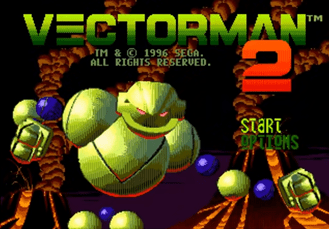
Title screen (screenshot taken by the author)

Vectorman 2 is a single player run and gun platform game and the sequel to Vectorman (1995). It was developed by BlueSky Software and published by Sega for the Mega Drive in 1996. For this review, I played the version found on Sonic’s Ultimate Genesis Collection (2009).

Plot

After defeating Warhead and foiling its plans to kill the humans when they returned to Earth, Vectorman resumes his normal duties. One day whilst completing the routine task of accompanying a sludge barge, his ship is hit by a missile of unknown origin. Vectorman survives the crash landing and finds himself near a research facility. As he investigates the origin of the missile, he discovers a population of mutant insects that have taken up residence in the research facility. The insects show clear signs of a destructive nature towards the Earth, but it is unclear who is controlling them. Vectorman must destroy the insects to once again save Earth.

Use Vectorman’s built-in weapon to destroy the mustant insects (screenshot taken by the author)

Gameplay

Vectoman can run and jump, and fire a weapon from his hand. Whilst at the apex of his jump, he can use his Boot-Blasts to gain even more height. These Boot-Blasts can also be used to cause damage to enemies when ignited. The game consists of seven parts, divided into 22 scenes.

Weapons

Whilst battling through the levels, Vectorman can temporarily acquire other weapons including:

  • Laser – Allows rapid fire.
  • Energy Shot – Solid beam of incredible power.
  • Super Energy Shot – More powerful than the Energy Shot, can ricochet of walls and also break through tiles.
  • Pulse – Fires in a more dispersed range. The second most powerful weapon Vectorman can use.
  • Overkill – A single shot which destroys everything onscreen.

Morphs

At times, Vectorman can also morph into the following:

  • Helicopter – Helps him hover and control his descent.
  • Skates – Enables him to travel through level at high speed.
  • Tornado – Helps Vectorman spin very fast for a limited time causing destruction to whoever comes into contact with him.
  • Tank – Pure firepower.

Power-Ups

Some enemies drop Assimilation icons which temporarily allows Vectorman to take on the characteristics of that enemy:

  • Shell Bug – Shield.
  • Scorpion – Attack using a deadly stinger.
  • Rhino Beetle – Charge through walls and into enemies.
  • Tick – Destroy your enemies by giving them a mighty wallop.
  • Fireant – Fireball.

Other Power-Ups include:

  • Multipliers x2, x3, x5, x10 – Multiplies points earned respectively.
  • Health Point – Restores one health ball.
  • Full Health – Fully restores health.
  • Max Health – Increases number of health balls.
  • 1-Up – Extra life.
  • Milestone – If you die, you will restart the level from this point.
  • Extra Time – Gives you extra time on the level.
  • Power Sacks – Destroy these to get power-ups inside.
  • Photons – Collect these for points. If enough are collected, you will be taken to a bonus round.
(screenshot taken by the author)

How Does It Handle?

The controls are exactly the same as its predecessor. They are tight, and responsive and the game is easy to just pick up and play. I really liked the changes in enemies from the robotic minions of the first game to the mutant insects of this game. It emphasises that you are facing a different challenge and helps differentiate the two games. The addition of different morphs and the ability to take on the characteristics of some of your enemies makes for a more interesting game too.

Graphics

The graphics of the Vectorman’s sprite look a little more refined in my opinion. There seems to be a new sheen to our hero. The levels look good…not spectacular but good. The mutant insect’s look ok, and the bosses look pretty good. One nice touch is that when you are in dark caves and Vectorman fires his gun, the area around him lights up.

Music and SFX

The music was ok, but it was quite forgettable. What I did like was the introduction of Vectorman’s robotic voice which I can’t remember from the first game. When he picks up new weapons and power-ups, he speaks but I couldn’t for the life of me understand what he was saying. It was still cool to hear though. There is also more differentiation between the sounds of the weapons when fired.

Replay Value

Vectorman 2 has three diffficulty settings but other than that, and there isn’t much to keep you coming back time and time again fter completing it a few times.

Did I Complete The Game?

No, I got to the last boss and died.

What The Critics Said:
Electronic Gaming Monthly: “No surprises here. Vectorman 2 is a solid side-scrolling platform game that will keep players busy for a few weekends. It’s levels-which include above-and below-ground areas-are huge and allow for a lot of exploration. Although the graphics are rarely outstanding, they’re always decent (and often very dark, as well). Boss monsters look especially good Many are so huge they fill the screen in fact, most of the game’s enemies look pretty cool. What really calls attention to this title, though, is its soundtrack, a booming techno-beat that sounds nothing like the static-ridden music pumped out by most genesis games. Overall 29/40.[1]

GamePro: “It’s simple mindless fun – just like the good old days. Vectorman 2 is the most addicting Genesis game this year…and it may be one of the last, so enjoy! Overall 19.5/20.[2]

Awards:

Electronic Gaming Monthly – Genesis Game of the Year 1996[3]

My Verdict:

This is another solid action-platformer. Very fun to play and challenging enough more experienced gamers. There is enough to make this game different enough from its predecessor

Rating:

What are your memories of Vectorman 2? I would love to hear your thoughts, and don’t for get to follow and subscribe so that you don’t miss my latest reviews! You can also find me on Instagram: @nicklovestogame.


[1] ‘Review Crew – Vectorman 2′. Electronic Gaming Monthly. (November 1996) Issue 88:90.

[2] Scary Larry. ‘Genesis Proreview – Vectorman 2 GamePro. (December 1996). Volume 09 Number 12 Issue 99:154.

[3] ”The Best of 96′.  Electronic Gaming Monthly. (March 1997). Number 92:86.