PGA Tour Golf III – Review

By the mid-90s, Electronic Arts, under EA Sports, seemed to have established themselves as the number one developers of sports simulations. American football, football, rugby, ice hockey, golf, cricket and basketball, their games were lauded for their realism, gameplay, graphics, and ability to get licenses of sports personalities and teams to incorporate into their games. With the critical and commercial success of PGA Tour Golf II (1992), it made sense for EA to continue the franchise. Would PGA Tour Golf III garner the same praise from critics and achieve commercial success as well?

Title screen (screenshot taken by the author)

PGA Tour Golf III is a sports simulation video game. It was developed by Hitmen Productions and published by EA Sports for the Sega Mega Drive in 1994.

Gameplay

There are three modes to choose from:

Practice Round – Play 18 holes on any course just for fun. You can also just practice your long game on the driving range and/or short game on the putting green.

Tournament – Compete in any tournament which consists of 4 rounds of 18-hole rounds. However, to qualify for the next round, you must make the cut by ensuring you score low enough on your round. If you successfully compete the final round, you earn money and may even win the tournament if you consistently score the lowest numbers of strokes per round.

Skins Challenge – Two to four players can compete in an 18-hole match where each hole is assigned a monetary value. To win the hole, simply complete the hole in the least strokes. The winner takes the pot for that hole. The value of the holes increase as the match progresses. If a hole is tied, the money rolls over to the next hole. To make it more interesting, you can also opt to have pros join the game controlled by the computer.

The portraits of the players and commentator as well as the background images have now been digitized. (screenshot taken by the author)

You can play eight courses including:

TPC at Avenel

TPC at Las Colinas (New)

TPC at River Highlands (New)

TPC at Scottsdale

TPC at Southwind

TPC at Summerlin (New)

TPC at The Woodlands (New)
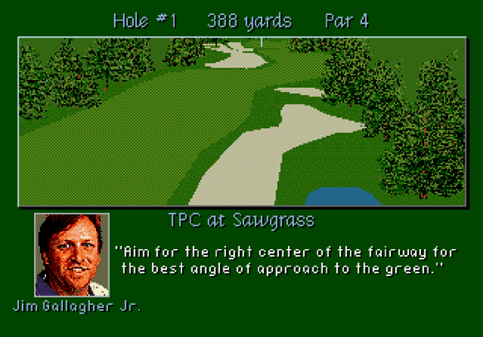
Advice from the professionals before every hole (screenshot taken by the author)

Unlike previous PGA Tour Golf games, you can play as one of eleven professional golfers who had won the following accolades at the time of the game’s release:

Brad Faxon – Three professional tournament wins

Jim Gallagher Jr. – Three professional tournament wins including The Tour Championship (1993)

Lee Janzen – Three professional tournament wins including the US Open (1993)

Tom Kite – Nineteen professional tournament wins including The Players Championship (1989), Nabisco Championship (1989), and the US Open (1992)

Bruce Lietzke – Twelve professional tournament wins including the Canadian Open (1978 & 1982)

Davis Love III – Eight professional tournament wins including The Players Championship (1992)

Mark O’Meara – Eight professional tournament wins

Jeff Sluman – One professional tournament win which was the PGA Championship (1988)

Craig Stadler – Ten professional tournament wins including the Masters Tournament (1982) and The Tour Championship (1991)

Fuzzy Zoeller – Ten professional tournament wins including the Masters Tournament (1979) and the US Open (1984)

Other than that, the gameplay hasn’t changed much. At the beginning of each hole, there is a slow flyover approach to the green with advice from one of the professional golfers on how to approach the hole.  Before each stroke, a bird’s eye view of the hole with a cross hair over the pin will appear. You can move the cursor and it tells you the distance from your golfer to the cursor. You can go back to the overview at any time by pressing ‘A’ button.

There has been a slight change to the gameplay. For example, when addressing the ball, a box with the lie of the ball appears where you can move a cursor allowing you effect the flight of the ball by adding a draw or fade to the flight or affect the arc of the ball. You can also change your type of shot from Normal, to Chip to Punch shot.

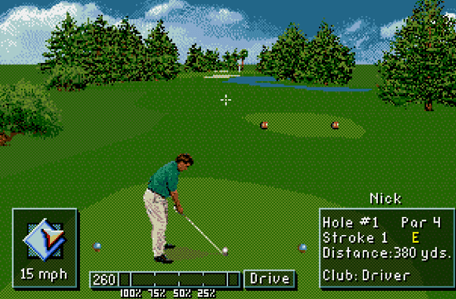
The information shown on the HUD has not changed. The wind speed and direction box is still on the bottom left, the power gauge remains in the middle, and the hole number, hole par, stroke number, current score, distance to pin and club are still bottom right. On the horizon is the cross hair which shows you were you are aiming your shot. You can move this cursor left or right. Your caddy will automatically select the club they think you should use but you can change clubs yourself by pushing up or down on the D-pad. As you do this, you will notice the number to the left of the power gauge will increase or decrease. This is the maximum number of yards the club will hit the ball if the ball was unaffected by wind or how the ball lies.

When you are ready to hit the ball, press ‘B’ and the power gauge begins to fill from right to left. When you have reached your desired power, press ‘B’ again and the power bar begins to descend having left a mark when you stopped the power gauge rising. You then need to press ‘B’ a third time as the power bar reaches the Stroke Bar. If you are accurate, you will hit the ball without a slice or draw. The earlier or later your stop the power gauge either side of the stroke bar will determine the degree of which you slice or draw the ball. After striking the ball, and when the ball begins to descend, the camera angle changes, and you will see where the ball lands.

When you reach the green, a 3D square grid will appear showing you the lie of the green. This allows you to judge the slopes of the green when attempting to putt. Again, by pressing up and down on the D-pad when you are on the green increases and decreases the maximum power of the putt. The 3D view when observing the putting green is unaltered from PGA Tour II (1992). I guess if it ain’t broke, why fix it?

PGA Tour Golf II (1992) (screenshot taken by the author)
PGA Tour Golf III (screenshot taken by the author)

How Does It Handle?

Again, little has changed from the first two PGA Tour instalments. The game is easy to pick up and play but mastering it will take patience and practice. It might just be me, but I found this game harder than its predecessors. I can’t seem to place very high in any of tournaments. Clearly, I need more practice.

You have to be incredibly precise (maybe too precise) when you try to stop the descending gauge at the Stoke Bar else you can very easily draw or slice the shot. If you’re not accurate with your timings, you will inadvertently put your next shot in a place that puts you at a big disadvantage. It is very unforgiving.

They have kept the power gauge and method of changing clubs which is simpler than other golf games.

When putting, I like the fact that you can change the maximum strength of the putter as this allows you to more accurately gauge the strength of your putt. That is not to say that putting is easy, of course. I found the putting to be very unforgiving with little margin for error. I still think the putting is the best and most accurate method to date. With regard to the 3D view of the green, it becomes a tad annoying when you need to keep rotate the view in order to check the line of your shot. One would think this would be done automatically.

Graphics

The first thing to notice is that they have moved away from illustrated pictures of courses and headshots of pros and have moved to digitized photos…and I have to say it looks great! The sprites have been rotoscoped too, allowing the addition of extra frames to ensure a more realistic golf swings. The courses themselves are also more detailed. The trees look a lot more realistic and the horizon contains detailed clouds in the skies and even some mountainous terrain.

However, I didn’t like that the fairways have been pixelated in two shades of green. I found it an attack on the eyes. I also didn’t like the new wind indicator, but overall, the HUD looks a bit slicker.

When comparing the game to its contemporaries, I think it looks much better than PGA European Tour (1994) (which is basically the same as PGA Tour Golf II (1992). I also prefer this instalment’s sprites over those of Pebble Beach Golf Links (1994). When it comes to the colouring of the courses, I also prefer the more muted, realistic palette of colours of PGA Tour Golf III than that of Pebble Beach Golf Links (1994). The edges of the sand bunkers and fairways are better too as on Pebble Beach Golf Links (1994), they look too angular rather than smooth curves.

Music & SFX

The only music that I recall is a slow piano like melody that is played over the leaderboard. I’m surprised there wasn’t any music played over the title screen.

Again, the minimalist sound creates a laid back and relaxing environment. The occasional thwack of the ball, the gentle ripple of applause from the crowd, and the infrequent bird tweets, does well to capture the atmosphere of the game.

Replay Value

The desire to do better draws you back in to play again and again. Having more courses also encourages further forays into the world of golf. Definitely a game enjoyed more in two-player mode.

Viewing the putting green has not changed at all. I guess if it ain’t broke…(screenshot taken by the author)

Did I Complete The Game?

I didn’t spend as much time on this game as I did on PGA Tour Golf II (1992) because I felt I grasped quickly what the game had to offer. I did not come anywhere near winning a tournament yet.

What The Critics Said:

Next Generation: “Other Genesis golf games have looked better (like the first Genesis golf game, Arnold Palmer Golf), but none maintain the depth of play or the true PGA experience like PGA III has been improved with an arc meter that helps control backspin. Golf fans put down that Golf Digest, keep your eye on the ball, keep your left arm straight, and pick up this game. Overall 4/5.[1]

Liverpool Post: “Evolution not revolution, but PGA addicts will want it anyway. Overall 16/20.”[2]

My Verdict:

“Arguably, the most realistic golf game to date with regard to graphics and gameplay. Addictive and tough to beat, though, casual gamers may be deterred by its difficulty.”

Rating:

What are your memories of PGA Tour Golf III? I would love to hear your thoughts, and don’t for get to follow and subscribe so that you don’t miss my latest reviews! You can also find me on Instagram: @nicklovestogame.


[1] ‘Sega Genesis – Hole In One’. Next Generation. (March 1995). Issue 3:102.

[2] (Jan 7, 1995) ‘Fairway to go for revolution’. Liverpool Daily Post. p29.
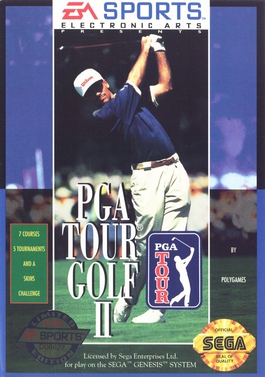
PGA Tour Golf II – Review

In the early 1990s, EA Sports quickly made a name for themselves as the producers of the most realistic sports videogames. Their PGA Tour Golf (1990) release set the standard for how realistic and additive a golf videogame could be. The question was: could EA Sports produce a sequel to PGA Tour Golf (1990) that maintained the high standard set by the first instalment but have enough differences to make purchasing copy worthwhile?

PGA Tour Golf II is a sports simulation game developed by Polygon Games and published by EA Sports for the Mega Drive in 1992. A version was released on the Game Gear by Time Warner Interactive in 1995. For this review, I played the Sega Mega Drive version.

(screenshot taken by the author)

Plot

As with most sport sims, there is no plot per se. The object of the game is to compete in and win six tournaments whilst competing against other professional golfers.

Gameplay

With up to four players, there are several modes to play:

Practice Round – Play 18 holes on any course just for fun. You can also just practice your long game on the driving range and/or short game on the putting green.

Tournament – Compete in any tournament which consists of 4 rounds of 18-hole rounds. However, to qualify for the next round, you must make the cut by ensuring you score low enough on your round. If you successfully compete the final round, you earn money and may even win the tournament if you consistently score the lowest numbers of strokes per round.

Skins Challenge – A nice addition to the game. Two to four players can compete in an 18-hole match where each hole is assigned a monetary value. To win the hole, simply complete the hole in the least strokes. The winner takes the pot for that hole. The value of the holes increase as the match progresses. If a hole is tied, the money rolls over to the next hole. To make it more interesting, you can also opt to have pros join the game controlled by the computer.

The courses you can choose to play include:

TPC at Avenel

TPC at Eagle Trace (New)

TPC at Sawgrass

TPC at Scottsdale (New)

TPC at Southwind (New)

PGA West Stadium

At the beginning of each hole, you are greeted with a rotating 3D view of the green and advice from one of the professional golfers on how to approach the hole.  Before each stroke, a bird’s eye view of the hole with a cross hair over the pin will appear. You can move the cursor and it tells you the distance from your golfer to the cursor. You can go back to the overview at any time by pressing ‘A’ button.

As you address the ball, a small window will appear showing you how the ball lies, allowing you to select the most appropriate club. The HUD contains all the information you need. You have the wind speed and direction in a box on the bottom left, the power gauge in the middle, and the hole number, hole par, stroke number, current score, distance to pin and club you are using in a box on the bottom right. On the horizon is the cross hair which shows you were you are aiming your shot. You can move this cursor left or right. Your caddy will automatically select the club they think you should use but you can change clubs yourself by pushing up or down on the D-pad. As you do this, you will notice the number to the left of the power gauge will increase or decrease. This is the maximum number of yards the club will hit the ball if the ball was unaffected by wind or how the ball lies.

When you are ready to hit the ball, press ‘B’ and the power gauge begins to fill from right to left. When you have reached your desired power, press ‘B’ again and the power bar begins to descend having left a mark when you stopped the power gauge rising. You then need to press ‘B’ a third time as the power bar reaches the Stroke Bar. If you are accurate, you will hit the ball without a slice or draw. The earlier or later your stop the power gauge either side of the stroke bar will determine the degree of which you slice or draw the ball. After striking the ball, and when the ball begins to descend, the camera angle changes, and you will see where the ball lands.

When you reach the green, a 3D square grid will appear showing you the lie of the green. This allows you to judge the slopes of the green when attempting to putt. Again, by pressing up and down on the D-pad when you are on the green increases and decreases the maximum power of the putt.

A new feature includes a Draw/Fade option allowing you more control over your ball when evading sand bunkers and water hazards.

There is also the new “Hole Browser” feature which allows you to really inspect the course, scrutinize the hazards, and plan the best approach to the green.

PGA Tour Golf (1990) (screenshot taken by the author)
PGA Tour Golf II (screenshot taken by the author)

How Does It Handle?

Very little has changed from PGA Tour Golf (1990). The controls are easy to learn. It’s the execution that proves difficult, but that is what makes the game so frustrating yet addictive.

Graphics

The graphics have improved since PGA Tour Golf (1990). The sprites are more detailed, and the swing animation is smoother and looks more realistic. The courses look better too with more differentiation between the light rough and heavy rough. I also think there are more varieties of trees of which are more detailed. The HUD looks slicker too.

When compare to its 16-bit console contemporaries, I think the sprites and courses look much better than Pebble Beach Golf Links (1992).

Music and SFX

Nice, upbeat pieces of music can be heard over the title screen, at the beginning of each tournament, and at the start of each hole which suits the game. In my mind, it is reminiscent of music that would be heard on Prime Time TV over the intro montages to sports TV programmes. There is no music whilst playing your rounds of golf which I prefer.

SFX are very minimal too. You’ll hear the occasional bird tweeting, the ‘thwack’ as you strike the ball, when ball when it lands, an applause when you putt in the hole, and the frustrating splash as the water lands in a water hazard. You don’t need more than this for a golf game. Less is more in this case.

Use the 3D mapping to read the green (screenshot taken by the author)

Replay Value

Like most sports games, this really comes into its own in multiplayer mode. The addition of the Skins Challenge is certainly something that will have you returning time and again. Add to that, the game is tough but strangely addictive. It is also a relaxing game which can be played in a semi-sedate manner.

Did I Complete The Game?

You can’t complete this game as such. I guess “completing” it would be winning all the tournaments. The best I ever did was place third in the TPC at Scottsdale.

Personal Memories

I used to own this game as a kid, and my father and I would regularly play the Skins Challenge. I was also better than my father at this game and after a few holes…and a few bogeys on his part…he would make an excuse along the lines of “I better get on with some jobs your mum wants me to do.” and would resign from the game, a little to my annoyance.

What The Critics Said:

MegaTech: “Seven 3D courses based on real-life PGA Tour venues are the setting for this prime golf simulation. Multi-player and skins tournaments, on-screen advice form the pros, battery game save – this cartridge is just loaded with features. Overall 94%.[1]

My Verdict

“Arguably, one of the best 16-bit golf games of its time. It looks great but don’t be fooled by its serene atmosphere. It is challenging enough so that you won’t get bored easily, and addictive enough to keep you coming back for more, especially in multiplayer mode.”

Rating

What are your memories of PGA Tour Golf II? I would love to hear your thoughts, and don’t for get to follow and subscribe so that you don’t miss my latest reviews! You can also find me on Instagram: @nicklovestogame


[1] Game Index – PGA Tour Golf 2‘. MegaTech. (October 1993). Issue 22:101.

PGA Tour Golf – Review

In real life, I enjoy playing golf. I’m not very good, and I’ve never scored a birdie, but it is hard not to love being surrounded by greenery and, in some cases, wildlife. I have played in scorching heat in Canada (Alberta and Ontario), fighting off mosquitoes but receiving regular visits from the cart girls selling refreshments, and I have played in rainy, gusty conditions in England where there are no cart girls but it’s easy to sneak your own drinks onto the course.

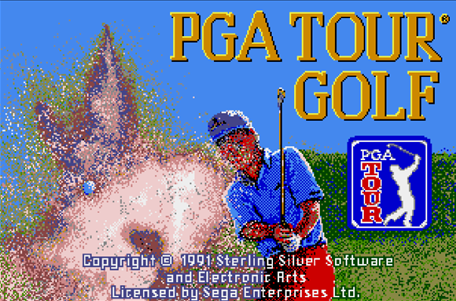
Title screen (screenshot taken by the author)

PGA Tour Golf is a sports simulation game developed by Sterling Silver Software and published by Electronic Arts. The first of a franchise, it was released in 1990 for MS-DOS. It was later released for the Mega Drive and Amiga in 1991, and SNES in 1992. Later releases for the Master System and Game Gear were published by Tengen in 1994. For this review, I played the Mega Drive version.

Plot

As with most sport sims, there is no plot per se. The object of the game is to compete in and win four tournaments whilst competing against other professional golfers.

Gameplay

With up to four players, you have the option to play a Practice Round or a Tournament, or you can simply practice on the Driving Range and/or Putting Greens. The practice modes are self-explanatory, but they are handy for people unacquainted with the game.

In Tournament Mode, each tournament consists of four rounds of 18 holes competing against 60 other golfers, of which all are real-life professionals.

The game contains three real courses from the US and one fictional course:

TPC at Sawgrass (Florida)

TPC at Avenel (Maryland)

PGA West Stadium (California)

Sterling Shores (Fictional)

At the beginning of each hole, you are greeted with a  rotating 3D view of the green and advice from one of the professional golfers on how to approach the hole.  Before each stroke, a bird’s eye view of the hole with a cross hair over the pin will appear. You can move the curser and it tells you  the distance from your golfer to the cursor. You can go back to the overview at any time by pressing ‘A’ button.

As you address the ball, a small window will appear showing you how the ball lies, allowing you to select the most appropriate club. The HUD contains all the information you need. You have the wind speed and direction in a box on the bottom left, the power gauge in the middle, and the hole number, hole par, stroke number, current score, distance to pin and club you are using in a box on the bottom right. On the horizon is the cross hair which shows you were you are aiming your shot. You can move this cursor left or right. Your caddy will automatically select the club they think you should use but you can change clubs yourself by pushing up or down on the D-pad. As you do this, you will notice the number to the left of the power gauge will increase or decrease. This is the maximum number of yards the club will hit the ball if the ball was unaffected by wind or how the ball lies.

When you are ready to hit the ball, press ‘B’ and the power gauge begins to fill from right to left. When you have reached your desired power, press ‘B’ again and the power bar begins to descend having left a mark when you stopped the power gauge rising. You then need to press ‘B’ a third time as the power bar reaches the Stroke Bar. If you are accurate, you will hit the ball without a slice or draw. The earlier or later your stop the power gauge either side of the stroke bar will determine the degree of which you slice or draw the ball. After striking the ball, and when the ball begins to descend, the camera angle changes, and you will see where the ball lands.

When you reach the green, a 3D square grid will appear showing you the lie of the green. This allows you to judge the slopes of the green when attempting to putt. Again, by pressing up and down on the D-pad when you are on the green increases and decreases the maximum power of the putt.

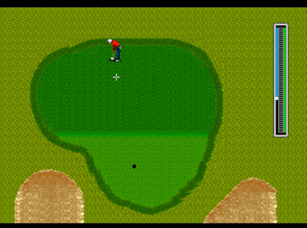
An overview of on of the four courses you can play (screenshot taken by the author)

How Does It Handle?

PGA Tour Golf is not for the feint hearted. It is clearly designed for golf fans and is very challenging, much more challenging and unforgiving than Arnold Palmer Tournament Golf (1989). I wonder if the game is a bit too difficult. You have to be incredibly precise (maybe too precise) when you try to stop the descending gauge at the Stoke Bar else you can very easily draw or slice the shot. That being said, I really like the power gauge for this game. The ease of which you can change clubs and use the percentages of the power bar to estimate shots is a much simpler and user-friendly way of playing than Arnold Palmer Tournament Golf (1989).

When putting, I like the fact that you can change the maximum strength of the putter as this allows you to more accurately gauge the strength of your putt. That is not to say that putting is easy, of course. I found the putting to be very unforgiving with little margin for error.

Unlike Arnold Palmer Tournament Golf (1989) where you have to keep pressing ‘A’ to scroll through wind, distance, club selection etc., I love how all that information is one the main HUD. This speeds up the game and means you don’t keep having to go back a screen because you’ve forgotten the distance to the pin.

All the information you need on one screen (screenshot taken by the author)

Graphics

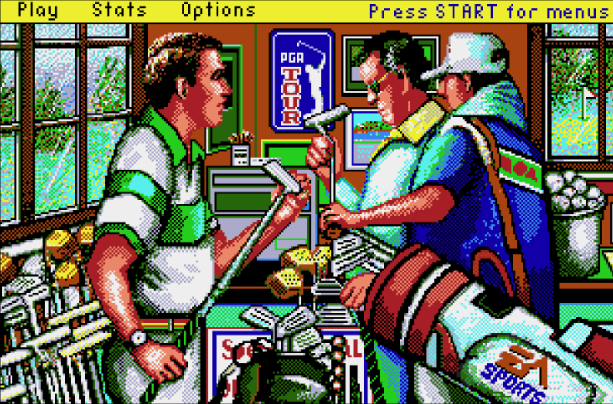
I love the design of the main menu. The picture of the Pro Shop is very colourful and nicely illustrated, and it really adds to the feeling of getting ready for a round of golf. The drop down menus show that the game was designed for MS-DOS/PC.

The in-game graphics aren’t as realistic as Arnold Palmer Tournament Golf (1989) and the courses themselves are far less detailed when it comes to the trees, sky, and differentiation between the fairway and the rough. The bitty graphics become even more apparent the larger your TV screen. The sprite also pales in comparison. Oddly, there is no difference in the look of the clubs or the stance of the golfer whilst using them with the exception of the putter which is disappointing. However, I do prefer the graphics of PGA Tour Golf to Jack Nicklaus’ Unlimited Golf & Course Design (1990).

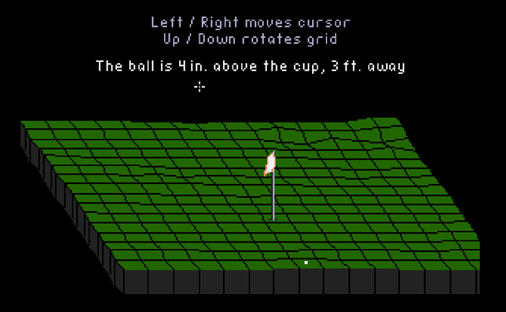
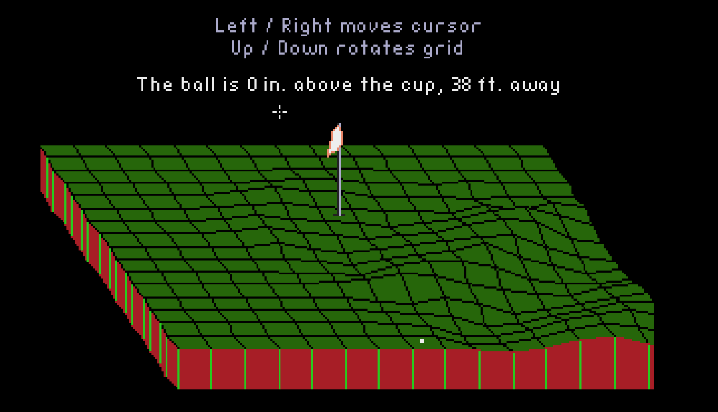
The innovative 3D overview of the greens is awesome. It is a simple design, but is a great way to display the lie of the green. It allows the player to read the greens more accurately that previous methods. Bravo!

I also like the way the camera angle changes a few seconds after you have hit your shot so that you view the ball coming into land is a nice touch. This really helps with the feel of professional golf you see on television. 

Music and SFX

The only music you hear in the game is the cheap 8-bit ear-offending tune that plays over the introduction to each hole where a professional golfer offers advice on how to play the hole. I appreciate this game is ported from MS-DOS but one would expect the music to be of better quality for the Mega Drive. 

The sound is very minimalist. You hear a few birds tweets, the sound of the ball as you strike it and as it lands, and a ripple of applause when you putt the ball. It is how golf should be. Peaceful and relaxing…at least for the spectators anyway.

Replay Value

The main replay value of this game is the multiplayer mode. Each of the tournaments are individual titles and so once you have won them, you have won them. The money accrued means very little other than to be kept as a bragging statistic which is a shame. It would have been nice to be able to buy some different clubs like you can in Arnold Palmer Tournament Golf (1989). That is not to say that the game will be cast aside quickly. The tournaments are incredibly hard to win and mastering the game will take some time.

Did I Complete The Game?

At present, I have not won a tournament…in fact, after several attempts, I have only ever qualified for the third round once whilst competing in the Sterling Shores tournament and the second round of the TPC at Sawgrass.

The 3D view allows for more challenging green designs (screenshot taken by the author)

What The Critics Said:

Mean Machines: “A superb sports simulation which will appeal massively to golf fans, and will even be enjoyed by those who normally wouldn’t play this type of game. Overall 91%.[1]

Raze: “PGA Tour Golf is a very accomplished piece of programming on the Amiga, and even more so on the Mega Drive, putting Arnold Palmer in the rough. The slick presentation on both versions gives the game a very professional look and a lot of appeal. To casual players or more serious golf devotees it will provide an ideal opportunity for long term entertainment. Overall 87%.[2]

Video Games and Computer Entertainment: “The computer plays a good game, but this is one of those that really shines when you play with one, two or three other people. If the graphics, which would seem to be no more than 32 colours, were on a level with Arnold Palmer Tournament Golf (or even the celebrated Links 256-colour golf game from Access), it’d be a truly remarkable achievement. As it is, PGA Tour Golf is still a thoroughly entertaining, challenging and complex golf simulation. Overall 26/40“.[3]

Sega Power: Possibly the best golf game to appear on the MD! Good 3D views, loads of options, a multiplayer mode, a Save Game option, and classic golfing play. A must for all golfers. Overall 5/5.[4]

My Verdict:

“Although the graphics are a bit sub-par (pun intended), PGA Tour Golf is fun and easy to learn but challenging to master. It has plenty of replay value, especially in multiplayer mode, and the creators have captured the atmosphere of the sport nicely.”

Rating:

What are your memories of PGA Tour Golf? I would love to hear your thoughts, and don’t for get to follow and subscribe so that you don’t miss my latest reviews! You can also find me on Instagram: @nicklovestogame.


[1] ‘Mega Drive Review: PGA Tour Golf’. Mean Machines. (April 1991). Issue 7:40-42.

[2] ‘Reviews – PGA Tour Golf’. (May 1991). Raze. Issue 7:38.

[3] Mandel, J., ‘PGA Tour Golf’. Video Games and Computer Entertainment. (May 1991). :47-8.

[4] The Hard Line – PGA Tour Golf’. Sega Power. (October 1991). 23:54.

Arnold Palmer Tournament Golf – Review

In the 1980s, game developers cottoned on to the fact that celebrity endorsements help increase game sales. Beginning with Atari’s Pele’s Soccer (1980), it wasn’t long before names and likenesses of other celebrities such as Bruce Lee (albeit posthumously) and Daley Thompson soon appeared on video games. The quality would vary, however, and a celebrity endorsement was not always a guarantee of a good game.

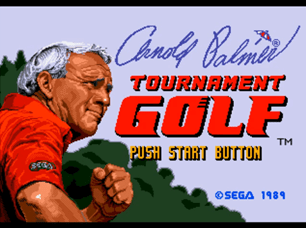
Title screen (screenshot taken by the author)

Arnold Palmer Tournament Golf (Naomichi Ozaki Super Masters in Japan) is a golf game developed and published by Sega and released in 1989. AS far as I know, the game has not been ported or re-released at a later date and so the Mega Drive version was the only option I have to review the game. 

Plot

As with most sports games, there is no plot other than you must compete against other golfers to win the tournament. To win the tournaments, you must finish each hole in the least number of shots.

Gameplay

Played in single or two-player modes, you can choose to play practice rounds or full Tournament Mode. Practice Mode can be played with one or two players, and you have a choice to play any of the three courses. The Tournament consist of 12 rounds of 18 holes played over three different courses located in the US, Japan and Great Britain. As you progress, you earn money based on your standings at the end of each round. This money can be used to upgrade your clubs from the default black carbon to the better glass fibre and ceramic clubs. Your skill level also increases allowing for greater distances with your shots and your caddy offers better advice for each shot.

Most of the rounds of are played as normal stroke play golf, in that you simply have to get around the course in the least number of shots. However, rounds seven and eleven are played as match games where you play against one other golfer. All you need to do is finish the hole in less shots than it takes your opponent. If, at the end of the tournament you are tied, you will play a sudden death game where the first golfer to win a hole, wins the match.

When it is your turn to address the ball, the HUD becomes split. On the left, you’ll see an overview of the hole and on the right, you’ll see your golfer and the caddy standing with their golf bag. There are three black boxes on the screen displaying various pieces of information. The top left box consists of the number of the hole, distance from the pin, and the hole’s par length; the top right box is the caddy’s advice; and the bottom right box displays your name, the number shot you are on and the club you are going to select. When you press ‘A’, a fourth black box will appear with the options to get Advice, to see the Green, or to see the Score. Press ‘A’ again, and all the black boxes will disappear, and a weathervane will appear showing the wind speed and direction. Press ‘A’ again and the weathervane disappears and an image of how the ball lies appears. Press ‘A’ again and the lie of the ball disappears, and picture of your club appears. You can use the direction button to search for the club you wish to choose. Press ‘A’ again and you will then be shown the stance of your golfer. Again, using the direction button you can adjust the stance allowing your golfer to deliberately ‘slice’ or ‘draw’ the ball. Press ‘A’ again, and the weathervane will appear once more as will the power gauge, and a small yellow arrow on the horizon. The direction button controls the yellow arrow and allows you to aim where you wish to hit the ball. You then press ‘A’ and two white markers begin to ascend on the power gauge. A third white marker will remain in the bottom third of the power gauge. Once they reach your desired power, you press ‘A’ again. The left marker will stop, and the right marker will begin to descend. You then press ‘A’ a third time to stop the descending marker in line with the stationary marker in the bottom third of the power gauge. Your player will then strike the ball. The progress of your hit ball can be seen on the overview map on the left. You will then be told where the ball lands (E.g., fairway, rough, sand bunker), and the process starts all over again. When you land on the green, the view changes to a near bird’s eye view. The lighter areas of the greens are higher than the darker areas of the green. Pressing ‘A’ will make arrows appear on parts of the green which shows you the direction of the slopes.

To help you during the rounds, you have a caddy who offers advice to you before you take a shot. At first, the advice simply states distance left to the hole. As you progress through the game, the caddy begins to offer more advice regarding how the ball lie and various landmarks and hazards on each hole of the course.

Excellent graphics and beautifully detailed (screenshot taken by the author)

How Does It Handle?

For the most part, the game is easy to pick up and play, but you will need the instruction manual to remind yourself of the maximum distance of each club. Adjusting your strength of shot and direction based on wind speed and direction takes some getting used to but adds a sense of realism to the game. Sometimes the wind works in your favour, other times it works against you. The putting is the hardest part as each increment of the putting gauge equals one yard. Add slopes into the mix and the speed with which the power increases in the power gauge, and you can be forgiven for missing some seemingly straightforward puts. I much prefer the way the greens can be viewed in PGA Tour Golf (1991) but I still prefer it to Power Golf (1989).

One of the things I found frustrating was the HUD display. The remaining distance to the hole wasn’t displayed at all times. Once you play your first stroke, you only need to know the remaining distance and to be reminded of the par of the hole. You don’t need reminded of the hole length. The annoyance of having to constantly click the ‘A’ button and then the ‘B’ button to go back and forth does become tiresome after a while. I actually prefer the HUD display for PGA Tour Golf (1991) and Power Golf (1989) which displays all the information all the time.

Oddly, there is an inaccuracy between the map of the hole and what you can see on the right screen when the ball has struck. Many a time I have struck a ball into an area and the ball is seemingly on the fairway but it is in fact in a bunker or in the rough. For example, on hole 13 of one of the courses, I forget which, the ball was lying on the fairway according to the right section of the screen but on the map sections, it showed I was in the bunker. It was rather annoying at times.

Graphics

I think the game looks great. The colours are vibrant, and the sprites move in a very realistic way. The courses are clearly defined so that you can differentiate between the fairway, rough, sand bunkers and trees. I think I actually prefer the way the courses look here than I do with PGA Tour Golf (1991), which looks a tad bland for me, or Power Golf (1989), which looks a bit too cartoony for me.

Halfway through each course, you have a tea break where you are greeted with one of several animations of Sega Master System hero Alex Kidd playing golf. He is joined by Opa-Opa of Fantasy Zone fame.

Oddly, the backgrounds of the courses do not vary and so the courses are not visually distinctive. This is very disappointing as it would have been a great opportunity to design courses based around styles and fashions from those nations: mountains for the USA and cherry blossom trees and some pagodas for Japan. These may come across as stereotypical, but the visuals would have been a nice way to differentiate the courses.

It is also disaapointing that there is only one player face to choose from and that you cannot change the colour of the jersey. The only colour change is a palette change when you compete against another opponent.

Music & SFX

Music plays throughout in the form of an upbeat and bouncy number which doesn’t really lend itself to the sedate nature of a golf game. I do like the music, but If I’m honest, I prefer silence with the occasional bird tweeting and the gentle ripple of applause from the crowd as you bag another birdie. There is a satisfying noise as you sink your ball and a nice little applause from the crowd, but I found that I just turned down the sound and listened to my own music or podcasts as the music and noise aren’t really needed for the game. Weirdly, there is a slight delay of sound when you hit the ball.

Replay Value

For golfing fans in particular, I think this game has lots of replay value. Picture a relaxing evening with a beer or cup of tea, maybe a bit of light music on in the background whilst you play a genial game of golf. Two-player mode will also ensure that level of competitiveness amongst friends remains ignited.

Apparently, there is a secret Fantasy Zone level hidden within the game. To find it, allegedly hit the ball 100 times on the first hole without putting in. You then enter up, up, down, down, left, right, left, right, B and A on the game over screen. However, I’ve never had the patience to do this and so cannot confirm if this is true.

Did I Complete The Game?

As of yet, I have never won the overall tournament but I have won the GB Pro Tournament and earned a nice set of fibre glass clubs for my troubles.

“Driving for show, putting for dough” (screenshot taken by the author)

What The Critics Said:

Mean Machines: “More fun than Bruce Forsyth, better looking than Tarby, and more strokes than Cecil Parkinson. Overall 83%.[1]

Raze: “The whole game is slickly designed and beautifully executed. Arnold Palmer may sound like a boring old fart to you, but he’s got one hell of a game to play. Overall 89%.[2]

Sega Pro: “One of the first and still one of the best. Accurate graphics, good sound and heaps of playability make this an impressive golf simulation, but PGA Tour Golf plays a lot better. Overall 83%.[3]

Sega Power: “Impressive looking game with convincing 3D courses, good player animation and a hidden Fantasy Zone Game! Simple play-style grows dull so seasoned golfers should go for PGA Tour Golf instead. Overall 3/5.[4]

Verdict:

“I think this is a solid golf game. Lovely colours and animation, and the game is surprisingly addictive. There is a fair amount of replay value and I’d wager than you’ll be paying your golf fees again and again with this one.”

Rating:

What are your memories of Arnold Palmer Tournament Golf? I would love to hear your thoughts, and don’t for get to follow and subscribe so that you don’t miss my latest reviews! You can also find me on Instagram: @nicklovestogame.


[1] ‘Mega Drive Review – Arnold Palmer’s Golf’. Mean Machines. (December 1990). 3:58-60.

[2] Ellis, L., ‘Reviews – Arnold Palmer’s Tournament Golf’. Raze. (February 1991)4:60-61.

[3] Proview – Arnold Palmer’s Tournament Golf’. Sega Pro. (November 1991). 1:37.

[4] ‘The Hard Line – Arnold Palmer Tournament Golf’. Sega Power. (October 1991). 23:52.