Blockout – Review

Tetris (1988) is one of the most popular puzzle games of all time. The learning curve is steep, and the game is highly addictive. Although Sega owned arcade cabinets of Tetris (1988), licensing issues meant their Mega Drive release in 1989 had to be abandoned. This may account for the development of Blockout as a potential rival. The question soon became: would it be just as successful?

Title screen (screenshot taken by author)

Blockout is a 3D puzzle game developed by P.Z. Karen Co. Development Group and published by American Technos for the arcade in 1989. That same year, it was also released for Amiga, Apple IIGS, Commodore 64, Mac OS, MS-DOS, PC-98 (California Dreams). It was later released for Atari ST (California Dreams) and NES (Technos Japan Corp.) in 1990, Atari Lynx (Atari Corporation) and Sega Mega Drive (Electronic Arts) in 1991, and Virtual Boy (as 3D Tetris) in 1996. For this review, I played the Sega Mega Drive version.

Plot

There is no plot other than to earn the maximum points you can.

Gameplay

Played in single or two-player mode, you play by looking down a 3D “well” where blocks of varying shapes and sizes slowly descend. The slow descent rate gives you time to rotate the block around three coordinate axes and place it into your desired position. When a facet of the block touches the floor (or the lowest point of the well where a previous block has been placed), it will fill with colour, meaning you can no longer move or rotate that block. Every block you place earns you points. Once you have filled an entire layer (known as a “face”) and there are no gaps in that layer, it will disappear, earning you a bonus, and the rest of the cubes drop down as far as they can go. If you are able to empty the well, you will receive a “Block Out Bonus”. 

Like Tetris, as the game progresses and the levels increase, the speed with which the blocks fall gradually increases. The game continues until you fail, and the blocks fill the well.
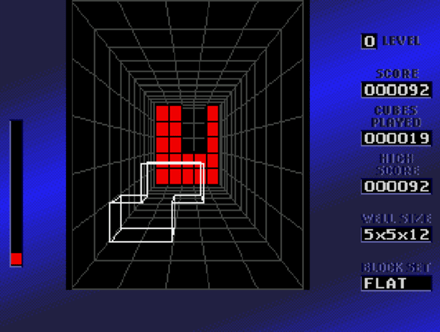
It’s tetris but in 3D! (screenshot taken by author)

How Does It Handle?

The 3D element and three coordinate axes rotation format adds an extra degree of difficulty that you wouldn’t find in Tetris. It definitely takes a lot of practice. Being able to change the dimensions of the well is a nice feature too adding an extra challenge to the game.

Graphics

The graphics are basic, but they don’t need to be complicated for this game. Having different colours to differentiate each layer is sufficient for the game.

Music and SFX

The intro music is quite aggressive for a puzzle game. It remined me of the fuzzy musical notes of Road Rash (1991). There is no in-game music and minimal SFX when you place a block or complete a Face. I think some light music would not have gone amiss here.

Replay Value

For fans of Tetris and the like, I imagine this would be an addictive game, especially with a two-player mode.

Did I Complete The Game?

I’m not sure that you can complete this game but I didn’t spend too much time trying to find out. I don’t enjoy these sorts of games so don’t put in the time to become a good player. My highest score so far is a pitiful 18242.
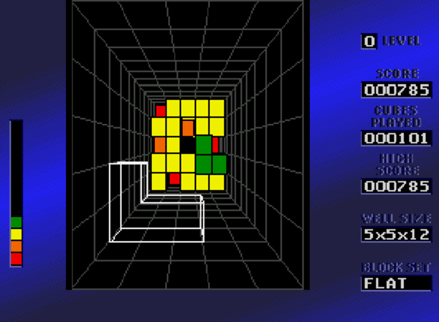
Different colours help differentiate the layer (screenshot taken by author)

What The Critics Said:

MegaTech: “This sort of 3D Tetris is surely the finest Megadrive puzzle game available, packed with tons of options (including a simultaneous two-player mode) and featuring highly addictive gameplay, this is a must for your collection. Overall 91%.[1]

Mean Machines: “This sort of 3D Tetris is surely the finest Megadrive puzzle game available. Packed with tons of options (including simultaneous two-player mode) and featuring highly addictive gameplay, this is a must for your collection. Overall 91%.[2]

My Verdict:

“It’s Tetris in 3D. Personally, I’m not a huge fan of these sorts of games and but can appreciate their appeal and the skill and practice that goes into being able to achieve high scores. Ardent fans will play for hours and return time and time again.”

Rating:

What are your memories of Blockout? I would love to hear your thoughts, and don’t forget to follow and subscribe so that you don’t miss my latest reviews! You can also find me on Instagram: @nicklovestogame.


[1] ‘Game Index – Block Out’. MegaTech. (May 1992). Issue 6:76.

[2]’Review: Mega Drive – Block Out’. Mean Machines. (October 1992). Issue 1:137.

Alien Soldier – Review

Ah, emulation vs original hardware. There are very good arguments for both sides of this divisive coins. Personally, I do not have the funds, or patience, to seek out games I wish to play on original hardware due to the prices have been inflated by collectors, the scarcity of the original hardware and pure laziness. So, I say, thank God for emulation. Without emulation there are many, many games that I would never have heard of and would never have had the opportunity to play. Alien Soldier is one such game.

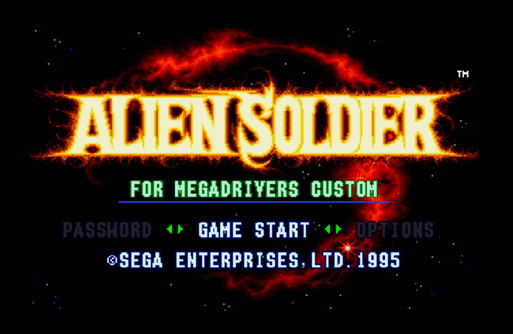
Title screen (Screenshot taken by the author)

Alien Soldier is a single-player side-scrolling run and gun video game developed by Treasure Co., LTD. and published by Sega. It was released for the Mega Drive in 1995 and would be re-released on PlayStation 2’s as part of the Gunstar Heroes Treasure Box (2006), Volume 25 of the Sega Ages 2500 series. It would go on to be re-released on the Wii Virtual Console (2007), Steam (2011), Nintendo Switch Online (2022) and the Sega Genesis Mini 2 (2022). For this review, I played the version found on Sega Mega Drive Classics (2010) for the PlayStation 4.

Plot

The plot to this game is a weird one. Basically, it’s 2015 and the planet Sierra is under attack by a terrorist group known as Scarlet. Led by the evil Xi-Tiger, they plan to destroy the human race. Scarlet’s former leader, Epilson-Eagle has sworn to defeat the terrorist group putting and end to Xi-Tiger’s evil scheming once and for all. (Bearing in mind, Epsilon-Eagle is not trying to save humanity but simply seeking revenge on Xi-Tiger).

Gameplay

Epsilon-Eagle must battle his way through 25 stages, defeating 26 bosses along the way. Before embarking on your mission, you must arm yourself with four out of a potential six weapons, each with their own advantages and disadvantages:

Select your weapons! (Screenshot taken by the author)

Buster Force – Firing bright yellow blasts at your enemy, this weapon has a weak attack but uses less ammo and has a good range.

Flame Force – A deadly flame that uses less ammo but is limited in range.

Sword Force – A deadly laser beam with a good range but that guzzles your ammo.

Ranger Force – Three way shot that is a bit of an all-rounder. Not as strong as the Sword or Lancer Forces but uses less ammo than them.

Homing Force – Flame thrower that seeks out the enemies’ weak spots. Great for bosses but not as strong as the Sword or Lancer Forces. It does use less ammo though.

Lancer Force – Another deadly laser beam with a good range but that guzzles your ammo.

To change weapons in game, please ‘A’ and cycle through the wheel until you find your desired weapon. press ‘A’ again to close the wheel.

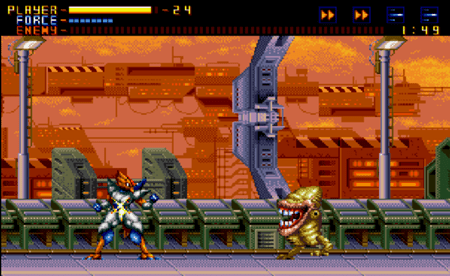
Awesome graphics (Screenshot taken by the author)

How Does It Handle?

The controls are nice and responsive but take a little getting used to. You need to be super quick when changing weapons as the game will continue to play. Since there are only four weapons, I think it would have been better to simply press ‘A’ to cycle to the next weapon on the list. This would enable you to continue to evade your enemies rather than be a sitting duck.

Although you can block by double tapping the fire button but I don’t think this works very well. The six-button controller was around by this time so why not utilise it?

I like the idea tht there is a target on the bosses body so that you know where to shoot. Hardened gamers may disagree but this is a personal preference.

I don’t think I used the hover function until stage 11, but I certainly used the Zero Teleport. In fact, spoiler alert, using the Zero Teleport was the easiest way to defeat most bosses which made them a little monotonous after a while. Having said that, I’m yet to get past the boss on Stage 11 and you can’t use the Zero Teleport much on it.

Graphics

I think the game looks great. Epsilon-Eagle is well illustrated and animated and there is plenty of variation between the enemies and each boss is noticeably different. Lots of big explosions, screen shakes when the bosses have been defeated. I think the levels look great too with a nice variation of backgrounds which are very detailed and modestly coloured so as not to draw the eye away too much from the action.

Music and SFX

The music is very high-octane stuff which fits a game like this well. The issue is that I was so engrossed in what I was doing, I never noticed the music. I had to play through again and really pay attention to it. SFX-wise, again lots of explosions and laser noises but they get lost amid the chaos of the game. Although I do like the siren going off and the vocalised “Emergency” when you are coming to a boss battle.

Replay Value:

Having more than one difficulty setting always adds a little to the replay value but I think the game is very samey and did not make me want to continue playing.

The game focusses on boss battles more than level length (Screenshot taken by the author)

Did I Complete The Game?

No. At present, I got to stage 10 or 11 before I felt I had seen all the game has to offer. I will continue to play at a later date though.

What The Critics Said:

Consoles +: “A good shoot ’em up for the MD. Overall 88%.[1]

Computer and Video Games: “This is a well worn genre and there aren’t many roads forward. Alien Soldier doesn’t exactly build a new orbital motorway, but it does lead you down quite an interesting road. Basing play on boss fighting isn’t a new idea, but Alien Soldier does quite a tidy job of delivering the goods. Alien Soldier will take any budding sadist a lot of determination to complete, my only worry is that your blood lust may dry and your interest shrivel into repetitive stress syndrome before you kill the final infernal boss. Overall 80%.[2]

Mean Machines Sega: “A modern classic that turns the concept of platform blasting inside-out, but that suffers from being a bit samey. Overall 85%.[3]

Verdict:

“Alien Soldier looks great and is exciting to play…at first. As the levels progress, the game becomes a bit monotonous.”

Rating:

What are your memories of Alien Soldier? I would love to hear your thoughts, and don’t for get to follow and subscribe so that you don’t miss my latest reviews! You can also find me on Instagram: @nicklovestogame.


[1] ‘Mega Driver Review – Alien Soldier’. Consoles +. (April 1995). No. 42. :131.

[2] ‘CVG Review/Showcase – Alien Soldier’. Computer and Video Games. (June 1995). Issue 163:52-57. 

[3] ‘Megadrive Review – Alien Soldier’ – Mean Machine Sega. (July 1995). Issue 33:80-81. 

PGA Tour Golf II – Review

In the early 1990s, EA Sports quickly made a name for themselves as the producers of the most realistic sports videogames. Their PGA Tour Golf (1990) release set the standard for how realistic and additive a golf videogame could be. The question was: could EA Sports produce a sequel to PGA Tour Golf (1990) that maintained the high standard set by the first instalment but have enough differences to make purchasing copy worthwhile?

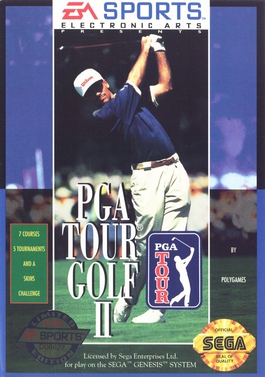
PGA Tour Golf II is a sports simulation game developed by Polygon Games and published by EA Sports for the Mega Drive in 1992. A version was released on the Game Gear by Time Warner Interactive in 1995. For this review, I played the Sega Mega Drive version.

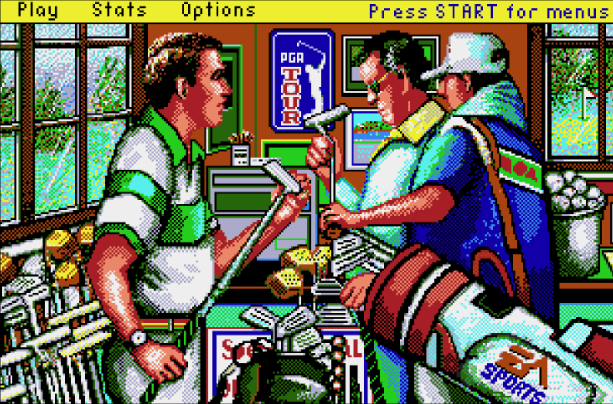
(screenshot taken by the author)

Plot

As with most sport sims, there is no plot per se. The object of the game is to compete in and win six tournaments whilst competing against other professional golfers.

Gameplay

With up to four players, there are several modes to play:

Practice Round – Play 18 holes on any course just for fun. You can also just practice your long game on the driving range and/or short game on the putting green.

Tournament – Compete in any tournament which consists of 4 rounds of 18-hole rounds. However, to qualify for the next round, you must make the cut by ensuring you score low enough on your round. If you successfully compete the final round, you earn money and may even win the tournament if you consistently score the lowest numbers of strokes per round.

Skins Challenge – A nice addition to the game. Two to four players can compete in an 18-hole match where each hole is assigned a monetary value. To win the hole, simply complete the hole in the least strokes. The winner takes the pot for that hole. The value of the holes increase as the match progresses. If a hole is tied, the money rolls over to the next hole. To make it more interesting, you can also opt to have pros join the game controlled by the computer.

The courses you can choose to play include:

TPC at Avenel

TPC at Eagle Trace (New)

TPC at Sawgrass

TPC at Scottsdale (New)

TPC at Southwind (New)

PGA West Stadium

At the beginning of each hole, you are greeted with a rotating 3D view of the green and advice from one of the professional golfers on how to approach the hole.  Before each stroke, a bird’s eye view of the hole with a cross hair over the pin will appear. You can move the cursor and it tells you the distance from your golfer to the cursor. You can go back to the overview at any time by pressing ‘A’ button.

As you address the ball, a small window will appear showing you how the ball lies, allowing you to select the most appropriate club. The HUD contains all the information you need. You have the wind speed and direction in a box on the bottom left, the power gauge in the middle, and the hole number, hole par, stroke number, current score, distance to pin and club you are using in a box on the bottom right. On the horizon is the cross hair which shows you were you are aiming your shot. You can move this cursor left or right. Your caddy will automatically select the club they think you should use but you can change clubs yourself by pushing up or down on the D-pad. As you do this, you will notice the number to the left of the power gauge will increase or decrease. This is the maximum number of yards the club will hit the ball if the ball was unaffected by wind or how the ball lies.

When you are ready to hit the ball, press ‘B’ and the power gauge begins to fill from right to left. When you have reached your desired power, press ‘B’ again and the power bar begins to descend having left a mark when you stopped the power gauge rising. You then need to press ‘B’ a third time as the power bar reaches the Stroke Bar. If you are accurate, you will hit the ball without a slice or draw. The earlier or later your stop the power gauge either side of the stroke bar will determine the degree of which you slice or draw the ball. After striking the ball, and when the ball begins to descend, the camera angle changes, and you will see where the ball lands.

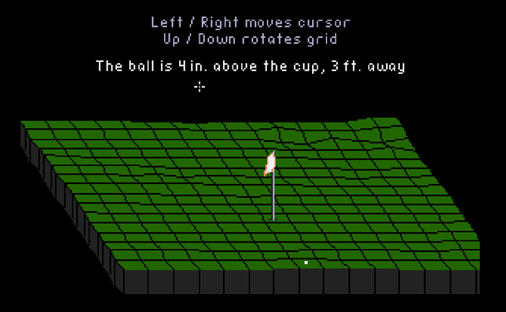
When you reach the green, a 3D square grid will appear showing you the lie of the green. This allows you to judge the slopes of the green when attempting to putt. Again, by pressing up and down on the D-pad when you are on the green increases and decreases the maximum power of the putt.

A new feature includes a Draw/Fade option allowing you more control over your ball when evading sand bunkers and water hazards.

There is also the new “Hole Browser” feature which allows you to really inspect the course, scrutinize the hazards, and plan the best approach to the green.

PGA Tour Golf (1990) (screenshot taken by the author)
PGA Tour Golf II (screenshot taken by the author)

How Does It Handle?

Very little has changed from PGA Tour Golf (1990). The controls are easy to learn. It’s the execution that proves difficult, but that is what makes the game so frustrating yet addictive.

Graphics

The graphics have improved since PGA Tour Golf (1990). The sprites are more detailed, and the swing animation is smoother and looks more realistic. The courses look better too with more differentiation between the light rough and heavy rough. I also think there are more varieties of trees of which are more detailed. The HUD looks slicker too.

When compare to its 16-bit console contemporaries, I think the sprites and courses look much better than Pebble Beach Golf Links (1992).

Music and SFX

Nice, upbeat pieces of music can be heard over the title screen, at the beginning of each tournament, and at the start of each hole which suits the game. In my mind, it is reminiscent of music that would be heard on Prime Time TV over the intro montages to sports TV programmes. There is no music whilst playing your rounds of golf which I prefer.

SFX are very minimal too. You’ll hear the occasional bird tweeting, the ‘thwack’ as you strike the ball, when ball when it lands, an applause when you putt in the hole, and the frustrating splash as the water lands in a water hazard. You don’t need more than this for a golf game. Less is more in this case.

Use the 3D mapping to read the green (screenshot taken by the author)

Replay Value

Like most sports games, this really comes into its own in multiplayer mode. The addition of the Skins Challenge is certainly something that will have you returning time and again. Add to that, the game is tough but strangely addictive. It is also a relaxing game which can be played in a semi-sedate manner.

Did I Complete The Game?

You can’t complete this game as such. I guess “completing” it would be winning all the tournaments. The best I ever did was place third in the TPC at Scottsdale.

Personal Memories

I used to own this game as a kid, and my father and I would regularly play the Skins Challenge. I was also better than my father at this game and after a few holes…and a few bogeys on his part…he would make an excuse along the lines of “I better get on with some jobs your mum wants me to do.” and would resign from the game, a little to my annoyance.

What The Critics Said:

MegaTech: “Seven 3D courses based on real-life PGA Tour venues are the setting for this prime golf simulation. Multi-player and skins tournaments, on-screen advice form the pros, battery game save – this cartridge is just loaded with features. Overall 94%.[1]

My Verdict

“Arguably, one of the best 16-bit golf games of its time. It looks great but don’t be fooled by its serene atmosphere. It is challenging enough so that you won’t get bored easily, and addictive enough to keep you coming back for more, especially in multiplayer mode.”

Rating

What are your memories of PGA Tour Golf II? I would love to hear your thoughts, and don’t for get to follow and subscribe so that you don’t miss my latest reviews! You can also find me on Instagram: @nicklovestogame


[1] Game Index – PGA Tour Golf 2‘. MegaTech. (October 1993). Issue 22:101.

The Story of Thor: A Successor of the Light/Beyond Oasis – Review

Nintendo’s The Legend of Zelda: A Link to the Past (LTTP) really changed the way gamers think about action-adventure games. The story line, the music, the graphics, the shear size of the game set the standard for action-adventures going forward into the 1990s. As far as I can tell, the only offering Sega had in this category was A Faery Tale (1991). There may be others, but none spring to mind. As far as I can tell, it took Sega until 1994 to create a reply to LTTP. The question is, would it be any good?

Title screen (Screenshot taken by the author)

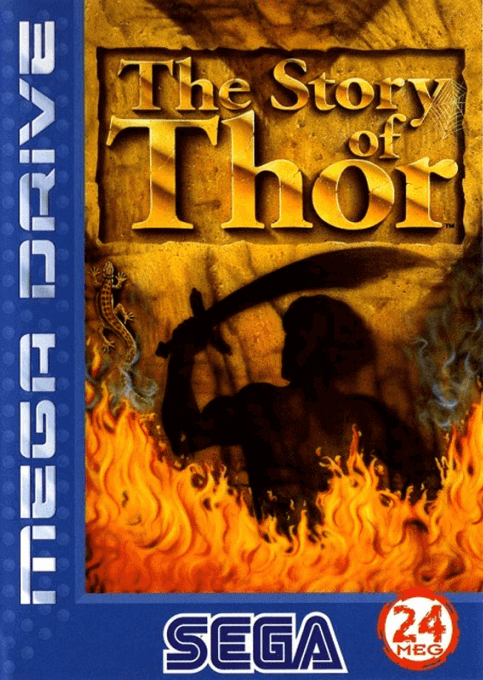
The Story of Thor: A Successor of the Light is an action-adventure game developed by Ancient Corp. and published by Sega. It was released in Japan in 1994, and Europe and North America in 1995 for the Sega Mega Drive. It would later be released on the Wii Virtual Console in 2007 and on the PlayStation 3 as part of Sonic’s Ultimate Genesis Collection (2009). Interestingly, it was released in North America under the title Beyond Oasis. For this review, I played the version found on the Sonic’s Ultimate Genesis Collection.

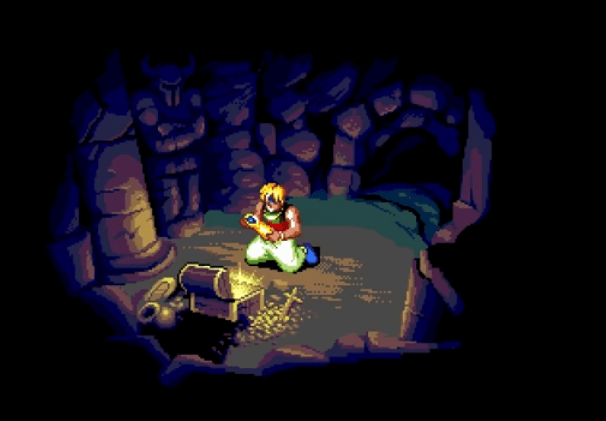
The intro is beautifully illustrated (Screenshot taken by the author)

Plot

Prince Ali is a treasure hunter, living on the land of Oasis. One day, whilst exploring a cave on a nearby island, he discovers a golden armlet. When he tries on the armlet, a ghostly face appears and re-tells the story of a magical war between two sorcerers. One of the sorcerors, Reharl, wore the golden armlet and used it to control four spirits: Dytto the Water Spirit; Efreet, the Fire Spirit; Shade, the Shadow Spirit; and Bow, the Plant Spirit. The other, Agitio, wore the silver armlet and used it for evil, causing death and destruction everywhere within his reach. Ali must search Oasis and gain the power of the four spirits and prevent the silver armlet from being used to destroy the world.

Gameplay

Like LTTP, as you explore the map, you will encounter numerous baddies that you can engage in battle and kill. You can attack these enemies using your dagger, swords, bow and arrow, and bombs. The dagger is the only weapon that you can use infinitely. Occasionally, these fallen foes will leave behind items that will help restore your health or magic bar. As the game progresses, you gain the ability to control the four spirits to get to previously in accessible areas and to defeat your enemies or help you regain health.

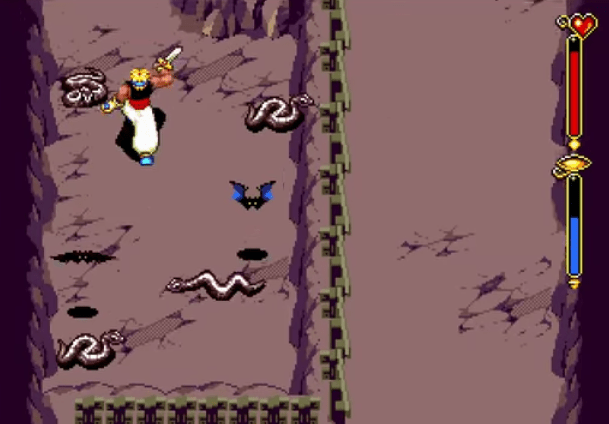
Battle your way through caves full of monsters to find the four spirits to aid you in your quest (screenshot taken by the author)

How Does It Handle?

The controls are easy to learn, and the game interface is intuitive and easy to use. The only difficulty is jumping, which takes some practice as it’s not always easy to gauge where you will land, even with a shadow to assist.

What makes the battles with foes more interesting than LTTP is that you have to crouch to hit foes such as snakes, and have to jump in order to hit bats. This adds an extra challenge to the game. The bosses are challenging but not too difficult, even for a younger gamer.

One annoying aspect of the gave is that Efreet is difficult to control. When trying to get him to ignite lanterns, for example, he must be facing them but he is often moving around and facing the wrong direction.

Graphics

The game begins with a beautifully illustrated cutscene giving the back story of the game. The in-game graphics are bright, colourful and much more detailed and interesting than in LTTP. The sprites are clearly defined and there is a good array of different foes to fight.

Music

Sadly, the music sucks and really can’t hold a candle to LTTP. In LTTP, the music is inspiring with hints of danger and intrigue. It encourages you to be brave and venture forth into the unknown. Beyond Oasis just falls flat and doesn’t inspire the same feelings.

Replay Value

As for replay value, although the game only has one difficulty setting, it is worth revisiting again, but there is nowhere near the amount of secret objects (if there are any at all) to find and the game is so much shorter than LTTP. In fact, you could easily beat it in the half the time it’d take to finish LTTP.

Efreet, the fire spirit, is one of four you need to find and gain control of (Screenshot taken by the author)

Did I Complete The Game?

Yes

What The Critics Said:

Electronic Gaming Monthly: “This one is pretty enjoyable…with the standard fare of menacing enemies and creative boss characters. The best element is probably the gigantic area you cover, and the plot twists throughout the game. Overall 38/50.”[1]

GameFan: “The game excels in almost every category. The music gets a tad repetitive, but it’s high quality… Overall 94.7%.[2]

Next Generation: “The use of magic, whether it be the fireball or meteor storm; a user-friendly interface, and an ever-ready map put Beyond Oasis beyond others of its type. But ultimately, poor fighting and an uninspired storyline leave this title looking more like a mirage. Overall 2/5.[3]

Awards:

Action RPG of the Year – GameFan’s Mega Awards 1995[4]

My Verdict:

“This game looks fantastic and incorporates some very interesting features such as the different abilities of the four spirits and the imaginative bosses. What let’s this game down is the music and game length. It’s well worth playing though!”

My Rating:

What are your memories of The Story of Thor: A Successor of the Light/Beyond Oasis? I would love to hear your thoughts, and don’t for get to follow and subscribe so that you don’t miss my latest reviews! You can also find me on Instagram: @nicklovestogame.


[1] ‘Review Crew – Beyond Oasis’. Electronic Gaming Monthly. (March 1995). Issue 68:36.

[2] ‘Viewpoint Beyond Oasis’. GameFan. (March 1005). Volume 3 Issue 3:18.

[3] ‘Rating Genesis – Beyond Oasis’. Next Generation. Issue 4:94.

[4] ‘GameFan’s Mega Awards 1995’. GameFan. (January 1996). Volume 4, Issue 1:106.

Sonic the Hedgehog 3 – Review

It must be difficult for game creators. Do they stick to a winning formula for a sequel and run the risk of the concept becoming stale, or do they gamble on new features that have the potential to disgruntle loyal fans to the franchise? It’s a hard balance to get right as many games have shown over the years. The question is, will Sonic 3 fall foul of over-zealous creators or will they get it right for a third time in a row?

Title screen (Screenshot taken by the author)

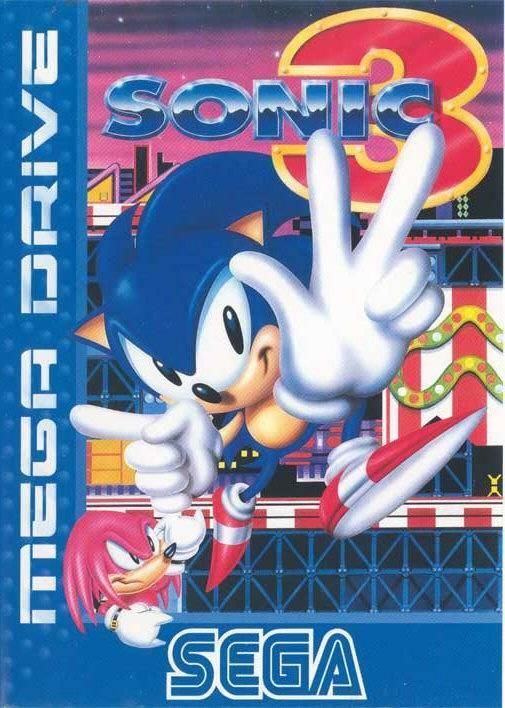
Sonic the Hedgehog 3 is a platform game developed and published by Sega. It was released in 1994 on the Sega Mega Drive/Genesis and latterly for Windows in 1997. Later, it would be made available for the Game Cube, PS3 and Xbox 360. For this review, I revisited the Sega Mega Drive version.

Visually, very little has changed between Sonic 1, 2, and 3 (Screenshot taken by the author)

Plot

After Sonic 2, Dr. Robotnik’s spaceship crashed into the mysteriously floating Angel Island. He meets and tricks the island’s guardian, Knuckles the Echidna, into believing that Sonic is trying to steal the Master Emerald. Sonic and Tails must once again defeat Dr. Robotnik who is being aided by Knuckles.

Gameplay

Once again, you can choose to play as Sonic and Tails alone, or have as Sonic but have Tails tagging along controlled by the computer. Apart from the usual gameplay of running through levels and collecting of rings in order to access bonus stages to win the Chaos Emeralds, there are several new features to this game. Firstly, access to the bonus stages are now via giant gold rings which can be found in secret locations.

The bonus stages themselves are much for interesting and fun than Sonic 2. They consist of Sonic and Tails running around a globe in third person view. The object is to collect all the blue spheres. If you hit a red sphere you fail. The more blue spheres you collect, the faster Sonic runs, adding some difficulty to the harder bonus stages.

Once Sonic gains all the Chaos Emeralds, he can become Super Sonic, making him invincible for a short period of time.

Secondly, Sonic can attain three shields: lightning, bubble and fire, each giving him a unique ability when using them.

The new bonus stages are so much more enjoyable than the tunnels of Sonic 2 (Screenshot taken by the author)

How Does It Handle?

As usual, this game plays incredibly well. Tight controls, fun to play, and the new features, although not groundbreaking or genre defining, add enough to ensure the franchise doesn’t become stagnant.

One of the issues I have with this game is that the levels are so much bigger than previous games, but are filled with slopes and shoots and other features that you feel like you’re just whizzing through the levels without actually doing much. I appreciate that the whole appeal of Sonic is that he is fast, but sometimes it feels like you’re just on autopilot because he just whizzes through the game. Along with this speed comes another issue that the creators have yet to rectify…when Sonic is going at full speed, and the screen is busy, the game lags and the sprites flicker.

Graphics

As expected, the game looks great. Lots of beautifully designed levels for you to navigate through, and plenty of unique sprites to evade or destroy. However, I feel that if you were to be shown screenshots of Sonic 1, 2 and 3, there are times you’d be hard pressed to distinguish between the three. This is certainly not the case with the Mario franchise where the graphics of each game are very distinguishable. Now, I concede that Super Mario 1, 2 and 3 were all released on the NES and Super Mario World on the SNES, and so is bound to look different. However, even when comparing Super Mario World to Super Mario World 2: Yoshi’s Island, there is a clear distinctive design to the levels and enough gameplay changes so that both games can stand on their own.

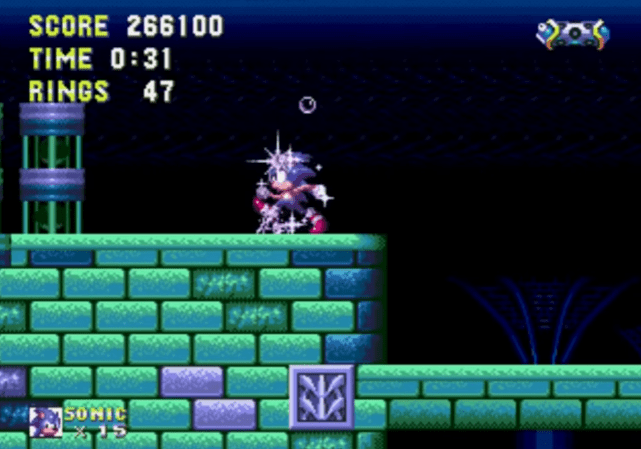
The all too familiar underwater levels…you’d have thought he would have learnt to swim by now! (Screenshot taken by the author)

Music

The intro music has changed and although it is more update and emphasises Sonic’s speed. I still prefer the original theme tune. That is a personal thing of course. The rest of the music, for me, isn’t as memorable as previous games with the exception of the Carnival Night levels where they’ve mixed in a very “carnival” sounding theme into the music.

Did I Complete The Game?

Yes, with all Chaos Emeralds captured.

What The Critics Said:

Electronic Gaming Monthly: “Sonic 3 is simply the perfect Sonic game. It beats out all previous Sonics with outstanding graphics, more hidden items and new items like many types of shields…The bonus rounds give the average player a fair chance this time, unlike “those tunnels” of part 2. It seems unlikely that Sega will be able to top this one. Overall 38/40.[1]

Gamepro: “Sonic 3 proves that you can teach the old hedgehog new and exciting tricks. Take that old Sonic magic, add fun new variations, and you have another spectacular game. Overall 19/20.[2]

Hyper: “Everything you expect from a Sonic game, nothing more. If it was just me, the score would be lower, but Sonic freaks are going to go off. Overall 90%[3]

Entertainment Weekly: “Sonic 3, by contrast, represents the apotheosis of the Sonic concept: Unlike previous games, the stages are linked cinematically (Sonic and Tails literally tumble from one scene to the next), and the characters have some stunning new techniques — I, for one, never thought I’d see a spiny blue hedgehog on a pair of skis. Ovearll A+[4]

Mean Machines Sega: “Sonic’s Back! Back! Back! This game re-establishes him as King of the Hill, Top of the Heap and Life Emperor of the Platform Universe. Huzzah! Huzzah! Overall 94%[5]

Sega Power: “No radical changes to the game, but its sheer size, super graphics, wealth of imagination and above all playability, guarantee Sonic gold status. Overall 90%.[6]

Sega Magazine: “An amazing release and serious contender for Best Platform Game ever award. Overall 95%.[7]

My Verdict:

“Sonic 3 is a very good game. If you like the solid formula of speed, ring collecting and bonus stages that the creators have been successful with in their first two outings, then this game is for you and you’ll enjoy every second of it. Personally, I worry that there aren’t enough differences between this and the previous two games and it’s in danger of going stale.”

Rating:

What are your memories of Sonic the Hedgehog 3? I would love to hear your thoughts, and don’t for get to follow and subscribe so that you don’t miss my latest reviews! You can also find me on Instagram: @nicklovestogame.


[1] ‘Sonic 3’. Electronic Gaming Monthly. (March 1994). Volume 7, Issue 3:30.

[2] ‘Proreview – Sonic the Hedgehog 3’. (March 1994). Gamepro. Issue 56:42-44.

[3] ‘Sonic 3’. Hyper. (March 1994). 4:26-29.

[4] Strauss, B., (February 11, 1994). ‘Sonic CD; Sonic Chaos; Sonic Spinball; Sonic 3’. Entertainment Weekly. (https://ew.com/article/1994/02/11/sonic-cd-sonic-chaos-sonic-spinball-sonic-3/ Accessed 23rd November 2020).

[5] ‘Mega Drive Review – Sonic 3’. Mean Machines Sega. (March 1994) Issue 17:49.

[6] ‘Mega Drive Review – Sonic 3’. Sega Power. (March 1994). Issue 52:30.

[7] ‘Mega Drive Review – Sonic 3’. Sega Magazine. (February 1994). :87-88.