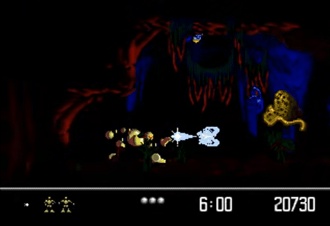
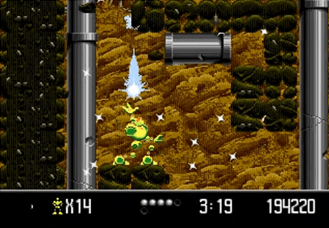
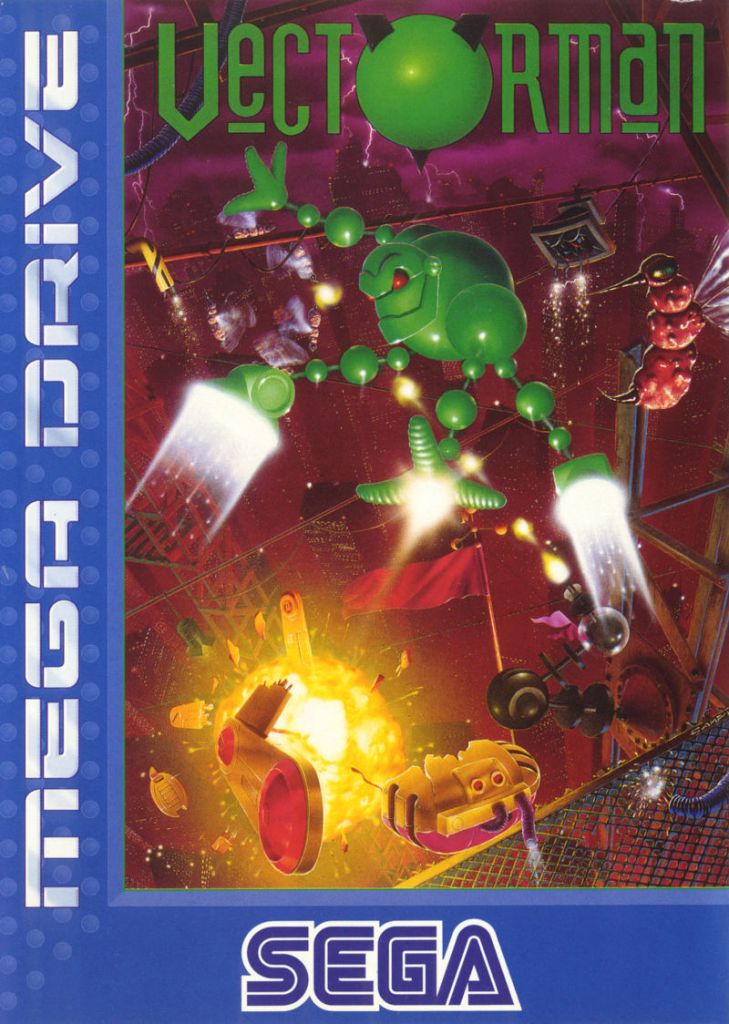
Zaxxon – Review

Zaxxon holds the accolade of being the first arcade game advertised on television.[1] A 30 second commercial was created by Paramount for around $150,000.[2] The advertising seems to have had the desired effect as the game was a commercial success and one of highest earners for arcades between October 1981 and September 1982.[3]
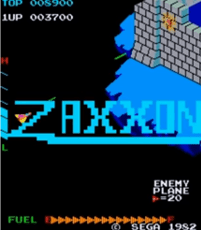
Zaxxon is an isometric shooter developed and published by Sega for the arcade in 1982. Over the next three years, Zaxxon was ported to the following: Aaple II, Atari 8-bit family, Atari 2600, Atari 5200, ColecoVision, Commodore 63, Dragon 32, IBM PC compatibles, Intellivision, MSX, Sega SG-1000, TRS-80, TRS-80 Color Computer, and the ZX Spectrum. Over the years, it has ben emulated to many consoles. For this review, I played the version found on the PlayStation 3 as part of Sonic’s Ultimate Genesis Collection (2009).

Plot

You must pilot a ship through a series of heavily defended space fortresses, destroying as many enemy buildings and crafts a possible.

Gameplay

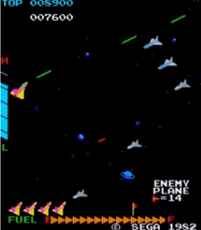
The aim of the game is to earn as many points as possible buy hitting various targets throughout the levels. Danger comes threefold: You must evade enemy fire, evade walls and electrical fields, and be careful not to run out of fuel. To replenish your fuel, simply destroy fuel drums when you see them. Each level also contains a certain number fo enemy planes. If you destroy all the enemy planes then you are rewarded with bonus points.

Zaxxon consists of three levels played in a loop which increase in difficulty as the game progresses. Level 1 is a fortress that you must fly through, level 2 is a battle in outer space, and the third is also a fortress culminating a boss battle at the end.

At several points throughout the fortesses, you will need to ascend or descend to fly through gaps in their defensive walls. To gauge height, your ship casts a shadow and the HUD displays a sort of altimeter.

How Does It Handle?

I think the game handles well. The controls are responsive, but it is very easy to ascend or descend unintentionally which can cause you to crash. This difficulty in judging height can become frustrating. You also need to keep pressing the fire button so be prepared for your thumb to get a workout.

Graphics

Zaxxon has been credited with being the first game to use axonometric projection which emulates 3D from a third-person viewpoint.[4]

I think the levels look really good. There is a good array of colours and detail to the levels. No complaints here.

Music and SFX

There is no music in this game, but there is a permanent sort of white noise in the background adding to the illusion of flying in space. However, the predominant noise you will hear is the pew-pew sound when you fire, followed by booms as you destroy your targets. Also, during your dogfights, when an enemy locks on to you, you will hear a distinctive beep, reminding you to perform some evasive manoeuvres.

Replay Value

If you like this game and have a competitive nature, you will return to this game often. It is a pity that there is no two player option.
What The Critics Said:

At present, I have yet to find a contemporary review. Wikipedia claims that an article from Computer and Video Games magazine has given Zaxxon a position review but upon reading the article they do no such thing. They simply describe how the game is played.

My Verdict:

“I didn’t spend that much time on this game as I just didn’t enjoy playing it. The graphics and SFX are good, and the gameplay is fun if you like this sort of game. I’m not saying this game is bad, far from it. It just wasn’t for me.”

Rating:

What are your memories of Zaxxon? I would love to hear your thoughts, and don’t for get to follow and subscribe so that you don’t miss my latest reviews! You can also find me on Instagram: @nicklovestogame.


[1] Wolf, M.J.P., ‘A Brief Timeline of Video Game History’. in eds. Wolf, M.J.P. The Video Game Explosion: A history from PONG to Playstation and Beyond. Connecticut: Greenwood Press. pxviii.

[2] Harmetz, A., (Saturday, July 3rd 1982). ‘Movie Themes Come to Video Games’. Star-News.

[3] ‘Industry News – AMOA Announces Jukebox and Games Awards Winners’. Cashbox. (October 30th, 1982). :37.

[4] Therrien, C., ‘Graphics in Video Games’. in eds. Wolf, M.J.P. The Video Game Explosion: A history from PONG to Playstation and Beyond. Connecticut: Greenwood Press. p240.

Space Harrier – Review

“Welcome to the Fantasy Zone. Get Ready!”

Title screen (screenshot taken by the author)

Space Harrier is an arcade rail shooter. It was developed and published by Sega and released for the arcade in 1985. It was later ported to the Master System in 1986, the Game Gear in 1991, and the Mega Drive’s 32x in 1994. Non-Sega releases included the TurboGrafx-16, Famicom, ZX Spectrum, Amstrad, Commodore 64, Nintendo 3DS, Xbox 360 and Playstation 3 as part of Sonic’s Ultimate Genesis Collection (2009). It was the latter version that I chose to review.

Plot

The arcade version had no plot as such, but when it was released on the Master System in 1986, a back story was given. It explained that the once peaceful Land of Dragons was attacked by an army of monsters and robots. As Space Harrier, you are sent to defeat the invading army and return the Land of Dragons to its peaceful existence.

Gameplay

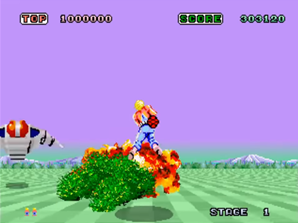
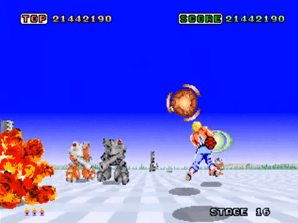
Played in third person, Space Harrier runs briefly before taking off. You then fly around the screen destroying or evading oncoming enemies. The enemies consist of an array of robots and monsters. One such monster is a mammoth with one eye…weird! You must also be aware of the many stationary pillars throughout the stages. One hit from your enemies or a collision with a pillar will result in death.

Space Harrier will always default to the centre of the screen, so if you let go of the controls, he will automatically move to the central position.

There are 18 Stages, with numbers 5 and 12 being Bonus Stages. The Bonus Stages sees you riding a Haku-esque (Studio Ghibli fans will know what I mean) dragon. The object of the Bonus Stage is to smash down trees or pillars to gain extra points.

Don’t forget to evade enemy fire and stationary objects (screenshot taken by the author)

How Does It Handle?

The game is very fast and chaotic, and I think there is little finesse required. I often felt that I got through the stages on sheer luck and persistence. If it wasn’t for infinite continues, I would not have made it past the first few levels. However, the manoeuvring controls are tight, but you must remember to keep tapping the fire button. There are no automatic weapons to make the game easier for you.

Disappointingly, there is only one weapon for you to utilise. It would have been nice to be able to pick up a few power-ups along the way.

One of the issues with the third person view and the speed of the game is that it is that it can be tough to judge the depth of the projectiles being hurled at you. When being peppered with fireballs, it is difficult to determine when they will hit you. So much is happening that you are simply trying to fly in random patterns before slamming into an enemy laser or fireball. Again, I think you just need luck more than skill.

According to a reviewer from Computer & Video Games magazine (see below), the game will adapt its difficulty based on how well you play it. I’m unsure if this feature was on my version, but I certainly noticed that some levels appeared to be faster than others.

In the Bonus Stages, although you can direct the dragon, you can’t really steer it.

Graphics

The sprites look great! Space Harrier is brightly coloured and nicely detailed. Sadly, you don’t have much time to admire the illustrations of the enemy sprites as they whizz by incredibly fast. Only when you die, and if an enemy is close to the foreground do you see how awesome the robots or dragon creatures look.

The level design is quite basic. The floors are coloured in bi- or tri-tonal chequered patterns and change colour with every stage. The skies tend to have multi-coloured horizontal stripes patterns. The backgrounds contain minimal detail, but you don’t really have time to admire them as your attention is on the incoming enemies and pillars.

Music & SFX

When I began writing this review, I had to go back and play a few levels just to listen to the music. The music is actually good and fits the game well but because of the on-screen action, my brain seemed to filter it out.

I loved the vocalised “Welcome to the Fantasy Zone. Get Ready!” at the beginning of the game. Is it me, or does the sound Space Harrier makes when he dies very similar to Altered Beast (1988)?

I also like the fact that when you hit an enemy, there are two distinctive sounds to indicate whether the enemy has taken damage or not.

Replay Value

For me, there isn’t much replay value with this game unless you are a fan of rail shooters. I doubt I will return to this game again. There isn’t even a two-player mode to compete against a friend with.

I really like the enemy sprite designs (screenshot taken by the author)

Did I Complete The Game?

Yes, although it took me around 16 continues. If we equate this to £1 per continue, it took me £16 to complete. That’s not too bad…or is it? I don’t know how to gauge these things. My final score was 29438560.

Spoiler Alert!

I felt cheated when I beat the game. A message appears simply stating “The End”, and that’s it!

What The Critics Said:

Computer and Video Games: “What makes it so interesting is, other than the fast and exciting game play and clear bright graphics, is that the machine will judge for itself how proficient you are, and change the level of difficulty accordingly, sometimes within the same screen.” No Rating.[1]

Sinclair User Magazine: “The fabulously colourful 3D graphics, the movement of the sit-in cabinet were, and still are, breathtaking. The first thing you’ll notice about Space Harrier as you climb into the pilot’s seat is the seatbelt. It makes you wonder what type of ride you’re in for. Take it from me – it’s turbulent. Still using the basic blast-everything -which-moves theme, Space Harrier hurls you up, down, left and right while managing to tilt the cabinet in a roll in whatever direction you push your joystick. It’s hair-raising and great fun.” No Rating.[2]

Computer Gamer: “The game is basically of the shoot anything that moves, and if it doesn’t explode get out of the way, type – but the graphics are extremely good, and the 3D effects are quite good.” No Rating.[3]

My Verdict

“This game is fast and furious, and the way the original cabinet would move you around as you played must have been revolutionary. Without the cabinet, the game is probably a lot of fun for rail shooter fans, but I came away from it feeling like I’d not actually done that much. The sprites look great, and the controls are tight, but I don’t think there is that much skill required for this game, and I don’t feel like playing it again.”

Rating

What are your memories of Space Harrier? I would love to hear your thoughts, and don’t for get to follow and subscribe so that you don’t miss my latest reviews! You can also find me on Instagram: @nicklovestogame.


[1] Edgeley, C., ‘Arcade Action – Space Harrier’. Computer and Video Games. (Feb 1986). :83.

[2]  ‘The Arcade Coin-Op Giants for 1987 – Space Harrier’. Sinclair User Magazine. (Feb 1987). Issue 59:92.

[3] ‘Coin-Op Connection – Space Harrier’. Computer Gamer. (March 1986). Number 12:26.

Shinobi – Review

I can’t speak for females, but I would wager that most boys (and men come to think of it) have fantasised about being a ninja at one point in their lives. The idea of being a stealthy assassin dressed in black and wielding “cool” weapons such as nunchaku, shuriken, and kusarigama is an appealing fantasy…until you realise the amount of training and self-discipline one would need to achieve such expertise. Thank God for video games, eh?

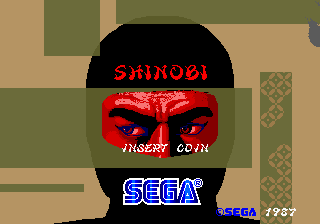
Titlescreen (screenshot taken by the author)

Shinobi is a side-scrolling hack-and-slash action game. It was developed and published by Sega and released in the arcade in 1987. It was ported to the following:

  • Master System (1988)
  • Amiga, Amstrad CPC, Atari ST, Commodore 64, NES, PC Engine (Japan only) and ZX Spectrum (1989)
  • Wii Virtual Console and Xbox Live Arcade
  • PlayStation 3 and Xbox 360 as part Sonic’s Ultimate Genesis Collection (2009)
  • Nintendo Switch as part of Sega Ages series (2020).

Plot

The evil Zeed Terrorist Organization have kidnapped young students who belong to the clan of ninja master Joe Musashi. Joe must battle through a number of levels dodging gunshots and flying swords in order rescue his students.

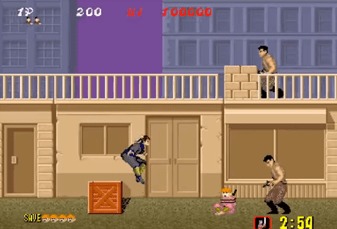
Rescue the hostages by walking into them (screenshot taken by the author)

Gameplay

The controls are very basic. You can walk, crouch, jump and attack. Depending on your proximity to the enemy will determine if your throw a shuriken or kick. There is only one movement speed, but you can jump into the background and back into the foreground to evade enemies and save your students. You have an unlimited supply of shuriken and when you rescue certain hostages, they are replaced by a gun. You can also find a katana to replace your melee attack too. If things gets too tough, you can use your ninjitsu attack, but only once per level. Your ninjitsu attack changes Depending on the level: thunderstorm, tornado, or doppelganger.

Although you can harmlessly bump into enemies, this is a one hit kill game. If you are killed, the stage begins again minus the hostages that you have saved (if you saved any that is). This game has infinite continues and you will simply restart the stage (apparently this does not happen if you run out of lives on the final stage though).

Each level has a time limit of three minutes. You can gain points by finishing the stage quickly, and refraining from using your special attacks or melee attacks. After each boss, you will fight in a bonus game where, from a first-person perspective, you must throw shuriken at encroaching enemy ninjas. Winning this bonus round will gain you an extra life.

Complete the bonus stage to gain an extra life (screenshot taken by the author)

How Does It Handle?

This game handles incredibly well. The controls are very responsive allowing you to duck or jump and evade enemy attacks. Also, the ability to jump to and from the background adds an element of tactical gameplay too. The game isn’t as fast and furious as The Legend of Kage (1985) but I think the characters look and move more realistically.

The bonus stage was a nice little addition too, to break up the gameplay and offer something a little different.

One of the frustrating aspects to the game are the beige coloured enemies who guard the captives. They have three attacks: they swing their sword, throw their sword at you, or throw their sword in the style of a boomerang. It is difficult to determine what the sword is going to do.

Also, I found the first boss much tougher than the ones at the end of stages two and three. It was incredibly difficult to judge the flight of the fireballs that he shoots.

Graphics

The graphics aren’t ground-breaking but I still I think the game looks good. The sprites aren’t, as detailed or as colourful as the likes of Rastan (1987) or Ninja Gaiden (1988) but I prefer them to The Legend of Kage (1985) and Captain Silver (1987). There is enough detail about the sprites to make them interesting to look at. Th levels and backgrounds are good too, but not very memorable.

Music and SFX

The main music from the first two stages and the boss battle have a good beat and fits very well with this style of game. It returns for later stages and is quite memorable for me, but the other music from the game doesn’t seem to stick in my mind.

I like the voice over stating the mission numbers at the beginning and end of each mission as well as the “Welcome to Bonus Stage” introduction to the bonus stage. The SFX in general are fine. There are no annoying sounds or trings that drive you nuts.

Upgrade your shuriken to the more powerful pistol (screenshot taken by the author)

Replay Value

I think there is replay value to this game because, although it is very difficult, it is very fun to play and I can see myself returning to again.

Did I Complete The Game?

No, as of yet, I cannot get past the first stage of mission four.

What The Critics Said:

Computer & Video Games: “Fast moving and very challenging, Shenobi is well worth playing. I particularly liked it for the controls which weren’t too complex. A straightforward kick and punch game with bags of action.” No rating.[1]

Sinclair User: “Conventional combat ideas – but the gameplay makes up to make a winner. Overall 8/10.[2]

Commodore User: “Shinobi doesn’t break much new ground but nevertheless bares the hallmarks of a coin-op wow. It’s tough, but not so tough that you lose interest. It combines several different kinds of shoot ‘em and beat ‘em up action in one well thought out, well executed game. It looks good, it plays brilliantly and it’s coming to an arcade near your soon. Overall 8/10.[3]

Verdict:

“I like this game. It’s fun and it’s the sort of game I would have spent all my money on in the arcades. There’s nothing ground-breaking about it but there doesn’t need to be. Good music, good graphics…simply a solid game.”

Rating:

What are your memories of Shinobi? I would love to hear your thoughts, and don’t for get to follow and subscribe so that you don’t miss my latest reviews! You can also find me on Instagram: @nicklovestogame.


[1] ‘Arcade Action – Shenobi’. Computer & Video Games. (March 1988). Issue 77:92-3.

[2] ‘Coin-Ops – Shinobi’. Sinclair User. (June 1988). Number 75:83.

[3] Kelly, N., ‘Arcades – Shinobi’. Commodore User. (February 1988). Number 54:104.

Fantasy Zone – Review

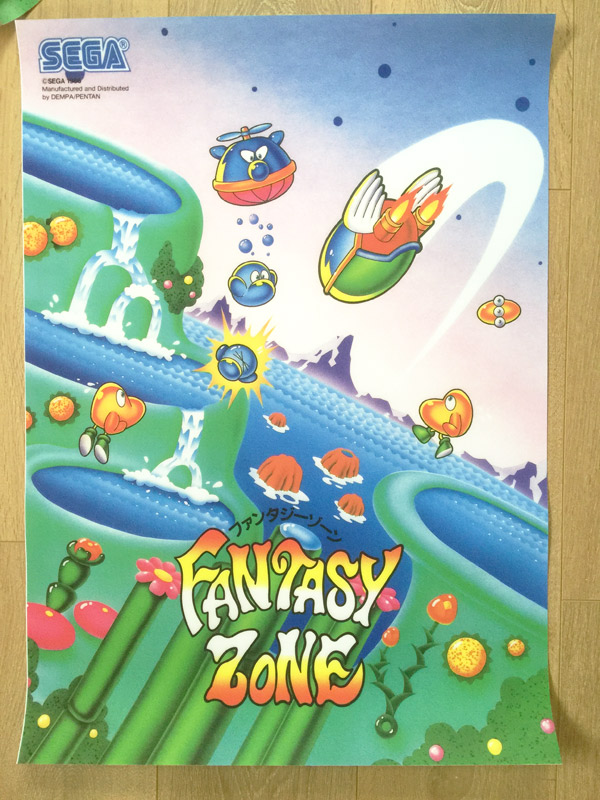
In this world of almost unlimited access to video games through emulation, we forget sometimes that once certain games were only released in selected countries. I myself used to own a Honey Bee, which allowed me to play Japanese games on my Mega Drive. Although ported to consoles around the world, as far as I can tell, the Fantasy Zone arcade cabinet could only be found in Japan. It proved very popular in Japan and so it is anyone’s guess as to why it was never exported to Europe or the US.

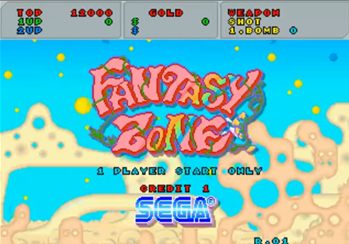
Title screen (screenshot taken by the author)

Fantasy Zone is a side-scrolling shooter developed and released by Sega. It was released for the arcade in 1986 and was later ported to the Master System, MSX, NES, Sharp X68000 and PC Engine. Each port contained slight alterations to the game. Later releases include:

  • PlayStation 2 as part of Sega Classics Collection (1996), although there were some very noticeable changes to the graphics.
  • Sega Saturn as part of Sega Ages (1997)
  • Mobile devices in 2002 and 2003
  • Virtual Console (2008)
  • PlayStation 3 and Xbox 360 as part of Sonic’s Ultimate Genesis Collection (2009)
  • Nintendo 3DS (3D port) as part of 3D Fantasy Zone: Opa-Opa Bros. (2014).

For this review, I played the version found onSonic’s Ultimate Genesis Collection (2009).

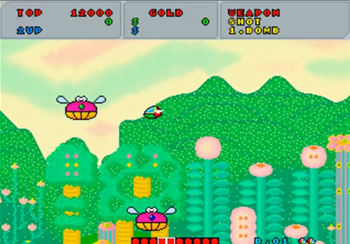
Unlike many other side-scrolling shoot ’em ups, you can turn and fly in the other direction (screenshot taken by the author)

Plot

The Fantasy Zone, a solar system with 8 planets, is under threat from the evil Menons who are using foreign money, acquired by illicit means, to build a force of flying monsters. You must destroy the Menons and recover as many coins as possible along the way.

Gameplay

You control a sentient spaceship called Opa-Opa. Armed with your Twin Shot gun and single bombs, you have 8 stages to conquer. In each stage you must destroy 10 specific ships in order to collect the coins they drop. Once you have collected all the coins from one planet, you can move on to the next…after a boss battle, of course. Oh, and unlike many shooters I’ve played, this one allows you to turn around and fly in the opposite direction.

Throughout the stages, you will occasionally see a balloon which has the word ‘Shop’ written across it. Flying into these balloons will allow you access the shop where you can spend your hard-earned coins on upgrades and weapons:

Shot Type Upgrades:

  • Wide Beam – Damages over a wider area than your Twin Shot
  • Laser Beam – Incredibly powerful laser
  • 7-Way Shot – Shoots in 7 directions at once

Bomb Type Upgrades:

  • Twin Bombs – Launches two bombs at once
  • Fire Bombs – When it hits its target, it fires out a blast in two directions destroying everything in its path
  • Smart Bomb – Damages every enemy on the screen
  • Heavy Bomb – Drop to smash through anything it comes into contact with.

Speedup Parts (Each upgrade allows your ship to fly faster):

  • Big Wings
  • Jet Engine
  • Turbo Engine
  • Rocket Engine

Other:

  • Extra Life

Weapons and bomb power-ups contain a limited number of ammo. When they run out, your ship will revert back to your default weapon.

Beware, one hit from an enemy and your ship will get destroyed, losing any power-ups you have bought!

Don’t be fooled by the cutsie appearance, this game is tough (screenshot taken by the author)

How Does It Handle?

The controls are very responsive, allowing you to quickly evade enemies. You can keep your thumb on the fire button to release a steady stream of fire, or quickly tap the fire button for more rapid fire.

As the levels progress, the main enemies you need to kill require more hits to be destroyed and the screen becomes busier with smaller enemies increasing the level difficulty.

Graphics

This game is very bright and colourful. There is plenty to look at and take in and the many enemy creatures are nicely illustrated and animated. At first glance, you can be forgiven for thinking this is aimed at kids. After all, compared to the likes of Alcon, Darius and Lifeforce (also released in 1986) the graphics have a very cartoon-like feel. These graphics will sit well with some but not with others who may desire a more adult look to their games.

Music and SFX

I quite like the music. It has a good beat and I found myself bopping along to it as I attempted to evade the many flying enemies. The change in tone to a lower register for the boss battles adds a feeling of danger. You find yourself saying “Right, here we go”.

When shooting the enemies where you gain the main coins from, the noise changes slightly which I thought was a nice touch, and there is a satisfying ‘boing’ sound when you blow up the smaller flying enemies.

Replay Value

There is an addictiveness to this game as well as an element of competition in two-player mode. It is a pity that two players can’t play at the same time but it is understandable as it would likely take away the option to scroll the screen in both directions.

As the levels progress, the main enemies take more shots to kill (screenshot taken by the author)

Did I Complete The Game?

At present, I can only get to the third planet.

What The Critics Said:

At present, I have been unable to find a contemporary review for the arcade version.

Verdict

“It may look cute, but it doesn’t play cute. This game is a real challenge! Bright and colourful, with nice music, its simplicity is also its appeal.”

Rating

What are your memories of Fantasy Zone? I would love to hear your thoughts, and don’t for get to follow and subscribe so that you don’t miss my latest reviews! You can also find me on Instagram: @nicklovestogame.

Congo Bongo – Review

There will always be a debate about emulation vs original hardware. Some argue that you can only experience the true essence of a game upon playing the original. Others aren’t that fussed or simply can’t afford or access the original hardware. Why should they miss out? I tend to fall into the later category. I would never have played Congo Bongo had it not been for emulation…and I’m glad I did.

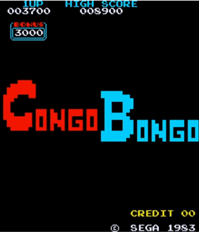
Title screen (screenshot taken by the author)

Congo Bongo (also known as Tip Top) is a platform game developed and released by Sega for the arcade in 1983. For this review, I played the version found on Sonic’s Ultimate Genesis Collection (2009) for the PlayStation 3.

Plot

One night, deep in the jungle, an unnamed safari explorer has his tent set on fire by a huge ape named Bongo. The explorer then proceeds to chase Bongo to try and capture him.

Gameplay

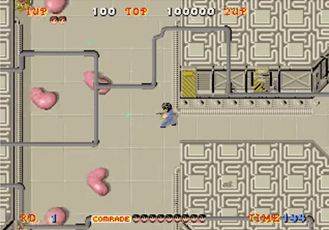
The explorer must pursue Bongo across four screens. Whilst in pursuit, there are a number of obstacles for you to evade and conquer. These include jumping across water, dodging other jungle creatures who wish you harm, or evading coconuts thrown by Bongo. You are unable to attack any of the other jungle animals, but you can jump over them to avoid being hit by them.

The four stages include:

  • Stage 1 – The hunter must climb a series of cliffs whilst dodging coconuts thrown at him by Bongo and avoiding the smaller monkeys who try to throw him off the ledges.
  • Stage 2 – The hunter must cross a swamp by riding on the backs of diving and swimming hippos. There are also poisonous snakes and scorpions to avoid.
  • Stage 3 – The hunter must cross a plain and crouch into holes to evade the horns of charging rhinos. He must then climb more ledges to get to the next stage.
  • Stage 4 – The hunter crosses a second swamp with lily pads, fish, and hippos. Once you reach the other side of the swamp, you must dodge more charging rhinos that are blocking the ledges where you can capture bongo.

One you reach the end of level four the game repeats from the first level with increased difficulty.

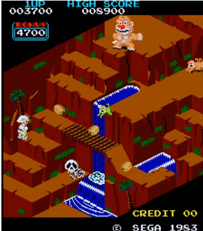
Watch out for the cocnuts! (screenshot taken by the author)

How Does It Handle?

I think our hero moves at a good speed and is easy to control once you get used to the isometric view. I find it helps to rotate my controller to match the directions he will go on the screen. The jumping is tight too. No complaints there. As you can imagine from old arcade games, this is a tough game to master. I think I’ve only ever managed to get to level five or six before losing all my lives.

Graphics

I think this game looks great for 1983. I love the blue of the water, and the animation of our hero as he climbs out of the holes and climbs up the ledges of the mountains. I think the animals are nicely animated too. No issues for me here.

Music & SFX

There is no intro music or in-game music, but there is a nice little piece of celebration music as you pass each level which for some reason reminds me more of a wild west game than it does a jungle game. There is also a strange little riff when you die and float up to heaven.

The noise that the coconuts make as they are being thrown and bounce down the mountains is annoying, as is the low level bassy noise when the rhinos are on screen.

Replay Value

I can imagine that when this game was released it had tons of replay value. I can envisage groups of friends hanging around the machine seeing who could get the highest score. I can also see this game being quite addictive too. There is something about it which draws you back to it.

Did I Complete The Game?

I don’t think this the sort of game you can complete but I only reached level five or six before losing all my lives.

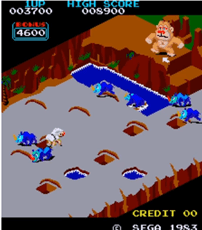
I didn’t know there rhinoceroses in the jungle?! (screenshot taken by the author)

What The Critics Said:

Computer and Video Games:  “Donkey Kong in three dimensions is the fascinating idea behind Tip Top. (No rating)“.[1]

My Verdict:

“I think this would have been a good game in its day. I like the look of it, but the music just doesn’t fit for me. It is also incredibly difficult. Other than that, I can see this game becoming addictive.”

Rating:

What are your memories of Congo Bongo? I would love to hear your thoughts, and don’t for get to follow and subscribe so that you don’t miss my latest reviews! You can also find me on Instagram: @nicklovestogame.


[1] ‘Arcade: Jungle Revenge in 3D – Tip Top’. Computer and Video Games. (July 1983). Issue 21:30.

Alien Syndrome – Review

Sadly, I was a bit too young to experience the heyday of the arcade. Being born in 1983, the closest arcade we had was at the Rotunda Amusement Park in Folkestone, England. My parents took me there a handful of times, but mainly for the rides. We only ventured into the arcade to play a few games. In particular, I remember playing Hang-On (1985). Since I was small at the time, my father had to help me shift my weight on the bike to steer. I also recall a clay pigeon shooting game, but we mostly stuck to playing pinball machines. By the time I began to venture into arcades on my own as a teenager, many of the games had been replaced by fruit machines. There was still a good selection of video games but my pocket money would never last as long I wished it to. Nowadays, the Rotunda has long since gone, and the nearest arcade is over 20 miles away. C’est la vie!

Title screen (screenshot taken by the author)

Alien Syndrome is a run and gun game that can be played in single-player or two-player co-op mode. It was developed and published by Sega, and released in the arcade in 1987. A year later, it would be ported to Amiga, Amstrad CPC, Atari ST, Commodore 64, NES (published by Tengen), Master System and MSX. Later ports also appear on the ZX Spectrum in 1989, Game Gear and Sharp X68000 in 1992. For this review, I played the arcade version found as part of Sonic’s Ultimate Genesis Collection (2009).

Plot

An alien fleet has appeared in our solar system and captured a large number of humans. You must travel from ship to ship and rescue 10 captives from each one before a bomb explodes killing all on board.

Gameplay

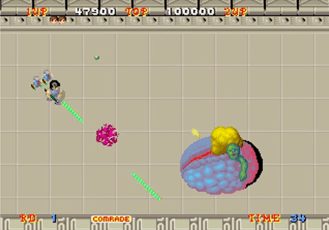
You can play as either Ricky or Mary (or both in two-player mode). As you run around the ship looking for captives to free (to rescue the captives, simply walk into them), you will encounter many weird and hostile aliens. You are armed only with a gun, but will find many power-ups along the way including flame throwers and lasers. Once you have rescued enough captives, you will be told to head for the exit where you will encounter a boss battle. When the boss has been defeated, you will head to the next alien ship. However, there is time limit so be careful you don’t take too long rescuing the captives.

Shoot those blobs! (screenshot taken by the author)

How Does It Handle?

The controls are tight, much needed for a game of this sort. You are able to fire in eight directions and there is a nice array of different weapons, each with their own merits. These can be found by looking for metallic doors with letters painted on them (L for Laser, etc.). You can’t hurt your partner or the captives so I’d recommend pounding that fire button!

Each level also contains maps that are attached to the walls. When you walk near one, a small map appears which shows the exit and locations of the other captives. This allows the action to continue rather than pausing the game to get your bearings.

This game is very difficult and unforgiving, and you will die a lot! It’s one of those games that older gamers will tell younger gamers about whilst stating things like “Games were harder when I were a lad!”. The difficulty does diminish the fun a little, but I think that if you had a dedicated friend who was willing to play a few hours with you, I reckon it would be completable.

Graphics

The graphics look good. Certainly not as colourful as the likes of Gauntlet (1985), but the backgrounds and levels are certainly more detailed and interesting to look at. There are also levels (like Level 3) where enemies rise and fall giving the game a real feeling of depth. The enemy sprites are more detailed and are nicely animated too.

Music & SFX

At the beginning of every level, a robotic voice states, “The time bomb is set!” which is a nice touch as it adds to the tension of the level.

The music is there, but I think you become so engrossed in what’s going on that it’s easy to forget it’s there. Add to that the constant zapping from your weapons and I think your brain seems to filter the music out. I’m sure you would miss it if it wasn’t there, though.

Replay Value

There are many ways to increase the difficulty of the levels including adjusting the difficulty setting, number of lives, and by reducing the time limit. The two-player co-op mode also adds to the replay value because it is quite a fun game to play with a friend.

Don’t be fooled by this weird brain-type thing, the bosses are tough (screenshot taken by the author)

Did I Complete The Game?

No, at present, I can’t get past the second boss on my own and couldn’t get past level four in two-player mode.

What The Critics Said:

Computer & Video Games: “It is a classic L and R job with the usual high strains of play and presentation expected from Sega. Overall 8/10.[1]

My Verdict:

“This game is tough…but fun. You just enjoy running around the levels blasting away to your heart’s content, especially in two-player mode.”

Rating:

What are your memories of Alien Syndrome? I would love to hear your thoughts, and don’t for get to follow and subscribe so that you don’t miss my latest reviews! You can also find me on Instagram: @nicklovestogame.


[1] ‘Mean Machines – Alien Syndrome’. Computer & Video Games. (April 1988). Issue 78:23.

Altered Beast (Arcade) – Review

One of the great things about emulation is that you get to play arcade games that you didn’t get the chance to experience first time around. Compared to their console ports, the arcade versions usually had better graphics and sound…but were a lot harder!

Title screen (screenshot taken by the author)

Altered Beast is a side-scrolling beat ‘em up with some platform gaming elements. It was developed and published by Sega, and released in the arcade in 1988. I have already reviewed the Mega Drive version of Altered Beast (1989), but for this review, I played the arcade version found on Sonic’s Ultimate Genesis Collection (2009).

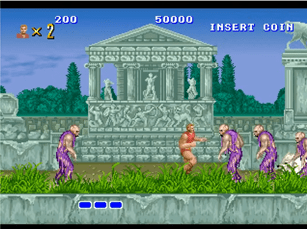
Smash your way through a graveyard filled with the undead (Screenshot taken by the author)

Plot

“Rise from your grave!” commands Zeus, as you emerge from your tomb. You play as a Roman Centurion who is resurrected by Zeus (I know Zeus was a Greek God and the Roman equivalent was Jupiter, but let’s overlook the mythological inaccuracies). Your mission is to rescue Zeus’ daughter, Athena, (Minerva for the Romans) from the evil Demon God known as Neff who has taken her to the Underworld.

Gameplay

You must punch and kick your way through graveyards and caverns to reach the Underworld, all the while fighting numerous undead minions and monsters. In order to meet and defeat the end of level bosses, you need to collect three orbs which increase your strength and eventually morph you into anthropomorphised animals such as wolves, bears, tigers and dragons, each with unique abilities.

The Gothic organ that plays over the cutscenes is awesome (Screenshot taken by the author)

How Does It Handle?

Interestingly, there are one or two differences between the Mega Drive version and the arcade version. For example, the punching and kicking is noticeably slower in the arcade version. This all changes, however, once you transform into your beastie. Your speed increases significantly and you pretty much whizz around the screen destroying everything you com into contact with, which you don’t do when playing the Mega Drive version. The arcade version also sees a slight delay when you try to jump higher because our hero crouches briefly before leaping. This adds an element of realism to the game but takes some getting used to.

Graphics

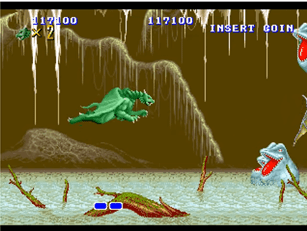
Being an arcade version, the graphics are obviously superior to any of the console ports, especially where the backgrounds are concerned. The sky on level one, for example, blends the different shades of blue seamlessly, and the sprites themselves are smoother and more detailed with more vibrant colours. The two-headed dogs, for instance, are more defined and you can actually see what they are. As a kid, I thought they were some kind of bull.

When you kill an enemy, rather than just explode, bits of their broken torso fly at the screen towards you which is a gory but cool touch. The animations for when you transform into your beast look great and your attacks are better illustrated and animated. I also like the fact that when you are greeted by Neff at the end of the level, you actually see him grow before he turns into the boss which is a nice addition. After the boss fight, Neff’s head appears and sucks the orbs out from you, returning you to your puny former self. The blue field that surrounds you whilst he does this looks great.

Music and SFX

The music itself isn’t all that memorable but I do like the way that for each level, it starts off quite understated but jacks up when you transform into your beast, and for when you fight the boss battle. The best music from this game, though, comes during the cut scenes. When the purple disc appears showing the various stages of Neff’s ritual, a creepy, Gothic organ plays over the top. It’ll certainly send a shiver down your spine.

When you collect an orb, your hero proclaims “power up” as he grows into a more muscular version of himself. This is so iconic that I’d wager any gamer worth their salt upon hearing that soundbite would be able to tell you what game it came from.

I also like how when you meet Neff and he states, “Welcome to your doom!”. In the arcade version he actually sounds scary, as oppose to the raspy greeting you get on the Mega Drive.

Collect three orbs and become magical beast (Screenshot taken by the author)

Did I Complete The Game?

Yes, but only because the version played had infinite continues.

What The Critics Said:

The Games Machine: “Altered Beast is an interesting coin-op in that while not being a highly visual game like Space Harrier, Out Run and the like, it offers enough in its gameplay warrant a good play. Overall Positive.[1]

Commodore User: “…the gameplay really doesn’t vary greatly, or increase markedly in toughness. Still, a cleaver game, and still worth a few tens of anybody’s money.  Overall 7/10.[2]

My Verdict:

“Although the graphics are clearly superior to any port version, the action when you’re human is slowed down and gives the game a laboured pace. Disappointing really as even the arcade version falls short of what could’ve been so much better.”

Rating:

What are your memories of Altered Beast? I would love to hear your thoughts, and don’t for get to follow and subscribe so that you don’t miss my latest reviews! You can also find me on Instagram: @nicklovestogame.


[1] ‘Confrontation Co-op – Altered Beast’. The Games Machine. (November 1988). Issue 12:30-1.

[2] Kelly, N., ‘Arcades – Altered Beast’. Commodore User. (September 1988). Issue 60:94-5.

Monkey Island 3: The Curse of Monkey Island – Review

After the success of The Secret of Monkey Island (1990) and Monkey Island 2: LeChuck’s Revenge (1991), is it any wonder that LucasArt would continue with the franchise? However, fans would have to wait another six years before the third instalment appeared…The Curse of Monkey Island!

Title screen (screenshot taken by the author)

The Curse of Monkey Island is a point and click adventure game develop and publish by LucasArt. It was released in 1997 for Microsfit Windows. For this review, I played the version downloaded from Steam.

Plot

Once again, we follow our hero Guybrush Threepwood. After being stranded at sea for many days in a bumper car, the tides drift him to Plunder Island where he is instantly caught in the middle of LeChuck’s bombardment of Elaine’s fort. It seems LeChuck still wants to marry her and won’t take no for an answer. After foiling LeChuck’s assault, Threepwood finds a diamond ring amongst the pirate treasure. He then formally proposes to Elaine, who accepts. As soon as she puts the ring on, she transforms into a gold statue…the ring is cursed! She is stolen soon after. Threepwood must save Elaine and find a way to lift the curse. Easy right?

Gameplay

The game continues in the point and click format. Your cursor is an ‘X’. When you hover over items, characters, or scenery, that you can interact with, the name of what you can interact with will appear on the screen. The interface is in the style of a gold pirate doubloon. To access it, simply hold the left mouse button over an item and the interface will appear. The hand icon instructs Threepwood to pick up, use, or hit someone; the eyes allow you to examine something; and the parrot head instructs Threepwood to talk to or bite/eat something. To access your inventory, you simply click the right mouse button.

When talking to characters, there are usually several options that appear which usually involves comical quips or questions that help you progress.

A new feature in the series are the sea battles. Using left click to steer and right click to fire, you must learn to manoeuvre your ship into range before firing a volley broadside into the enemy whilst evading their fire.

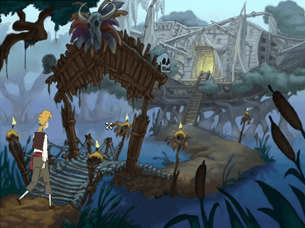
The new graphics look fab! (screenshot taken by the author)

How Does It Handle?

The user interface and the number of commands has been simplified to make the game more enjoyable (in my opinion). This game is easy to learn and easy to navigate. No complaints here. The ship battles are easy, but fun and a good way to mix up the action. They may not be everyone’s bottle of rum though.

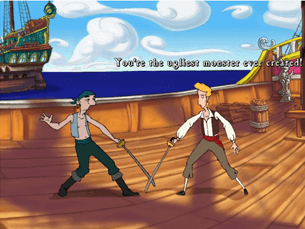
Apart from the usual: examine everything on screen tactic used by point and click fans everywhere, which offers quips from Guybrush, there are two other aspects to the game that add to this gaming experience. The first is by adding a banjo duelling scene where you must compete with another banjo player by plucking the correct strings in order. The second is sword battles where you win by hurling verbal insults at your opponent or countering their insults with even bigger burns. These two aspects of the game are alot of fun!

Graphics

As one may expect after such a long hiatus, the graphics are vastly improved. Not everyone was happy with the more comical style that the characters took on, but I loved it. The scenes are quirky an colourful with plenty to investigate, and the characters are larger than life. Bravo!

Music and SFX

Once you’ve selected your difficulty setting, you begin to hear a few primates chattering away. Over the next few seconds there is clearly some excitement as the voices become louder and more animated. I loved this intro to the game…but then again, I love chimps too.

During the story introduction, you are met with a beautifully animated introduction to the game with some fab Caribbean-style music played over the top. The in-game music doesn’t grab your attention, but its subtlety really works and is fitting for the game.

This game is the first in the series to have voice acting. It stars Dominic Armato as Guybrush Threepwood, Alexandra Boyd as Elaine Marley, and Earl Boen as Ghost Pirate LeChuck.

Replay Value

You have the option of playing a simpler game with less puzzles for a harder game with more puzzles. This is a neat feature and adds replay value to the game. This game is certainly worth revisiting and I know many of my firends who have played through this more than once.

“I am rubber, you are glue!” (screenshot taken by the author)

Did I Complete The Game?

Yes, but I probably used more hints from a walkthrough than I should have. Oh, the impatience of age!

What the Critics Said:

Computer Gaming World: Outstanding animation, plot, dialogue, and puzzles add up to the most satisfying adventure game of the year. Overall 5/5.[1]

Next Generation: “…despite its flaws, Curse, like its two predecessors, is still fun enough to remain a satisfying experience. The Monkey Island games are massively popular for a reason: people enjoy playing them. So it’s hard to find too much fault with LucasArt for epitomizing the axiom, “If it ain’t broke, don’t fix it. Overall 3/5.[2]

Gamespot: “There simply isn’t much to dislike about this game, except possibly the ending, which seemed a bit abrupt and anticlimactic after 20 hours of gameplay. Still, The Curse of Monkey Island should more than satisfy the cravings of the Monkey Island faithful and even appeal to gamers who don’t typically go in for graphic adventures. Overall 9/10”.[3]

PC Gamer US: “If this isn’t destined to be a classic, I’ll swallow a cutlass. Overall 95%”.[4]

PC Zone: “Essentially, then, The Curse Of Monkey Island offers more of the same. That’s no bad thing because there are still mad fools out there who’ve never laid their eyes on Monkey 2, but of course to us old ape hands, Monkey 3 is no longer startlingly ‘new’. It’s far more polished than its prequel, yet at the same time familiar and reassuringly tip-top territory. Overall 9.2/10.[5]

PC Games: The Secret of Monkey Island was an enormous success. By contrast, LeChuck’s Revenge seemed weak, and the laughs intermittent. The Curse of Monkey Island, though, features all the vitality of the original release. If you want inventive puzzles, fine graphics, and, above all, enough wit to power an entire season of prime-time television, don’t miss this game. Overall A.[6]

Awards:

Adventure Game of the Year 1997 – Computer Gaming World[7]

Adventure Game of the Year 1997 – Computer Games[8]

Best Adventure Game 1997 – Gamespot[9]

My Verdict:

“What’s not to like? This game looks awesome, has fab music with great SFX and voice acting with larger than life characters. It is also incredibly fun to play and is a worthy sequel to the ever-popular Monkey Island series. I’m now itching to play the next instalment.”

Rating:

What are your memories of The Curse of Monkey Island? I would love to hear your thoughts, and don’t for get to follow and subscribe so that you don’t miss my latest reviews! You can also find me on Instagram: @nicklovestogame.

[1] Green, J., ‘Review: The Curse of Monkey Island’. Computer Gaming World. (March 1998). Issue 164:152-3.

[2] ‘Rating – The Curse of Monkey Island’. Next Generation. (March 1998). Issue 39:113.

[3] Ryan, M.E., (Nov 25 1997) ‘The Curse of Monkey Island’. Gamespot. (http://www.gamespot.com/pc/adventure/curseofmonkeyisland/review.html Accessed 18th April 2022).

[4] ‘Curse of Monkey Island, The,’ PC Gamer US. (February 1998). (https://web.archive.org/web/19991206173715/http://www.pcgamer.com/reviews/289.html Accessed on 18th April 2022).

[5] ‘PC Reviews – Monkey Island 3: The Curse of Monkey Island’. PC Zone. (https://web.archive.org/web/20080407171909/http://www.computerandvideogames.com/article.php?id=3210 Accessed on 18th April 2022).

[6] Brenesal, B., (01/05/1998). ‘The Curse of Monkey Island’. PC Games. http://www.games.net/pcgames/articles/0%2C1034%2C1211%2C00.html?CHANNEL=pcgames&AD_SECTION=review Accessed on 18th April 2022).

[7] ‘CGW 1998 Premier Awards: Adventure Game of the Year’. Computer Gaming World. (March 1998). Issue 164:76.

[8] ‘The winners of 1997 Computer Games Award’. Computer Games Strategy Plus. (https://web.archive.org/web/20050206152953/http://www.cdmag.com/articles/009/194/1997_cgsp_awards.html Accessed on 18th April 2022).

[9] ‘Best & Worst Awards 1997 – Best Adventure Game’. Gamespot. (https://web.archive.org/web/20010210224852/http://www.gamespot.com/features/awards97/adven.html Accessed on 18th April 2022).

Vectorman 2 – Review

By 1996, there had been a sharp decline in the titles being released for the Mega Drive. Creators were clearly favouring the next generation of consoles such as the PlayStation, Sega Saturn, and Nintendo 64. However, due to the success of its predecessor, Vectorman returns for a second adventure. The question is, will it receive the same plaudits as the first instalment?

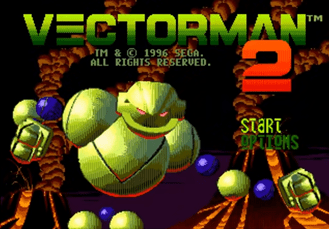
Title screen (screenshot taken by the author)

Vectorman 2 is a single player run and gun platform game and the sequel to Vectorman (1995). It was developed by BlueSky Software and published by Sega for the Mega Drive in 1996. For this review, I played the version found on Sonic’s Ultimate Genesis Collection (2009).

Plot

After defeating Warhead and foiling its plans to kill the humans when they returned to Earth, Vectorman resumes his normal duties. One day whilst completing the routine task of accompanying a sludge barge, his ship is hit by a missile of unknown origin. Vectorman survives the crash landing and finds himself near a research facility. As he investigates the origin of the missile, he discovers a population of mutant insects that have taken up residence in the research facility. The insects show clear signs of a destructive nature towards the Earth, but it is unclear who is controlling them. Vectorman must destroy the insects to once again save Earth.

Use Vectorman’s built-in weapon to destroy the mustant insects (screenshot taken by the author)

Gameplay

Vectoman can run and jump, and fire a weapon from his hand. Whilst at the apex of his jump, he can use his Boot-Blasts to gain even more height. These Boot-Blasts can also be used to cause damage to enemies when ignited. The game consists of seven parts, divided into 22 scenes.

Weapons

Whilst battling through the levels, Vectorman can temporarily acquire other weapons including:

  • Laser – Allows rapid fire.
  • Energy Shot – Solid beam of incredible power.
  • Super Energy Shot – More powerful than the Energy Shot, can ricochet of walls and also break through tiles.
  • Pulse – Fires in a more dispersed range. The second most powerful weapon Vectorman can use.
  • Overkill – A single shot which destroys everything onscreen.

Morphs

At times, Vectorman can also morph into the following:

  • Helicopter – Helps him hover and control his descent.
  • Skates – Enables him to travel through level at high speed.
  • Tornado – Helps Vectorman spin very fast for a limited time causing destruction to whoever comes into contact with him.
  • Tank – Pure firepower.

Power-Ups

Some enemies drop Assimilation icons which temporarily allows Vectorman to take on the characteristics of that enemy:

  • Shell Bug – Shield.
  • Scorpion – Attack using a deadly stinger.
  • Rhino Beetle – Charge through walls and into enemies.
  • Tick – Destroy your enemies by giving them a mighty wallop.
  • Fireant – Fireball.

Other Power-Ups include:

  • Multipliers x2, x3, x5, x10 – Multiplies points earned respectively.
  • Health Point – Restores one health ball.
  • Full Health – Fully restores health.
  • Max Health – Increases number of health balls.
  • 1-Up – Extra life.
  • Milestone – If you die, you will restart the level from this point.
  • Extra Time – Gives you extra time on the level.
  • Power Sacks – Destroy these to get power-ups inside.
  • Photons – Collect these for points. If enough are collected, you will be taken to a bonus round.
(screenshot taken by the author)

How Does It Handle?

The controls are exactly the same as its predecessor. They are tight, and responsive and the game is easy to just pick up and play. I really liked the changes in enemies from the robotic minions of the first game to the mutant insects of this game. It emphasises that you are facing a different challenge and helps differentiate the two games. The addition of different morphs and the ability to take on the characteristics of some of your enemies makes for a more interesting game too.

Graphics

The graphics of the Vectorman’s sprite look a little more refined in my opinion. There seems to be a new sheen to our hero. The levels look good…not spectacular but good. The mutant insect’s look ok, and the bosses look pretty good. One nice touch is that when you are in dark caves and Vectorman fires his gun, the area around him lights up.

Music and SFX

The music was ok, but it was quite forgettable. What I did like was the introduction of Vectorman’s robotic voice which I can’t remember from the first game. When he picks up new weapons and power-ups, he speaks but I couldn’t for the life of me understand what he was saying. It was still cool to hear though. There is also more differentiation between the sounds of the weapons when fired.

Replay Value

Vectorman 2 has three diffficulty settings but other than that, and there isn’t much to keep you coming back time and time again fter completing it a few times.

Did I Complete The Game?

No, I got to the last boss and died.

What The Critics Said:
Electronic Gaming Monthly: “No surprises here. Vectorman 2 is a solid side-scrolling platform game that will keep players busy for a few weekends. It’s levels-which include above-and below-ground areas-are huge and allow for a lot of exploration. Although the graphics are rarely outstanding, they’re always decent (and often very dark, as well). Boss monsters look especially good Many are so huge they fill the screen in fact, most of the game’s enemies look pretty cool. What really calls attention to this title, though, is its soundtrack, a booming techno-beat that sounds nothing like the static-ridden music pumped out by most genesis games. Overall 29/40.[1]

GamePro: “It’s simple mindless fun – just like the good old days. Vectorman 2 is the most addicting Genesis game this year…and it may be one of the last, so enjoy! Overall 19.5/20.[2]

Awards:

Electronic Gaming Monthly – Genesis Game of the Year 1996[3]

My Verdict:

This is another solid action-platformer. Very fun to play and challenging enough more experienced gamers. There is enough to make this game different enough from its predecessor

Rating:

What are your memories of Vectorman 2? I would love to hear your thoughts, and don’t for get to follow and subscribe so that you don’t miss my latest reviews! You can also find me on Instagram: @nicklovestogame.


[1] ‘Review Crew – Vectorman 2′. Electronic Gaming Monthly. (November 1996) Issue 88:90.

[2] Scary Larry. ‘Genesis Proreview – Vectorman 2 GamePro. (December 1996). Volume 09 Number 12 Issue 99:154.

[3] ”The Best of 96′.  Electronic Gaming Monthly. (March 1997). Number 92:86.

Vectorman – Review

It is always confusing when you come across a game that you’ve never heard of before and it’s awesome. Why? Because you begin to wonder why you haven’t heard of it before! Why were these games not championed more by creators, critics, and gamers alike? I wonder whether Vectorman’s late arrival to the scene was simply overshadowed by the focus on the next generation of consoles. Had Vectorman been released just a year or two earlier, it may have been given higher regard by the gamer community.

Title screen (Screenshot taken by the author)

Vectorman is a single player run and gun platform game developed by BlueSky Software and published by Sega. It was released on the Mega Drive in 1995 and would later appear on a number of compilations such as Sonic Gems Collection (2005) for the GameCube, Sega Genesis Collection (2006/7) for the PlayStation 2 and PlayStation Portable, and Sonic’s Ultimate Genesis Collection (2009) for the PlayStation 3 and Xbox 360. It was also released on the Wii Virtual Console in 2007 and on Steam in 2018 as part of the Sega Genesis Classics Pack. It was also included on the Mega Drive Mini in 2019. For this review, I played dthe version found on Sonic’s Ultimate Genesis Collection (2009).

Plot

In the year 2049, the Earth is one big cesspit of pollution and toxic waste. Humans decide to leave Earth and seek a new home to colonise. In the meantime, they create robots known as “orbots”, designed to clean up the mess whilst the humans are away. Raster, a highly advanced orbot, is accidentally connected to a nuclear weapon by a lesser orbot. This turns Raster from a benevolent orbot into the psychopathic machine known as Warhead. He is hellbent on ruling Earth himself and plans the execution of humans once they return to Earth.

Vectorman is a lesser orbot whose job is to clean up toxic waste and dispose of it in the sun. He was off planet when Raster became Warhead and returns to find the planet in a state of chaos. Vectorman decides that he should try to stop Warhead’s evil plans.

Vectorman has a built-in gun in his hand (Screenshot taken by the author)

Gameplay

The game consists of Vectorman fighting his way through 16 levels, battling Warhead’s minions on the way. At his disposal is his built-in gun, which he uses to destroy the baddies or to blow-up the TV screens that offer power-ups. The weapon power-ups include:

  • Rapid Fire: Keep the fire button held down to produce a continuous stream of bullets.
  • Wave: Useful for killing enemies not directly in your line of sight.
  • Bolo: Fires a bit rotating ball.
  • Orb: Can be used only one and designed to kill all nearby orbots in a huge explosion.
  • Nucleus Shield: Temporary invincibility. Once it runs out, you also lose your previous weapon power-ups.

Note: Shooting downwards whilst falling, will slow your descent.

Other power-ups include:

  • Health Point: Fills one ball on your health indicator.
  • Full Health: Fills all balls on your health indicator.
  • Max Health: Increases number of balls on your health indicator.
  • 1-Up: Gives you an extra life.
  • Milestone: Should you die, you restart the level where you picked this up.
  • Extra Time: Adds time to the count down.
  • Photons: Pick these up for extra points.
  • x2: Multiples points by 2.
  • x3: Multiples points by 3.
  • x5: Multiples points by 5.
  • x10: Multiples points by 10.

Vectorman can also pick up morph icons that will transform him into other types of robots to help him advance in the level:

  • Drill: Allows you to break through certain floors.
  • Bomb: Explosion will kill nearby enemies and destroy certain walls and floors.
  • Jet: Enables you to fly higher than you can jump.
  • Fish: Enables you to swim faster than you can run.
  • Missile: Enables you to break through certain ceilings.
  • Parachute: Allows you to slowly descend with greater manoeuvrability.
  • Buggy: Can be used as a battering ram to break through certain walls.

Vectorman has the ability to jump a little higher by tapping the jump button again whilst when he reaches the top of his initial jump. This will briefly ignite rockets in his feet which also causes damage to enemies.

Destroying satellite dishes allow you access to bonus stages. However, to destroy these you first need to find and destroy the shield generators which are hidden throughout the levels.

(Screenshot taken by the author)

How Does It Handle?

The game is quite chaotic at times and there is a lot on the screen to take in, and at first, I had no idea what was going on. However, there is lots of fun to be had charging through the levels and blasting all the baddies. I feel it would have been better to have the view zoomed out a little more so that you can take in more of the level.

Graphics

The Vectorman sprite looks awesome and the movements are incredibly fluid. When you move into dark areas, your sprite also goes dark, but you can still see red flashing lights on his body, face and extremities that remind us that he is a robot. This was a nice touch. I also liked the lightning flashes on Day 12.

Most of the backgrounds for the levels looked good, but I just felt that they lacked something. Maybe they just weren’t full of vibrant colour that I have been used to with so many Mega Drive games. Then again, maybe the drabness was to emphasise the polluted state the Earth is in. Even so, the flags flying in the breeze in particular look very realistic.

Music

The game contains electronic techno dance music throughout which I though suited the game very well.

Replay Value

The game has three difficulty settings Lame, wicked, and insane which offers some relay value. However, although the end of level scores state whether you picked up all the photons and destroyed all the TV screens, there is no difference to the outcome of the game if you do destroy all TV screens and pick up all the photons. I think this is a missed opportunity to add something more to the game encouraging gamers to return to it.

Did I Complete The Game?

Yes, but so far, only on the Lame setting.

What The Critics Thought?

Electronic Gaming Monthly: “It seems like Sega has a new mascot. Vectorman offers graphics that make it look like it’s on a system other than the Genesis. The animation is really smooth. Surprisingly, VM excels in the control department. It doesn’t have anything really new, but it plays well. The gameplay is fast, and the action generally is intense but not frustrating. Think of Strider with a gun. The audio is just right. Overall 33/40.[1]

GamePro: “Your 16-bit system isn’t dead yet, and Vectorman is the reason why! This entertaining platform game is tough, but it rewards you with tons of fun. Overall 19.5/20.[2]

Awards:

GamePro Editor’s Choice Awards 1995 – Best Genesis Game[3]

GameFan’s 1995 Megawards – Genesis Game of the Year[4]

GameFan’s 1995 Megawards – Best Genesis Action Platformer[5]

My Verdict:

“This is a fun game. Lots of charging through levels blasting everything in sight with an array of weapons. It’s a beautiful looking game with a solid soundtrack. My only criticism is the lack of replay value for me. Definitely worth your time though!”.

Rating:

What are your memories of Vectorman? I would love to hear your thoughts, and don’t for get to follow and subscribe so that you don’t miss my latest reviews! You can also find me on Instagram: @nicklovestogame.


[1] ‘Vectorman’. Electronic Gaming Monthly. (November 1995). Number 76:42.

[2] ProReview – Vectorman‘.GamePro. (November 1995). Issue 76:70-1.

[3] Editor’s Choice Awards 1995‘. GamePro. (February 1996). Issue 79:26.

[4] ‘GameFan’s 1995 Megawards’ GameFan. (January 1996). Volume 4 Issue 1:106.

[5] ‘GameFan’s 1995 Megawards’ GameFan. (January 1996). Volume 4 Issue 1:104.