
In the 1980s, game developers cottoned on to the fact that celebrity endorsements help increase game sales. Beginning with Atari’s Pele’s Soccer (1980), it wasn’t long before names and likenesses of other celebrities such as Bruce Lee (albeit posthumously) and Daley Thompson soon appeared on video games. The quality would vary, however, and a celebrity endorsement was not always a guarantee of a good game.
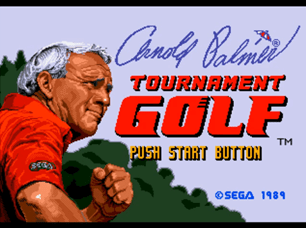
Arnold Palmer Tournament Golf (Naomichi Ozaki Super Masters in Japan) is a golf game developed and published by Sega and released in 1989. AS far as I know, the game has not been ported or re-released at a later date and so the Mega Drive version was the only option I have to review the game.
Plot
As with most sports games, there is no plot other than you must compete against other golfers to win the tournament. To win the tournaments, you must finish each hole in the least number of shots.
Gameplay
Played in single or two-player modes, you can choose to play practice rounds or full Tournament Mode. Practice Mode can be played with one or two players, and you have a choice to play any of the three courses. The Tournament consist of 12 rounds of 18 holes played over three different courses located in the US, Japan and Great Britain. As you progress, you earn money based on your standings at the end of each round. This money can be used to upgrade your clubs from the default black carbon to the better glass fibre and ceramic clubs. Your skill level also increases allowing for greater distances with your shots and your caddy offers better advice for each shot.
Most of the rounds of are played as normal stroke play golf, in that you simply have to get around the course in the least number of shots. However, rounds seven and eleven are played as match games where you play against one other golfer. All you need to do is finish the hole in less shots than it takes your opponent. If, at the end of the tournament you are tied, you will play a sudden death game where the first golfer to win a hole, wins the match.
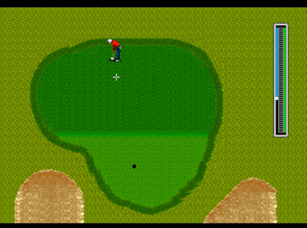
When it is your turn to address the ball, the HUD becomes split. On the left, you’ll see an overview of the hole and on the right, you’ll see your golfer and the caddy standing with their golf bag. There are three black boxes on the screen displaying various pieces of information. The top left box consists of the number of the hole, distance from the pin, and the hole’s par length; the top right box is the caddy’s advice; and the bottom right box displays your name, the number shot you are on and the club you are going to select. When you press ‘A’, a fourth black box will appear with the options to get Advice, to see the Green, or to see the Score. Press ‘A’ again, and all the black boxes will disappear, and a weathervane will appear showing the wind speed and direction. Press ‘A’ again and the weathervane disappears and an image of how the ball lies appears. Press ‘A’ again and the lie of the ball disappears, and picture of your club appears. You can use the direction button to search for the club you wish to choose. Press ‘A’ again and you will then be shown the stance of your golfer. Again, using the direction button you can adjust the stance allowing your golfer to deliberately ‘slice’ or ‘draw’ the ball. Press ‘A’ again, and the weathervane will appear once more as will the power gauge, and a small yellow arrow on the horizon. The direction button controls the yellow arrow and allows you to aim where you wish to hit the ball. You then press ‘A’ and two white markers begin to ascend on the power gauge. A third white marker will remain in the bottom third of the power gauge. Once they reach your desired power, you press ‘A’ again. The left marker will stop, and the right marker will begin to descend. You then press ‘A’ a third time to stop the descending marker in line with the stationary marker in the bottom third of the power gauge. Your player will then strike the ball. The progress of your hit ball can be seen on the overview map on the left. You will then be told where the ball lands (E.g., fairway, rough, sand bunker), and the process starts all over again. When you land on the green, the view changes to a near bird’s eye view. The lighter areas of the greens are higher than the darker areas of the green. Pressing ‘A’ will make arrows appear on parts of the green which shows you the direction of the slopes.
To help you during the rounds, you have a caddy who offers advice to you before you take a shot. At first, the advice simply states distance left to the hole. As you progress through the game, the caddy begins to offer more advice regarding how the ball lie and various landmarks and hazards on each hole of the course.

How Does It Handle?
For the most part, the game is easy to pick up and play, but you will need the instruction manual to remind yourself of the maximum distance of each club. Adjusting your strength of shot and direction based on wind speed and direction takes some getting used to but adds a sense of realism to the game. Sometimes the wind works in your favour, other times it works against you. The putting is the hardest part as each increment of the putting gauge equals one yard. Add slopes into the mix and the speed with which the power increases in the power gauge, and you can be forgiven for missing some seemingly straightforward puts. I much prefer the way the greens can be viewed in PGA Tour Golf (1991) but I still prefer it to Power Golf (1989).
One of the things I found frustrating was the HUD display. The remaining distance to the hole wasn’t displayed at all times. Once you play your first stroke, you only need to know the remaining distance and to be reminded of the par of the hole. You don’t need reminded of the hole length. The annoyance of having to constantly click the ‘A’ button and then the ‘B’ button to go back and forth does become tiresome after a while. I actually prefer the HUD display for PGA Tour Golf (1991) and Power Golf (1989) which displays all the information all the time.
Oddly, there is an inaccuracy between the map of the hole and what you can see on the right screen when the ball has struck. Many a time I have struck a ball into an area and the ball is seemingly on the fairway but it is in fact in a bunker or in the rough. For example, on hole 13 of one of the courses, I forget which, the ball was lying on the fairway according to the right section of the screen but on the map sections, it showed I was in the bunker. It was rather annoying at times.
Graphics
I think the game looks great. The colours are vibrant, and the sprites move in a very realistic way. The courses are clearly defined so that you can differentiate between the fairway, rough, sand bunkers and trees. I think I actually prefer the way the courses look here than I do with PGA Tour Golf (1991), which looks a tad bland for me, or Power Golf (1989), which looks a bit too cartoony for me.
Halfway through each course, you have a tea break where you are greeted with one of several animations of Sega Master System hero Alex Kidd playing golf. He is joined by Opa-Opa of Fantasy Zone fame.
Oddly, the backgrounds of the courses do not vary and so the courses are not visually distinctive. This is very disappointing as it would have been a great opportunity to design courses based around styles and fashions from those nations: mountains for the USA and cherry blossom trees and some pagodas for Japan. These may come across as stereotypical, but the visuals would have been a nice way to differentiate the courses.
It is also disaapointing that there is only one player face to choose from and that you cannot change the colour of the jersey. The only colour change is a palette change when you compete against another opponent.
Music & SFX
Music plays throughout in the form of an upbeat and bouncy number which doesn’t really lend itself to the sedate nature of a golf game. I do like the music, but If I’m honest, I prefer silence with the occasional bird tweeting and the gentle ripple of applause from the crowd as you bag another birdie. There is a satisfying noise as you sink your ball and a nice little applause from the crowd, but I found that I just turned down the sound and listened to my own music or podcasts as the music and noise aren’t really needed for the game. Weirdly, there is a slight delay of sound when you hit the ball.
Replay Value
For golfing fans in particular, I think this game has lots of replay value. Picture a relaxing evening with a beer or cup of tea, maybe a bit of light music on in the background whilst you play a genial game of golf. Two-player mode will also ensure that level of competitiveness amongst friends remains ignited.
Apparently, there is a secret Fantasy Zone level hidden within the game. To find it, allegedly hit the ball 100 times on the first hole without putting in. You then enter up, up, down, down, left, right, left, right, B and A on the game over screen. However, I’ve never had the patience to do this and so cannot confirm if this is true.
Did I Complete The Game?
As of yet, I have never won the overall tournament but I have won the GB Pro Tournament and earned a nice set of fibre glass clubs for my troubles.
What The Critics Said:
Mean Machines: “More fun than Bruce Forsyth, better looking than Tarby, and more strokes than Cecil Parkinson. Overall 83%“.[1]
Raze: “The whole game is slickly designed and beautifully executed. Arnold Palmer may sound like a boring old fart to you, but he’s got one hell of a game to play. Overall 89%“.[2]
Sega Pro: “One of the first and still one of the best. Accurate graphics, good sound and heaps of playability make this an impressive golf simulation, but PGA Tour Golf plays a lot better. Overall 83%”.[3]
Sega Power: “Impressive looking game with convincing 3D courses, good player animation and a hidden Fantasy Zone Game! Simple play-style grows dull so seasoned golfers should go for PGA Tour Golf instead. Overall 3/5”.[4]
Verdict:
“I think this is a solid golf game. Lovely colours and animation, and the game is surprisingly addictive. There is a fair amount of replay value and I’d wager than you’ll be paying your golf fees again and again with this one.”
Rating:

What are your memories of Arnold Palmer Tournament Golf? I would love to hear your thoughts, and don’t for get to follow and subscribe so that you don’t miss my latest reviews! You can also find me on Instagram: @nicklovestogame.
[1] ‘Mega Drive Review – Arnold Palmer’s Golf’. Mean Machines. (December 1990). 3:58-60.
[2] Ellis, L., ‘Reviews – Arnold Palmer’s Tournament Golf’. Raze. (February 1991). 4:60-61.
[3] Proview – Arnold Palmer’s Tournament Golf’. Sega Pro. (November 1991). 1:37.
[4] ‘The Hard Line – Arnold Palmer Tournament Golf’. Sega Power. (October 1991). 23:52.
 Nick Loves to Game