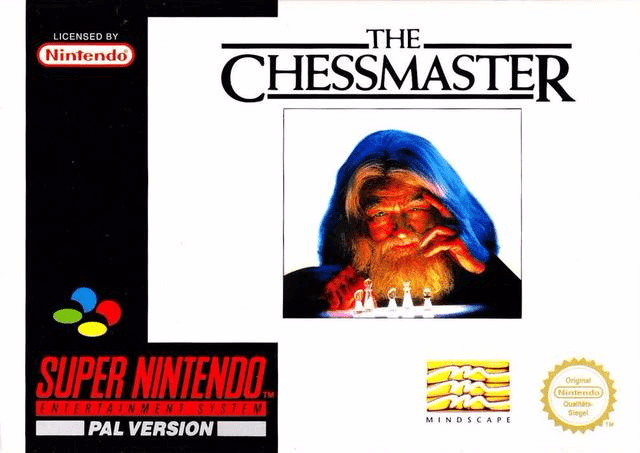
Chess is one of those games that I find rather intimidating. People who excel at chess are considered incredibly intelligent…which is probably why I suck at the game! The Chessmaster franchise was originally developed by Ubisoft and published by The Software Toolworks (formally Software Country). The first instalment of the franchise was released under the name of The Chessmaster 2000 (1986) for the Amiga, Amstrad CPC, Apple II, Atari 8-bit, Atari ST, Commodore 64, DOS, Macintosh, MSX, and ZX Spectrum. Since its humble beginnings, technology (and gamer expectations) had moved on. How would the mighty SNES deal with those expectations?
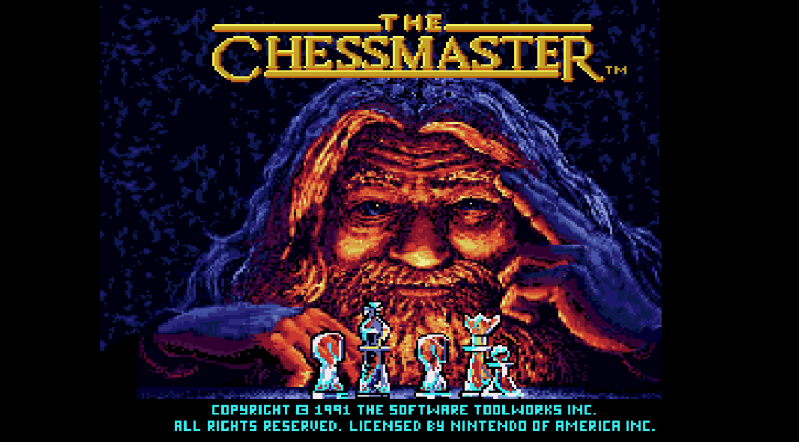
The Chessmaster is a chess simulator released for the NES (1989), Game Gear and Game Boy (1991), and the SNES and Mega Drive in (1992). For this review, I played the SNE version.
Objective
Manoeuvre your pieces so that you can gain a “checkmate” on your opponent. A “checkmate” is when you position your pieces in such a way that your opponent cannot move their king safely out of “check”, block your pieces with one of theirs, or take one of your pieces to take their king our of “check”.
Gameplay
The game can be played in single or two-player mode. You ad your opponent begin with a full army of troops that include:
Pawn x 8 – They can move two spaces forward on their first turn but can only move forward one space after that. They can “take” an opponent’s piece if they are diagonally one space in front of them. If the make it to the last row closest to you opponent, your pawn can be promoted to either a Rook/Castle, Knight, Bishop or Queen.
Rook/Castle x 2 – They can move as many spaces as they like horizontally or vertically (forward and backward) or until they are blocked by another piece.
Knights x 2 – They can move in all directions as long as it equates to one space forward/backward/sideways and then one space diagonally in the same direction. They are the only piece that can leap over other pieces.
Bishops x 2 – They move diagonally forward or backwards in a straight line as many spaces as they like until they are blocked by another piece.
Queen – The most powerful piece. She can move in a straight line in all directions as many spaces as they like until they are blocked by another piece.
King – The king can only move one space, in any direction they wish, at a time (with the exception of “castling”, see below).
If the king is in “check”, the only move you can make is to either move the king out of check or move another of your pieces to block the check, or take the piece that has the king in “check”.
To move your pieces, use the ‘D’ pad to move the hand over the piece you wish to move and then drag them to the square you wish to place them. The computer will tell you if you try to make an illegal move.


Special Moves:
En Passant – French for “in passing”, it can only be performed under specific circumstances by pawns. Rather than me attempting to poorly explain it to you, follow the link to hear chess expert David Pruess explain the manoeuvre.
Castling – This is one of the first special moves you are likely to have been taught when playing chess. Your rook/castle and king must still be in their original starting positions without having been moved so far during the game and with no other piece of either colour standing between them. The king can then move two spaces towards the castle. The castle then automatically transfers to the next space on the opposite side of the king.
At anytime in this version, you can open up the options menu which allows you the option of the following:

How Does It Handle?
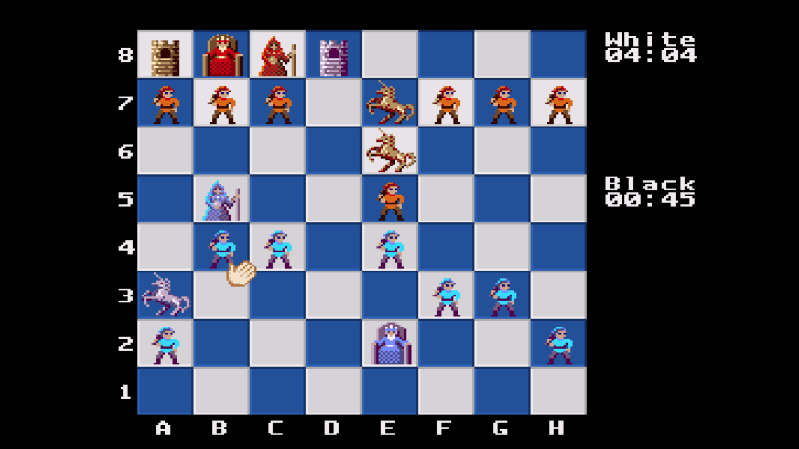
Once you learn how the pieces move, it is easy to play. However, I’d still recommend playing in 2D mode as I found I was less likely to miss opportunities take a piece or would not spot when one of my pieces was going to be taken.
One of the things I found odd was that from the title screen, you simply jump straight into a game. You then have to open the options menu and make any necessary changes you wish to make. This doesn’t make sense to me. Why not have the options screen available before beginning a game?
Also rather than the hand, I think I would have preferred the square to be highlighted instead. I think this would make it slightly easier to navigate the board.
Graphics
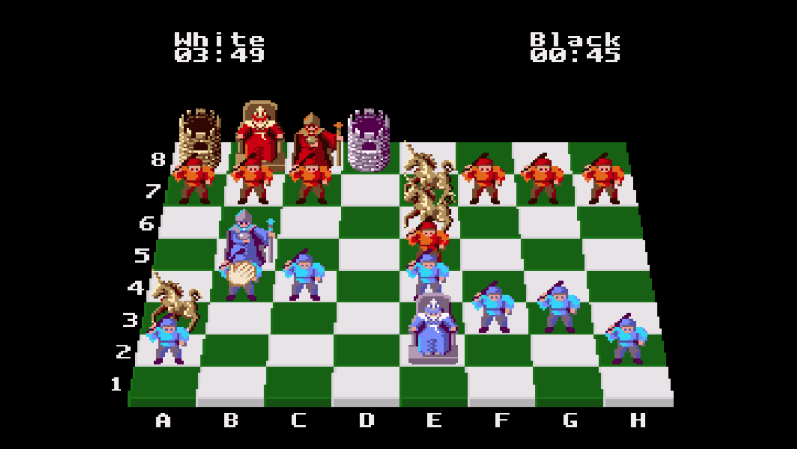
The graphics are very basic, but some would argue you don’t need more than that for a chess game. A chessboard against a black backdrop is sufficient. The 3D fantasy mode looks ok but I think you’d expect better sprites from the SNES and maybe even a little animation like Battle Chess (1988). The fantasy pieces are fun and quirky, but serious gamers may prefer to stick with the standard pieces.
It is unclear why the 2D fantasy view is the only view that changes from green squares to blue squares.
Music & SFX
The music over the title screen (you can also turn this on throughout the game) is a very cheap 8-bit piece that is unbecoming of the SNES.
As for the SFX, there aren’t any, save for a weird duh-duh-duh-da after every move. Who on Earth thought that was a good idea? It becomes incredibly annoying almost instantly.

Replay Value
If you enjoy chess, then this game has endless replay value. There are around 16 different difficulty levels and every game will be different. For the casual gamer, it may not hold the attention for that long.
Did I Complete The Game?
I only beat the game on level Newcomer 1.
What the Critics Said:
At present, I couldn’t find and contemporary review of this game.
My Verdict
“Awful, cheap music and SFX really let this game down. I know chess is a serious game and doesn’t need all the bells and whistles, but this is a SNES game and I expected a bit more in those departments. I just hope it didn’t cost £40 on its release!”
Rating:

What are your memories of The Chessmaster? I would love to hear your thoughts, and don’t for get to follow and subscribe so that you don’t miss my latest reviews! You can also find me on Instagram: @nicklovestogame.
 Nick Loves to Game